Part II The War With the Sioux
Reading edition
183
CHAPTER ONE With Crook’s Advance
I. The Cause of the Fighting
Late in 1876 the government determined that thereafter all Indians in the Northwest must live on the reservations. For a long time the Interior Department, to which the management of Indian affairs was committed, had been trying in vain by peaceable means to induce them to do this. The Indians were at last definitely informed that if they did not come into the reservation by the first of January, 1876, and stay there, the task of compelling them to do so would be turned over to the War Department. They did not come in; on the contrary, many of those on the reservations left them for the field; and thus the war began.
The principal adviser and most influential head man among the Sioux Nation and its allied tribe, the Cheyennes, was Sitting Bull,[56] an Unkpapa chief and a great medicine man. He does not seem to have been much of a fighter. The Indians said he had a big head but a little heart, and they esteemed him something of a coward; in spite of this, his influence over the chiefs 184and the Indians was paramount, and remained so until his death.
Perhaps he lacked the physical courage which is necessary in fighting, but he must have had abundant moral courage, for he was the most implacable enemy and the most dangerous—because of his ability, which was so great as to overcome the Indians’ contempt for his lack of personal courage—that the United States had ever had among the Indians. He was a strategist, a tactician—everything but a fighter. However, his lack of fighting qualities was not serious, for he gathered around him a dauntless array of war chiefs, the first among them being Crazy Horse, an Oglala, a skilful and indomitable, as well as a brave and ferocious, leader.
The Sioux country was encircled by forts and agencies. The Missouri River inclosed it on the east and north. On the south were the military posts along the line of the Union Pacific Railroad. To the west were the mountains. Sitting Bull and his followers took position in the valleys of the Big Horn near the sources of the Powder River, right at the center of the encircling forts and agencies. It was a situation whence they could move directly upon the enemy in any direction as necessity required.
For years unscrupulous and mercenary traders had supplied the savages with high-grade firearms in spite of government protests. The Indians were better armed than the soldiers, and possessed ammunition in plenty. Their numbers in the field have been estimated at from twelve hundred to six thousand warriors, with their wives and children. Those who have studied the war from the Indian point of view have put the number at the lower figure; nearly every one else at 185from three thousand up. Whatever the facts, there were enough of them to give the United States Army the busiest time that it had enjoyed since the Civil War.
Three expeditions were planned for the winter, which were to be launched upon the Indians simultaneously. One, under General Gibbon, was to come eastward from western Montana; another, under General Crook, was to advance northward from southern Nebraska; and the third, under Custer, was to strike westward from Fort Lincoln. It was believed that any one of the three, each of which comprised more than a thousand men, would be strong enough to defeat the Indians, the only problem being to catch them or corner them.
The well-known disinclination of Indians to fight pitched battles is a factor which enters largely into every campaign. Somehow or other, the Indians in this campaign did not seem to be so disinclined that way. One cannot but admire the skill with which they manœuvered and the courage with which they fought. Putting aside all questions of their cruelty and brutality—and what else could be expected from them?—they were patriots fighting for the possession of their native land. Bravely they fought, and well. They were fully apprised of the movements of the troops, and resolved to attack them in severalty and beat them in detail. We shall see how completely they did so, and with what brilliant success they battled, until they were run down, worn out, scattered, killed, or captured.
II. Reynolds’ Abortive Attempt
The weather was something frightful. Indeed, all through the ensuing spring it was unprecedentedly inclement. 186Neither Custer’s expedition nor Gibbon’s got away in winter. Crook did advance, and first came in touch with the enemy with results not altogether satisfactory. General Joseph J. Reynolds, with ten troops from the Second and Third Cavalry, surprised and took possession of Crazy Horse’s village, on the Powder River, on the morning of March 17, 1876. The troops had partially destroyed the village while under a severe fire from the Indians who had rallied on bluffs and hills round about it, when Reynolds abandoned the position and retreated. He was, of course, pursued by the Indians, grown bolder than before, if possible, as they saw the reluctant soldiers giving up their hard-won prize.
So precipitate was Reynolds’ withdrawal, in fact, that the bodies of several troopers who had been shot in the action were abandoned to the malignity of the savages, and there was a persistent whisper, which will not down, to the effect that one wounded man was also left behind.
As to this, an army officer of high rank personally stated to me that Reynolds was in such a state of excitement, as the afternoon wore away and Crook did not join him in the village, that he finally peremptorily ordered the troops to mount and go away, in spite of the fact that the work of destruction was not complete. This was bad enough, but my informant solemnly asserted that Reynolds, in spite of plea and even remonstrance, compelled him to leave behind a wounded trooper, who must necessarily have been tortured by the Indians so soon as they reoccupied the village. Captain Bourke has gone on record in his “On the Border with Crook,” expressing his belief in the truth of this charge, which forever stains the name 187of the commander of the expedition. The whole affair was a disgrace to the army, and many of the officers of the command, capable and brave men, felt it keenly. They chafed for a chance to show their qualities, which they had later on.
The cold was intense, the temperature dropping to thirty degrees below zero. The soldiers suffered greatly in the retreat. The Indians, who seemed impervious to cold, pursued them and succeeded in recapturing their pony herd of some seven hundred head, which Reynolds was endeavoring to bring away with him. Crook, bringing up the infantry and wagons, was furious when he met the retreating cavalry and heard its story.
There were a number of courts-martial subsequently, but little came of them, and the matter was finally allowed to drop upon the retirement or resignation of some of the officers chiefly concerned. It was a disgraceful affair, and all the honors rested with Crazy Horse. The Indians were greatly encouraged. The loss of the troops was four men killed and six wounded, and sixty-six men badly frozen or otherwise incapacitated by the cold.
III. The March to the Tongue River
After the ignominious outcome of Reynolds’ attack upon the village of Crazy Horse, the various expeditions noted spent the greater part of the spring in preparing for the grand advance of the converging columns which were to inclose the recalcitrant Indians in a cordon of soldiers, force them back on the reservations, and thus, it was sincerely hoped, end the war. It will be necessary to follow the movements of the several columns 188separately. As that of Crook first came in contact with the Indians, its history will be first discussed.
The reorganized command for the campaign, which assembled at Fort Fetterman, Wyoming, included fifteen troops of cavalry—about nine hundred men—ten of the Third, under command of Colonel Evans, and five of the Second, under Major Noyes, the whole being under the command of Colonel William B. Royall, of the Third.[57] There were also three companies of the Ninth Infantry and two of the Fourth, a total of three hundred men, under the command of Colonel Chambers.
There was an abundance of transportation, a long wagon train, and an invaluable pack train. The troops were generously provided with everything necessary for the hard work before them. It was the largest, and it was believed to be the most efficient, force which had ever been sent against the Indians in the West.
Crook, an officer of large experience, especially in Indian fighting, assumed personal command of the expedition on the 28th of May, 1876. On the 29th the march began. The objects of the campaign were the 189villages of Crazy Horse and Sitting Bull, which were believed to be somewhere on the Rosebud River. The topography of that country is well known now, but then it was more or less of a terra incognita—rather more than less, by the way. Certainly, this was true after the Tongue River was reached. The advance was made at first up the Bozeman trail, past Fort Reno, and over the battle-fields around the ruins of abandoned and destroyed Fort Phil Kearney, which were objects of much interest to the soldiers.
On the 9th of June the army encamped on the south side of the Tongue River, near the point where that stream intersects the Montana boundary line. Crazy Horse[58] had been fully advised by disaffected Indians at the agencies and military posts, as well as by his own daring scouts, of all these preparations that were being made to overwhelm him. He had sent to Crook a specific warning not to cross the Tongue River, and declared his intent to attack him immediately he reached that stream. To prove that his threat was no idle boast, he mustered his warriors, and at half after six o’clock on the evening of the 9th, from the high bluffs on the other side, opened fire upon the camp.
Through a fortunate mistake the Indians directed their fire to the tents of the camp, imagining that they would be full of men. They happened to be empty. The Sioux soon got the range, and the camp was swept with bullets. They ripped open mess chests, 190shattered the sides of the wagons, destroyed the baggage, killed a few horses, but did little damage to the men.[59]
The Third Cavalry was divided into three battalions, one of four, and two of three troops each. Captain Mills commanded the first battalion, Captain Henry the second, Captain Van Vliet the third. Crook acted promptly. He sent forward three companies of his infantry, deploying them as skirmishers, to line the river bank and open fire on the Indians in plain view on the bluff on the other side. At the same time he ordered Captain Mills to take his battalion across the river and charge the enemy. The Sioux were already unsettled by the accurate fire of the infantry with their long-range rifles, and as Mills’ battalion deployed, dashed through the water and at the steep bluffs on the other side, they broke and fled, having suffered little or no loss, and not having inflicted much more.
IV. The Flying Column
The skirmish was simply a grim earnest of the determined purpose of the Indian chief. No pursuit was attempted at that time. Negotiations had been entered into between the Crows, who were the hereditary enemies of the Sioux, and the Shoshones, with a view to securing a body of Indian auxiliaries to the troops, whose services would be invaluable for scouting. Persuaded 191thereto by Frank Gruard,[60] a celebrated scout, something less than two hundred Crows, with eighty odd Shoshones, joined the army on the 15th of June.
To pursue Indians while incumbered with infantry and a wagon train was well nigh a hopeless task. Crook determined to park the wagons and baggage, leave them under the command of Major Furey, the quartermaster, strip his command to the lightest marching order, and make a dash for the Rosebud River and the Indian country. One hundred infantrymen, protesting most vehemently against their orders, to their credit, be it said, were detailed to remain with the train. Two hundred others, who professed to have some skill in riding, were mounted on the mules of the wagon train to accompany the cavalry.
The morning of the 15th was spent in accustoming the infantrymen to the mules and the mules to the infantrymen. The cavalrymen and the Indian allies enjoyed the circus which ensued when the mules were bridled and saddled for the first time, and mounted by men who had never before straddled anything more formidable than a fence rail. It took the whole morning before the infantrymen and the mules learned to get along with each other, even in a half-hearted way.
192At five A.M., on the 16th, the force, numbering a little less than eleven hundred men, with two hundred and fifty Indian auxiliaries, crossed the Tongue River and marched to the Rosebud.[61] They bivouacked that night on the banks of the Rosebud, on a level depression surrounded by low bluffs on all sides, forming a sort of natural amphitheater, on the top of which the pickets were stationed. Each man carried four days’ rations of hardtack, coffee, and bacon in his saddle-bags and one hundred rounds of ammunition upon his person. The pack train was limited to two mules carrying the medical supplies. There being little to do at the wagon camp on Goose Creek, a number of mule packers, led by a veteran, Tom Moore, accompanied the expedition to help the foot soldiers to manage their mules, and incidentally to take part in the fighting. There were no tents, of course, and but one blanket (a single blanket at that) for each man. This blanket barely kept off the heavy dew, and the night was a thoroughly uncomfortable one.
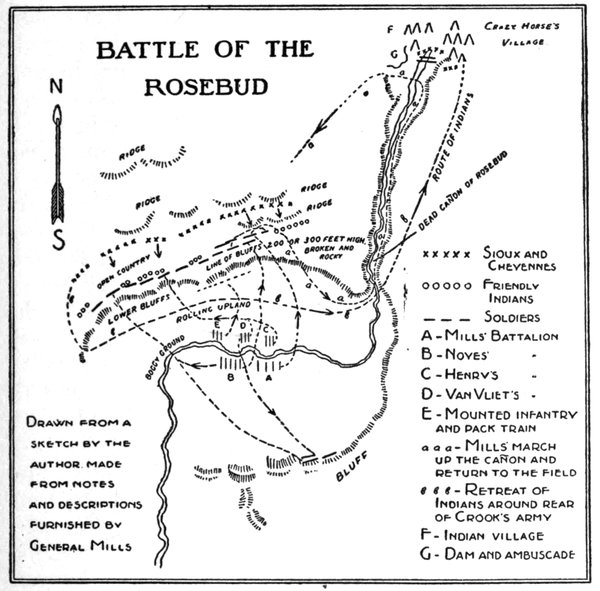
At three A.M. on the 17th of June reveillé was sounded. After breakfast and the care of the horses and mules, six o’clock found the troops on the march down the Rosebud. At eight o’clock they halted and unsaddled their animals to give them a nibble of grass and a little rest, preparatory to a farther advance later on, while the Crows and Shoshones were sent on ahead to scout. The place in which they had stopped was an amphitheater, like their camp ground of the night before, a rolling bit of boggy prairie, inclosed on all sides by bluffs, every point being within rifle shot of the center. Through this amphitheater ran the Rosebud River, here a mere creek, its general direction being 193from west to east. Toward the east side of the amphitheater the creek was diverted to the left, the northeastward, and plunged into a gloomy and forbidding cañon, called the Dead Cañon of the Rosebud. The course of the river was marked by a rank undergrowth of grass, small trees, etc.
Mills’ battalion of the Third Cavalry halted on the south bank of the creek. In rear of Mills was Noyes’ battalion of the Second Cavalry. Across the creek were Henry’s and Van Vliet’s battalions of the Third Cavalry, the mounted infantrymen, and the small pack train with the packers. Crook desired to keep his movements secret, but it had been impossible to restrain the impetuosity of the Indian auxiliaries the day before. They had come across a herd of buffalo and had made great slaughter of the helpless animals, killing one hundred and fifty of them, for which they had no use at all. It is certain that so able a general as Crazy Horse had scouts watching Crook all the time, and would have discovered his advance in any event; but with all the noise made by the Indians in the buffalo hunt, there was no possibility of a surprise. As a matter of fact, it was Crazy Horse who began the game. Crook was ready for him.
V. The Battle of the Rosebud
About half after eight o’clock in the morning, the resting soldiers were called to attention by the sound of shots from the bluffs in front of them, over which their allies had disappeared. It was at first supposed that these friendly Indians had run across another herd of buffalo, but a few moments told the practised troopers that the firing was the beginning of a battle rather than 194that of a hunt. At the same time the Indian auxiliaries came galloping back to the main body at full speed, yelling:
“Sioux, Sioux! Heap Sioux!”
Without waiting for orders, the troopers saddled their horses and fell in. They got ready none too soon, for right on the heels of the fleeing Crows and Shoshones came the Sioux. In front of them to the right, the left, the low bluffs inclosing the plain, were ringed with Indians in full war-gear. As one observer described it to me, they looked like swarms of blackbirds, there were so many of them and in such rapid motion. They kept coming and coming into view, and as they dashed up to the brink of the hills upon their war ponies they opened a long-range fire upon the soldiers, which from the distance did little damage. There were at least a thousand of them in plain sight. How many others there might be, no one could tell. It was a safe guess that those in sight constituted but a small part of the force.
It is said that there were at least six thousand warriors that day under the command of Crazy Horse, but that most of them were not engaged. Crazy Horse had planned an ambush for General Crook, and he had hoped to defeat him by luring the soldiers into it, or by separating the army into small detachments and overwhelming them in detail. His plans were well devised, and came very near being successful. That they did not succeed is probably due more to the acts of the Indians themselves than because of the wariness of the soldiers.
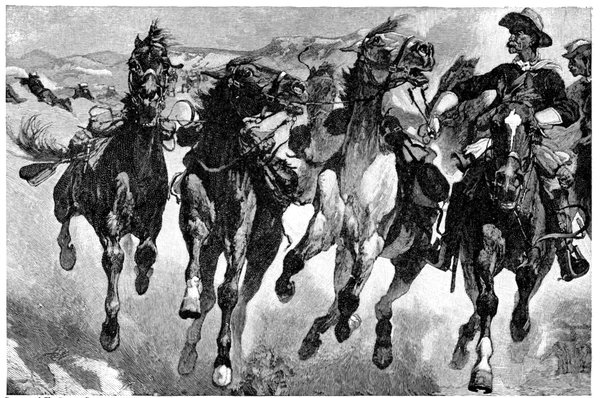
Courtesy of The Century Co. THE DIFFICULT TASK OF THE HORSE-HOLDERS IN ACTION Drawing by Frederic Remington
Crook acted at once. Sending his staff officers to rally the Crows and Shoshones, he directed them to circle to the right and left, and make ready to fall on the flanks of the Indians. Mills, who had behaved so gallantly 195at the Tongue River, was ordered to charge the Indians straight up the valley to the bluff to the northward, the front. Two troops of Van Vliet’s squadron were rushed off to the southward, the rear, to seize a commanding position to prevent the Indians from circling around in that direction and getting in Crook’s rear. The infantry and part of the Second Cavalry were dismounted, and thrown forward as skirmishers around the foot of the bluffs. Royall took Henry’s battalion, with Van Vliet’s remaining troop, one of Mills’ troops which he detached while the battalion was on the gallop, and another of Noyes’ troops, and charged the Indians on the left.
Mills’ charge was most gallantly delivered. The soldiers struggled through the bog, raced across the bottom land for about eight hundred yards, and scrambled up the bluffs in twenty minutes, finding themselves, when they reached the top, within fifty paces of the Sioux. There was no time to use carbines. Firing revolvers, the battalion rushed at the Indians. The savages fired ineffectively, gave way, and fled instantly to higher ground six hundred yards further on, where they opened fire. In their excitement they shot badly. Mills dismounted his battalion, deployed them as skirmishers, rushed the second ridge and cleared it, the Indians sullenly retiring before him, and again opened fire on the troops, to which the cavalrymen made effective reply. The Sioux galloped rapidly to and fro, yelling and firing from their horses, kicking up clouds of dust, but doing little harm.
Royall, Henry, and Van Vliet had a similar success on the left, where the ground was much more open and unfavorable for defense, although the Indians were massed more heavily in that quarter than before Mills.
196Meanwhile the Crows and Shoshones had fallen upon the flanks of the Sioux, but not very effectively. Every one in the field except a small reserve was now hotly engaged. The pressure on Mills became stronger, but he drove the Indians from him by another gallant attack. Thereafter he was reinforced by Noyes’ battalion. The front of his line was finally partially cleared by this last dash. The Indians who had been attacking him thereupon left him, and joined the others before Royall and Henry.
Crook now withdrew Mills’ command from the battlefield, and Mills was ordered to take his three troops down the Dead Cañon of the Rosebud and attack the villages which it was believed the Indians were defending. Mills’ movements were supported by the five troops of the Second Cavalry under Noyes. Crook promised to follow up the movement, and support it with the remaining cavalry and infantry. We will follow this movement later.
Mills’ place in the line was occupied by Tom Moore and his packers and some other auxiliaries from the camp, and a smart fire was kept up in that direction. On the left the firing was fast and furious. The Indians from the front cleared by Mills joined their associates on the left, and again and again attacked Royall, Henry, and Van Vliet, who had joined the other two, with the most determined courage. Charge and counter charge were made over that portion of the field. Now the troops gave way before the Indian advance, now the soldiers were rallied and hurled back the Indians, now the Indians retreated before some desperate countercharge. So went the varying fortunes of the hour. The number of savages increased with every passing moment. To the eyes of the astonished soldiers they 197seemed to spring from the ground. If one fell in the line, a dozen were ready to take his place.
In one of the charges Captain Henry was shot through the face and frightfully wounded. The troopers had dismounted, but the officers remained mounted. Henry reeled in his saddle as the bullet pierced both his cheek bones and tore out the whole front of his face below the eyes. Although, as an eye-witness has it, he was spitting blood by the handful, he continued on the battle line. The situation of Royall’s wing of Crook’s army 198was precarious. Henry’s battalion held the extreme left flank. It was his duty to remain there. Vroom’s troop L, of the Third Cavalry, had become separated from the main body during the battle, and was caught ahead of the line and surrounded by Indians, in imminent danger of annihilation. Crook had ordered Royall to bring his men back to their horses, in order to mount them and prepare for a general charge. The Indians took this movement for a retreat, and came dashing after the retrograding troopers. Only the cool courage of Royall and Henry, and the magnificent way in which they handled their forces when they went forward to the rescue, prevented the annihilation of Vroom’s troops.
It was in the midst of this operation that Henry received his fearful wound and stayed on the line.[62] Presently he fell from his horse. As he did so, the soldiers, dismayed by his fall, began to give back before the Sioux. The impetuous Indians charged over the place where Henry lay. Fortunately, he was not struck by the hoofs of the galloping horses. His men rallied and rushed to his rescue. Old Chief Washakie and his Shoshones at this period of the fighting displayed splendid courage. The fight actually raged over the body of Captain Henry until the Indians were driven off, and Henry was rescued from what would otherwise have been certain death. After this fierce struggle, part breaking through the line and part turning the flank, the Indians galloped down the valley between the river and the troops, and finally disappeared on the other side of the Dead Cañon, their retreat accelerated by the movement of Mills toward the village. The fighting had lasted a little more than two hours.
199
VI. Mills’ Advance down the Cañon
Meanwhile Mills and his men, in a column of twos, trotted down the gloomy depths of the Dead Cañon, the rocky walls of which, towering on either side, would have afforded abundant cover for Indian riflemen. Before entering the cañon, they had cleared the mouth of it of a body of Sioux by a smart charge, and they were thereafter unmolested. They advanced rapidly but with caution, although what they could have done if attacked it is hard to see, and how caution would have saved them it is difficult to tell. They had their orders to go through the cañon and attack the village. There was nothing to do but obey. Sending them forward was a mistake which might have resulted in a terrible disaster, although nobody believed that then. The soldiers had not yet realized what fighters these Indians were. The Custer disaster was still to come, and no one imagined that so large a body as that commanded by Mills and Noyes could be defeated. If Crook had followed with his whole force, the troops under his command would have been annihilated; it is probable that not one of them would have come out of that cañon.
When Crook began to prepare to follow Mills with the rest of his force, he discovered that he had a much larger number of wounded than he had thought possible, and the doctors protested against their being left with a feeble guard while Crook with the best of the force went up the cañon. The protest was justified by the situation. Besides, the attack on Royall and Henry had not yet ceased. Crook reflected, concluded that he could not leave the field, and that Mills’ force was too weak for the work assigned it. The general thereupon despatched 200Captain Nickerson, of his staff, attended by a single orderly, at the imminent peril of their lives, with orders to ride after Mills and tell him to leave the cañon, defile to the left, and rejoin him at once. Crook hoped that Mills, on his return to the field, might succeed in getting in the rear of any Indians who might be lurking in the hills before Royall’s shattered line.
So rapid had been Mills’ movements, that Nickerson, although going at the full speed of his horse, did not overtake him until he had penetrated some seven miles down the cañon. Fortunately for all concerned, the command had halted where a cross cañon made an opening toward the west, and on that side the cañon was so broken and so sloping that it could be scaled by the troopers. Firing was heard to the front, and the Indians were detected massing to attack Mills’ detachment. A halt had been ordered for the purpose of making final preparations for the attack.
“Mills,” said Nickerson, as he came galloping up, “Royall has been badly handled—there are many wounded. Henry is severely hurt, and Vroom’s troop is all cut up. The General orders that you and Noyes defile by your left flank out of this cañon and return to the field at once. He cannot move out to support you and the rest on account of the wounded.”
Never was order more unwelcome. The officers at the head of the column urged Mills to go on. The Indian village was in sight. Crook could not have known how near they were, or he would not have recalled them. Mills, however, was a thorough soldier. In his mind orders were to be obeyed, and he silenced the objectors and advisers, and did as he was directed, although with great disappointment and reluctance. Never was obedience better justified. General Mills admits now that, had 201he disobeyed Crook, his command would have been annihilated.
The cañon was the mouth of Crazy Horse’s trap. A short distance farther on, it ended in a great dam covered with broken logs, making a dangerous abattis. Here the main body of the Indians had been massed. Here they expected, seeing the confident advance of the eight troops of cavalry up the cañon, to fall upon them and kill them all, which they might easily have done. Nickerson got there just in time.
Mills instantly turned to the left and led his troops up the broken wall of the cañon to the high ground on the farther side; fortunately, he had been overtaken at about the very point where the ascent was practicable for troops. Presently the detachment rejoined the main body, their progress being unmolested.
There were ten soldiers killed and twenty-seven seriously wounded, besides a great number of slightly wounded. Most of the casualties were in Royall’s command, Vroom’s troop having lost heavily while it was in such peril.
Crook camped for the night on the battle-field. The dead were buried, the wounded looked after temporarily, and the next morning the soldiers withdrew. They went back to their camp at Goose Creek and stayed there. The battle was in one sense a victory for the white soldiers, in that they drove the Indians from the field, forcing them back at least five miles. In another, and a larger and more definite sense, it was a decided victory for Crazy Horse. He had fought Crook to a standstill. He had forced him back to his base of supplies. He had stopped the farther progress of that expedition. He had protected his villages and had withdrawn his army in good order.
202If Mills’ command had not been recalled, it is certain that it would have been annihilated. As it was, the Indians had done remarkably well. Crazy Horse, free from further apprehension of pursuit by Crook for the present, had leisure to turn his attention to the other two expeditions, which there is no doubt he was well aware had been launched against him.
While technically it was perhaps a drawn battle, as a feat of arms the battle of the Rosebud must go down to the credit of the Indians. It was more like a pitched battle than any that had been fought west of the Missouri heretofore. The individual officers and soldiers of the army did splendidly; so did the Indians. Mills had displayed commendable dash and daring in all his charges. Royall, Henry and Van Vliet, and Chambers with the infantry, had fought skilfully and bravely against an overwhelming force. Crook’s dispositions were good on the field, and were well carried out by his subordinates. The same may be said of Crazy Horse, his subchiefs, and their warriors.
Crook had nearly exhausted his ammunition in the hard fighting, the larger part of his supplies had been expended, and he had a number of very seriously wounded on his hands. There was not one chance in a thousand that he could catch the Indians now. There was nothing left for him to do but go back to the main camp, send his wounded back to Fort Fetterman for treatment, order up more supplies and more troops, and await a favorable opportunity to attack again.
To anticipate events, it may be noted that, owing to the disaster to Terry’s column, Crook did not advance until August.
203
CHAPTER TWO Ex-Trooper Towne on the Rosebud Fight
I am afraid that any attempt on my part to comply with your request will be a very feeble attempt to describe to you the Battle of the Rosebud, which took place on June 17th, 1876. There are many men living who participated in that battle who can describe more fully and more comprehensively than I the details of that day. However, I will do my best.
On the 16th day of June, 1876, General Crook with his command was camped on the Tongue River awaiting the arrival of three hundred Crow and Shoshone Indians to be used as scouts, under Frank Gruard, a noted scout of the Indian country, it being Crook’s intention thoroughly to scout the whole country from the Powder and Tongue Rivers north to the Yellowstone, and to co-operate with the other columns in the field under Custer, Terry, and Gibbon.
At about five P.M. on the afternoon of June 16th the three hundred scouts came into our camp, and shortly afterward General Crook gave orders to the command to prepare for a night march. Extra ammunition and extra rations were issued, and at about eight P.M. we broke camp and mounted into the saddle to commence our march into the Indian country, which was overrun 204by the Oglalas, Brulés, Unkpapas, and Miniconjous, the four most powerful tribes of Sioux Indians on the plains, for it is to be remembered that the whole Sioux Nation had left their reservations and was then on the war-path.
General Crook had, on the morning of the 16th, sent out scouts to find and report any Indian signs that might be found. Numerous signs were found which indicated that a large party of Indians had recently passed that way going in a northerly direction, with the evident intention of joining those from the Brulé agency on the Yellowstone. It was General Crook’s purpose to cut them off. Thus the forced march of the night of the 16th.[63]
After a long and tiresome journey of all night, about seven A.M. of the 17th Indians were seen on the hills to our front and left who were evidently watching our movements. It was reported to General Crook by the scouts that we had gotten into a country that was completely alive with hostile Indians and that we were near an immense Indian camp.
General Crook at about 7.30 A.M. went into camp with the intention of making another night march and, if possible, overtake their camp the next day. As we had been in the saddle all night, men and horses needed a few hours rest.
After going into camp we unsaddled and put our horses to graze, but first hobbling them to prevent any stampede that might be attempted. While we were putting our horses to graze the whole range of hills in our front became literally alive with Indians, and at the 205same time the Crow and Shoshone Indians with us commenced their warlike preparations by daubing themselves with war paint and riding their ponies in a circle one behind the other, and at the same time singing their war songs.
After riding in this manner a short while, the circle broke and the whole group of Indian scouts charged up the hill toward their enemies. It is a well known fact that the Sioux and Crow Indians were enemies toward each other at that time. I have seen the Crow Indians shoot buffalo and let them lie where they fell, not even undertaking to remove the hide, because, they would say, “Sioux Buffalo no good,” which indicated that as the Sioux Indians were their enemies, so were the buffalo found in the Sioux country their enemies also. Everything in the Sioux country was an enemy to the Crow Indian.
While our Indians were making their charge upon the Sioux, General Crook gave orders to saddle up, for well he knew that a battle was on hand. After we had saddled and formed in line, my troop, F, Third Cavalry,[64] was placed on the left flank of the command, and it with two other troops were detailed as skirmishers and were ordered to make a flank movement to our left and gain the hills, where we dismounted, leaving each fourth trooper to hold the horses. We then formed the skirmish line on foot, which was commanded by Lieutenant-Colonel Royall.
At this time I witnessed a most daring act by a bugler by the name of Snow, who was carrying a despatch from General Crook to Colonel Royall. General Crook was stationed on one of the hills to our right, near the center 206of the line,[65] where he could view all that was taking place. Wishing to send an order to Colonel Royall, he directed his orderly, Bugler Snow, to carry it with all haste. The most direct route was down a steep hill and across a level plain and then up another hill, where Colonel Royall was. All chances of reaching there alive were against him.
When I saw him he was coming as fast as his horse could carry him, while two Indians were after him with the intention of capturing him. Seeing that they could not capture him, they finished the game by shooting at him, and proved their good marksmanship as poor Snow fell from his horse, shot through both arms, but he delivered his orders all right.
After remaining on the skirmish line for perhaps two hours, we were ordered to fall back and remount our horses to take a new position (our horses were held in check in a ravine), as it was impossible to hold our present position against such overwhelming odds. I must say that I never saw so great a body of Indians in one place as I saw at that time, and I have seen a great many Indians in my time. It seemed that if one Indian was shot five were there to take his place. If we had remained in our first position we would all have been killed, and I consider that we retreated in the right time.
I had not gone more than one third of the distance from our position to where the horses were when I overtook three other soldiers of my own troop carrying a sergeant by the name of Marshall, who had been shot through the face. I knew that time was precious and none to lose. I could not give them the cold shoulder by passing them without giving a helping hand. Glancing 207back, I saw the hostiles coming over the hill. I said to the others, “Quick, here they come!”
At that instant my comrades, to save themselves, dropped the wounded sergeant and hastened to their horses. The sergeant, seeing that I was the only one left, said:
“Save yourself if you can, because I am dying. Don’t stay with me.” I replied:
“Dave, old boy, I am going to stay right here with you and will not desert you.”
Grasping him with all my strength, I carried my comrade until it was useless to carry him any farther, for he was dead. I then laid him down and left him and hurried to get away.
I don’t think that I had gone more than ten yards when I was surrounded by about twenty or more of the most murderous looking Indians I ever saw. You can talk of seeing devils; here they were in full form, painted in the most terrifying manner, some with their war bonnets adorned with horns of steers and buffalo. It was enough to strike terror to anyone’s heart.
I knew that my time had come, I knew that I would be taken prisoner. I fought, but it was fighting against terrible odds. There I was down in that ravine, alone and in the midst of a lot of murderous savages.
Taking my carbine from me and throwing a lariat over my head and tightening it about my feet, I was helpless. This was all done in an instant, while I struggled and fought in vain, until I was struck on the head with something which rendered me unconscious and caused me to fall. As I went down a bullet struck me in the body.
I think that when the bullet struck me I regained my consciousness, because I realized I was being 208dragged at a lively pace over the ground by a pony at the other end of the lariat. It was, I think, the intention of the Indians either to drag me to death at the heels of the pony or after getting me away to torture me in some other manner.
They captured one other comrade of mine by the name of Bennett, of L Troop, Third Cavalry, and completely cut him in pieces. His remains were buried in a grain sack.
After I was dragged in this manner for some distance, my captors were charged by one of the troops of cavalry, and to save themselves from capture abandoned me and made their escape. Thus was I enabled to regain my liberty.
I was immediately sent to the field hospital, and three days later I, with eighteen other wounded men, was sent to the post hospital at Fort Fetterman. You ask in your letter did I get a medal of honor for trying to get my sergeant away. I am very sorry to say that I did not, although I do think that even at this late day had I some one who would speak a good word in my behalf I think that my case would be taken up and that I might get one.[66]
I receive a very small pension for the wound received in this Indian battle, and that is all my recompense.
Hoping that this narrative of my experience in the Battle of the Rosebud may be of interest, I have the honor to remain,
Yours sincerely,
Phineas Towne.
St. Louis, Mo.
209
CHAPTER THREE The Grievance of Rain-in-the-Face
I. The Yellowstone Expedition of 1873
Having thus disposed of the most formidable column, Crook’s, in so summary and so effective a manner, the Indians under their able leadership turned their attention to Custer and Gibbon.
Before the Little Big Horn campaign is discussed, however, in order the better to understand the most terribly dramatic episode in the most disastrous of our Indian battles, it will be necessary to go back a little and take up the thread of the discourse later.
The country watered by the Yellowstone and its affluents, traversed by the Black Hills and other ranges of mountains, and protected by the almost impassable Bad Lands in Dakota, had been up to 1873 practically a terra incognita. However, the Northern Pacific Railroad was even then surveying a route across it. Gold had been discovered, and miners and settlers were crowding in. The Indians, since the treaty of 1868, which had resulted in the abandonment of Fort Phil Kearney and the other posts, had been ugly in mood and troublesome in action. They welcomed neither railroad nor men.
210An expedition of some seventeen hundred men under General Stanley was sent into the country in 1873. Custer and the Seventh Cavalry formed a large part of the command. There were no guides. The country, especially in the Bad Lands, was a terrible one to cross, and Custer volunteered to take two troops of cavalry and ride some miles ahead of the main body every day to mark a road. Custer possessed a faculty for this sort of work which was simply marvelous. He was a born pathfinder, better even than Frémont.
On the 4th of August he left camp at five o’clock in the morning with the troops of Moylan and Tom Custer, eighty-six men, five officers, and a favorite Arikara scout, called Bloody Knife. At ten A.M., reaching the crest of some bluffs along the river bank, they saw spread before them a beautiful village, through which the river gently meandered between the tree-clad banks. They advanced two miles up the valley, and made camp under the trees for a noonday rest. They had come at a smart pace and were far ahead of the main column, which was out of sight in the rear. The passage through the valley was easy, and there was no necessity for them to press on. The weather was hot. After picketing the horses, partaking of their noonday meal and posting sentries, officers and men threw themselves on the grass and fell asleep.
At one o’clock the sentry on the edge of the timber gave the alarm. A small party of Indians was approaching, in the hope of stampeding the horses. All Indian attacks begin that way. After the horses are stampeded the soldiers have to fight where they are, and, as the Indians are mounted, the dismounted troopers are at a disadvantage. Custer was on his feet in an instant, shouting:
211“Run to your horses, men!”
The troopers were no less alert. Before the Indians could stampede the horses, each man had reached his animal and led him back into the timber. A few shots drove off the little party of savages, the horses were saddled, and the men moved out. As they did so, six mounted Indians appeared on the crest of a little hill. Custer led the way toward them. They retreated slowly, keeping just out of range. In this manner they drew the soldiers some two miles up the valley.
Finally, in the hope of getting near to them, Custer took twenty men, with his brother and Lieutenant Varnum in command, and rode out some two hundred yards ahead of the remainder under Captain Moylan, who were directed to keep that distance in rear of the advance. Custer, accompanied only by an orderly, rode about the same distance ahead of the advance, making peace signs to the six Indians whom they had pursued. As he approached nearer to them, their pace slackened and they suddenly stopped.
To the left of the soldiers was a thick wood. It occurred to Custer that Indians might be concealed therein, and he sent his orderly back to the advance to caution them to be on their guard. Scarcely had the orderly reached the advance when the Indians they had been pursuing turned and came at full gallop toward Custer, now alone in the valley. At the same instant, with a terrific war whoop, three or four hundred splendidly mounted Sioux burst out from the trees on the left.
Custer was riding a magnificent thoroughbred. In a second he was racing for his life toward the advance-guard. The Indians had two objects in view. They wanted to intercept Custer and also cut off the advance 212party from Moylan’s men, who were coming up at a gallop. Only the speed of Custer’s horse saved his life. As he galloped toward them, he shouted to Tom Custer to dismount his men. He was not heard in the confusion, but young Custer knew exactly what to do. While five men held the horses, the other fifteen threw themselves on the ground. On came the Indians after Custer. As soon as they were within easy range, the dismounted men blazed away right in their faces. The troopers were armed with breech-loaders, and the first volley was succeeded by a second. Several of the savages were hit and many of their horses. They reeled, swerved, and Custer rejoined his men. A few moments after, Moylan came up with the main body.
Custer now dismounted most of his men, and keeping a bold front to the Indians, retreated in the timber, fighting hard all the way. Reaching the river, they made good their defense. The Indians tried all their devices to get them out. They set fire to the grass, but it was green and did not burn readily. All their efforts to dislodge the troopers failed, and late in the afternoon a heavy squadron came up on the gallop from the main body under Stanley and put them to flight. It was a sharp affair, and the Indians suffered severely.
The only losses to the expedition on that day were two civilians: Doctor Honzinger, a fat old German, who was the veterinarian of the regiment, and Mr. Baliran, the sutler. They were both quiet, inoffensive, peaceable men, very much liked, especially the doctor. They were amateur naturalists, and frequently wandered away from the main body on botanizing excursions. They had done so that morning, following Custer’s advance, and the Indians had fallen upon them and murdered them. It was the discovery of the remains of 213these two men which had caused General Stanley to despatch the cavalry to the relief of the advance.
Bitter was the anger of the officers and men over this murder of unarmed non-combatants, and deep and abiding was their thirst for vengeance on the Indians who perpetrated it.
II. The Capture of Rain-in-the-Face
The next year, 1874, the Seventh Cavalry being stationed at Fort Abraham Lincoln, near Bismarck, on the upper Missouri, word was brought to Custer by a scout that a famous Sioux, called by the picturesque name of Rain-in-the-Face, was at Standing Rock Agency, some twenty miles away, boasting that he had killed Doctor Honzinger and Mr. Baliran. Rain-in-the-Face was already a renowned warrior, of more than ordinary courage. That he should have left the hostiles under Sitting Bull to come to the agency was a thing implying peculiar bravery; and that he should there openly boast of the murder was even more extraordinary. Custer immediately determined upon his capture, although to effect it would be a matter of difficulty and danger.
The agency was filled with Indians waiting for the issue of rations; and, though they were on a peaceable errand, they were always unruly, insubordinate, and on the alert. Captain Yates and Captain Tom Custer, with one hundred troopers, were detailed to make the arrest. The arrival of one hundred men at the agency instantly excited the suspicion of the Indians. To divert it from the real object, Captain Yates ostentatiously detached a lieutenant with fifty men to ride to some villages ten miles away in quest of certain Indians who had some time before raided a settlement and run off 214some stock, killing the herders. With the remainder he purposed to wait for the return of the detachment. Meanwhile it was learned from a scout that Rain-in-the-Face was in the sutler’s store.
Tom Custer, with five picked men, was ordered to enter the store and make the arrest. The store was full of Indians. The weather was very cold, and the Indians kept their blankets well around their faces. It was impossible to tell one from another. Tom Custer had received a good description of Rain-in-the-Face, however, but it availed him nothing under the circumstances. He and his men, therefore, mingled freely with the Indians from time to time, making small purchases of the sutler to divert suspicion as they lounged about the store. They deceived the savages entirely, in spite of their watchful scrutiny and suspicion. At last one Indian dropped his blanket and stepped to the counter, either to speak to the trader or to make a purchase.
It was Rain-in-the-Face. Custer recognized him immediately. Stepping behind him, he threw his arms about him and seized him in an iron grasp. The Indian, who had observed the movement too late, attempted to fire his Winchester; but Custer was too quick for him. The five troopers sprang to the side of their captain, disarmed Rain-in-the-Face, and presented their guns to the astonished and infuriated Indians. The room was filled with seething excitement in a moment. The Indians surged toward the troopers, and perhaps would have made short work of them, had not Captain Yates at this juncture entered the room with a detail of his men.
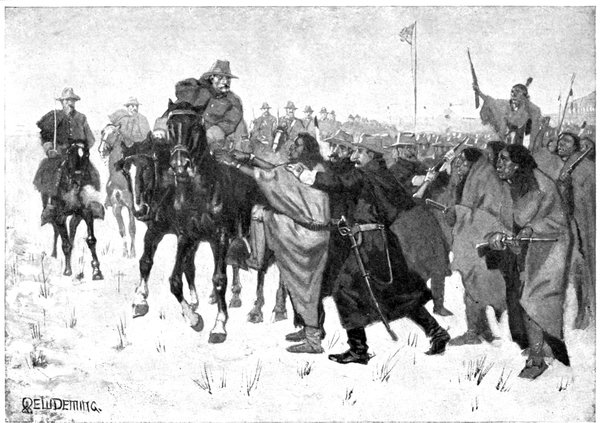
THE CAPTURE OF RAIN-IN-THE-FACE Drawing by E. W. Demian
Rain-in-the-Face, a magnificent specimen of Indian manhood, had ceased to struggle the moment he was convinced that it was unavailing. He was led outside, 215securely bound and mounted on a horse. The troopers were assembled, and in spite of threats and menaces by the Indians, who did not venture to attack, they started back to Fort Lincoln with their prisoner.
Messengers were sped in every direction to the different bands of Indians to mass a force to release Rain-in-the-Face, who was a man of such importance, being the brother of Iron Horse, one of the principal chiefs of the Unkpapas, that no price was counted too great to secure his liberty; indeed, before starting, they had offered Yates two warriors in exchange for him. The rapidity with which the troops moved was such that the prisoner was safely imprisoned at Fort Lincoln before anything could be done.
Rain-in-the-Face stubbornly refused to say anything for a day or two, but finally made full confession that he had shot Mr. Baliran and wounded Doctor Honzinger, who had fallen from his horse, whereupon he had crushed his head with stones. He was put in the guard-house preparatory to being tried for murder, and kept there in spite of the efforts to release him that were made by many prominent Indians. In the same guard-house were some civilians who had been caught stealing grain. One bitterly cold night, during a raging blizzard, the civilians, with some outside assistance, succeeded in making their escape. Rain-in-the-Face took advantage of the opportunity and left also. He joined the hostiles under Sitting Bull, and sent back word that he intended to have his revenge on the Custers for the treatment he had received.
216
CHAPTER FOUR The Little Big Horn Campaign
I. Custer Loses His Command
To return to the spring of 1876. When the column which Custer was to have commanded moved out, Custer led his own regiment, while Major-General Alfred H. Terry was in personal command of the column. I give the reason in the words of General George A. Forsyth in a recent letter to me:
“For some reason Custer, one of the most splendid soldiers that ever lived, hated General Belknap, the Secretary of War. He was a good hater, too. When General Belknap was imprisoned and undergoing trial Custer wrote that he knew of certain things regarding the appointment of post-traders on the upper Missouri River, which things the prosecution thought were what they needed to insure conviction. As a matter of fact, Custer did not know anything. He had heard disappointed men who had failed to get said post-traderships curse Belknap and say that they knew Belknap had sold the traderships to the appointees. It was not so. Belknap had given these appointments to certain able Iowa politicians for their friends, in order to secure their influence in the next campaign for United States Senator 217from Iowa, as he had determined to try for a senatorship from his state, viz., Iowa.
“It was entirely within his own right to make these appointments and there was really nothing wrong in doing so. Of course the disappointed applicants were furious, and especially certain men who had served with Belknap during the Civil War and who thought they had a claim on him. They could not tell lies fast enough about Belknap and especially to Custer, who was thoroughly honest and believed what they said. This was what Custer thought he knew.
“Custer was summoned to Washington of course. When he was questioned by the House Committee of prosecution it was apparent that he did not know anything. His evidence was all hearsay and not worth a tinker’s dam. The President—General Grant—was indignant at Custer’s statements regarding Belknap, which turned out to be all hearsay.... The President directed General Sherman not to permit Custer to take the field against Sitting Bull—undoubtedly to punish him.
“You will recall that Belknap was—in a sort of Scotch verdict way, ‘Not proven, my lord’—acquitted. It was only upon the strong, insistent and urgent request of General Sheridan to General Sherman—the then Commanding General of the Army—that the President finally said that if General Sheridan regarded Custer’s services of great importance in the campaign, Sherman might authorize Sheridan to permit him to join his regiment and serve under General Terry, who was appointed to command the expedition. Sherman wired Sheridan what the President said, and Sheridan at once applied for Custer as in his opinion ‘necessary.’[67]
218“I was in Europe at the time of the Custer disaster, and on my return to General Sheridan’s headquarters I saw all the correspondence in the case.”
Therefore, instead of commanding the column, Custer was placed under Terry, who was to command Gibbon’s column as well, when the junction had been made between the two. On the 17th of May the command left Fort Lincoln. The seriousness of the situation was felt as never before in an Indian campaign. It was realized that no child’s play was before the troops, and it was with unusual gravity that the regiment marched away. Mrs. Custer tells how General Terry ordered the force to parade through Fort Lincoln to reassure the women and children left behind by the sight of its formidable appearance.
The best part of the expedition was the Seventh Cavalry, six hundred strong, with Custer at its head. The band played “Garry Owen,” the famous battle tune of the Washita, as they marched away. They halted on the prairie afterward, and an opportunity was given to the officers and men to say good-by to the dear ones to be left behind; then, to the music of “The Girl I Left Behind Me,” they started on that campaign from which half of them never came back.
They reached the Powder River without mishap, and were there joined by General Gibbon, who reported his command encamped along the Yellowstone, near the mouth of the Big Horn. Major Reno, of the Seventh Cavalry, with six troops had been sent on a scouting expedition to the southward, and had discovered a big Indian trail leading westward toward the Big Horn country. On the 17th of June Reno’s men had been within forty miles of the place where Crook was fighting 219his fierce battle, although, of course, they knew nothing of it at this time. On the 22d Custer was ordered to take his regiment with fifteen days’ rations and march down the Rosebud, thoroughly examining the country en route until he struck the Indian trail reported by Reno.
II. Did Custer Obey His Orders?
And now we come to the most important question of this remarkable campaign. On the one hand, General Terry has been severely censured for its dire failure; the death of Custer and the escape of the Indians have been laid at his door. On the other hand, it has been urged that Custer disobeyed his orders, broke up Terry’s plan of campaign, and by his insubordination brought about a terrible disaster and let slip the opportunity for administering a crushing defeat to the Indians, which probably would have ended the war and prevented a deplorable loss of life, to say nothing of prestige and treasure. Both officers had, and still have, their partizans, and the matter has been thoroughly threshed out.
As between Custer and Terry, I profess absolute impartiality, although, if I have any natural bias, it is toward Custer, whose previous career, as I have investigated it, appeals to me more than Terry’s, distinguished as were the latter’s services. I have studied the situation carefully, examining all the evidence published by both sides, and very reluctantly, in spite of my liking for poor Custer, I am compelled to admit that he did disobey his orders; that his action did break up a most promising plan, which, it is highly probable, would have resulted in a decisive battle with the Indians and 220the termination of the war; and that he, and he alone, must be held responsible for the subsequent disaster.
General Terry’s order to Custer, which follows, is entirely clear and explicit:
Camp at Mouth of Rosebud River, M. T.,
June 22d, 1876.
Lieutenant-Colonel Custer, 7th Cavalry. Colonel:
The Brigadier-General Commanding directs that, as soon as your regiment can be made ready for the march, you will proceed up the Rosebud in pursuit of the Indians whose trail was discovered by Major Reno a few days since. It is, of course, impossible to give you any definite instructions in regard to this movement, and were it not impossible to do so, the Department Commander places too much confidence in your zeal, energy, and ability to wish to impose upon you precise orders which might hamper your action when nearly in contact with the enemy. He will, however, indicate to you his own views of what your action should be, and he desires that you should conform to them, unless you should see sufficient reasons for departing from them. He thinks that you should proceed up the Rosebud until you ascertain definitely the direction in which the trail above spoken of leads. Should it be found (as it appears almost certain that it will be found) to turn toward the Little Horn,[68] he thinks that you should still proceed southward, perhaps as far as the head-waters of the Tongue, and then turn toward the Little Horn, feeling constantly, however, to your left, so as to preclude the possibility of the escape of the Indians to the south or southeast by passing around your left flank. The column of Colonel Gibbon is now in motion for the mouth of the Big Horn. As soon as it reaches that point it will cross the Yellowstone and move up at least as far as the forks of the Big and Little Horns. Of course its future movements must be controlled by circumstances, as they arise, but it is hoped that the Indians, if upon the Little Horn, may be so nearly inclosed by the two columns that their escape will be impossible.
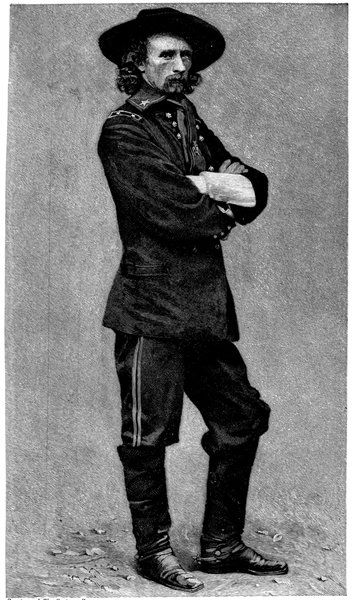
Courtesy of The Century Co. GEN. GEORGE ARMSTRONG CUSTER Killed with half his regiment at the Little Big Horn
221The Department Commander desires that on your way up the Rosebud you should thoroughly examine the upper part of Tullock’s Creek, and that you should endeavor to send a scout through to Colonel Gibbon’s column, with information of the result of your examination. The lower part of this Creek will be examined by a detachment from Colonel Gibbon’s command. The supply steamer will be pushed up the Big Horn as far as the forks if the river is found to be navigable for that distance, and the Department Commander, who will accompany the command of Colonel Gibbon, desires you to report to him there not later than the expiration of the time for which your troops are rationed, unless in the meantime you receive further orders.
Very respectfully your obedient servant,
E. W. Smith,
Captain 18th Infantry,
Acting Assistant Adjutant General.
Custer was directed to march southward until he struck the trail Reno had discovered. If, as Terry supposed, it led across the Rosebud, he was not to follow it westward to the Little Big Horn, or until he met the Indians, but he was to turn to the southward until he struck the head-waters of the Tongue River. If he found no Indians there, he was to swing northward 222down the valley of the Little Big Horn, toward the spot where Terry supposed the Indians to be, and where, in reality, they were. Meanwhile Gibbon was to come up the Little Big Horn from the north toward the same spot. In the general plan of the campaign, Crook and his force were supposed to prevent the Indians from moving south—which they did, by the way. Custer was to keep them from going east, and, as he advanced, was “to feel to his left” to preclude all possibility of their slipping between him and Crook, while Gibbon was to keep them from going off to the north. The Indians would have no direction open to them for flight except westward, and in that case the troops hoped to overtake them in a difficult country, inclosed by mountains and rivers.
Terry, although he was not an experienced Indian fighter, had divined the position of the Indians with remarkable accuracy, and he fully expected to find them on the Little Big Horn. If Custer had followed Terry’s orders, he would have reached the Indians on the day that Gibbon’s men, as we shall see, rescued Reno. After the disaster Terry magnanimously strove at first to conceal from the public the fact that Custer had disobeyed his orders. Custer had paid the penalty for his disobedience with his life, and Terry was willing to bear the odium of the defeat and failure. His self-sacrifice was noble and characteristic; but a mistake, caused by the carelessness of General Sherman, coupled with the enterprise of a brilliant newspaper reporter, who posed as a regularly accredited government messenger, defeated Terry’s intent, and instead of the first report, which made no allusion to the disobedience of orders, being made public,[69] a second report, which told the whole 223story, and which was intended for the authorities alone, was given to the press and immediately spread broadcast. The first report soon turned up, and Terry thereafter was made the victim of unmerited obloquy by Custer’s partizans, who said that the absence of any mention in the original report of any disobedience on the part of Custer, and the alleged failure to allude to the plan of campaign which Custer had frustrated, was evidence that no importance was attached to the plan by Terry or any one until after the failure and consequent popular indignation. Terry’s answer to this was a noble silence, to save Custer’s reputation. The living assumed the responsibility to protect the fame of the dead—honor to him!
General Gibbon also has gone on record in a letter to Terry regarding the situation:
“So great was my fear that Custer’s zeal would carry him forward too rapidly, that the last thing I said to him when bidding him good-by after his regiment had filed past you when starting on his march was, ‘Now, Custer, don’t be greedy, but wait for us.’ He replied gaily as, with a wave of his hand, he dashed off to follow his regiment, ‘No, I will not.’ Poor fellow! Knowing what we do now, and what an effect a fresh Indian trail seemed to have had upon him, perhaps we were expecting too much to anticipate a forbearance on his part which would have rendered coöperation of the two columns practicable.[70]
“Except so far as to draw profit from past experience, it is perhaps useless to speculate as to what would have been the result had your plan, as originally agreed upon, been carried out. But I cannot help reflecting that in 224that case my column, supposing the Indian camp to have remained where it was when Custer struck it, would have been the first to reach it; that with our infantry and Gatling guns we should have been able to take care of ourselves, even though numbering only about two-thirds of Custer’s force; and that with six hundred cavalry in the neighborhood, led as only Custer could lead it, the result to the Indians would have been very different from what it was.”
With regard to Gibbon’s generous suggestion that Custer was suddenly carried away by the opportunity presented, the testimony of the late General Ludlow is interesting. According to him, Custer stated on the 8th of May, in St. Paul, Minnesota, that he intended, at the first chance he got in the campaign, to “cut loose from (and make his operations independent of) General Terry during the summer;” that he had “got away from Stanley and would be able to swung clear of Terry.”[71]
It is difficult, nay, it is impossible, therefore, to acquit Custer of a deliberate purpose to campaign on his own account so soon as he could get away from General Terry. The sentence of Terry’s orders commencing: “It is, of course, impossible to give you any definite instructions,” etc., and expressing confidence in his zeal and energy, and Terry’s unwillingness to hamper him with precise directions, when nearly in contact with the enemy, did not warrant Custer in disobeying his orders. It was only to govern his conduct when he should be in contact with the enemy, in which case, of course, he would have to be the sole judge of what was best to be done. 225His conduct in that case will be considered later. In any event it has no bearing on the question of disobedience, for the crux is here: had Custer obeyed orders, he would not have come in contact with the enemy when and where he did. The conditions would have differed greatly.
Every student of military matters knows that the words used, “He desires that you should conform to them (his own views) unless,” etc., convey a direct, positive command.[72]
The abstract question of disobedience of orders is one that has often been discussed. It is impossible to maintain the position that an officer should never, under any circumstances, disobey his orders. Circumstances sometimes compel him to do so. But when an officer commanding troops which are supposed to act in coöperation with other troops receives orders to carry out a certain specified detail of a stated general plan, and in the exercise of his own discretion concludes to disobey his orders and do something other than what he was directed to do, he takes upon himself the onus of success or failure, not merely of his own immediate manœuver, but of the whole general plan. If the plan miscarries 226through his disobedience, whatever may have been his motives, woe be unto him! If by his disobedience he brings about the end at which the original plan aimed, the defeat of the enemy, that is another proposition. The event has then justified his disobedience.
Every soldier understands that reasons for disobedience must be so clear, so convincing, and so unexpected, that he is warranted in taking so prodigious a risk. Disregarding for the moment, for the sake of argument, General Ludlow’s testimony as to preconceived and deliberate intent on Custer’s part to disobey, supposing Custer’s disobedience to have been caused by some exigency or crisis, we may ask ourselves what were the reasons that caused him entirely to disregard Terry’s plan and so to manœuver as to bring himself directly in touch with the Indians in the shortest possible time, without attempting either to examine Tullock’s Creek[73] or to incline to the southward—“feel with his left”? These reasons—if any there were—can never be known, owing to Custer’s death. It can only be said that no satisfactory reasons appear which justify Custer’s action.
The best that can be urged in defense of Custer is contained in the following paragraph taken from Colonel Godfrey’s Century article.[74]
“Had Custer continued his march southward—that is, left the Indian trail—the Indians would have known of our movements on the 25th and a battle would have been fought very near the same field on which Crook had been attacked and forced back only a week before; the 227Indians would never have remained in camp and allowed a concentration of the several columns to attack them. If they escaped without punishment or battle, Custer would undoubtedly have been blamed.”
It may be pointed out with due reverence to Colonel Godfrey—whom I consider one of the ablest officers in the United States Army, by the way—that it is hard to see how Custer could have been blamed for obeying his orders, and that it is by no means certain that the Indians would have discovered Custer’s column. Indeed, his previous success in concealing his movements and surprising the Indians (witness the Washita campaign) leads me to believe that he could have carried out his orders without observation. If Gibbon had struck the Indians first and had held them in play Custer could have annihilated them. General Fry’s comments in the Century (appended to Colonel Godfrey’s article) on Custer’s action are entirely wrong.
As to what would have happened if Custer had been successful, it is more or less idle to speculate. Certainly, if he had overwhelmingly defeated the Indians, I do not think he would have been court-martialed; but if he had been in Reno’s place and had been besieged with heavy loss, then I feel certain that Terry would have been in duty bound to prefer charges against him. All this is beside the main question, however, and it is now time to return to the history of the expedition.
Terry offered Custer four troops of the Second Cavalry and two Gatling guns, which were refused. Custer said that any force that was too big for the Seventh Cavalry alone to deal with would be too big for the Seventh Cavalry plus the four troops, and urged that the guns would hamper and harass his movements. Terry, who elected to go with Gibbon’s infantry column, agreed with him.
228Neither Terry nor Custer nor any one expected to meet more than one thousand warriors. They had no knowledge whatever of the large numbers of the so-called peaceable Indians, for whom rations had been regularly issued, who had broken away from the agencies and joined the hostiles. They did not know of Crook’s defeat, and the great effect it had in inducing wavering bucks to give their allegiance to the brave men on the war-path. It will, perhaps, be fair to estimate the number of Indian warriors in the field at a mean between the white and Indian accounts, which range from twelve hundred on the one hand to three thousand on the other. To be on the safe side, I shall call it at least two thousand.[75] Whatever their number, there were enough of them.
In their way they were two thousand of the fiercest and most desperate fighters on the face of the globe. While they were undisciplined, untrained, and not entirely amenable to one will, as were the soldiers, they were, nevertheless, a fearfully formidable force. Their common hatred of the white man gave them sufficient coherence to form a rude but effective organization. They were led by experienced chiefs and were used to fighting. From 1868, after the close of the treaty by which the frontier posts were abandoned and the country restored to the Sioux and the Cheyennes, to 1876, no less than two hundred distinct fights, like that described in the account of the Yellowstone expedition, had occurred between the soldiers and the Indians. They were now to be tried in a real battle, and, as we shall see, they were not found wanting; for, in the end, all the honors of the campaign rested with them.
229
III. Custer’s Expedition
The Seventh Cavalry left the camp at the mouth of the Powder River at twelve o’clock noon, on the 22d of June, 1876. Generals Terry, Gibbon, and Custer reviewed it as it marched away. With the column were fifty Arikara (“Rees”) Indian auxiliaries, a few Crows, and a number of white scouts and newspaper correspondents. At four o’clock, after they had progressed twelve miles, the march was halted, and that evening the officers were summoned to Custer’s headquarters, and marching instructions were given them. No bugle-calls were to be sounded. The march was to be made with the greatest possible rapidity; every officer was to look carefully to his men and horses. Squadron and battalion formations were abandoned; each troop commander was to report to Custer in person.
Custer was usually very uncommunicative. Ordinarily, he kept his plans to himself until the time to strike arrived. On this occasion, however, he announced his purpose, which was to follow the trail until they found the Indians, and then “go for them.” He was not “carried away” by anything, and this declaration is further evidence of his deliberate purpose. His manner, at all times blunt and peremptory, not to say brusque, was now entirely changed. He was usually full of cheerfulness and confidence. There appeared to be a marked absence of both qualities in this instance. Officers have recorded that he seemed worried and depressed. It may be that he was feeling the displeasure of Grant, which his imprudent conduct had brought about. Perhaps the serious character of the risk he was taking by his independent move weighed upon him. If he succeeded, he 230would regain all he had lost in the censure. If he failed—well, he would not anticipate that. It was enough to give a man serious thoughts. His letters to his wife seem as cheerful and confident as ever, but, perhaps, he may have affected that for her sake. At any rate, the testimony as to his mental condition is unequivocal.
However he may have felt, he acted with his usual energy. Starting at five on the morning of the 23d, the regiment went into camp at five in the afternoon, having covered thirty-three miles over an execrable marching country—the “Bad Lands.” On the 24th they marched twenty-eight miles over an even worse territory. Indian signs were abundant. Hundreds of Indians evidently had passed. As no one could tell how near they were to the hostiles, after supper on the 24th fires were put out and the men were allowed to sleep until half after eleven, while the officers and scouts examined the trail. It was reported to Custer that it led straight across the divide separating the Rosebud and the Little Big Horn. At half after eleven the men were routed out and marched ten miles toward the crest of the Little Big Horn Mountains, which they reached at two o’clock in the morning of Sunday, the 25th. A further halt was made, and at eight o’clock the advance was taken up once more.
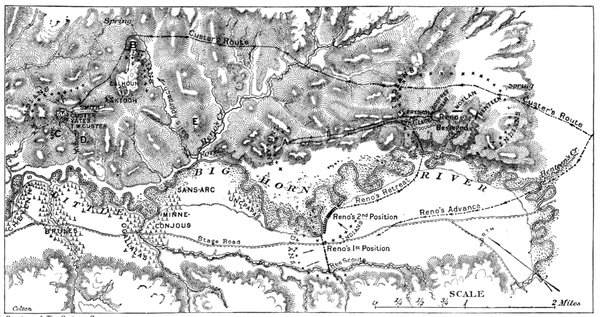
Courtesy of the Century Co. MAP OF CUSTER’S DEFEAT ON THE LITTLE BIG HORN Movements of Battalions plotted from data furnished by Col. Edward S. Godfrey
They marched ten miles farther, and concealed themselves in a large ravine near the divide and about sixteen miles from the little Big Horn, about half after ten in the morning. Smoke was seen trembling in the air by the scouts in the crow’s nest on the top of the divide, and there were other evidences of Indians down the valley of the Little Big Horn. It is believed that Custer intended to remain in hiding during the day, and deliver his attack on the next morning. Unfortunately, 231however, his trail had been crossed by the Indians. A box of hard bread had fallen from one of the pack-mules during the night march. When its loss was discovered, a squad of men had been sent back for it. They found an Indian trying to open it. He made his escape, and would undoubtedly alarm the villages they were approaching.
And now we come to another problem. As the result of his disobedience he was now practically in contact with the enemy, although he should not have been. Being in contact, however, what was he to do? There were no orders to govern him now. He was thrown on his own resources—just what he wanted, and what he had schemed and planned for. How was he to deal with his self-created opportunity?
Believing, as he and every one else did, that the Indian force did not greatly outnumber his own, an attack was entirely feasible. Should he deliver that attack, or should he wait to be attacked? The advantage is usually with the attacking party in Indian warfare. Should he seize or yield that? Suppose he decided not to attack the Indians, and they moved away and escaped? Would he not be censured for allowing them to get away, since he had got in touch with them?
Suppose—remote contingency—he were not entirely successful in his attack on the Indians? Gibbon must be somewhere in the vicinity. A day or two would probably bring him to the rescue. Could he not fight a waiting battle, if necessary, until the other column arrived on the field? Was it not absolutely incumbent upon him to embrace the opportunity presented to him? He had what he believed to be the finest regiment of cavalry in the service. He had tried it, tested it, on many fields; he knew, or thought he knew, the temper of his officers and 232men. He decided to attack. Indeed, there was nothing else for him to do. Fight he must. In the opinion of distinguished military critics who have expressed themselves upon the point, from General Sheridan down, he was justified in his decision. In that opinion I concur. And there is no evidence that he ever contemplated doing anything else. He had arranged matters to bring about the opportunity, and he had no hesitation in embracing it. Evidently, he had absolutely no premonition of defeat or disaster.
A little before noon he communicated his intention to his officers and men. He divided his regiment into three battalions. To Major Marcus A. Reno,[76] an officer with no experience in Indian fighting, he gave 233Troops A, G, and M; to Captain Benteen, a veteran and successful Indian fighter, Troops D, H, and K; Captain McDougall, with Troop B, was ordered to bring up the mule train and take it in charge; Custer himself took the five remaining troops, C, E, F, I, and L.
They left the ravine, and about noon crossed the divide which separated them from Little Big Horn Valley. Benteen was ordered to swing over to the left and search the country thoroughly in that direction, driving any hostiles he might come across into the village and preventing any escape of the Indians to the southward and westward. Reno was to follow a small creek, sometimes called Reno’s Creek, to its junction with the Little Big Horn and strike the head of the village, supposed to be there. Custer’s movements would be determined subsequently, although for the present he followed Reno. McDougall came last, following their trail with the slow-moving train, which dropped rapidly to the rear as the others proceeded at a smart pace. Benteen at once moved off to the westward, while Reno, followed by Custer, started down toward the valley of the Little Big Horn.
This river is a rapid mountain stream of clear, cold water, with a pebbly bottom, from twenty to forty yards wide. The depth of the water varies from two to five feet. While it is very tortuous, the general direction of the stream is northward to the Big Horn, which flows 234into the Yellowstone. The valley, from half a mile to a mile in width, is bordered by the bare bluffs. Along the river in places are thick clumps of trees. The Indian camp, the end of which they could see as they crossed the divide, was strung along the valley for several miles.
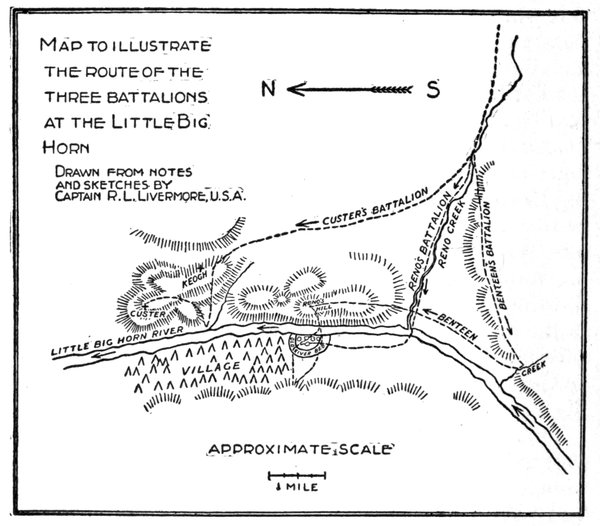
Reno’s advance down the creek took him near to the east bank of river. Custer had followed him, slightly on his right flank. When Reno discovered the head of the village in the valley, he crossed the creek to Custer and reported what he had seen. Custer directed him to cross the river, move down the valley, and attack in force, informing him that he would be “supported” by 235Custer’s battalion. Reno accordingly put his battalion to a fast trot in columns of four, crossed the Little Big Horn River beyond the mouth of the creek, and proceeded onward for perhaps half a mile. Then he threw his troops in line, reaching from the river to the bluffs on the left, with the Arikara scouts on the left flank, and galloped down the valley for a mile farther.[77]
Reno stated subsequently that he believed that Custer intended to keep behind him all the time; and he fully expected, should he come in contact with Indians, that Custer would be on hand to join in the attack. Custer, however, had not continued down the creek or crossed the river with Reno, but had swung off to the high bluffs on the right bank of the creek, east of the river. Reno mistook the purport of Custer’s statement. In order to support an attack, it is not necessary to get behind it. A flank attack or a demonstration in force, from some other direction, frequently may be the best method of supporting an attack. Custer’s plan was entirely simple. Reno was to attack the end of the village. Benteen was to sweep around and fall on the left of it, Custer on the right. The tactics in the main were those which had been used so successfully in the Battle of the Washita (q.v.), and were much in vogue among our Indian fighters during the Indian wars.
Dividing forces in the face of an enemy to make several simultaneous attacks is dangerous, because it is almost impossible to secure a proper coöperation between the attacking units. A skilful general will concentrate his force upon the separately approaching and more or less isolated units and beat them in detail. Washington’s tactics at Germantown were similar to 236those of Custer; and his force, which would have swept the British from the field if his plans had been carried out, was beaten in detail for lack of coördination in the separate attacks. Some of Napoleon’s most brilliant battles were fought when he occupied interior lines and by successive attacks broke up converging columns.
Still, the Indians were not believed to be veteran tacticians, although everybody underestimated their qualities. They were extremely liable to panic. A sudden attack or a surprise almost always disorganized them and threw them into confusion. Under the peculiar circumstances, I think there is little question that Custer’s tactics were entirely sound and well considered, although this conclusion is often disputed. Where Custer made a mistake appears to be in his failure to take greater precautions that the attacks should be delivered simultaneously. He had a much longer distance to go than Reno and over a much worse country before he could attack, and he was not at all sure as to where Benteen was or when he could join. Nevertheless, the chances of success were many, the chances of failure few, and I have no doubt that Custer would have been successful had there not been a woeful lack of conduct on the part of his principal subordinate.
237
CHAPTER FIVE The Last of Custer
I. Reno’s Failure at the Little Big Horn
It will be necessary, in order clearly to comprehend the complicated little battle, to treat each of the three operations separately, and then see how they were related to one another.
As Reno’s men trotted down the valley, they saw, some distance ahead of them and to the right across the river on a line of high bluffs, Custer attended by his staff. The general waved his hat at them encouragingly, and disappeared over the brow of the hill. That glimpse of Custer, standing on that hill with outstretched arm gallantly waving his troopers on to battle, was the last any one of his comrades in the valley had of him in life; and it is certain that Reno must have realized then that Custer was not following him, and that he was expected to attack in his front alone.
However, Reno, having drawn near to the village, deployed his skirmishers, and slowly advanced down the valley. In a few moments they were hotly engaged with a constantly growing force of Indians.
Now, one thing about the battle that followed is the utter unreliability of the Indian reports of their movements. It is alleged that fear of punishment made them 238and keeps them reticent and uncommunicative. Different Indians tell different stories. Most of these stories disagree in their essential details, and it is impossible to reconcile them. It may be that the faculties of the Indians are not sufficiently alert to enable them to recall the general plan of the battle, or at least to relate it, although they knew well enough how to fight it at the time. Their accounts are haphazard to the last degree. Some say that they knew nothing of the advent of the troops until Reno’s men deployed in the valley. At any rate, they had sufficient time, on account of his dilatory and hesitating advance, to assemble in heavy force. Reno had less than one hundred and fifty men with him. Even if Dr. Eastman’s estimate,[78] that the Indians numbered but twelve hundred warriors, be true, they still outnumbered Reno, although, owing to the fact that the villages were strung along the river for several miles, only a portion of them were at first engaged with the troops. Flushed with their previous victory over Crook a short time before, these Indians now fell upon Reno like a storm.
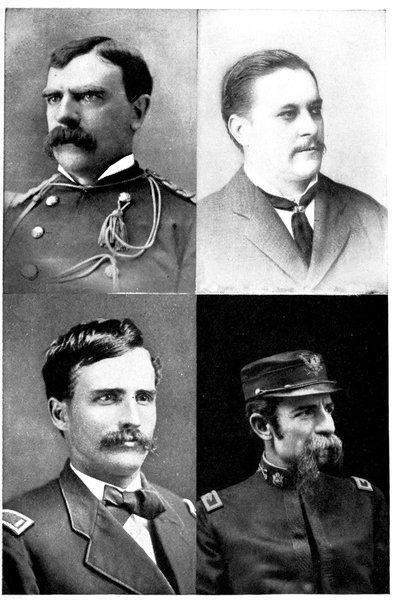
CAPT. MYLES MOYLAN MAJ. MARCUS A. RENO
LIEUT. A. E. SMITH[79] CAPT. EDWARD S. GODFREY
SOME OF CUSTER’S OFFICERS
Reno’s line extended clear across the valley, which was quite narrow where the battle was joined, the right flank protected by the river, the left by the bluffs. Recovering from their alleged panic, possibly because of the feeble advance of the soldiers, the Indians rallied, and with wonderful generalship massed their attack on the left flank, which was most unfortunately held by the Arikara scouts. No Arikara that ever lived was a match for the Sioux or the Cheyennes. The Rees, as these Indian auxiliaries were called, broke and fled incontinently. 239They never stopped until they reached the supply camp on the Powder River, miles away. At the same time the horses of two troopers in the command ran away with them, and plunged straight into the Indian lines with their riders. Their fate was plain.
As the Ree scouts broke, the Indians turned Reno’s left flank. The troopers gave way at once. There was no reserve which could be thrown upon the Indians until the line was restored. The whole force was slammed back, like a door, into the timber on the bank of the river.
Here Reno made a serious mistake. After rallying his men, he ordered them to dismount. Cavalry may be dismounted for defense, but sound judgment and military usage demand that for an attack, especially upon an Indian village of that kind, they should charge upon horseback. As one veteran cavalryman has written me, “I never could understand why Reno did not charge desperately on the Indians in front of him. His dismounting his men was against all sound military judgment. ‘Audacity, always audacity,’ is the motto for a cavalryman.”[80] Had Reno been governed by this principle and charged, as he should have done, the result would have been different.[81]
The position was instantly surrounded by yelling Indians galloping madly to and fro, firing upon the troops. So far, Reno had lost but one wounded and the two who had galloped into the Indian line. His second position was admirable for defense. Sheltered by the trees, with his flanks and rear protected by 240the river, he could have held the place indefinitely. However, he had not been detailed to defend or hold any position, but to make a swift, dashing attack. Yet, after a few moments of the feeblest kind of advance, he found himself thrown on the defensive. Such a result would break up the most promising plan. It certainly broke up Custer’s. In spite of the defection of the Rees, a vigorous countercharge down the valley would have extricated Reno and might have saved Custer.
It is a painful thing to accuse an army officer of misconduct; yet I have taken the opinion of a number of army officers on the subject, and every one of them considers Reno culpable in a high degree. One at least has not hesitated to make known his opinion in the most public way. I am loath to believe that Major Reno was a coward, but he certainly lost his head; and when he lost his head, he lost Custer. His indecision was pitiful. Although he had suffered practically no loss and had no reason to be unduly alarmed, he was in a state of painful uncertainty as to what he should do next. The soldier, like the woman, who hesitates in an emergency which demands instant decision, is lost.
How long the troops stayed under the trees by the river bank cannot be determined accurately. Some have testified that it was a few moments, others an hour. Personally I think it was a few moments, which fear and apprehension lengthened to an impossible period. There had as yet been no panic, and under a different officer there would have been none; but it is on record that Reno at last gave an order for the men to mount and retreat to the bluffs. Before he could be obeyed, he countermanded this order. Then the order was repeated, but in such a way that nobody save those immediately around him heard it, because of the din of the battle 241then raging in a sort of aimless way all along the line, and no attempt was made to obey it. It was then repeated for the third time. Finally, as those farther away saw those nearest the flurried commander mounting and evidently preparing to leave, the orders were gradually communicated throughout the battalion, and nearly the whole mass got ready to leave. Eventually they broke out of the timber in a disorderly column of fours, striving to return to the ford which they had crossed when they had entered the valley.
Reno calls this a charge, and he led it. He was so excited that, after firing his pistols at the Indians who came valiantly after the fleeing soldiers, he threw them away.[82] The pressure of the Indians upon the right of the men inclined them to the left, away from the ford. In fact, they were swept into a confused mass and driven toward the river. All semblance of organization was lost in the mad rush for safety. The troops had degenerated into a mob.
The Indians pressed closely upon them, firing into the huddle almost without resistance. Evidently in their excitement the Indians fired high, or the troops would have been annihilated. The Indians supposed, of course, that they now had the troops corralled between them and the river, and that all they needed to do was to drive them into it. Chief Gall, who with Crazy Horse and Crow King was principally responsible for the Indian manœuvers, seeing the retreat of Reno to the river, summoned a large body of warriors, left the field and crossed the river farther down, intending to sweep down upon the other side and attack Reno’s men as they struggled up the steep bank in case any of them succeeded in crossing. This was, as it turned out, a fortunate move for the Indians.
242Meanwhile, Reno’s men providentially found a pony trail which indicated a ford of the river. On the other side the trail led into a funnel-shaped amphitheater, surrounded by high, slippery bluffs. Into this cul-de-sac the whole fleeing body plunged, the Indians pressing the rear hard. The men jumped their horses from the bank into the water, and finding that the trail stopped at the bluff on the other side, actually urged them up the steep slopes of the hill.
There is no denying that they were panic-stricken. Although some of the veterans opened fire upon the savages, the bulk of the troopers did nothing but run. Dr. DeWolf was one of the coolest among those present. He stopped his horse deliberately, and fired at the Indians until he was shot dead. Lieutenant MacIntosh, striving to rally his men, was shot just as they left the timber. Lieutenant Hodgson, reaching the river bank, had his horse shot. In his agony the animal stumbled into the river and fell dead. The same bullet which killed the horse broke Hodgson’s leg. He cried for help, and Sergeant Criswell rode over to where he lay. Hodgson took hold of the sergeant’s stirrup, and under a heavy fire was dragged out on the bank, which he had scarcely reached before a second bullet struck him in the head, killing him instantly. Criswell was swept on by his men, but so soon as he could he rode back under a furious fire and brought off the body, as well as all the ammunition in the saddle-bags on several dead horses. He received a medal of honor for his courage.