Part II The War With the Sioux (continued 3)
Reading edition
Gruard, whose instincts as a guide were of the highest order, led them over magnificent mountains, through gloomy cañons, past overhanging cliffs, along impossible trails on the sides of tremendous precipices, one of which stretched for several hundred feet below them and three hundred feet above them, almost sheer. Not being mountaineers, they would have been utterly unable to have followed the scout had it not been for the Red Terror that lurked behind. They had succeeded in getting, perhaps, a mile away from and some distance above the valley, when they heard several heavy volleys, followed by a series of wild yells, which apprised them that the Indians had at last rushed their camp. They were so confident of escape now that they actually burst into roars of laughter at the thought of the Indian disappointment when the attackers found their victims had decamped. Those Indians were not accustomed to hunt on foot. An Indian off a horse is about as awkward as a sailor on one. The pursuit was soon abandoned, and the soldiers left to follow their course unmolested. Theirs had been a lucky escape. Without Gruard, they had all been killed.
The day was frightfully hot. The fast going caused by the exigencies of the occasion and the desperate nature of the climbing increased their discomfort. The 302men threw away everything in the way of superfluous clothing which would impede their progress or tire them in their hurry, save their weapons and ammunition. They camped that night, or halted, rather, for there was nothing with which to camp, on the crest of the range. It turned very cold, a terrible storm arose, and they suffered severely. They had nothing to eat; their provisions had been in their saddle-bags, and they had not dared to take them in their attempt to escape, lest the suspicions of the Indians should be excited by their efforts.
The next day, the 9th of July, they started down the mountain. Gruard’s instincts were not at fault. He led them to the foot-hills overlooking Crook’s main camp far away. In order to reach the plain they had to cross a rapid mountain brook, the water of which came almost up to their necks. Two men who could not swim and who were in a very nervous condition from their exciting adventures, stubbornly refused to try to cross the stream, even with the assistance of their comrades. They chose rather to hide themselves where they were, and begged that help might be sent back to them. The rest of the party managed to cross and started for the camp, still about fifteen miles distant. They were met in the evening by a scouting party of soldiers, who brought them back to camp.
Their clothing and shoes were torn to ribbons, and they were greatly exhausted from the terrible strains and hardships to which they had been subjected. That they escaped at all was a miracle, due to the coolness of young Sibley and the marvelous skill of Gruard. A detachment went back for the two men who had remained behind and brought them back to the camp.
Lieutenant Sibley reported to General Crook that he 303had found the Indians, but whether that statement is accurate is a question. It would, perhaps, be more truthful to say that the Indians had found him. Sibley and Gruard were highly complimented by Crook; and Mr. Finerty, who had displayed great courage, wrote a graphic account of it, from which this brief sketch has been abridged.
304
CHAPTER NINE The First Success
I. Crook and Mills at Slim Buttes
After the defeat of General Custer, and the successful retreat of the Sioux and Cheyennes from the Little Big Horn, the government hurried reinforcements into the field, and ordered Crook and Terry to press the pursuit of the Indians with the greatest vigor. It was not, however, until nearly a year after the disaster on the Little Big Horn that the Sioux war was concluded, and it was not until after the Indians had met with several crushing defeats and had been pursued until they were utterly exhausted that peace was declared.
The greatest individual factor in bringing about this much desired result was General George Crook, a celebrated cavalryman during the Civil War, and a more celebrated Indian fighter after its close. With unwearied tenacity and vigor he pursued the savages, striking them through his subordinates whenever and wherever they could be found. The terrible persistence with which he urged his faint, starving, foot-sore, tattered soldiers along the trail, to which he clung with a resolution and determination that nothing could shake, entitles him to the respect and admiration of his countrymen—a 305respect and admiration, by the way, which was fully accorded him by his gallant and equally desperate foes.
After Crook, the men who brought about the result were, first and foremost, Nelson A. Miles—singularly enough not a cavalryman, but the Colonel of the Fifth Infantry; and, next to him, Colonel Ranald S. Mackenzie, of the Fourth Cavalry, and Captain Anson Mills, of the Third, whom we have already noted doing gallant service at the Battle of the Rosebud. Miles had been ordered into the field to reinforce Terry’s shattered and depleted column.
After much marching and scouting, the columns of Terry and Crook combined; but Terry’s forces were in bad condition, and his command was soon withdrawn from the field. What was left of the Seventh Cavalry was sent back to Fort Lincoln, whence they had started out with such bright hopes a few months before. Gibbon’s command was returned to Montana, where it had been made up, on account of the threatening aspect of things in that quarter, and Terry retired from active campaigning to resume command of his department. Miles, as we shall see, was sent to the Yellowstone.
Crook was left alone in the active pursuit. Space and time are lacking to describe the details of the wonderful marches he made on the trails of the Indians—now under burning suns, which parched the ground until it was as bare as the palm of a hand; again through torrents of drenching rains, which succeeded the fierce heat; and, finally, through the snows and cold of a winter of unexampled severity. During the summer there was no forage for the horses of the cavalry nor for the very small pack train, and rations for the men became shorter and shorter. Finally, early in September, the supply of provisions was reduced to two and a half 306days’ rations. Crook calculated that they could march two weeks on that amount.
They supplemented the rations by living on horse and mule meat and a few wild onions which they could gather from time to time in spots which had escaped the universal baking of the summer. At last the command literally reached the end of its resources. The Indians were in bad condition, too, but their situation was not nearly so desperate as was that of Crook and his men. The Indians were worn out and exhausted by the energetic and relentless pursuit which had been hurled after them by the indomitable commander, but they still had plenty to eat, and they had managed to keep ahead of him, and to avoid various scouting columns.
On the 7th of September, 1876, Crook realized that his men had reached the limit of their endurance, and that forage and food must be procured or they would all die in the wilderness. The Indians had swept the country bare of game, and the sun had swept it clean of fodder. One hundred and fifty of the best men—that is, those who showed the fewest signs of the hardships they had undergone—with the best horses and the last of the mules, were formed into an advance party under Captain Anson Mills, of the Third Cavalry. Mills had instructions to push on to Deadwood City, one of the new towns in the Black Hills, to get provisions, “Any kind of provisions, for God’s sake!” which he could bring back to the rest of the army, now in a destitute condition.
Mills was not expected to hunt for, or to fight, Indians—primarily, that is. He was to go for food in order to keep the army from starving; but as he marched southward, his scouts discovered a large village of forty or fifty lodges at a place called Slim Buttes, in the northwest corner of South Dakota. The tepees 307had been pitched on a little rising from the banks of a small stream called Rabbit Creek. The place was inclosed on three sides by a series of tall cliffs, whose broken sides seemed here and there to have been cut in half-formed terraces, making the ascent easy. Little ravines and small cañons ran through the buttes, gradually ascending until they met the plateau on top.
Mills instantly determined to attack the camp—a wise and soldierly action on his part. He made his dispositions with care. Reaching the vicinity of the camp, he halted in a deep gorge on the night of September 8, and prepared for battle early the next morning. The night was dark, cold, and very rainy, and the tired men suffered greatly. Marching out at dawn, Mills succeeded at daybreak in surprising the camp, which proved to be that of a band of Sioux led by American Horse, one of the most prominent chiefs. Leaving Lieutenant Bubb with the pack train and the lead horses, Mills directed Lieutenant Schwatka, afterward so well known from his Arctic explorations, to charge directly into the village with twenty-five mounted men. The remainder of his force he dismounted and divided into two parties, under Lieutenants Von Luettwitz and Crawford, respectively, with orders to move on the camp from different sides.
The attack was a complete success. The village was taken with but little loss. Some of the Sioux were killed and others captured, but most escaped through the ravines to the plateau surrounding the valley. One heroic but unfortunate little band, consisting of American Horse and four warriors, with fifteen women and children, was driven into one of the cañons which ended in a cave. One or two of the soldiers had been wounded in the attack. Lieutenant Von Luettwitz, 308who had fought all through the Franco-Austrian War in Italy, and who was a veteran of the Civil War, was shot in the knee and so badly wounded that his leg had to be amputated on the field.
Being now in complete command of the village, the pack train was ordered up and the captured village was examined. To the joy of Mills and his soldiers, an immense quantity of provisions, in the shape of meat, forage, and other stores, was discovered.
There still remained the little band of savages in the ravine to be dealt with. A detachment was ordered to drive them out. The Indians had been busy making rifle-pits, and as the soldiers advanced to storm the cave, they were met with a rapid and well-directed fire. Two of them were shot dead and others wounded.[99] The Indian position appeared to be impregnable. An interpreter crept near enough under cover to make himself heard, and asked their surrender. They replied to his command with taunts and jeers. They incautiously informed him, however, that Crazy Horse with his warriors was in the vicinity, and on being apprised of their situation by some of the fugitives, he would undoubtedly come to their rescue. Crazy Horse could have made short work of Mills and his hundred and fifty. Meanwhile the survivors of the village, which had contained a hundred warriors, formed an extended line on the buttes and opened fire on the soldiers.
309Mills acted promptly. He despatched a courier to Crook on the best horse in the command, to report the situation and ask him for reinforcements at once. Incidentally, he mentioned that a great quantity of provisions had been found. Then he made preparations to hold the place, and at the same time to prosecute his attack against the cave, all the time keeping up a smart fight with the men on the buttes. So soon as Crook received the message, he started forward, intending to take with him a select body of men; but the whole army, spoiling for a fight and hungry for a square meal, insisted on going along. They made a forced march, and reached Mills about half after eleven in the morning.
Crook immediately proceeded to dislodge the Indians in the cave. The men were led forward under a galling fire, to which the general, in spite of the entreaties of his staff, exposed himself with indifference. When they got in a position to command the cave, Crook, willing to spare his brave foemen, again asked them to surrender. His request was met by a decided negative. The men opened fire, and searched every cranny and recess of the cave with a storm of bullets. Gruard, one of the scouts, taking advantage of cover, crept to the very mouth of the cave, remained there unobserved, watched his opportunity, seized a squaw who incautiously exposed herself, and with her as a shield dashed forward and shot one of the warriors, escaping in safety himself.
II. The Death of American Horse
After two hours of firing, the death-chants of the squaws induced Crook to order a cessation for another parley. This time his request that the Indians surrender 310met with some response; for the squaws and children, to the number of thirteen, came reluctantly forth on his positive assurance that they would be protected. The braves refused to give up. They were confident that Crazy Horse would succor them. The engagement at once began again, but after it had lasted some little time the fire of the Indians ceased.
The offer of mercy was made a fourth time. A young Indian stepped out and received additional assurance that no harm should come if they surrendered. He went back into the cave and presently reappeared with another young warrior, supporting between them the tall, splendid figure of brave old American Horse. He had been shot through the bowels, and his intestines protruded from the wound. He was suffering frightful agony, and was biting hard upon a piece of wood to control himself. He handed his gun to Crook and gave up the contest. The surgeons with the command did everything they possibly could for him, but his wound was beyond human skill. That night, surrounded by his wives and children, he died, as stoically and as bravely as he had lived.
Inside the cave the rocky walls were cut and scored by the rain of bullets which had been poured into it, and lying on the floor were the bodies of the two Indian warriors, together with a woman and a child, who had been killed. The soldiers had not known, until the squaws came out, that there were any women or children there. The little band had sold their lives dearly. Even the women had used guns, and had displayed all the bravery and courage of the Sioux.
Too late Crazy Horse, with some six hundred warriors, appeared on the scene. Imagining he had only to deal with Mills’ small force, he galloped gallantly forward 311to the attack at about five o’clock. He was greatly astonished at the number of antagonists developed thereby. He retired to the top of the buttes, and the soldiers in gallant style dashed after him. They scaled the cliffs, finally gaining the level plateau. Crazy Horse made one or two attempts to break through the line, but it was impossible, and seeing himself greatly outnumbered, he wisely retired, having sustained some loss.
The battle was one of the most picturesque ever fought in the West. Crook and his officers stood in the camp, the center of a vast amphitheater ringed with fire, up the sides of which the soldiers steadily climbed to get at the Indians, silhouetted in all their war finery against the sky. The loss of life on either side was not great, but the capture of the village and the provisions which had been accumulated for the winter was a serious one.
In the camp were discovered many articles that had belonged to the Seventh Cavalry—a guidon, money, one of Captain Keogh’s gauntlets, marked with his name, orderly books, saddles, etc. Among other things, were letters written by officers and soldiers to friends in the East, some of them still sealed and ready for mailing. They must have come like voices from the dead when they reached those to whom they had been written.
312
CHAPTER TEN A Decisive Blow
I. Mackenzie’s Winter Battle
Crook now gave over the pursuit, and returned to Fort Fetterman to organize a winter campaign. This expedition was one of the best equipped that ever started on an Indian campaign. It contained all arms of the service, with an abundance of everything necessary to success. To follow its marches to the Big Horn Range would reveal little of interest; but late in November it was learned, from a captured Cheyenne, that the principal Cheyenne village was located in a cañon through which flowed one of the main sources of Crazy Woman’s Fork of the Powder River. Colonel Ranald S. Mackenzie was ordered, with the Indian scouts and ten troops of cavalry from the Second, Fourth, and Fifth regiments, to find and destroy the village.
The Cheyennes were not so numerous as the Sioux, and the greater number of their allies has sometimes caused people to minimize the quality of the Cheyennes; but no braver, more magnificent fighters ever lived than this same tribe. They had some of the Homeric qualities of the ancient Greeks. I believe it will generally be admitted that they were the finest of the Plains Indians. 313They were foemen worthy Mackenzie’s or anybody else’s steel. The battle which ensued was in some respects one of the most terrible in Western history, and in its results exemplified, as few others have done, the horrible character of the war. It was, perhaps, as great a contribution to the downfall of the Sioux as any single incident that occurred.
Mackenzie’s men left the main encampment on the 23d of November. The ground was covered with snow. The weather was arctic in its severity. The scouts and friendly Indians—Pawnees, Crows, Shoshones, the hereditary enemies of the Cheyennes, including certain Cheyennes also who had entered the service of the United States[100]—had located the camp in Willow Creek Cañon. Some of the Indians had kept the camp under observation while Mackenzie brought up his troops. He had seven hundred and fifty cavalrymen and three hundred and fifty Indians. Halting at the mouth of the cañon, which he reached on the night of the 24th, he resolved to await the still hours before the break of day the next morning before delivering his attack.
The cañon was a gloomy gorge in the Big Horn Mountains. A swift, ice-bound river rushed over the rocks between precipitous walls, which soared into the sky for perhaps a thousand feet on either side. Numberless icy brooks poured their contents into the main stream through lateral cañons scarcely less forbidding in their appearance than the main one, and which made the trail of the creek almost impossible. Here and there the cañon widened, and in one of these open 314places the Cheyennes, under the leadership of Dull Knife, had pitched their camp. They fondly believed the place impregnable—as, indeed, with careful guarding it would have been. The greatest precaution was taken by Mackenzie to prevent his men from making any noise. They stood in ranks by their horses in the snow in that polar cold, waiting for the order for the advance. Presently the moon rose, flooding the recesses of the ravine with silvery light, which sparkled with dazzling brilliancy upon patches of snow here and there on the dark walls.
Mackenzie, calculating that day would be breaking just about the time he would reach the camp from his present position, at last gave order to take up the march. With what relief the benumbed troopers sprang to their saddles and urged their shivering horses forward, can scarcely be imagined by dwellers in peaceful lands around warm firesides. As they struggled up the cañon they could hear the sound of dancing and revelry in the Indian camp, faintly blown back to them by the night wind. They learned afterward that the Cheyennes had just returned from a successful raid on the Shoshones, and that the dance was in celebration of an important victory they had gained. They halted again, therefore, until all was silence, before they once more advanced. Day was beginning to break as they reached the village.
The sleeping Indians in the camp had not the slightest suspicion that the enemy was within a hundred miles. The troops, cheering and shouting, burst upon them like a winter storm. Indians, when not apprehensive of attack, invariably sleep naked. The Cheyennes had just time to seize rifles and cartridge belts, while the women caught hasty blankets about the children, when the soldiers were upon them. Indeed, so quick and 315sudden was the attack that some of the warriors could not get out of the tepees. With their knives they slashed the wigwams, and from these openings fired upon the soldiers as they galloped through the village. Many were shot dead where a few moments before they had slept in peace.
Most of the pony herd was captured, and the village in a short time was in possession of Mackenzie. The Cheyennes, though overwhelmed, were undismayed. They had retreated headlong up the cañon, but were soon rallied by their subchiefs. Dull Knife, their leader, was found in the village with half a dozen bullets in him. He had fought gallantly in the open until he died.
Presently the Indians came swarming back along the side of the cañon. They occupied points of vantage, and, naked though they were in the frightful weather, with the thermometer ranging from ten to twenty degrees below zero during this campaign, they opened fire upon their opponents. Unless they could be dislodged, Mackenzie’s position was untenable. He sent his Shoshone and other Indian scouts, who, animated with bitter hatred of the Cheyennes, were eager to obey his commands, to the summits of the cliffs to clear the Indians from them.
Meanwhile he directed Lieutenant John A. McKinney, with his troop, to charge and drive the Indians from a rocky eminence where they were concentrating and from which they were pouring a hot fire upon the soldiers. McKinney’s charge was entirely successful, for he drove the Cheyennes back until he was stopped by a ravine. Wheeling his men, he attempted to find a crossing, when he was fired upon by a flanking party of Indians and instantly killed, being hit no less than six times. Six of his troopers were wounded, and a 316number of horses were shot. The troop was thrown into confusion, and some of the men started to retreat. Mackenzie, observing the situation, immediately ordered Captain John M. Hamilton and Major G. A. Gordon to charge to the rescue. The charge was gallantly made and stubbornly resisted.
The fighting was hand to hand, of the fiercest description; and the Cheyennes, while keeping the rest of Mackenzie’s forces engaged, began concentrating on these two troops, which had been joined by Captain Davis, with his men. There was no reserve; the cavalry were all in, and this detachment might have been wiped out had it not been for the success of the Shoshones and other Indians, who cleared the key to the position on the summit of the plateau above the cañon, and then came to the assistance of the sorely beset soldiers. Twenty Cheyennes were killed here and several of the soldiers.
Relieved in a measure by these two movements, although not altogether, for the Cheyennes with their superior knowledge of the topography of the country could not be entirely dislodged from their position, and kept up a fierce fire upon the soldiers all day long, to which he could make little reply, Mackenzie sent back word to Crook of his success, and meanwhile began the destruction of the village. All the winter supplies for over a thousand Indians were there. The Cheyennes were a forehanded, prosperous tribe of Indians, as Indians go, and the property destroyed was enormous.
II. The Sufferings of the Cheyennes
What must have been the despair of the surprised warriors, with their women and children, naked, shivering in the hills, as they saw their belongings consumed by the flames! It was simply impossible for them to maintain their position during the night. They had to move away or die of cold. As it was, twelve little Indian babies froze to death that awful night. Many of the older men and women were kept alive only by having their hands and feet, and in the case of the children, their whole bodies, thrust into the warm bodies of the few ponies not captured by the soldiers, which had been disemboweled for the purpose.
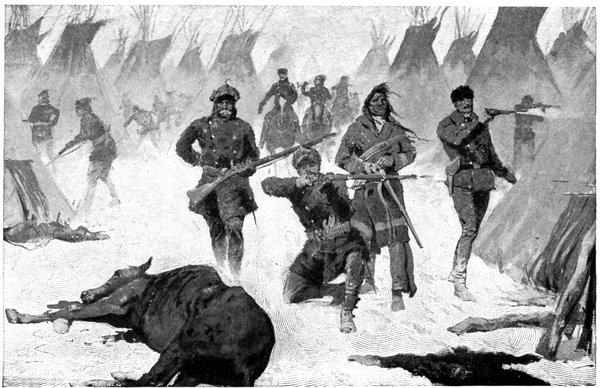
Courtesy of The Century Co. MACKENZIE’S MEN IN DULL KNIFE’S VILLAGE Drawing by Frederic Remington
317There was no fighting on the 26th. The Cheyennes took up a strong position six miles farther up the cañon, from which Mackenzie could not dislodge them, and on the 27th he started on his return to the camp. Crook, who made a forced march night and day, with Colonel Dodge and the infantry, who came forward with astonishing speed in spite of storm and cold, met Mackenzie retiring just after he left the cañon, and the whole army returned to the encampment.
The subsequent sufferings of the Indians were frightful. Naturally, they repaired to Crazy Horse, expecting that he would succor them, feed them, and clothe them. The Sioux and the Cheyennes had been warm friends and allies, and had fought together on many a field. Had they come in their prosperity, Crazy Horse would have given them a warm welcome. As it was, he had little with which to support his own band during the winter, owing to Crook’s pursuit of him, and with short-sighted, yet natural—from an Indian point of view—policy, he refused to receive these Cheyennes, or to share anything with them.
Exasperated beyond measure by their treatment by the Sioux, and swearing eternal vengeance upon Crazy Horse, the wretched band struggled into the nearest agency 318and surrendered, and in the following spring moved out with the soldiers against Crazy Horse and his men.
It is appalling to think of that night attack in that awful weather upon that sleeping camp—to read of those wretched women and children, wandering naked in that bitter cold; to learn of those little ones frozen to death; of the old men and women abandoned by the road to die—yet there is another side to the picture, scarcely less horrible.
In this Indian camp also were found many relics of the Custer battle. So far as that is in question, I may say that I consider that action to have been a fair and square stand-up fight, in which one side was defeated and its members all died fighting.[101] Naturally, the Indians despoiled the slain for trophies. White soldiers have done the same when conditions have been reversed, as has been noted in the preceding chapters of this book. Of course, the Indians mutilated the dead and tortured the living, but some instances of both practices are found among white men, and we cannot judge the Indian by our standards, anyway.
But in the camp there were other evidences of savage ferocity, from which the soul shrinks in horror, and which showed that these Indians were among the most cruel and ruthless on the continent, and that they were only getting what they had given. Two instances will suffice. The troops took from the body of a dead warrior an unique necklace of human forefingers, which had been displayed with pride upon his barbaric breast;[102] and a bag was found which contained the right hands of twelve little Shoshone babies and children, which had been recently cut from little arms to give some ruthless warrior a ghastly trophy.
319
CHAPTER ELEVEN Miles’ Great Campaigning
I. Miles and His Foot Cavalry Defeat Sitting Bull
Now let us turn to Miles and his men.
General Miles was ordered to march his command up the Yellowstone to the mouth of the Tongue River, and establish a temporary post or cantonment there for the winter. He was an officer in whom great confidence was reposed, and from whom much was to be expected. He had as brilliant a record in the Civil War as Custer, and had practically fought one decisive battle in the closing campaign on his own responsibility, with splendidly successful results. He was a natural-born soldier, and he never showed his talents to better advantage than in the operations which followed. His career before and after this period is still fresh in the minds of a grateful people.
While Crook and his men were hammering away in one portion of the field, Miles was doing splendid service in the other. The original intention had been to place under his command some fifteen hundred men, but the force he really received amounted only to about five hundred. With these he was not expected to do more than maintain his position, and acquire such information 320as he could in preparing for the spring and summer campaign of the following year. That was not, from his point of view, a satisfactory program.
Veteran Indian fighters in the Northwest informed him that it would be useless to try to reach the Indians in the winter; but Miles was not that kind of a soldier. If the Indians could live in tepees in that season, he saw no reason why white soldiers should not move against them in spite of the weather. He had one of the finest regiments of infantry in the service—the Fifth. Based upon the report of courts-martial, discipline, etc., no regiment surpassed or even equaled its record. Miles himself proved to be the most successful commander against Indians that the war produced, and his success was not due to what envious people called good luck. It was well merited and thoroughly earned.
The government, upon the representations of Sheridan and Sherman, which were based upon Miles’ previous successful fighting with the Southwestern Indians, allowed the young colonel everything he asked for. If his troops were not completely equipped for the work in which their commander designed to employ them, it would be his fault. With wise forethought, he provided the soldiers as if for an arctic expedition. They cut up blankets for underwear. They were furnished with fur boots and the heaviest kind of leggings and overshoes. Every man had a buffalo overcoat and a woolen or fur mask to go over his face under his fur cap. Their hands were protected by fur gloves. It was well for them that they were thus provided, for the winter of 1876–7 was one of the most severe that had ever visited that section of the country. The mercury frequently froze in the thermometer, and on one occasion a temperature of sixty degrees below zero was recorded by the spirit thermometer.
321Busying themselves during the late fall, which was, in effect, winter, in the erection of the cantonment on the Tongue and Yellowstone, the first important touch they got with the Indians was on the 18th of October, when Lieutenant-Colonel Elwell S. Otis, commanding a battalion of four companies of the Twenty-third Infantry, escorting a wagon-load of supplies from Glendive, Montana, to the cantonment, was attacked by a large force of hostiles. The attack was not delivered with any great degree of force at first, but it grew in power until the troops had to corral the train. The soldiers had a hard fight to keep the animals from being stampeded and the train captured. Having beaten off the Indians, the train advanced, fighting, until Clear Creek was reached. During a temporary cessation of the attacks a messenger rode out from the Indian lines, waving a paper, which he left upon a hill in line with the advance of the train. When it was picked up, Colonel Otis found it to be an imperious message—probably written by some half-breed—from the chief whom he had been fighting. It ran as follows:
“Yellowstone.
“I want to know what you are doing traveling on this road. You scare all the buffalo away. I want to hunt in this place. I want you to turn back from here. If you don’t, I’ll fight you again. I want you to leave what you have got here, and turn back from here.
I am your friend,
Sitting Bull.
“I mean all the rations you have got and some powder. Wish you would write me as soon as you can.”
I consider this document unique in the history of Indian warfare, and it well illustrates not only the spirit, 322but the naïveté of the great chief. Otis despatched a scout to Sitting Bull with the information that he intended to take the train through to the cantonment in spite of all the Indians on earth, and if Sitting Bull wanted to have a fight, he (Otis) would be glad to accommodate him at any time and on any terms. The train thereupon moved out, and the Indians promptly recommenced the fight. But the engagement was soon terminated by a flag of truce. A messenger appeared, who stated that the Indians were tired and hungry and wanted to treat for peace. Otis asked Sitting Bull to come into his lines, but that wily old chief refused, although he sent three chiefs to represent him.
Otis had no authority to treat for peace or anything else, but he gave the Indians a small quantity of hardtack and a couple of sides of bacon, and advised them to go to the Tongue River and communicate with General Miles. The train then moved on, and after following a short distance, with threatening movements, the Indians withdrew.
On the same night Otis fell in with Miles and his whole force. Miles, being alarmed for Otis’ safety, had marched out to meet him. The train was sent down to the cantonment, and the troops, numbering three hundred and ninety-eight, with one gun, started out in pursuit of Sitting Bull. They overtook him on the 21st of October at Cedar Creek. With Sitting Bull were Gall and other celebrated chiefs, and one thousand warriors of the Miniconjous, San Arcs, Brulés, and Unkpapas, together with their wives and children, in all over three thousand Indians. Crazy Horse, with the Oglalas and Two Moon’s band of the Northern Cheyennes, were not with Sitting Bull, while Dull Knife’s band, as we have seen, had gone to Wyoming for the winter.
323The reason for this separation is obvious. They could better support the hardships of the winter, more easily find shelter, and with less difficulty escape from the pursuing soldiers, if they were broken up in smaller parties.
Sitting Bull asked Miles for an interview, which was arranged. He was attended by a subchief and six warriors, Miles by an aide and six troopers. The meeting took place between the lines, all parties being on horseback.
Sitting Bull wanted peace on the old basis. The Indians demanded permission to retain their arms, with liberty to hunt and roam at will over the plains and through the mountains, with no responsibility to any one, while the government required them to surrender their arms and come into the agencies. The demands were irreconcilable therefore. The interview was an interesting one, and although it began calmly enough, it grew exciting toward the end.
Sitting Bull, whom Miles describes as a fine, powerful, intelligent, determined looking man, was evidently full of bitter and persistent animosity toward the white race. He said no Indian that ever lived loved the white man, and that no white man that ever lived loved the Indian; that God Almighty had made him an Indian, but He didn’t make him an Agency Indian, and he didn’t intend to be one.
The manner of the famous chief had been cold, but dignified and courteous. As the conversation progressed, he became angry—so enraged, in fact, that in Miles’ words “he finally gave an exhibition of wild frenzy. His whole manner seemed more like that of a wild beast than a human being. His face assumed a furious expression. His jaws were tightly closed, his lips were 324compressed, and you could see his eyes glisten with the fire of savage hatred.”[103]
One cannot help admiring the picture presented by the splendid, if ferocious, savage. I have no doubt that General Miles himself admired him.
At the height of the conference a young warrior stole out from the Indian lines and slipped a carbine under Sitting Bull’s blanket. He was followed by several other Indians to the number of a dozen, who joined the band, evidently meditating treachery. Miles, who, with his aide, was armed with revolver only, promptly required these new auxiliaries to retire, else the conference would be terminated immediately. His demand was reluctantly obeyed. After some further talk, a second meeting was appointed for the morrow, and the conference broke up.
During the night Miles moved his command in position to be able to intercept the movement of the Indians the next day. There was another interview with the picturesque and imperious savage, whose conditions of peace were found to be absolutely impossible, since they involved the abandonment of all the military posts, the withdrawal of all settlers, garrisons, etc., from the country. He wanted everything and would give nothing. He spoke like a conqueror, and he looked like one, although his subsequent actions were not in keeping with the part. Miles, seeing the futility of further discussion, peremptorily broke up the conference. He told Sitting Bull that he would take no advantage of the flag of truce, but that he would give him just fifteen minutes to get back to his people to prepare for fighting. Shouting defiance, the chiefs rode back to the Indian lines.
There was “mounting in hot haste” surely, and hurried 325preparations were made for immediate battle on both sides. Watch in hand, Miles checked off the minutes, and exactly at the time appointed he ordered an advance. The Indians set fire to the dry grass, which was not yet covered with snow, and the battle was joined amid clouds of flame and smoke. Although outnumbered nearly three to one, the attack of the soldiers was pressed home so relentlessly that the Indians were driven back from their camp, which fell into the possession of Miles.
The Sioux were not beaten, however, for the discomfited warriors rallied a force to protect their flying women and children, under the leadership of Gall and others, Sitting Bull not being as much of a fighter as a talker. They were led to the attack again and again by their intrepid chiefs. On one occasion, so impetuous was their gallantry that the troops were forced to form square to repel their wild charges. Before the battle was over—and it continued into the next day—the Indians had been driven headlong for over forty miles.
They had suffered a serious loss in warriors, but a greater in the destruction of their camp equipage, winter supplies, and other property. Two thousand of them came in on the third day and surrendered, under promises of good treatment. Several hundred broke into small parties and scattered. Miles’ little force was too small to be divided to form a guard for the Indians who had been captured; and besides, he had other things to do, so he detained a number of the principal chiefs as hostages, and exacted promises from the rest that they would surrender at the Spotted Tail or Red Cloud Agency—a promise which, by the way, the great majority of them kept. Sitting Bull, Gall, and about four hundred others refused to surrender, and made for the boundary line, escaping pursuit for the time being.
326This was the first and most serious defection from the Indian Confederacy. It was followed by others. In a subsequent campaign, in the depth of winter, a battalion under Lieutenant Baldwin struck Sitting Bull’s depleted and starving camp on two separate occasions, inflicting further loss upon that implacable chieftain.[104]
II. Miles’ Crushing Defeat of Crazy Horse at Wolf Mountain
Late in December Miles, having practically eliminated Sitting Bull from the game, moved out against Crazy Horse. He had with him five companies of the Fifth Infantry and two of the Twenty-second, in all four hundred and thirty-six officers and men and two Napoleon guns. These guns were fitted with canvas wagon-tops, and were so disguised as exactly to resemble the supply wagons of the train. The men left the cantonment on the 29th of December, 1876. It had been learned that Crazy Horse was in the valley of the Tongue River, south of the Yellowstone. There were sharp skirmishes on the first and third of January between the advance and war parties of Indians, who were moving gradually up the Tongue toward the mountains. On the evening of the 7th of January, 1877, a young warrior and a woman were captured, belonging to those Cheyennes who were still with Crazy Horse and the Unkpapas, and were related to some of the principal members of the band. From them much was learned of the situation of the Indian position.
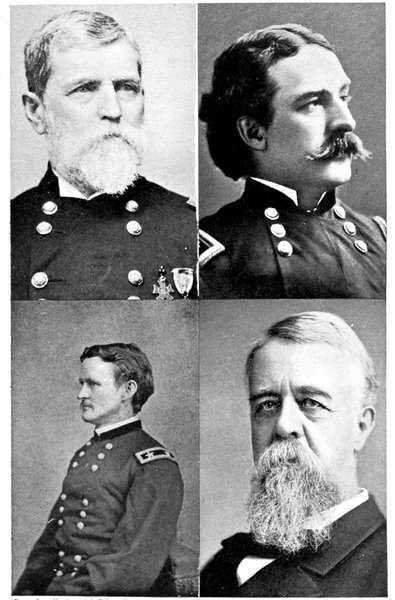
From the collection of J. Robert Coster
GEN. JOHN GIBBON GEN. NELSON A. MILES
GEN. WESLEY MERRITT GEN. ALFRED H. TERRY
SOME FAMOUS INDIAN FIGHTERS
327The next morning, the weather being bitterly cold, the men moved out to attack the Indian camp. Crazy Horse’s warriors numbered between eight and nine hundred. He had posted his men on the cliffs surmounting a valley in the Wolf Mountains, a spur of the Big Horn Range, not far from Crook’s battle-ground on the Rosebud. The troops entered the valley in full view of the Indians occupying the heights. The position was well chosen; for in order to make the attack, the soldiers would have to climb straight up the walls to get at the Indians, who were enabled, by the configuration of the ground and by their numbers, almost to surround the soldiers. One reason why Crazy Horse was willing to fight was because of his great desire to get possession of the Indians recently captured.
Seeing that Crazy Horse was willing to accept battle, Miles made his preparations deliberately. The troops, out of range of the Indians, calmly had breakfast and made their camp secure. Having done everything at his leisure, Miles moved out to the attack.
The Sioux were plainly visible on the cliffs. They could be seen shaking their fists and brandishing their rifles as the soldiers slowly advanced through the deep snow which covered the ground. The Indians seemed absolutely confident that Miles was marching into a trap, that when he got into the cañon he would be unable to scale the slopes, and they would have him at their mercy. There was no ambush about it. The whole thing was open and plain. They had chosen their position and had invited the soldiers to make at them. There was, indeed, no other way for Miles to get to them, so cunningly 328had they taken advantage of the ground, except the way which lay open before them. As the troops drew nearer, the gestures of defiance and contempt were accompanied by yells and jeers. Among the things they shouted in their confident assurance of success were these significant words:
“You have had your last breakfast!”
Indeed, the grim prophecy did not seem unlikely of fulfilment.
It might have been supposed that men, encumbered as were the soldiers with their heavy, winter clothing, could never have scaled those heights, especially in the face of such opposition as the redoubtable warriors of Crazy Horse would offer. If they did not succeed in clearing the cliffs of the Indians, they would probably be shot down in scores in the valley. They would then be forced to retreat to their train, if any of them were left alive to do so, and stand a siege; and as they were three or four hundred miles from any possible relieving force, and in the depth of a Dakota winter, that would mean a speedy annihilation. It was a serious risk to take, but no battle was ever won without taking risks, and the nice art of the soldier consists in knowing what risks to take and when to take them. Not the least of Miles’ claims to admiration as a commander was his determination, under all circumstances, to fight then and there.
Undaunted by the threatening prospect and unmoved by the savage shouts and jeers, although some of the scouts who knew the Sioux language retorted in kind, the troops deployed, and at as rapid a pace as they could manage, started for the hills. The artillery was exposed and unlimbered, and the shells thrown into the Indian position caused great surprise and consternation. The key to the position was a high elevation upon the 329left. The Indians who held it were led by Big Crow, the chief medicine man. As the battle began he exposed himself freely between the lines, dressed in a magnificent Indian war shirt and bonnet, running up and down and yelling like a fiend.
Miles massed a little column against Big Crow and the warriors defending the eminence. At the same time he ordered a general escalade of the cliff along the whole line. Under a heavy fire, which, however, like most plunging fires down the sides of mountains or slopes, did but little damage, the troops slowly toiled up the icy, snow-covered bluffs.[105] Led by Major Casey and Captains McDonald and Baldwin, the charge was delivered with the utmost resolution. It was not a dash. No men, encumbered as were those soldiers, could move rapidly up icy cliffs, covered, wherever the sharpness of the acclivity permitted, with from one to three feet of snow. It was rather a slow, dogged, determined crawl, with a stop every few moments to fire at some Indian silhouetted above them on the gray sky-line of that winter morning.
The fighting for the high cliff on the left of the line was spirited and desperate. Finally, the men came to a hand-to-hand struggle. The Indians clung tenaciously to the post until Big Crow was shot, when the soldiers succeeded in dislodging them. This bluff commanded the lines. It was occupied by the troops, who poured an enfilading fire upon the army of Crazy Horse. The Indian position, therefore, became untenable, and fighting 330sullenly and stubbornly, they withdrew in good order, though closely pursued by the troops. In the latter part of the advance snow began to fall, and before the battle was closed the combatants were fighting in the midst of a blinding storm. Miles says that the moment at which the Indians turned their backs and began the retreat was one in which he felt relief scarcely to be expressed, so desperate had been the fighting, so difficult the ascent, and so doubtful the result.
The Indians were pursued for some distance, and a large portion of their camp equipage, with supplies, was captured. On the whole, they had suffered a most disheartening and disorganizing defeat. Their ammunition was about gone, their confederates in other tribes had been captured, the main body of the redoubtable Cheyennes had been crushed and were starving, the Unkpapas, the Miniconjous, the Sans Arcs, and the Brulés had surrendered. The game was up. There was nothing for Crazy Horse and the exhausted remnant which remained faithful to him to do but to surrender, which they accordingly did in the early spring.
III. The Capture of Lame Deer’s Village
There remained, then, in the field practically but one band of sixty lodges,[106] under Lame Deer and Iron Star, who refused positively to surrender. The indefatigable and brilliantly successful Miles pursued this band, overtook it, surprised it one morning in May, captured the village, dispersed the greater portion of the Indians, and succeeded in isolating and surrounding Lame Deer and Iron Star, with half a dozen principal warriors. Miles was very desirous of taking them alive. He advanced 331with some of his officers toward the desperate little body of Indians who had been cut off from the fleeing mass of savages, making peace signs and crying peace words.
The Indians were tremendously excited and remained on guard, but committed no act of hostility. Miles rode up, and leaning over the saddle, extended his hand to Lame Deer. The intrepid chieftain, who was quivering with emotion under his Indian stoicism, grasped the general’s hand and clung to it tightly. Iron Star took Baldwin’s hand. The other Indians came forward, reluctantly, with hands extended, and all was going well.
At this juncture one of the white scouts, not knowing what was going on, dashed up to the group, and possibly under a misapprehension that the life of the commanding officer was threatened, covered Lame Deer with his rifle. The Indian, probably thinking that he was to be killed in any event, resolved to die fighting. Miles strove to hold him and to reassure him, but by a powerful wrench he freed himself, lifting his rifle as he did so, and pointing it straight at the general.
Miles had been in many battles, but he was never nearer death than at that moment. His quickness and resource did not desert him. Just as the Indian’s finger pressed the trigger he dug his spurs into his horse and swung the animal aside in a powerful swerve. Lame Deer’s bullet, which missed him by a hair’s breadth, struck one of the escort and instantly killed him. Iron Star also drew away from Baldwin and raised his rifle, as the other Indian had done. None of them were so quick, however, as Lame Deer had been. The soldiers closing in had seen Lame Deer’s motion, and before any further damage was done by the Indians they were overwhelmed by a rapid fire, which stretched them all dead 332upon the ground. The fighting had been short, but exceedingly sharp. The troops lost four killed and seven wounded, the Sioux fourteen killed and a large number wounded. The band was completely broken up, and most of the Indians surrendered soon after.[107]
Of all the Indians who had borne prominent parts in this greatest of our Indian wars with the savage tribes, there remained at large only the indomitable Sitting Bull, and he had escaped capture because, with a wretched band of starving but resolute followers, he succeeded in crossing the British Columbia boundary line.
Crook’s persistence, Mills’ bold stroke, Mackenzie’s desperate dash up Willow Creek Cañon, Miles’ splendid campaigning, his hard fighting at Cedar Creek and Wolf Mountain, his pursuit of Lame Deer, his policy and skill in dealing with the critical situations which had arisen, at last brought peace to the blood-drenched land. The most important work ever done by the United States Army outside of the greater wars of the nation had been successfully and brilliantly accomplished.
IV. Farewell to a Great Chief and His Hopes
A note of the fate of the two chief antagonists of the United States may fittingly close this chapter. Sitting Bull returned to the United States, and surrendered to the army a few years later. Ever a malcontent, he was one of the moving spirits in the Ghost Dance uprising, which culminated in the battle of Wounded Knee in 1890, and he was killed by the Indian police while resisting arrest.[108]
333The end of Crazy Horse came sooner, in a mêlée in a guard-house on the 7th of September, 1877. He was stabbed in the abdomen, and died from the effects of the wound. He was dissatisfied always, in spite of his surrender, and had been conspiring to take the war-path again. Believing that his intentions had become known and that he would be rigorously dealt with on account of the discovery, he started to run amuck, with a knife of which he had become possessed by some means, in the guard-house. When the fracas was over, he was found on the ground, with a desperate wound in the abdomen. Whether the wound was given by the bayonet of the sentry at the door, whether the blow was delivered by some of the Indians who threw themselves upon him, and with whom he struggled, is a matter which cannot be determined. However it was come by, it was enough, for from the effects he died in a short time.
So that was the melancholy end of Crazy Horse, the protagonist of these tales, and one of the most famous Indians that ever lived. Captain Bourke[109] thus describes him:
“I saw before me a man who looked quite young, not over thirty years old, five feet eight inches high, lithe and sinewy, with a scar in the face. The expression of his countenance was one of quiet dignity, but morose, dogged, tenacious, and melancholy. He behaved with stolidity, like a man who realized that he had to give in to Fate, but would do so as sullenly as possible.... All Indians gave him a high reputation for courage and generosity. In advancing upon an enemy, none of his warriors were allowed to pass him. He had made himself hundreds of friends by his charity toward the poor, as it was a point of honor with him never to keep anything 334for himself, excepting weapons of war. I never heard an Indian mention his name save in terms of respect. In the Custer Massacre, the attack by Reno had first caused a panic among the women and children and some of the warriors, who started to flee; but Crazy Horse, throwing away his rifle, brained one of the incoming soldiers with his stone war-club, and jumped upon his horse.”
Crazy Horse was a born soldier, whose talents for warfare and leadership were of the highest order. He had repulsed Reynolds on the Powder River, wresting a victory from apparent defeat. He had thrown himself in succession upon the columns of Crook on the Rosebud and of Custer on the Little Big Horn; and it must be admitted that he had not only checked, but had driven back, Crook by a crushing attack upon him, while he had annihilated half of Custer’s command. He had fought a desperate, and, from a military point of view, highly creditable, action with Crook’s vastly superior forces at Slim Buttes. The only man who had fairly and squarely defeated him was Miles at Wolf Mountain, and even there Crazy Horse managed to keep his force well in hand as he withdrew from the field.
He would probably never have surrendered, had it not been for the defections around him, and for the disastrous defeat of the Cheyennes by Mackenzie, and the destruction of so much of his camp equipage at Wolf Mountain. As it was, he might have continued the fighting, had not his warriors been freezing and starving, and almost entirely out of ammunition. There was nothing left for the Indians but surrender. As one of them said to Miles:
“We are poor compared with you and your force. We cannot make a rifle, a round of ammunition, or a knife. In fact, we are at the mercy of those who are taking possession 335of our country. Your terms are harsh and cruel, but we are going to accept them, and place ourselves at your mercy.”
That summed up the situation, although the terms granted the Indians were very far from being harsh or cruel.
So passed out of history the great war chief of the Sioux, one of the bravest of the brave, and one of the most capable and sagacious of captains in spite of his absurd name. He had many of the vices, perhaps all the vices, of his race; but he had all their rude virtues, too, and great abilities, which most of them lacked. Sitting Bull, wise, crafty, indomitable as he was, was not to be compared with him for a moment.
It was a tragedy any way you look at it. You cannot but feel much admiration for those Sioux and Cheyennes—cruel, ruthless though they were. I bid good-by to them with a certain regret.
Some one has said, as the Rosebud and the Little Big Horn marked the high-water of Indian supremacy in the Northwest, so the forgotten grave of Crazy Horse marks an ebb from which no tide has ever risen.
As he passes to the happy hunting-ground in the land of the Great Spirit, I stand and salute him with a feeling of respect which I have gathered not only from a study of his career, but from the statements and writings of men who could best judge of his qualities—for they were the soldiers who fought him.
NOTES ON THE LAME DEER FIGHT
By Colonel D. L. Brainard, U. S. A.[110]
The command, consisting of four troops of the Second Cavalry, “F,” “G,” “H,” and “L,” two companies of the Fifth Infantry, two 336of the Twenty-second Infantry, and a company of mounted scouts, all under command of Colonel Nelson A. Miles, left the cantonment on Tongue River May 1, 1877, and marched up Tongue River, with a view of intercepting a band of hostile Indians, under Lame Deer, known to be at or near the head-waters of the Rosebud River. The transportation consisted of bull teams, mule teams, and a few pack animals. The command marched up Tongue River four days, when the train was left in charge of a small guard, the main command pushing on with pack trains, the cavalry leading and the infantry following more slowly, striking across country toward the Rosebud River, marching day and night, stopping only long enough to make coffee for the men, and to rest and graze the animals.
We bivouacked on the evening of the 6th in a deep valley near Little Muddy Creek, and about two o’clock the following morning were again in the saddle, moving silently and swiftly down the valley toward the Indian camp, which had been located the previous evening by White Bull, Brave Wolf, Bob Jackson, and the other scouts. The scouts had reported that the camp was only about six miles distant, but it was soon discovered that it was much farther than this, and at early dawn we were still some distance away. The command had been moving at a trot, but the gallop was immediately taken up, and just as the sun appeared above the horizon, we rounded a bend in the valley and came in sight of the Indian camp, which was located on the right side, close to the hills.
At first we saw no Indians except a few boys guarding the ponies, which were grazing a little distance beyond the camp, but they came out immediately, and dropping in the grass, began to fire in our direction, though without effect. As we charged down on the camp, these Indians, together with squaws and children, ran for the hills, driving with them the few horses that were near the tepees. “H” Company, under command of Lieutenant Lovell H. Jerome, charged through the camp and beyond, capturing the pony herd. The other companies, all under command of Captain Ball, charged to the village, formed line to the right, deployed as skirmishers, and pursued the Indians up the hill.
The hills were so steep at this point that it was necessary to dismount the command and advance on foot, the horses being sent around by an easier route to join us later near the summit of the hill. The line as formed was “F” troop (Tyler) on the right, “L” troop (Norwood) center, and “G” troop (Wheelan) on the left. The Indians were driven up over the hills, where they scattered like quail. Our horses 337were brought up, and mounting, we charged across the country for two or three miles, and later returned to the village.
As my recollections serve me, four soldiers and fourteen Indians were killed, ten soldiers being wounded, myself being one of the number. About four hundred ponies were captured, which were afterward used for mounting a battalion of Infantry, which later performed much effective work in the field. There were over sixty tepees, in which we found tons of dried buffalo meat, a few arms, some ammunition, and a great many buffalo robes, saddles, and an assortment of camp property, all of which were burned that afternoon, thus so effectually crippling the band that the remnant came in and surrendered a few weeks later.
We camped on the battle-ground that night, the following day moving back in the direction of our wagon train.
One of the most interesting incidents of the fight occurred just as the troop to which I belonged (“L”) charged on the village. I saw General Miles riding toward the first tepee, near which were two Indians, followed by his orderly. He called out something to these Indians which I did not understand, but I later understood he had called on them to surrender. One of these was evidently the Chief, Lame Deer, for he wore a long head-dress of eagle feathers, the head-dress reaching to the ground. As Miles approached on horseback, the Chief walked rapidly toward him, with his hand extended, as though to shake hands, but when within ten or twelve feet of him, the Indian in the rear, who was said to be Iron Star, a son of Lame Deer, and also a medicine man of the tribe, called sharply to Lame Deer, presumably warning him of the approaching troops, and urging him to follow the other Indians to the hills.
Lame Deer stopped, turned, hesitated, then ran back a few steps, and picking up a loaded carbine from the ground, fired point blank at General Miles, who, seeing the movement, wheeled his horse sharply and bent forward. The bullet passed over him, striking his orderly in the breast, killing him instantly. The Chief then ran up the steep hill, accompanied by the other Indian. The head-dress made a very conspicuous mark, and many shots were immediately fired in that direction. From his tottering steps we saw that the Chief was badly wounded, and at this point his companion, instead of escaping as he could have done, placed his arm around the Chief’s waist, and supported him up the hill. About this time the Chief drew a revolver, and without turning about, held it in rear of him and fired in our direction, the bullets striking the ground only a few feet in his rear. This act, 338we assumed, was one of defiance of a man who knew he could not escape, but who was game to the last. Iron Star supported the Chief until the latter fell, when he escaped over the hill, only to be killed by “G” troop, which had been pushing up on that side. After the devotion and bravery he had displayed in supporting Lame Deer up the hill, we were almost sorry he had not escaped alive.
A few days later Bob Jackson told me that, on examining Lame Deer’s body after the fight, he had found that he had been hit seventeen times.
Another incident which illustrates the valor of the United States soldier was that of Private Leonard, Troop “L,” Second Cavalry, who had dropped behind to readjust his saddle, a couple of miles from the Indian camp. The command was moving rapidly, and the Indians slipped in between the rear of the column and this lone soldier. However, when he saw them he rode to the top of a hill, and lying down behind some rocks, held these Indians at bay for several hours until relief came to him. It was fortunate that relief came as it did, for he had nearly exhausted his ammunition in firing at these Indians, who had several times charged his position.
339
CHAPTER TWELVE What They Are There For A Sketch of General Guy V. Henry, a Typical American Soldier
I. Savage Warfare
The most thankless task that can be undertaken by a nation is warfare against savage or semi-civilized peoples. In it there is usually little glory; nor is there any reward, save the consciousness of disagreeable duty well performed. The risk to the soldier is greater than in ordinary war, since the savages usually torture the wounded and the captured. Success can only be achieved by an arduous, persistent, wearing down process, which affords little opportunity for scientific fighting, yet which demands military talents of the highest order.
Almost anybody can understand the strategy or the tactics of a pitched battle where the number engaged is large, the casualties heavy, and the results decisive; but very few non-professional critics appreciate a campaign of relentless pursuit by a small army of a smaller body of mobile hostiles, here and there capturing a little band, now and then killing or disabling a few, 340until in the final round-up the enemy, reduced to perhaps less than a score, surrenders. There is nothing spectacular about the performance, and everybody wonders why it took so long.
And as injustice and wrong have not been infrequent in the preliminary dealings between the government and the savages, the soldier, who has only to obey his orders, comes in for much unmerited censure from those who think darkly though they speak bitterly. Especially is he criticized if, when maddened by the suffering, the torture, of some comrade, the soldier sinks to the savage level in his treatment of his ruthless foeman. No one justifies such a lapse, of course, but few there be who even try to understand it. The incessant campaigning in the Philippines, with its resulting scandals, is an instance in point.
Long before the Spanish-American War and its Philippine corollary, however, our little army had shown itself capable of the hardest and most desperate campaigning against the Indians of the West—as difficult and dangerous a work as any army ever undertook. There was so much of it, and it abounded with so many thrilling incidents, that volumes could be written upon it without exhausting its tragedy, its romance. There were few soldiers who served beyond the Mississippi from 1865 to 1890 who did not participate in a score of engagements, whose lives were not in peril more than once in many a hard, but now forgotten, campaign.
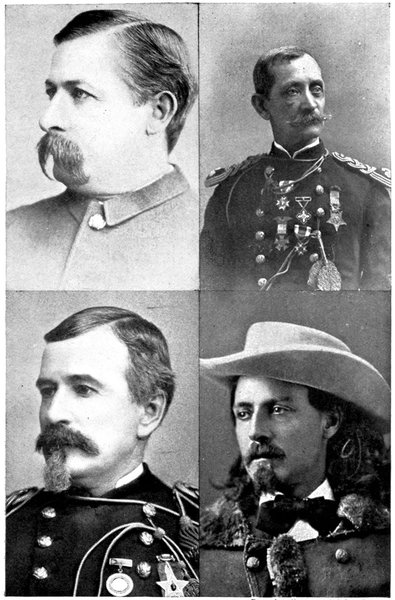
From the collection of J. Robert Coster
COL. RANALD S. MACKENZIE GEN. GUY V. HENRY
CAPT. ANSON MILLS W. F. CODY (BUFFALO BILL)
GROUP OF DISTINGUISHED INDIAN FIGHTERS
All except General Henry from contemporary photographs
One of the bravest of our Indian fighters was Guy V. Henry. Personally, he was a typical representative of the knightly American soldier. Officially, it was his fortune to perform conspicuous services in at least three expeditions subsequent to the Civil War. He was a West Pointer, and the son of another, born in the service 341at Fort Smith in the Indian Territory. Graduating in 1861, a mere boy, he participated in four years of the hardest fighting in the Civil War, from Bull Run to Cold Harbor. At the age of twenty-three, his merit won him the appointment of Colonel of the Fortieth Massachusetts Volunteers, “a regiment that was never whipped.” The tall, brawny Yankees fairly laughed at the beardless stripling who was appointed to command them. “They laugh best who laugh last,” and Henry had the last laugh. He mastered them, and to this day they love his memory.
He was thrice mentioned in despatches, and brevetted five times for conspicuous gallantry in action during the war, out of which he came with the rank of brigadier-general. For heroic and successful fighting at Old Cold Harbor, he received the highest distinction that can come to a soldier, the medal of honor. Having two horses shot from under him in the attack upon the Confederate lines, he seized a third from a trooper, mounted him under a withering fire, and led his soldiers forward in a final assault, which captured the enemy’s intrenchments; this third horse was shot under him just as he leaped the breastworks.
“Thin as a shoestring and as brave as a lion,” he was a past-master of military tactics and a severe disciplinarian. “I tell you he is a martinet,” cried one young officer angrily, smarting under a well-deserved reproof. “You are wrong,” replied a wiser officer, who knew Henry better; “he is trying to make your own record better than you could ever make it yourself.” Sudden as a thunderbolt and swift as a hawk when he struck the red Sioux, in his family and social relations he was a kindly, considerate, Christian gentleman. He could kill Indians—but never cruelly, mercilessly, only in open 342warfare—and teach a class in Sunday-school. I’ve seen him do the latter, and no man did it better; the boys of his class simply idolized him. And his men in the army did the same. Cool and tactful, a statesman, for all his fiery energy, he was perhaps the best of our colonial governors. When he died the people of Porto Rico mourned him as a friend, where the little children had loved him as a father.
II. A March in a Blizzard
At the close of the Civil War he was transferred to the Third Cavalry, a regiment with which he was destined to win lasting renown. It must have been hard for men who had exercised high command, and who had proved their fitness for it, to come down from general officers to subalterns; but Henry accepted the situation cheerfully. He was as proud of his troop of cavalry as he had been of his regiment and brigade of volunteers. His new detail took him to Arizona, where for two years he commanded a battalion engaged in hard scouting among the Apaches. The winter of 1874 found him at Fort Robinson in the Black Hills. While there he was ordered to go into the Bad Lands to remove certain miners who were supposed to be there in defiance of treaty stipulations.
The day after Christmas, with his own troop and fifteen men of the Ninth Infantry under Lieutenant Carpenter, with wagons, rations, and forage for thirty days, the men set forth. The expedition involved a march of three hundred miles, over the worst marching country on the face of the globe, and in weather of unimaginable severity, the cold continually ranging from twenty to forty degrees below zero. The miners were not found, 343and on the return journey the command, which had suffered terrible hardships, was overtaken by a blizzard.
When, in an Eastern city, the thermometer gets down to the zero mark, and it blows hard, with a heavy snow for twenty-four hours, people who are not familiar with the real article call such insignificant weather manifestations a blizzard. Imagine a fierce gale sweeping down from the north, filled with icy needles which draw blood ere they freeze the naked skin, the thermometer forty degrees below zero, a rolling, treeless country without shelter of any sort from the blinding snow and the biting wind, and you have the situation in which that expedition found itself. The storm came up an hour after breaking camp on what was hoped to be the last day on the return journey. To return to the place of the camp was impossible. To keep moving was the only thing to be done. The cold was so intense that it was at first deemed safer to walk than ride. The troops dismounted and struggled on. Many of the men gave out and sank exhausted, but were lifted to their saddles and strapped there, Henry himself doing this with his own hands. Finally, the whole party got so weak that it was impossible for them to proceed. In desperation, they mounted the exhausted horses and urged them forward. Henry had no knowledge of direction, but trusted to the instincts of his horse. He led the way. Many of the men had to be beaten to keep them awake and alive—to sleep was death.
Finally, when hope and everything else was abandoned, they came to a solitary ranch under the curve of a hill, occupied by a white man and his Indian wife. They were saved; that is, they had escaped with their lives. The horses were put in shelter in the corral, the men crowded into the house, and the painful process of 344thawing out was begun. The ranch was fifteen miles from Fort Robinson, and when the blizzard abated the next day wagons and ambulances were sent out, and the helpless soldiers were carried back to the post.
Most of them were in a terrible condition, and few had escaped. They were broken from the hardships they had undergone, especially from the freezing, which those who have suffered from declare causes a prostration from which it is difficult to recover. When Henry entered his quarters his wife did not recognize him. His face was black and swollen. His men cut the bridle reins to free his hands, and then slit his gloves into strips, each strip bringing a piece of flesh as it was pulled off. All his fingers were frozen to the second joint; the flesh sloughed off, exposing the bones. One finger had to be amputated, and to the day of his death his left hand was so stiff that he was unable to close his fingers again. As he was a thin, spare man, with no superfluous flesh, he had suffered more than the rest. Yet he made no complaint, and it was only due to his indomitable persistence that the men were not frozen to death that awful day. Henry’s winter march is still remembered, by those in the old service, as one of the heroic achievements of the period.
III. A Ghastly Experience
The heroism and sufferings of the young soldier were nothing, however, to what he manifested and underwent two years later. Just before the Custer Massacre, General Crook, with some eleven hundred men, moved out from Fort Fetterman, Wyoming, on the expedition that culminated in the battle of the Rosebud. Colonel W. B. Royall had command of the cavalry of Crook’s 345little army. One morning in June the Sioux and the Cheyennes, under Crazy Horse, who as a fighter and general was probably second to few Indians that ever lived, attacked Crook’s men. The left wing, under Royall, was isolated in a ravine and practically surrounded by a foe who outnumbered them five to one. The rest of the army, heavily engaged, could give them no succor. The Indians made charge after charge upon the troops, who had all dismounted except the field officers. Henry had command of the left battalion of Royall’s force. Cool as an iceberg, he rode up and down the thin line, steadying and holding his men. At one time, by a daring charge, he rescued an imperiled company under a brother officer.
At last, in one of the furious attacks of the Sioux, he was shot in the face. A rifle bullet struck him under the left eye, passed through the upper part of his mouth under the nose, and came out below the right eye. The shock was terrific. His face was instantly covered with blood, his mouth filled with it. He remained in the saddle, however, and strove to urge the troops on. In the very act of spurring his horse forward to lead a charge, he lost consciousness, and fell to the ground.
At that instant the war-bonneted Indians, superbly mounted, delivered an overwhelming onslaught on the left flank of the line. The men, deprived of their leader, for a time gave back. The Indians actually galloped over the prostrate figure of the brave soldier. Fortunately, he was not struck by the hoofs of any of the horses. A determined stand by Chief Washakie, of the friendly Shoshones, our Indian allies in that battle, who with two or three of his braves fought desperately over Henry’s body, prevented him from being scalped and killed.
346The officers of the Third speedily rallied their men, drove back the Indians, and reoccupied the ground where Henry lay. He was assisted to his horse and taken to the rear where the surgeons were. Such was the nature of his wound that he could not speak above a whisper; he could not see at all, he could scarcely hear, and he had great difficulty in breathing. As the doctor bent over him he heard the wounded man mumble out, “Fix me up so that I can go back!”
There was no going back for him that day. Through the long day he lay on the ground while the battle raged about him. There was little water and no shelter; there wasn’t a tent in the army. Although it was bitter cold during the nights in that country at that season, at midday it was fearfully hot. He was consumed with thirst. His orderly managed to give him a little shade by holding his horse so that the shadow of the animal’s body fell upon the wounded man. His wound was dressed temporarily as well as possible, and then he was practically left to die.
One of the colonel’s comrades came back to him during a lull in the fight. There he lay helpless on the bare ground, in the shadow of the restive horse, which the orderly had all he could do to manage. No one else could be spared from the battle line to attend to Henry’s wants, although, as a matter of fact, he expressed no wants. The flies had settled thickly upon his bandaged face. The officer bent over him with an expression of commiseration.
“It’s all right, Jack,” gurgled out from the bleeding lips; “it’s what we’re here for.”[111]
347Royall’s forces were finally able to effect a junction with the main body by withdrawing fighting, and Henry was carried along any way in the hurried movement. The Indians at last withdrew from the field (the battle must be considered a drawn one), and then there was time to consider what was to be done with the wounded. The facilities for treatment were the slenderest. The column had been stripped of its baggage, in order to increase its mobility, to enable it to cope with the Indians. All they had they carried on their persons, and that included little but the barest necessities.
Nobody expected Henry to survive the night. He didn’t expect to live himself, as he lay there through the long hours, listening to the men digging graves for those who had fallen, and wondering whether or not he was to be one of the occupants thereof. The next day they sent him to the rear. He was transported in what is called a travois. Two saplings were cut from the river bank; two army mules, one at each end, were placed between the saplings, which were slung over the backs of the animals. An army blanket, or piece of canvas, was then lashed to the poles, and on them the sufferer was placed. There were a number of wounded—none of them, however, so seriously as Henry. It was some two hundred miles to Fort Fetterman, and they carried him all that distance that way.
The weather at night was bitterly cold. In the daytime it was burning hot. The travois was so short—they had to take what poles they could get, of course—that several times the head of the rear mule hit the wounded officer’s head, so that finally they turned him about, putting his head behind the heels of the foremost animal, where he was liable to be kicked to death at any moment.
348On one occasion one of the mules stumbled and fell and pitched Henry out upon his head. The officers of the little escort stood aghast as they saw him fall out; but it is a matter of record, solemnly attested, that such was Henry’s iron self-control that he made no sound, although the agony was excruciating. In fact, on the whole journey he made no complaint of any sort. His only food was broth, which was made from birds shot by the soldiers as they came upon them, and he got this very infrequently.
Finally, the little cortège reached Fort Fetterman. The last mishap awaited them there. The river was crossed by a ferryboat, which was pulled from shore to shore by ropes and tackles. The river was very high and the current running swiftly, and as they prepared to take the wounded officer across, the ropes broke, and the whole thing went to pieces, leaving him within sight, but not within reach, of clean beds, comforts, and medical attention he hoped to secure. Some of the escort, rough soldiers though they were, broke into tears as they saw the predicament of their beloved officer. He himself, however, true to his colors, said nothing. Finally, they offered to take him across the raging torrent in a small skiff—the only boat available—if he were willing to take the risk. Of course, if the skiff were overturned, he would have been drowned. He took the risk, and with two men to paddle and an officer to hold him in his arms, the passage was made.
IV. An Army Wife
Three hundred miles away, at Fort D. A. Russell, his wife was waiting for him. Long before he reached 349Fort Fetterman, she heard through couriers the news of his wound, which was reported to her as fatal, although he had taken care to cause a reassuring message to be sent her with the first messenger. With the heroism of the army wife, although she was in delicate health at the time, she immediately made preparations to join him. The railroad at that time ran as far as Medicine Bow. Beyond that there was a hundred-mile ride to Fort Fetterman. All the troops were in the field; none could be spared from the nominal garrisons for an escort. Again and again Mrs. Henry made preparations to go forward, several times actually starting, and again and again she was forbidden to do so by the officers in command at the various posts. It was not safe to send a woman across the country with a few soldiers; the Indians were up and out in all directions. There was no safety anywhere outside the forts or larger towns; she had to stay at home and wait. Sometimes the devoted wife got word from her husband, sometimes she did not. The savages were constantly cutting the wires. Her suspense was agonizing.
Finally, the arrival of troops at Fort Fetterman enabled a stronger escort to be made up, and Henry was sent down to Fort D. A. Russell. The troops arrived at Medicine Bow on the third of July. The train did not leave until the next day. They were forced to go into camp. The cowboys and citizens celebrated the Fourth in the usual manner. That night the pain-racked man narrowly escaped being killed by the reckless shooting of the celebrators. Two bullets passed through the tent in which he lay, just above his head. The next morning found him on the train. His heart action had been so weakened by chloral and other medicines 350which they had given him, that at Sherman, the highest point on the journey, he came within an inch of dying.
His thoughts all along had been of his wife. When he got to the station he refused to get in an ambulance, in order to spare her the sight of his being brought home in that way. A carriage was procured, and supported in the arms of the physician and his comrades, he was driven back to the fort. With superhuman resolution, in order to convince his wife that he was not seriously hurt, he determined to walk from the carriage to the door. Mrs. Henry had received instructions from the doctor to control herself, and stood waiting quietly in the entrance.
“Well,” whispered the shattered man, as she took him tenderly by the hand, alluding to the fact that it was the Fourth of July, “this is a fine way to celebrate, isn’t it?”
After the quietest of greetings—think of that woman, what her feelings must have been!—he was taken into the house and laid on the sofa. The doctor had said that he might have one look at his wife. The bandages were lifted carefully from his face, so that he might have that single glance; then they were replaced, and the wife, unable to bear it longer, fled from the room. The chaplain’s wife was waiting for her outside the door, and when she got into the shelter of that good woman’s arms she gave way and broke down completely.
“You know,” said the chaplain’s wife, alluding to many conversations which they had had, “that you asked of God only that He should bring him back to you, and God has heard that prayer.”
Everybody expected that Henry would die, but die he did not; perhaps it would be better to say die he would 351not. And he had no physique to back his efforts, only an indomitable will. He never completely recovered from that experience. He lost the sight of one eye permanently, and to the day of his death was liable to a hemorrhage at any moment, in which there was grave danger of his bleeding to death.
He took a year’s leave of absence, and then came back to duty. In 1877, when his troop was ordered to the front in another campaign under Crook against the redoubtable Sioux, he insisted upon accompanying them. He had been out an hour or so when he fell fainting from the saddle. Did they bring him back? Oh, no! He bade them lay him under a tree, leave two or three men with him to look after him, and go ahead. He would rejoin them that night, when it became cooler and he could travel with more ease! What he said he would do he did. A trooper rode back to the post on his own account and told of his condition. An order was sent him by the post commander to return. Henry quietly said he would obey the first order and go on. He remained with the troop for six weeks, until finally he was picked up bodily and carried home, vainly protesting, the doctor refusing to answer either for his eyesight or for his life if he stayed in the field any longer.
V. The Buffalos and Their Famous Ride
Thirteen years after that Henry was commanding the Ninth Cavalry, with headquarters at Fort McKinney. The Ninth Cavalry was a regiment of negroes. From the overcoats which they wore in Wyoming in the winter they were called the “Buffalos,” and sometimes they were facetiously referred to as “Henry’s Brunettes.” 352Whatever they were called, they were a regiment of which to be proud.
In 1890 occurred the last outbreak of the Sioux under the inspiration of the Ghost Dancers, which culminated in the battle of Wounded Knee. Troops from all over the United States were hurried to the Pine Ridge Agency as the trouble began. On the 24th of December Henry and the “Brunettes” were ordered out to the former’s old stamping ground in the Black Hills on a scouting expedition. It was bitter cold that Christmas Eve, but, thank God! there was no blizzard. Fifty miles on the back of a trotting horse was the dose before them. They rested at four A.M. on the morning of Christmas Day. Some of the garments the men wore were frozen stiff. They had broken through the ice of the White River in crossing it. How the men felt inside the frozen clothing may be imagined. Eight miles farther they made their camp. They did not have much of a Christmas celebration, for as soon as possible after establishing their base at Harney Springs they went on the scout. They hunted assiduously for several days, but found no Indians. These had gone south to join their brethren concentrated about the agency. One day they rode forty-two miles in a vain search. They got back to camp about seven o’clock. At nine a courier from the agency fifty miles away informed them of the battle of Wounded Knee, and that five thousand Oglala Sioux were mustering to attack the agency.
“Boots and Saddles!” instantly rang out, and the tired troopers mounted their jaded horses again. This time the camp was broken for keeps, and tents were struck, wagons packed to abandon it. It was a bitter cold night. There was a fierce gale sweeping through the valley, blowing a light snow in the faces of the men 353wrapped to the eyes in their buffalo coats and fur caps. They pushed steadily on in spite of it, for it was Henry’s intention to reach the agency in the dark in order to avoid attack by the Indians.
It was thought advisable, therefore, to leave the wagon train under an escort of one company and press forward with the rest. The men arrived at the agency at daybreak, completing a ride of over ninety miles in less than twenty hours. Fires were kindled, horses picketed, and the exhausted men literally threw themselves on the ground for rest. They had been there but a short time when one of the men from the escort came galloping madly in with the news that the wagon-train was heavily attacked, and that succor must be sent at once. Without waiting for orders, without even stopping to saddle the horses, Henry and his men galloped back over the road two miles away, where the escort was gallantly covering the train. A short, sharp skirmish, in which one man was killed and several wounded, drove back the Indians, and the regiment brought in the train.
It was ten o’clock now, and as the negro troops came into the agency, word was brought that the Drexel Mission, seven miles up the valley, was being attacked, and help must be sent immediately. There were two regiments of cavalry available, the Seventh and the Ninth. For some unexplained reason, the Ninth was ordered out. In behalf of his men, Henry made protest. They must have a little rest, and so the Seventh was despatched, and was soon hotly engaged. Two hours later a messenger reported that the Seventh, in the valley where the mission was situated, was heavily attacked by the Indians, who had secured commanding positions on the surrounding ridges. Unless they could 354be relieved, they would probably be overwhelmed. Again the trumpet call rang out, and the tired black troopers once more climbed into their saddles and struck spurs into their more tired horses, galloping away to the rescue of their hard-pushed white comrades. The ridges were carried in most gallant style, and after some sharp fighting the Indians were driven back. The Seventh was extricated and the day was saved.
In thirty-four hours of elapsed time, the Ninth Cavalry had ridden one hundred and eight miles—the actual time in the saddle being twenty-two hours. They had fought two engagements and had rested only two hours. Marvelous to relate, there wasn’t a sore-backed horse in the whole regiment. One horse died under the pressure, but aside from that and their fatigue, horses and men were in excellent condition.
That was probably the most famous ride ever performed by troops in the United States. For it Henry was recommended for a further brevet, as major-general—the sixth he had received.
The Spanish-American War was too short to afford Henry an opportunity to distinguish himself in the field, but in Porto Rico he showed that his talents were not merely of the military order. In the brief period his health permitted him to remain there, he accomplished wonders, and did it all in such a way as to gain the respect—nay, the affection—of the people over whom, with single-hearted devotion and signal capacity, he ruled. He stayed there until he broke down. I, sick with typhoid fever on a transport at Ponce, saw him just before he collapsed. We were old friends, and he came off to the ship to visit me. I was not too ill then to realize that his own time was coming. He would not ask to be relieved.
355“Here I was sent”, he said; “here I will stay until my duty is done.”
He was the knightliest soldier I ever met, and I have met many. He was one of the humblest Christians I ever knew, and I have known not a few. It was his experience at Porto Rico which finally brought about his death; for it is literally true that he died, as a soldier should, in his harness. In those trying times at Ponce, when life and health were at a low ebb, he wrote, in the sacred confidence of his last letter to his faithful wife, words which it was not his custom to speak, but which those of us who knew him felt expressed his constant thought:
“I am here alone. One by one my staff officers have fallen ill and gone home. Home!—let us not speak of it. Jesus is here with me, and makes even this desolation home until a brighter one is possible.”
So, his memory enshrined in the hearts that loved him, his heroic deeds the inspiration of his fellow-soldiers, passed to his brighter home Guy V. Henry, a Captain of the Strong.
357