Part II The War With the Sioux (continued 2)
Reading edition
If Gall had completed his projected movements, Reno’s men would have been annihilated then and there. As it was, they reached the top of the bluffs without further molestation. They had lost three officers and twenty-nine men and scouts killed; seven men were 243badly wounded, and one officer, Lieutenant DeRudio, and fifteen men were missing.[83] These had been left behind in the confusion of Reno’s “charge.”
It was now somewhere between half after one and two o’clock in the afternoon, and during the fighting Reno was joined by Benteen’s battalion. The Indians kept up a desultory fire on the position, but they seemed to have diminished in numbers. Reno occupied the next hour in reorganizing his force, getting the men into their accustomed troops, and taking account of casualties.
II. With Benteen’s Battalion
In accordance with his orders, Benteen had moved off to the westward. He speedily became involved in almost impassable country, full of deep ravines, in which progress was slow and difficult. Water was very scarce in the country over which the regiment had marched until it reached the valley of the Big Horn. What water they had found that morning was so alkaline that the horses and mules, although they had been nearly a day without water, would not drink it. The horses were naturally tired, having marched over fifty miles since the morning of the day before, and the terrible up-and-down hill work exhausted them still more, although they were by no means played out. No Indians were seen by Benteen, and the condition of the country was such that it was evident there were none before him.
He turned to the right, therefore, and struck into the valley of the Big Horn, just ahead of McDougall and the pack train, intending to cross the river and attack the village or join Reno, as the case might be. He had 244just watered his horses at a little brook following out a morass, when a sergeant from Custer’s battalion passed by on a gallop, with a message for the supply train to come at once. As the trooper raced along the line he shouted exultantly, “We’ve got ’em, boys!” Benteen’s men took this to mean that Custer had captured the village. A few moments after, Trumpeter Martini galloped up with a message from Custer to Benteen, signed by Cook, the adjutant, which read as follows:
“Benteen. Come on. Big village. Be quick. Bring packs.
“P. S. Bring packs.”
The need for the spare ammunition with the pack-train was apparently so urgent that in his hurry Cook repeated the last two words. At the same time the sound of distant firing was heard in the valley. Making ready for instant action, Benteen led his troopers forward at a gallop down the valley. Tired though the animals were, they responded nobly to the demands of their riders, and the whole party swept across the hills in the direction whence the trumpeter had come until they overlooked the valley. Every one supposed that Custer had entered the valley and was driving the Indians before him. That he expected to have a big fight on his hands was indicated by the reiteration of his request that the pack-train should be rushed forward, evidently to bring the reserve ammunition.
The valley was filled with dust and smoke; the day was frightfully hot and dry. Bodies of men could be distinguished galloping up and down. Benteen would, perhaps, have crossed the river and charged down the valley had his attention not been called to a body of men in blue on the bluff on the same side of the river to the right. They were, assuredly, hotly engaged, but there 245were also evidences of fierce fighting far down the valley. What was happening? What should he do? At this junction one of the Crow scouts—these Indians had not fled with the cowardly Rees, but remained with the command, fighting bravely—came up driving a small bunch of captured ponies, and he indicated that the principal battle was on the bluff. Benteen accordingly galloped around the bend of the river, and joined the demoralized Reno without opposition.
It is interesting to speculate what might have happened if Benteen had crossed the river and had charged down the valley. In that case, if Reno had recrossed the river and again attacked, the day might still have been won, but in all probability Reno would not have recrossed and Benteen would have been annihilated. At any rate, Benteen did the only thing possible when Reno’s whereabouts and need were made known to him by the scout.
Reno had lost his hat in his famous “charge,” and had his head tied up in a handkerchief. He was much excited, and apparently had no idea as to what he should do next. The officers of his battalion made no bones about admitting to the newcomers that they had been badly beaten and were in a critical condition. None of them could tell anything about Custer.
III. The Battle on the Bluffs
Benteen’s men were ordered to divide their ammunition with Reno’s. A line of skirmishers was thrown out around the bluffs, and an effort to get water from the river was made, the supply in the canteens having been long ago exhausted. The Indian fire prevented this. There was, of course, not a drop of water on the bluffs, 246and the wounded suffered greatly, to say nothing of the thirsty men. The officers collected in groups on the edge of the bluffs overlooking the field, and discussed the question. They were not molested by the Indians at this time.
The general impression was that Custer had made the mistake of his life in not taking the whole regiment in together. Possibly Reno’s men took that view because they had been so badly mauled themselves. The valley had been filled with Indians, but, about three o’clock or a little after, most of them galloped down the river and were soon out of sight. The river banks were still lined with Indians under cover, who kept up a smart fire on Reno’s men if they attempted to descend the bluffs and approach the water; but the main force had evidently withdrawn.
Firing was heard far away to the northward. It was heavy and continuous. There could be but one explanation of it. Custer’s detachment had at last met the Indians and was engaged. This should surely have been a stimulus to Reno. Custer was fighting; Reno was not menaced—what should he do? Later in the afternoon two heavy volleys in rapid succession were remarked. This was so unusual under the circumstances that it was finally felt to be a signal from Custer. He must surely be in grave peril, then, and calling for help. How, in the name of all that was soldierly, could such an appeal be neglected? Many and anxious were the questions the officers and men put among themselves as to why Reno did not do something. It was felt by everybody that Custer was in grave jeopardy, and that Reno should move at once. He had about three hundred men under his command, one-half of whom had not been engaged.
247
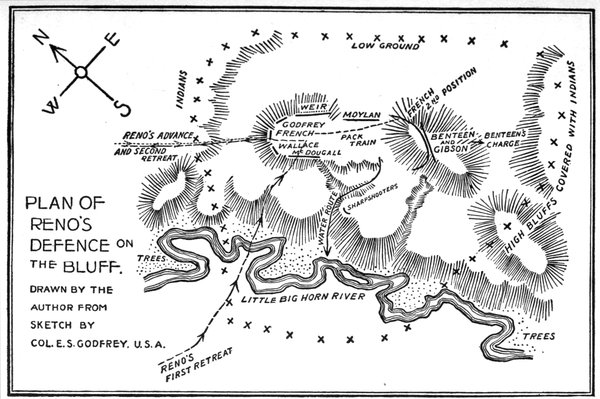
248Captain Weir, of D Troop, on the right of Reno’s command, having cleared away the Indians in front of him, at last boldly took matters in his own hands. After pleading again and again for permission,[84] he started alone without it toward the sound of the firing to see what he could. Lieutenant Edgerly, his second, supposed that he had received orders to advance, and he accordingly put the troop in motion. Weir was on the bluff, Edgerly lower down in a small ravine. The Indians moved to attack Edgerly, when Weir signaled him to lead his men up the bluff, which he did without loss. The troop, unsupported and in defiance of Reno’s orders, advanced to the point where Custer had been last seen to wave his hat, and there stopped. The men could overlook the ridges and valleys beyond them for a great distance.
A mile and a half or two miles away they could see, through the defiles in the ridges, great clouds of mounted Indians. Reports of rifles indicated that the battle, whatever it was, was still being waged. It was impossible for Weir and Edgerly to do anything with their single troop. Although they were not seriously attacked in their bold advance, Reno at first made no movement to support them.
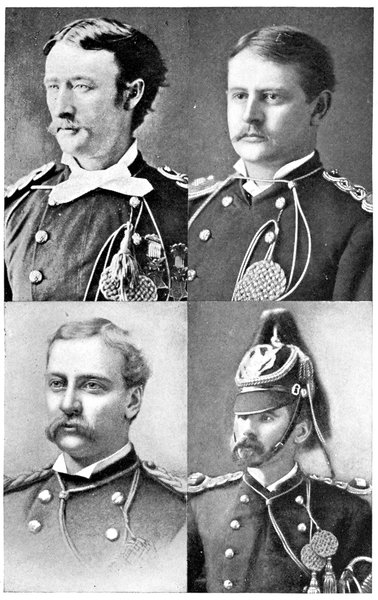
CAPT. THOS. W. CUSTER LIEUT. JAMES CALHOUN
CAPT. GEORGE W. YATES CAPT. MILES W. KEOGH
SOME OF CUSTER’S TROOP COMMANDERS
All killed with him at the Little Big Horn
At half after four Captain McDougall and the pack train joined Reno. They had not been molested in any way. At last, about five o’clock, Reno yielded to the urgent and repeated representations of the angry officers, and marched along the ridge to the position Weir and 249Edgerly had reached. He came up to this point at half after five. The firing on the bluffs far ahead was practically over. The Indians could still be seen and some shooting was going on, but there did not appear to be a battle raging. They learned afterward that it was the Indians shooting into the bodies of the dead.
It was evident to every one that whatever might have been done earlier in the afternoon, there was no use in advancing now. Indeed, the Indians came sweeping back in great force in front of Reno, and at once attacked him. There was nothing for him to do but retreat to the most defensible position he could find, and endeavor to hold his ground. Custer and his men, if they still survived, must be left to face as best they could whatever fate had in store for them. Reno accordingly retreated to the place on the bluff whence he had just come. Lieutenant Godfrey, of K Troop, the rear guard, without orders deployed and dismounted his men, and, ably seconded by his junior, Lieutenant Luther R. Hare, by hard fighting kept off the Indians till the retreat was safely made by the rest, whom he and his troopers succeeded in joining. It was well that he did this, for his coolness and courage saved the command.
There was a little depression back of a ridge, which afforded some cover for the horses and pack train. During the retreat an incident occurred worthy of mention. One of the pack mules, loaded with precious ammunition, broke away and galloped toward the Indian line. Sergeant Hanley, of C Troop, sprang to his horse and raced after it. Officers and men called to him to come back, but knowing how priceless was the ammunition, he persisted in his course. He succeeded in heading off the animal, which turned and ran parallel to the Indian line, along which he galloped under a perfect 250shower of bullets, none of which, fortunately, touched him. He captured the mule, and brought it back with the ammunition intact. For this exploit he received a medal of honor.
The men took position around the ridge, across the depression and on a hill to the right, so as to protect the packs and the field hospital from all sides except on the river side, where the height of the bluffs and the distance prevented any Indian attack from that direction. Benteen’s Troop H was placed on the right. They were on top of the break of the ridge and were without cover, the ridges being entirely bare of trees. Farther off, to the right, Benteen’s position was commanded by higher ridges. At first the brunt of the fighting fell on the left, but the Indians soon surrounded the position and the engagement became general. The men threw themselves on the ground, and dug rifle-pits with their knives, tin pans—anything they could get. The fighting soon became severe, but gradually slackened as darkness approached, and stopped at about nine o’clock at night. The village in the valley was the scene of triumphant revel that night, and the shouting of the Indians could plainly be heard on the bluffs.
The early part of the night was full of wild confusion, but before long the soldiers recovered their equanimity and set to work strengthening their position. They were now completely surrounded; but most of them were under cover except Benteen’s men, whose position, as has been stated, was overlooked by higher ridges within easy range. At two A.M., contrary to their usual habit, the Indians opened fire, but no attack was made. The next morning the battle began again in grim earnest.
The Indians pressed the party closer and closer. Benteen’s 251exposed line suffered more than any other position. That experienced fighter saw that the Indians were massing in front of him, evidently intending to deliver a charge. If it fell upon his single troop it would not be possible to withstand it, and the whole force on the hill would be taken in reverse and annihilated. His men had nearly exhausted their ammunition, several had been killed, and there were a number of wounded to be attended to.
Ordering Lieutenant Gibson to hold the line at all hazards, Benteen ran to Reno, explained the situation, and begged for a reinforcement. After much urging he succeeded in getting Troop M, Captain French, sent over to the hill. Then he entreated Reno to allow the two troops to charge. Reno hesitated. Benteen urged him again and again, pointing out that if something were not done immediately, the position would be rushed and the command wiped out. At last he wrung a reluctant permission from Reno. He ran back to his position on the hill, and not a moment too soon formed his men up for the charge, putting himself at their head.
“All ready now, men!” he cried gallantly. “Now’s your time! Give ’em hell! Hip! Hip! Here we go!”
The Indians had also given the word to charge, but Benteen was too quick for them. Leading his men with splendid bravery, revolver in hand, he rushed at the Indians. There was a brief hand-to-hand mêlée and the Indians broke and fled. Reno, seeing the effect of Benteen’s gallant dash, actually led out a portion of his command on the other side of the hill and drove back the Indians in that direction. Benteen’s magnificent courage had saved the day for the present.
The fire having slackened somewhat about eleven o’clock in the morning, volunteers were called to get 252water for the command, especially for the wounded. The Indians swept the banks of the river with their fire, and the attempt was hazardous to a degree. Nineteen men offered their services. Four of the best marksmen—Geiger, Windolph, Voit, and Mechling, of Troop H—were detailed to cover the others by taking an exposed position on the brink of the bluffs overlooking the river, as near as they could get to it. The other fifteen, one of whom has told me about the attempt, carrying canteens and camp-kettles, but without arms, crawled down through the bushes and ravines to the open space on the bank of the river, and then, covered by the rapid fire of the four men stationed above them, dashed for the stream. The Indians, who were execrable shots, opened a heavy fire upon them, but the men succeeded in filling the vessels they had brought, and though many of these vessels were hit and some of the men wounded, none of them was killed. A scanty supply of water it was, but it was a godsend. These nineteen also received medals of honor.
At three o’clock in the afternoon the firing, which had been maintained intermittently since noon, finally stopped, and later the men on the hill saw the Indians withdrawing from the valley. They set fire to the grass to screen their movements, but about seven o’clock in the evening they were distinctly seen moving out with all their possessions toward the mountains of the Big Horn. Eighteen troopers had been killed on the hill, and fifty-two wounded.
IV. The Last of Custer
Now let us turn to Custer.
Nobody knows exactly what he did. The testimony 253of the field is not clear, and the statements of the Indians are contradictory. Dr. Eastman, an educated Sioux, has investigated the subject among many of his people, and arrives at one conclusion; Colonel Godfrey, one of the troop commanders who was with Benteen, and who has subsequently examined the field in company with Benteen and other officers, taking the testimony of Chief Gall, holds another. According to Eastman, whose account agrees with the popular understanding, Custer attempted to ford the river at a place now called Reno’s Creek,[85] and fall on what he supposed to be the rear of the village, but which was really the middle of the upper half, and was driven back to the hills, where the final tragedy took place.
Godfrey, on the contrary, says that Custer, from the point where he was last seen by Reno’s men, had a view of the village for several miles, although not for its whole length; that he must have been confident that he had it below him then, and that he made a wide detour in order to fall on the rear of the village. It was from this point that he sent the hurry-up message to Benteen. When at last, having gone far enough, as he thought, to take the village in the rear, or what he supposed was the rear, he turned toward the river, and was at once met by the Indians in great force.
It was probably about half after two in the afternoon. Reno had been forced back and driven across the river. Chief Gall, it will be recalled, had taken a large body of men across the river to intercept Reno on the other side. Before he could move down to the right for this purpose, Custer’s men suddenly appeared on the hills. 254Custer’s manœuvering had been fine, and his appearance was a complete surprise, which at first greatly alarmed the Indians. Gall, however, did not lose his head. Rightly judging that Reno was temporarily eliminated from the game, he at once determined to attack Custer. He sent word of the situation to Crazy Horse, who was pressing Reno. Leaving just enough warriors to make a demonstration before the demoralized Reno, Crazy Horse galloped headlong down the valley, followed by his men and joined by others from the far end of the village, who had as yet taken no part in the fighting. They too crossed the river at the point where a deep ravine concealed their movements and enabled them to obtain a position on Custer’s right flank. A similar ravine enabled Gall to menace the left flank. The Indians were in sufficient force completely to surround Custer. In the twinkling of an eye he found himself attacked in front and on both sides. Instead of advancing, he was forced to defend himself against an overwhelming attack. The troops were dismounted, horses moved to the rear, and Custer’s men occupied the ridges.
Calhoun’s troop was posted on the left, followed by those of Keogh, Smith, and Yates, with Tom Custer’s on the extreme right. The last three troops happened to have the best defensive position upon the highest hill. With them was Custer. The Indians attacked at once. Riding at full gallop along the front of the line on their ponies, they poured a heavy fire from their long-range rifles upon the soldiers, to which the latter made a brave, steady, but not very effective reply with their inferior carbines. Keogh’s and Calhoun’s horses were stampeded at the first fire.
The force menacing them was so great that Custer 255dared not leave his position on the hills. To retreat was hopeless, to advance impossible. They must stand on the defensive and pray that the advance of Reno’s command up the valley, which they probably hoped that Benteen would reinforce, would compel the withdrawal of the Indians from their front. They fought on, therefore, coolly and resolutely, husbanding their ammunition and endeavoring to make every shot tell on their galloping, yelling foemen. They were, I imagine, by no means without ultimate hope of victory. The Indians in their accounts speak of the cool, deliberate courage of numbers of the officers and men, whom they singled out for their bravery.
Yet the troopers suffered great loss as the afternoon wore on. Their ammunition began to run low, and the contracting, whirling circle of Indians drove them closer and closer together. The remaining horses of the other three troops were at last stampeded, and with them went all of the reserve ammunition. The situation had evidently become so serious that Custer, in the vain hope that Reno would understand his peril at last, fired the two volleys which have been referred to. It appears at this time that he must have endeavored to send a message to Reno, for the body of a solitary soldier, Sergeant Butler, was found after the battle at a point half way between Custer’s and Reno’s commands. A little heap of cartridges lay near his body, evidencing that he had sold his life dearly. The Indians were acute enough—so they say, and probably with truth—to pick out the officers with Custer, and the mortality among them was fearful. It was evident to all on the hill, as the afternoon drew toward its close, that they were doomed. It was hardly possible that a counterattack by Reno would save them now, and there were 256no evidences whatever that he was anywhere in the vicinity.
“Where, in God’s name,” they must have asked themselves in their despair, “can Reno be?”
One of the Crow scouts has said—although his account is generally disbelieved—that he went at last to Custer, as yet unharmed, and told him that he thought he could get him away, and that Custer, of course, refused to leave the field. The Crow altered his appearance by draping a blanket about him so as to look as much like a Sioux as possible, and in the confusion of the fight got away safely.[86] He was the only human survivor of the field.[87] What occurred after is a matter of conjecture, based upon the contradictory and inadequate testimony of the Indians themselves.
Gall and Crazy Horse now determined to end the affair. Massing their warriors in the ravine, they fell on both flanks at the same time that Crow King and Rain-in-the-Face led a direct charge against the front of the thinned and weakened line. They swept over the little band of men, probably now out of ammunition, in a red wave of destruction. There was a fierce hand-to-hand struggle with clubbed guns, war-clubs, and tomahawks, and all was over. Some twenty or thirty men, without their officers, who had probably all been killed where they stood, for their bodies were found grouped around that of Custer on the highest hill, endeavored to break through on the right. They were slaughtered to a man before they reached the river. A few scattered bodies, here and there in different parts of the field, indicated 257that separate men had made futile dashes for freedom. But the bulk of the command was found just where it had fought, with the troopers in line, their officers in position! They had been beaten and killed. Not an officer or man lived to tell the story, but they had not been disgraced.
There, the second day afterward, Terry, with Gibbon, having relieved Reno’s men, found them on the hills which they had immortalized by their desperate valor. They had been stripped and most of them mutilated. Custer’s body was shot in two places, in the side and in the temple. It was not scalped or mutilated. Colonel Dodge, an authority on Indian customs, declares that if Custer’s body was neither scalped nor mutilated, he is convinced that the general committed suicide. None of the officers with whom I have communicated who inspected the body is willing to indorse this statement; on the contrary. Therefore, I am sure Colonel Dodge must be in error. The Indians give no particular information as to Custer’s death. All that is known is that his body was there with those of his brave men.
With Custer in that fight perished many gallant souls. His brother, Captain Tom Custer, was the only man in the United States Army who held two medals for capturing two flags with his own hands in the Civil War. Rain-in-the-Face had accomplished his terrible revenge, for after the battle he had cut open the breast of the brave young soldier and had eaten his heart. Calhoun, of L Troop, was Custer’s brother-in-law. With him was young Crittenden, a lieutenant of infantry, who had sought an assignment with Custer for this campaign. Smith was the captain of E, the Gray Horse Troop. At the storming of Fort Fisher, after two color-bearers had been killed, he had led his regiment to the attack, colors in hand. His shoulder had been smashed by a musket 258ball in that attack. He could never afterward put on his coat without assistance. With him was young Sturgis. Yates, a veteran of the Civil War, was captain of F, the Bandbox Troop; and with him was Riley, the youngest lieutenant there. Keogh, of I Troop, the oldest soldier of them all, and not the least brave, had been an officer of the Papal Zouaves in early life. He had a gallant record in the Civil War, too. With him was Porter, and with the others who had done their parts were Cook, the adjutant, and Lord, the doctor.
Others worthy of note fell on that fatal field: Mark Kellogg, a newspaper correspondent; Charlie Reynolds, the famous scout; Boston Custer, the General’s brother, who was civilian forage-master of the regiment, and Autie Reed, the General’s nephew—a mere boy, who wanted to see something of life in the West and who had welcomed with joy his opportunity to make the campaign. Well, he saw it, poor fellow! Indeed, the Custer family was almost wiped out on that fatal Sunday.
Premonitions of disaster, such as loving women may feel, were in the air that afternoon. Back at Fort Abraham Lincoln, the devoted wife tells how the women of the garrison assembled in her quarters in an agony of apprehension. There were words of prayer. Some one at the piano started “Nearer My God to Thee,” and the women tried to sing it, but they could not finish it. It was not until the 5th of July that they received the news that at that very hour their loved ones were dying on the hill.
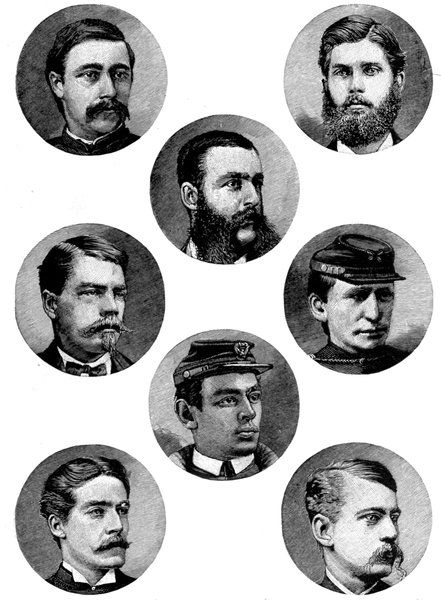
Courtesy of The Century Co.
OFFICERS OF THE SEVENTH CAVALRY
All killed at the Little Big Horn
V. After the Battle
On the morning of the 27th of June Terry and Gibbon rescued Reno. The next day the surviving troops of the regiment, with some individuals from the other 259command, marched to the scene of Custer’s defeat to identify and bury the dead. The bodies upon the dry grass had all been stripped and left, white and ghastly save for the red stains of wounds. The bodies of Doctor Lord, Lieutenants Porter, Harrington, and Sturgis, with those of a number of men, were not recovered. What became of them is not known to this day. They may have been captured alive and taken by the Indians to the village, and there tortured to death and their bodies disposed of. This, however, is unlikely. The Indians positively deny that they took any prisoners, and it is probable that they did not. There are quicksands near the bed of the Little Big Horn, and possibly those bodies were engulfed in them. But all this is only surmise. No one can tell anything about it, except that they were undeniably killed. And we may be certain they died as brave men should.
They buried two hundred and twelve bodies on the hill, and the total losses of the regiment in the two days of fighting were two hundred and sixty-five killed and fifty-two wounded—over fifty per cent. The losses of the Indians were never ascertained. They did not, however, begin to equal those of the soldiers. It is grossly unfair to speak of the battle as the “Custer Massacre,” as is often done. Custer attacked the Indians, and they fought him until all the white men were killed. There was no massacre about it.
The cause of the disaster must, first of all, be laid to Custer’s disobedience of orders. In spite of that, however, I think it is probable that he might have won the battle, or at least made good his defense until relieved by Terry and Gibbon, although sustaining heavy loss, had it not been for three happenings. The first was the vastly greater number of Indians in the field than any 260one expected to encounter. The next, and to me this is absolutely decisive, was Reno’s failure to press his attack. If he had gone in with the dashing gallantry which was expected of him, while it is certain that he could not alone have whipped the Indians, yet he could have so disorganized them as to have maintained his position in the valley in the midst of the village without the greatest difficulty, until Custer could fall upon the rear of those attacking him, and Benteen, with the pack train, could reinforce them both. The Indians say that they were demoralized for the time being by Reno’s sudden appearance, and that the squaws were packing up getting ready for flight when the weakness of Reno’s advance encouraged them to try to overwhelm him. Custer had a right to expect that Reno would do his duty as a soldier and take a bold course—which was, as usual, the only safe course.
Colonel Godfrey, in his account, suggests still a third cause. The carbines of the troopers did not work well. When they became clogged and dirty from rapid firing, the ejectors would not throw out the shells, and the men frequently had to stop and pick out the shells with a knife. The chambers of the carbines at that time were cylindrical, and the easily accumulated dirt on the cartridges clogged them so that the ejectors would not work properly. The chambers were afterward made conical, with good results. The Indians had no such trouble. Their weapons were newer and better than those of the soldiers. If the indifferent weapons of the troopers failed them, their annihilation in any event would have been certain.[91]
261I have censured Custer somewhat severely in this article, and it is a pleasure to me to close it with a quotation from Captain Whittaker’s life of his old commander. In this quotation Lawrence Barrett, the eminent actor, who was an old and intimate friend of Custer, has summarized the character of the brave captain in exquisitely apposite language; and, in his words, I say good-by to the gallant soldier whose errors were atoned for by an heroic death in the high places of the field:
“His career may be thus briefly given: He was born in obscurity; he rose to eminence; denied social advantages in his youth, his untiring industry supplied them; the obstacles to his advancement became the steppingstones to his fortunes; free to choose for good or evil, he chose rightly; truth was his striking characteristic ... his acts found his severest critic in his own breast; he was a good son, a good brother, a good and affectionate husband, a Christian soldier, a steadfast friend. Entering the army a cadet in early youth, he became a general while still on the threshold of manhood; with ability undenied, with valor proved on many a hard-fought field, he acquired the affection of the nation; and he died in action at the age of thirty-seven, died as he would have wished to die, no lingering disease preying upon that iron frame. At the head of his command, the messenger of death awaited him; from the field of battle where he had so often ‘directed the storm,’ his gallant spirit took its flight. Cut off from aid, abandoned in the midst of incredible odds ... the noble Custer fell, bequeathing to the nation his sword; to his comrades an example; to his friends a memory, and to his beloved a Hero’s name.”
Note.—The question concerning Custer’s conduct is 262so important a one that I have included in Appendix A the opinions, pro and con, of several officers with whom I have corresponded; and in which I have indicated some other sources of information by which the reader may settle the debatable question for himself.
263
CHAPTER SIX One of the Last Men to See Custer Alive
Mr. Theodore W. Goldin, of Janesville, Wisconsin, formerly a trooper of the Seventh Cavalry, now Chairman of the Republican State Central Committee of Wisconsin, was the last, or perhaps the next to the last, man to see Custer alive. He has prepared an account of his personal experiences in the battle, which is one of the most interesting of the contributions that have been made to this volume. His description of the death of Hodgson is splendidly dramatic, as is his story of the brief conversations between Custer and Keogh, Reno and Weir, and Benteen and Wallace.
What a magnificent picture is that presented by Hodgson, determined to retreat no longer, facing about, drawing his revolver, and dying at last, face to the foe, weapon in hand! Mr. Goldin contradicts the popular impression, as repeated by Colonel Godfrey and others, that Reno threw away his pistols in his “charge.”
Milwaukee, Wis., August 11, 1904.
My Dear Sir:—
I am in receipt of your letters of July 28th and August 2d, asking me for a few reminiscences of personal experiences 264and touching on my acquaintance and knowledge of Gen. Custer and his last fight.
The years that have elapsed since that stirring event may have somewhat dimmed my recollections, and the time at my disposal at this time is so very limited, that what I may say must, of necessity, be somewhat fragmentary. Your articles on this subject, as well as the entire series, have been read with great interest, and I am very much pleased to know they are to be published in book form.
In reply to your request, I will say that I had known Gen. Custer from the time I joined the regiment in 1873 up to the time of his tragic death, and had campaigned with him and with the regiment with the exception of the year 1875, when the troop to which I was attached was stationed in the South.
Early in the spring of ’76, we received word that an expedition was being organized against the Sioux, and that three large columns were to take the field, and a few weeks later our marching orders came, and our battalion changed station from near Shreveport, La., to Fort Lincoln, D. T.
At the time of our arrival Gen. Custer was in Washington before some investigating committee, and only joined the regiment a few days before our column took the field, he having been ordered under arrest at Chicago while en-route from Washington.
I will not take the time or space to touch on our march from Fort Lincoln to the Yellowstone, which we struck near the mouth of the Powder River. Here we remained a few days while outfitting our pack train, as it had been determined that we would abandon our wagons here and establish a supply camp. Maj. Reno had left us a few days before on a scout, expecting 265to rejoin us near the mouth of the Tongue River on June 17th.
After arranging to leave our wagon train and some dismounted recruits and the regimental band at the Powder River, we moved camp to the mouth of the Tongue, where we lay on the 17th of June, the day on which Gen. Crook had his big fight with the Indians on the Rosebud. During the day we watched every distant dust cloud that whirled across the river bottom, hoping that it meant the approach of Maj. Reno’s command, but as nothing was heard from him, we broke camp on the morning of the 18th and moved up the valley, where we effected a junction with Reno soon after noon. During the previous days we could not help but note the fact that Gen. Custer seemed moody and discontented, and, entirely different from his usual habit, appeared nervous and excited to some extent.
When Reno came in with his report he became a changed man. His old-time energy and snap were made apparent by the manner in which he hustled the command into marching order and took the trail for the Rosebud, where Gen. Terry on our supply steamer the “Far West” had already preceded us in the hope of striking the command of Gen. Gibbon, who was known to be somewhere in that vicinity. Our march was prolonged far into the night, but we finally struck the Yellowstone and went into camp, assured that if the steamer was below us we were bound to intercept it.
The following morning we were in the saddle early, and soon after noon we sighted the wagon train of Gen. Gibbon’s command moving slowly up the river and a few moments later the “Far West” steamed into sight. Couriers were sent out to advise them of the fact that Reno had discovered the trail of a considerable 266body of Indians, and in a short time we were in camp near the mouth of the Rosebud and a council of war was held at which we understood that Reno’s report was discussed in detail.
The following day arrangements were made for a vigorous campaign. A final council was held on the steamer on the night of the 21st, as I now recollect it, at which time Gen. Custer received his final orders, substantially as you have stated them. At this council, and just about the time it was breaking up, the question was asked Gen. Gibbon as to what time he could reach the mouth of the Little Big Horn River, and he replied,
“Not before noon of the 26th.”
At this conference it was reported that Custer had been offered the battalion of the Second Cavalry and the artillery which had been brought up on the steamer, but declined both, claiming that he knew his command so well that he preferred to trust himself with them alone, and that he feared the artillery might delay his march when nearly in presence of the enemy. Many of the officers and men felt that it was but a part of a preconceived scheme to secure an independent command, such as he had been used to having for years, but be that as it may his request was granted.
On the afternoon of June 22d we passed in review before Gen. Terry and Gen. Gibbon, and soon struck the trail described by Maj. Reno. From that time until Reno struck the Indian village we did not deviate from it except when it became necessary to find a satisfactory camping ground. No attempt was made to scout the country as we had been directed to do, nor was any attempt made to send a courier across to Gen. Gibbon, although a man named Herndon, 267a scout, had been attached to our command for that purpose.
Our marches were long and our movements very rapid until the night of the 24th, when we moved off the trail some distance and apparently settled down for the night. But this was only a ruse to mislead the Indians, as we had received orders not to unpack our saddles and to be prepared for a night march.
From the hour we left the Rosebud Gen. Custer acted in many respects like another man, his old-time restless energy had returned, and he seemed to think of nothing but to reach and strike the Indians. In this connection it might be well to say that the trail we were following led from the direction of the Missouri River and indicated, according to the estimate of Bloody Knife and some of our Crow scouts, a band of from a thousand to twelve hundred Indians, whom we afterward learned came from the Missouri River agencies and consisted almost entirely of warriors.
About eleven o’clock we received word to saddle up and lead into line. In the meantime a scouting party of Crows and Rees, with some of our officers, Lieut. Varnum and, I think, Lieut. Hare, had pushed on ahead of us to scout the trail across the divide and seek to locate the Indians if possible. Leaving our bivouac, we again struck the trail and pushed forward, seeking to cross the divide and get into the shelter of the foot-hills along the Little Big Horn before daybreak the following morning. Owing to the roughness of the country and the difficulty in scouting the trail, we were unable to do this, and daybreak found us in a ravine at the foot of a range of high bluffs, just how far from the river we did not know.
Some time during the night it was said Gen. Custer 268had pushed ahead and joined the scouts, and that just after daybreak they told him they had located the village in the valley of the Little Big Horn, but Gen. Custer replied that he did not believe them. In the meantime it became apparent that our presence in the country was known, as, during the night a box of ammunition[92] had been lost and a detachment sent back to recover it came across some Indians trying to open the box. On this being reported to Gen. Custer, he seemed to decide on an immediate advance.
In the talk, just about the time the division was made in the command, Mitch Bowyer, a half-breed Crow interpreter, said to Gen. Custer that he would find more Indians in that valley than he could handle with his command. Custer replied that if he (Bowyer) was afraid to go he could stay behind. Bowyer replied that he was not afraid to go wherever Custer did, or something to that effect, but that if they went in there neither of them would come out alive.
Just before the advance was made I was detailed by Lieut. McIntosh to report to Gen. Custer for duty as orderly, and at once did so. The general directed me to ride with Lieut. Cook, our regimental adjutant, and perform any duties he might assign to me.
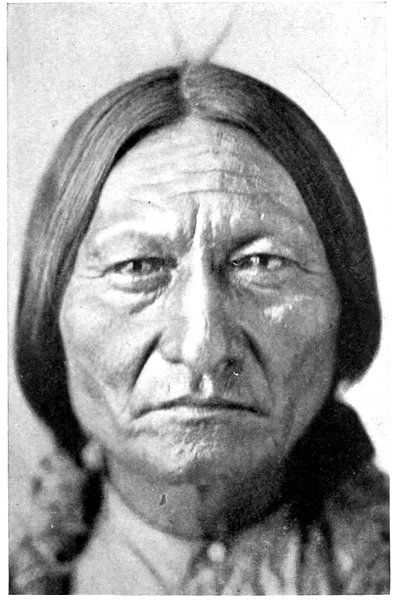
Copyright by D. F. Barry SITTING BULL Chief Medicine Man of the Sioux Nation
During our brief halt the men had thrown themselves on the ground and were most of them asleep, while the horses were grazing among the sage brush. Gen. Custer ordered the advance, saying that the company in each battalion first ready should have the right of the line, and in a few minutes we were all in the saddle. During the halt it had been ordered that Benteen with 269his battalion should move off to the left, scouting the country in that direction, driving before him any Indians he might discover, and sending word to the command of anything he might find. Reno was to follow the trail, while Gen. Custer with the five troops under him struck off to the right, leaving McDougall with the pack train to follow as best he could.
We immediately took up the line of march in accordance with these orders, and after probably a half hour’s hard ride the impassibility of some of the hills and ravines forced the column under Gen. Custer to veer off to the left and we soon came up with the command of Maj. Reno, which was pushing ahead on the trail as fast as the roughness of the ascent would permit. After a hard climb we reached the top of the ridge, where we saw before us a rolling plateau sloping off toward the foot-hills of the river, which was perhaps some five or six miles away.
As our command dashed over the divide we could see Reno some distance in front of us, moving rapidly down the trail, while several miles to our left was the command of Col. Benteen, scouting the bluffs as he had been ordered. For some distance we followed the general course of Reno’s advance, but were some distance in his rear and to his right.
To those of us who were near him it seemed that Custer was chafing at the apparent slowness of our advance, as he would at times dash ahead of the column and then rein in and await our approach and again off he would go. Just about this time we discovered a huge dust cloud moving down the river valley, but could not determine the nature of it. As soon as this was discovered Custer rode over toward the river accompanied only by his orderly trumpeter, and stopped for a moment 270on the top of a high pinnacle, where we saw him wave his hat, apparently in salutation to some one in the distance, and then come dashing back toward the head of the column which was headed by Capt. Keogh and “I” Troop, veterans of a dozen fights. With his eyes snapping in his excitement, Custer rode up to Keogh and said, somewhat excitedly:
“Keogh, those Indians are running. If we can keep them at it we can afford to sacrifice half the horses in the command.”
Calmly as though on dress parade, Keogh turned in his saddle and looked back at the long line of eager, bronzed, bearded faces, and turned to Custer with the remark:
“General, we will do all that man and horse can do.”
A moment later the bugles blared out the charge, the first bugle note we had heard since leaving the Rosebud, and away we thundered northward down the river, two or three times seeking to find a place where we could work down into the valley below us, but without success.
After perhaps the third unsuccessful trial, Gen. Custer talked hurriedly with Capt. Cook for a moment, and Cook pulled out his pad and dashed off a line or two, which he folded up, at the same time calling for an orderly. I happened to be the first one to reach him, and he handed me the paper with the order.
“Deliver that to Maj. Reno, remain with him until we effect a junction, then report to me at once,” and he was gone.
An instant later the rear of the column dashed past me and was lost to sight in the ravines. For an instant I looked after them, and then realizing that I was in a dangerous country and alone, I lost no time in heading 271in the direction of Reno’s command, which I was able to locate by the dust cloud that hovered over them. Fortunately, I was not molested to any great extent. A few long-range shots were fired at me, which only served to accelerate my speed and materially added to my desire to be among friends.
A ride of some five or six miles and I overtook Reno just as he was dismounting to fight on foot. I delivered my dispatch, the contents of which I did not know. Reno glanced at it somewhat hurriedly and stuck it in his pocket. About this time the Ree scouts stampeded and, as we afterward learned, did not recover their sand until they reached the Powder River and the shelter of the wagon train. It soon became apparent that the Indians were passing our flank and coming in behind us, and we were forced to face about and endeavor to repel their advances until we could get our horses into the timber, in which attempt several horses were shot and two or three stampeded. Soon after this we retired into the timber, where we had better protection and resumed the fight. Sheltered by the timber and the river bank, we were able to make a much better defense for a short time.
Soon after this we noticed that Capt. Moylan was mounting his troop and Lieut. Wallace, who stood near me on the skirmish line, called to Capt. French, who was commanding the center company, and asked what the orders were. French replied that he hadn’t received any but would try and find out, and in a few minutes he called to us saying he understood they were going to charge, that he had not received any orders, but we might as well mount and support them.
We were ordered to get to our horses, and while doing this we found that some fifteen of our men were dismounted 272either because of the shooting or stampeding of their horses. Lieut. McIntosh had lost his horse and took one belonging to a trooper named McCormick, who gave him up with the remark that we were all dead anyway, and he might as well die dismounted as mounted. Swinging into the saddle, we moved out of the timber and to our surprise discovered that instead of “charging the Indians” Reno was executing a masterly charge on the bluffs on the opposite side of the river.
As soon as the Indians discovered this, they massed on our flanks and opened a heavy fire on the retreating column. Fortunately, they were poor marksmen mounted, and our loss was comparatively small at this stage of the stampede, for that is what it was.
It is reported that Reno became so excited that he emptied his revolver at the Indians and then threw the weapon from him. I happen to know this was not so, as the revolver is now in the possession of Gen. Benteen or his family, or was a few years ago.
During the progress of this retreat I was riding on the left of our column and near the timber, and when almost in sight of the river my horse fell, throwing me into a bunch of sage brush, but without doing me serious injury save to exterior cuticle. As I scrambled to my feet Lieut. Wallace passed me, shouting for me to run for the timber as my horse was killed. I did not stop to verify his report, but took his advice, striking only one or two high places between where the horse fell and the timber, which I presently reached.
From where I was concealed I could see our men force their horses into the river and urge them across the boulder-strewn stream. I saw Lieut. Hodgson’s horse leap into the stream and saw him struggling as though wounded, I saw the lieutenant disengage himself from 273the stirrups and grab the stirrup strap of a passing trooper and with that aid make his way across the stream. No sooner had he reached the bank than it became apparent he had been wounded, but he pluckily held on, and the trooper seemed to be trying to help him up behind him on the saddle, but without daring to stop his horse. An instant later Hodgson seemed to be hit again, for he lost his hold, fell to the ground, staggered to his feet and sought to reach another comrade who reined in to aid him, and just as it seemed that he was saved I saw the second trooper throw up his arms, reel in the saddle and fall heavily to the ground. Hodgson started to make his way toward the ravine up which the command was disappearing, he staggered forward a few steps, stumbled, struggled to his feet again, only to fall once more. He apparently decided that further effort to retreat was useless, as I saw him turn and face the Indians, draw his revolver and open fire. An instant later three or four shots rang out from my side of the river, and I saw Hodgson reel and fall and I knew it was all over.
In the meantime our men had succeeded in crossing the river and made their way up a neighboring ravine, all save those who had met their fate at the ford, which was one of the worst along the river for many rods. Left alone, I began to wonder what my own fate was likely to be, but I was not observed and therefore not molested, the Indians being busy stripping and mutilating the bodies of our dead along the banks of the stream.
About this time I could hear sounds of heavy firing down the river, and made up my mind that Custer was engaging the Indians, and from the momentary glimpses I had of the village I felt that he was as badly outnumbered as we were. Most of the Indians in our 274front melted away and I could see them lashing their ponies as they hurried to join their friends at the lower end of the village.
About this time I saw the scout, Herndon, some little distance from me, making his way toward the river, and called to him, and we were soon together. He told me that the fifteen dismounted men of our outfit had made their way to a point in the timber about a couple of hundred yards from where we were, but that in order to get nearer the river they had to cross an open space and every time they tried it the Indians fired on them. Before leaving us the Indians had set the river bottom on fire, evidently with a design of concealing their movements, or of smoking or roasting out our wounded. This smoke proved to be our salvation, as under its cover we made our way to the river, forded it with some difficulty, and stumbled on to one of our Crow scouts, who pointed out to us the location of the command, which we soon joined.
We found that Benteen and his battalion had reached it and that nothing was known of the location of Custer and his command. We reported what we had heard and seen, and just about this time some one discovered a white flag waving from a point in the river bottom near where Herndon and myself had been concealed. Lieut. Hare, at the risk of his life, crept down to a point of bluffs overlooking the valley, and after considerable signaling satisfied the party we were friends and they made their way across the river and soon joined us, proving to be the dismounted men who had been left to their fate when Reno made his retreat.
I omitted to state that when we started on our retreat Lieut. McIntosh, mounted on McCormick’s horse, was several rods in front of me and I noticed that in some 275way his lariat had become loosened and was dragging on the ground, the picket pin striking sage brush and other obstacles, and rendering his immediate vicinity very dangerous. Several of the men sought to call his attention to it, but evidently he did not hear them. A moment after this I saw his horse go down, but whether he was shot or not I do not know. All I could see as I passed was that the lieutenant was lying where he fell, and was either dead or stunned, probably dead, as we found him in the same place the day after the Indians left us.
As we were standing on the bluffs looking down into the valley I heard some loud talk near me, and turning in that direction, I heard Capt. Weir say:
“Well, by G—d, if you won’t go, I will, and if we ever live to get out of here some one will suffer for this.”
He strode away, and a few moments later I saw “D” Troop mount up and move down the valley in the direction of the distant firing. Apparently without orders, the entire command followed them in no sort of military order with the exception of the two troops under Benteen and Godfrey. In this way we pushed down the valley some distance, when we discovered Weir and his troop falling back before a largely superior body of Indians.
Hastily forming a line, we held back the advancing horde until Weir and his command had passed our lines and formed some distance in our rear, where, with the support of some of our men who were near them, they formed a line and opened fire, permitting us to fall back and re-form again in their rear. In this way we fell back some little distance, when Col. Benteen, who seemed to be the leader in our section of the field, spoke to Lieut. Wallace, saying:
276“Wallace, there is no use falling back any further. Form your troop, your right resting here, and we will make a stand.”
Wallace grinned and said,
“I haven’t any troop, only two men.”
Benteen laughed grimly and answered,
“Form yourself and your two there, and I will tell you more about it when I find out myself.”
That was the nucleus of our line of defense. Others soon joined us and we sheltered ourselves behind sage brush and hurriedly heaped piles of dirt and opened fire, keeping the Indians at a respectable distance until darkness came to our relief. During the night we changed our position a trifle, located our corral and hospital, and put in the night intrenching ourselves as best we could. At daybreak the fight opened again and continued without intermission until about three in the afternoon, when to our surprise the Indians began to take down their tepees, pack their travois, and in a few hours were moving up the river valley, a great mass of ponies, travois and Indians, unfortunately just out of rifle range.
Twice during the afternoon volunteer parties had gone for water, each time being fired upon by the Indians, but it was only on the second trip that any one was hit. Poor Madden, of “K” Troop, was the unfortunate, his leg being shattered three times between the ankle and the knee. We carried him back to the hospital, where his leg was amputated that night.
On the following day Gen. Terry and Gen. Gibbon came to our relief, and through them we received the first authentic information as to the fate of our comrades of the other battalion. On the 28th, after having transported our wounded across the river, 277we visited the scene of the battle and buried such of Custer’s men as we found. Aside from General Custer, we found hardly a body on the field that had not been mutilated in some manner or another, but as I recollect now, we found no marks of mutilation on our dead leader.
In the space at my disposal it is not possible to deal in incidents of the fight or go into detailed descriptions. In fact, those have been well covered in your article already.
Since the fight I have discussed it with many officers of the army, and others who have had experience on the frontier, and the general opinion seemed to be that there were two, possibly three, main causes for this disaster.
First: A division of the command into practically four separate columns while still some fifteen miles from the battle-field, and without accurate knowledge as to the exact location or approximate strength of the enemy, and the separation of those columns so that at a critical period of the fight no two of them were in supporting distance of one another.
Second: The fact that Custer came into the presence of the enemy practically twenty-four hours ahead of time.
Third: The loss of the horses and with them much of the surplus ammunition of Custer’s command.
This subject has been so often discussed by men much abler than myself that I will not attempt it here.
My experiences with Gen. Custer always led me to look upon him as somewhat recklessly brave, disposed to take chances without fully considering the odds against him.
I have always felt that one possible reason for the course he followed, in the face of the orders he received, 278might be attributed to the fact that he was feeling keenly the apparent disgrace of the treatment accorded him by the President, and that he thought that by a brilliant dash and a decided victory, similar to his Washita fight, he might redeem himself and once more stand before the people as a leader and an Indian fighter second to none. Whatever may have been his motive, we must all admit that he made a most gallant fight and gave his life at the side of the comrades who had ridden with him to victory in many a previous battle.
Very truly yours,
Theo. W. Goldin.
279
CHAPTER SEVEN The Personal Story of Rain-in-the-Face
BY
W. Kent Thomas
Note.—It is rare, indeed, to get the Indian side of a story in so clear, so connected, and so dramatic a form as is the following account of the Battle of the Little Big Horn from one who played a great part in it and in the events that led up to it. This is a unique document in our records, and is inserted here by kind permission of Mr. Thomas. It originally appeared in Outdoor Life, Vol. XI., No. 3, for March, 1903. Its accuracy and fidelity to fact are so attested as to be beyond question.—C. T. B.
The writer saw much of the “Custer Indians” at the World’s Fair and afterward at Coney Island, and had a good chance to know some of them well. The following leaves from a diary kept at that time show how the Indians regarded the Custer fight; they considered that the white men were simply outgeneraled by Sitting Bull:
Coney Island, N. Y., Aug. 12, 1894.
Rain-in-the-Face (Itiomagaju) hobbled into the tent to-night, as McFadden and I were discussing the events 280of the day, and seating himself, unbidden, with true Indian stoicism, he grunted out that one word of all words so dear to a Lakota, “Minnewaukan!” which, literally translated, means “Water of God,” but which by usage has been interpreted as “fire-water.” Since the other Indians were all away from camp on a visit to their friends, the Oglalas at Buffalo Bill’s camp, I decided to yield for once to Rain’s oft-repeated demand, which had been hitherto as regularly denied.
He took my flask, and with a guttural “How!” drained it at one gulp, without straining a muscle of his face. “Ugh! good! like Rain’s heart,” he remarked, as he handed the empty bottle to “Mac” with a self-satisfied look. Then, after a long pause, he joined in our hearty laughter, and added: “Wechasa Chischina (Little Man, as he always calls me) good! Potoshasha (Red Beard, his name for McFadden) good! Minnewaukan good! All heap good!”
“Something’s come over the old man,” laughed Mac. “His heart’s good to-night. Suppose we take advantage of it, as the boys are all over at the Oglala tepees, and get Rain to turn his heart inside out. Here, give me my hat and I’ll get the flask refilled and bring back Harry with me to interpret.” Off he went like a shot, leaving me to entertain Rain as best I could with my small knowledge of the Sioux lingo and signs.
McFadden soon returned, bringing Harry McLaughlin, our interpreter. It didn’t take long to get Rain started; after he had had another pull at the flask, he said:
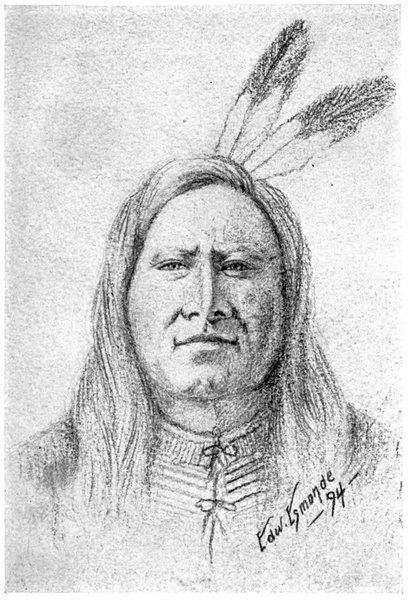
RAIN-IN-THE-FACE From a sketch from life made in 1894 by Edward Esmonde
“If you want a story, I will tell a true one. It’s about myself. I was a bad man and dangerous to fool with before I had to walk with crutches. My heart’s good now, but it was all the time bad when I was a fighter and 281a hunter. The maidens admired me, but the bucks were afraid of me. I would rather fight than eat. The long swords (soldiers) trembled when they knew I was near, and the Rees and Crows always felt of their hair every morning to see if their scalps were still on when Rain was near by.”
Here Harry headed him off, for it’s natural for an Indian to boast, and if any one will listen he will sing his own praises for hours at a stretch.
“Yes, we know you were a bad man and a fighter from ’way back,” said Harry, “but we want to hear about the time Tom Custer made you take water. If you were such a brave man, how did it happen that a little man like Tom Custer got the best of you?”
This had the desired effect, and Rain winced under such a reflection on his bravery, for he measured forty-six inches around his chest, stood five feet nine inches, and weighed about 195 pounds at that time, while Captain Tom Custer was under the average weight and height.
With great deliberation and much gesticulation, Rain told his version of the incident in question, and much to our surprise he continued on and related his version of the “Custer Massacre.”
Now, since nearly all the officers in the Regular Army, as well as all the agents of the Interior Department, have failed to get him even to speak of this fight (their trying, coaxing, and threatening for years has been in vain), and since Rain gets the credit of being the slayer of Custer, and has been immortalized in verse by Longfellow, it was a pleasant surprise to have this unexpected revelation. I am writing it down as nearly like McLaughlin interpreted it as I can.
“Two years before the big fight,” he said, “Gall and 282Sitting Bull had their camp at Standing Rock. All were hostiles. They were Unkpapa Sioux and fighters who never feared an enemy any more than a buffalo calf. The Yanktonais (friendly Indians) were coffee coolers (cowards) and hung around the agency which was at Lincoln then (Fort Abraham Lincoln on the upper Missouri now). We used to have great times in the hostile camp, dancing, running races, shooting and playing games. Buffalo and deer were plenty, and we had many ponies. I was a great fellow with the girls. They used to tease me to get me mad—when I got mad I knew no reason, I wanted to fight. One night a girl dared me to go up to Fort Lincoln and kill a white man. I told her it was too risky, as the long swords always kept watch. Besides, the Rees (another tribe of Indians, employed by the government as scouts) had their lodges on the hill back of the fort. The wood-choppers were camped between the fort and the river. She said:
“’A brave man fears nothing. If you are a coward, don’t go. I’ll ask some other young man who isn’t afraid, if he hasn’t danced in the Sun Dance.’ (This was a torture dance in which Rain-in-the-Face subsequently underwent the most horrible self-torture ever inflicted.[93])
283“The other girls laughed, but the young men who heard it didn’t. They feared me. I would have killed them for laughing. I went to my lodge and painted sapa (black, the color used when they go on the war-path), took my gun, my bow, my pony. Sitting Bull had forbidden any one to leave camp without his permission. I skipped off under cover of darkness and went up to Lincoln (forty-five miles north, opposite the present site of Bismarck, North Dakota). I hung around for two days, watching for a chance to shoot a long sword. I had plenty of chances to kill a Ree squaw, plenty to kill a wood-chopper, but I wanted to carry back the brass buttons of a long sword to the girl who laughed at me. I did so, and she sewed them on her shawl. One morning I saw the sutler (store keeper) and a horse medicine man (U. S. Veterinary Surgeon Hontzinger) go out to a spring; Long Yellow Hair (General Custer) and his men were riding back about 100 yards. I rushed up and shot the sutler and brained the horse medicine man with my war club; then I shot them full of arrows and cut off some buttons. Long Yellow Hair heard the shot and his troop charged back. I didn’t have time to scalp the men I got. I jumped on my pony and yelled at them 284to catch me. They chased me to the Cannon Ball (a small river twenty-five miles south). Charlie Reynolds (a scout) knew me and told Long Yellow Hair who did this brave deed.
“Next winter I went to the agency store at Standing Rock. I drew no rations—I hadn’t signed the paper. (All the Indians who signed a peace treaty and consented to live on the reservation, under military orders, were furnished with rations by the government twice a month. The hostiles had to live by hunting.) Istokscha (One Arm, the Hon. H. S. Parkin) was running the store then. I wasn’t afraid of any of them. Little Hair (Capt. Tom Custer) had thirty long swords there. He slipped up behind me like a squaw, when my back was turned. They all piled on me at once; they threw me in a sick wagon (ambulance) and held me down till they got me to the guard-room at Lincoln.
“I was treated like a squaw, not a chief. They put me in a room, chained me, gave me only one blanket. The snow blew through the cracks and on to me all winter. It was cold. Once Little Hair let me out and the long swords told me to run. I knew they wanted to shoot me in the back. I told Little Hair that I would get away some time; I wasn’t ready then; when I did, I would cut his heart out and eat it. I was chained to a white man. One night we got away. They fired at us, but we ran and hid on the bank of Hart river in the brush. The white man cut the chains with a knife (a file). They caught him next day.
“I rejoined Sitting Bull and Gall. They were afraid to come and get me there. I sent Little Hair a picture, on a piece of buffalo skin, of a bloody heart. He knew I didn’t forget my vow. The next time I saw Little Hair, ugh! I got his heart. I have said all.”
285And, Indian-like, he stopped.
We all knew that the greater part of this was true, since it tallied with the government account of the death of the sutler and Surgeon Hontzinger. But we wanted to hear how he took Tom Custer’s heart. McFadden, who is quite an artist as well as an actor of note, had made an imaginary sketch of “Custer’s Last Charge.” He got it and handed it to Rain, saying:
“Does that look anything like the fight?”
Rain studied it a long time, and then burst out laughing.
“No,” he said, “this picture is a lie. These long swords have swords—they never fought us with swords, but with guns and revolvers. These men are on ponies—they fought us on foot, and every fourth man held the others’ horses. That’s always their way of fighting. We tie ourselves onto our ponies and fight in a circle. These people are not dressed as we dress in a fight. They look like agency Indians—we strip naked and have ourselves and our ponies painted. This picture gives us bows and arrows. We were better armed than the long swords. Their guns wouldn’t shoot but once—the thing wouldn’t throw out the empty cartridge shells. (In this he was historically correct, as dozens of guns were picked up on the battle-field by General Gibbon’s command two days after with the shells still sticking in them, showing that the ejector wouldn’t work.) When we found they could not shoot we saved our bullets by knocking the long swords over with our war clubs—it was just like killing sheep. Some of them got on their knees and begged; we spared none—ugh! This picture is like all the white man’s pictures of Indians, a lie. I will show you how it looked.”
Then turning it over, he pulled out a stump of a lead 286pencil from his pouch and drew a large shape of a letter S, turned sideways.[94] “Here,” said he, “is the Little Big Horn river; we had our lodges along the banks in the shape of a bent bow.”
“How many lodges did you have?” asked Harry.
“Oh, many, many times ten. We were like blades of grass. (It is estimated that there were between four and six thousand Indians, hence there must have been at least a thousand lodges.)
“Sitting Bull had made big medicine way off on a hill. He came in with it; he had it in a bag on a coup-stick. He made a big speech and said that Waukontonka (the Great Spirit) has come to him riding on an eagle. Waukontonka had told him that the long swords were coming, but the Indians would wipe them off the face of the earth. His speech made our hearts glad. Next day our runners came in and told us the long swords were coming. Sitting Bull had the squaws put up empty death lodges along the bend of the river to fool the Ree scouts when they came up and looked down over the bluffs. The brush and the bend hid our lodges. Then Sitting Bull went away to make more medicine and didn’t come back till the fight was over.
“Gall was head chief; Crazy Horse led the Cheyennes; Goose the Bannocks. I was not a head chief—my brother Iron Horn was—but I had a band of the worst Unkpapas; all of them had killed more enemies than they had fingers and toes. When the long swords came, we knew their ponies were tired out; we knew they were fooled by the death lodges. They thought we were but a handful.
287
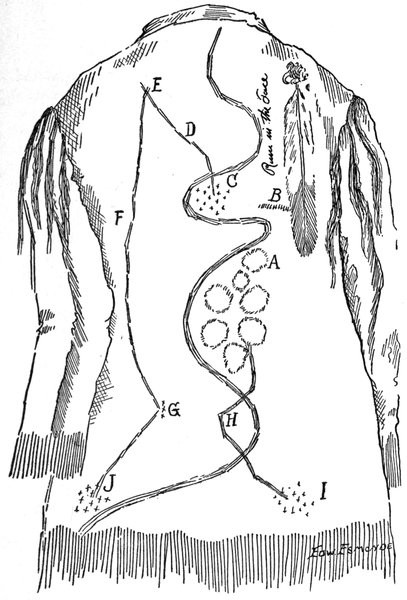
Key to map of Custer battle-field. Drawn on back of buckskin coat by Rain-in-the-Face for Edward Esmonde. Said to be the only map of the battle-field ever made by an Indian. A, Camp of the Indians; B, Reno’s Skirmish Line; C, Timber Where Reno’s Horses Were; D, Reno’s Retreat; E, Reno Joined Benteen; F, Custer’s Trail; G, Custer’s First Stand; H, Squaws and Children Crossed River; I, Where Squaws Went Into Camp After Re-crossing River; J, Where Last Stand Was Made and Custer Was Killed.
288“We knew they made a mistake when they separated. Gall took most of the Indians up the river to come in between them and cut them off. When we saw the Ree scouts had stayed back with Long Yellow Hair, we were glad. We saw them trotting along, and let them come in over the bluffs. Some of our young men went up the gully which they had crossed and cut them off from behind.
“Then we showed our line in front, and the long swords charged. They reeled under our fire and started to fall back. Our young men behind them opened fire. Then we saw some officers talking and pointing. Don’t know who they were, for they all looked alike. I didn’t see Long Yellow Hair then or afterward. We heard the Rees singing their death song—they knew we had them. All dismounted, and every fourth man held the others’ ponies. Then we closed all around them. We rushed like a wave does at the sand out there (the ocean beach) and shot the pony holders and stampeded the ponies by waving our blankets in their faces. Our squaws caught them, for they were tired out.
“I had sung the war song, I had smelt the powder smoke. My heart was bad—I was like one that has no mind. I rushed in and took their flag; my pony fell dead as I took it. I cut the thong that bound me. I jumped up and brained the long sword flag-man with my war club, and ran back to our line with the flag.
“The long sword’s blood and brains splashed in my face. It felt hot, and blood ran in my mouth. I could taste it. I was mad. I got a fresh pony and rushed back, shooting, cutting, and slashing. This pony was shot, and I got another.
“This time I saw Little Hair. I remembered my vow. I was crazy; I feared nothing. I knew nothing 289would hurt me, for I had my white weasel-tail charm on.[95] (He wears the charm to this day.) I don’t know how many I killed trying to get at him. He knew me. I laughed at him and yelled at him. I saw his mouth move, but there was so much noise I couldn’t hear his voice. He was afraid. When I got near enough I shot him with my revolver. My gun was gone, I don’t know where. I leaped from my pony and cut out his heart and bit a piece out of it and spit it in his face. I got back on my pony and rode off shaking it. I was satisfied and sick of fighting; I didn’t scalp him.
“I didn’t go back on the field after that. The squaws came up afterward and killed the wounded, cut their boot legs off for moccasin soles, and took their money, watches, and rings. They cut their fingers off to get them quicker. They hunted for Long Yellow Hair to scalp him, but could not find him. He didn’t wear his fort clothes (uniform), his hair had been cut off, and the Indians didn’t know him. (This corroborates what Mrs. Custer says about her husband’s having his long yellow 290curls cut at St. Paul some weeks before he was killed.)
“That night we had a big feast and the scalp dance. Then Sitting Bull came up and made another speech. He said: ‘I told you how it would be. I made great medicine. My medicine warmed your hearts and made you brave.’
“He talked a long time. All the Indians gave him the credit of winning the fight because his medicine won it. But he wasn’t in the fight. Gall got mad at Sitting Bull that night. Gall said: ‘We did the fighting, you only made medicine.’ It would have been the same anyway. Their hearts were bad toward each other after that, always.
“After that fight we could have killed all the others on the hill (Reno’s command) but for the quarrel between Gall and Sitting Bull. Both wanted to be head chief. Some of the Indians said Gall was right and went with him. Some said Sitting Bull was. I didn’t care, I was my own chief and had my bad young men; we would not obey either of them unless we wanted to, and they feared us.
“I was sick of fighting—I had had enough. I wanted to dance. We heard more long swords were coming with wheel guns (artillery, Gatlings). We moved camp north. They followed many days till we crossed the line. I stayed over there till Sitting Bull came back, and I came back with him. That’s all there is to tell. I never told it to white men before.”
When he had finished, I said to him: “Rain, if you didn’t kill Long Yellow Hair, who did?”
“I don’t know. No one knows. It was like running in the dark.”
“Well,” asked Mac, “why was it Long Yellow Hair 291wasn’t scalped, when every one else was? Did you consider him too brave to be scalped?”
“No, no one is too brave to be scalped; that wouldn’t make any difference. The squaws wondered afterward why they couldn’t find him. He must have laid under some other dead bodies. I didn’t know, till I heard it long afterward from the whites, that he wasn’t scalped.”
“How many Indians were killed in the fight?”
“I don’t remember, but about ten and four or ten and six.”
“How about Curley, the Crow scout, who claims to have escaped?” asked Mac.
“Ugh! I know Curley. He is a liar. He never was in the fight. His pony stumbled and broke something. He stayed behind to fix it. When he heard the firing, he ran off like a whipped dog. One long sword escaped, though; his pony ran off with him and went past our lodges. They told me about it at Chicago. I saw the man there, and I remembered hearing the squaws tell about it after the fight.”
Rain-in-the-Face (Itiomagaju) is about sixty years of age now, and is the only chief that survives to tell the tale of the Custer fight. Gall and Sitting Bull have both gone to hunt the white buffalo long since. Rain can write his name in English. I taught him to do it at the World’s Fair in order to sell Longfellow’s poem, entitled “The Revenge of Rain-in-the-Face.” He doesn’t know the significance of it after he writes it. His knowledge of English is confined to about thirty words, but he can’t say them so any one can understand him, though he can understand almost anything that is said in English. Like all other Indians, his gratitude is for favors to come and not for favors already shown. He is utterly heartless and unprincipled, physically brave but morally 292a coward. His redeeming feature lies in the fact that you can depend upon any promise he makes, but it takes a world of patience to get him to promise anything. Even at the age of sixty he is still a Hercules. In form and face he is the most pronounced type of the ideal Fenimore Cooper, dime novel Indian in America.
293
CHAPTER EIGHT Two Interesting Affairs
I. The Fight on the War Bonnet
Before entering upon a detailed description of the larger events of the campaign after the Battle of the Rosebud and Little Big Horn, two smaller affairs are worthy of mention. One, though nothing but a skirmish, was of great importance in determining the final result. The other well illustrates something of the adventurous life and perilous duty of a soldier in Indian warfare.
On Saturday, July 15, 1876, the Fifth Cavalry, under General Wesley Merritt, was marching toward Fort Laramie, under orders to join Crook. At noon word was received from the agency that a body of Cheyennes, numbering, perhaps, one thousand warriors, who had heretofore remained quiet on the reservation at the Red Cloud Agency, on the White River, South Dakota—the Pine Ridge Agency—was about to break away and join the Indians in the field. Their minds had been inflamed by the story of Crook’s defeat and the account of the disaster to the Seventh Cavalry. They thought they saw unlimited opportunities for plunder, scalp-taking, and successful fighting—therefore they decided to go on the war-path without delay. There were not troops 294enough near the agency to prevent this action, which was entirely unsuspected anyway.
The orders for Merritt to join Crook were imperative; but, in view of this news, the general decided to disregard them for the present. He realized that he could perform no better service than heading off this body of Cheyennes, and either defeating and scattering them or, better still, forcing them back to the agency.
The trail they would have to take would cross a creek in the extreme southeast corner of South Dakota, called the War Bonnet,[96] some eighty-five miles, by the only practicable route, from where the Fifth Cavalry then was. The Indians were a much shorter distance from it. Merritt would have had to march around, practically, three sides of a square, owing to the configuration of the country, to reach that point, which was the best place for miles around, within the knowledge of W. F. Cody (Buffalo Bill), his chief scout, to intercept the flying Cheyennes.
Merritt did not hesitate an instant after learning the news. He put his command in motion immediately, and by a forced march of thirty-one hours, got to the crossing in good time. There was no evidence that the Cheyennes had passed. The troopers concealed themselves in ravines under the bluff’s, and waited for the Indians.
Early on the morning of July 17th, the pickets, commanded by Lieutenant Charles King,[97] observed the approach of the Indians. At about the same time Merritt’s wagon train, under Lieutenant Hall, with two hundred infantrymen spoiling for a fight, concealed in the wagons as a guard, was observed toiling along, some four 295miles to the southwest, in an endeavor to reach the rendezvous on the War Bonnet. The regiment remained carefully concealed, and the Indians, in high glee, thought they had the train at their mercy.
So soon as he sighted the Cheyennes, Lieutenant Hall despatched two troopers of his small cavalry escort ahead to the crossing to apprise Merritt that the Indians were at hand. An advance party of Cheyennes, superbly mounted and led by a gorgeous young chief, determined to intercept these troopers, who were ignorant of their peril. The two soldiers came down one trail which led through a ravine, the Indians came up another which led through another ravine. The troopers and the Cheyennes were hidden from each other, but both were in plain view of the picket on the hill. The two trails joined at the foot of the hill. The plain back of the wagon-train was black—or red, rather—with Indians coming up rapidly, although they were not yet near enough to attack.
Merritt and one or two other officers, with Buffalo Bill and a few of his scouts and several troopers, joined King on the hill. The main body of the Indians was too far away to attack, so the little advance party determined to wait until the Cheyennes, who were endeavoring to cut off the two soldiers, were close at hand and then fall upon them. Everybody withdrew from the crest of the hill except Lieutenant King, who was to give the signal, when the party below should sally around it and fall on the Cheyennes.
King, who has described the situation with masterly skill in his “Campaigning with Crook,” flattened himself out on the brow of the hill, with nothing showing but the top of his hatless head and his field glass, and watched the soldiers rapidly galloping up one trail and 296the Indians more rapidly rushing down the other. He waited until the Indians had almost reached the junction. Then he gave the signal. Merritt’s escort and Cody’s scouts raced around the base of the hill, and dashed slap into the faces of the astonished Cheyennes. Two Indian saddles were emptied in the twinkling of an eye. Such was the impetus of their charge that the Indians scarcely had time to rein in their steeds before the white men were upon them.
Buffalo Bill shot the leader of the war party, a famous young chief named Yellow Hand, through the leg. The bullet also pierced the heart of the pony Yellow Hand was riding. Both crashed to the earth. In spite of his pain, Yellow Hand dragged himself to his feet and fired at the scout, killing his horse. The two, not twenty paces apart, exchanged shots the next instant. The Indian missed, but Buffalo Bill sent a bullet through Yellow Hand’s breast. The Indian reeled, but before he fell Cody leaped upon him and drove his knife into his gallant enemy’s heart. Yellow Hand was a dead Indian when he struck the ground. “Jerking the war bonnet off,” he says, “I scientifically scalped him in about five seconds.”[98]
Yellow Hand had recognized Buffalo Bill, and had virtually challenged him to this duel. “The first scalp for Custer!” shouted Cody, waving his trophy in the air.
Some of the other Indians had now come within range. They opened fire upon the little party; the bullets zipped around them in every direction, one narrowly grazing General Merritt. They nicked a horse here and there, but, as usual, their marksmanship was execrable.
As the little party charged the Indians, Merritt had 297directed King to order the rest of the regiment to advance. In the midst of the firing, the splendid troops of the dandy Fifth came bursting through the ravines and over the hills, making for the Cheyennes on the gallop. At the same time Lieutenant Hall’s infantrymen scrambled out of their wagons and sent a few volleys at the Cheyennes at long range. A more astonished body of Indians the United States has probably never contained. They hadn’t the slightest idea that there was a soldier within five hundred miles, except those in the wagon train which they had expected to capture. They had anticipated no trouble whatever in joining Sitting Bull, and now they found themselves suddenly face to face with one of the finest cavalry regiments in the service. What were they to do? They hadn’t much time to decide, for the cavalry were after them at full gallop. They turned and fled incontinently. They stood not on the order of their going, but went at once.
If they could get back to the reservation, they would be free from attack. They fled at the highest possible speed of their horses, throwing aside everything they possessed, save their guns and ammunition, in their frantic desire to get away. For thirty miles Merritt and his men pursued them with the best will in the world to come up with them; but the horses of the soldiers were more or less tired from their long march of the day before, and the Indians, lightly equipped and on fresh horses, finally succeeded in escaping. By nightfall the whole party was back on the reservation. Thereafter care was taken that they found no further opportunity to go on the war-path.
The coöperation of this splendid body of Indians with that under the command of Crazy Horse might 298possibly have turned the scale in some of the hotly contested battles, and Merritt’s promptness was greatly commended by the authorities. Buffalo Bill received the chief glory of the little adventure from his dramatic duel with Yellow Hand, in full view of soldiers and Indians.
II. The Sibley Scout
The other event is known in army records as The Sibley Scout. While General Crook was waiting for reinforcements and additional supplies at his camp on Goose Creek, near the Tongue River, he decided to send out a scouting party to see what had become of his friend, Crazy Horse, who had handled him so severely at the Rosebud a few weeks before.
Lieutenant Frederick W. Sibley, of E Troop, of the Third Cavalry, an enterprising but cool-headed young officer, was given command of twenty-five picked men from the regiment. With him went scouts Frank Gruard and Baptiste Pourier, commonly known as “Big Bat,” to distinguish him from another scout, Baptiste, a smaller man. To the party also were attached John Becker, mule packer, and the indefatigable Finerty, the war correspondent of the Chicago Times, making a total of thirty men.
Each man carried one hundred rounds of ammunition on his person, and a few days’ rations in his saddle-bags. They started on the 6th of July. On the 7th they had reached the Rosebud, some fifty miles away from Crook’s camp. There they came across the Indians. Gruard and Pourier observed them from the top of a hill, behind which the rest of the expedition halted. There were hundreds of them, apparently, and the scouts rejoined 299the command immediately. To take the back track was impossible. Therefore, they struck westward over the mountains, leading their horses. The Indians, marching slowly southward, soon came upon the trail of the party, and followed it at some distance. Urged by the imminence of their peril, the men, led by the unerring Gruard, who was familiar with all the ramifications of the Big Horn Range, since he had often hunted there during his captivity with the Sioux, did some rapid mountain climbing, and finally thought they had escaped pursuit, especially as no one could ride up the trail up which they had climbed, and these Indians were poor trailers when on foot. Having progressed some five miles over terrific trails, they halted in a little glade under the shade of some trees, unsaddled their horses, made coffee, and ate dinner. Feeling themselves safe from pursuit, they rested for several hours, and it was not until late in the afternoon that they took up their march again.
The going here was easier than before, and they could mount their horses once more. Presently they trotted into a level, thickly wooded valley. The trail led along the right side of the mountain, which was broken and rugged. There were woods to the left and in front of them, and high rocks and open timber on the right. John Becker, who brought up the rear, suddenly alarmed everybody by the shout of “Indians, Indians!”
The next instant the timber and boulders to the right were alive with a war party of Sioux and Cheyennes, not two hundred yards away—not the same party they had seen in the valley, by the way. So soon as the Indians appeared they opened fire. Again their shooting was bad. Not a trooper was hurt, although a number of horses were hit, some seriously. Sibley acted with prompt decision. A word with Gruard determined him 300in his course. Under a spattering fire from the Indians, the party turned to the left and raced for the thick timber as fast as they could go. They threw themselves to the ground in a semi-circular line so soon as they reached the woods, tied their horses to the trees back of them, and taking advantage of fallen logs and boulders as a breastwork, opened fire upon the Indians, who, on their part, sought concealment and commenced firing in earnest. The soldiers were well protected in the forest, however, and although the Indians killed many of the horses, they did not hit any of the troopers.
The party was now overwhelmingly outnumbered. There were already several hundred Indians engaged. Their leader was a magnificent young Cheyenne chief, dressed in a suit of white buckskin. It was afterward learned that his name was White Antelope. Gruard was recognized by the Indians, who were desirous of taking him alive. After firing for perhaps half an hour, White Antelope led the Indians on foot in a direct charge on the woods.
Sibley ordered his men to hold their fire until they could make every shot tell. They mowed the advancing Indians down in scores. White Antelope was seen to leap into the air and fall. He had been pierced, it was afterward learned, by several bullets, and started for the happy hunting grounds then and there. The charge was handsomely repulsed, and the Indians retired in confusion, although still keeping up a severe fire.
CHIEF TWO MOON OF THE NORTHERN CHEYENNES Allies of the Sioux at Little Big Horn Painted from life by F. A. Burbank
It was evident to every one that the Indians would hold the soldiers in play until they were joined by other war parties—indeed, their numbers were increased already—when Sibley’s detachment would be surrounded and exterminated. Gruard, therefore, proposed abandoning the horses—most of them had been killed anyway—and 301that the whole party should steal away through the timber and endeavor to escape over the mountains on foot. Firing two or three volleys and then keeping up a scattering fire for a short time to make the Indians think they were on the alert, the troopers, exercising the greatest caution, one by one crawled through the underbrush until they were hidden by the forest trees. Then everybody got up on his feet and ran like mad.