Part I Protecting the Frontier (continued 3)
Reading edition
Sheridan was anxious to have Carr join his regiment because of his experience with Indians and his general reputation, and therefore sent him to Fort Wallace with orders to have the two troops of cavalry there go under my command and escort Carr and overtake the Fifth, if possible, to enable him to join his regiment. The troops consisting of Troops H and I, Tenth Cavalry, were officered by myself and Captain Graham, Lieutenants Banzhaf, Amick, and Orleman, and were soon in readiness for the duty required. We had returned from the relief of Forsyth Oct. 1st, and we started with Carr at ten A.M. Oct. 14th.
I concluded to march north so as to strike the Beaver as soon as possible, and then to follow down that creek with the expectation of finding the Fifth Cavalry or of striking its trail. On the 15th I reached the Beaver at about one P.M., and after proceeding some miles down, went into bivouac. As we expected, we found a very 125large Indian trail about two weeks old, over which over two thousand head of ponies had been ridden or driven, going in the same direction.
The next day we continued our journey down the stream, finding plenty of water, a fine bottom covered with grass and timber, and still observing the Indian trail, which ran to a point about twenty miles east from the place where we first struck the Beaver. At this locality the signs showed that the Indians had encamped for the night. The ground was covered for acres with old fire-places, pieces of wood, and the manure of ponies; and a little distance off we found a dead Cheyenne, wrapped in his robes, lying upon a scaffolding in a tree, a protection against ravenous wolves. The trail then struck south toward Short Nose Creek, the Indian name for a stream about twenty miles south of the Beaver. We continued our course, however, on the Beaver, until we made about thirty miles, and then stopped for the night.
As there was no pack outfit at Wallace, I was compelled to take wagons to carry our supplies, and had eleven with me. The mules, dragging heavy loads over rough country, were made to trot in order to keep up with the cavalry column. We had now moved down the Beaver about forty-five miles without finding anything about the Fifth, and it began to look as if something had taken the regiment in another direction.
The next morning I sent Lieutenant Amick and ten men well mounted with Sharp Grover, the famous scout, with orders to proceed as quickly as possible across country to the Short Nose to look for signs of the Fifth Cavalry and to keep a sharp lookout for Indians.
Grover, who, it will be remembered, had been with Forsyth, afterward joined my command. He had married 126a Sioux woman and had lived for years with the Indians before the outbreak of hostilities. He could speak their language and knew their ways and customs, and was perfectly trained in reading signs. It was interesting to see how he could read what the tracks meant, as if they had been books. He could tell how long since the tracks were made, whether they were made by horses or ponies, shod or unshod, how many were ridden, how many were driven, whether it was a war party or a party changing camp. If Indians stopped for the night he could tell how many men or squaws were in the party, to what tribe they belonged, from the shape of their moccasins, and many more details. Like most of his ilk, Grover drank heavily on occasion. When the Indians went on the war-path Grover could not stay longer with the Sioux, as his life was not safe, and he entered the government employ, where he rendered heroic and invaluable services. Later he was killed in a row at Pond City, near Fort Wallace.
Amick and his party soon disappeared over the hills to our right and we kept on down the stream, the general course of which was to the northeast. I began to feel certain that the Fifth Cavalry had never reached the Beaver, and that we would probably be attacked by the Indians if this was the case. Under these circumstances I felt that it would be wise to be cautious and on the lookout against surprise. The road we passed over was very rough and the stream in most places ran through deep-cut banks several feet high, with very few places suitable for crossing.
As night came on a place was selected for a camp in a bend of the creek where the wagons could be placed across, giving room inside to graze the animals without fear of a stampede from howling savages. Amick returned 127just before night, having scouted some miles beyond the Short Nose without discovering any trace of the Fifth Cavalry. Grover told me that as they passed across the divide between the Beaver and the Short Nose he came across a single Indian pony track. This track was coming from a direction to our rear, and showed that the pony was going at a rapid gallop. Grover inferred from this that it was probably an Indian hunter returning homeward who had most likely crossed our trail behind us, discovered our presence in the country, and was riding as fast as possible to carry the news to the Indian camps somewhere to our front and not far off.
After a council over the situation General Carr came to the conclusion, after having traveled some sixty miles down the Beaver without finding the Fifth, that the regiment had never reached that stream and that therefore he would give it up and start on our return in the morning. About seven A.M. on the next day, Oct. 15th, Captain Graham expressed a wish to make a scout for a short distance to the front, and rode forward with two men. The command was ordered saddled up and everything made in readiness to move. In view of the fact that the south side of the creek was hilly and difficult and offered opportunities for ambuscades, I determined to go back by the north side, which was comparatively open. The afternoon before I had sent Lieutenant Orleman with a detachment to dig down the sides of the creek and prepare a practicable passage for the wagons and troops.
Graham had hardly ridden a thousand yards when twenty-five Indians suddenly dashed over the hill to his rear, with the evident intention of cutting him off. They were almost upon Graham before he discerned them, but 128he instantly struck spurs into his horse and dashed for the creek, the Indians firing a volley at short range upon the party. One of the bullets passed through Graham’s hat, another through his coat, and a third through his leggings without wounding him. One of the horses was shot through the shoulder and fell. His rider succeeded in getting into the creek and behind the bank along with the other soldiers, and they commenced firing upon the Indians. Graham’s girth burst as his horse sprang away at the first fire, but as his saddle gave way he seized his horse’s mane and dragged himself forward on the animal. He then dashed the horse over the bank of the creek, about ten feet to the bottom. He fell from his horse in this jump, but the horse, fortunately, ran in our direction.[40]
By this time I started out thirty men under Lieutenants Amick and Orleman to cover the retreat of Graham’s men. As they charged toward the hill the savages rushed from the creek to avoid being cut off, and were hotly pursued by our men. Judging that the presence of these Indians indicated that a large party could not be far off, I thought it best to be prudent and sent a trumpeter to overtake Amick and tell him to discontinue the pursuit and fall back slowly to camp. Without further delay I now broke up the camp, crossed the creek with wagons and troops, and, having dismounted the men, deployed them as riflemen to cover the retreat of Amick.
In a few minutes the absent party made its appearance on the hills, with bodies of Indians, numbering at least a hundred, skirmishing on our flank and rear. 129They slowly fell back toward the creek, and when within range the dismounted men on the banks opened fire on the advancing savages, and under cover of this Amick crossed and joined the command, while the Indians kept at a respectful distance.
The wagons were now placed in double column so as to make everything as compact as possible.[41] H Troop was assigned on the flanks and advance, deployed in open order. Troop I covered the rear in the same manner, with one platoon under Graham as a reserve. These arrangements being completed, we moved steadily up the creek bottom. As soon as this movement commenced, a large body of Indians made their appearance and charged toward us, taking advantage of ravines, trees, and bluffs to fire from the south side of the creek. Some of the balls were well aimed and came close.
I soon saw that if we continued down the creek bottom the enemy would harass us immensely under cover of the timber and banks, and therefore changed our course so as to leave the valley and take the higher ground or divide. The Indians followed, showing about two hundred strong, and acted boldly in their attacks on the rear and flanks. The men and officers behaved very coolly, facing toward the enemy and driving them back without stopping the progress of the column.
130
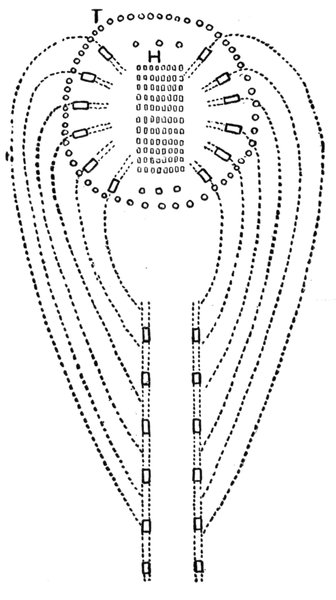
Position of Wagons and Soldiers in Beaver Creek Fight T, Troopers Surrounding Wagons; H, Horses Inside the Inclosure Drawn by General Carpenter
At one point we passed near a deep ravine, and the enemy, quick to observe cover of any kind, occupied it with quite a number of warriors and opened up a serious fire. The reserve platoon under Graham charged at the place as we were passing and, arriving at the edge of the ravine, poured in a volley at close range on the 131savages. A number must have been hurt and the Indians certainly lost no time in getting out of their position. Afterward they were more cautious in occupying ground too close to us. The flankers, under Banzhaf and Orleman, also repulsed the Indians on several occasions.
One Indian carried a red flag with some white device upon it, and by his movements the whole force seemed more or less governed. They were all stripped to the waists, and were decorated by various ornaments hanging from their heads and their shields, quivers, and bridles, so as to glisten and shine in the sun at every turn of the ponies. Up to this time five Indians were known to be killed at various points and quite a number wounded.
At one P.M. the enemy seemed to stop the fight and apparently withdrew, and I supposed that I had seen the last of them; but half an hour afterward, hearing an exclamation, I looked back and saw the Indians appearing again on the hills to our rear. On they came, one body after another coming in sight until it was estimated by all present that at least six hundred warriors were in view. Emboldened by their number they rushed forward, directing themselves toward our front, flanks and rear, making things look rather serious. I soon saw that we could not continue the march and meet this force, but that we must select a position and make a stand.
In the first attack in the morning I had offered the command to General Carr, as the senior officer present, but he declined it, stating that he considered himself simply as a passenger to be escorted, and I therefore continued to direct the operations.[42]
132I looked around and saw a small knoll or rise a short distance to the front, from which the ground fell in every direction, and this point was immediately selected. The teamsters were directed to take the trot, aim for this place, and on arrival at the knoll immediately to form a circular corral, half a circle on either side, with the mules facing inward, affording a shelter within and something of a fortification. As soon as we increased our pace the Indians evidently thought we were running from them, and sent up a yell which made shivers run down the backs of some of our recruits. We kept on, however, at a fast gait, and the moment we struck the highest ground, the wagons were corralled with six wagons one side, five wagons on the other, and the troops were rushed inside at a gallop and dismounted. The horses were tied together inside the corral with some men to watch them, and the rest were formed outside the corral in open order.[43] This was done in about two minutes and then the advance of the Indians was upon us.
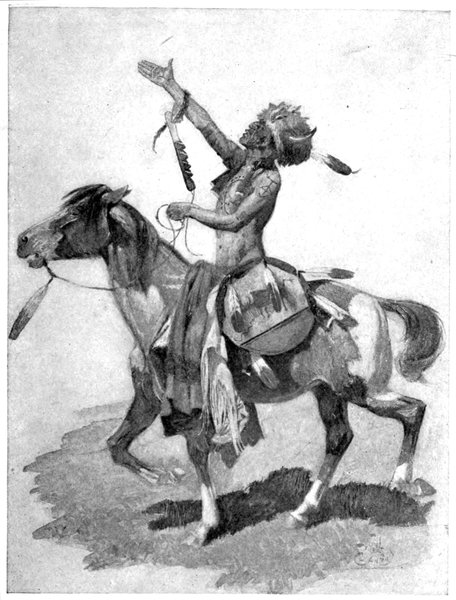
THE CHIEF MEDICINE MAN AT BEAVER CREEK Drawing by Will Crawford
A fire commenced from our seven-shooter Spencers which sounded like the fire of a line of infantry. The 133Indians charged up around the wagons, firing rapidly and seriously wounded some of the men, but in a very short time they were driven back in wild disorder, leaving the ground covered with ponies, arms, and some bodies. Three dead warriors lay within fifty feet of the wagons. One man who was killed here was carried off by his comrades.
The chief Medicine Man, on a fine looking horse, rode out in front of our line about two hundred yards off, after the retreat of the Indians, to try to show that his medicine was good and the white man’s bullets could not hurt him. I directed several men near me to aim carefully at him. They fired and the Medicine Man went down, accompanied by a howl from the more distant Indians. After the repulse the men rushed forward from the wagons, seized and hauled in ten bodies of the Indians. The savages, disheartened and surprised at this reception, withdrew out of gunshot and assembled, apparently for council.[44]
The men carried corn sacks and made breastworks near the wagons and we waited, expecting a renewal of the attack, for about an hour, when it became evident that some of the Indians were withdrawing. The day was very warm, we had been engaged about eight hours, and in the hot sun men and animals were suffering very 134much from thirst. I made up my mind to move for water, and keeping the wagons in double column, the horses inside and the men dismounted on the outside, we marched for the Beaver. A large party of Indians followed up to where their dead comrades lay and set up a mournful howl over their remains. Their loss in this fight, added to what they had suffered the month before in the conflict with Forsyth, must have had a sobering effect.
We now proceeded to the creek without further interference, and selecting a wide bottom encamped for the night, preparing some rifle-pits to cover our outlying pickets and to enable them to receive the enemy if an attack were made in the morning. We heard them around us all night imitating coyotes, but they did not find a weak place and refrained from molesting us. The next morning the Indians were gone and we marched by the shortest route to Fort Wallace, arriving there on the 21st.
On our return journey we passed through Sheridan City, a frontier town located at the then terminus of the Kansas Division of the Union Pacific R. R. It was full of taverns, saloons, gambling houses and dens, and of a rather tough lot of citizens and desperadoes. These people and others crowded into the streets when we passed through, and when they saw the troopers and their horses decorated with the spoils from the Indians whose dead bodies we had captured, they knew that we had been in a successful fight and they gave us a perfect ovation.
The savages suffered a considerable loss, but we escaped with a few men wounded (some of them seriously) and none killed. General Carr found the Fifth Cavalry had returned to the railroad, and through mistake they 135never reached the Beaver. He took command of the regiment, marched again and pursued the Indians over the Platte River, and followed them on a long campaign.
This was one of the smartest and most successful Indian fights on record. Carpenter’s tactics throughout had been admirable. General Carr was much surprised and pleased at the conduct of these black troopers, and on his return to Fort Wallace telegraphed to General Sheridan that “the officers and troops behaved admirably.” General Sheridan published a general order highly commending the commander, the officers and the men for this brilliant and gallant affair. Carpenter was brevetted colonel in the Regular Army (his fifth brevet), and afterward received a medal of honor for this fight and the relief of Forsyth. Well did he deserve them both.—C. T. B.
136
CHAPTER NINE A Further Discussion of the Beaver Creek Affair
When General Carpenter’s account of the fight on the Beaver Creek was published serially, General Carr took exception to it in a public letter to the editor of the periodical in which it appeared. I am permitted by the editor to make extracts from this letter, which, with my own comment and General Carpenter’s rejoinder, appear as follows:
I. General Carr’s Account
I do not think that General Sheridan sent orders for my escort to go under command of Colonel Carpenter. I know that, after waiting with General Sheridan at Fort Hayes for several days, he ordered me to go to Fort Wallace, take an escort and go to find Royall, who had not been heard from as expected.
While we were going over the “rough hills” Colonel Carpenter, and perhaps some of the others, came up and remonstrated with me for marching the command so hard; said they could not be responsible for its effect on the horses, and when I insisted, asked me to take command and be responsible. I said, “All right, I 137will take command; but you must attend to the details. I will not appoint an adjutant and take the office work” (detailing guards, stable duties, etc., etc.).
I had with me an officer of my regiment, Captain Kane, Fifth Cavalry, and now wish I had appointed him adjutant and taken formal command.
Finding that the stream (Beaver Creek) was persistently hugging the south side of the valley, on which we were traveling, creating bluffs and ravines over which it was difficult to move the wagons, I determined to cross to the north side, where the valley consisted of a gentle and smooth slope.
I selected the camp in an “ox bow” bend of the creek, putting the tents and wagons across the entrance, the guard at the bow and the animals inside, selected a place for crossing, and ordered the banks to be cut down to the bed of the creek, so that the wagons and animals could cross.
In the Indian country I always had my commands up and under arms before daylight, which is the most dangerous time; and next morning we were up, had breakfast, the tents struck and the wagons packed, and were standing ’round the camp fire when Amick called out “Indians!”
I had intended to move camp across the creek and get fresh grass. Graham had started on his trip, following a narrow path between the bluff and the river bank. He was riding a fine horse called “Red Eye,” which had a very deep chest and thin barrel. As he told me afterward, his saddle began to slip back, but he waited to get down to fix it till he should reach a more open place ahead at the mouth of a ravine, when bang, bang! came some shots. His horse dodged and jumped down the bank into the creek, slipping the saddle farther back and 138kicking it clear, while Graham landed on the shoulders of the horse and from there on the bed of the creek. He turned back with his gun toward the bank, which protected him while he fired, till I sent Lieutenant Amick with some skirmishers, who covered his retreat. His two men jumped their horses down into and up out of the creek and fell back, and when we got the men all in I moved the command up to and over the crossing I had prepared and out to the open slope on the north side of the valley. As we had not found Royall but had found the Indians, or, rather, they had found us, it was of no use to go farther down the Beaver, and I determined to move toward home.
The Indians kept coming out from those bluffs, crossing the creek and following us, and I arranged the wagons in two columns, with Carpenter’s company in front and on the flanks, and Graham’s company in rear, where I was also.
Some of the Indians got on our flanks as skirmishers, a few in front and more in rear, while the main body got into two columns, about like the two halves of a regiment in columns of four, marching steadily and gradually, closing on us by increasing their gait. I estimated them at seven hundred warriors; we had about one hundred colored soldiers. Their chiefs were marching between the heads of their columns; they had a flag and a bugle. I sent word to Carpenter to turn more toward the higher ground, away from the timber along the creek, which Indians were using for cover. Pretty soon he began to trot, and I had to send Captain Kane to him with orders to go slower, for fear of a stampede. I was in the rear near Graham’s troop. He was one of the bravest men I ever saw. He would amuse himself with the Indians by concealing men in hollows, taking away their 139horses till Indians came up for them to shoot at, then charging up with their horses, mounting and bringing them off. Most of the men were cool, but I saw one man loading and firing when the Indians were a mile away. I called to him to stop, but he paid no attention, seemed to be dazed, and I had to go up and lay my hand on him before he obeyed my order. As the Indians got closer, one of the men dismounted to shoot. When he tried to remount, his horse got scared and edged away from him, and I rode up on the off-side, got hold of the rein, and let his horse come against mine. Then he put his foot in the stirrup, made a leap and got his leg over, when we both cantered off—just in time. He lost his cap, and we lost a dog which was playing about between us and the Indians, interested in the shooting till he got near enough to them to be killed. These were our only losses.
As the main body of the Indians got closer and increased their gait to the charge, the leading wagons turned toward each other and stopped. The others turned their mules inside of those in front of them, lapping onto and tying to the wagons, forming a corral in shape of a flat-iron, and the horsemen rode inside, dismounted, tied their horses, and began to fire at the Indians who were thronging around us. One Indian, on a clay-bank pony and wearing a red blanket, with no arms, rode ’round and ’round us within fifty or one hundred yards, and seemed to bear a charmed life. I shot at him several times, and Grover said he also shot at him till he began to think the Indian had strong medicine which protected him—Grover was a squaw man and had imbibed some of their superstitions. He was shooting a Sharp’s carbine, and, taking it down to reload, happened to notice that he had the sight set for five 140hundred yards and had been shooting over the Indian’s head.
I had a Spencer carbine which had been sent me by the company for trial. With it I shot down an Indian, who fell and lay within thirty yards of the corral. He was not dead, and I afterward talked with him through Grover. He said his name was Little Crow, and mentioned the name of his father, whom Grover said he knew. He was young—about eighteen. I asked him why they attacked us. He said because we came on their creek. He told where their camp was, so that one week from that day, which was Sunday, October 18th, 1868, I found them with my own regiment, the Fifth, had a fight lasting two days and two nights, and drove them out of Kansas.
While the fight was going on our soldiers showed great bravery. While inside the wagon corral they would rush from one side to the other, wherever the Indians appeared, so as to fire at them. Their officers did not seem to keep them in their places, and, after it was over, I reprimanded them for not commanding their men. After the Indians were repulsed we went around and rearranged the wagons, got out sacks, cracker-boxes, etc., fixed breastworks in anticipation of another attack, and then sat down and ate our lunch.
It was two o’clock. Our soldiers wanted to scalp the dead Indians, of whom about ten were lying too near the corral for their friends to carry off. We prevented this till, while we were going around the corral rearranging, the soldiers got the chance to scalp them. Two were lying wounded when two soldiers approached them; one drew his bow and sent an arrow through the thighs of one of the men. The arrow passed through the fleshy part of one thigh and entered the other and 141stopped against the bone. It had to be cut in two to extract it. Years after, at Fort Leavenworth, a first sergeant showed me an arrow-head with the point marred, and said he was that man.
The other wounded Indian had a pistol, and shot the other soldier in the calf of his leg. These were the only men we had hurt. It was then that there was some talk of abandoning the wagons and going direct for the railroad. With the wagons, we had, of course, to go by routes over which wheeled vehicles could travel. I do not recall whether Captain Graham advocated this, but there would have been no impropriety in his stating his views to me. Any officer can talk to his commander, and I had been giving orders from time to time directly to him and his men. We sat there eating our lunch and talking with each other and the wounded Indian who lay in front of us, when he made a motion with his hand back toward me. I asked Grover what he meant. He said, “He wants you to go away; says his heart is bad.” This pleased me very much. I had been watching the Indians, who had fallen back to some rising ground nearly a mile off. They were moving about, pow-wowing, and, I supposed, preparing for a new attack. They seemed to be diminishing in numbers, but I thought they were trying to get around to some place where they would have a better chance at us. I really did not expect to get out of that fix. If those Indians had had sufficient resolution, being seven to one, they ought to have used us up. When the wounded Indian made this motion, I took it to mean that he knew they were giving up. He could see them as well as we could, and knew better what they were doing. I suppose that those who remained were the friends of the dead, waiting for us to go.
142I gave orders to reload the wagons and move out. Some of the Indians followed us for several miles, but did not again attack.
Colonel Carpenter did not offer the command to me at the first attack in the morning, nor did I decline it. I was exercising the command all the time. One of the articles of war provides that “when troops join and do duty together the highest in rank of the line of the army shall command the whole, and give the orders needful for the service,” and I could not have avoided the responsibility.
The foregoing narrative shows that I was not a “passive spectator,” nor did I “refrain from advice or suggestion,” nor from giving orders as required.
I, no doubt, said that I was a guest, and did not interfere unnecessarily; but my long experience on the plains and with Indians rendered it incumbent on me to exercise my judgment.
Eugene A. Carr,
Brevet Major-General and Congressional Medallist.
With reference to this letter from General Carr I beg to point out:
That General Carr in his letter practically admits in two places that he was not in command. First, when he writes of Captain Kane, “I wish I had appointed him adjutant and taken formal command.” Second, when he writes: “I, no doubt, said that I was a guest, and did not interfere unnecessarily.”
I do not see, therefore, that there is really any serious discrepancy between the account of General Carpenter and that of General Carr. I presume, if there is, I am more to blame than any one for the note to which General Carr takes exception. The original wording of 143that note was, possibly, not happy, and probably conveyed more than I intended. I did not suppose that any one thought that General Carr sat around and twiddled his thumbs while the fighting was going on. I have made changes in the note, which appears in this book in its amended form.
It must not be forgotten that General Carpenter received his medal of honor in part for this fight, and he certainly would not have received it had he not been in command.
Here follows a communication from General Carpenter on the subject. This discussion, I think, settles the matter in a way which I trust will be satisfactory to the friends of both of these distinguished officers.
II. General Carpenter’s Reply
I was very much surprised in reading General Carr’s contention that he was in command of the troops who constituted his escort to enable him to join the Fifth Cavalry, and who were in the action on the Beaver in October, 1868. The account I wrote is from my recollection, and from letters written home at the time, and I repeated what I thought there was no question about, and had no desire to ignore General Carr or any one concerned.
The two troops of the Tenth Cavalry, a portion of the garrison at Fort Wallace, under my command as the senior officer, were ordered to act as escort for General Carr, then Major, Fifth Cavalry.
I am quite positive that General Carr was offered the command by me, knowing him to be senior, and that he declined it. Many officers have been escorted by troops without taking command of the escort although 144of senior rank. As the troops were to escort this officer, of course he was consulted about the direction of the march, the time for camping, and concerning many other details of greater or less importance, but he never took formal command. If he did not, then, it would be manifestly improper for him to issue orders directly to subordinate officers or men. The officers and men were mentioned in General Orders by General Sheridan in 1868 for their gallantry and bravery in this action, and it is stated that they were escorting General Carr.
Thirty-five years have passed since the affair, and I never heard of any question about who commanded the troops engaged. This length of time naturally accounts for some difference of memory, and no two narratives may be expected altogether to agree. As mentioned before, Carr was consulted frequently during the expedition and his wishes were carried out, as was proper under the circumstances.
Some of the details mentioned by General Carr I do not remember, but I certainly regarded myself as being in command of the troops during the fight and gave directions as I have stated in accordance with my recollection, and selected the ground on which the wagons were corralled and the Indians repulsed.
I do not know of any officers being reprimanded, but when we returned to Fort Wallace we were informed that General Carr had reported to General Sheridan that “the officers and men had behaved admirably,”
I inclose a copy of General Field Orders, No. 4, Headquarters Department of the Missouri, dated October 27, 1868, issued by order of General Sheridan to commend the conduct of the troops engaged in the combat on the Beaver, October 18, 1868:
145Headquarters Department of the Missouri.
In the Field, Fort Hays, Kansas, October 27, 1868.
General Field Orders, No. 4.
The attention of the officers and soldiers of this department is called to the engagement with hostile Indians on Beaver Creek, Kansas, October 18, 1868, in which a detachment of cavalry (escorting Brevet Major-Gen’l E. A. Carr, Major, Fifth Cavalry to his Regiment) under the command of Brevet Lieut.-Col. Louis H. Carpenter, Captain, Tenth Cavalry, consisting of Companies I, Tenth Cavalry, under Capt. George W. Graham and 1st Lieut.-Major J. Amick, and H, Tenth Cavalry, under 1st Lieut. Charles Banzhaf and 2d Lieut. Louis H. Orleman, engaged about five hundred (500) Indians for several hours, inflicting a loss on the savages of ten (10) killed and many wounded, losing three (3) enlisted men wounded.
The major-general commanding desires to tender his thanks for the gallantry and bravery displayed by this small command against so large a body of Indians.
By command of Major-General Sheridan.
J. Schuyler Crosby,
Brevet Lieut.-Col. A. D. C.
A. A. A. General.
It is expressly stated that the detachment of cavalry (escorting Brevet Major-General Eugene A. Carr, Major, Fifth Cavalry, to his regiment) was “under the command of Brevet Lieut.-Col. Louis H. Carpenter, Captain, Tenth Cavalry.”
The records show, further, that Brevet Lieut.-Col. Louis H. Carpenter was brevetted colonel for gallant and meritorious conduct in the engagement with Indians on Beaver Creek, Kansas, October 18, 1868. This appointment was made on the recommendation of General Sheridan, and was undoubtedly conferred on this officer as being in command of the troops during the fight. Others behaved gallantly and their conduct deserved recognition, but this was the only brevet given at the time.
Louis H. Carpenter.
146
CHAPTER TEN The Battle of the Washita
I. Custer and the Famous Seventh Cavalry
A fighter of fighters and a soldier of soldiers was that beau sabreur of the American Army, George Armstrong Custer, “Old Curly” to his men, “The White Chief with the Yellow Hair,” or, more briefly, “Long Hair” to the Indians. From Bull Run to Appomattox his career was fairly meteoric. Second lieutenant in the Army of the Potomac at twenty-one, fresh from West Point, a brigadier-general at twenty-three, a major-general at twenty-four, and commander of the third cavalry division, which, in the six months preceding the downfall of the Confederacy, had taken one hundred and eleven guns, sixty-five battle-flags, and over ten thousand prisoners of war, without losing a flag or gun, and without a failure to capture whatever it went for—such was his record.[45]
I have heard my father tell of the impression made by the dashing young soldier whose spirited horse ran away on Pennsylvania Avenue at the Grand Review in Washington, 147in spite of the efforts of his rider—a peerless horseman—to restrain him. Custer’s hat fell off, his long, yellow curls floated back in the wind, making a dashing and romantic picture. He was a man of superb physique and magnificent strength. I saw him when I was a boy, and I have never forgotten him. His devoted wife, in one of the three charming books in which she has told the deathless romance of their married life on the frontier, relates how, on one occasion, riding by her side, with his left arm he lifted her out of the saddle high in the air, held her there for a moment or two, then gently replaced her on her horse. No fatigue was too great for him to surmount, no duty, however arduous, ever caused him to give back.[46]
Reams have been written about his unfortunate campaign upon the Little Big Horn, in which he went down to such awful destruction, but little is known of some of the exploits of his early career on the plains. After the war, more fortunate than most of the younger general officers who were forced to content themselves with captaincies or less, General Custer was appointed Lieutenant-Colonel of the new Seventh Regular Cavalry, a regiment which was born with him, lived with him, and a large part of which died with him.
The officers of the regiment were a set of unusual men. Custer himself was allowed considerable voice in the selection of them, and such a body of officers had been rarely assembled in one command. Most of the troopers were not at first of the high grade to which they afterward attained. The best men, in the ranks at least, at the close of the Civil War, had had enough of 148fighting. They wanted to get back to civil life once more. Not frequently it was only the inferior soldiers who could be induced to re-enlist from the volunteer into the regular regiments which were being organized or reorganized.
There were in the ranks, however, a leaven of veterans who were soldiers from love as well as from habit. With these as a nucleus, Custer and his officers, by a judicious weeding out and a rigorous course of discipline, soon gathered a body of troopers than which there were none finer in the service of the United States, nor, in fact, in any other service. Owing to the fact that the colonel, a distinguished general officer in the war, was on detached service commanding a department, the regiment was practically continuously under the command of Custer until his death in 1876.
The duty that devolved upon it was the protection of the settlers in Kansas. The job was no sinecure. In the last half of the year 1868 statistics, which do not pretend to be comprehensive, for they are only facts reported officially to the headquarters of the Department of the Missouri, show one hundred and fifty-seven people killed, fifty-seven wounded, including forty-one scalped, fourteen women outraged and murdered, one man, four women and twenty-four children taken into captivity, one thousand six hundred and twenty-seven horses, mules and cattle stolen, twenty-four ranches or settlements destroyed, eleven stage coaches attacked, and four wagon trains annihilated. This with a total loss to the Indians of eleven killed and one wounded. Truly there was a reign of blood upon that frontier. Every man murdered was also frightfully and disgustingly mutilated. This record takes no account of soldiers who were killed.
149In one instance ten troopers under Lieutenant Kidder, of the Second Cavalry, with a message for Custer’s command, then in the field, were overtaken and slaughtered to a man after a desperate defense. When Custer came upon the scene of battle the bodies were so mutilated that it was impossible to tell one from the other. The only distinguishing mark upon any one of them was a shirt neckband made of a material of a peculiar marking, which was yet a common article of wearing apparel at that time. It was by this shirt collar that the body of Lieutenant Kidder was subsequently identified by his mother and taken East for burial.
As usual, there was strife between the Indian agents and the army. There always has been, there always will be. The agents invariably declared that there was peace in the land and sought to embarrass the army in its efforts to protect the frontier. Popular indignation, however, at last forced the government to act, and the campaign was long and arduous during the latter part of the summer of 1868.
The success of the soldiers was not pronounced at first. The extent of territory was great, the force available small, the Indians exceedingly mobile, and the troopers had as yet scarcely learned the rules of the game, so that it was a matter of extreme difficulty to get at any considerable body of Indians and inflict a crushing blow. As we have seen, General Forsyth’s command barely escaped annihilation in the great battle of the Arickaree. Matters dragged on, however, with nothing decisive happening until the summer and fall had slipped away and winter was at hand. The Indians rarely did any fighting in the winter. It was difficult and dangerous for horsemen to move on the exposed prairies in the winter season, and hitherto fighting had 150been abandoned with the advent of the cold. The Indians, during the winter, naturally tended southward, seeking a less severe climate if it might be had, and from November to April had been considered a closed season.
II. The March in the Blizzard
General Sheridan, however, who had command of the department, determined to inaugurate a winter campaign in the hope that the Indians, who would naturally congregate in large villages in secluded spots sheltered by trees along the river banks, might be rounded up and defeated decisively. The force at his disposal for these projected operations consisted of eleven troops of the Seventh Cavalry, four companies of infantry, and the Nineteenth Kansas Volunteer Cavalry, a regiment of settlers and old soldiers which had been organized for the campaign.
The expedition was under command of Sheridan himself. The rendezvous was at Camp Supply, in the Indian Territory, about one hundred miles south of Fort Dodge, Kansas. No Indians—in any considerable body, that is—had been seen by any of the scouts sent out, and no outrages were reported. It was evident that the hostiles were lying snugly concealed somewhere for the winter season. Sheridan determined to detach Custer and his regiment from the command and send them scouting farther southward, while with the rest of the force, so soon as it should be in condition to march, he himself would explore the country in other directions.
Custer received his orders on the 22d of November, late at night. Reveillé was sounded at four o’clock on the twenty-third. The thermometer was below zero. There was a foot of snow upon the ground, and it was 151still coming down furiously when Custer reported to Sheridan that he was ready to move.
“What do you think of this?” asked Sheridan, alluding to the weather.
“It’s all right,” answered Custer, cheerfully; “we can move. The Indians can’t.”
There was a hasty breakfast, coffee and hardtack, each trooper standing by the head of his horse, and the column moved off. The undaunted band of the regiment, surely made up of the most heroic and hardy musicians that ever tooted horn or thumped sheepskin, in gallant style played them out and into the terrible blizzard then raging, with the old marching tune “The Girl I Left Behind Me,” which was more fancy than truth, for there were no “girls” with that expedition, save one hard-featured old campaigner, red-headed at that, who went along as the commanding officer’s cook at her own earnest request.
No one can realize the force of a blizzard on the plains who has not, as I have, experienced it. The guides almost immediately declared themselves unable to lead the regiment. Every cavalry officer in the field carries a pocket compass. Custer knew where he wanted to go. With his own compass to show the way he led the regiment forward. The men stumbled on through the awful snow and hurricane until two o’clock, when they were stopped on the bank of Wolf Creek, fifteen miles from the starting point. First caring for the exhausted horses, they made camp, and as the wagons came up fires were soon burning, meals were prepared, and some of the effects of the deadly cold were dissipated.
The next morning, November 24th, they marched down Wolf Creek. The snow had stopped falling, but the temperature stood at seven degrees below zero. The 15225th they continued the march. Many another commander would have been stopped by the fearful weather; but Custer was known as a man who would press on as long as the mules could draw the wagons, and when they could not he would abandon the wagons and live off the mules. He kept on. On the twenty-sixth, Thanksgiving Day, arriving at the north bank of the Canadian River, he despatched Major Elliott, the second in command of the regiment, with three troops on a scouting expedition up the river, which he proposed to cross with the balance of his men. There was no Thanksgiving dinner awaiting them, and the remembrance of the holiday spent under happier circumstances but aggravated their present condition.
The river was frozen, but not sufficiently so to bear the regiment. They had to break through the ice and find a ford in the icy water, and it was after eleven o’clock in the morning before the whole command succeeded in passing to the south side. Scarcely had they done so when they noticed a horseman galloping at full speed toward them on the other side. As soon as he came near they recognized him as Scout Corbin, one of Elliott’s guides. He brought the startling news that Elliott had come upon the trail of an Indian war party, at least one hundred and fifty strong, and not twenty-four hours old, which led to the south side of the river. The scout was given a fresh horse and ordered to return to Elliott, who was directed to follow the trail cautiously until eight o’clock at night, at which time he was to halt and wait for Custer, who would leave the wagon train and follow him immediately.
Calling the officers to him, Custer briefly gave his orders for the advance. The wagon train was to be left under the care of an officer and eighty men. Each 153trooper was to take one day’s rations of coffee and hardtack and one hundred rounds of ammunition upon his person, together with a little forage for his horse, and the regiment was to push on at the highest possible speed to join Elliott.
When it came to designate an officer to remain with the train, the detail fell upon Captain Louis McLane Hamilton, whose turn it was to act as officer of the day in camp. This young man bore two historic names. McLane was the second in command of Light Horse Harry Lee’s famous cavalry in the Revolution, and he was the grandson of the great Alexander Hamilton. He demurred bitterly to being left in the rear in command of the train under such circumstances. There was no help for it, however, until Custer finally informed him that if he could get any one to take his detail he could go.
It was discovered upon inquiry that one of the officers of the regiment had become almost helpless from snow blindness, the glare of the ice and snow being something terrible, especially upon an open prairie such as they were then traversing. This officer was entirely unfit for active campaigning, but such was his zeal to go forward that he concealed his ailment until Hamilton’s scrutiny brought it forth. To him, therefore, was committed the charge of the wagon train, much against his wish, and Hamilton was allowed to go at the head of his troop.
III. The Trail in the Snow
It had grown somewhat warmer during the day. The top crust of the snow became soft, and the horses sank through it to their knees. There was no road or 154trail, of course, but the command advanced straight across the open prairie toward the point where Corbin had indicated that Elliott had picked up the trail. The several troops were successively placed in the advance for the fatiguing and arduous labor of breaking up the road. There was every desire to spare the horses, but they were nevertheless urged to the last limit to overtake Elliott. Under such circumstances it was problematical whether they would find him alive; for the Indians, who were believed to be in great force, might discover him, ambush him, attack him, and wipe him out as Fetterman had been annihilated, or as Forsyth had been overwhelmed.
During the afternoon Custer and his command struck Elliott’s trail, but it was not until nine o’clock at night that they overtook him. They found him encamped on the banks of a little stream and thoroughly concealed in the timber. With relief the regiment halted, and taking advantage of the deep ravine through which the creek ran, they managed to build a few fires, which, being well screened, were invisible a short distance away. Over the fires the men made coffee, which, with the hardtack, constituted their only meal since morning—a Thanksgiving dinner indeed.
Elliott had followed the trail, which was still well defined, until eight o’clock, and then had halted in accordance with the orders of Custer, and had waited for his commander. A hasty council was held and some were for taking up the advance at once. But it was pointed out that the moon would rise in one hour and by waiting they would have the benefit of the moonlight in following the Indian trail. Besides, the short rest would do the command good. Saddles were taken off, the horses rubbed down and sparingly fed from the scanty supply 155of forage. At ten the march was once more resumed in this order:
First of all, riding some distance ahead of the main body, were two Osage Indian scouts. One of these was Little Beaver, who was chief of a small band of Indian auxiliaries which had volunteered for the campaign. Next to them came other Indians, several famous frontiersmen, California Joe and Scout Corbin, and a hideous half Negro, half Indian interpreter whose name was Romero, but whom the soldiers facetiously dubbed Romeo, because he was so ugly; then General Custer and his staff, and then, some distance in rear, the successive troops of the regiment in a column of fours. About three miles from their camping place Little Beaver came back to Custer in considerable agitation and declared that he smelled fire. Nobody else smelled anything, but at his insistence the command was halted, and he and one of his men went forward with Custer and one or two of the scouts until they had gone a mile from the halting place.
Sure enough, after surmounting a little hill, they saw ahead of them and some distance away the embers of a fire. The advance party halted. Little Beaver and the other Indians snaked their course over the ground, taking advantage of every cover to learn what they could. With beating hearts the general and the others watched them. Would they stumble upon the foemen then and there? They waited, concealed beneath the hillock, until Little Beaver returned to tell them that the fire had evidently been kindled by the boys guarding the herds of ponies during the day. At any rate it had almost gone out, no one was there, and the way was safe for the present, although the main camp was probably not far distant.
156Orders were sent back to the regiment to advance but to keep its present distance behind Custer and the scouts. The command proceeded with the utmost caution, with an excitement in their veins at the stealthy approach with its possible consequences which made them almost insensible to the frightful cold. About half after twelve o’clock on the morning of the twenty-seventh, Custer saw the leading Indian suddenly sink down behind a hill and wave his hand quickly backward. The whole party dismounted, and the commanding officer with one of his scouts crawled to the hill where the Indian lay. Whispering a word or two, Little Beaver pointed straight in front of him.
Half a mile away a huge black blotch was tremulously moving on the snow in the moonlight. Experienced eyes recognized a herd of ponies. Where the ponies were there were the Indians also. Custer watched the scene for a moment, and upon the still air—the wind had died and the night though bitter cold was intensely quiet—he heard the sound of a bell, evidently tied to the neck of the leader of the herd. Dogs barked, and as they waited they marked the thin, shrill cry of a little child. It was an Indian camp beyond peradventure. Beyond it, among the bare and leafless trees, gleamed in the moonlight the ice-bound shores of a half-frozen river—the Washita.
The general, as tender-hearted a man as ever lived, and as kindly for all his fights, tells us how strangely that infant’s cry heard on that bitter winter night moved him, appealed to him. It filled his mind with natural regret that war had to be waged and an attack delivered upon a camp in which there were women and children; but the stern necessities of the case permitted no other course.
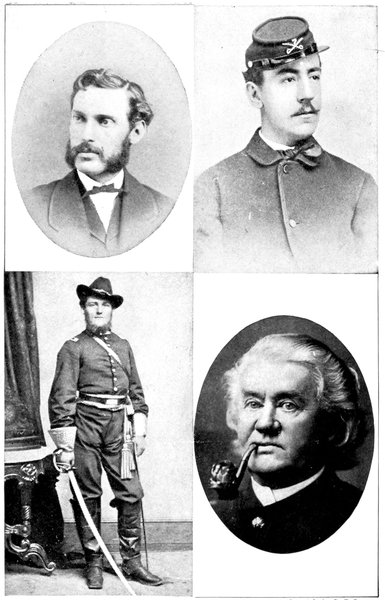
Copyright by D. F. Barry
CAPT. JAMES M. BELL CAPT. J. W. BENTEEN
SOME OFFICERS OF THE SEVENTH CAVALRY IN THE WASHITA EXPEDITION
157The band of Indians under his gaze was that of Black Kettle,[48] Head Chief of the Cheyennes since the death of Roman Nose, one of the most ferocious and brutal of the Plains Indians. The blood of scores was upon his hands and upon the hands of his followers as well. Torture, infamy, treachery, shame beyond estimation, had stained that band. Even then in the camp there were helpless captives, poor women whose fate cannot be described or dwelt upon.
When Custer had satisfied himself at last that he had found the camp for which he had been searching—which appeared to be a very large one from the number of lodges which they thought they could make out in the distance—leaving the scouts to observe the Indians, he tramped back through the snow to the command, and by messengers summoned the officers about him. Taking off their sabers for the moment, so that their clanking would not betray them, the officers crept to the crest of the hill and made themselves as familiar with the situation as they could by such inspection.
There Custer gave them their final orders. The regiment was divided into four squadrons; Major Elliott, with three troops, G, H, and M, was ordered to circle cautiously to the left and get in the rear of the Indian camp. Captain Thompson, with troops B and F, was directed to make a long detour to the right and join Elliott. Captain Myers, with troops E and I, was commanded to move a shorter distance to the right and take position on the left of Thompson, while Custer himself, with the four remaining troops—Captain Hamilton commanding one squadron, comprising troops A and C, Captain West, another, of troops D and K, with the 158Osages and scouts and forty sharp-shooters under Adjutant Cook—was to approach the village from the point where they then stood.
Not a sound was to be made, not a shot fired, not a signal given. The attack would be delivered at dawn. When they heard the bugler sounding the charge in the still air of the morning they were to rush in immediately. In order not to impede their movements the men were directed to remove their overcoats and leave them in care of the guard in the rear before the attack was delivered. Then, after hearty handshakes and whispered salutations, the officers assembled their several squadrons and silently started out upon the long detours necessary to enable them to reach their designated positions.
The Indian village was located in the valley of a small river in the Indian Territory, an affluent of the Canadian called the Washita. It was in a deep depression, below the surrounding country, and was well sheltered by trees on the banks of the stream, here easily fordable. By the time all preparations had been made in Custer’s own detachment it still wanted some four hours to dawn. The troops with Custer had nothing to do but wait where they were, and a weary, freezing wait it was. So insistent was the general that there should be no noise that he refused to allow the men even to beat their breasts to keep up circulation, or to stamp their feet to ward off the numbing cold. Conversation was forbidden. They were dealing with a warrior who was the most watchful of foemen, with men who could detect an enemy, as the Osage had the fire a mile away, seemingly by instinct. They must take every precaution. The men dismounted and stood uncomplainingly by the side of their horses. Some of them wrapped themselves in 159their overcoats, and attaching their bridle reins to their wrists, lay down on the ground and actually went to sleep.
About an hour before dawn Custer despatched the last squadron under Captain Myers, who had but a short distance to go, and then, as the first pale grayness of the morning began to steal over the eastern hills and mingle with the moonlight, he gave orders to call the troops to attention. The first sergeants went through the ranks and by a touch of the hand woke the sleeping men. Stiff and numb with the cold, they staggered to their feet, took off their overcoats, left them under the care of a small guard, and mounted their horses. Their sabers had been left behind and they were armed with revolvers and Spencer carbines. The officers quickly formed up their troops and with whispered words placed themselves at the head.
The troops were deployed in line, Hamilton’s squadron to the right, West’s to the left. Cook’s sharp-shooters were about forty yards in advance of the left, dismounted, their horses being left with the guard. Some distance in front of all the rest rode Custer. Following him was his bugler. Next to the bugler was the indomitable regimental band. The orders were, in Hamilton’s last words, “Now men, keep cool; fire low, and not too rapidly.”
The Osages had been somewhat doubtful as to the issue of the attack. They had made medicine, war-painted themselves and arrayed themselves for battle, but with a great deal of trepidation. They expected the white soldiers would be beaten, and they reasoned that in that case their allies would endeavor to purchase their own salvation by surrendering the Osages to the vengeance of their enemies. They determined to take 160such a position as would enable them to be governed by circumstances in their movements—so they could either fight or fly. They knew the reverence with which the soldiers regarded their flag. Never having been in action with the white man, they concluded that the flag would be kept in a place of safety and if they stood religiously close to the banner they would be in a good position to attack or retreat as circumstances required. Consequently, they rallied on the flag. For once the red man’s reasoning led him into trouble, for, as it happened, and as it was to be expected, the flag was in the thick of the fight, and, to give them credit, after they saw their mistake and saw no means of rectifying it, the Osages fought as bravely and as efficiently as the rest.
The command went silently down the hill, making for the center of the valley and the trees where lay the Indian camp. The excitement of the situation was intense. Nobody knew just what he was about to encounter. No one could tell whether the other troops had succeeded in getting within supporting distance or not. But Custer knew his officers, and he, rightly in this instance—alas, that it might not have been so in other cases!—depended upon them. Nearer and nearer the line approached the village. Clearer and clearer came the light from the pale sky. Little, hazy clouds of smoke floated above the tepees under the trees, but aside from that there was yet no evidence of life among them.
However cautiously it was conducted the advance of such a body of men over the snow made a great deal of noise. They had come so near the camp that they could not hope to remain undiscovered another moment. At the instant Custer was about to give the signal a rifle shot was heard on the other side of the camp. At first it was thought to be an accidental discharge from one of 161the other attacking parties. It was afterward learned that shot was fired by Black Kettle himself, who had heard the noise of the advancing troops, for every squadron had reached its appointed place, and practically at the same time they commenced their advance upon the devoted town. So soon as the crack of the rifle broke upon the still air the bugle sounded the charge.
With the first notes Custer turned to the band. Each trumpeter had his trumpet to his lips, each drummer his drum-sticks in the air.
“Play!” he shouted, and for the first time in action the stirring notes of the tune now peculiar to the Seventh Cavalry as its battle music—“Garry Owen”—broke on the air. Three answering bugle calls rang out from the different squadrons on all sides of the village. The cavalry charged, the dismounted soldiers advanced on the run. They all cheered.
IV. The Attack in the Morning
The village was strung along the banks of the creek and the troopers fell upon it like a storm. The Indians, completely surprised, nevertheless did not lose a moment. They poured out of the lodges, and seeking the shelter of the trees or standing knee-deep in the icy water of the river, with the banks acting as rifle-pits, returned the fire of the white men. A few of them succeeded in breaking away, but most of them had to fight where they were, and right well they fought.
Brave Captain Hamilton, who had sought the detail with such zeal, was shot from his horse and instantly killed. Captain Barnitz received a wound through the breast under his heart. Here and there others fell.
162Strict orders had been given to spare the women and children. Most of the squaws and children remained hidden in the tepees. Others took part in the defense. The various troops scattered throughout the village and the fighting was hand-to-hand of a most vigorous character. Captain Benteen, galloping forward, was approached by an Indian boy about fourteen years of age on horseback. The boy was armed with a revolver. As the captain drew near he called out to the lad that his life would be safe if he would throw away his weapon. Fearing he could not understand him he made peace signs to him. For reply the boy leveled his weapon and shot at the captain. The bullet missed him. The Indian fired a second time and the bullet cut through the sleeve of Benteen’s coat. The captain was still making signs of amity and friendship when the boy fired a third time and hit his horse. As he raised the pistol to fire a fourth time the officer was forced to shoot him dead.
One squaw seized a little white boy, a captive, and broke for the river. She got into hiding in some underbrush where she might have remained unmolested, but such was her malignity that she busied herself by taking pot-shots at the galloping troops with her revolver. They captured her when her revolver was empty and then discovered that she had been fighting them in spite of a broken leg.
The Indians rallied in certain places favorable for defense. In their desperation seventeen braves threw themselves into a little depression in the ground and refused to surrender, fighting until all were killed. In a ravine running from the river thirty-eight made a heroic defense until they were all shot. In all, one hundred and three were killed, including Black Kettle, the chief.
163The furious fighting had lasted one hour. The village was now in possession of the troops. A number of officers and men had been wounded and a temporary hospital was established in the middle of the village. Details were sent through the lodges to rout out the squaws and children, and a roll-call was ordered.
Custer was dismayed to find that Major Elliott and fourteen men, including Sergeant-Major Kennedy and three corporals, were missing. Where they had gone to no one at first could imagine. Finally a trooper stated that a number of Indians had escaped in the gap between Elliott and Thompson, and that he had seen Elliott with a few troopers break away in pursuit of them. An order was given for a troop to search for them, but before it could get away Indians were perceived in a heavy force on the bluffs directly in front of the command. Custer had succeeded in killing practically the whole of Black Kettle’s band, and as the Indians who had escaped had been forced to run for their lives, naked as they came from the lodges, he could not understand the appearance, just out of range of his men, of this portentous and constantly increasing force arrayed in full war panoply.
Inquiry among the captives disclosed the fact that the valley had been chosen as the winter headquarters for the principal bands of the Kiowas, Arapahoes, Cheyennes, “Dog Soldiers,”[49] Comanches, and even a wandering band of Apaches. There were at least two thousand warriors in this assemblage. At that moment 164the men who had been guarding the overcoats and the lead horses came running in saying that they had been driven off by a heavy force of Indians. The situation was indeed critical.
Something had to be done at once. Custer dismounted his men, threw them out in a half circle about the camp, and prepared for battle. The Indians did not delay in delivering it. Led by Little Raven, an Arapahoe, and Satanta,[50] a famous Kiowa, and Black Kettle’s successor, Little Rock, they at once attacked. A fierce battle was on and Custer’s ammunition was running low. The troops were now fighting for their lives. They had not expected anything of this kind. Fortunately, at this critical juncture a four-mule wagon came dashing through the Indian line. The Indians, being occupied in fighting, did not observe it until it was right upon them. Driving the wagon was Major Bell, the quartermaster, from the train. With him was a small escort. He had loaded the wagon with ammunition and galloped toward the sound of the fighting. With the fresh supplies, therefore, the troops at last made a bold charge which drove the Indians headlong down the valley, during which Little Rock, striving to rally his braves, was killed.
Custer now set fire to the lodges, totally destroying them and their contents. What to do with the ponies of the herd which had been captured in spite of the efforts of the squaws to run off with them, was a problem. It was impossible, under the circumstances, to drive them back to the camp. To turn them loose would have allowed them to fall into the hands of other Indians for use in future warfare. They had to be shot. It 165was a most unpleasant and repulsive duty for the soldiers, but there was no alternative. The whole herd was slaughtered. It took an hour and a half to kill them, and those engaged in the work said they had never done anything so harrowing and distressing.
By this time it was late in the afternoon. The Indians from the other villages, finding they were pursued but a short distance, had reassembled and once more prepared for attack. It was necessary for Custer to retreat at once. He put every available man on horseback, threw out skirmishing parties, the colors were brought up, the indefatigable band started playing, and the party advanced gaily up the valley toward the Indians. As he hoped and planned, they immediately reasoned that he would not advance with such confidence against such an overwhelming force, unless he was supported by heavy reinforcements to his command. After a short resistance they broke and fled.
It was night by this time, and Custer lost no time in getting out of the valley. The weather was still frightfully cold, and his men were without their overcoats, for they had, of course, not recovered them, and were almost perishing. They got back in safety, however, to Camp Supply, having accomplished the object of their expedition in dealing a decisive blow to the Indians. More than that, they had shown the Indians, who trusted for immunity to the season, that winter and summer were alike to the American soldier.
The Indian loss was one hundred and three killed in the village, including Black Kettle; an unknown number, believed to be large, killed and wounded during the all-day fighting, including Little Rock; the capture of fifty-three squaws and children; eight hundred and seventy-five ponies, eleven hundred and twenty-three 166buffalo robes and skins; the destruction of over five hundred pounds of powder and one thousand pounds of lead; four thousand arrows, seven hundred pounds of tobacco, besides rifles, pistols, saddle-bows, lariats, immense quantities of dried beef, and other winter provisions; in short, the complete destruction of the village and the annihilation of the band.
The losses of the regiment in the engagements were one officer and fourteen men missing (Elliott and his party), one officer and five men killed, three officers and eleven men wounded. General Sheridan called the affair the most complete and satisfactory battle ever waged against the Indians to that time.
Custer had marched through that blizzard and over the snow-clad plains to victory. His stealthy approach, the skill with which he had surrounded the village, the strength with which the attack had been delivered, and the battle which he had fought with the unexpected Indian force, the ruse by which he had extricated himself, and, last but not least, Bell’s gallant dash with the ammunition wagon, were all given the highest praise. And well they merited it.
One or two incidents of the battle are worthy of especial mention. When the troops obtained possession of the village, they found the dead body of a white woman. The fact that she still had some vestige of civilized clothing upon her, quite new, proved that she had been but recently captured. She had been shot dead by the Indians at the moment of attack to prevent her rescue; and there was also the body of a little white child, who had been killed by those who had him in charge, lest he should be returned to his family again.
The squaws, of course, were in great terror. They thought they would be instantly put to death when 167they were routed from their tepees. Black Kettle’s sister, Mah-wis-sa, who seemed to be the leading woman of the village, made a long oration to Custer, telling him that she was a good Indian, and that she had tried to restrain Black Kettle in his nefarious career—which was all a lie, of course. She wound up by bringing the comeliest of the young Indian maidens to Custer, and, after solemnly placing the hand of the girl in that of the General, mumbled some kind of a gibberish over the two. The General observed Romeo standing near with a broad grin upon his face, and asked him what Mah-wis-sa was doing. He was told that she was marrying him to the beauty of the tribe to propitiate him. That marriage did not stand.
V. The Fate of Elliott and his Men
The fate of Elliott’s detachment remained a mystery. His comrades hoped that he had escaped, but as the days passed and he did not return to the regiment, and as nothing was heard from him, they abandoned hope in despair. This was not, by any means, the end of the winter campaigning; and some time after, Custer and his men, this time heavily reinforced, again marched up the valley of the Washita. A short distance from the place where Black Kettle’s band had been annihilated they found the remains of Elliott and his men. The evidence of the field and what was afterward learned from Indian captives told the sad story.
Pursuing the fleeing Indians, Elliott and his party suddenly ran into the midst of a horde of braves coming down the valley to help Black Kettle and the men who had been engaged with Custer. To fly was impossible. They dismounted from their horses, formed themselves 168in a semicircle a few feet in diameter, stood back to back, as it were, and fought until they died. There were evidences of a terrible conflict all around them. Right dearly had they sold their lives.
The last survivor of that gallant little band had been Sergeant-Major Kennedy, the finest soldier in the regiment. He was not wounded, it appeared, but had expended all his ammunition for both rifle and revolver. Being an officer, he wore a sword. Seeing him, as they supposed, helpless, the Indians resolved to take him alive for the purpose of torturing him. There was not a soldier who knew of the habits of the Indians who would not chose death to captivity any time. The brave Kennedy stood alone in the midst of the bodies of his comrades, fronting death, sword in hand. I like to think of the courage of that heroic man in the midst of that savage, ravening assemblage.
With wily treachery the Indians made peace signs, and walked toward him with hands outstretched, saying: “How, How!” Kennedy, who knew the true value of such proceedings, waited until the chief of the band approached him nearly, then thrust his sword up to the hilt into the Indian’s breast. When they found Kennedy’s body he had been pierced by no less than twenty bullets. The other troopers had received one or two bullet wounds each. They were all stripped, scalped, and mutilated.[51]
There was a great outcry when this battle became known, and Custer was accused of slaughtering helpless, inoffensive, gentle Indians! Unmerited obloquy was heaped upon him, but those who lived near enough to feel the effects of the Red Scourge realized that he had done for the settlers the best thing that could be done. 169People who knew, and his superior officers, not only sustained but commended him.
Custer again, in command of a much larger force, surprised a more populous village later in this same winter. It was completely in his power. He could have wiped it from the face of the earth, although it contained a force of Indians nearly equal to his own; but he stayed his hand, and said he would spare the savages if they would deliver to him two wretched women, one a young bride, the other a young girl, whom they held in captivity and for whose deliverance the campaign had been undertaken. By masterly skill Custer captured Satanta the Infamous, and held him until the captives were given up. With the expedition was the brother of one of the captives. Custer tells, in his simple, terse manner, with what feelings that whole army watched the poor women brought into camp, and how the boy, the last of his family, stood trembling by the general’s side until he recognized, in one of the wrecks of humanity which the Indians handed over, the sister whom he was seeking.[52] The red-headed cook, referred to above, was with the army again, and proved herself, in her rude way, an angel of mercy and tenderness to these, her wretched sisters.
170
CHAPTER ELEVEN Carr and Tall Bull at Summit Springs
I. A Brilliant Little Fight
General Eugene A. Carr, in command of the Fifth Cavalry, did some brilliant skirmishing and fighting in 1868–9 western Kansas and Colorado. His most notable exploit was the surprise of Tall Bull’s camp. Next to Black Kettle, Tall Bull was probably the most vicious and diabolical of the Indian raiders in these two states.
Carr, with five troops of the Fifth Cavalry and with W. F. Cody (Buffalo Bill) as chief guide, learning where Tall Bull’s camp was, marched one hundred and fifty miles in four days in pursuit of him. Halting when he believed he had reached the vicinity of the camp, he sent Buffalo Bill with some of his Pawnee Indian auxiliaries to find out exactly where the Indians were located.
Cody, having discovered the location of the village, returned to General Carr and advised him to take a wider detour, keeping his forces concealed among the hills, so that he could approach the Indians from the north, a direction from which they would not be expecting attack, and whence they might be the more easily surprised. The advice was followed, the command made its encircling march without detection, and formed up 171in line of troops, each troop two abreast, in the ravines about twelve hundred yards from the village.
They were between the Indians and the Platte River. The camp was located at Summit Springs, Colorado. Every preparation having been made, Carr ordered the bugler to sound the charge. The man was so excited that he was unable to produce a note. Twice Carr gave the command. Finally, Quartermaster Hayes snatched the bugle from the agitated musician and sounded the charge himself, and the whole regiment rushed out into the open.
The Indians made for their ponies and advanced to meet the charge. The rush of the soldiers was too threatening, however. After a hasty fire they broke and fled on their horses, the whole party, soldiers and Indian scouts, following after at full speed through the village. The attack was a complete success. Fifty-two Indians were killed, two hundred and seventy-four horses and one hundred and forty-five mules were captured. The soldiers had one man wounded, with no other casualties.
In the camp were found the bodies of two unfortunate white women, who had been captured. Swift as had been the dash of the soldiers, the Indians had taken time to brain one of the women with a war-club, while the second was shot in the breast and left for dead. She was given every possible attention by the soldiers, who took her back to Fort Sedgwick, and her life was eventually spared. Her sufferings and treatment had been beyond description. Fifteen hundred dollars in money—in gold, silver, and greenbacks—strange to say, had been found in the camp. This sum the soldiers, by permission of the general, donated to the poor woman, as an expression of their sympathy for her.
According to some accounts, Tall Bull, who was chief 172of the camp, and one of the head chiefs of the Sioux, was killed in this attack. Buffalo Bill tells another story.[53] The day after the fight the various companies of the Fifth Cavalry—which had remained in the camp all the ensuing day and night, at the insistence of the plucky commander, in spite of the pleas of some of the officers, who, fearing an attack in force, suggested retiring immediately—separated in order the more effectively to pursue the flying Indians. Several days after the surprise the detachment for which Cody was guide was attacked by several hundred Indians. The soldiers fought them off, killing a number. The chief of this party was believed by Cody to be Tall Bull.
Buffalo Bill crept through a ravine for several hundred feet, unobserved by the Indians, until he reached an opening whence he had the savages in range. Watching his opportunity as the Indians were careering wildly over the prairie, he drew a bead on the chief and shot him dead. Whether that was Tall Bull or not, one fact is clear—that he was killed either then or before, for he was certainly dead thereafter.
When the troops were following the Indian trails on the march to Summit Springs, at every place where the Indians had camped they found marks of white women’s shoes. It was this knowledge that gave additional determination and fire to their magnificent attack.
General Carr deservedly gained great reputation for his dash and daring.
Here I include a letter describing this battle from the standpoint of a soldier, which is a most interesting contribution to the story of the affair:
173
II. Account of the Battle of Summit Springs
Written by J. E. Welch to his comrade, Colonel Henry O. Clark, of
Vermont.[54]
The next spring, 1869, I heard that General Eugene A. Carr, commanding a detachment of the Fifth U. S. Cavalry, was organizing an expedition to go after a large band of Indians (Sioux and Cheyennes) who had been raiding and murdering through Colorado, New Mexico, and Kansas. Some other fellows and myself went to Fort McPherson and offered our services as volunteers to serve without pay. The general could not accept our services, but he said we could go along and act with the scouts—so along we went.
The expedition consisted of about four hundred cavalry, one hundred and fifty Pawnee scouts, under Colonel Frank North, and about twenty civilians. Buffalo Bill was the guide. He struck out for the Republican River, and the first night after we got there the hostiles tried to stampede our horses; they came near accomplishing their object, too, but they only succeeded in wounding a teamster and killing a mule. Next day we found the trail of their main body and followed it, but soon found that we could not gain an inch on them; we kept on, however, until we came to a place where the trail divided. The trail to the right was very plain, while the one to the left was scattered and so dim it was evident to the most inexperienced man in the command that the trail they intended us to follow was the one to the right. So General Carr detached two troops of 174cavalry and some Indians, under Major Royall, caused them to make as big a show as possible and take the decoy trail, while the main body was kept back in a low place for a day in order that any hostile scouts who might be watching us would think the whole command had gone on the decoy trail. Next day we started on the dim trail, and before night we became satisfied that we were on the trail of the main body of the hostiles. Major Royall followed the decoy trail until it scattered, then turning the head of his column to the left he intercepted and rejoined the command. We now found that we were gaining on the game we were after. They evidently thought they had fooled us, and were taking their time.
On the tenth of July we marched sixty-five miles, passing three of their camps. On the eleventh we were on the march before daylight. The trail was hot, the Indians making for the Platte. Every one knew that if they succeeded in crossing the river the game was up. By noon we had marched thirty-five miles, at which time Buffalo Bill, who had been far in advance of the command all day, was seen approaching as fast as his tired horse could come. As soon as he reached the column he called for a fresh horse, and while transferring his saddle told General Carr that he had encountered two bucks who were hunting and that the Indian camp was about twelve miles ahead.
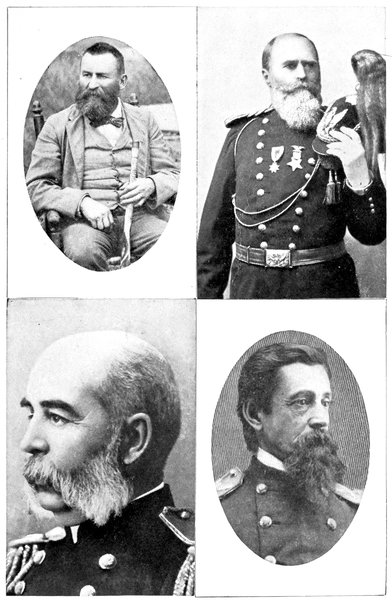
GEN. GEORGE CROOK GEN. EUGENE A. CARR
GEN. ELWELL S. OTIS GEN. HENRY B. CARRINGTON
GROUP OF DISTINGUISHED GENERAL OFFICERS
The general, knowing the bucks who had been run off by Cody would make every effort to reach their camp ahead of us in order to give the alarm, gave the command “Trot.” Both horses and men seemed to brighten up, and we put real estate behind us at a rapid rate. When within a mile of the hostile camp a halt was called to let the Pawnees unsaddle, as they flatly refused to go 175into action with saddles on their horses. They began daubing their faces with paint and throwing off their clothing. They were made to retain enough of the latter to enable us to distinguish them from the hostiles. After this short delay we moved forward at a sharp trot, and in a few moments we were looking down at “Tall Bull’s” camp in a small valley below us. In a moment the camp was alive with Indians running in every direction.
General Carr, taking in the situation at a glance, gave utterance to a few words of command, winding up his remarks with the order, given loud and clear and sharp:
“Charge!”
Every horse leaped forward at the word, and in a twinkling we were among them and the fight was on. It did not last long. There was rapid firing for about five minutes, when all was over except an occasional shot as some fellow would find an Indian who had failed to secure a horse and escape.
The result of the fight was about as following: no white men killed, four or five horses killed, about one hundred and eighty-eight dead Indians, forty of whom were squaws and children;[55] one hundred and five lodges captured, many rifles, five tons of dried buffalo meat baled for winter use, a very ample supply of ammunition, consisting of powder, lead, etc., and a greater number and variety of brass kettles than I ever saw before.
Of their live stock we captured five hundred and sixty head of ponies and mules.
To pursue those who had fled was out of the question, our horses being too badly done up. As we charged the camp, we saw a white woman run from among the 176Indians, one of whom fired at her as she ran. We shouted to her to lie down, which she did, our horses leaping over her without a hoof touching her. She was wounded in her side, but not fatally. Almost at the same moment we saw an Indian seize another white woman by the hair and brain her with a tomahawk. Some of us rode straight for that Indian, and there was not a bone left in his dead carcass that was not broken by a bullet. I dismounted in the midst of the hubbub to see if I could help the woman, but the poor creature was dead. (She had the appearance of being far gone in pregnancy.) I mounted my horse again with a very good stomach for a fight.
After firing a few shots, I happened to see a Red mounted on a large paint pony making off by himself, and driving four fine mules ahead of him. I gave chase and gained on him rapidly, which he soon perceived, dropping his mules and doing the best he could to get away. But it was no use. “Sam,” my horse, was Kentucky bred, and walked right up on him. When I was within seventy-five or one hundred yards of him he wheeled his horse and fired, the bullet passing through the calf of my leg and into my horse. The Indian threw his gun away and rode at me like a man, discharging arrows as he came. The third arrow split my left ear right up to my head. It was then my turn, and I shot him through the head. This Indian’s name was “Pretty Bear.” He was chief of a band of Cheyennes. The Pawnees knew him and were anxious to secure his scalp, which I was glad to give them as I soon became disgusted with the ghastly trophy. “Pretty Bear” had on his person the badge of a Royal Arch Mason, with West Springfield, Ill., engraved on it. I sent the badge to the postmaster at Springfield with a statement as to 177how it came into my possession. “Pretty Bear” had five or six scalps on the trail of his shield, one of which was that of a woman. The hair was brown, very long, and silken.
“Tall Bull,” the Sioux chief, was killed by Lieutenant Mason, who rode up to him and shot him through the heart with a derringer. After I had taken the scalp of “Pretty Bear” I found that Sam was shot through the bowels. I unsaddled him and turned him loose to die, but he followed me like a dog and would put his head against me and push, groaning like a person. I was forced to shoot him to end his misery. I had to try two or three times before I could do it. At first to save my life I could not do it. He kept looking at me with his great brown eyes. When I did fire he never knew what hurt him. He was a splendid horse, and could do his mile in 1.57.
My wounds being slight, I rustled around and soon managed to catch a small mule, which I mounted bareback, intending to scout around a little. I did not carry out my intention, however. The brevet horse ran into the middle of the Indian camp, threw me into a big black mud-hole, my boot was full of blood, my ear had bled all over one side of me, so that when I crawled out of that mud-hole I was just too sweet for anything. By this time the fight was over. A friend of mine, Bill Steele, went with me to the spring that ran into the mud-hole, where he washed me as well as he could, bandaged my leg, sewed my ear together with an awl and some linen thread. He made a good job of it, and I was all right except that my leg was a little sore and stiff.
After the fight we found we had one hundred and seventeen prisoners, four squaws, and fifteen children. They were turned over to the Pawnees. The Pawnees 178did not fight well. They skulked and killed the women and children. I have never seen Indians face the music like white men. We camped where we were that night. Men were coming into camp all night. In fact, they did not reach the scene of action until about ten o’clock next day. They were fellows who had been left along the trail by reason of their horses giving out.
Our first duty next day was to bury the poor woman they had so foully murdered the day before. Not having a coffin, we wrapped her in a buffalo robe. General Carr read the funeral service and the cavalry sounded the funeral dirge, and as the soft, mournful notes died away many a cheek was wet that had long been a stranger to tears. The other woman was found to be all right with the exception of a wound in the side. She was a German, unable to speak English. Both of the women had been beaten and outraged in every conceivable manner. Their condition was pitiful beyond any power of mine to portray.
The Indian camp and everything pertaining thereto was destroyed, after which we took up our line of march for Fort Sedgwick, where we arrived in due time without any mishap.
I think it just as impossible to make a civilized man of the Indian as it would be to make a shepherd dog of a wolf, or a manly man of a dude. They do not in my opinion possess a single trait that elevates a man above a brute. They are treacherous, cowardly, and ungrateful, Cooper to the contrary notwithstanding. I knew a Greek in Arizona who came to the country with camels for the government. After the camels died he married an Apache squaw, learned the language, and was employed by the United States government as an interpreter. This man told me that in the Apache dialect 179there was no word, or combination of words, whereby they could convey the idea that we do by using the word Gratitude. What do you think of that?
Well, old man, I have been writing half the night, and have only got as far as the 11th of July ’69. I am discouraged, and right here I quit you like a steer in the road. How long am I to wait for that picture? I am curious to see how much of a change old dad Time has wrought in you. He has played h—l with me.
As ever,
J. E. Welch.
P. S. The photo has come. I could have known you anywhere. You have changed a little—for the better, I think.
J. E. W.
181