Part I Protecting the Frontier (continued 2)
Reading edition
During the summer of ’67 life was one continual round of fighting. We lost a great many men, but damaged the Sioux much more than during the previous 66year. The soldiers had better guns, and were far better Indian fighters. They had learned that it was safer to keep their faces to the Indians, than, as during the previous year, their backs. When you run from an Indian you are his meat.
On the day of the wagon-box fight, accompanied by my partner, I left the fort before daylight. We went to the foot-hills to get some deer. A short time after daylight we discovered a lot of Indian smoke signals on the hills, and decided that we had better get back to the fort. In making our way back we followed the Little Piney down for some distance, and found that the country was full of Indians. We then struck out for the wood train. The Indians had got between us and it. We then went to the wagon-box corral, and got there none too soon.
Your description of the corral is correct as I remember it to be. Its location is about right, except that it was not on an island. I never heard of Little Piney Island, and I do not believe such an island existed there at that time.[26] The wagon boxes were of the ordinary government boxes. They were set off from the wagons, as the wagons were in corral. The intervals between were packed with logs, bales of blankets, clothing, sacks of corn, etc. As to the wagon boxes being lined with iron, you are right. They were not. Up to that time, and during my time on the plains, I never saw wagon boxes so lined. The wagon box that I was detailed to fight in had no such protection, but we had gunny sacks of corn placed on edge two deep on the inside of the box, with a two inch auger hole at the point where the four sacks came together. This made good protection for 67the body when lying down. As stated in your article, the tops of the wagon boxes were literally torn to pieces with the bullets fired at us by the Indians. Without this protection the fight would not have lasted very long.
There was a surplus of ammunition and guns. I had two Spencer carbines, and two revolvers (six-shot army Colt’s). During the first charge I emptied the carbines and the revolvers less two shots (reserved for myself in case of a show down). The balance of our men must have fired as many shots as I did. The soldier that was in the box with me had a needle gun and a Spencer; also one or two revolvers. And he kept them busy while he lived. This man was an infantry soldier—do not remember his company. He was shot through the head, dying in about two hours after being shot.
Lieutenant Jenness had just cautioned me not to expose my person, and to hold my fire until I was sure of getting an Indian at each shot. He had moved a few feet from my box when he was shot through the head. I think he died instantly. He was a grand, good man, and a fearless officer. I told him to keep under cover. He stated he was compelled to expose himself in order to look after his men.
I got a slight wound in my left hand; a bullet came in through my porthole, which I thought was close shooting for a Sioux.
This fight lasted about four hours, and was very hot from the start. I had been in several Indian fights prior to this time, but never saw the Indians make such a determined effort to clean us up before. They should have killed the entire party. They certainly had force enough to ride over us, but our fire was so steady and severe that they could not stand the punishment.
68Our men stood the strain well, held their fire until the bullets would count. In fact, shooting into such a mass of Indians as charged on us the first time, it would be nearly impossible for many bullets to go astray. In all my experience in fighting Indians prior to this time, I never saw them stand punishment so well as they did at this time; they certainly brought all their sand with them. In charging on our little corral they rode up very close to the wagon boxes, and here is where they failed. Had they pushed home on the first charge, the fight would not have lasted ten minutes after they got over the corral.
Many dead and wounded Indians lay within a few feet of the wagon boxes. The wounded Indians did not live long after the charge was over. They would watch and try to get a bullet in on some of our men. We had to kill them for self-protection. Anyway, it was evening up the Fetterman deal. They never showed mercy to a wounded white man, and should not expect any different treatment. I had a canteen of water when the fight commenced, and used most of it to cool my guns.
You state that all of our loss occurred at time of the first charge. This is an error, as the man in my box was shot after he had been fighting nearly an hour. I think that his name was Boyle. Up to the time that he was shot he certainly filled the bill and did his duty, dying with his face to the foe as a soldier should.
I do not try to estimate the number of the Indians, but, as my partner said, “The woods were full of them.” This was the largest gathering of Indians that I ever saw, and the hardest fighting lot that I ever encountered.
When the reinforcements came in sight we took on a new lease of life, and when they dropped a shell over the 69Indians we knew that the fight was won. Indians will not stand artillery fire. They call it the “wagon gun.” The reinforcements came just in time. One hour more of such fighting would have exhausted our men and ammunition.
As to the Indians carrying off all their dead and wounded, here you are again mistaken, as many of our men carried away with them scalps, etc., taken from the bodies of the dead Indians near the corral.[27] The Indians certainly hauled off all their dead and wounded that they could, but did not expose themselves very much in order to get the dead ones near the corral.
On arrival of reinforcements we immediately retreated to the fort. Captain Powell was the right man to command under such trying circumstances. No better or braver man ever held a lieutenant’s commission than Jenness. As to the Indian loss, I think you have overestimated it. We thought that we had killed and wounded some more than four hundred. However, you may be right in your estimates. We had the opportunity to clean up that number, and we certainly did our best to do so.
After the massacre of ’66 (Dec.) we received reinforcements, as I now remember, four companies of infantry and two companies, L and M, of the 2d Cav. This large additional force, stationed at a four-company fort, and only provisioned for four companies, caused a great deal of suffering during the winter, resulting in 70much sickness and many deaths from scurvy. Nearly all of us were suffering from this disease. I have never fully recovered from the effect of it.
Colonel Carrington was severely censured by the War Department and many others for the Fort Phil Kearney massacre, and, I think, unjustly. Had Col. Fetterman and Capt. Brown and the other officers in command obeyed his orders, the massacre would not have occurred, not, at least, at this time.
Fetterman and Brown were dare-devil fighters, always anxious for a fight, and took this opportunity to get into one. Capt. Brown, on his “calico” pony, was a familiar figure around this fort—the boys called him “Baldy.” The Indians were very anxious to kill Brown; he was a thorn in their sides. While we to some extent lay the blame of the massacre on Brown and Fetterman, to be honest, we were nearly all partly to blame. We were always harping at the colonel to send a large force out and fight the Indians, but he always insisted on a conservative course. We all thought up to that time that one hundred good men could walk through the entire Sioux Nation. This massacre demonstrated that in a fight in the open the Sioux should not have over five to one of us.
I was well posted in regard to the Carrington Powder River Expedition of 1866 and the history of Fort Phil Kearney from the date of establishment to Nov., 1867, and acquainted with all of the officers and many of the soldiers and citizens. I probably would not have written this little statement of actual history were it not for the fact that in your article you stated that you got some of the record from the only living member of the celebrated wagon-box fight. I am still in the flesh and will pull down the scale at two hundred 71pounds. In all probability there are others alive, as we all were young men at that time.
The history of the three forts established in 1865 and 1866, well written, would make interesting history, as almost every day was full of stirring events. Quite a number of the citizens in that country at this time were discharged volunteer soldiers and some rebel soldiers also. As a rule, they were hard nuts for the Indians to crack. It was noticeable that they would not take chances fighting citizens that they would take with the soldiers.
After leaving Fort Phil Kearney I went to Cheyenne and followed the Union Pacific R. R. to the finish. Was at Promontory Point in Utah when the Union Pacific and Central Pacific R. Rs. connected; this was one of the mile-stones in the history of the West, and practically solved the Indian problem. The Indians fought hard for this territory. It was the best hunting ground that they had left. There were many half-breeds among them, and they were daring and shifty fighters.
Respectfully yours,
R. J. Smyth”
72
CHAPTER FIVE Forsyth and the Rough Riders of ’68
I. The Original “Rough Riders.”
No one will question the sweeping assertion that the grittiest band of American fighters that history tells us of was that which defended the Alamo. They surpassed by one Leonidas and his Spartans; for the Greeks had a messenger of defeat, the men of the Alamo had none. But close on the heels of the gallant Travis and his dauntless comrades came “Sandy” Forsyth’s original “Rough Riders,” who immortalized themselves by their terrific fight on Beecher’s Island on the Arickaree Fork of the Republican River, in Eastern Colorado, in the fall of 1868.
The contagion of the successful Indian attacks on Fort Phil Kearney had spread all over the Central West. The Kansas Pacific was then building to Denver, and its advance was furiously resisted by the Indians. As early as 1866, at a council held at Fort Ellsworth, Roman Nose, head chief of the Cheyennes, made a speech full of insolent defiance.
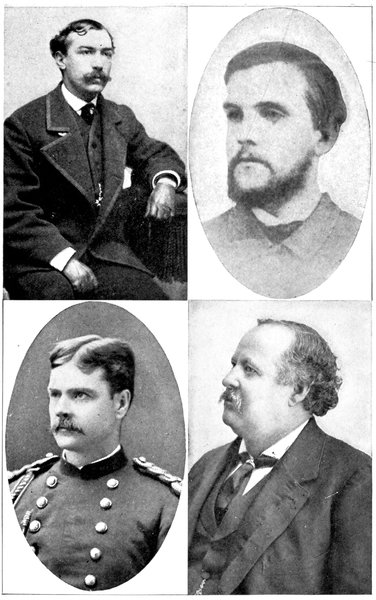
CAPT. LOUIS H. CARPENTER LIEUT. FREDK. H. BEECHER[29]
MAJ. GEORGE A. FORSYTH SCOUT JACK STILLWELL
BEECHER’S ISLAND FIGHTERS
All contemporary portraits except Stillwell’s
73“This is the first time,” said the gigantic warrior, who was six feet three and magnificently proportioned,[28] “that I have ever shaken the white man’s hand in friendship. If the railway is continued I shall be his enemy forever.”
There was no stopping the railway. Its progress was as irresistible as the movement of civilization itself. The Indians went on the war-path. The Cheyennes were led by their two principal chiefs, Black Kettle being the second. We shall see subsequently how Custer accounted for Black Kettle. This story deals with the adventures of Roman Nose.
As fighters these Indians are entitled to every admiration. As marauders they merit nothing but censure. The Indians of the early days of the nation, when Pennsylvania and New York were border states, and across the Alleghenies lay the frontier, were cruel enough, as the chronicle of the times abundantly testify; but they were angels of light compared with the Sioux and Cheyennes, the Kiowas, Arapahoes and Comanches, and these in turn were almost admirable beside the Apache. The first-named group were as cruel as they knew how to be, and they did not lack knowledge, either. The Apaches were more ingenious and devilish in their practices than the others. The Sioux and the Cheyennes were brutal with the brutality of a wild bull or a grizzly bear. To that same kind of brutality the Apaches added the malignity of a wildcat and 74the subtlety of a snake. The men of the first group would stand out and fight in the open to gain their ends, although they did not prefer to. They were soldiers and warriors as well as torturers. The Apache was a lurking skulker, but, when cornered, a magnificent fighter also.[30] General Crook calls him “the tiger of the human species.” However, from the point of detestableness there wasn’t much to choose between them.
Perhaps we ought not to blame the Indians for acting just as our ancestors of, say the Stone Age, acted in all probability. And when you put modern weapons and modern whisky in the hands of the Stone Age men you need not be surprised at the consequences. The Indian question is a terrible one any way you take it. It cannot be denied they have been treated abominably by the United States, and that they have good cause for resentment; but the situation has been so peculiar that strife has been inevitable.
As patriots defending their country, they are not without certain definite claims to our respect. Recognizing the right of the aborigines to the soil, the government has yet arbitrarily abrogated that right at pleasure. At times the Indians have been regarded as independent nations, with which all differences were to be settled by treaty as between equals; and again, as a body of subjects whose affairs could be and would be administered willy-nilly by the United States. Such vacillations are certain to result in trouble, especially as, needless to say, the Indians invariably considered themselves as much independent nations as England and France might consider themselves, in dealing with the United States or with one another. And the Indians naturally 75claimed and insisted that the territory where their fathers had roamed for centuries belonged solely and wholly to them. They admitted no suzerainty of any sort, either. And they held the petty force the government put in the field in supreme contempt until they learned by bitter experience the illimitable power of the United States.
To settle such a growing question in a word, offhand, as it were, is, of course, impossible, nor does the settlement lie within the province of these articles; but it may be said that if the United States had definitely decided upon one policy or the other, and had then concentrated all its strength upon the problem; if it had realized the character of the people with whom it was dealing, and had made such display of its force as would have rendered it apparent, to the keenest as well as to the most stupid and besotted of the Indians, that resistance was entirely futile, things might have been different. But it is the solemn truth that never, in any of the Indian wars west of the Missouri, has there been a force of soldiers in the field adequate to deal with the question. The blood of thousands of soldiers and settlers—men, women, and children—might have been spared had this fact been realized and acted upon.
The Cheyennes swept through western Kansas like a devastating storm. In one month they cut off, killed, or captured eighty-four different settlers, including their wives and children. They swept the country bare. Again and again the different gangs of builders were wiped out, but the railroad went on. General Sheridan finally took the field in person, as usual with an inadequate force at his disposal. One of his aides-de-camp was a young cavalry officer named George Alexander Forsyth, commonly known to his friends as “Sandy” 76Forsyth. He had entered the volunteer army in 1861 as a private of dragoons in a Chicago company. A mere boy, he had come out a brigadier-general. In the permanent establishment he was a major in the Ninth Cavalry. Sheridan knew him. He was one of the two officers who made that magnificent ride with the great commander that saved the day at Winchester, and it was due to his suggestion that Sheridan rode down the readjusted lines before they made the return advance which decided the fate of the battle. During all that mad gallop and hard fighting young Forsyth rode with the General. To-day he is the only survivor of that ride.
Forsyth was a fighter all through, and he wanted to get into the field in command of some of the troops operating directly on the Indians in the campaign under consideration. No officer was willing to surrender his command to Forsyth on the eve of active operations, and there was no way, apparently, by which he could do anything until Sheridan acceded to his importunities by authorizing him to raise a company of scouts for the campaign. He was directed, if he could do so, to enlist fifty men, who, as there was no provision for the employment of scouts or civilian auxiliaries, were of necessity carried on the payrolls as quartermasters’ employees for the magnificent sum of one dollar per day. They were to provide their own horses, but were allowed thirty cents a day for the use of them, and the horses were to be paid for by the government if they were “expended” during the campaign. They were equipped with saddle, bridle, haversack, canteen, blanket, knife, tin cup, Spencer repeating rifle, good for seven shots without reloading, six in the magazine, one in the barrel, and a heavy Colt’s army revolver. There were no 77tents or other similar conveniences, and four mules constituted the baggage train. The force was intended to be strictly mobile, and it was. Each man carried on his person one hundred and forty rounds of ammunition for his rifle and thirty rounds for his revolver. The four mules carried the medical supplies and four thousand rounds of extra ammunition. Each officer and man took seven days’ rations. What he could not carry on his person was loaded on the pack mules; scanty rations they were, too.
As soon as it was known that the troop was to be organized, Forsyth was overwhelmed with applications from men who wished to join it. He had the pick of the frontier to select from. He chose thirty men at Fort Harker and the remaining twenty from Fort Hayes. Undoubtedly they were the best men in the West for the purpose. To assist him, Lieutenant Frederick H. Beecher, of the Third Infantry, was detailed as second in command. Beecher was a young officer with a record. He had displayed peculiar heroism at the great battle of Gettysburg, where he had been so badly wounded that he was lame for the balance of his life. He was a nephew of the great Henry Ward Beecher and a worthy representative of the distinguished family whose name he bore. The surgeon of the party was Dr. John H. Mooers, a highly-trained physician, who had come to the West in a spirit of restless adventure. He had settled at Hayes City and was familiar with the frontier. The guide of the party was Sharp Grover, one of the remarkable plainsmen of the time, regarded as the best scout in the government service. The first-sergeant was W. H. H. McCall, formerly brigadier-general, United States Volunteers. McCall, in command of a Pennsylvania regiment, had been promoted for conspicuous 78gallantry on the field, when John B. Gordon made his magnificent dash out of Petersburg and attacked Fort Steadman.
The personnel of the troop was about equally divided between hunters and trappers and veterans of the Civil War, nearly all of whom had held commissions in either the Union or Confederate Army, for the command included men from both sides of Mason and Dixon’s line. It was a hard-bitten, unruly group of fighters. Forsyth was just the man for them. While he did not attempt to enforce the discipline of the Regular Army, he kept them regularly in hand. He took just five days to get his men and start on the march. They left Fort Wallace, the temporary terminus of the Kansas Pacific Railroad, in response to a telegram from Sheridan that the Indians were in force in the vicinity, and scouted the country for some six days, finally striking the Indian trail, which grew larger and better defined as they pursued it. Although it was evident that the Indians they were chasing greatly outnumbered them, they had come out for a fight and wanted one, so they pressed on. They got one, too.[31]
II. The Island of Death
On the evening of the fifteenth of September, hot on the trail, now like a well-beaten road, they rode through a depression or a ravine, which gave entrance into a valley some two miles wide and about the same length. Through this valley ran a little river, the Arickaree. They encamped on the south bank of the river about four o’clock in the afternoon. The horses and men were weary with hard riding. Grazing was good. They were within striking distance of the Indians now. Forsyth believed there were too many of them to run away from such a small body as his troop of scouts. He was right. The Indians had retreated as far as they intended to.
79
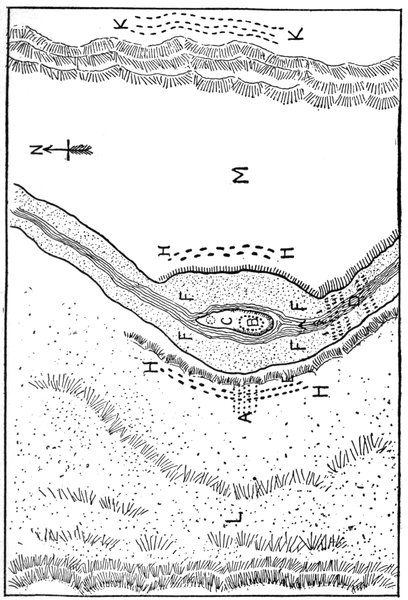
MAP OF FORSYTH’S DEFENSE OF BEECHER’S ISLAND, ARIKAREE RIVER, COLORADO (Drawn by the author from rough sketches and maps furnished by General Forsyth) Explanation of Map: A. Forsyth’s camp before attack. B. Rifle-pits on island. C. Low, unoccupied land on island with solitary cottonwood at end. D. Indian charge led by Roman Nose and Medicine Man. EE. Low banks fringed with trees. FF. Dry sandy bed of the river. HH. Indian riflemen on the banks. KK. Indian women and children on bluffs, half a mile from river. L. Ground sloping gently to river. M. Level grassy plain to bluffs.
80The river bed, which was bordered by wild plums, willows and alders, ran through the middle of the valley. The bed of the river was about one hundred and forty yards wide. In the middle of it was an island about twenty yards wide and sixty yards long. The gravelly upper end of the island, which rose about two feet above the water level, was covered with a thick growth of stunted bushes, principally alders and willows; at the lower end, which sloped to the water’s edge, there rose a solitary cottonwood tree. There had been little rain for some time, and this river bed for the greater part of its width was dry and hard.[32] For a space of four or five yards on either side of the island there was water, not over a foot deep, languidly washing the gravelled shores. When the river bed was full the island probably was overflowed. Such islands form from time to time, and are washed away as quickly as they develop. The banks of the river bed on either side commanded the island.
The simple preparations for the camp of that body of men were soon made. As night fell they rolled themselves in their blankets, with the exception of the sentries, and went to sleep with the careless indifference of veterans under such circumstances.
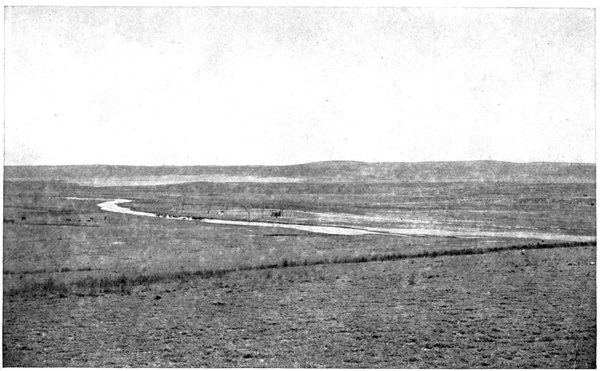
BEECHER’S ISLAND FIELD The battle took place just about where the cattle are standing in the river. The shifting current has obliterated the Island.
81Forsyth, however, as became a captain, was not so careless or so reckless as his men. They were alone in the heart of the Indian country, in close proximity to an overwhelming force, and liable to attack at any moment. He knew that their movements had been observed by the Indians during the past few days. Therefore the young commander was on the alert throughout the night, visiting the outposts from time to time to see that careful watch was kept.
Just as the first streaks of dawn began to “lace the severing clouds,” he happened to be standing by the sentry farthest from the camp. Silhouetted against the sky-line they saw the feathered head of an Indian. For Forsyth to fire at him was the work of an instant. At the same time a party which had crept nearer to the picket line unobserved dashed boldly at the horses, and resorting to the usual devices with bells, horns, hideous yells, and waving buffalo robes, attempted to stampede the herd.
Men like those scouts under such circumstances slept with their boots on. The first shot called them into instant action. They ran instinctively to the picket line. A sharp fire, and the Indians were driven off at once. Only the pack mules got away. No pursuit was attempted, of course. Orders were given for the men to saddle their horses and stand by them. In a few moments the command was drawn up in line, each man standing by his horse’s head, bridle reins through his left arm, his rifle grasped in his right hand—ready! Scarcely had the company been thus assembled when Grover caught Forsyth’s arm and pointed down the valley.
“My God!” he cried, “look at the Injuns!”
In front of them, on the right of them, in the rear of 82them, the hills and valleys on both sides of the river seemed suddenly to be alive with Indians. It was as quick a transformation from a scene of peaceful quiet to a valley filled with an armed force as the whistle of Roderick Dhu had effected in the Scottish glen.
The way to the left, by which they had entered the valley, was still open. Forsyth could have made a running fight for it and dashed for the gorge through which he had entered the valley. There were, apparently, no Indians barring the way in that direction. But Forsyth realized instantly that for him to retreat would mean the destruction of his command, that the Indians had in all probability purposely left him that way of escape, and if he tried it he would be ambushed in the defile and slain. That was just what they wanted him to do, it was evident. That was why he did not attempt it. He was cornered, but he was not beaten, and he did not think he could be. Besides, he had come for that fight, and that fight he was bound to have.
Whatever he was to do he must do quickly. There was no place to which he could go save the island. That was not much of a place at best, but it was the one strategic point presented by the situation. Pouring a heavy fire into the Indians, Forsyth directed his men to take possession of the island under cover of the smoke. In the movement everything had to be abandoned, including the medical stores and rations, but the precious ammunition—that must be secured at all hazards. Protected by a squad of expert riflemen on the river bank, who presently joined them, the scouts reached the island in safety, tied their horses to the bushes around the edge of it, and in the intervals of fighting set to work digging rifle-pits covering an ellipse twenty by forty yards, one pit for each man, with which to defend 83the upper and higher part of the island They had nothing to dig with except tin cups, tin plates, and their bowie knives, but they dug like men. There was no lingering or hesitation about it.
The chief of the Indian force, which was made up of Northern Cheyennes, Oglala and Brulé Sioux, with a few Arapahoes and a number of Dog Soldiers, was the famous Roman Nose, an enemy to be feared indeed. He was filled with disgust and indignation at the failure of his men to occupy the island, the strategic importance of which he at once detected. It is believed that orders to seize the island had been given, but for some reason they had not been obeyed; and to this oversight or failure was due the ultimate safety of Forsyth’s men. It was not safe to neglect the smallest point in fighting with a soldier like Forsyth.
With more military skill than they had ever displayed before, the Indians deliberately made preparations for battle. The force at the disposal of Roman Nose was something less than one thousand warriors. They were accompanied by their squaws and children. The latter took position on the bluffs on the east bank of the river, just out of range, where they could see the whole affair. Like the ladies of the ancient tournaments, they were eager to witness the fighting and welcome the victors, who, for they never doubted the outcome, were certain to be their own.
Roman Nose next lined the banks of the river on both sides with dismounted riflemen, skilfully using such concealment as the ground afforded. The banks were slightly higher than the island, and the Indians had a plunging fire upon the little party. The riflemen on the banks opened fire at once. A storm of bullets was poured upon the devoted band on the island. The 84scouts, husbanding their ammunition, slowly and deliberately replied, endeavoring, with signal success, to make every shot tell. As one man said, they reckoned “every ca’tridge was wuth at least one Injun.” The horses of the troop, having no protection, received the brunt of the first fire. They fell rapidly, and their carcasses rising in front of the rifle-pits afforded added protection to the soldiers. There must have been a renegade white man among the savages, for in a lull of the firing the men on the island heard a voice announce in perfect English, “There goes the last of their horses, anyway.” Besides this, from time to time, the notes of an artillery bugle were heard from the shore. The casualties had not been serious while the horses stood, but as soon as they were all down the men began to suffer.[33]
During this time Forsyth had been walking about in the little circle of defenders encouraging his men. He was met on all sides with insistent demands that he lie down and take cover, and, the firing becoming hotter, he at last complied. The rifle-pit which Surgeon Mooers had made was a little wider than that of the other men, and as it was a good place from which to direct the fighting, at the doctor’s suggestion some of the scouts scooped it out to make it a little larger, and Forsyth lay down by him.
The fire of the Indians had been increasing. Several scouts were killed, more mortally wounded, and some slightly wounded. Doctor Mooers was hit in the forehead and mortally wounded. He lingered for three days, saying but one intelligent word during the whole period. Although he was blind and speechless, his motions sometimes 85indicated that he knew where he was. He would frequently reach out his foot and touch Forsyth. A bullet struck Forsyth in the right thigh, and glancing upwards bedded itself in the flesh, causing excruciating pain. He suffered exquisite anguish, but his present sufferings were just beginning, for a second bullet struck him in the leg, between the knee and ankle, and smashed the bone, and a third glanced across his forehead, slightly fracturing his skull and giving him a splitting headache, although he had no time to attend to it then.
III. The Charge of the Five Hundred
During all this time Roman Nose and his horsemen had withdrawn around the bend up the river, which screened them from the island. At this juncture they appeared in full force, trotting up the bed of the river in open order in eight ranks of about sixty front. Ahead of them, on a magnificent chestnut horse, trotted Roman Nose. The warriors were hideously painted, and all were naked except for moccasins and cartridge belts. Eagle feathers were stuck in their long hair, and many of them wore gorgeous feather war bonnets. They sat their horses without saddles or stirrups, some of them having lariats twisted around the horses’ bellies like a surcingle. Roman Nose wore a magnificent war bonnet of feathers streaming behind him in the wind and surmounted by two buffalo-horns; around his waist he had tied an officer’s brilliant scarlet silk sash, which had been presented to him at the Fort Ellsworth conference. The sunlight illumined the bronze body of the savage Hercules, exhibiting the magnificent proportions of the man. Those who followed him were in every way worthy of their leader.
86As the Indian cavalry appeared around the bend to the music of that bugle, the fire upon the island from the banks redoubled in intensity. Forsyth instantly divined that Roman Nose was about to attempt to ride him down. He also realized that, so soon as the horses were upon him, the rifle fire from the bank would of necessity be stopped. His order to his men was to cease firing, therefore; to load the magazines of their rifles, charge their revolvers, and wait until he gave the order to fire. The rifles of the dead and those of the party too severely wounded to use them were distributed among those scouts yet unharmed. Some of the wounded insisted upon fighting. Forsyth propped himself up in his rifle-pit, his back and shoulders resting against the pile of earth, his rifle and revolver in hand. He could see his own men, and also the Indians coming up the river.
Presently, shouting their war songs, at a wild pealed whoop from their chief, the Indian horsemen broke into a gallop, Roman Nose leading the advance, shaking his heavy Spencer rifle—captured, possibly, from Fetterman’s men—in the air as if it had been a reed. There was a last burst of rifle fire from the banks, and the rattle of musketry was displaced by the war songs of the Indians and the yells of the squaws and children on the slopes of the hills. As the smoke drifted away on that sunny September morning, they saw the Indians almost upon them. In spite of his terrible wounds the heroic Forsyth was thoroughly in command. Waiting until the tactical moment when the Indians were but fifty yards away and coming at a terrific speed, he raised himself on his hands to a sitting position and cried, “Now!”
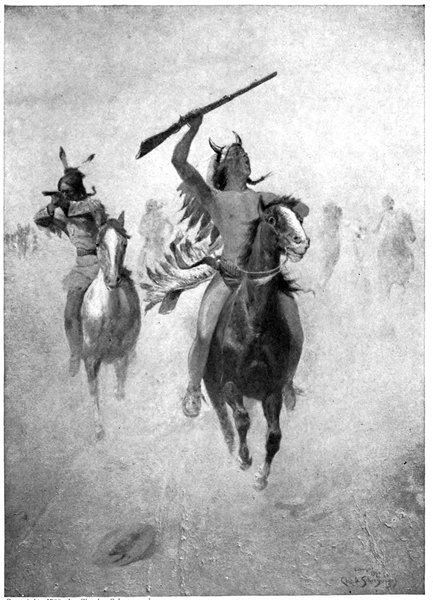
Copyright, 1900, by Charles Schreyvogel ROMAN NOSE LEADING THE CHARGE AGAINST FORSYTH’S DEVOTED BAND Drawing by Charles Schreyvogel
87The men rose to their knees, brought their guns to their shoulders, and poured a volley right into the face of the furious advance. An instant later, with another cartridge in the barrel they delivered a second volley. Horses and men went down in every direction; but, like the magnificent warriors they were, the Indians closed up and came sweeping down. The third volley was poured into them. Still they came. The war songs had ceased by this time, but in undaunted spirit, still pealing his war cry above the crashing of the bullets, at the head of his band, with his magnificent determination unshaken, Roman Nose led such a ride as no Indian ever attempted before or since. And still those quiet, cool men continued to pump bullets into the horde. At the fourth volley the medicine man on the left of the line and the second in command went down. The Indians hesitated at this reverse, but swinging his rifle high in the air in battle frenzy, the great war chief rallied them, and they once more advanced. The fifth volley staggered them still more. Great gaps were opened in their ranks. Horses and men fell dead, but the impetus was so great, and the courage and example of their leader so splendid, that the survivors came on unchecked. The sixth volley did the work. Just as he was about to leap on the island, Roman Nose and his horse were both shot to pieces. The force of the charge, however, was so great that the line was not yet entirely broken. The horsemen were within a few feet of the scouts, when the seventh volley was poured into their very faces. As a gigantic wave meets a sharply jutting rock and is parted, falling harmlessly on either side of it, so was that charge divided, the Indians swinging themselves to the sides of their horses as they swept down the length of the island.
The scouts sprang to their feet at this juncture, and 88almost at contact range jammed their revolver shots at the disorganized masses. The Indians fled precipitately to the banks on either side, and the yelling of the war chants of the squaws and children changed into wails of anguish and despair, as they marked the death of Roman Nose and the horrible slaughter of his followers.
It was a most magnificent charge, and one which for splendid daring and reckless heroism would have done credit to the best troops of any nation in the world. And magnificently had it been met. Powell’s defense of the corral on Piney Island was a remarkable achievement, but it was not to be compared to the fighting of these scouts on the little open, unprotected heap of sand and gravel in the Arickaree.
As soon as the Indian horsemen withdrew, baffled and furious, a rifle fire opened once more from the banks. Lieutenant Beecher, who had heroically performed his part in the defense, crawled over to Forsyth and said:
“I have my death wound, General. I am shot in the side and dying.”
He said the words quietly and simply, as if his communication was utterly commonplace, then stretched himself out by his wounded commander, lying, like Steerforth, with his face upon his arm.
“No, Beecher, no,” said Forsyth, out of his own anguish; “it can not be as bad as that.”
“Yes,” said the young officer, “good-night.”
There was nothing to be done for him. Forsyth heard him whisper a word or two of his mother, and then delirium supervened. By evening he was dead. In memory of the brave young officer, they called the place where he had died Beecher’s Island.
89At two o’clock in the afternoon a second charge of horse was assayed in much the same way as the first had been delivered; but there was no longer a great war chief in command, and this time the Indians broke at one hundred yards from the island. At six o’clock at night they made a final attempt. The whole party, horse and foot, in a solid mass rushed from all sides upon the island. They came forward, yelling and firing, but they were met with so severe a fire from the rifle-pits that, although some of them actually reached the foot of the island, they could not maintain their position, and were driven back with frightful loss. The men on the island deliberately picked off Indian after Indian as they came, so that the dry river bed ran with blood. The place was a very hell to the Indians. They withdrew at last, baffled, crushed, beaten.
With nightfall the men on the island could take account of the situation. Two officers and four men were dead or dying, one officer and eight men were so severely wounded that their condition was critical. Eight men were less severely wounded, making twenty-three casualties out of fifty-one officers and men.[34] There were no rations, but thank God there was an abundance of water. They could get it easily by digging in the sandy surface of the island. They could subsist, if necessary, on strips of meat cut from the bodies of the horses. The most serious lack was of medical attention. The doctor lying unconscious, the wounded were forced to get along with the unskilled care of their comrades, and with water, and rags torn from clothing for dressings. Little could be done for them. The day had been frightfully hot, but, fortunately, a heavy rain 90fell in the night, which somewhat refreshed them. The rifle-pits were deepened and made continuous by piling saddles and equipments, and by further digging in the interspaces.
One of the curious Indian superstitions, which has often served the white man against whom he has fought to good purpose, is that when a man is killed in the dark he must pass all eternity in darkness. Consequently, he rarely ever attacks at night. Forsyth’s party felt reasonably secure from any further attack, therefore, notwithstanding which they kept watch.
IV. The Siege of the Island
As soon as darkness settled down volunteers were called for to carry the news of their predicament to Fort Wallace, one hundred miles away. Every man able to travel offered himself for the perilous journey. Forsyth selected Trudeau and Stillwell. Trudeau was a veteran hunter, Stillwell a youngster only nineteen years of age, although he already gave promise of the fame as a scout which he afterwards acquired. To them he gave the only map he possessed. They were to ask the commander of Fort Wallace to come to his assistance. As soon as the two brave scouts had left, every one realized that a long wait would be entailed upon the little band, if, indeed, it was not overwhelmed meanwhile, before any relieving force could reach the island. And there were grave doubts as to whether, in any event, Trudeau and Stillwell could get through the Indians. It was not a pleasant night they spent, therefore, although they were busy strengthening the defenses, and nobody got any sleep.
Early the next morning the Indians again made their 91appearance. They had hoped that Forsyth and his men would have endeavored to retreat during the night, in which event they would have followed the trail and speedily annihilated the whole command. But Forsyth was too good a soldier to leave the position he had chosen. During the fighting of the day before he had asked Grover his opinion as to whether the Indians could deliver any more formidable attack than the one which had resulted in the death of Roman Nose, and Grover, who had had large experience, assured him that they had done the best they could, and indeed better than he or any other scout had ever seen or heard of in any Indian warfare. Forsyth was satisfied, therefore, that they could maintain the position, at least until they starved.
The Indians were quickly apprised, by a volley which killed at least one man, that the defenders of the island were still there. The place was closely invested, and although the Indians made several attempts to approach it under a white flag, they were forced back by the accurate fire of the scouts, and compelled to keep their distance. It was very hot. The sufferings of the wounded were something frightful. The Indians were having troubles of their own, too. All night and all day the defenders could hear the beating of the tom-toms or drums and the mournful death songs and wails of the women over the bodies of the slain, all but three of whom had been removed during the night.[35] These three were 92lying so near the rifle-pits that the Indians did not dare to approach near enough to get them. The three dead men had actually gained the shore of the island before they had been killed.
The command on the island had plenty to eat, such as it was. There was horse and mule meat in abundance. They ate it raw, when they got hungry enough. Water was plentiful. All they had to do was to dig the rifle-pits a little deeper, and it came forth in great quantities. It was weary waiting, but there was nothing else to do. They dared not relax their vigilance a moment. The next night, the second, Forsyth despatched two more scouts, fearing the first two might not have got through, thus seeking to “make assurance double sure.” This pair was not so successful as the first. They came back about three o’clock in the morning, having been unable to pass the Indians, for every outlet was heavily guarded.
The third day the Indian women and children were observed withdrawing from the vicinity. This cheered the men greatly, as it was a sign that the Indians intended to abandon the siege. The warriors still remained, however, and any incautious exposure was a signal for a volley. That night two more men were despatched with an urgent appeal, and these two succeeded in getting through. They bore this message:
93“Sept. 19, 1868.
To Colonel Bankhead, or Commanding Officer,
Fort Wallace:
I sent you two messengers on the night of the 17th inst., informing you of my critical condition. I tried to send two more last night, but they did not succeed in passing the Indian pickets, and returned. If the others have not arrived, then hasten at once to my assistance. I have eight badly wounded and ten slightly wounded men to take in.... Lieutenant Beecher is dead, and Acting Assistant Surgeon Mooers probably cannot live the night out. He was hit in the head Thursday, and has spoken but one rational word since. I am wounded in two places—in the right thigh, and my left leg is broken below the knee....
I am on a little island, and have still plenty of ammunition left. We are living on mule and horse meat, and are entirely out of rations. If it was not for so many wounded, I would come in, and take the chances of whipping them if attacked. They are evidently sick of their bargain.... I can hold out for six days longer if absolutely necessary, but please lose no time.
P.S.—My surgeon having been mortally wounded, none of my wounded have had their wounds dressed yet, so please bring out a surgeon with you.”
The fourth day passed like the preceding, the squaws all gone, the Indians still watchful. The wound in Forsyth’s leg had become excruciatingly painful, and he begged some of the men to cut out the bullet. But they discovered that it had lodged near the femoral artery, and fearful lest they should cut the artery and the young commander should bleed to death, they positively refused. In desperation, Forsyth cut it out himself. 94He had his razor in his saddle bags and, while two men pressed the flesh back, he performed the operation successfully, to his immediate relief.
The fifth day the mule and horse meat became putrid and therefore unfit to eat. An unlucky coyote wandered over to the island, however, and one of the men was fortunate enough to shoot him. Small though he was, he was a welcome addition to their larder, for he was fresh. There was but little skirmishing on the fifth day, and the place appeared to be deserted. Forsyth had half a dozen of his men raise him on a blanket above the level of the rifle beds so that he might survey the scene himself. Not all the Indians were gone, for a sudden fusillade burst out from the bank. One of the men let go the corner of the blanket which he held while the others were easing Forsyth down, and he fell upon his wounded leg with so much force that the bone protruded through the flesh. He records that he used some severe language to that scout.
On the sixth day Forsyth assembled his men about him, and told them that those who were well enough to leave the island would better do so and make for Fort Wallace; that it was more than possible that none of the messengers had succeeded in getting through; that the men had stood by him heroically, and that they would all starve to death where they were unless relief should come; and that they were entitled to a chance for their lives. He believed the Indians, who had at last disappeared, had received such a severe lesson that they would not attack again, and that if the men were circumspect they could get through to Fort Wallace in safety. The wounded, including himself, must be left to take care of themselves and take the chances of escape from the island.
95The proposition was received in surprised silence for a few moments, and then there was a simultaneous shout of refusal from every man: “Never! We’ll stand by you.” McCall, the first sergeant and Forsyth’s right-hand man since Beecher had been killed, shouted out emphatically: “We’ve fought together, and, by Heaven, if need be, we’ll die together.”
They could not carry the wounded; they would not abandon them. Remember these men were not regular soldiers. They were simply a company of scouts, more or less loosely bound together, but, as McCall had pointed out, they were tied to one another by something stronger than discipline. Not a man left the island, although it would have been easy for the unwounded to do so, and possibly they might have escaped in safety.
For two more days they stood it out. There was no fighting during this time, but the presence of an Indian vedette indicated that they were under observation. They gathered some wild plums and made some jelly for the wounded; but no game came their way, and there was little for them to do but draw in their belts a little tighter and go hungry, or, better, go hungrier. On the morning of the ninth day, one of the men on watch suddenly sprang to his feet, shouting:
“There are moving men on the hills.” Everybody who could stand was up in an instant, and Grover, the keen-eyed scout, shouted triumphantly:
“By the God above us, there’s an ambulance!” They were rescued at last.
Note.—The serial publication of this article called forth another version of this affair, differing from it in some non-essential features, which was written by Mr. Herbert Myrick, and published serially. Mr. Myrick 96accounts for the “mysterious voice” which the scouts heard saying in English, “There goes the last of their horses anyway,” by disclosing the interesting fact that there were two renegade white men among the Indians. One of them was called “Nibsi” or “Black Jack,” a notorious desperado, who was afterwards hung for murder. The other was Jack Clybor, once a trooper of the Seventh Cavalry. Having been shot and left for dead in an engagement, the Indians captured him, nursed him back to life, adopted him, and named him “Comanche.” He was a singular compound of good and evil, and became as notorious for his good deeds as for his bad acts. Mr. Myrick has been collecting a mass of unknown and unpublished Western material for many years, which when published will undoubtedly clear up many mysteries, throw light upon many disputed questions, and prove of the deepest interest as well.
97
CHAPTER SIX The Journey of the Scouts and the Rescue of Forsyth
I. The Adventures of the Scouts
Trudeau and Stillwell, the first pair of scouts despatched by Forsyth with the story of his desperate situation on Beecher’s Island, left their commander about midnight on the evening of the first day of the attack. The Indians had withdrawn from the immediate vicinity of the river and were resting quietly in the camps on either side, although there were a number of warriors watching the island. The men bade a hasty good-by to their comrades, received their captain’s final instructions, and with beating hearts stole away on their desperate errand.
They neglected no precaution that experience could dictate. They even took off their boots, tied them together by the straps, slung them around their necks, and walked backward down the bed of the river in their stocking feet, so that, if the Indians by any chance stumbled upon their trail the next morning, it would appear to have been made by moccasined feet and perhaps escape attention, especially as the tracks would point toward the island instead of away from it. Further 98to disguise themselves, they wrapped themselves in blankets, which they endeavored to wear as the Indians did.
They proceeded with the most fearsome caution. Such was the circumspection with which they moved and the care necessary because of the watchfulness of the foe, who might be heard from time to time moving about on the banks, that by daylight they had progressed but two miles. During most of the time after leaving the river bed they had crawled on their hands and knees. Before sunrise they were forced to seek such concealment as they could find in a washout, a dry ravine, within sight and sound of the Indian camps. Providence certainly protected them, for if any of the Indians had happened to wander in their direction there was nothing to prevent their discovery; and if the savages had stumbled upon their hiding-place it would have been all up with them. Death by torture would have been inevitable if they were taken alive, and the only way to prevent that would be suicide. They had determined upon that. They had pledged each other to fight until the last cartridge, and to save that for themselves. They had nothing to eat and nothing to drink. The sun beat down upon them fiercely all the long day. After their experience of the one before, it was a day calculated to break down the strongest of men. They bore up under the strain, however, as best they could, and when darkness came they started out once more.
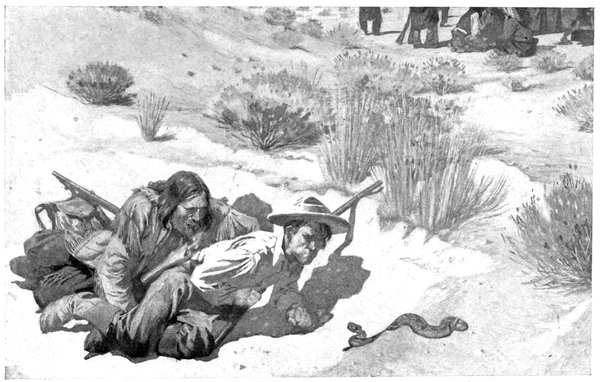
“SIMULTANEOUSLY WITH THEIR ARRIVAL A RATTLESNAKE MADE HIS APPEARANCE” Drawing by Will Crawford
This night there was no necessity for so much caution and they made better progress, although they saw and successfully avoided several parties of Indians. When the day broke they were forced to conceal themselves again. The country was covered with wandering war parties, and it was not yet safe to travel by daylight. 99This day they hid themselves under the high banks of a river. Again they were fortunate in remaining unobserved, although several times bands of warriors passed near them. They traveled all the third night, making great progress. Morning found them on an open plain with no place to hide in but a buffalo wallow—a dry alkali mud-hole which had been much frequented in the wet season by buffalo—which afforded scanty cover at best.
During this day a large party of scouting Indians halted within one hundred feet of the wallow. Simultaneously with their arrival a wandering rattlesnake made his appearance in front of the two scouts, who were hugging the earth and expecting every minute to be discovered. The rattlesnake in his way was as deadly as the Indians. The scouts could have killed him easily had it not been for the proximity of the Cheyennes. To make the slightest movement would call attention to their hiding-place. Indeed, the sinister rattle of the venomous snake before he struck would probably attract the notice of the alert Indians. Between the savage reptile and the savage men the scouts were in a frightful predicament, which young Stillwell, a lad of amazing resourcefulness, instantly and effectually solved. He was chewing tobacco at the time, and as the snake drew near him and made ready to strike, he completely routed him by spitting tobacco juice in his mouth and eyes and all over his head. The rattlesnake fled; he could not stand such a dose. The Indians presently moved on, having noticed nothing, and so ended perhaps the most terrible half hour the two men had ever experienced.
They started early on the evening of the fourth night, and this time made remarkable progress. Toward 100morning, however, Trudeau all but broke down. The brunt of the whole adventure thereupon fell on Stillwell. He encouraged his older companion, helped him along as best he could, and finally, late at night, they reached Fort Wallace and told their tale. Instantly all was excitement in the post. Captain and Brevet Lieutenant-Colonel Louis H. Carpenter, with seventy men of Troop H, of the Tenth Cavalry (a negro regiment), with Lieutenants Banzhaf and Orleman, Doctor Fitzgerald and seventeen scouts, with thirteen wagons and an ambulance, had been sent out from the post the day before with orders to make a camp on the Denver road, about sixty miles from the fort. From there he was to scout in every direction, keep off the Indians, and protect trains.
At eleven o’clock at night a courier was despatched to Carpenter with the following order:
“Headquarters, Fort Wallace, Kansas,
September 22, 1868, 11:00 P.M.
Brevet Lieut.-Colonel L. H. Carpenter, 10th U. S. Cavalry. On Scout.
Colonel:
The Commanding Officer directs you to proceed at once to a point on the “Dry Fork of the Republican,” about seventy-five or eighty miles north, northwest from this point, thirty or forty miles west by a little south from the forks of the Republic, with all possible despatch.
Two scouts from Colonel Forsyth’s command arrived here this evening and bring word that he (Forsyth) was attacked on the morning of Thursday last by an overwhelming force of Indians (700), who killed all the animals, broke Colonel Forsyth’s left leg with a rifle ball, 101severely wounding him in the groin, wounded Doctor Mooers in the head, and wounded Lieutenant Beecher in several places. His back is supposed to be broken. Two men of the command were killed and eighteen or twenty wounded.
The men bringing the word crawled on hands and knees two miles, and then traveled only by night on account of the Indians, whom they saw daily.
Forsyth’s men were intrenched in the dry bed of the creek with a well in the trench, but had only horse-flesh to eat and only sixty rounds of ammunition.
General Sheridan orders that the greatest despatch be used and every means employed to succor Forsyth at once. Colonel Bradley with six companies is now supposed by General Sheridan to be at the forks of the Republic.
Colonel Bankhead will leave here in one hour with one hundred men and two mountain howitzers.
Bring all your scouts with you.
Order Doctor Fitzgerald at once to this post, to replace Doctor Turner, who accompanies Colonel Bankhead for the purpose of dressing the wounded of Forsyth’s party.
I am, Colonel, very respectfully your obedient servant,
Hugh Johnson,
Acting Post Adjutant.
1st Lieutenant 5th Infantry.”
One hour afterward Bankhead himself, with one hundred men and two howitzers and the surgeon, started for the relief of Forsyth. With Bankhead went the undaunted Stillwell as guide. Trudeau had suffered so much during the perilous journey that he was unable to accompany the relief party, and he soon afterward 102died from the hardships and excitement of the horrible days he had passed through.
II. The Rescue of Forsyth
Carpenter had bivouacked on the evening of the 22d of September at Cheyenne Wells, about thirty-five miles from Fort Wallace. He had broken camp early in the morning and had marched some ten miles, when, from a high point on a divide he had reached, which permitted a full view of the Rocky Mountains from Pike’s to Long’s Peaks, he observed a horseman galloping frantically toward them. He was the courier despatched by Colonel Bankhead. Carpenter was a splendid soldier. He had received no less than four brevets for gallantry during the Civil War. He had been on Sheridan’s staff with Forsyth, and the two were bosom friends. No task could have been more congenial to him than this attempt at rescue.
He communicated the situation of their white comrades to his black troopers, and their officers crowded close about him. The orders were received with exultant cheers. The regiment had been raised since the war, and had not yet had a chance to prove its mettle. There were no veterans among them, and Carpenter and the other officers had been obliged to build the regiment from the ground up. Now was an opportunity to show what they could do. Carpenter had been trained to obey orders to the letter. In this instance he determined to disobey the command regarding Doctor Fitzgerald. It appeared to him that Bankhead had little hope that he (Carpenter) would find Forsyth, for he had sent him no guide; but Carpenter perceived that if he did find Forsyth—and he intended to find him—the conditions 103would be such that the services of a physician would be vitally necessary. He therefore retained the doctor. He also retained the wagon train, having no other way of carrying necessary supplies. For one reason, if he had detached a guard for the train, it would have weakened his force so greatly as to have made it inadequate to the enterprise. The mules were strong and fresh, and he decided to keep the wagons with him. The pace was to be a fast one, and he instructed the wagon masters that, if any of the mule teams gave out, they should be shot and, if necessary, the wagon should be abandoned.
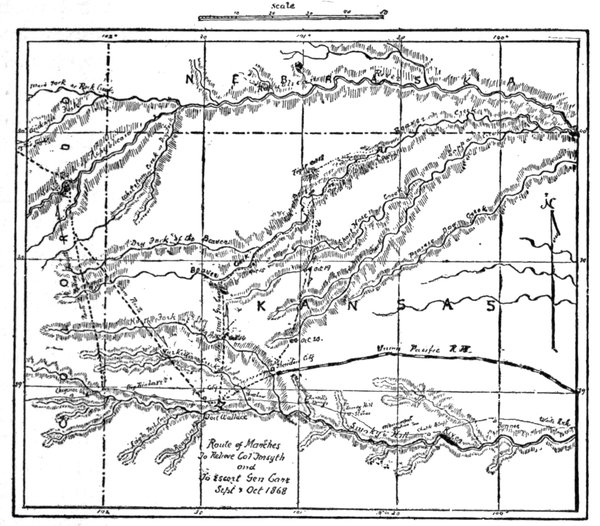
Map of Marches to Relieve Colonel Forsyth and to Escort General Carr, Drawn by General Carpenter
104There was no one in his command, he found, who had ever been in that territory. Indeed, it is probable that, save Forsyth’s men, no white men had ever penetrated that section of the country before. The map that Carpenter had was very defective. He studied over the matter a few moments, and then led his command toward the place where he supposed Forsyth to be. They advanced at a fast trot, with intervals of walking, and when they camped at night near some water holes they had covered nearly forty-five miles. The mules, under the indefatigable and profane stimulus of their drivers, had kept up with the rest. As soon as it was dawn the next day they started once more, and, after a twenty-mile ride, arrived at the dry bed of a river.
Whether this was the fork of the Republican, on which Forsyth was besieged, no one could tell. It happens that the Republican has three forks—a north fork, the Arickaree, and the south or dry fork. Carpenter was afraid to leave the fork he had found without satisfying himself that Forsyth was not there, so he concluded to scout up the river for some fifteen or eighteen miles. Finding nothing, he then turned northward again until he came to a stream flowing through a wide, grass-covered valley surrounded by high hills. As they entered the valley they came across a very large, fresh Indian trail. The scouts estimated that at least two thousand ponies had passed along the trail within a few hours. Various other signs showed a large village had moved down the trail.
They had traveled over forty miles this second day, and were apprehensive that the Indians, being so close to them, might attack them. It was nearly evening. A spot 105well adapted for defense was chosen near the water, the wagons were corralled, and preparations made for a stout resistance in case of an attack. While the men were making camp, Carpenter with a small escort rode to the top of one of the high hills bordering the valley. He could see for miles, but discovered no Indians nor any other living object in any direction. In front of them, however, on the top of another hill, were a number of scaffolds, each one bearing a human body. The Cheyenne method of burial was instantly recognized. A nearer look developed that the scaffolds had been recently erected. Five of them were examined, and in each case the body contained was that of a Cheyenne warrior, who had been killed by a gunshot wound. This was proof positive that they were some of the Indians who had been fighting against Forsyth.
While this was going on, one of the troopers noticed something white in a ravine on the opposite side of the valley. They galloped over to it, and found it to be an elaborate and beautiful tepee or wigwam, made out of freshly tanned white buffalo skins. The colonel dismounted, opened the tepee, and entered. There, upon a brush heap, lay a human figure wrapped in buffalo robes. When the robes were taken away the body of a splendid specimen of Indian manhood was disclosed. “He lay like a warrior taking his rest, with his martial cloak around him.” His stern and royal look, the iron majesty of his features, even though composed in death, revealed at once a native chieftain. In his breast was a great, gaping wound, which had pierced his heart. He lay in his war-gear, with his weapons and other personal property close at hand.
After the examination they recovered him and left him undisturbed. Then they went back to the camp. 106The corral was watchfully guarded during the night, but no one appeared to molest them. It was decided to follow the Indian trail at daylight, as it would probably lead to the site of Forsyth’s fight. Early the next morning, while they were packing up, they saw some horsemen coming over the hills to the south of them. They were white men, led by a scout named Donovan. Two more men had been despatched by Forsyth from the island on the third night of the siege, and being unobserved by the Indians, they had made their way to Fort Wallace. When they arrived there they found that Colonel Bankhead had already gone; whereupon Donovan had assembled five bold spirits and had immediately started out on the return journey. Fortunately for Carpenter, Donovan had struck the latter’s trail, and had followed it to the camp.
Carpenter thereupon took thirty of his best mounted troopers and the ambulance loaded with hardtack, coffee, and bacon, and set out on a gallop in the direction in which they supposed the island lay. Banzhaf was left in command of the rest, with orders to come on as fast as he could.
Carpenter went forward at a rapid gallop, and after traveling eighteen miles, while it was yet early in the morning, came to a spur of land from which he had a view of the surrounding country for miles. As he checked his horse on the brink, he saw to the right of him a valley through which meandered a narrow silver stream.
In the center of the valley there was an island. From it rose a solitary cottonwood. Men could be seen moving about the place. Donovan recognized it instantly. The horses of the detachment were put to a run, and the whole party galloped down the valley toward the island. 107The scouts swarmed across the river with cries of joy, and welcomed the soldiers. The faithful mules dragged the ambulance close behind. There was food for everybody. Carpenter was struck with the wolfish look on the faces of the hungry men as they crowded around the ambulance. Later one of them brought him a piece of mule or horse meat which was to have been served for dinner that day, if the rescuers had not appeared. Carpenter could not endure even the odor of it.
Galloping across the river bed, the first to enter the rifle-pits on the island was Carpenter. There, on the ground before him, lay Forsyth. And what do you suppose he was doing? He was reading a novel! Some one had found, in an empty saddle-bag, an old copy of Oliver Twist. Forsyth was afraid to trust himself. He was fearful that he would break down. He did not dare look at Carpenter or express his feelings. Therefore he made a pretense of being absorbed in his book.
The black cavalry had arrived in the very nick of time. Forsyth was in a burning fever. Blood-poisoning had set in, and his wounds were in a frightful condition. Another day and it would have been too late. Everything was gone from him but his indomitable resolution. Many others were in like circumstances. It was well that Carpenter had brought his surgeon with him, for his services were sadly needed. The men were taken off the island, moved half a mile away from the terrible stench arising from the dead animals; the wagon train came up, camps were made, the dead were buried on the island they had immortalized with their valor, and everything possible done for the comfort of the living by their negro comrades.
The doctor wanted to amputate Forsyth’s leg, but he protested, so that the amputation was not performed, 108and the leg was finally saved to its owner. One of the scouts, named Farley, however, was so desperately wounded that amputation had to be resorted to. The doctor performed the operation, assisted by Carpenter. A military commander in the field has to do a great many things.
The next day Bankhead made his appearance with his detachment. He had marched to the forks of the river and followed the Arickaree fork to the place. He was accompanied by two troops of the Second Cavalry, picked up on the way. He did not find fault with Carpenter for his disobedience in retaining Doctor Fitzgerald. On the contrary, such was his delight at the rescue that he fairly hugged his gallant subordinate.
As soon as it was possible, the survivors were taken back to Fort Wallace. Forsyth and the more severely wounded were carried in the ambulance. It took four days to reach the fort. Their progress was one long torture, in spite of every care that could be bestowed upon them. There was no road, and while the drivers chose the best spots on the prairie, there was, nevertheless, an awful amount of jolting and bumping.
Forsyth was brevetted a brigadier-general in the Regular Army for his conduct in this action. This was some compensation for two years of subsequent suffering until his wounds finally healed.
III. The End of Roman Nose
On the way back the men stopped at the white tepee in the lonely valley. Grover and McCall rode over to the spot with the officers and examined the body of the chieftain. They instantly identified him as Roman 109Nose. With a touch of sentiment unusual in frontiersmen they respected his grave, and for the sake of his valor allowed him to sleep on undisturbed. His arms and equipments, however, were considered legitimate spoils of war, and were taken from him. It was a sad end, indeed, to all his splendid courage and glorious defiance of his white foemen.
The loss of the Indians in the several attacks was never definitely ascertained. They admitted to seventy-five killed outright and over two hundred seriously wounded, but it is certain that their total losses were much greater. The fighting was of the closest and fiercest description, and the Indians were under the fire of one of the most expert bodies of marksmen on the plains at half pistol-shot distance in the unique and celebrated battle. The whole action is almost unparalleled in the history of our Indian wars, both for the thrilling and gallant cavalry charge of the Indians and the desperate valor of Forsyth and his scouts.
IV. A Few Words About Forsyth’s Men
The heroism and pluck of the men in the fight had been quite up to the mark set by their captain. A man named Farley had fought through the action with a severe bullet wound in the shoulder, which he never mentioned until nightfall; his father was mortally wounded, but he lay on his side and fought through the whole of the long first day until he died. Another man named Harrington was struck in the forehead by an arrow. He pulled out the shaft, but the head remained imbedded in the bone. An Indian bullet struck him a glancing blow in the forehead and neatly extricated the arrow—rough surgery, to be sure, but it served. Harrington 110tied a rag around his head, and kept his place during the whole three days of fighting.
When they first reached the island one of the men cried out, “Don’t let’s stay here and be shot down like dogs! Will any man try for the opposite bank with me?” Forsyth, revolver in hand, stopped that effort by threatening to shoot any man who attempted to leave the island. In all the party there was but one coward. In looks and demeanor he was the most promising of the company—a splendid specimen of manhood apparently. To everybody’s surprise, after one shot he hugged the earth in his rifle-pit and positively refused to do anything, in spite of orders, pleadings, jeers, and curses. He left the troop immediately on its arrival at Fort Wallace.
Per contra, one of the bravest, where all but one were heroes, was a little, eighteen-year old Jewish boy, who had begged to be enlisted and allowed to go along. He had been the butt of the command, yet he proved himself a very paladin of courage and efficiency when the fighting began.[36]
111One of the last acts of the recent Congress was the setting apart of one hundred and twenty acres of land in Yuma County, Colorado, as a national park. This reservation forever preserves Forsyth’s battlefield and the vicinity from settlement. On the edge of the river bank, on what was once Beecher’s Island, which the shifting river has now joined to the bank, is a wooden monument to Beecher and the other scouts who were buried somewhere in those shifting sands.[37]
The few survivors of the battle have formed themselves into an association which holds an annual reunion on the battlefield. Soon there will be none of them left. Would it not be a graceful act for some one who honors courage, manliness, and devotion to duty to erect a more enduring monument to the memory of Beecher and his comrades than the perishable wooden shaft which now inadequately serves to call attention to their sacrifice and their valor?
Note.—The following interesting communication slightly modifies one of the statements in the above article. It certainly shows prompt decision upon the part of Lieutenant Johnson, who was left in command of the post after Bankhead’s departure.
Great Barrington, Mass., August 5th, 1904.
Dr. Brady says “Donovan had assembled five bold spirits, and had immediately started out on the return journey.” As a matter of fact, Donovan did no such 112thing. The departure of General Bankhead’s relief column stripped the garrison of Fort Wallace to seven enlisted men, took away the last horse, and placed me in command. Forsyth’s second note, brought by Donovan, fell into my hands. It was telegraphed in full to General Sheridan, who ordered me to spare no expense of men, money, and horses to hasten relief to Forsyth. By the promise of $100 each, four citizens of the neighboring town of Pond Creek were induced to seek the Carpenter command. Donovan I persuaded to guide them, promising him $100 in addition to his pay as a scout. This party started at daylight, on government mules, rode all day, all night, and found Carpenter’s command on the south fork of the Republican River, about ten miles southeast of the scene of the fight. Guided by these men, Carpenter pushed out, and Forsyth and his men were relieved some hours in advance of the arrival of the other relief commands.
The country from Fort Wallace to Arickaree Fork I passed over the following December, in an unsuccessful endeavor to secure the bodies of those killed in the fight. We surprised a village of Indians at the scene of the fight, fought them off, and found the body of one of the scouts, but Lieutenant Beecher’s and Dr. Mooers’ graves were empty. Yours very truly,
Hugh M. Johnson,
Late Lieutenant 5th U. S. Infantry.
113
CHAPTER SEVEN A Scout’s Story of the Defense of Beecher’s Island
By great good fortune I am permitted to insert here a private letter to me from Mr. Sigmund Schlesinger, the Jewish boy referred to in Chapter Six, which, as it contains an original account of the defense of Beecher’s Island from the standpoint of one of the participants, is an unique document in our Western historical records:—C.T.B.
For several days we had been following an Indian trail so broad that it looked like a wagon-road. Those in our command experienced in Indian warfare told us that we must be on the track of an Indian village on the move, with a large herd of horses. Evidently they knew that we were behind them, and seemed to be in a hurry to get away, for we found camp utensils, tent-poles, etc., which had been dropped and no time taken to pick them up. Among other things we saw fresh antelope meat, quarters, etc., and although our rations were nearly, if not all, gone, except some coffee and very little “sow-belly,” we did not dare eat the Indians’ remnants.
The night of Sept. 16th, before the attack next morning, 114Scout Culver, who was killed next day, pointed out to a few of us some torch-lights upon the hills that were being swung like signals. I knew that something “would be doing” soon, but, like a novice, I was as if on an anxious seat, under a strain of anticipation, expecting something strange and dangerous. The next thing that I now recall was that I was awakened just before daylight by a single cry, “Indians!” so loud and menacing that when I jumped up from the ground I was bewildered and felt as if I wanted to ward off a blow, coming from I knew not where, for it was still quite dark. That cry I will never forget. Soon I perceived a commotion among our horses and mules. The Indians, about a dozen, tried to stampede them. I could see in the dawning light the outlines of a white horse in the distance, and from the noise I realized that they were driving some of our stock before them. Later, in the daylight we could recognize some of our ponies on a neighboring hill in the possession of the Indians.
As soon as we crossed from the north bank of the river to the island, just before the attack, we tied our horses and pack mules to shrubs as best we could. During the day a mule with a partial pack on his back got loose and wandered around the vicinity of my pit. He had several arrows sticking in his body and seemed wounded otherwise, which caused him to rear and pitch to such an extent that Jim Lane, my neighbor, and I, decided to kill him. After shooting him he fell and lay between us, and served us the double purpose of food and barricade.
My horse was securely tethered to the underbrush on the island, and later that day I saw the poor beast rearing and plunging in a death struggle, having been shot and killed like the rest of our horses and mules. 115He also furnished me with several meals during the siege, even after he began to putrefy. There was little to choose between horse and mule meat under such circumstances—both were abominable.
When day broke that Tuesday, the seventeenth of September, 1868, we saw our pickets riding toward camp as fast as their horses could carry them, excitedly yelling: “Indians! Indians!” As I looked up the valley toward the west I beheld the grandest, wildest sight—such as few mortals are permitted to see and live to tell about. Many hundreds of Indians in full war paraphernalia, riding their splendid war ponies, rushed toward us en masse. Some were galloping in one direction, others cantering in another, their lances topped with many-colored streamers, the fantastic Indian costumes lending an awful charm to the whole. About this time those among us who had any had boiled some coffee and were preparing to cross over to the island.
I will frankly admit that I was awed and scared. I felt as if I wanted to run somewhere, but every avenue of escape was blocked. Look where I might I perceived nothing but danger, which increased my agitation; so I naturally turned to Colonel Forsyth as a protector, as a young chick espying the hawk in the air flutters toward the mother wing. Under such conditions of strain some things engrave themselves vividly upon your mind, while others are entirely forgotten. I remember that distinctly as in my trepidation I instinctively kept close to the colonel. I was reassured by his remarkable self-possession and coolness. While stirring every one to activity round us, he consulted with Lieutenant Beecher and the guide, Sharp Grover, giving directions here, advice there, until most of the command had crossed; then he crossed himself and posted 116the men, telling them where to take up their different positions. Meantime the Indians were coming closer. I was just behind the colonel when the first shot from the enemy came flying seemingly over our heads. I heard him say, smilingly, “Thank you,” but immediately afterward he ordered every one of us to lie flat upon the ground, while he, still directing, kept on his feet, walking around among us, leading his horse. The shots began coming thicker, and many of us yelled to him to lie down also. How long after this I do not know, but I heard the colonel cry out that he was shot, and I saw him clutch his leg and get down in a sitting position.
I was lying alongside of Lou McLaughlin; some tall weeds obscured my vision, so I asked Lou to crouch lower and I rolled over him to the other side and was there kept busy with my carbine, for the Indians were onto us. They were circling around while others were shooting. Very soon I heard Lou growl and mutter. I looked at him and saw that he was hit, a bullet coming from the direction where I was lying struck his gun-sight and glanced into his breast. He told me what had happened, but I could give him no attention, for there seemed lots of work to do before us. But later, after the repulse of the attack, I looked at Lou and was surprised to see him lying in a wallow. In his pain he had torn up the grass and dug his hands into the sand. In answer to my question whether he was hurt bad, he told me not bad, and advised me to dig into the sand and make a hole, as it would be a protection.
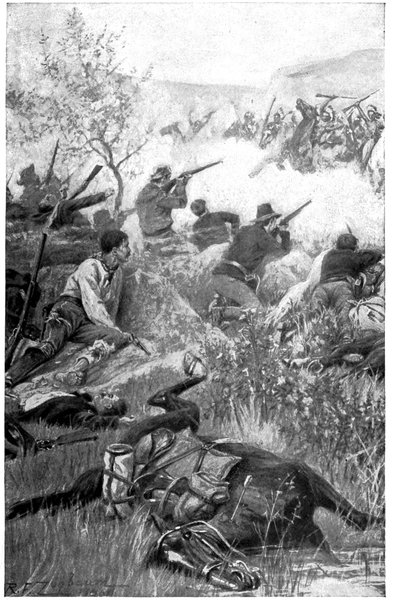
Courtesy of Chas. Scribner’s Sons THE CRUCIAL MOMENT ON BEECHER’S ISLAND Drawing by R. F. Zogbaum
I am not sure at this time, but I am now under the impression that I told Colonel Forsyth of this; and from that time on we began to dig with our hands or whatever we could use, and kick with our heels and toes in 117the sand, and some of us soon had holes dug deep enough to protect the chest, at least.
Time seemed out of our calculations. I heard some one call, “What time is it?” An answer came, “Three o’clock.” I had thought it was about ten A.M. We had nothing to eat or drink all day and, strange to say, I was not hungry, which may have been the reason why I thought it was still early. Word was passed that Lieutenant Beecher and Scouts Wilson and Culver were killed, Colonel Forsyth wounded again, also Doctor Mooers shot in the head and others hurt whose names I do not now remember.
We fought steadily all day. After dark the Indians withdrew; then nature began to assert itself. I got hungry; there was nothing to eat in the camp that I knew of, except some wild plums that I had gathered the day before, which were in my saddle-bags, still on the body of my horse. I got out of my hole, creeping on hands and knees toward where I knew the poor animal lay. As I felt my way in the darkness I touched something cold, and upon examination found that it was Wilson’s dead hand. He lay where he fell; it was a most horrible feeling. The shivers ran up and down my back, but I got to my horse at last, and tugging, I finally secured the bag and my plums. I also found in it a piece of bacon, the size of two fingers, which I reserved for a last emergency, and was still in possession of that rusty piece of fat when relief came.
On my way back to my hole I passed one where Doctor Mooers lay wounded, moaning piteously. I put a plum in his mouth, and I saw it between his teeth next morning. He died on the night of the 19th. All our wounded were very cheerful, and to look at Colonel Forsyth and talk to him as he lay there helpless, no outsider 118would have suspected that he was crippled. We used to gather round him in his pit and hold conversation, not like men in a desperate situation, but like neighbors talking over a common cause.
Colonel Forsyth was the right man in command of such a heterogeneous company. Like the least among us, he attended to his own horse when in camp, and many times have I seen him gather buffalo chips to supply the mess fuel. While he was our commander in practice he was our friend, and as such we respected him, followed and obeyed him.
On about the fifth day, as the Indians began leaving us, we began to walk about and look around. About fifteen or twenty feet from my pit I noticed a few of our men calling to the rest of us. I ran to the place, and there, against the edge of the island, I saw three dead Indians. Their friends evidently could not reach them to carry them off, which explained to us the persistent fighting in this direction. When I got there the Indians were being stripped of their equipments, scalps, etc. One of them was shot in the head and his hair was clotted with blood. I took hold of one of his braids and applied my knife to the skin above the ear to secure the scalp, but my hand coming in contact with the blood, I dropped the hair in disgust.
Old Jim Lane saw my hesitation, and taking up the braid, said to me: “My boy, does it make you sick?” Then inserting the point of the knife under the skin, he cut around, took up the other braid, and jerked the scalp from the head. I had been about three years in that country and four years in America, and life on the plains under such hardships as I had undergone hardens the sensibility, yet I was not quite ripe for such a cutting affray, even with a dead Indian.
119After this we were not molested, but devoted our time to looking around for something to eat besides the rotten horse and mule meat, which we boiled several times in water and powder, not to get it soft, but to boil out the stench as much as possible. We found some cactus fruit, and killed a coyote, of which the brains and a rib were my portion. Aside from this we had nothing but horse and mule during the siege, which soon told on our bowels; but in spite of all this, I do not remember a despondent man in our crowd.
One morning, being the ninth since we were attacked, I was lying outside of my pit, having done some guard duty during the night; I was half dozing and dreaming of home and a good meal. I felt so homesick and so hungry when I heard some one call attention to something moving on the hill.
I was all attention at once. Soon I heard again “I think that’s Doctor Fitzgerald’s greyhound.” Whoever it might be, we would welcome. We would even have been pleased to have the Indians attack us again, in hopes of killing one of their horses for fresh meat; but it was soon evident that help was coming, and when I fully realized this fact, enfeebled as I was, I jumped up and joined in a lunatics’ dance that was in progress all around us. Those on the hill must have seen us, for there was a rush of horsemen down the hill toward us, followed by one or two ambulance wagons.
They were as eager to reach us as we were to greet them, and as I ran uphill I noticed a soldier on a white horse coming full tilt. The momentum carried him past me, but in passing I grabbed his saddle-bag and was taken off my feet, but it would have taken more than one horse to drag me from my hold. I suspected some eatables in there, and as soon as he could stop, without 120dismounting he assisted me to open that bag. With both hands I dived in, and with each hand I clutched some hardtack, but only one hand could reach my mouth; my other was in the grip of one of our men, who ravenously snatched the “tacks.” We ate, cried, laughed, and ate, all in a breath.
As soon as possible we put our dead in the ground. Those that died at one end of the island were cared for by those in that vicinity, and others in their vicinity, so that one part of the island was not aware of the location of the corpses of the other part; at least I did not know where the bodies lay of those killed on the eastern end of the island. So one time, as I walked around among the pits, I noticed something red and round sticking out of the sand, like a half-buried red berry. I kicked it, but by so doing it was not dislodged; I kicked again, but to no result. I then looked closer and discovered that it was the nose of a dead man. I called others to my assistance, and we fixed matters so that no desecration was possible again.
Our mortally wounded were made as comfortable as possible before they died. I assisted at such ministrations given to Lieutenant Beecher. We removed his boots, coat, etc., and, of course, these things were not replaced on the body after he was dead, but lay around unnoticed. My shoes were quite badly worn, especially after being used for digging in the sand, so when relief came and we were preparing to leave the island, I put on his shoes, which were just about my size, and wore them even after I got back to New York City, leaving my old shoes in their stead on the island.
At one of our “sittings” around Colonel Forsyth in his pit, the incident of killing the coyote was discussed, and plans were suggested for the killing of more of them. 121Along with others, I also suggested a scheme, but it was ridiculed, and I soon retired to my pit, which was near enough to the colonel’s, so that I could hear what was said there. One of the men remaining was saying uncomplimentary things about me, when the colonel silenced him, telling him that I was but a boy unused to such things and that, under the circumstances, I was doing better than some of the older men. Colonel Forsyth is unconscious of the fact that I am very grateful to him for his kindness to that strange “boy” among those strangers, and that I still hope some day that I may have the opportunity to show my appreciation.
Jack Stillwell and I were the only boys in the company, and naturally gravitated toward each other. We were friends as soon as we met and chums before we knew each other’s names. When the colonel asked for volunteers to go to Fort Wallace for help, Jack was among the first to announce himself. I wanted to go with him, but the colonel gave no heed to my request; even Jack discouraged me, for he knew I was too inexperienced. After Colonel Carpenter came to our relief Jack was not with him, which made me and others feel very uneasy. The day after Colonel Carpenter’s arrival we saw the mounted sentinel that had been posted by Colonel Carpenter on a high eminence in the hills about three miles from the island, signaling that a body of men was approaching, which created a flutter of excitement, but there was a strong sensation of security, mingled with a sense of dependence upon our black rescuers permeating our emaciated party, after being cooped up, so to say, for so long a period in dread and suspense. At least that was my sensation. I remember watching that vedette, horse and rider turning around and around, being the only moving object in that dim distance, indicating 122to the anxious watchers that either friend or foe was in the vicinity. As he showed no inclination to leave his post, it was soon evident he had no fear of the approaching column, and that friends were coming. Not long after a few horsemen were seen coming around the bend of the river bed, and among them was my friend Jack Stillwell. Nearly all of us ran to meet the party. Soon Jack jumped from his horse, and in his joy to see so many of us alive again, he permitted his tears free flow down his good honest cheeks. I kept up correspondence with him all these years past. Last year he died.[38] He was a big-hearted, jovial fellow, brave to a fault.
123
CHAPTER EIGHT Carpenter and His “Brunettes.”[39] The Fight on Beaver Creek
Carpenter had performed a very commendable thing in his march of over one hundred miles in two days for the relief of Forsyth. And it is marvelous that he had been able to find him in that vast expanse of country. He received high praise for it, which he fully deserved; but the battle which, with his black comrades, he fought three weeks later, elicited still more praise. The fight was one of the prettiest and most typical of any in our Indian campaigns; and I am fortunate in being able to give it in General Carpenter’s own words, written especially for this book, the notes appended being my own contribution.—C. T. B.
While on the forced march to relieve the party of scouts with Colonel George A. Forsyth, surrounded by Indians on the Arickaree fork of the Republican River, the troops under my command discovered a large trail of the Indians who had been engaged in that fight on the south fork of the Republican.
124The scouts discovered that this trail left the valley of the stream a short distance below and struck across country in the direction of the Beaver Creek. After the relief of Forsyth, on my return to Fort Wallace with the survivors and wounded, a report was made to General Sheridan, then to the east of Fort Hayes, Kansas, of the probable whereabouts of the Indians; and the Fifth Cavalry, which had just arrived from the East by rail, was disembarked between Hayes and Wallace and ordered to move north under Major Royall, and strike the savages, if possible, on the Beaver. A day or two after the Fifth had left, Brevet-Major-General Eugene A. Carr reported for duty to General Sheridan. Carr had been a general officer of volunteers during the Civil War with an excellent record, and now reverted to his rank in the regulars of Major in the Fifth Cavalry.