The Wonderland of France
Reading edition
I.
"Whatever you do, you must not miss the valley of the Tarn—the finest scenery in Europe." Thus wrote a celebrated novelist and traveller to me when sending some hints on my projected tour in the Cevennes, a district which to Mr. S. R. Crockett is almost as familiar as his own romantic Galloway. I have good reason to be grateful for his advice, as the river Tarn is the waterway through what I shall venture to call the Wonderland of France. A clever writer has observed that "there are landscapes which are insane," and truly in this little-known corner of southern France nature has performed some of her maddest, most fantastic freaks. Here she is seen in a mood more sensational than the weird imaginings of a Gustave Doré; there is no scenery that I have looked upon or read about in any other part of Europe comparable with this of the Tarn. In the old world at least it is unique, and we have to go for comparison to the renowned cañons of the Colorado.
Not the least curious feature of the story of the Tarn, its awesome gorges and wondrous caverns, is the fact that less than thirty years ago the region was "discovered" to France by M. E. A. Martel, the celebrated grottologist, with as much éclat as it had been an island in an unknown sea. Of course, the whole district, like every other part of France, had long ago taken its place in history and romance; but although many a generation of peasant folk and monkish fraternities had lived out their lives in these southern fastnesses, the Tarn country-side had not before been explored by one in search of the picturesque or the wonders of Nature. Thus, in every sense of the word, M. Martel is to be reckoned a discoverer, and the surprise is that, despite a somewhat tiresome journey, there are so few English tourists who find their way to this enchanted land. The journey is no more fatiguing than that to Geneva or Lucerne, which in the summer months swarm with English visitors, and, for all their beauties, possess nothing to equal the natural glories of the Tarn.
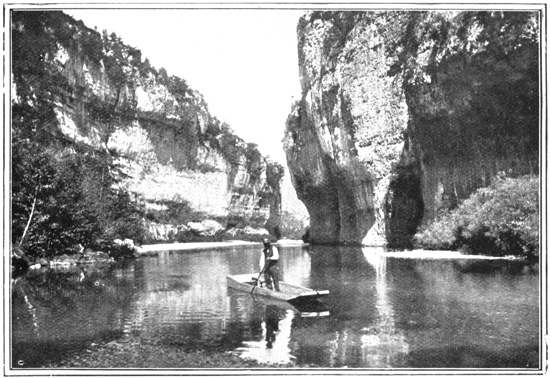
ON THE TARN
"One sits as in a cockle shell on the Enchanted Sea, gliding along magically amid scenes of unequalled splendour."
There are several ways of reaching this little-known corner of France, but the best is undoubtedly by way of Mende, a fine town 434 miles south of Paris, "chief place" of the Department of the Lozère. Mende, although one of the cleanest and brightest of the French towns, with a population of less than 10,000, and pleasantly situated in a wide green valley, with low and sparsely-timbered hills billowing on every side under a sky so blue and in atmosphere so clear that the eye seems to acquire an unusual power of vision, would scarcely be worth the journey for itself alone. But it is the real starting-place for the descent of the Tarn gorges, and it possesses many excellent hotels and an ample service of coaches for the journey across the great plateau of the Causse de Sauveterre to Ste. Enimie, a distance of about eighteen miles. This would be the most convenient route for the traveller who depended upon the train and coach for his locomotion, but those who, like the writer, make use of the bicycle, would be well advised to make Florac their starting-point, as not the least beautiful part of the river scenery lies between that pretty little town and Ste. Enimie.
II.
It fitted well with my plans one summer to explore a much longer reach of the Tarn than most visitors are in the habit of following, and I should have been sorry indeed to have missed any part of the journey. In company with another friend of the wheel, I struck eastward from Mende along the lovely valley of the Lot, and crossing the great mountain range that gives its name to the Department of the Lozère we first came upon the Tarn at Pont de Montvert, some fourteen miles north-east of Florac, at which point R. L. Stevenson began his acquaintance with the river. From this sleepy old town the river runs through a deep and narrow valley, the slopes thick with mighty chestnut trees, and the scenery in parts somewhat reminiscent of our Scottish Highlands, and totally unlike those reaches which, in its south-westerly course, render it unique among the rivers of Europe. For a few miles beyond Florac the aspect of the country is somewhat similar in kind, but on a more massive scale, the valley wider and more pastoral; but when one has reached the little town of Ispagnac, which sits snugly amid its fruitful orchards, the real character of the Tarn begins to reveal itself.
It was after sunset when we had come thus far on our journey to Ste. Enimie, a distance of about seven miles from Florac, and never am I likely to forget the weird and thrilling impression of our passage from Ispagnac to Ste. Enimie, a matter of fifteen miles. The night comes quickly in that latitude, and as we advanced along the well-made road that follows the sinuous course of the river, at first mounting steadily until the noise of the water is heard but faintly far below, and then for mile upon mile gradually tending downward, the gloaming deepened into dark, and the gorge of the river, at all times awe-inspiring, took on in many a strange and mysterious shadow of the night a moving touch of Dantesque grandeur. We had left behind us all the tree-bearing slopes, and the river now ran in a great chasm of volcanic cliffs, shooting their fantastic pinnacles a thousand feet into the darkling sky, and presenting many an outline that might have been mistaken for the towers and bastions of some eerie stronghold. Not a soul was passed on all the miles of road, no sound was heard but the varying noise of the water, nothing moved in our path except an occasional bat, that zigzagged its noiseless flight across the road. One sat on the saddle with a tight hold on the handle bars, and kept as close as possible to the uprising rock, for towards the river was a sheer drop of some 500 feet, and only a low coping stood between us and disaster. So tortuous was the road, that, being at one time some little distance in advance of my companion, I awaited his approach, and could see the light of his lamp shoot out like a will-o'-the-wisp into the middle of an abyss, and then disappear in a hollow of the rocks, only to emerge again and flash upon an uncanny bridge across some gaping gully. For a considerable time we gazed enraptured on Venus, which is here seen with a radiance seldom witnessed in England, and seemed to lie like a glittering gem on the very brow of a mighty cliff. Presently summer lightning began to play along the riven lips of the valley, and continued at thrilling intervals to add a touch of dramatic intensity to a scene already sensational enough.
The only place of habitation through which we passed was the little village of Prades, where the lighted window of a café with noise of merriment within, and the solemn gruntling of oxen in an open stable, gave one a little human encouragement though the street lay void and black. As you may suppose, it was with no small satisfaction that we at length wheeled into Ste. Enimie at half-past nine o'clock, and found mine host of the Hôtel de Paris delighted to welcome two belated voyagers.
III.
Ste. Enimie, which has a population of 1,000, is the chief town of its canton, and is cosily tucked away close by the river side in a great amphitheatre of hills and cliffs, the meeting-place of three important highways: that by which we had come, and the road across the Sauveterre from La Canourgue, and that across the other mighty plateau, the Causse Méjan. The town is of great antiquity, and is said to owe its origin to a certain princess named Enimie, daughter of Clotaire II., who, being tainted with leprosy, was cured by some waters at this place, and founded a monastery here at the close of the sixth century. This religious house became one of the richest in all Gévaudan, but was suppressed, like so many of its kind, at the time of the great Revolution. The remains of the building are still an interesting feature of the place, and high on the cliff above is the hermitage of the saint, a little chapel built about the cave in which she is supposed to have slept. The river is here crossed by a splendid bridge, which the builders were busy improving at the time of our visit.
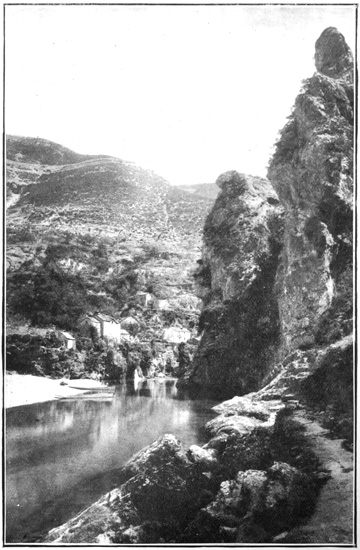
A ROCKY DEFILE ON THE TARN
Showing the mass of the Causse Méjan rising on the left
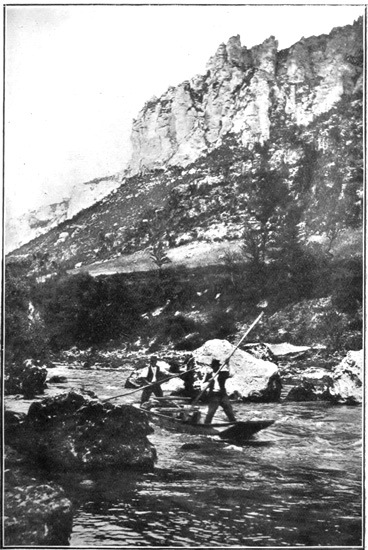
IN THE GORGE OF THE TARN
"The river roars between precipices, that rise sheer and stupendous from its brink."
While the mistress of the hotel was preparing what we later pronounced a most excellent meal, mine host was telling me surprising things in the dining-room, to which one gained access through a fine old-fashioned kitchen. With one of Taride's large scale maps before me, whereon was shown a "national road" right through the gorges of the Tarn to Millau, I asked for some particulars of the route, and was smilingly informed that it did not yet exist.
"But it is here, shown by a thick red line, on this map."
"Quite so, m'sieu; many cyclists come here with a map like that and think they can cycle all the way. But there is no road as yet, though in five years or six there will be one. The only way to descend the Tarn from here to Le Rozier is in a barque."
Now, experience has made me doubtful of anything a hotel-keeper in a tourist resort will tell you about boats and coaches, for you never know to what extent he is financially interested in the matter, and he of the Hôtel de Paris was avowedly the agent of the company to whom belong the boats used for the descent of the river. Although his hotel had a modern and well-appointed annexe—token of the growing popularity of the place where hotels are rapidly increasing—in person he resembled a brigand grown stout with easeful days, and one naturally grew more suspicious when he protested that it would not make the difference of a sou to him whether we went by boat or toiled ourselves to death across the mountains. A good friend at Florac—none other than the Free Church minister—had also assured us there was no road beyond Ste. Enimie, but that the boat charges were not dear. "Nor are they," said the hotel-keeper; "it is only thirty-six francs (thirty shillings) all the way, which is very cheap." We were unable to see eye to eye with him then, but subsequently came round to his opinion when we knew how much labour and skill could be purchased for this modest outlay.
IV.
You must know that the Tarn and its ways are not to be measured by the ordinary experiences of holiday travel. At seven o'clock in the morning you wake and breakfast without loss of time, in order to set out without delay and reach Le Rozier, thirty miles to the south, in time for six o'clock dinner. On the beach, close by the hotel, lie a number of flat-bottomed barques, rudely constructed affairs, exactly similar to fishing-punts used in shallow English waters. A plank of wood with a back to it, and covered with a loose cushion, is laid athwart the primitive craft, and here you take your seat. It is possible, I believe, for six passengers to be carried, but personally I should be loath to trust myself in such a boat with more than four, for two boatmen are necessary to each punt. The charge is for the boat irrespective of numbers, so that we might have had two more in ours without adding to the cost, but our bicycles helped us to square matters. Our boatmen were rough, half-shaven fellows, and he who took his place at the stern seemed to have been drinking unnecessarily early in the morning. But both knew their business thoroughly, and were alive to every current and whirlpool in the river.
Their system of navigation is at once simple and effective, the only possible method of using the water-way. Armed with a strong pole, they stand, the one in front and the other behind, and allow the barque to glide down the swift current of the river, which runs, as I should judge, at six or eight miles an hour. Its course is broken up by innumerable gravel beds and rocky snags, and while we seem to be on the very instant of dashing into a seething whirlpool one of the boatmen will, with admirable precision, jab his pole into a hidden gravel bank and thrust the boat once more into the main current. Beautiful was it to watch how skilfully the men made use of this current, and that, guiding the frail craft straight into what seemed a perilous swirl of breakers, only that they might avail themselves of a different current resulting therefrom, and pilot us into a quiet pool by the beach on the very lip of a thundering weir.
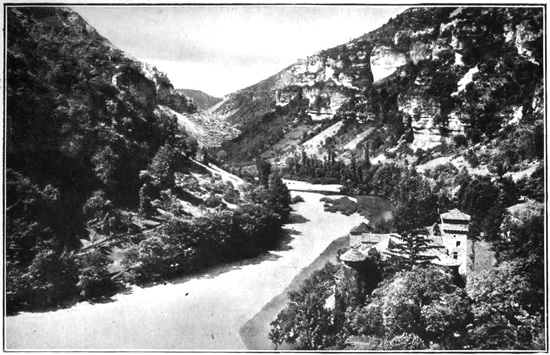
THE CHATEAU DE LA CAZE ON THE TARN
"One of the most beautiful and romantic pictures is supplied by the ancient Castle of La Caze, which occupies a sheltered corner in a bend of the river."
It is indeed difficult to convey any adequate idea of the sensation of such a journey, where the water itself is at once the element and the cause of the progress. One sits as in a cockle shell on the enchanted sea, gliding along magically amid scenes of unequalled splendour; but, alas! the bronzed youth at the prow and the hairy wine-bibber at the stern are no creatures of fairyland, but the very serviceable mortals without whose aid the wonders of the Tarn would have remained to this day as distant as the realms of faëry.
The panorama, which seems to pass us slowly on both sides of the river—for the absence of mechanical propulsion gives one the illusion of sitting still while the cliffs on each hand move past the boat—is of ceaseless change. For a time the hills reach up, green and carefully cultivated, to the higher basaltic cliffs, that rise perpendicular to the edge of the plateau, a thousand feet or more above our level, and then as they suddenly narrow, with never a foothold for the tiniest of creatures, the river roars between precipices that soar sheer and stupendous from its water, or in some cases lean forward so that at a little distance both sides seem to meet and form an arch across the stream. And the whole is rich in colour, the prevailing grey of the rocks being varied by great masses in which warm reds and browns occur, while every crevice is picked out with greenery, and wherever the foot of venturesome man can scramble there have been those bold enough to terrace patches of the slopes where vines and even tiny crops of wheat contrive to grow. One of the most beautiful and romantic pictures is supplied by the ancient castle of La Caze, which occupies a sheltered corner in a bend of the river, where above it the cliffs uprear with great hollows and rotundities, illustrating how in the unknown ages the water has eaten its way down from the upper level to its present bed.
The Château de La Caze is set about by many tall and leafy trees, and one could imagine no holiday more enjoyable than a few days passed here, for—Oh, ye romantic and practical Frenchmen!—the castle has been transformed into an hotel, where all the appointments and even the costumes of the servants recall the Middle Ages in which it was built. As we approached, one of our boatmen took up a large conch and, blowing into it, set the gorge echoing as from a foghorn; but we had decided not to visit the château, as it was our purpose to lunch farther down at La Malene, and the sounding of the conch was meant only to attract the attention of some of the servants, to whom our boatmen shouted that we had thrown on the river-bank about a quarter of a mile above the castle a sack of loaves for its inmates.
V.
Between Ste. Enimie and La Malène there are four or five points at which we have to change our barque, where the river leaps over dangerous weirs, and several changes are necessary on the lower beach. It is due to this manœuvring and to a wait of nearly two hours at La Malène, while the bateliers lunch and gossip boisterously at one of the hotels—the voyageurs also being not unmindful of refreshment—that Le Rozier is not reached until six o'clock, despite the rapid course of the river.
La Malène is one of the three places south of Ste. Enimie, and still in the real cañon of the Tarn, where the river is crossed by bridges; all splendid structures, designed to withstand the spring floods when the current carries with it many a mighty block of ice and all sorts of debris from the hills. The first and newest of the bridges is passed at St. Chely, a small and dirty, but extremely picturesque, hamlet half-way between Ste. Enimie and La Malène, where we explored a wonderful series of ancient cave dwellings, and where, by the way, an enterprising photographer has joined the modern to the prehistoric by painting an advertisement of his wares on the face of the cliff overlooking the former haunts of the Troglodites.
La Malène is, to my thinking, one of the most beautiful points on the route. The little town sits in the mouth of a great ravine that reaches far into the Causse de Sauveterre, and on the opposite side the majestic mass of the Causse Méjan climbs to well-nigh 1,800 feet above the river, the mountain road wriggling upward from the bridge in a series of wonderful twists and turns, "exactly like an apple paring thrown over the shoulder of the engineer," as Mr. Crockett has said of another highway in the farther south. It takes a man, walking at his best, more than an hour to climb that same road, as I can testify, and never for a moment during the ascent is the little town at the foot out of view. This will convey some idea of the barrenness of the mountain-side, where cattle and sheep crop a scanty herbage on fields that slope like the roof of a house and are thickly strewn with stones and boulders. At La Malène also there is a mediæval castle, which, like La Caze, is the property of that great tourist agency, "La France Pittoresque," and now serves as a hotel; but we were more interested in the old church of Romanesque design, where we saw the common grave of the thirty-nine villagers who were slain by the Republican troops during the Terror, and are remembered throughout the Cevennes as "the Martyrs of La Malène." It is striking proof of the terrible thoroughness of that bloody regime that even to this remote and sequestered nook the gory hand of the Terror stretched out.
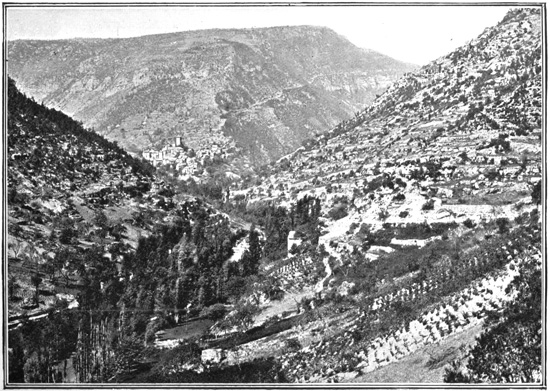
PEYRELAU, IN THE VALLEY OF THE JONTE
The French are the best of all road-makers; more than any of the Latin peoples they have retained and fostered this gift of their Roman forebears. The highway they are now constructing along the Tarn was almost completed between St. Enimie and La Malène, at the time of our passing, and a splendid road it promised to be, here running like a gallery along the face of a cliff and there tunnelling some mighty bluff that juts out into the cañon. But the river will always remain the real highway, as the scenery can only be viewed to full advantage from a seat in a barque, and the bateliers need not fear the competition of the road that is in the making.
VI.
If one were innocent enough to believe the boatmen who live by the tourist traffic, it would be difficult to know which part of the Tarn is the most beautiful. At St. Enimie you would be assured, in the event of your being undecided as to the whole trip, that the stretch between that town and La Malène was by far the best; while at La Malène you would find the local boatmen emphatic as to the unrivalled beauty of the cañon between that point and Les Vignes, where the third bridge stands; and as surely when you arrived there you would be told the Tarn was only beginning to be worth seeing from there to Le Rozier! Naturally, it is impossible for two boatmen to take you a voyage which, occupying twelve hours, requires more than double that time and many times more energy, to bring the empty boats back to the starting-places. Thus the bateliers are prejudiced in favour of their own particular part of the journey, and the only way is to make the entire trip; but indeed that is for all who do not cycle imperative, as the expense of reaching a railway station from any of the places mentioned before Le Rozier would be prohibitive, and one must continue the journey from the last-named place to Millau by coach and train, for which only a small charge is made.
My own impression, if one can distinguish among scenes so differently beautiful, is that the cañon between La Malène and Les Vignes presents its most surprising aspect. At Les Detroits the giant walls lean forward in a bold and menacing way, and further on, at the Cirque des Baumes and Les Baumes Basses, we see some of Nature's most picturesque effects, while the Pas de Soucy is a wild and thrilling part of the journey, where the great basaltic masses are scattered about as if an awful earthquake had but recently shaken them into their fantastic positions.
But really there seems to be no end to the beauty of the Tarn, and when one has arrived at Le Rozier fresh wonders await the eye, and scenes rivalling anything we have witnessed are still to behold, if we will make a short detour into the valley of the Jonte, where the ancient town of Peyreleau sits like a queen enthroned among enfolding hills. If one can go a little farther along this tributary of the Tarn and visit the famous grotto of Dargilan, discovered by M. Martel in 1884, a strange and beautiful underworld, before which the most extravagant fantasies of the Arabian Nights pale into insignificance, will be revealed. There, by the light of torches, we can wander through gigantic caverns of stalactite greater and more awe-inspiring than any cathedral, and journey by canoe on underground rivers, in what—those practical Frenchmen once again!—is "the property of the Society 'La France Pittoresque.'"
Even that part of the Tarn between Le Rozier and Millau, no longer a gorge, but broadening into a smiling and fruitful valley, with the great impregnable wall of the Causse Noir frowning along its eastern length, is full of beautiful vistas; but the wild and rugged grandeur of the cañon has given place to scenes of pleasant pastoral life, and we cycle along a highway fringed with cherry trees in fruit, passing many a populous little town before we enter the leafy boulevards of the historic and prosperous city of Millau.
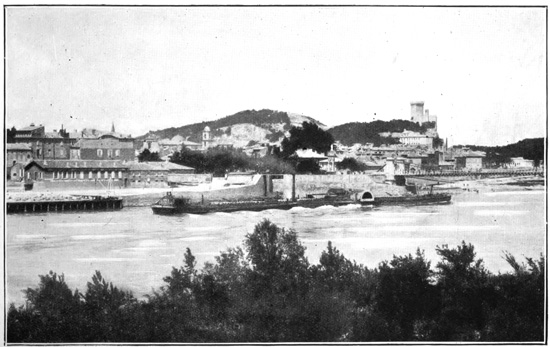
BEAUCAIRE: SHOWING CASTLE AND BRIDGE ACROSS THE RHONE TO TARASCON