Along the Route of "An Inland Voyage"
Reading edition
"Now, to be properly enjoyed, a walking tour should be gone upon alone. If you go in company, or even in pairs, it is no longer a walking tour in anything but name. It is something else, and more in the nature of a picnic. A walking tour should be gone upon alone, because freedom is of the essence; because you should be able to stop and go on, and follow this way or that as the freak takes you, and because you must have your own pace, and neither tramp alongside a champion walker, nor mince in time with a girl. And then you must be open to all impressions, and let yourself take colour from what you see. You should be as a pipe for any wind to play upon."
I.
Thus wrote Stevenson in one of his essays, but I doubt if he ever put into practice this engaging theory of his. He came nearest to being alone when he undertook his famous tour through the Cevennes; yet a donkey, and one of so much character as his Modestine, is company of a sort. When he made the first of his little journeys with a literary end in view, he had a companion after his own heart in the late Sir Walter Simpson, to whom the first of his books, An Inland Voyage, is dedicated. That was, however, an enterprise of some adventure, and it was well that the author had a companion, for had he fared forth alone in his frail canoe, as did his great exemplar John MacGregor, in the Rob Roy, it is doubtful if An Inland Voyage—not to say all that came after it—had ever been written. In a letter sent from Compiègne during the voyage, he gives a very cheerless picture of the business: "We have had deplorable weather, quite steady ever since the start; not one day without heavy showers, and generally much wind and cold wind forby.... Indeed, I do not know if I would have stuck to it as I have done if it had not been for professional purposes." I suspect that no less potent an influence than "professional purposes" in raising his courage to the height of the occasion, was the companionship of "My dear Cigarette," as he addresses Sir Walter, whose canoe had been named Cigarette, that of Stevenson sporting the classic title Arethusa. Fortunately for the reading world, the voyage, despite its discomforts, had happy issue in one of the most charming books that came from the pen of the essayist, and although hints are not lacking of the shadows through which the canoeists passed, the sunshine of a gay and bright spirit is radiant on every page.
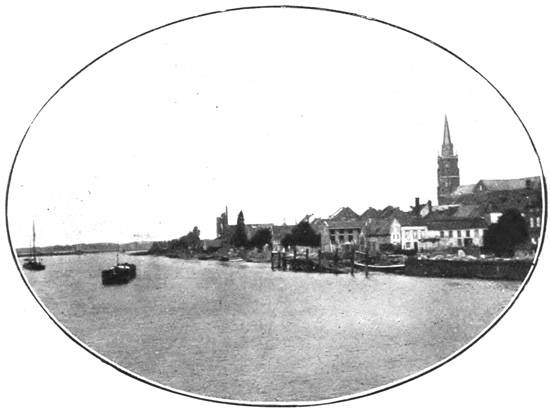
BOOM ON THE RUPEL
"Boom is not a nice place."—R. L. S.
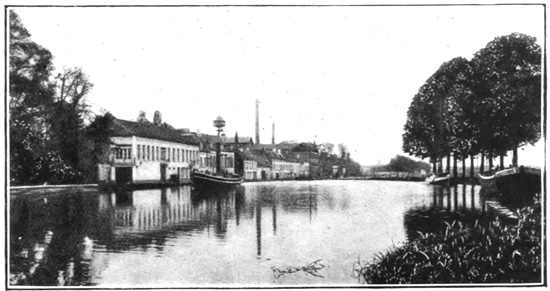
VILLEVORDE ON THE WILLEBROEK CANAL
"The rest of the journey to Villevorde, we still spread our canvas to the unfavouring air."—R. L. S.
As it had been my pleasant fortune in the summer of 1903, together with a friend, to follow the footsteps of Stevenson in his travels among the Cevennes, and the pilgrimage having proved plentiful of literary interest, it seemed to me that one might find in a journey by road along the route of "An Inland Voyage" as much of interest, and certainly some measure of personal pleasure. Moreover, with the disciple's daring, often greater than the master's, I desired to test the plan of going alone. But it was more by happy chance than any planning of mine that I betook myself, with my bicycle, to Antwerp at precisely the same season that, eight-and-twenty years before, Stevenson and his companion set out upon their canoe voyage by river and canal, from that ancient port to the town of Pontoise, near the junction of the Seine and Oise, and within hail of Paris.
In the preface to the first edition of An Inland Voyage, its author expresses the fear that he "might not only be the first to read these pages, but the last as well," and that he "might have pioneered this very smiling tract of country all in vain, and found not a soul to follow in my steps." That others have been before me in my late pilgrimage is more than probable, although I have found no trace of them; but perhaps I have not searched with care, for I would fain flatter myself that here, as in the Cevennes, I found a field of interest where there had been no passing of many feet.
II.
Antwerp seems a town so antique that no change of modern handiwork can alter in any vital way its grey old features. Yet in my own acquaintance with it, on its outward quarters at least, it has taken on surprisingly the veneer of modern Brussels, though by the river-side it remains much as it was when, in the later days of August, 1876, the Cigarette and the Arethusa, with their adventurous occupants, were launched into the Scheldt to the no small excitement of the loungers about the docks. There must have been some excitement, too, in the breasts of the voyagers, but, like the true Scots they were, we can well believe they gave no show of it. Stevenson had never been in a canoe under sail before, and to tie his sheet in so frail a craft in the middle of a wide and busy river called for no contemptible degree of courage. But he tied his sheet.
"I own I was a little struck by this circumstance myself," he writes. "Of course, in company with the rest of my fellow-men, I had always tied the sheet in a sailing-boat; but in so little and crank a concern as a canoe, and with these charging squalls, I was not prepared to find myself follow the same principle, and it inspired me with some contemptuous views of our regard for life. It is certainly easier to smoke with the sheet fastened; but I had never before weighed a comfortable pipe of tobacco against an obvious risk, and gravely elected for the comfortable pipe. It is a common-place that we cannot answer for ourselves before we have been tried. But it is not so common a reflection, and surely more consoling, that we usually find ourselves a great deal braver and better than we thought."
There is but little of interest up the river, which waters a level, unpicturesque country to Rupelmonde, where the canoeists would bid good-bye to the Scheldt and steer to the south-east up the Rupel, a broad and smooth-flowing stream that joins the greater water at this point. Against the current they would urge their tiny prows until they arrived after a journey of a few miles at the town of Boom, whence the canal extends to Brussels in an almost straight line:
As I made my way that grey autumn morning through the little villages and along the tree-lined highway, the brown leaves flickering down in the cold wind that stirred among the branches, it pleased me to fancy how Stevenson, had his youth fallen in the days of the bicycle, would have enjoyed the privilege of riding on the Belgian footpath, which to us who live in a land where no cyclist dare mount his machine except on the highway affords a delightful sensation of lawlessness. It is well to observe, however, that but for this right of the footpath there would be no cyclist in all Flanders or Northern France, since highways and by-ways there are made of the most indiscriminate cobbles, and in the remote country places a cart on the lonely road moves with as great a clatter as one on the stony streets of Edinburgh.
III.
I was no great way from Boom when I saw advancing a high and narrow structure, drawn by a horse, that progressed to the weird and irregular clangor of a heavy bell, reminding me curiously of Stevenson's moving description of the leper bell in The Black Arrow. When I came up with the horse and its burden, I found the latter to consist of a large circular tank, set on four wheels, with a tall box in front for the driver, above whose head a large bell was suspended. The word "Petrol," painted on the tank, indicated its contents. Here, surely, was something that made the days of the canoe voyage seem remote indeed; the peddling vendor of petrol belongs emphatically to the new century.
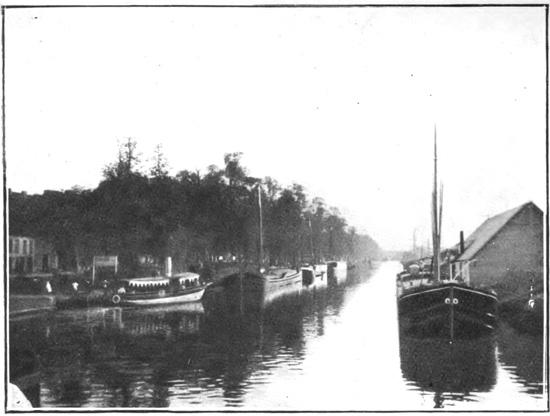
THE ALLEE VERTE AT LAEKEN
The head-quarters of the "Royal Sport Nautique" is hidden among the trees on the left of the picture.
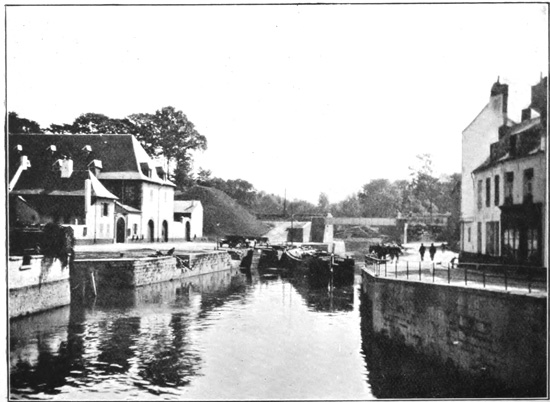
THE SAMBRE AT MAUBEUGE
It was at this point, "on the Sambre canalised," that the canoe voyage began in earnest.
"Boom is not a nice place, and is only remarkable for one thing: that the majority of the habitants have a private opinion that they can speak English, which is not justified by fact." I can heartily endorse our canoeist's opinion of the town, but this linguistic pride of its inhabitants is surely a vanity of the past. I found none—and I spoke to several—who had any delusions as to their knowledge of English, and, indeed, few of them had more than a smattering of French. A pleasant fellow on a cycle, who had insisted on riding close to me through the outlying districts of the town, which are entirely taken up by extensive brickworks, where I noticed the labourers all went bare-footed, I found capable of understanding a few words of broad Scots, and when I said, "Boom, is't richt on?" or "Watter, richt on?" he nodded brightly, and replied in Flemish, which was comically like the Scots.
The Hôtel de la Navigation, where the paddlers put up for the night, and of which Stevenson gives so bad an account, I found no trace of, nor did I tarry any length of time in Boom, since its attractions were so meagre. The "great church with a clock, and a wooden bridge over the river," remain the outstanding features of the town, and viewed from the south side of the river, it makes by no means an unpleasing picture.
IV.
The canal was simply packed with barges and great ungainly scows in the vicinity of the town, awaiting their turn to slip through the locks into the freer water of the Rupel, and heigh! for Antwerp, or even the coastwise towns of Holland. It was good to feel as one proceeded along the tow-path that here, in this world of change, was a stream of life flowing onward through the generations serene and changeless. "Every now and then we met or overtook a long string of boats with great green tillers; high sterns with a window on either side of the rudder, and perhaps a jug or flowerpot in one of the windows; a dinghy following behind; a woman busied about the day's dinner, and a handful of children." Every day since R. L. S. paddled in this same stretch of water the canal has presented the same picture of life, and thirty years hence, it is safe to prophesy, the wayfarer will find no change, as these canals remain the great highways of Belgium and France for the transport of goods that are in no haste; and when we come to think of it, a great proportion of the commodities of life may be carried from place to place in no gasping hurry for prompt delivery.
Stevenson has many profitable reflections on the life of the canal-folk, with which in the course of his journey he was to become so familiar. "Of all the creatures of commercial enterprise," he writes, "a canal barge is by far the most delightful to consider. It may spread its sails, and then you see it sailing high above the tree-tops and the windmill, sailing on the aqueduct, sailing through the green corn-lands, the most picturesque of things amphibious. Or the horse plods along at a foot-pace, as if there were no such thing as business in the world; and the man dreaming at the tiller sees the same spire on the horizon all day long.... There should be many contented spirits on board, for such a life is both to travel and to stay at home.... I am sure I would rather be a bargee than occupy any position under heaven that required attendance at an office. There are few callings, I should say, where a man gives up less of his liberty in return for regular meals." But our philosopher, when he goes on to enhance his comfortable picture of a bargee's life, is scarcely correct in saying that "he can never be kept beating off a lee shore a whole frosty night when the sheets are as hard as iron." For these great clumsy craft know well the scent of the brine, and there are times when the snug outlook on the towing-path, and the slow business of passing through innumerable locks are changed for floundering in heavy seas and a straining look-out for a safe harbour. Not all their days are smooth and placid, and sometimes, we may imagine, the dainty pots of geraniums, that look so gay against the windows as we pass, must be removed to safer places, while the family washing, drying on deck to-day, has to be stowed elsewhere, and the tow-haired children, now playing around the dog-kennel on the top of the hatches, have to be sent below when salt waves break over the squat prow of the vessel.
The journey along the canal bank was to me a very pleasant one, and I had hopes of being more fortunate than the canoeists in reaching Brussels with a dry skin. They had to paddle in an almost continual drizzle, and even made shift to lunch in a ditch, with the rain pattering on their waterproofs. But when I got as far as Villevorde, where gangs of men were labouring on the extensive works in connection with the railway and the new water supply, the rain began, and I was wet to the skin long before I had reached the royal suburb of Laeken, where, for evidence of Belgium's industrial progress, witness the splendid improvement on the canal at this point, soon to become a system of docks and water-ways resembling in extent a great railway junction.
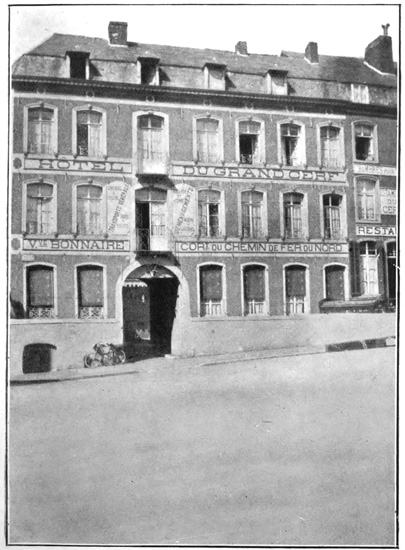
THE GRAND CERF MAUBEUGE
Where R. L. S. and his companion stayed for some days awaiting the arrival of the canoes by rail from Brussels.
V.
One of the most amusing episodes in "An Inland Voyage" was the encounter of the canoeists with the young boatmen of the "Royal Sport Nautique," who in their enthusiasm for rowing gave a warm welcome to the strangers, and by assuming the latter to be mighty men of the paddle, led them into the most unwarranted boasting about the sport. "We are all employed in commerce during the day," said the Belgians, "but in the evening, voyez-vous, nous sommes sérieux." An admirable opening for a characteristic bit of Stevensonian philosophy: "For will anyone dare to tell me that business is more entertaining than fooling among boats?"
Whether or not the newer generation of Brussels boatmen are as serious as the youths of thirty years ago I cannot say. The next afternoon, being Sunday, I came out again from Brussels to make enquiries concerning the "Royal Sport Nautique," and found a commodious brick building occupying the site of the boathouse wherein Stevenson had been entertained, but no signs of nautical life about it. There was the slip where the Cigarette and the Arethusa were drawn up out of the canal, and on the roadway opposite stood this new boathouse and clubroom, with the dates 1865—94 indicating, as the only member whom I found on the premises explained, that the club had been founded in the former year, and the building erected in the latter. But he was a churlish fellow, this coxcomb in his Sunday dress, and barely answered my questions. If I too, had paddled my own canoe, perhaps it might have been otherwise! The day was fine, and the canal was busy with little excursion steamers that were well patronised by holiday-makers, and were covered almost to the water-line with flaring advertisements of Scotch whiskies and English soaps, only one out of a dozen advertisements being of local origin: a circumstance that would, we may be sure, have drawn from Stevenson some pages of gay philosophy.
VI.
Following the example of the original travellers, I took train from Brussels to the French frontier town of Maubeuge, where in real earnest their canoe voyage began. To the traveller who has wandered the highways of France south and west of Paris, such a town as this presents some uncommon features, and I cannot but think that R. L. S. gives a wrong impression of it. "There was nothing to do, nothing to see," he tells us, and his only joy seems to have been that he got excellent meals at the "Grand Cerf," where he encountered the dissatisfied driver of the hotel omnibus, who said to him: "Here I am. I drive to the station. Well! Then I drive back again to the hotel. And so on every day and all the week round. My God! is that life?" And you remember Stevenson's comment: "Better a thousand times that he should be a tramp, and mend pots and pans by the wayside, and sleep under the trees, and see the dawn and the sunset every day above a new horizon." Here spoke the lover of romance; but the facts are quite otherwise.
Maubeuge I found a bright little town, surrounded by mighty ramparts with spacious gates and bridges over the fosse. It is picturesquely situated on the river Sambre, on whose banks stand large warehouses and manufactories, while the shops bear evidence of prosperity. Even l'art nouveau has reached out from Paris and affected the business architecture of the town. There is a bustling market-place, a handsome little square with a spirited monument to the sons of the country-side who have fallen for France, a grey old church, and a pleasure-ground with a band-stand and elaborate arrangements for illumination on gala nights. Indeed, I can imagine life to be very tolerable in Maubeuge, which is really the residential centre of an immense industrial district resembling more closely than any other part of France our own Black Country.
Stevenson makes no mention of having visited the church, which is interesting in one respect at least. Beneath the stucco casts of the stations of the cross some curé of an evangelical turn of mind has ventured on a series of little homilies unusual in my experience of French churches. Thus, under the representation of Christ falling while bearing His cross we read: "Who is it that causes Jesus to fall a second time? You, unhappy person, who are for ever falling in your faults, because you lack resolution. Ask, therefore, of God that you may henceforth become more faithful unto Him."
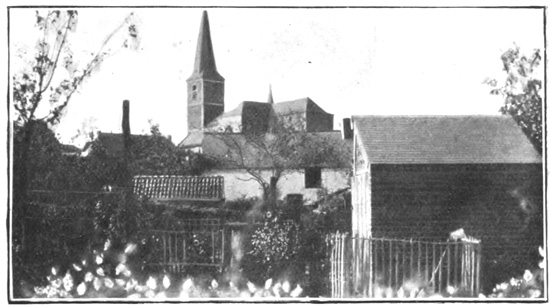
THE CHURCH AT QUARTES
"A miry lane led us up from Quartes with its church and bickering windmill."—R. L. S.
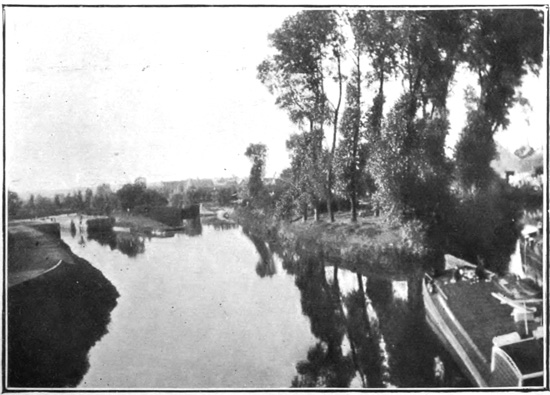
THE SAMBRE FROM THE BRIDGE AT PONT
Where "the landlady stood upon the bridge, probably lamenting she had charged so little," when the canoeists arrived back by river from Quartes after having been treated like pedlars at Pont.
Only in the most insignificant way can Maubeuge have changed since Sir Walter Simpson was nearly arrested for drawing the fortifications, "a feat of which he was hopelessly incapable," so that I suspect something of misplaced sentiment in Stevenson's impressions of the place. For my part, I should find it difficult to mention a town of the same size in England or Scotland to compare with Maubeuge as a place to pass one's days in. That omnibus driver with the soul of a Raleigh may have been in some measure a creature of the romancer's fancy. At all events, it is likely enough that he has travelled far since 1876, as I take him to have been a man of middle age then. The hotel omnibus with its two horses still makes its journey to and from the station, but the driver is a stout young fellow of florid face, who, I am sure, is perfectly contented with his lot, and enjoys his meals. "C'est toujours la même ici," said Veuve Bonnaire, the landlady of the "Grand Cerf," when I chatted with her in the bureau after luncheon. Yet not always the same, for where was M. Bonnaire? And I fear that our canoeists, if they could visit the hostelry again would scarce recognise in this lady of gross body their hostess of thirty years ago. The building itself is quite unchanged, I was assured, and I ate my food in the same room and in just such company as the voyagers dined—military officers all absurdly alike in sharp features, small moustache and tuft on chin, and ungallant baldness of head; and three or four commercial travellers, each with a tendency to "a full habit of body."
VII.
The whole establishment of the "Grand Cerf" accompanied the canoeists to the water's edge when they were ready to take their leave. Madame Bonnaire, however, has quite forgotten that exciting episode of her middle life; but there, we have Stevenson's word for it, and the good woman must accept the fame. The day was a dismal one, we are told—wind and rain, and "a stretch of blighted country" to pass through. I heartily wished for a speedy end to that same stretch. For six or seven miles the road is lined with factories and dirty cottages, while dirty electric cars rattle along, well-laden with passengers, for here France is at work and grimy; here is the France of which the tourist along the beaten tracks has no notion. A stout gentleman with whom I conversed by the wayside was very proud of the varied industries of the district. "Look you; we have glass works, pottery works, iron foundries, engine works, copper, and many other industries in the neighbourhood." Still, I was glad when, a mile or two beyond Hautmont, I found myself outside this region of smoke and growling factories and advancing into a pleasant pastoral country, the river only a little way from the road. Stevenson's word picture of the scene is photographic in its accuracy, but his art environs it with that ethereal touch the old engravers could give to a landscape, an art that has been lost to us by the vogue of cheap modern "processes."
"After Hautmont," he writes, "the sun came forth again and the wind went down; and a little paddling took us beyond the ironworks and through a delectable land. The river wound among low hills, so that sometimes the sun was at our backs, and sometimes it stood right ahead, and the river before us was one sheet of intolerable glory. On either hand, meadows and orchards bordered, with a margin of sedge and water-flowers, upon the river. The hedges were of a great height, woven about the trunks of hedgerow elms; and the fields, as they were often small, looked like a series of bowers along the stream. There was never any prospect; sometimes a hill-top with its trees would look over the nearest hedgerow, just to make a middle distance for the sky; but that was all. The heaven was bare of clouds.... The river doubled among the hillocks, a shining strip of mirror glass; and the dip of the paddles set the flowers shaking along the brink."
In this land of many waters every male creature seems to be a disciple of Sir Isaak Walton. A prodigious number of anglers will be encountered; I must have seen hundreds. Every day and all day they are dotted along the canals and rivers as patient as posts, and apparently as profitably employed. It was a continual wonder to me how they could spare the time; and a pleasure also, for it is cheering to know that so many fellow-creatures can afford to take life so leisurely, and that the factory may whistle and the surburban train shriek laden to the town without causing them to turn a hair. "They seem stupefied with contentment," says R. L. S. in a fine passage, "and when we induced them to exchange a few words with us about the weather, their voices sounded quiet and far away."
VIII.
At the little hamlet of Quartes, "with its church and bickering windmill"—the latter gone these many years—the canoeists went in search of a lodging for the night, but had to trudge with their packs to the neighbouring village of Pont sur Sambre for accommodation. They would have fared better at Quartes to-day, as there is now a clean little auberge hard by the bridge, kept by a jovial fellow, who told me that his son had taken up photography, with deplorable results. "He takes my photograph, I assure you, M'sieu, and makes me look like a corpse in the Morgue"—and the landlord would laugh and show two rows of dusky teeth beneath his wiry moustache—"and when I say I'm not so awful as that, he will say that now I see myself as I really am, for, look you, the camera must tell the truth." He laughs again, and rising, says: "But come with me here," throwing open the door of a private room. "Now there's a portrait I had done in Brussels, and I'm really a decent-looking chap in that. So I say to my son, whenever he makes a new and worse picture of me: 'There's your papa to the life, done by a real photographer.'"
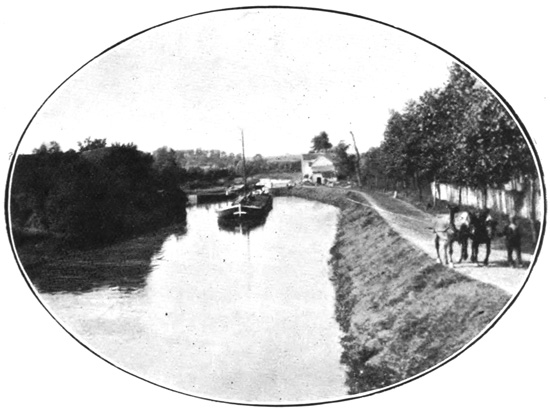
ON THE SAMBRE AT QUARTES
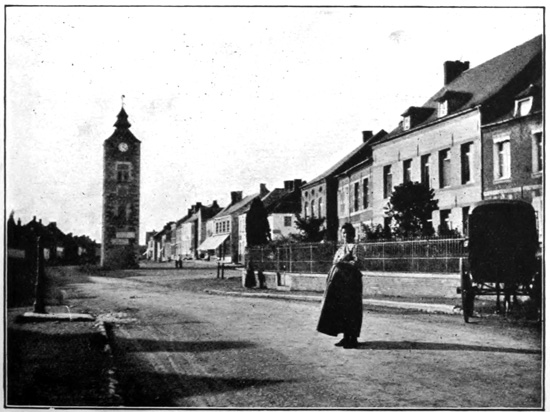
SCENE AT PONT-SUR-SAMBRE
"Away on the left, a gaunt tower stood in the middle of the street."—R. L. S.
I am sure they are a happy family at the inn at Quartes, and they enjoy life, the score or two of barges and boats that pass their door every day keeping them in touch with the outer world of towns. The landlord informed me that he had several times been as far as Paris by the rivers and canals, and that there are excursions all that distance—nearly 200 miles by water—every summer.
IX.
Pont sur Sambre is a long thin village, a mile or so from Quartes, and different from other villages only in the possession of a strange lone tower that stands in the middle of the wide street. Stevenson makes note of it, and says: "What it had been in past ages I know not; probably a hold in time of war; but nowadays it bore an illegible dial-plate in its upper parts, and near the bottom an iron letter-box." As I was preparing to take a photograph of this landmark, a buxom woman came up and begged that I might photograph her. I protested my inability to do so with any satisfaction, having no stand for my camera. "But you have a camera; isn't that enough? And I am so anxious for a photograph." What would you in such a case? Especially as she said she could wait a month or more for me to send a print from England. So the widow Cerisier poses in the foreground of my picture of the strange tower at Pont—a tower which, she told me, has weird underground passages leading away into regions of mystery.
It was at a little ale-house within sight of the tower that Stevenson and his friend passed the night, the landlady treating them as pedlars, and they enjoying the experience. Here, too, they fell in with a real pedlar, Monsieur Hector Gaillard of Maubeuge, who travelled in grand style with a tilt-cart drawn by a donkey, and was accompanied by his wife and his young son. Pedlars' fortunes seem to have improved since those days, as I found a travelling cheap-jack at Pont, with a very commodious wagon, which must have required two horses to move it about, cunningly contrived to open into a veritable bazaar, around which housewives and children clustered like bees. Another packman was showing his wares hard by on a lorry equally commodious, where he displayed to advantage an immense assortment of second-hand clothes and remnants of cloth, while his wife was inducing the thrifty women of Pont to buy.
The Sambre at Pont looks very alluring, especially when the sun shines and projects the green shadows of the waving willows across its sluggish waters. Barges pass under the bridge at a snail's pace, and away among the winding avenue of poplars and willows that marks the river's zigzag course through the rich and restful meadow-land we see the masts of other boats moving with consummate slowness. R. L. S. illustrates the erratic course of the river by stating that while they could walk from Quartes to Pont in about ten minutes, the distance by river was six kilometres, or close on four miles. The folk at the ale-house were amazed when their guests, after walking to Quartes next morning, arrived by river an hour or so later as the owners of two dainty canoes. "They began to perceive that they had entertained angels unawares. The landlady stood upon the bridge, probably lamenting she had charged so little; the son ran to and fro, and called out the neighbours to enjoy the sight; and we paddled away from quite a crowd of wrapt observers. These gentlemen pedlars indeed! Now you see their quality too late."
X.
The country between Pont and Landrecies wears many signs of quiet prosperity; houses are numerous, orchards well-stocked, the people—and never is the highway utterly deserted—smiling and contented, to all appearance. The river at a point about six miles from Landrecies skirts a part of the forest of Mormal, and our sentimental traveller turns the occasion to profit thus:
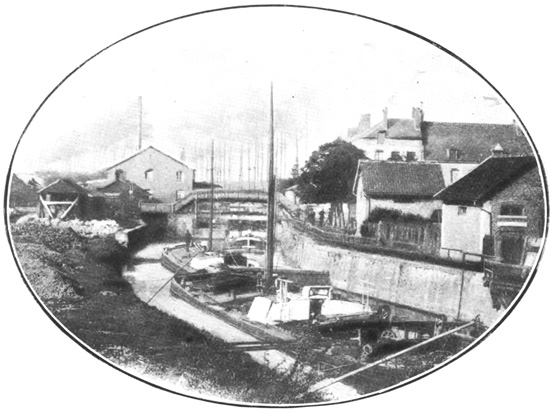
THE SAMBRE CANAL AT LANDRECIES
As it was at the time of "An Inland Voyage."
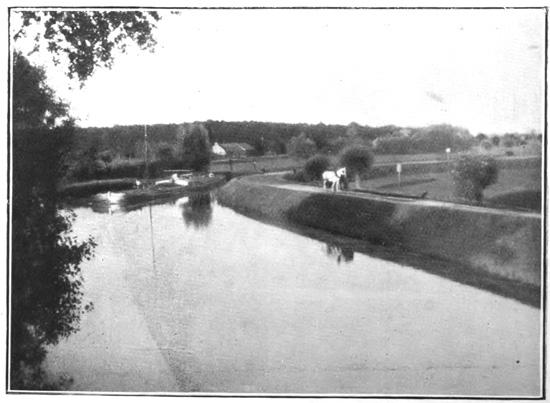
THE FOREST OF MORMAL FROM THE SAMBRE
"We were skirting the Forest of Mormal, a sinister name to the ear, but a place most gratifying to sight and smell."—R. L. S.
"There is nothing so much alive, and yet so quiet, as a woodland; and a pair of people, swinging past in canoes, feel very small and bustling by comparison. And surely of all smells in the world, the smell of many trees is the sweetest and most fortifying. The sea has a rude, pistolling sort of odour, that takes you in the nostrils like snuff, and carries with it a fine sentiment of open water and tall ships; but the smell of a forest, which comes nearest to this in tonic quality, surpasses it by many degrees in the quality of softness. Again, the smell of the sea has little variety, but the smell of a forest is infinitely changeful; it varies with the hour of the day, not in strength merely, but in character; and the different sorts of trees, as you go from one zone of the wood to another, seem to live among different kinds of atmosphere. Usually the resin of the fir predominates. But some woods are more coquettish in their habits; and the breath of the forest of Mormal, as it came aboard upon us that showery afternoon, was perfumed with nothing less delicate than sweetbriar."
Further on he says: "Alas! the forest of Mormal is only a little bit of a wood, and it was but for a little way that we skirted by its boundaries." So it may have seemed to the canoeists, who saw only a scrap of the great forest, that thrusts southward to the river at a place called Hachette. But it was not without some misgiving that I found myself suddenly plunged into the woodland, and discovered that I had six miles of it to penetrate and roads to ride which a little boy in a cart described eloquently by stretching his arm to its limit and then sweeping it down to the cart, and up and down half a dozen times! The forest has indeed, as R. L. S. observes, "a sinister name to the ear," and I felt—if I must speak the truth—a little quickening of the pulse when I had ridden about half an hour through its lonely rough roads, with rabbits and other wild creatures of the undergrowth making strange rustlings among the leaves by the wayside. The sun had been going down as I came into the forest, but the air among the trees was chilling and wintry after the warm high-road, not a slanting ray of sunshine penetrating the dense growth of trees. The only pedestrians whom I met were a party of rough sportsmen, who eyed me as a curious bird when, in answer to their questions, I said I had come from London. I had wandered from the direct road through the forest, it appeared, and one of the men, having a map, was able to work out a route for me; but it was another half-hour—which seemed like half a day—before I caught a welcome glimpse of the clear evening sky among the lower branches, and presently emerged on the main road into Landrecies, at a place suggestively named Bout du Monde.
XI.
If there is another town so dead as Landrecies in all the department of Le Nord, I have a great wish not to pass a night within its walls. It is changed times there since the passage of R. L. S., although it was triste enough when "Arethusa" and "Cigarette" spent two days at the roomy old Hôtel de la Tête d'Or. "Within the ramparts," he says, "a few blocks of houses, a long row of barracks and a church, figure, with what countenance they may, as the town. There seems to be no trade; and a shopkeeper, from whom I bought a sixpenny flint-and-steel, was so much affected that he filled my pockets with spare flints into the bargain. The only public buildings that had any interest for us were the hotel and the café. But we visited the church. There lies Marshal Clarke; but as neither of us had heard of that military hero, we bore the associations of the spot with fortitude."
Marshal Clarke, whose tomb looks as new as though it had been set up yesterday, was one of Napoleon's generals, and, as his epitaph reminds us, sometime minister of war. Had he hailed from Scotland instead of Ireland he might have been more interesting to R. L. S.
If Landrecies was so dull thirty years ago, picture it to-day, with its barracks almost empty, its ramparts demolished, and its less than 4,000 inhabitants in bed by nine o'clock! "It was just the place to hear the round going by at night in the darkness, with the solid tramp of men marching, and the startling reverberations of the drum. It reminded you, that even this place was a point in the great warfaring system of Europe, and might on some future day be ringed about with cannon smoke and thunder, and make itself a name among strong towns." Alas! the barking of a melancholy dog and the clock of the Hôtel de Ville ringing out the lazy hours were the only sounds I heard that night, though just before dusk a wandering camelot selling in the street a sheet of "all the latest Paris songs" made a welcome diversion. I sampled his stock, and found it to consist of doggerel rhymes about the Russo-Japanese War, mingled with some amorous ditties, and a piece of a devotional kind! "C'est une ville morte," said a dumpy lady with a scorbutic face, who drank her after-dinner coffee in the dining-room with me. "Think of Paris, and then—this!" she sighed. I wondered what had brought her there, and doubtless she thought I was some cycling fellow who had lost his way.
But if the military glory of Landrecies is departed, it makes a brave effort to recall the past with an elegant column near the site of the north gate, whereon are recorded the sieges which Landrecies withstood, the last being in the Franco-German War. Also erected since Stevenson's time is a striking monument to the great Joseph François Dupleix, whose gallant effort to found an Indian empire for France was frustrated by Clive, and who, born in Landrecies, spent his substance for his fatherland, only to die in poverty and neglect.
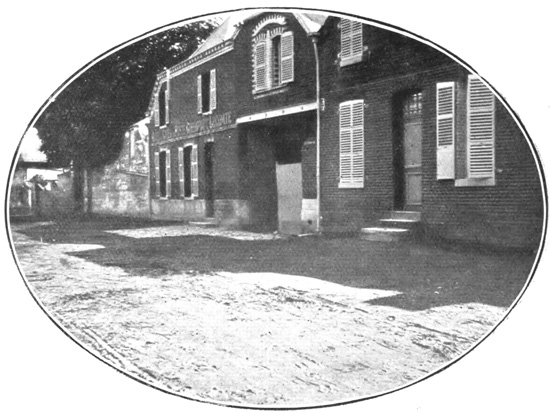
THE INN AT MOY
"Sweet was our rest in the 'Golden Sheep' at Moy."—R. L. S.
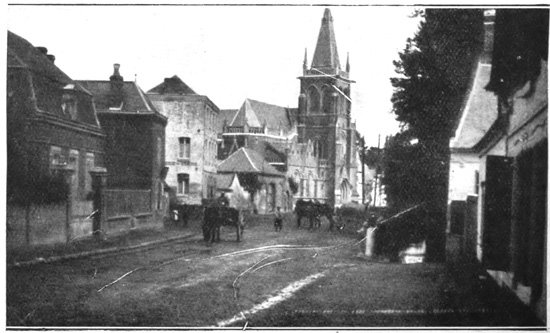
THE VILLAGE STREET, MOY
"Moy was a pleasant little village."—R. L. S.
The landlord of the hotel assured me that he remembered the visit of my heroes, even mentioning the hour of their arrival and departure. He was a young man then; but to-day his hair is streaked with grey. The Juge de Paix, who entertained the travellers, is still to the fore: a bachelor then, he is a widower now.
I noticed an odd feature of the hotel: its meat safe was the roof of the passage to the courtyard. Here, hanging from hooks fixed in the roof, were joints of beef, legs of mutton, hares, rabbits, and so forth—an abundant display; and when the cook was in need of an item, she came out with a long pole and reached down the piece she wanted.
XII.
The canoeists left Landrecies on a rainy morning, the judge under an umbrella seeing them off. My lot was pleasanter, for the morning was fine and the landlord's son, a bright lad, with those babyish socks which French boys wear, escorted me some way out of the town on his bicycle, chatting merrily about the state of the roads, and evincing great surprise when he heard that we would be fined for cycling on the footpath in England.
My route lay along the highway to Guise for a time and close to the canal, passing through a gentle undulating country with far views of thickly-wooded fields and little hills. The hamlets by the way were surrounded by hop fields, the great poles with their fantastic coverings of the vine being the most noticeable feature of the wayside, just as R. L. S. had observed them when the hop-growers of to-day were bien jeune, as the old gentleman at the play in Paris described Stevenson himself. Etreux, where the canal journey ended, I found a thriving and agreeable little town, the rattle of the loom being heard from many an open door, and the thud, thud of flails in the farm-steadings on the outskirts. At Etreux the canoes were placed on a light country cart one morning, and the travellers walked to Vadencourt by way of Tupigny, a village where I was served with a make-shift lunch at a little inn, the landlady doing the cooking and laying the table with a baby held in her left arm! Vadencourt is full of weavers, and here close by the old bridge over the river the Arethusa and Cigarette were launched in the fast-flowing water of the River Oise.
XIII.
The canoeists were now in the full swing of perhaps the most enjoyable part of their journey. Let a canal be never so beautiful, it is still a canal, and no adventure need be looked for there; but a river that runs wild and free is a possible highway to the enchanted kingdom of Romance. We have the avowal of R. L. S. that on this sedgy stream, wriggling its devious ways by field and woodland, he had some of the happiest moments of his life.
"We could have shouted aloud," he says in a glowing passage. "If this lively and beautiful river were, indeed, a thing of death's contrivance, the old ashen rogue had famously outwitted himself with us. I was living three to the minute. I was scoring points against him every stroke of my paddle, every turn of the stream. I have rarely had better profit of my life. For I think we may look upon our little private war with death somewhat in this light. If a man knows he will sooner or later be robbed upon a journey, he will have a bottle of the best in every inn, and look upon all his extravagances as so much gained upon the thieves. And above all, where, instead of simply spending, he makes a profitable investment for some of his money, when it will be out of risk of loss. So every bit of brisk living, and above all when it is healthful, is just so much gained upon the wholesale filcher, death. We shall have the less in our pockets, the more in our stomach, when he cries, 'Stand and deliver.' A swift stream is a favourite artifice of his, and one that brings him in a comfortable thing per annum; but when he and I come to settle our accounts, I shall whistle in his face for these hours upon the upper Oise."
Indeed, he came near to settling accounts with old Death more readily than he could have cared; for not many miles from Vadencourt, in attempting to shoot below the over-hanging trunk of a fallen tree, the lively "Arethusa" was caught in its branches, while his canoe went spinning down stream relieved of its paddler. He succeeded in scrambling on to the tree-trunk, though he "seemed, by the weight, to have all the water of the Oise in my trouser-pockets." But through all, he still held to his paddle. "On my tomb, if ever I have one, I mean to get these words inscribed: 'He clung to his paddle.'" Brave heart, this is in truth but a humorous phrasing of the stately requiem on the stone upon Vaea Top.
It was a dripping "Arethusa" that got into Origny Sainte-Benoîte that night, and but for the ready and resourceful "Cigarette" the adventure might have ended less happily. Although Origny is a dusty little village, as dull as any in all Picardy, the canoeists rested there a day, and had good profit of the people they met at the inn, as Stevenson's pages witness. The landlord was a shouting, noisy fellow, a red Republican. "'I'm a proletarian, you see.' Indeed, we saw it very well. God forbid that I should find him handling a gun in Paris streets! That will not be a good moment for the general public."
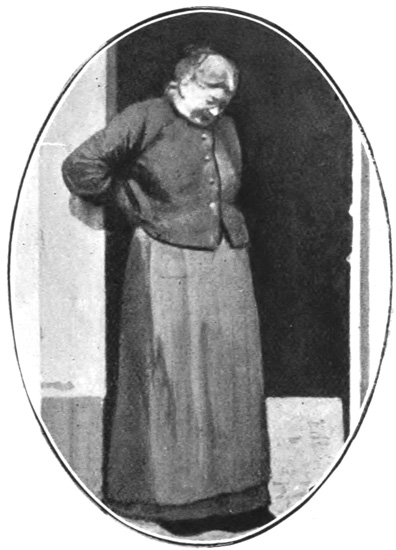
VEUVE BAZIN
Hastily and unnecessarily "tidying herself" while being photographed at her door.
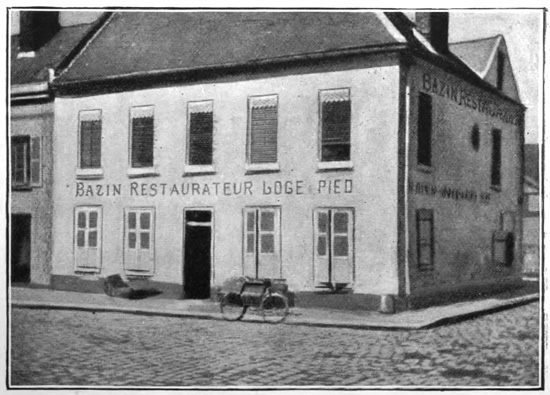
THE BAZINS' INN AT LA FÈRE
"Little did the Bazins know how much they served us."—R. L. S.
XIV.
An accident to my bicycle in the neighbourhood of Origny made it necessary for me to go on to Moy by train, on a quaint little railway worked chiefly by women, who act as station-mistresses, ticket-clerks, restaurant-keepers, and guards of the level crossings. The carriages were filled chiefly with anglers, and every little station had a gang of them armed with a prodigious number of rods and lines, and each carrying a pail with a brass lid. I gathered that the pails were empty almost without exception, as sport had been extremely bad, though numerous patient creatures with rod and line were still to be seen in the drizzling rain along the river, which is here broken into many backwaters, lying in flat land among scraggy pine woods and good green meadows. One sturdy fellow who, like his companions, bore his ill-fortune with a smiling face, averred that though he'd fished all day and caught nothing, he had bagged fifteen broche the previous day between one o'clock and half-past two, and between three and five he had caught an unbelievable number of trout. Anglers are the same in all lands, I suspect.
"Moy (pronounced Moy) was a pleasant little village, gathered round a château in a moat," as our author records. "The air was perfumed with hemp from neighbouring fields. At the 'Golden Sheep' we found excellent entertainment." I asked for the "Golden Sheep," and was directed to an establishment that was named the Hôtel de la Poste. I passed on and asked another villager, but he sent me back, as I found on following his instructions, to the same hotel. The postman put me right at length by explaining that the landlord had rechristened his house three months before in honour of the new post office across the way, a shoddy little building where I bought stamps from a middle-aged woman next morning. The landlady of the hotel, who might pass in every particular, save the myopia, for the "stout, plain, short-sighted, motherly body, with something not far short of a genius for cookery," described by R. L. S., agreed with me that her husband had made a sad mistake in dropping the old sign of the "Collier d'Or," "but he would have his own way, and there you are!" If I could have got the fellow—a fat, jolly mortal—to understand that to have the name of his hotel in a book by R. L. S. was an honour worth living up to, perhaps the old sign would have been fished out, regilded and placed in its old position. But he had not been the patron thirty years ago, and he did not care a straw for anything so remote, though his wife had a gleam of pleasure when I quoted to her Stevenson's note: "Sweet was our rest in the 'Golden Sheep' at Moy."
It is a progressive place, although it seems to go to bed at eight o'clock, for there is a good supply of electric light—furnished by water power, of course—in the hotel and other establishments; but not a solitary street lamp to pierce the blue-black of an autumn night. I must tell you that I was the only guest at the inn, yet a splendid dinner was prepared for me. Soup, fish with mayonaise, fillet of beef with mushrooms, green haricots au beurre, cold chicken, and a delicious salad of white herbs with a suspicion of garlic, a sweet omelet, pears, grapes, cheese, bread and butter, and, if I had cared, a whole bottle of red wine. An excellent café noir followed, in the estaminet, where my hostess apologised for lighting only one electric lamp "pour l'economie, vous savez." My bedroom was commodious and well-appointed, and I had a good French petit dejeuner next morning. The bill? Three shillings and ninepence, I declare! Pour l'economie! Madame, I sympathise, and some day I must return to make a visit more profitable to you.
XV.
From Moy to La Fère is a very short journey even by the river, but the canoeists had lingered till late afternoon before leaving the former place, which "invited to repose," and it was dark when they got to La Fère in their chronic state of dampness. "It was a fine night to be within doors over dinner, and hear the rain upon the windows." They had heard that the principal inn at the place was a particularly good one, and cheery pictures of their comfortable state there arose in their minds as they stowed their canoes and set forth into the town, which lies chiefly eastward of the river, and is enclosed by two great lines of fortification. But they reckoned without their hostess! The lady of the inn mistook them for pedlars, and rushed them back into the dismal night. "Out with you—out of the door!" she screeched. "Sortez! Sortez! Sortez par la porte!" Stevenson's picture of the incident is full of sly humour, but the feelings of the travellers must indeed have been poignant. "We have been taken for pedlars again," said the baronet, "Good God, what it must be to be a pedlar in reality!" says his companion of the pen. "Timon was a philanthropist alongside of him." He prayed that he might never be uncivil to a pedlar. But after all, it was for the best. That cosy inn would not have afforded the essayist such interesting matter for reflection as he found at "la Croix de Malte," a little working-class auberge at the other end of the town, where the Porte Notre-Dame gives exit to the straggling suburbs.
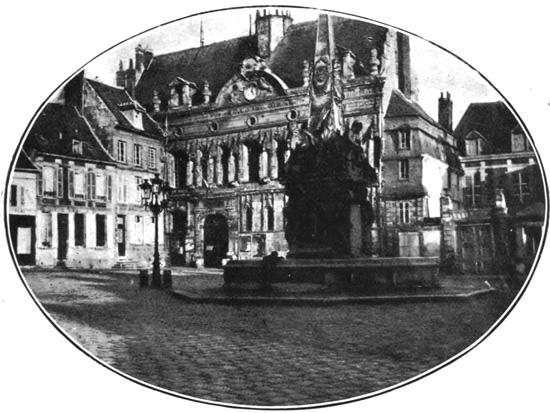
THE TOWN HALL, NOYON
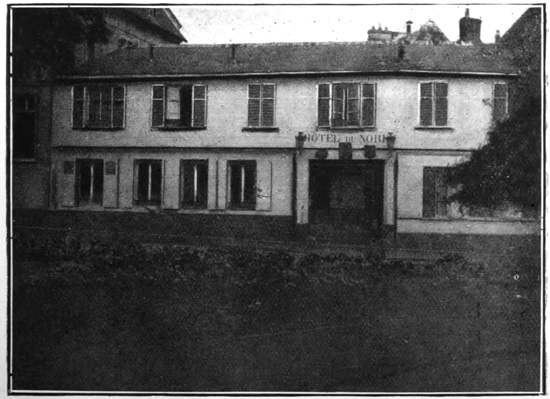
HÔTEL DU NORD, NOYON
Where the travellers stayed
"The Hotel du Nord lights its secular tapers within a stone-cast of the church."—R. L. S.
XVI.
There is no passage in the whole of An Inland Voyage so moving, so simple in its intense humanity, as that wherein its author sets down in his own inimitable way his impressions of the humble folk who kept this inn. Scarcely hoping that I might be so fortunate as to find either of the Bazins alive, I asked at one of the numerous cafés opposite the great barracks, whence crashed forth the indescribable noise of a brass band practising for the first time together, if there was an inn in the town kept by one Bazin. To my delight I was told there was, and you may be sure I made haste to be there. I found the place precisely as Stevenson pictures it, noting by the way a tiny new Protestant chapel with the legend "Culte Evangélique" over its door, a cheering sight to Protestant eyes in so Catholic a country as the north of France.
"Bazin, Restaurateur Loge à pied,"—there was the altered sign on the cream-coloured walls of the house. In the common room of the little inn, which was full of noisy reservists that memorable night when the canoeists sought shelter there, I found two or three rough but honest-looking fellows drinking, while a grey-haired woman, pleasant and homely of appearance, sat at lunch with a young woman and a youth, the latter wearing glasses and being in that curious condition of downy beard which we never see in England. I stood on the sandy floor by the little semi-circular bar, with its shining ranks of glasses, waiting the attention of a young woman who was serving the customers with something from an inner room, when the old lady, looking up at me through her spectacles, asked what I wanted. "To speak with the patron," I replied. "Well?" she said. "Have I the pleasure of addressing Madame Bazin?" I asked, and on her answering with a slight show of uneasiness, I proceeded to explain that I had come to see the inn out of interest in a celebrated English author, who had once stayed there and had written so charmingly about Madame and Monsieur Bazin. In an instant the old lady and the younger folk were agitated with pleasure, and, to my surprise, they knew all about the long-ago visit of R. L. S. and his friend. "Perhaps he was your papa," Madame suggested as the likeliest reason for my having come so far on a matter so sentimental. And the good soul's eyes brimmed with tears when she told me that her husband had been dead these three years. Stevenson had sent them a copy of his book, and they had got the passage touching the voyagers' stay at the inn translated by a young friend at college, so that worthy old Bazin had not been suffered to pass away without knowing how he and his good wife had ministered to the heart of one of the best beloved writers of his generation. You will remember Stevenson's beautiful reference to these worthy people. But let me quote it, for it may be read many times with increase of profit:
"Bazin was a tall man, running to fat; soft spoken, with a delicate, gentle face. We asked him to share our wine; but he excused himself, having pledged reservists all day long. This was a very different type of the workman-innkeeper from the bawling, disputatious fellow at Origny. He also loved Paris, where he had worked as a decorative painter in his youth. He had delighted in the museums in his youth, 'One sees there little miracles of work,' he said; 'that is what makes a good workman; it kindles a spark.' We asked him how he managed in La Fère. 'I am married,' he said, 'I have my pretty children. But, frankly, it is no life at all. From morning to night I pledge a pack of good enough fellows who know nothing,' ... Madame Bazin came out after a while; she was tired with her day's work, I suppose; and she nestled up to her husband, and laid her head upon his breast. He had his arm about her, and kept gently patting her on the shoulder. I think Bazin was right, and he was really married. Of how few people can the same be said!
"Little did the Bazins know how much they served us. We were charged for candles, for food and drink, and for the beds we slept in. But there was nothing in the bill for the husband's pleasant talk, nor for the pretty spectacle of their married life. And there was yet another item uncharged. For these people's politeness really set us up again in our own esteem. We had a thirst for consideration; the sense of insult was still hot in our spirits, and civil usage seemed to restore us to our position in the world.
"How little we pay our way in life! Although we have our purses continually in our hand, the better part of service goes still unrewarded. But I like to fancy that a grateful spirit gives as good as it gets. Perhaps the Bazins knew how much I liked them? Perhaps they also were healed of some slights by the thanks that I gave them in my manner?"
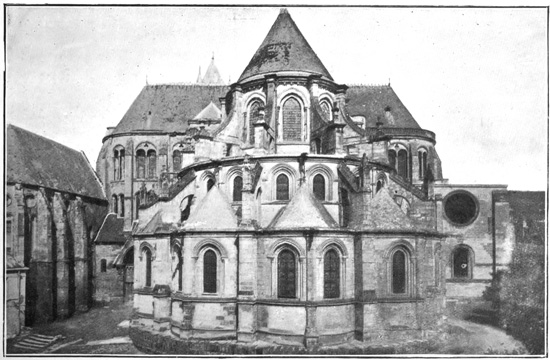
NOYON CATHEDRAL FROM THE EAST
"We had the superb east end before our eyes all morning from the window of our bedroom."—R. L. S.
Is that not a lovely monument to have? Many of us who have made a greater clatter in the world than old Bazin will be less fortunate than he in this respect. And you see that although he had little affection for La Fère, he lived five-and-twenty quiet years there after Stevenson came his way. Yet not, in one sense, quiet, as the bugles are for ever braying, and even the street boys whistle barrack calls instead of music-hall ditties. As Madame told me, the town exists solely for the military, and we may be sure that it is none the sweeter on that account. But her little inn struck me as a wholesome and entirely innocent establishment. Those "pretty children" are men and women now, and the young man with the nascent whiskers, whom I took to be a clerk in the town, was a grandson of the old folk. Not a feature of the auberge has changed, except that the Maltese Cross, having served its day, has been taken down. Stevenson—who has lighted a little lamp of fame on this humble shrine—and Sir Walter Simpson and old Bazin have all passed away, while children's children sit in the old seats; truly the meanest works of man's hands are more enduring than man himself. Madame Bazin, to my regret, made a quick effort to throw aside her apron, and needlessly to tidy her bodice, when I asked her to face the camera. She was caught in the act by the instantaneous plate. Even here, you see, the apron signifies servitude, and must not appear in pictures; yet it and the cap, which latter I have seldom seen north of Paris, are the only redeeming features of the country Frenchwoman's dress. The women of rural France give one the impression of being in permanent mourning, and consequently, when they do go into real mourning, they have to emphasise the fact with ridiculous yards of flowing crape. Madame Bazin had never heard of Stevenson's death, and I felt curiously guilty of an ill deed in telling her about that grave in far Samoa.
XVII.
The Oise runs through a stretch of pastoral country south of La Fère, known as "the Golden Valley," but a strath rather than a valley in character. It was a grey day on which I journeyed, and little that was golden did I see. But the quaint old town of Noyon, as grey and hoar as any in France, is rich in the gold of history; "a haunt of ancient peace." It stands on a gentle hill, about a mile away from the river, and is one of the cleanest of the old French towns that I have visited, reminding me somewhat of Lichfield; in atmosphere, I imagine, rather than in any outward resemblance, since I would be at a loss to point to the likeness if I were asked. R. L. S. had no more agreeable resting-place on all his voyage than at Noyon. The travellers put up at a very prosperous-looking hostelry, the Hôtel du Nord, which stands withdrawn a little way from the east end of the grand old cathedral—the glory of Noyon, and one of the gems of early French Gothic, though perhaps the least known to English tourists.
Seldom in France do we find the cathedral so regally free of surrounding buildings. No shabby structures lean unworthy heads against its old grey walls, and where, on the north side, the canons' library, with its crumbling timbers of the fifteenth century, nestles under the wing of the church, the effect is entirely pleasing. At the west front, too, where there is a spacious close, with well-cared-for houses and picturesque gateways, one has a feeling of reverence which the surroundings of French cathedrals so often fail to inspire. There is a pleasant touch of humour in Stevenson's description of the exterior of the beautiful apse:
"I have seldom looked on the east end of a church with more complete sympathy. As it flanges out in three wide terraces, and settles down broadly on the earth, it looks like the poop of some great old battleship. Hollow-backed buttresses carry vases which figure for the stern lanterns. There is a roll in the ground, and the towers just appear above the pitch of the roof, as though the good ship were bowing lazily over an Atlantic swell. At any moment it might be a hundred feet away from you, climbing the next billow. At any moment a window might open, and some old admiral thrust forth a cocked hat, and proceed to take an observation. The old admirals sail the sea no longer ... but this, that was a church before ever they were thought upon, is still a church, and makes as brave an appearance by the Oise. The cathedral and the river are probably the two oldest things for miles around and certainly they have both a grand old age."
Inside the cathedral he found much to engage his mind, and the somewhat perfunctory performances of certain priests jarred with the noble serenity of the building. "I could never fathom how a man dares to lift up his voice to preach in a cathedral. What is he to say that will not be an anti-climax?" But, on the whole, he "was greatly solemnised," and he goes on to say: "In the little pictorial map of our whole Inland Voyage, which my fancy still preserves and sometimes unrolls for the amusement of odd moments, Noyon Cathedral figures on a most preposterous scale, and must be nearly as large as a department. I can still see the faces of the priests as if they were at my elbow, and hear 'Ave Maria, ora pro nobis,' sounding through the church. All Noyon is blotted out for me by these superior memories, and I do not care to say more about the place. It was but a stack of brown roofs at the best, where I believe people live very reputably in a quiet way; but the shadow of the church falls upon it when the sun is low, and the five bells are heard in all quarters telling that the organ has begun. If ever I join the Church of Rome, I shall stipulate to be Bishop of Noyon on the Oise."
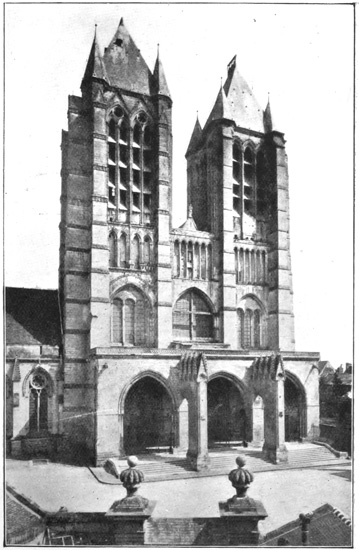
NOYON CATHEDRAL: WEST FRONT
"The Sacristan took us to the top of one of the towers, and showed us the five bells hanging in their loft."—R. L. S.
This pretty fancy of his need lose none of its prettiness when we know that Noyon has not had a bishop since the Revolution, when the cathedral became a dependency of the Bishop of Beauvais, though it had been a bishopric so long ago as the year 531. But I am sorry R. L. S. was evidently not aware that when at Noyon he was in the town where John Calvin was born in 1709, his father being procurator-fiscal and secretary of the diocese; for surely here was an opening for some real Stevensonian obiter scripta? The beautiful old Town House, of Gothic and Renaissance architecture, dates back to the end of the fifteenth century, but all the ancient buildings of Noyon fall long centuries short of its history in age, as King Pippin was crowned here in 752, and his infant son Carloman was at the same time created King of Noyon, while in 771 the town saw the coronation of Pippin's eldest son, the mighty Charlemagne, no less.
XVIII.
The last wet day of the voyagers was that on which they set out from Noyon. "These gentlemen travel for pleasure?" asked the landlady of the little inn at Pimprez. "It was too much. The scales fell from our eyes. Another wet day, it was determined, and we put the boats into the train." Happily, "the weather took the hint," and they paddled and sailed the rest of the voyage under clear skies. At Compiègne they "put up at a big, bustling hotel, where nobody observed our presence." My impression of the famous town scarcely justified this, as in the day that I lingered there I seemed to meet everybody a dozen times over, and the company at a little café chantant in the evening was like a gathering of old friends, so many of the faces were familiar. Yet the town is populous, having some 17,000 inhabitants (about 2,000 of whom are English residents), and I was prepared for busier streets than I found.
There can be few towns in France more agreeable to live in. It is pleasantly situated on the river Oise, here wide and lively with barge-traffic, and spanned by an elegant bridge. The older town lies south of the river in a sort of amphitheatre; its streets are narrow and tortuous, but with bright shops and cafés in the neighbourhood of the Place de l'Hôtel de Ville, while the fashionable suburbs extend, in splendid quiet avenues, eastward and south from the centre of the town, by the historic palace built in Louis XV.'s reign and the Petit Parc, which is really very large. While a great many of the English residents have chosen the town for the same reason that my hostess at Moy put on one electric light—pour l'economie, vous savez—together with its healthy and beautiful surroundings in the great forest of Compiègne, many more are there for the employment afforded by the important felt hat factory of Messrs. Moore, Johnson & Co., whose commodious works stand near the station on the north of the river. Despite its shops, its business prosperity, its red-legged soldiers, its visitors, Compiègne is dull enough of an evening, and the brightly lighted but almost empty cafés leave one wondering how the business pays.
"My great delight in Compiègne," says inland voyager, "was the town-hall. I doted upon the town-hall. It is a monument of Gothic insecurity, all turreted and gargoyled, and slashed and bedizened with half a score of architectural fancies. Some of the niches are gilt and painted, and in a great square panel in the centre, in black relief on a gilt ground, Louis XII. rides upon a pacing horse, with hand on hip and head thrown back. There is royal arrogance in every line of him; the stirruped foot projects insolently from the frame; the eye is hard and proud; the very horse seems to be treading with gratification over prostrate serfs, and to have the breath of the trumpet in his nostrils. So rides for ever, on the front of the town-hall, the good king Louis XII., the father of his people.
"Over the king's head, in the tall centre turret, appears the dial of a clock; and high above that, three little mechanical figures, each one with a hammer in his hand, whose business it is to chime out the hours and halves and quarters for the burgesses of Compiègne. The centre figure has a gilt breast-plate; the two others wear gilt trunk-hose; and they all three have elegant, flapping hats like cavaliers. As the quarter approaches, they turn their heads and look knowingly one to the other; and then, kling go the three hammers on the three little bells below. The hour follows, deep and sonorous, from the interior of the tower; and the gilded gentlemen rest from their labours with contentment.
"I had a great deal of healthy pleasure from their manœuvres, and took care to miss as few performances as possible; and I found that even the 'Cigarette,' while he pretended to despise my enthusiasm, was more or less a devotee himself. There is something highly absurd in the exposition of such toys to the outrages of winter on a housetop. They would be more in keeping in a glass case before a Nürnberg clock. Above all, at night, when the children are abed, and even grown people are snoring under quilts, does it not seem impertinent to leave these ginger-bread figures winking and tinkling to the stars and the rolling moon? The gargoyles may, fitly enough, twist their ape-like heads; fitly enough may the potentate bestride his charger, like a centurion in an old German print of the Via Dolorosa; but the toys should be put away in a box among some cotton, until the sun rises, and the children are abroad again to be amused."
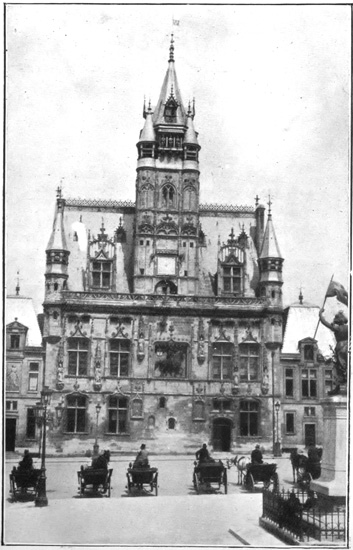
COMPIÈGNE TOWN HALL
"My great delight in Compiègne was the Town Hall."—R. L. S.
XIX.
There is but little interest in the remaining stages of Stevenson's journey; not because the towns through which the canoeists now passed are less worthy of note than any already described, but for the ample reason that R. L. S. had, in some measure, lost his earlier delight in the voyage. He pretends that on the broading bosom of the Oise the canoes were now so far away from the life along the riverside, that they had slipped out of touch with rural folk and rural ways. But this is not strictly true, when we know that the river, as far as Pontoise, is seldom greatly wider than the canals on which the Arethusa and the Cigarette had set out with high hopes of adventure a fortnight before. The towns are quaint and sleepy. The voyagers were nearing the end, the river ran smooth, the sky was bright, and a packet of letters at Compiègne had set them dreaming of home. Here was the secret; the spell was broken; their appetite for adventure had been slaked; every mile of easy-flowing water was taking them not away to unknown things, but homeward to familiar ones.
Pont Sainte Maxence, the end of their first stage below Compiègne, is a featureless little town, the Oise making a brave show through the centre of it, and I do not suspect its church of any stirring history. R. L. S. found its interior "positively arctic to the eye." It was here he noticed the withered old woman making her orisons before all the shrines; "like a prudent capitalist with a somewhat cynical view of the commercial prospect, she desired to place her supplications in a great variety of heavenly securities." I passed through Creil and Précy in the afternoon, following close to the river, which now skirts a country of gentle hills on the east, but westward fringes a vast level plain, with nothing but groves of poplar to break the line of the distant horizon.
XX.
In the gloaming I arrived at Pontoise, where I was told a fête was in progress; but the only signs of hilarity were two booths for the sale of pastries and sweet stuffs on the square in front of the station, and one small boy investing two sous in a greasy-looking puff. The rues of Pontoise have high-sounding names, but they are dull beyond words, though only eighteen miles away the "great sinful streets" of Paris are gleaming with their myriad lights.
Pontoise in the daylight might have been different; but seen in the dusk, I decided upon the eight o'clock train to Paris, and so ended my pilgrimage. Nor did I feel any lowering enthusiasm at the end, for Stevenson has nothing to tell us of the place beyond saying, "And so a letter at Pontoise decided us, and we drew up our keels for the last time out of that river of Oise that had faithfully piloted them, through rain and sunshine, for so long." He has not a word for the twelfth-century church of St. Maclou, his "brither Scot," or the tomb of St. Gautier at Nôtre Dame de Pontoise.
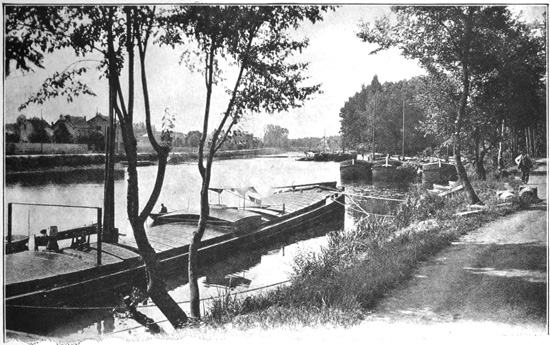
THE OISE AT PONTOISE
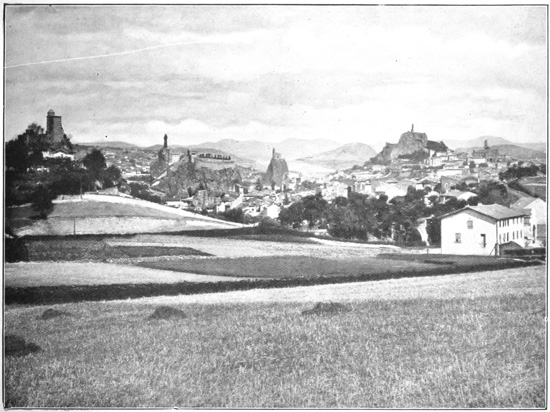
GENERAL VIEW OF LE PUY
"At Pontoise we drew up our keels for the last time out of that river of Oise that had faithfully piloted them through rain and sunshine so long."—R. L. S.
"You may paddle all day long," he concludes; "but it is when you come back at nightfall, and look in at the familiar room, that you find Love or Death awaiting you beside the stove; and the most beautiful adventures are not those we go to seek." Yet he was ever an adventurer in search of beauty, and who shall say his quest was vain?