"La Fête Dieu"
Reading edition
I.
For centuries the 19th of June has been to the people of France a day of high festival. No one who has happened to be travelling in Normandy or Brittany—or indeed in almost any of the French provinces—about this time of the year can have failed to notice the celebration of the Fête Dieu, and many may have wondered what it was all about. It has existed so long as one of the national customs, varying in its observance in different parts of the country, and having passed through many periods of change, that a few years ago he would have been accounted a rash and uninspired prophet who would have foretold that the Republican Government might have the temerity to lay its embargo on this sacred institution. But, behold the day when the secular hand of M. Combes had stretched out into the remotest parts of fair France, and following hard upon the upsetting of monastic peace, came the prohibition of religious processions in public. The effect of this order was to limit the fête in many places to a mere perambulation of the exterior of the church, and in others the procession was confined entirely to the interior, though here and there, it would seem, the function took place just as it did generations before M. Combes and the anti-clericals arose into power.
The festival is clearly of pagan origin, like so many of the ceremonies of the Christian church; it corresponds with the Corpus Feast in Spain, the exhibition of the holy sacrament having been grafted on to the heathenish rights very early in the Christian era. There seems to be evidences of the ceremony having been observed in some form or other centuries before 673, as in that year an ecclesiastical council, held at Braga in Spain, spoke of "the ancient and traditional custom of solemnly carrying the Host on the shoulders." It was Pope Urbain IV., who vainly endeavoured to stir up a new crusade on behalf of his former diocese of Jerusalem, that officially recognised and instituted as regular offices of the church in 1264 the ceremonies connected with the Fête Dieu. But, despite this papal ordinance, the festival did not become one of general observance until, some generations later, there had grown around the purely religious part of it a mass of painfully secular tomfoolery, which turned the fête into a great saturnalia. In the days of that merry monarch, King Réné, it had assumed such proportions that an entire week was devoted to the celebration, "courts of love," tournaments, jousts, mystery plays, and many other amusements being associated with the solemn procession of the sacred sacrament. Flourishing more or less, the fête continued annually, without interruption until the great Revolution, which gave short shrift to the old taste for processions; but under Louis XVIII. it was re-established, and the State even furnished troops as escorts for those taking part in the processions. Times are changed indeed when we find Le Pèlerin, an illustrated weekly newspaper devoted entirely to the interests of pilgrimages, publishing cartoons which show the police dispersing the pious participants in the procession of the Fête Dieu, while rowdy socialists are permitted to wave their red rags in the highway.
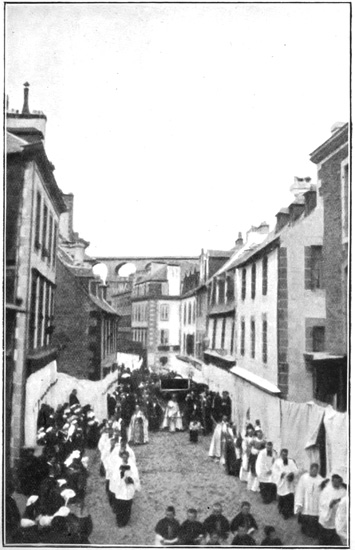
PROCESSION OF LA FÊTE DIEU
Photographed at Morlaix, in Brittany
II.
The festival, which has thus fallen upon evil times, might possibly have gone more steadily downhill to the limbo of old customs if the Government had left it alone, as of recent years it has not been gaining in popularity, and, practically speaking, only women and children have shown active interest in it under the direction of the priests and lay officials. Throughout Normandy it was a rare thing to see men taking part; but in Brittany, and especially at the quaint old town of Morlaix, which is famed for its high railway bridge and its Fête Dieu, and holds an extremely jolly kermesse, with dancing and the selling of cheap rubbish, immediately after the holy sacrament has been carried through the streets, a larger proportion of men were to be seen engaging in the ceremony; while in the far south, among the peasants of Provence and Aveyron, the men have long been as attached to this and similar fêtes of the church as the women, taking part with a comic gravity of demeanour absurdly out of keeping with their usually gay and careless behaviour. Generally speaking, the Fête Dieu, as celebrated during modern years, has been a picturesque, but brief and inoffensive ceremonial, that did not greatly disturb anybody, and seemed to please the women and children. In the course of time it might have died out as a public institution, though it must always survive, in some manner, as a religious festival; but the Government, in its crusade against the enemies of the Republic—for such undoubtedly are the Catholic priests—may find that it has, by its very prohibition, reawakened interest in this ancient and decrepid institution of the church.
As for the familiar procession of the Fête Dieu, there is not very much to describe: a brief notice of one may be taken as typical of all. The first indication that the visitor would have of something unusual toward was the strewing of the principal streets with rushes. Almost every shopkeeper would be seen with an armful of the green blades, laying them down to fullest advantage in the middle of the road. This done, the next thing was to bring out long sheets of white linen, which were tacked a little way below the windows of the first story, and hung downward to within a foot or so of the ground, the entire route being thus lined with a continuous stretch of white, whereon busy hands had pinned roses and other flowers, sometimes attempting designs such as a heart or a cross, or the monogram "I H S." Each shopkeeper seemed to vie with his or her neighbour to produce a more elaborate evidence of pious interest in the coming procession; but I have noticed frequently that many performed their part in the most perfunctory manner, only rushing up their white linen and sticking on a flower or two when the head of the procession was actually in sight, and whipping off the sheets as soon as it had passed by.
III.
In many parts of the town, often in the front garden of a private house, in some outside corner of a church or in a market-place, elaborate shrines, made of wood, covered with cloth, and decorated with rushes and flowers, would be erected. In one small town I have counted upwards of a dozen such erections, enclosing gaudy statues of the saints, especially well disposed towards those who supplied the money for the shrines. But here again I have noticed the proverbial economy of the French nation asserting itself, the attendant at such a gorgeous shrine lighting the numerous candles only on the approach of the procession, and blowing them out the instant it had passed, when also the dismantling of the shrine would begin! I recall a particularly gorgeous shrine which I saw many years ago in the town of Falaise. At a considerable distance the numerous candles seemed to be burning so brilliantly, that I was not altogether surprised on going up and examining them to find the supposed candles were actually incandescent electric lamps. Thus the preliminary arrangements of the populace for the coming of the procession.
The route was, as a rule, one that had been followed for years, but the erection of a particularly elaborate shrine by some person blessed with pelf and piety, in a street not within the usual itinerary, would be regarded as sufficient to justify a detour.
I have never witnessed the procession without being refreshed by its suggestion of old-world ease. "Build your houses as if you meant them to last for ever," was Ruskin's advice. "Proceed as if your procession had started at the Flood and was going on till Doomsday," would seem to be the motto that inspires the demonstrators in the Fête Dieu.
In the distance the sound of music is heard, and after a time at the far end of the road the head of the procession is seen moving towards us at a pace as much slower than a funeral as that is slower than a horse race. First comes the beadle, or church officer attached to the cathedral, whose blue or red uniform, with cocked hat, knee breeches, white hose and buckled shoes, remind one of the dress of our soldiers in the seventeenth century, a get-up very similar to that of the Swiss Guard at the Vatican, these beadles being, indeed, generally known as the "Swiss," though they are loutish and ignorant fellows, with as much regard for religion as the chucker-out at a roaring London tavern. But for all that, the Swiss makes a mighty picturesque figure at the head of the procession, his sword hanging at his hip, and a long mace carried in his hand as he steps out slowly and endeavours to combine dignity with scowls at the children who follow him, the little girls in their white muslin dresses, made for their first communion, and the little boys in the sort of midshipman's suit universally worn by French lads at the time of their confirmation, a white armlet being donned on this occasion and a rosary tied around it. Following the children, who carry banners with various religious devices, come bands of music and different groups of men and women, who also march under certain banners that indicate their membership of some brotherhood or sisterhood.
IV.
There are brotherhoods of the Holy Sacrament in many parts of France whose credentials date back to the Middle Ages, and who seem to exist solely for the purpose of being privileged to walk in religious processions, with a ludicrous gown lavishly trimmed, and having on the front, after the manner of a herald's tabard, a picture of Christ. The brethren of the various "charities," which in France correspond in some degree to our friendly societies, also wear uniforms, and, in some parts of the country assist in the procession. In the past many unseemly disturbances arose out of the rivalry of these brotherhoods as to their respective privileges in the Fête Dieu, and the sacred function was often marred by the most disgraceful scenes of rowdyism as the rivals fought for precedence, and especially for the right of bearing the canopy under which the Holy Sacrament is carried through the streets.
The approach of the Host is heralded by the acolytes in their scarlet gowns with lace tunicles, who come singing, and precede the white-robed members of the choir, lay brethren and priests, who are either diligently reading from books, or mumbling unintelligently the orisons provided for the occasion. Succeeding these come more acolytes, swinging censers, and others who, walking backwards, bear large baskets of rose leaves, and scatter their fragrant burdens in handfuls on the road in front of the bishop. The latter, arrayed in his most gorgeous vestments, advances slowly, holding aloft, with well-assumed solemnity, to impress beholders with the awful sacredness of his charge, the elaborate brass monstrance or cabinet which encloses the consecrated wafer. The bishop, who thus displays before the just and the unjust the Holy Sacrament, walks under a canopy of richly embroidered cloth, carried on four posts by specially chosen members of some of the brotherhoods, or perhaps by some unusually devout laymen, whose purses have not been altogether closed when the clerical hat has gone round.
Previously to the approach of the dais covering the bishop and his holy burden, the spectators in the street have been laughing and joking with and about the demonstrators, and some of the children in the procession have shown lamentable forgetfulness of the solemn nature of the function by putting out their tongues at us, and turning back to say derisively, "les Anglais!"—for this was before the days of the Entente. But the moment the bishop and the Host come up, down flop the spectators on their knees, crossing themselves, the men removing their hats, though I confess with pleasure that many a time I have seen groups of men showing as much reverence to the sacred wafer as Cockney crowds do to the Lord Mayor's coachman on show day.
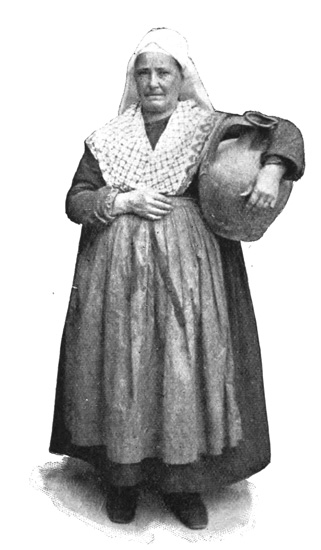
A WOMAN OF SAINTE ENIMIE
The procession is now at an end so far as our particular standpoint is concerned, and already the white sheets are disappearing all along the road, shopkeepers turning their attention to business again. But it is winding its way through other streets, pausing to make special obeisance before the temporary shrines, and to rehearse prayers cunningly adapted to the peculiar requirements of the saints to whom the shrines are dedicated. And so after, it may be, two or three hours perambulation, the demonstrators return to the cathedral, where High Mass is celebrated; this over, they are free to make merry to their heart's desire. And they do.