The Town of "Tartarin"
Reading edition
I.
The custom observed by English authors of giving fictitious names to places described in works of romance—as for example, Mr. Hardy's "Casterbridge" (Dorchester) and Mr. Barrie's "Thrums" (Kirriemuir)—has so brought their readers to accept the most faithful realism for romance, that when they take up a French novel they are apt to think the places mentioned therein are treated in the same way. But those who have any acquaintance with French fiction will know that the novelists across the Channel follow a method entirely opposed to ours. An English reader who may have enjoyed to the full the famous trilogy of "Tartarin" books may well be excused if he supposes that the town of Tarascon is largely a creation of their author, Alphonse Daudet. It is true that if he has ever travelled from Paris to Marseilles by way of Lyons and Avignon he will have passed through Tarascon, with its wide and open station perched high on a viaduct, and the porter bawling in his rich, southern tongue, "Tarascon, stop five minutes. Change for Nîmes, Montpellier, Cette." And if he has—as he cannot fail to have—delightful memories of the incomparable Tartarin, his feet will itch to be out and wander the dusty streets in the hope of looking upon the scenes of the hero's happy days; to peep perchance at his tiny white-washed villa on the Avignon Road with its green Venetian shutters, where the little bootblacks used to play about the door and hail the great man as his portly figure stepped forth, bound for the Alpine Club "down town." There would certainly be small other reasons for tarrying at this ancient town of France; it owes such interest as it possesses chiefly to the genius of Daudet, whose inimitable humour has vivified and touched it with immortality.
I had been wandering a-wheel over many a league of these fair southern roads one summer before I found myself at the ancient Roman city of Nîmes, the rarest treasure of France, and it was a visit to Daudet's birthplace there that suggested the idea of going on to Tarascon a desire intensified by the ardour of a gentleman from that town whom I met at a hotel, and who perspired with indignation as he denounced "that Daudet" for libelling the good folk of Tarascon. "Tartarin! The whole thing's a farce. There never was such a man!" But he asserted that the town was well worth seeing, if I could only forget Daudet's ribald nonsense.
It went well with my plans for reaching the main route back to Paris to make a little journey through the fragrant olive groves along the high road to Remoulins in order to visit the world-famous Roman aqueduct known as the Pont du Gard, near to which a gipsy told Tartarin he would one day be a king, and thence by the banks of the river Gardon to Beaucaire and Tarascon. Not often have I made a literary pilgrimage of so pleasant or profitable a nature.
II.
You must know, of course, what a rare fellow this Tartarin was—Coquin de bon sort! I am not sure that I should speak of him in the past tense; although his creator eventually gathered him to his fathers, Tartarin was built for immortality, and at most his passing was a translation; he is for all time the archetype of southern character, and Tarascon is alive with him to-day. Of medium height, stout of body, scant of hair on his head, but bushy-whiskered and jovial-faced, you will see his like sipping absinth at any café on the promenade of the sleepy old town, or playing a game of billiards with the grand manner of a Napoleon figuring out a campaign.
Tartarin, blessed with all the imagination of the generous south, was indeed an ineffectual Bonaparte, in the body of a good-natured provincial. "We are both of the south," he observed to his devoted admirer Pascalon, when that faithful henchman, at a crisis in his hero's career, pointed out the similarity between him of Corsica and him of Tarascon. Daudet makes him, in a bright flash of self-knowledge, describe himself as "Don Quixote in the skin of Sancho Panza," and Mr. Henry James has in this wise elaborated the point with his usual deftness:
"There are two men in Tartarin, and there are two men in all of us; only, of course, to make a fine case, M. Daudet has zigzagged the line of their respective oddities. As he says so amusingly in Tartarin of Tarascon, in his comparison of the very different promptings of these inner voices, when the Don Quixote sounds the appeal, 'Cover yourself with glory!' the Sancho Panza murmurs the qualification, 'Cover yourself with flannel!' The glory is everything the imagination regales itself with as a luxury of reputation—the regardelle so prettily described in the last pages of Port Tarascon; the flannel is everything that life demands as a tribute to reality—a gage of self-preservation. The glory reduced to a tangible texture too often turns out to be mere prudent underclothing."
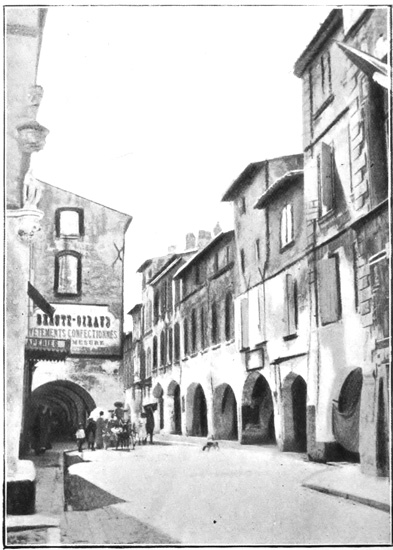
TARASCON: THE PUBLIC MARKET
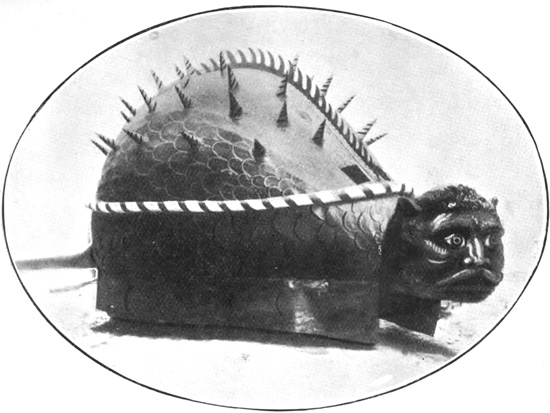
THE TARASQUE
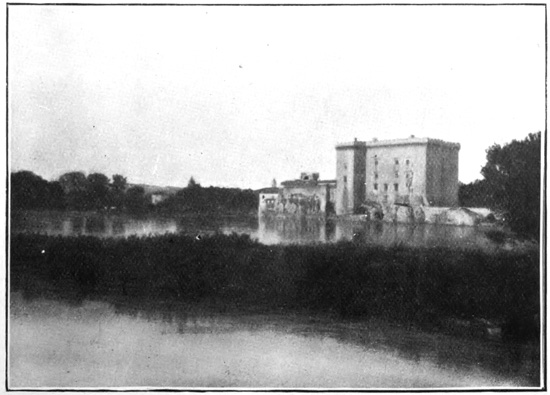
THE CASTLE OF TARASCON
It is true that a good deal of the humour that attaches to Tartarin is of the unconscious sort. He and his brethren of Provence stand in relation to their fellow-countrymen much as the Irish to the English in the matter of humour, but in that only. They are often the butt of northern witticisms, and are said to be experts in drawing the long bow. Tarascon in this respect no more than many a score of little towns in the Midi; but it suited the author's purpose admirably to locate the home of his hero there, as the place possesses many quaint little peculiarities of its own which fitted in admirably with the scheme of Tartarin's remarkable career.
III.
Since I visited the town the Tarasconians have proved worthy of their reputation, as a picture post card has been put in circulation bearing a photograph of "La Maison de Tartarin." It shows a square and comfortable white house, flat-roofed, with a series of loop-hole windows that give it a murderous look. In front is a large garden, where an old baobab stretches forth its branches and innumerable exotics mingle their strange leaves in the beautiful disorder of the primeval forest. So, at least, I gather from a French journal. Yet, while pointing out the mendacity of the picture post card, the journal in question publishes with every evidence of sincerity an equally apocryphal account of the real Tartarin, who we are told, was a person named originally Jean Pittalouga, a native of the south of Sardinia, not a Frenchman at all. He was bought out of slavery by the Brotherhood of the Trinity, and came to Tarascon to manage the property of the fraternity in that town. As Sidi-Mouley-Abdallah was the superior of Morocco and that country was part of Barbary, Pittalouga became known in Tarascon, because of his romantic experience among the Moors, first as Sidi-Barbari, and then as Barbarin. The time came when the Trinity fraternity had to clear out, and with them Barbarin, who now rented a neighbouring farm on the outskirts of the town—the veritable "Maison de Tartarin" of the post card. But he did not die there. He went away with the Trinity fathers into Africa, and is believed to have been devoured entirely by some terrible wild beast, with whom he had disputed the sovereignty of the desert. To all of which, as Daudet remarks of the member of the Jockey Club travelling avec sa nièce, "Hum! hum!"
One may note here that the author did first write of his comic hero as Barbarin; but as the French law affords the fullest measure of protection to living people whose names may be introduced in works of fiction, and as there lived in Tarascon a certain M. Barbarin, who wrote to Daudet a letter worthy of his hero, wherein he threatened the utmost rigour of the law unless the novelist ceased to make sport of "what was dearer to him than life itself, the unspotted name of his ancestors," Daudet altered the name to Tartarin, and was inclined to think in after years, when the fame of his creation had travelled around the globe, that his hero would never have been so popular under his original name. It may have been a case of "apt alliteration's artful aid"; but one may suppose that Tartarin would have been equally popular by any other name. He embodies the extravagant, and not the least lovable, side of French character, as truly as Uriah Heep and Mr. Pecksniff represent English humbug and hypocrisy; he has many points of similarity with Mr. Pickwick, but the last-mentioned can hardly be compared with him as reality seen through the eye of kindly caricature.
IV.
Tartarin was, in a word, an epitomy of innocent vanities; large-hearted, generous, he had the Cæsarian ambition to be the first man in his town; he was imbued with the national hunger for "la Gloire," and many were the amusing ways in which he sought to demonstrate his prowess. To impress his townsmen, the dear old humbug surrounded himself with all sorts of foreign curiosities. His garden was stuffed with exotics from every clime, most notable of all the wonderful baobab, which he grew in a flower-pot, although that is the unmatched giant of the tree kingdom! His study was decked with the weapons of many strange and savage people, and, like a miniature museum, his possessions were ticketed thus: "Poisoned arrows! Do not touch!" "Weapons loaded! Have a care!"
His earliest exploits were as chief of the "cap-hunters," for, you see, in those days the good folk of Tarascon were great sports, and the whole country-side having been denuded of game, they were reduced to the device of going forth in hunting-parties, and after a jolly picnic they would throw up their caps in the air and shoot at them as they fell! "The man whose hat bears the greatest number of shot marks is hailed as champion of the chase, and in the evening, with his riddled cap stuck on the end of his rifle, he makes a triumphal entry into Tarascon, midst the barking of dogs and fanfares of trumpets."
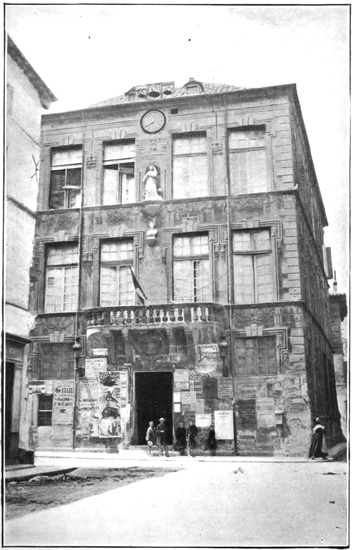
TARASCON: THE MAIRIE
Tartarin, however, determined to cover himself with glory—as well as flannel—by making an expedition into Algeria and Morocco, there to try his prowess on the lions of the Atlas. His ludicrous adventures on this great enterprise—how he shot a donkey and a blind lion, and returned to Tarascon pursued by his devoted camel—form the theme of the first of Daudet's three charming stories. The years pass with Tartarin lording it at Baobab House, and at the club every evening spinning his untruthful yarns, beginning: "Picture to yourself a certain evening in the open Sahara." Then comes the further adventures of "Tartarin in the Alps," and I confess that when, a good many years ago, I first clambered up a portion of Mont Blanc it was of Tartarin's famous ascent I thought rather than of Jacques Balmat's; the fiction was more vivid in my mind than the fact; and again at the Castle of Chillon—I say it fairly—the comic figure of Tartarin imprisoned there was more engaging to the imagination than that of Bonnivard; and, by the bye, in the famous dungeon one can see scratched on the wall the signatures of both Lord Byron and Alphonse Daudet.
The last, and in some respects the best, of all the Tartarin books—like Mulvaney, the mighty Tarasconian has his fame "dishpersed most notoriously in sev'ril volumes"—is Port Tarascon, wherein are detailed the mirthful misadventures of the great man, and many of his townsmen who, under his direction, set sail to found a colony in Polynesia, an undertaking that proved fatal to his fame, and ended eventually in his self-exile across the river to Beaucaire, where he died soon after; of sheer melancholy we may suppose.
V.
It was into the busy little town of Beaucaire, which lies around its ancient castle of Bellicardo, on the west bank of the broad Rhone, glaring across at Tarascon, that I wheeled one bright day in June. Beaucaire, for all its canal, wharves, and signs of prosperous industry, is as tidy a town as I have seen, and the fine old castle, ruined by Richelieu, where in the golden age of Languedoc's poesy the troubadors sang their ballads at the Court of Love, is beautifully situated on a little hill by the river-side, quite near to the magnificent suspension bridge which figures so humorously in Port Tarascon. The rivalry between the two towns, their mutual jealousies, furnished Daudet with many an opportunity to poke fun at them. "Separated by the whole breadth of the Rhone, the two cities regard each other across the river as irreconcilable enemies. The bridge that has been thrown between them has not brought them any nearer. This bridge is never crossed—in the first place, because it's very dangerous. The people of Beaucaire no more go to Tarascon than those of Tarascon go to Beaucaire." As the gentleman I met at Nîmes would have said, "Zut! It is not true." But that is neither here nor there.
Tartarin, up to his forty-ninth year, had never spent a night away from his own home. "The very limit of his travels was Beaucaire, and yet Beaucaire is not far from Tarascon, as there is only the bridge to cross. Unhappily that beastly bridge had been so often swept away by the storms; it is so long, so rickety, and the Rhone so broad there that—zounds, you understand!... Tartarin preferred to have a firm grip of the ground." But this must have referred to the old bridge that made way for the present magnificent structure, which crosses the river in four spans and is 1,456 feet in length. However, it was this suspension bridge, and no other, across which the hero's cronie Bompard came with such bravery to witness for his friend, when Tartarin, fallen from his high estate, was on trial at the court of Tarascon for having been party to a gigantic swindle in the great colonising fraud of Port Tarascon, a charge from which, as we know, he was rightly acquitted. Bompard at the time of the trial was in hiding at Beaucaire, where he had become conservator of the Castle and warden of the Fair Grounds—Beaucaire's annual fair is famed all over France—"but when I saw that Tartarin was really dragged into the dock between the myrmidons of the law, then I could hold out no longer; I let myself go—I crossed the bridge! I crossed it this morning in a terrible tempest. I was obliged to go down on all fours the same way as when I went up Mont Blanc.... When I tell you that the bridge was swinging like a pendulum, you'll believe I had to be brave. I was, in fact, heroic."
VI.
The view from the bridge as one crosses to Tarascon is as pleasant a picture as may be seen in any part of old France. The noble stream, broken by sedgy inlands, sweeps on between its low banks, and rising sheer from the water's edge on a firm rock-base, almost opposite the picturesque mass of Bellicardo, are the massive walls of the ancient castle of Tarascon, founded by Count Louis II. in the fourteenth century and finished by King Réné of Anjou in the fifteenth, and at one time tenanted by Pope Urbain II., but now, like many another palace of kings, fallen to the condition of a common prison. Within these grim walls Tartarin passed some of his inglorious days, but days not lacking romance, for was not Bompard from the opposite height signalling o' nights to him by means of mysterious lights?
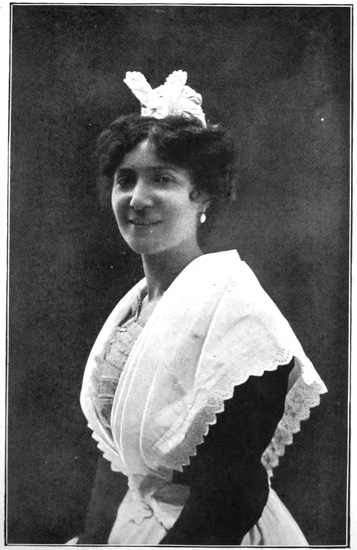
A WOMAN OF TARASCON
(Summer costume)
If one has never seen photographs of Tarascon it will be a surprise, as it is surely a pleasure, to note how faithfully the artists who illustrated Daudet's books have reproduced in their charming little vignettes the chief features of the actual town. There to the south of the bridge is the tiny quay from which we are to suppose the Tootoopumpum sailed away with the flower of Tarascon's aristocracy on that ill-starred expedition to the South Seas. Daudet is careful to preserve some slight respect for the truth by explaining that the vessel was of shallow draft; but, even so, the Rhone is here not navigable to ocean-going steamers.
Proceeding straight into the town, we arrive in a minute or so at the Promenade, with its long rows of plane trees, as in most French towns, only in Tarascon the trees seem to grow higher and leafier than anywhere else. It opens out a short distance from the riverside, and although it cannot be strictly called the "Walk Round" for the reason which the author gives—that it encircles the town—it certainly traverses a goodly portion of Tarascon, and takes in en route that "bit of a square" to which he makes so many sly allusions.
Almost the first thing one notices after crossing the bridge is the "Hotel of the Emperors," close by the Hospice at the opening of the Promenade. This title is worthy of Daudet himself! Along the south side of the Promenade stand the chief cafés and shops; as one sits by a table at a door watching the passers-by, the scene is entirely agreeable. Everybody seems to have walked out of Daudet's page. The men are of two types chiefly—those of the stout and bearded figure, such as Tartarin himself possessed, and the thin and sharp-featured fellows of Italian caste, like Bezuquet and Costecalde, with their bright, black eyes and fierce moustachios. Most of them, this sunny day, are abroad in their shirt sleeves, and almost to a man they wear the soft black felt hats such as our English curates affect.
VII.
There is a musical jingle of spurs, as some baggy-trousered soldiers pass on their way to the fine cavalry barracks which the town possesses. There go a pair of comfortable-looking priests in their long black gowns, their good fat fingers twined behind them; but nowhere do we see the white habit of the friars, whose monastery of Pampérigouste the gallant Tartarin and his crusaders defended from the Government troops so long ago! The women-folk whom one sees about are nearly all hatless, but they wear a dainty substitute in the shape of a little cap of white muslin and lace, and a pelerine of the same material over their shoulders and breast. Small, plump, swarthy, they are true daughters of the south, and by that token better to look upon than their sisters of the north. Here and there one may see a woman touched with something of the Paris fashion, members of that local aristocracy to which belonged the charming Clorinda of Pascalon's hopeless passion.
There is a constant toot-toot or tinkle of bells as cyclists go by, for the wheel has come into great popularity here as elsewhere since Tartarin made his tragic exit across the bridge. Perhaps the most unmistakable evidences of provincialism are supplied by the antiquated types of vehicles with their fat-faced drivers and their unshorn horses, many of the latter being harnessed with the most extravagant kinds of collars and saddles that project a couple of feet or more above the level of the animals' backs.
The whole scene is one of peaceful and happy life, and it is good to look upon people who are in no hurry to do business and seem to take things easily. Across the way, there, the chemist is standing at his door, with those great glasses of coloured water, that seem to have gone out of fashion in England, shining in his window, while he rolls a cigarette for the white-legged postman who has stopped to give him a letter, and chats with him in the passing. He might be Bezuquet himself, did we not know of the misfortune that befell the latter, when he was tatooed out of recognition by the South Sea Islanders, and had to wear a mask when he came home!
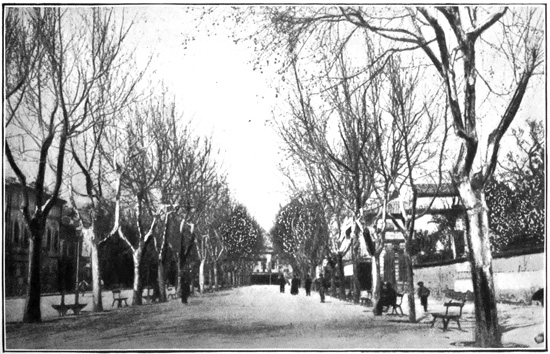
TARASCON: "THE BIT OF A SQUARE"
Going down a street that leads northward from the Promenade, we pass the Mairie, a quaint old building from whose balcony floats, not the Tarasque, but the tricolor, and by whose doorway are posted notices of coming bull-fights, for Tarascon is still keen on its ancient sport despite the restrictive legislation. Near by is the public market, and the whole district swarms with dogs of every breed. We peep into the church of St. Martha, which is no bad example of the Pointed Gothic and occupies the site of an old Roman Temple. One of the kings of Provence is buried here, but more interesting is the tomb of the saint to whom the church is dedicated.
VIII.
St. Martha and the Tarasque are the peculiar glories of the Tarasconians, who, you must know, would almost strike you if you breathed the word "Tartarin" to them, and have never forgotten Daudet for his satires on the town. We cannot do better than go to Daudet for the legend of St. Martha and the beast.
"This Tarasque, in very ancient days, was nothing less than a terrible monster, a most alarming dragon, which laid waste the country at the mouth of the Rhone. St. Martha, who had come into Provence after the death of our Lord, went forth and caught the beast in the deep marshes, and binding its neck with a sky-blue ribbon, brought it into the city captive, tamed by the innocence and piety of the saint. Ever since then, in remembrance of the service rendered by the holy Martha, the Tarasconians have kept a holiday, which they celebrate every ten years by a procession through the city. This procession forms the escort of a sort of ferocious, bloody monster, made of wood and painted pasteboard, who is a cross between the serpent and the crocodile, and represents, in gross and ridiculous effigy, the dragon of ancient days. The thing is not a mere masquerade, for the Tarasque is really held in veneration; she is a regular idol, inspiring a sort of superstitious, affectionate fear. She is called in the country the Old Grannie. The creature has herself stalled in a shed especially hired for her by the town council."
Daudet's light sketch of the Tarasque may be supplemented by a more circumstantial account of the strange ceremony from a writer on old customs (William S. Walsh), who informs us that "the famous Miracle Play of 'Sainte Marthe et la Tarasque,' instituted, it was said, by King Réné in 1400, was one of the last Provençal coronlas to disappear, as in its day it was one of the most popular. Even after the Mystery Play was itself abandoned, a remnant of it lingered on until the middle of the nineteenth century in the annual procession of La Tarasque, celebrated on July 29th, not only at Tarascon, but also at Beaucaire. The main feature was the huge figure of a dragon, made of wood and canvas, eight feet long, three feet high, and four feet broad in the middle. The head was small, there was no neck, the body, which was covered with scales, was shaped like an enormous egg, and at the nether extremity was a heavy beam of wood for a tail. Sixteen mummers, gaily caparisoned and known as the Knights of la Tarasque were among its attendants. Eight of the knights concealed themselves within the body to represent those who had been devoured, and furnished the motive power, besides lashing the tail to right and left, at imminent risk to the legs of the spectators. The other eight formed the escort, and were followed by drummers and fifers and a long procession of clergy and laity. The dragon was conducted by a girl in white and blue, the leading string being her girdle of blue silk. When the dragon was especially unruly and frolicsome she dashed holy water over it. A continuous rattle of torpedoes and musketry was kept up by those who followed in the dragon's train."
The celebration of the Tarasque has taken place several times, I believe, since the prohibition, while the procession of St. Martha is held annually; but as my visit did not synchronise with either, I had to be content with securing photographs from a local photographer, who was more inclined to discuss the weather and smoke his cigarette than sell his wares, and left his wife—at the time of my call, in a state of partial undress between changing her visiting costume for an indoor dress—to do the business of hunting up prints for me. It will be remembered by those who have read Port Tarascon that Tartarin foresaw his own downfall from the day on which, under the impression that he was shooting at a whale, he planted a bullet in the gross carcase of the Tarasque, which had been taken with the emigrants to the South Seas and was swept overboard to become a waif of the waves.
IX.
One of the peculiarities of Tarascon is its railway station on the outskirts of the town. It is situated some thirty feet above the level of the street, and you gain the platform by climbing several long flights of stairs, up which it is no light task to carry a heavily-burdened bicycle. During most of the day there is little evidence of life in or around the station, and a clerk will cheerfully devote a quarter of an hour to explain to you the absurdities of the railway time table; but five or six times a day the place wakes up on the arrival of a train from or to the capital, for all the trains in France seem to have a connection, however tardy and remote, with the octopus of Paris. Then there is much ringing of bells and blowing of trumpets, and you almost expect to see the quaint and portly form of Tartarin himself returning from his great adventure in the Sahara or his ascent of Mont Blanc. But you reflect that these and many other of his doings were much too good to be true, and take your place in the corner of the carriage, making yourself comfortable for the long and dreary journey to Paris.
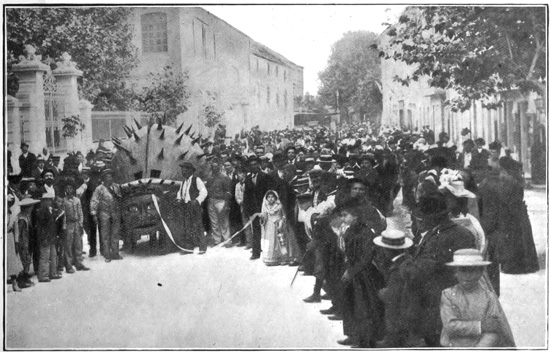
TARASCON: THE PROCESSION OF THE TARASQUE
The little girl leading the monster represents Saint Martha
The last thing you see as the train steams away is the white stretch of the Avignon Road lying between the railway and the river, its little white houses and modern villas close-shuttered and growing indistinct in the soft southern twilight.