"M'sieu Meelin of Dundae"
Reading edition
I.
Please do not consider it an affectation of superior knowledge if I begin by saying it is improbable that one out of a hundred of my readers has ever heard of Morbihan and the wonderful druidical remains in the Commune of Carnac. To be quite frank, I had never heard of them myself until one dusty summer day when I cycled into the little village of Carnac away on the south coast of Brittany, and within sight of the historic bay of Quiberon. The village of Carnac, whose population numbers only some six hundred souls, is one of the most interesting in Brittany, where almost every hamlet has some historic touch to engage the attention of the visitor. It consists practically of a little square of houses surrounding the ancient parish church, dedicated to Saint Corneille. This saint is the patron of cattle, and in September the town is the centre of a series of most picturesque celebrations, the peasants journeying hither from all parts of the surrounding country, accompanied by their cattle, horses, and even their pigs, for the pig is as notable a feature of rural life in Brittany as it is in Ireland. Saint Corneille, for a reason which will be explained further on, is supposed to take a very personal interest in the welfare of the Breton's cattle, and to see the simple peasants on their pilgrimage to his shrine, and later in the ceremonies of parading their beasts around the church and kneeling before his statue on the west front of the tower, kneeling again and sometimes even fighting for a dip in the water from his fountain, is to realise how sincere is their belief in his powers. But this is only by the way; my present intention is not to spend any more time in describing the quaint ceremonies that have long made Carnac a centre of pilgrimage, and have been the theme of many a story and poem by French writers.
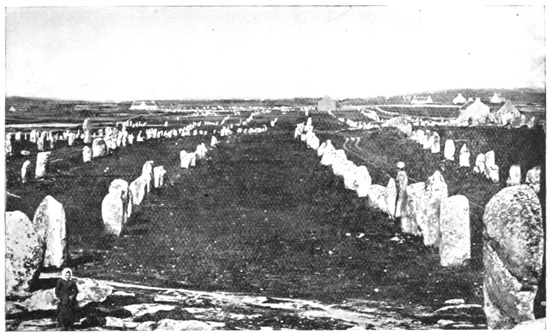
THE FAMOUS DRUIDICAL REMAINS AT CARNAC
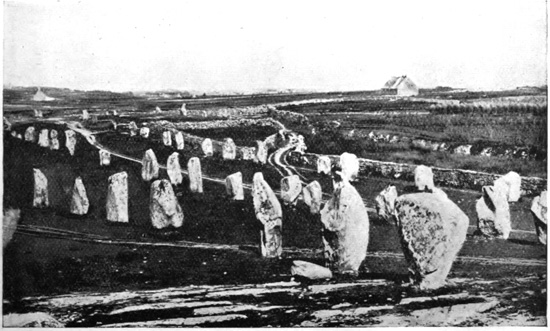
(The second view is a continuation of the first)
Leaving the little square and striking eastward along the main road, I noticed a small, plain building, almost the last of the few straggling houses in that direction, bearing in bold letters the legend "Musée Miln." The name had a pleasant suggestion of my ain countree, and in a trice I was knocking at the door, curious to know what lay behind. A tall, well-knit, clean-shaven Breton of about forty years of age opened and bade me welcome. He was carelessly dressed like any village shopkeeper in his shirt sleeves, and wearing a pair of carpet slippers; certainly presenting no aspect of the antiquary or the scholar, although it was not long before I found that he was a man of remarkable attainments in archæology. As far as I remember, the charge for admission was one franc, and although at first it seemed a large price to pay for looking at a roomful of things in glass cases, I left with the conviction that I had made an excellent bargain.
The museum I found to consist of an extremely valuable assortment of relics of the Stone and Bronze Ages. Admirably arranged and catalogued were hundreds of flint arrowheads and axes, some of the latter being of that earliest type before man had the sense to pierce the axe-head for the handle, but stuck the wedge-like head of the axe through a hole in the shaft. There were also many examples of rude instruments belonging to the Bronze Age, some Roman swords and a skeleton in a prehistoric stone coffin. The interest of these curiosities lay not only in their intrinsic value to the antiquary, but in the fact that they had all been dug up from the tumuli in the Commune of Carnac. But to me they assumed at once a far more vivid interest, when the custodian explained that the antiquary who had discovered most of them, and whose money had founded the museum, was "M'sieu Meelin of Dundae." When I explained that I was a countryman of this Mr. Miln, the curator launched into a warm description of that worthy's abounding good qualities, and recalled with the fervour of the French his own personal association with Mr. Miln in the work of excavation. He pointed with pride to a very ordinary oil painting of his old friend and master, which disclosed him as a fresh-complexioned, white-haired gentleman of unmistakable Scottish type, and assured me that he was "un homme très interessant et très aimable." I could readily believe the eulogy, as it was a kindly old Scotch face that looked out of the canvas at me.
II.
I wonder if the memory of Mr. Miln is treasured in Dundee. The chances are that what I have to tell of him may be news to his fellow-townsmen of to-day. A reference to that excellent work, Chambers's Biographical Dictionary, discloses the fact that he is remembered there to the extent of exactly two lines:
"Miln, James (1819-81), a Scotch antiquary made excavations at Carnac in Brittany, 1872-80."
That is all, but behind these two lines lie the long story of a romantic life in a foreign land and a little measure of fame among an alien people. In this respect the life of James Miln resembles curiously the lives of so many of his fellow-countrymen, who have wandered to the ends of the earth in the pursuit of their avocations, and left traces of their work everywhere except in the place of their birth.
My knowledge of the life of this notable Scotsman and his work is gleaned from the scholarly little brochure written by M. Zacharie le Rouzic, the slippered custodian of the "Musée Miln." It appears that James Miln was born at Woodhill in 1819, and while still young travelled in India, China, and spent some years in other parts of the far east. On his return to Scotland he threw himself with enthusiasm into antiquarian research and scientific studies. He succeeded to the estate of Murie in Perthshire on the death of his father, James Yeanan Miln, of Murie and Woodhill, and later to that of Woodhill in Forfarshire at the death of his brother, to whom that property had descended. His particular line of study for nearly forty years of his life would seem to have been the origin and development of portable firearms, and for a man of such peaceful pursuits it is strange to be told that he was especially ardent in encouraging every experiment for the perfection of rifles. Another of his hobbies was concerned with the improvement of the telescope; but all kinds of scientific instruments seem to have been objects of his study and inventive genius. In the experimental days of photography he speedily achieved success with the camera, and made a large collection of photographs of ancient sculptures in the east of Scotland. An accomplished linguist and something of an artist, he illustrated with his own pencil all his works on archæology, which M. Le Rouzic assures us was always his favourite study.
It was during the summer of 1873 that Miln first visited Carnac, where he encountered his friend, Admiral Tremlett, of Tunbridge Wells, who was interested in the wonderful neolithic remains in the neighbourhood, and became his guide in a series of explorations. Miln's enthusiasm was immediately aflame when he contemplated this rich and sparsely-explored field of research awaiting the excavator. His first idea was to purchase the ground on which some of the most interesting remains were standing, but finding this impossible, he approached the farmers on whose land the unbroken mounds, which represented burial-places of prehistoric people, were situated, and obtained leave from them to commence the work of excavation, to which he immediately resolved to devote himself during 1875 and 1876. The result was a series of important discoveries. Perhaps the most important of the remains unearthed were those of a Roman villa, consisting of eleven chambers, and surrounded by several other buildings, among which were baths and a small temple, that were believed to date back to the first half of the fourth century. Numerous examples of Roman pottery, glass, jewellery, money, a bronze statue of a bull, and many other curiosities were dug up. Within sight of the museum, and only a few minutes' walk away, is a tumulus surmounted by a little chapel to Saint Michael, and here in 1876 Miln made many notable discoveries, including the remains of an eleventh-century monastery.
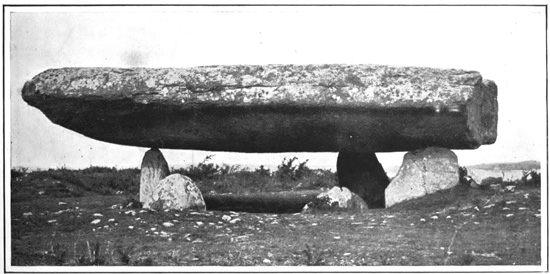
THE MERCHANTS' TABLE
One of the great dolmens near Carnac
III.
The results of these excavations were described in a large work written and illustrated by himself, and issued in Edinburgh and Paris. By January of 1877 he was busily prosecuting his explorations at Kermaric, a gunshot distant from Carnac, and the work went steadily on with the most fruitful results in many other parts of the district until the end of 1880, when Miln returned to Edinburgh in order to produce another book describing his researches. Unhappily, in the midst of his literary labour, he was seized with a brief illness, which at the end of six days resulted in his death on Friday, 28th January, 1881, at twelve minutes to eleven, as the faithful M. le Rouzic records.
James Miln was a member of the Scottish Society of Antiquaries, la Société royale des Antiquaries du Nord, the Academy of Copenhagen, and several learned societies in England and the Continent. "C'est avec une douloureuse émotion que l'on apprit, à Carnac, la nouvelle de sa mort," to quote again his faithful henchman. The museum with its precious contents was secured to Carnac through the efforts of Mr. Robert Miln, the son of the antiquary, and his friend Admiral Tremlett, and was opened on the 22nd May, 1882, since when it has remained a centre of great interest and importance to all antiquarian students, and an enduring monument to "M'sieu Meelin of Dondae."
This is a brief outline of the life of a little-known Scotsman, which is worth recalling as an example of the quiet, unostentatious way in which the Scot will carry on any enterprise that lies near to his heart, with no eye to personal advertisement, but out of sheer pleasure in the work his hand has found to do. Thus it is that one meets with traces of our countrymen in the remote and unfrequented corners of earth, and at the ring of an old name the mind of the wanderer is carried back across "the waste of seas" to the land whose sons, by some strange irony of fate, are prone to find their life-work far from home.
IV.
But my story must not end here, although we take our leave of James Miln and his museum. It is almost impossible to describe in any adequate way the historic value of this part of Brittany. Stonehenge, in England, is a national monument which we zealously treasure, yet its value, compared with the neolithic remains of Morbihan, is as a drop in a bucket of water. In the region to the east and north of Carnac druidical remains are as plentiful as blackberries in an autumn hedge. The sight of what are known as "les alignements de Carnac" is one never to be forgotten. Standing on the little mound by the chapel of Saint Michael already mentioned, and looking northward across the plain, we see an enormous range of menhirs or druidical stones standing like an army at attention. There are no fewer than 2,813 of these massive stones to be seen from this point, and the imagination is busy at once striving to picture the strange rites practised here by unknown people before the dawn of history. Dotted all over the vast plains are dolmens and cromlechs of varying size.
One of the largest dolmens that I visited is known as the Merchants' Table. It stands near Locmariaquer, and consists of an enormous stone laid flat on the top of a series of smaller stones. Originally the supporting stones would be only slightly imbedded in the earth, but in the ages that have passed the soil has accumulated until they are now sunk six or eight feet deep, but still project above the ground to the height of four or five feet. The roof-stone must weigh some hundred tons, and one of the mysteries is how a people, whose instruments were of the most primitive kind, could place such a mammoth block in so elevated a position. The dolmens, of which the Merchants' Table is one of the finest examples, were probably places of burial, and are always approached by a smaller chamber of the same rude construction. The interior of the one in question bears many strange carvings, that remain an enigma even to the most erudite.
Some authorities believe these structures may have been used as houses; others suppose them to have been altars, so that it will be seen their purpose has not yet been decided upon by their most learned students. The cromlechs, which are a series of stones standing in a circle, were most probably sanctuaries, and there is reason to believe that it was here the Druid priests practised their unknown rites. They are generally to be found at the end of an "alignment," and are oriented, so that the likelihood is the worshippers stood within the long rows of stones, which would correspond to the choir of a cathedral, and the priests were in the cromlech looking toward the rising of the sun.
To return for the last time to the great army of menhirs, or single stones, seen from St. Michael's chapel near Carnac, the legend popular in the district is that when St. Corneille, a Pope of Rome, was being pursued by an army of pagan soldiers, he had with him two oxen, which carried his belongings and sometimes himself when he was fatigued. One evening, when he had arrived near a village where he would have rested the night, he determined to press on beyond it because he had heard a young girl insult her mother! He saw soon afterwards that the soldiers, who had been following him, were arranged in line of battle, and he was between them and the sea. So he stopped, and transformed the entire army into stones. This is at least a picturesque way for accounting for those marvellous remains that have baffled the minds of men to explain.