PANCAKE TUESDAY
Reading edition
Pancake Tuesday is quite a nice name is it not? But it is not the only name for this holiday. It is also called Shrove Tuesday, Shrovetide, Fasting-tide, and Fasten-e'en or Fastern's-e'en. I shall try to explain to you why it has all these names. There is, as you must know, a great festival of the Christian Church called Easter. It is the festival of the resurrection of Christ, and to prepare for this solemn festival the ancient Church set apart a period of fasting which we call Lent. This fasting-time begins upon Ash Wednesday, and on the morning of the previous day, in the old times, people went to the priests to confess their sins and get shriven. Hence it was called Shrove or Shriven Tuesday; hence, also, it was called Fasten-e'en, because it was upon the eve of the Great Fast.
After attending church in the morning the people were permitted to enjoy themselves to their heart's desire all the rest of Shrove Tuesday, and before the rigorous fasting-time of Lent began. During the Middle Ages, indeed, this merry-tide lasted for several days, and some idea of the jollity of Shrovetide can be gathered from the way in which the Carnival is held upon the Continent, even now. In England, during the old times before the Reformation, there were great feasts during Shrovetide, and all the old English games and pastimes went right merrily. Some of these pastimes were very rough and cruel—such as cock-fighting and bull-baiting—and would not be permitted to-day. But there were also such games as football and hand-ball; and in certain towns in Scotland the game of hand-ball is still played, sometimes very roughly, upon Fastern's-e'en.
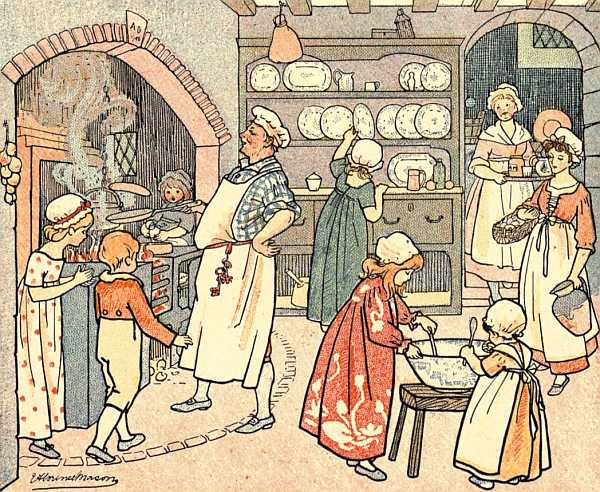
Of all the jollity and junketting of that festive time very little remains to us; almost nothing except the practice of baking and eating pancakes upon Shrove Tuesday. But nowadays the ceremonies connected with Pancake Tuesday are not so important and picturesque as they used to be. In the old days—the days when Shakspere lived—a bell was rung in the morning called the Pancake Bell. At the sound of the bell the preparation of the pancakes began. Wheaten flour mixed with water, spices, eggs and other nice things were dropped into the frying-pan as it sizzled over the fire. Then followed the tossing of the pancakes. This was a time of great fun, because it required a good deal of skill to toss the pancakes and catch them in the pan. In giving them a quick twirl round the pancakes sometimes dropped into the fire. But that did not greatly matter, because there were always plenty of pancakes for everybody; and also plenty of fun in the eating of them.
There was only one person in the company who did not enjoy the fun. For the first pancake tossed in the pan was given to that member of the party who was considered the most lazy. It was seldom eaten, you may be sure, as the Lazy One found it the best plan to run away and hide. But it was a merry day, especially for young people at school and college. At Westminster School, for instance, the cook used to bring his frying-pan with a pancake in it right into the schoolroom and toss it among the boys. In the scramble that followed the boy who captured the pancake unbroken and carried it to the Dean received a guinea for his cleverness. That was a jolly game and it is only one of many that used to be popular on Pancake Tuesday. 'Tis a pity that much of this merry-making has disappeared.>/p>