MAY DAY.
Reading edition
If there is one month in the year that is more joyful than another it is the month of May—the merry month of May. And it is not difficult to understand why it should be so. In Europe it is the month when nature out-of-doors awakens into life; when leaves appear upon the trees; when flowers in profusion peep from among the grass; when the little birds in lane and woodland sing their sweetest. Nature is joyously astir; and in the sunshine of the open sky all people, especially young people, find it good to be alive. That is the reason why May is the merry month. It is Nature's holiday time; the time when she calls upon all folk who are weary of winter and rough weather, to come out of their stuffy houses and enjoy themselves for a little in green places, under the blue tent of the sky.
It is the sun that brings all this new life and gladness as it goes higher in the heavens and shines brighter. So it happened that the ancient inhabitants of these islands, not knowing any better, held a great festival on the First of May to the praise and glory of the sun-god. A relic of this worship lingered until recently in the Beltane fires that were lit on the high hills of Scotland and Ireland. It was the same with the old Romans. They had a goddess of flowers called Flora, and about the beginning of May they held a festival in her honour. The houses were decked with garlands, there was much feasting and dancing out-of-doors, and at these feasts the goddess herself was represented by a beautiful maiden crowned with flowers.
There is reason to think that some of our May Day customs were derived from these ancient peoples. In any case, it has always been a joyful day in England, especially in the ancient times before the Puritans abolished May-poles and merry-making. Not only the citizens of London, but also the lords and ladies of the Court, used to go out to the woods around the city—it was a very much smaller city then—and gather hawthorn blossom. This they called going a-Maying, and the flower of the hawthorn came to be called May-blossom. It was brought into hamlet, town, and city with great rejoicing, and to the sound of music.
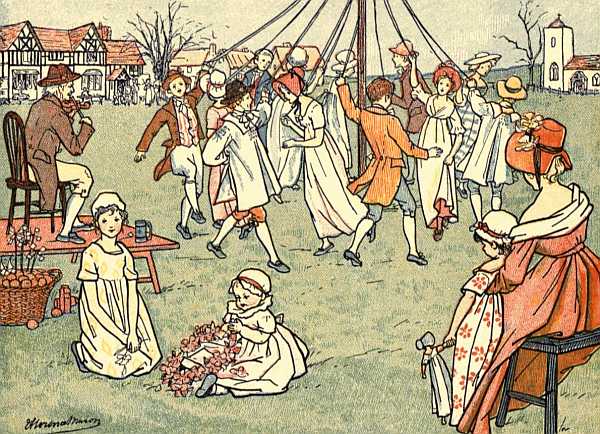
Then the whole day thereafter was spent in merry-making. In every town and village there was a tall pole fixed, called a May-pole; and on May Day this pole, the centre of all the frolic, was made gay with great garlands of flowers. Every town and village, also, had a Queen of the May, a maiden who was chosen for her beauty, and who sat apart crowned with flowers, an object of envy and admiration. The lads and lassies sang carols, played at such games as kiss-in-the-ring, and danced the morris dance. Not many of these customs now remain; the May-poles have disappeared; and very few of you children, I suppose, go a-Maying. Do you not think that is a mistake? I do; the work-a-day world is not such a mirthful place that we can afford to forget the cheery old customs, and there are surely many worse ways of spending a day than in dancing round a May-pole. I am sure that you children would like to have the merry-making of May Day brought back again.