LORD MAYOR'S DAY.
Reading edition
In London the 9th of November has been regarded, for many centuries, as a day of special importance. It is Lord Mayor's Day. That is to say, the new Lord Mayor of the City of London, who was elected by the freemen of the City Guilds on Michaelmas Day, goes in his state coach to the Law Courts to be "sworn into" office by His Majesty's judges. Until recent times the Law Courts were situated at Westminster, and in old Westminster Hall some of the greatest trials in English history took place,—such as the trials of Lord Cobham, Strafford, and Warren Hastings. Now the Law Courts are situated in the Strand, near to the spot where stood Temple Bar.
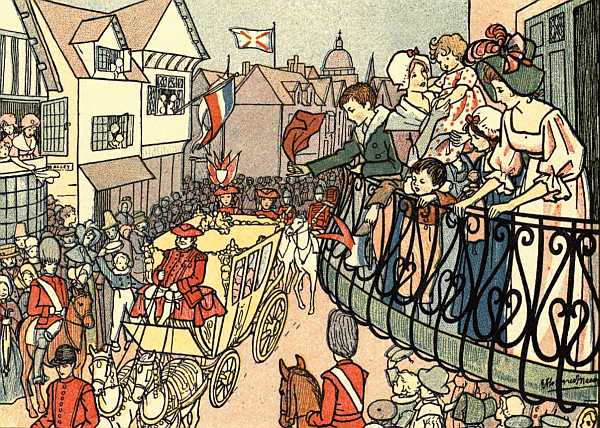
The Lord Mayor of London has still a certain amount of authority within the City bounds, but nothing like what he used to possess. At one time, indeed, in his capacity of Head of all the great trade guilds, he was more powerful than any of the king's nobles, and in London he exercised almost as much authority as the king himself. From this you will understand that when he, in the old times, journeyed from the City of London to the City of Westminster it was a great occasion, because the Lord Mayor was in truth a great man. The stately pageants wended to Westminster on Lord Mayor's Day both by coach and water-barge; glittering pageants that had a real significance. In many cases they were devised by clever play-wrights, and their glories recorded in the verses of the poet laureates.
In the year 1616 Sir John Leman, of the Fishmongers' Company, was Lord Mayor, and part of his pageant was a fishing-boat with fishermen drawing up their nets laden with living fish which they distributed among the people. This boat, set upon a wheeled stage, was followed by a dolphin with a youth on its back; then the King of the Moors, with six tributary kings on horseback; then a lemon-tree (the Mayor's name was Leman) laden with fruit and flowers; then a bower adorned with the names and arms of all members of the Fishmongers' Company; then an armed officer, with a representation of the head of Wat Tyler; lastly there was a great car drawn by mermen and mermaids, and on the top of it was a victorious angel, with a representation of King Richard surrounded by figures that symbolized all the royal virtues.
Some of the Lord Mayor's pageants were even more splendid than this one. Gilded chariots, giants, bowers wreathed with flowers, men in armour, full-rigged ships, satyrs, bannermen—these things, and many other fanciful contrivances, found a place in the Lord Mayor's procession. And this procession still forms a part of London life, but it has lost all its significance; and a great deal of its interest, even as a show. On the 9th day of each November the Lord Mayor's gilded coach, with a few mounted soldiers, the heralds, the aldermen in coaches, the City firemen, and a few symbolical cars block the traffic of London from east to west. It is not an occasion of great historical interest, yet it still draws great crowds, for your true Londoner loves a procession that goes to the sound of brazen music. The Lord Mayor's Show is also—just like a circus procession—beloved of all boys and girls.