ALL FOOLS' DAY.
Reading edition
He must have been a merry person who invented All Fools' Day, but no one can tell when he lived, where he lived, or what was his name. All we know about the matter is that the custom of fool-making upon the First of April is very old, and that it prevails over nearly the whole of Europe. Some people have tried to guess how this odd custom began, and they have found its origin in one of the old Miracle Plays that used to be played by the Monks in the Middle Ages at the Easter Festival. In this play Christ was represented as being sent hither and thither from one judge to another, from Annas to Caiaphas, and then from Pilate to Herod. This explanation is doubtful; it is more likely that the custom of fool-making had its origin in heathen times. In any case, it is a merry custom; and as the joker and the fool have many sons and daughters it is a custom that shall endure yet a while.
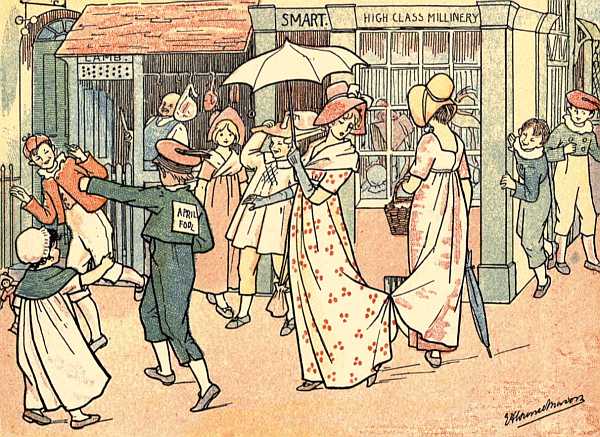
The great thing on the First of April is to have a good memory. Most people know about April fooling, but many people forget about it when the special day arrives. Some of you children, no doubt, have forgotten; with the result that the joker with a good memory has made of you an April Fool. In coming down to breakfast you have been asked quite solemnly, let us say, why your hair is brushed to the wrong side. If you have gone and peeped into a looking-glass there was an instant burst of laughter, and then you have become aware that All Fools' Day has come round again. Some boys and girls get angry when they have been thus fooled; but that only adds to their foolishness. A good plan is to laugh with those who are laughing; and you can better this plan by catching the joker off his guard. By so doing you may, if you are clever at keeping a solemn face, make a fool of the joker in his turn. Then the laugh is with you, and you can feel quite pleased with yourself until the next All Fools' Day.
This is the great festival of the Practical Joker, and all is well when his jokes are simple and amusing. To pin a piece of paper on someone's back, or to send the school Dunce into a bookseller's shop for a "History of Adam's Grandfather," is quite good fun. But there are some jokes which are carefully prepared in order to give pain to the persons upon whom they are played; they are not amusing, but merely cruel. It is not a good joke, for instance, to balance a bowl of water upon the top of a door, so that the first person to enter the room gets drenched. Neither is it nice fun to send an innocent boy upon an errand with a letter containing the instruction: "Send the fool another mile." This used to be a common form of April joke in Scotland, and it was not unusual to keep the poor boy trudging long distances for the greater part of the day. This is not fun, but a stupid form of cruelty; and of much the same character as the hoax that is played upon tradesmen who are asked to send goods to a particular house upon a particular morning. It is only when the vans choke up the street from end to end that someone remembers it is the First of April, and that the Practical Joker—a stupid and heartless person in this case—has again been exhibiting his foolishness.