GOOD FRIDAY.
Reading edition
Good Friday is the Friday before Easter, and by the Christian Church it is regarded as one of the most sacred days in the whole year. From a very early time it was regarded, in a special degree, as a day of fasting and mourning, because upon this Holy Friday the crucifixion of Jesus is commemorated. In the Church of England before the Reformation, and in the Roman Catholic Church still, the church service upon Good Friday is peculiar. Everything is made to appear mournful. The priests are dressed in black, at the elevation of the Host a wooden clapper is used instead of a bell, all the glittering ornaments are removed from the altar, and the music is more than usually sad.
But even more strange than that is the chief ceremony. In old times, it used to be that the priests had a figure of Christ fixed to a crucifix which they carried round the church, treated with great reverence, and ultimately buried solemnly by torchlight. Nowadays, this ceremony has been somewhat changed. On Good Friday the crucifix, in the Roman Catholic Church, is placed before the altar. Then the priests, followed by the whole congregation, approach the figure upon the crucifix creeping upon their knees, and reverently kiss its feet. This ceremony, and the chanting of the Miserere, have a very solemnizing effect upon all who are present.
Long ago, here in England, there was an odd ceremony performed by the King upon Good Friday. This was called Blessing the Cramp-rings. The ceremony is said to have originated in a wonderful ring, presented by a pilgrim to Edward the Confessor, and long used in Westminster Abbey as a cure for falling-sickness and cramp. On Good Friday the King of England used to go in state to his private chapel, and creep humbly upon his knees towards the crucifix. Following him came the King's Almoner with a silver basin in which were a number of gold or silver rings, and these rings the King blessed. Thereafter, they were given away to be used as an unfailing cure for cramp and epilepsy. In those days everybody believed that cramp-rings had the power to cure cramp, and in England to-day there are still a few people who so believe.
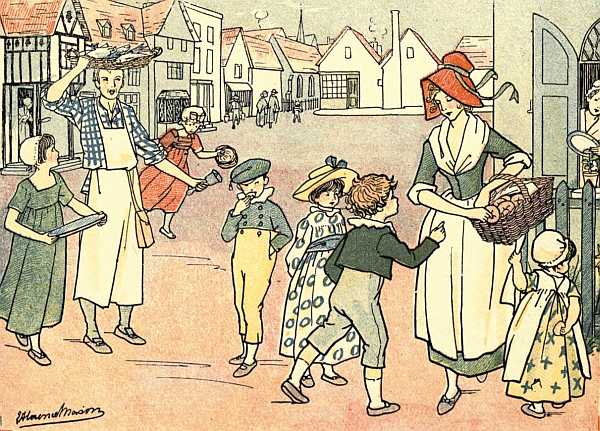
You children, however, do not think of rings upon Good Friday; it is much better to think of hot cross buns. If you ask how it is that buns came to be eaten on this day I cannot answer. All that can be said is that bread, in one or another form, has always formed part of religious observances; and it may be that the spicy buns which you eat on Good Friday are connected with a religion that is older than Christianity. All things change, you know, and even the desire for hot cross buns is not so great as it used to be when people struggled in crowds at the doors of the famous Chelsea bun-houses. On Good Friday we do not so often hear the cry:
One a penny, buns, Two a penny, buns, One a penny, two a penny, Hot cross buns!