Chapter XLV · Odds and Ends of History and Reminiscence
Reading edition
In this chapter we give some odds and ends of history and reminiscence that could not well be inserted elsewhere or that came into our possession after the foregoing chapters were written:
The result of the vote in Linn county in 1860 showed 2,227 for Lincoln electors, 1,220 for Douglas, 24 for Breckinridge, and 84 for Bell. In Rapids township Lincoln had 397, Douglas 201, Breckinridge 3, and Bell 26.
The first telegraph line reached Cedar Rapids February 24, 1860.
On the evening of Sunday, June 3, 1860, a destructive storm occurred, since known as "The Great Tornado." It was most destructive about five miles north of Cedar Rapids, and passed southward, leaving the county in the vicinity of Western. Some lives were lost and many buildings destroyed.
THE TOWN OF WESTERN
Western was laid out in March, 1856, under the auspices of the United Brethren church, with the design of forming proper surroundings for the college. Ground was first broken in June of that year. By August, 1857, there were forty-three dwelling houses and three hundred inhabitants. One college building had been completed. This was of brick, three stories in height, 36 by 62 feet. This was placed upon a campus of seventeen acres. Rev. S. Weaver was first president of this institution. The plan was to operate a large farm in connection with the college, that students might earn their way. In this new town there were already two stores, one hotel built and one building, a blacksmith shop, two physicians, and fourteen busy carpenters. Land in the vicinity was worth from $10 to $20 per acre. Its quality was proven when the college president, on his own farm, raised 1,800 bushels of wheat. There was a railroad coming there, of course, as there was one prospected to nearly every cross-roads in the state. This particular line was the Iowa Union, to run from Cedar Rapids to Iowa City.
Western was above all things a moral town. One Daniel Quin having opened a grog shop near the place, where the college authorities could not interfere, the people took up the matter. Sentiment was aroused and a mass meeting was held. At this meeting resolutions were adopted, which provided that a committee should wait upon the dram seller and urge him to desist. In case of his refusal the committee was to try legal methods for his suppression. If these proved ineffective the meeting was to be again called, to devise further measures. A very significant addendum was that the meeting would support the committee in any plan which might be considered necessary to eradicate the obnoxious business. It was further resolved to use the boycott—though the Irish captain had not yet given his name to the scheme. In other words they were not to employ or trade with any man engaged in the liquor business or who might in any way support the traffic. It is perhaps needless to say that Quin surrendered at discretion without forcing the committee and the people to extremities hinted at.
MT. VERNON
Mt. Vernon makes showing in several directions during 1857. The Congregationalists of that town being without a place of worship were enabled to rent from the Covenanters. But by the terms of the lease with that strict body promise was made that no minister of pro-slavery sentiments should be heard within the building, nor upon any occasion was a musical instrument of any description to be used therein. The institution at Mt. Vernon which had before this time been known as "Iowa Conference Seminary," was in August, 1857, changed in name to Cornell College. And Mt. Vernon, like the other college town of Western, was careful for civic peace and righteousness. Christianity in that time and in a new country was required sometimes to be of a stalwart and muscular kind, that it might meet evil tendencies sharply and effectively. Thus we learn of the discomfitures of a gang of rowdies from Linn Grove, who invaded the peace of Mt. Vernon and disturbed its Sabbath quietude, with intent to break up a religious meeting then in progress. These were overcome, after a tussle, by the worshippers, and held until passing of midnight brought a civic day. Then the justice was roused, the disturbers formally accused, tried and fined to the utmost extent of their resources. The affair was over before one o'clock Monday morning, the rowdies started home with empty pockets, sadder and wiser men, and the godly inhabitants of Mt. Vernon again slept the sleep of the just.
FIRST AGRICULTURAL ASSOCIATION
The Linn County Agricultural and Mechanical Association was organized in 1855, its first meeting being held at Cedar Rapids in May of that year. The organization was completed in July. The object, as stated, was "the encouragement of agriculture, manufactures and the mechanic arts." To accomplish this laudable purpose an annual county fair was to be held. The first of these was at Cedar Rapids in September, 1855, and the second at Marion the next year. These are reported as very creditable in exhibits, and fairly well attended. In 1857 the association was incorporated, and in consequence drew $200 from the state treasury. The third fair was again at Cedar Rapids, and the management took the public into its confidence in advance by revealing its slender resources. The premiums for '56 were not paid, but those of the next year were very promptly met, and a surplus remained over for the future. These annual fairs were recognized as something to be aided by all parties, and the various toll bridges notified intending exhibitors that all live stock taken to the fair would be passed free.
The statement of the association for 1860 shows total income of $462.00, of which amount $259.00 represented the gate receipts. The expenditures were $414.95, including $146.98 for premiums. The indebtedness of the society had increased to $618.65. The amount received from the state each year was $200.00. Officers elected for 1861 were: President, Charles Taylor, Cedar Rapids; vice presidents, Andrew Safely and W. S. Gott, Marion; secretary, S. D. McCauley, Cedar Rapids; treasurer, Lysander Jones, Marion.
FIRST TEACHERS ASSOCIATION
Another organization, though having nominal existence before this time, was really made effective in 1857. This was the Linn County Teachers' Association.
On October 31, on call of J. L. Enos, the teachers and others interested met in Cedar Rapids. Mr. Enos was then editor of the Voice of Iowa, the educational organ of the state. At this meeting a reorganization of the association was effected, and officers elected as follows: President, Rev. S. Weaver, president of Western college; vice presidents, Prof. S. M. Fellows of Mt. Vernon, E. A. Cooley of Marion, Ira G. Fairbanks of Cedar Rapids; secretary, Prof. N. W. Bartlett, Western; treasurer, Hon. E. N. Bates of Cedar Rapids. The executive committee consisted of M. Bowman, Franklin township; S. M. Bruce, Washington; William Parmenter, Western; J. L. Enos, Cedar Rapids; and A. Witter, Franklin. The work of preparing a constitution was committed to J. L. Enos, E. A. Cooley, and Ira G. Fairbanks. A further meeting of the association was held at Western, December 12th, at which time the constitution was adopted and the organization started on a very useful existence.
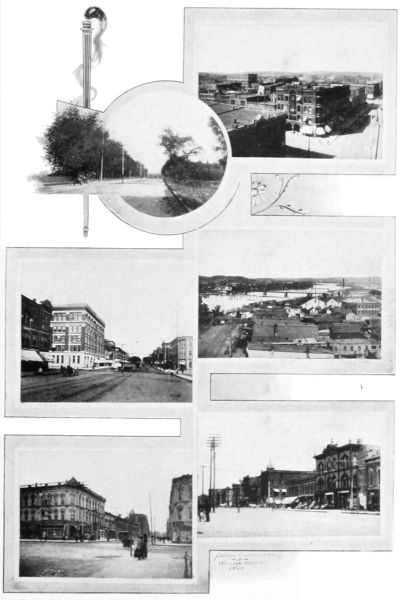
STREET VIEWS IN CEDAR RAPIDS, IN 1910
FIRST TEACHER'S CERTIFICATE IN CEDAR RAPIDS
The first teacher's certificate issued in Rapids township reads as follows:
"This certifies that I have this day examined Miss Susan A. Abbe, touching her ability to teach, both in regard to her education and to her moral character, and I find her well qualified for a teacher of common schools.
"This certificate shall be valid for one year.
"Rapids township, Linn county, Iowa, July 16, 1847.
"Alexander L. Ely, "Inspector of Common Schools for said Township."
Alexander L. Ely was one of the early settlers of Cedar Rapids, was interested in the public matters of the new town, and early engaged in politics. He was also largely interested in real estate, and operated one of the first mills on the Cedar river at the dam, which he caused to be built with N. B. Brown and other leading citizens.
Susan A. Abbe, the person to whom this certificate was issued, is still living in Hollister, California, and is known as Mrs. Susan Shields. She was seventeen years when the certificate was issued, and had then been a resident of the county ten years. She taught for a number of years in the public schools of this county.
Mrs. Shields maintains that she was the first legally qualified person to teach in the public schools of Cedar Rapids, according to the laws then in force in the state.
The evidence seems to confirm her contention.
TEACHERS' INSTITUTE
A teachers' institute, first of which record is made and notable in point of attendance, was held in Cedar Rapids December 26, 1859, and continued for three days. There was constant drilling for the pedagogues in common school branches. Some sixty teachers were present.
Linn county teachers held their institute for 1860 at Western October 29-30, with Prof. F. Humphrey of Cedar Rapids, president. Some of the subjects discussed may serve to illustrate differences in the times. Question of teachers (presumably male) using tobacco came up, and a resolution was adopted expressing "disapproval of the use of tobacco by teachers, and recommend to those of Linn county to abstain therefrom entirely." Dr. J. Maynard of Tipton made an address on the subject of "Children's Rights." Prof. Wheeler of Cornell orated on "Demosthenes." Editor Jerome of the Iowa City Republican urged teachers to use the press as an ally in the cause of education.
Mrs. Ruth A. Dale, of Cedar Rapids, sister of Elias Doty, now living near Bertram, where the family settled in the early days—1839—has distinct recollections of pioneer life in the county. She states that Aretas Crane and Daniel C. Doty, brothers of Elias and James M. Doty, the pioneers, settled at Ft. Stevens, now Davenport, in 1836 or 1837—1836 she believes is the correct date. Daniel Doty and his son, J. M. Doty, and his son-in-law, Aretas Crane, passed over the ground on which Cedar Rapids now stands in 1837. This being the fact, it is evident that these people were the first white men to look upon the present site of the city, with a view to finding a permanent settlement for themselves. They, however, after looking over the ground concluded that the site afterwards known as Westport, and somewhat later as Newark, was the preferable location. They returned to their home at Middletown, Butler county, Ohio, and arranged their affairs. James M. Doty and Elias Doty, sons of Daniel Doty, returned to the county in 1839 and took up a claim at Westport. There they started what was, without question, the first manufacturing plant within the limits of the county, and possibly in the state. This was a pottery. The date of its establishment was probably in 1840. Later the same year Elias Doty began the erection of the first saw-mill in the county.
The Dotys were induced to come to Iowa through the fact that their brother, Daniel C. Doty, was at the time engaged in steamboating on the Mississippi, his headquarters being at Davenport.
In this connection the following extracts from a letter written by Elias and J. M. Doty to their parents and dated May 2, 1841, are of interest:
"I have my mill frame up, that is, the lower frame. The upper frame is almost ready to raise. The millwright work can be done in about six weeks from the time we raise the frame. I have commenced the race. I have three hundred feet in length of a race and two hundred feet dam. As soon as I get water to it, it will be ready to run.
"There are hard times enough here for anybody. There is nothing that will bring cash that I know of. For my part I am hard run to live. I would like to have some money. It has not come yet.
"I cannot say that we are all well, but we are able to keep about. We had a great deal of sickness last fall. I cannot say that I like this country, it is too cold for me, the ground freezes from two to four feet deep. The frost is hardly out yet. The trees look like winter time. I think I will leave this place as soon as I can get my business settled, and money enough to carry me away. I have between two and three hundred dollars coming but can't get enough to buy myself a shirt. I bought corn last fall at three cents per bushel. I have three claims and want to sell them.
"Last night was a pretty moonlight night. Parmelia kicked up a fuss and after all night's watching about six o'clock this morning after a bright sunrise she was delivered of a prosperous looking son, weight nine pounds, seven ounces."
VOTE OF LINN COUNTY 1910
The vote of the county in November, 1910, for governor was as follows:
Twp.Rep.Dem.
Bertram3375
Brown209102
Boulder7690
Buffalo4027
Cedar133127
Clinton5264
College4995
Fairfax60111
Fayette9435
Franklin385182
Grant12495
Jackson16651
Linn5757
Maine22579
Marion519391
Monroe9966
Otter Creek6763
Putnam4396
Rapids17612443
Spring Grove8322
Washington145168
————
44204439
In addition to the above there were 382 votes cast for other candidates.
SOME MUNICIPAL FIGURES FOR CEDAR RAPIDS
The net taxable value of property in Cedar Rapids for the year 1910, on the one-fourth valuation, is $6,579,183. In addition the city has a mulct tax revenue and an income from licenses, police court fines, etc., of about $60,000 per year, giving a little more than $300,000 available for city purposes.
The real estate valuation for 1910 is $21,280,294, and the personal property is valued at $5,026,438. The valuation twelve years ago was one-half of the above amount. It has increased at the rate of one million dollars per year since 1898. This increase is largely due to improvements and new buildings. Land values have doubled in the past twelve years. For 1911 the valuation will go above these values as the city has increased in value so fast that it will be necessary for the assessors to raise the valuation on all property for 1911 at least three million dollars, which will bring the total valuation to nearly thirty millions by 1912.
EARLY DAYS IN LINN
IN CEDAR RAPIDS REPUBLICAN JUNE 20, 1910
Being in a somewhat reflective mood today I shall attempt to acquaint you of a few incidents in a life as memory unfolds them to me. It will be necessary before narrating these incidents to introduce to you my friend and acquaintance, Colonel McIntyre of Indian Creek bottom, familiarly known as "Pinkey" by his class mates at West Point. The colonel measured six feet two, symmetrically proportioned, tipping the scale at a trifle over two hundred pounds, eyes of steel grey, beard auburn, bordering slightly on the reddish and a military bearing in keeping with his long years of service as a disciplinarian. The incidents of this life take me back some years to that little cabin, that stood on the east side of the road running north and south past Indian creek bottom, built from roughly finished logs hewn from the trunks of trees cut from the nearby forest. Time does not seem to efface from memory recollections with the boys and girls of the sparsely settled neighborhood, attending spelling schools and such like. The unfolding of memory reveals to me versions of the old place and the childhood days spent beneath the clapboard roof as vividly as though it were but yesterday.
A little farther on up the road from this cabin, perhaps a half mile, there is a fork in the road, one fork leading on to what was then known as Turkey Grove and now to feather ridge, the other on to the Inn dwellers cave on the "Pinican" bluffs. On the flat iron point where the road forks was erected the first school house in that vicinity and is still standing as a monument to the men who were not afraid to do what they knew to be right regardless of the whims and petty clamorings of dissatisfaction that continually sway committees from the paths of rectitude and right. From this nucleus of education there go forth its quota of youth each year to enter higher institutions of learning or grapple with the more serious problems of life. The impressions I received while attending this school by the pleasant grove have not been eradicated by the conquering of new worlds or by the glamour of political conquests. Youthful dreams and the bewitching smile of some fair maid were a source of great pleasure to me; a smile from Miss Rose LaBelle during school time would set my heart going at a two minute clip and detract materially from my studies and the routine of school work.
From this miniature "college" have gone forth men and women who are now wielding an influence almost nation wide in its scope. Some are gradually wandering from the truths that were enunciated and make a cardinal principle of its teaching and are now searching in hidden paths of sociology for new light. I now recall an event that happened while attending this school that conveys to my mind another fact tending to establish the truth of the proposition, that "ingratitude" is no dream.
One bright morning in early spring when all nature seemed aglow with freshness and beauty, myself and a number of girls were the first to arrive at school, the teacher, Miss Theresa McCurty, being a little later than usual. On entering the school house we were held spellbound and speechless for a moment by a strange musical yet weird sound which seemed to come from the rear of the room. It took considerable effort to muster up courage to make an investigation, but finally a search was started and on approaching the rear end of the room the same musical weird sound would be at the other end of the room. Now in order to discover what it was that was making this strange weird noise and put the intruder to rout and discover if possible what kind of a looking monster he was, it was decided that two of us would go around to the rear and the rest remain in front and keep a sharp lookout for whatever it might be, when all at once one of the girls let out an unearthly scream and pointing at some object in the corner of the room shouted, "There it goes." We all gave chase, although some of the girls were rather timid on the start, and succeeded in capturing the intruder alive. It turned out to be a large white wood-mouse. What to do with this new and unruly possession was the important question now up for solution. Some were in for dispatching it at once, others said let's turn it loose, but Miss Orrie, who always had an eye for business when there was any fun in sight, suggested putting it in the teacher's desk and the result was that Miss Orrie had her way and we proceeded with all haste to carry out her plan, the girls holding up the lid of the old fashioned teacher's desk while I dropped the musical wonder in. This done, we went about our play as though nothing was ever expected to happen, impatiently waiting for something to happen, but not quite sure what. We didn't have long to wait.
Now the teacher, Miss Theresa McCurty, was of the type of spinsters who are apparently self-willed and thoroughly versed in the art of throwing round them an atmosphere of ability to convince others of their dependence only on themselves in case of emergency to take care of themselves.
We had barely completed the capture and imprisonment in the teacher's desk of the musical wonder, when Miss McCurty arrived, ready for her day's work of training the youthful intellect. It seemed as if this morning in particular she was more precise than ever and went about her work very deliberately.
It was her custom (a custom that the "Blasting at the Rock of Ages" ought not to minimize) to read a chapter from some book of the bible every morning to the scholars before commencing the further duties of the day, and that chapter which speaks about bearing false witness was the one chosen for this morning, a very fitting prelude too, to the further developments of the day. We were more prompt than usual in taking our seats after school was called this morning with an evident desire to impress the teacher as being very attentive to our studies, but at the same time keeping one eye in the teacher's direction, so as not to miss any of the movements of the teacher in case the anticipated fun was thrust upon us. Lowell Taylor, the boy who couldn't keep still if he had to, was bubbling over with mirth (every school has them) and was severely reproved for not keeping quiet and for disturbing the whole school by his antics. After delivering to Lowell this short lecture on disobedience she went to her desk to get her bible and as she lifted the lid out jumped the prisoner and such a screech as she let out seemed to almost freeze the marrow in your bones and sent the cold chills chasing up and down your spinal column as with one bound she made the first row of seats and in a jiffy was clean to the farther end of the room, perched upon the rear desk with her skirts tucked snugly around her shaking limbs and terror pictured in every line of her face.
In this position she remained impervious to all efforts to induce her to come off her high perch, until a second chase had been made and the intruder ejected from the room.
By recess time she had again settled back in the old well beaten path and assumed her usual calm and dignified way, her reason, which had been so suddenly dethroned by the advent of the harmless mouse, was again gaining mastery of the situation. With the return of reason came the tangled threads of suspicion, that perhaps she had been the victim of a designing bunch of scholars and that a huge joke had been perpetrated on her. With this object in view she began a systematic search for evidence and among the girls she struck a responsive chord. They were ready to convict any one in order to exculpate themselves. They gave the whole plot away and every last one of them persisted in their innocence so eloquently that the teacher was fully convinced of my guilt. She therefore proceeded to relieve her pent up feelings by putting into action several of her "suffragette" ideas about personal liberty. She restrained me of mine for the next two weeks during the noon hour.
EARLY DOCTORS IN THE COUNTY
The following extracts from a paper read in December, 1910, before the Iowa Union Medical Society at its meeting in Cedar Rapids, by Dr. H. W. Sigworth, of Anamosa, himself a pioneer physician in Linn county, is of interest:
I left northeastern Linn county thirty-four years ago.
In 1856 I commenced the study of medicine in Pennsylvania. After that I was a tramp schoolmaster, farmer, student at Wisconsin university, and U. S. soldier. I graduated from Rush in '63. After looking for a location in Indiana, Illinois, and Wisconsin, I located at Waubeek—think of it—in Waubeek, in Maine township, in 1863.
I had tried it a month at Fairview, in Jones county, before going to Waubeek. By the way, old Dr. Ristine made his first start in Iowa in the same historic town of Fairview before locating in Marion.
Northeastern Linn county at that time was very much on the frontier. There were no bridges on the Wapsie from Quasqueton to Anamosa, but at Central City; now there are five. At Waubeek we had a postoffice but no regular mail carrier. Any one going to Marion took the mail sack and brought back the mail.
Our first mail route was on Friday morning. It left Quasqueton horseback, making Paris, Central City (which was formerly called Clark's Ford), Waubeek, Necot (Perkins), Anamosa. Saturday it would return over the same route.
The earliest doctor of whom I can get any word of locating in this territory was Doctor Ashby at Paris. When I came in 1863, Doctor Patterson was at Central City. Dr. Lanning was at Paris. He sat next to me at Rush in 1861 and 1862. Dr. Stacy lived out the Anamosa and Quasqueton road at Valley farm. I never met him. He sent me my first case of fractured thigh in June of 1863; a boy, eight years old, who lived in a sod house with a board roof, two miles north of McQueen's (now Hill's Mill), now owned by Coquillette. The splints were made with an axe and pocket knife out of an old cradle found on the roof of the house. Extension on the ankle was by the top of an old shoe with strings through the foot-piece of the Liston splint. Results all right.
At Paris, after Lanning came Drs. Byam, Mrs. Dr. Byam, and my brother, M. P. Sigworth, Fullerton, McTavish, and Ellis, all of whom I knew, and not one of them alive now.
Where the thriving village of Prairieburg now is was a cross road, the northeast corner lying out to commons for years.
The first doctor to locate there was Dr. Young. He drove a little sorrel horse in a light rig with one wheel dished, which made a crooked track, and his disposition was something like the track of his buggy. Following him at this place was Dr. Ellis, who went to that place from Paris.
At Central City after Dr. Patterson came Mitchell, a state of Maine Yankee. At an early date a majority of the people here abouts were from the state of Maine, henceforth the name of Maine township. The Jordans, Friesons, Clarks, Waterhouses, were early settlers from the state of Maine.
Dr. Mitchell was a good doctor and a fine man. Poor fellow, he lost his life by having administered to him by a mistake a teaspoonful of poison when he was to have a tonic.
After his death at Central City the place was filled by Drs. Ristine, Fisher, McTavish, my son, Dwight Sigworth, and Percy, a scientific fellow. This field is now filled by Drs. Fisher and Woodbridge.
Waubeek was in the field of Dr. Love, he going northwest to Nugent's Grove at times. Dear old Dr. Love was a splendid man, a first-class diagnostician and a good physician and surgeon. If he lacked anything it was aggressiveness in surgery.
While at Waubeek I had for co-laborers Drs. Phipps, Scott, Bowers, and Grimm. Bowers tried to commit suicide by taking a teaspoonful of poison which made him very sick, but he ultimately recovered. Dr. Grimm was known as the Dutch doctor.
While I was at Waubeek when the river was high I had a stable on the north side of the river and I used to cross in a skiff to feed my horse and attend to calls on that side.
The north side of the river was all woods for three miles in those days, and my practice was largely on that side. I used to go into Delaware county, and I had a large slice of Jones county. And may I say it, there are some families in that county which have had no doctor but a Sigworth for forty-four years. After fourteen years I sold to Dr. Crawford and then in four years he sold to Dr. Woodbridge, who in ten years moved to Central City. At the present time Dr. Ward is in Waubeek.
The practice in those days was fraught with a great deal of difficulty and inconvenience. Swimming the river on horseback was one of the experiences which I did not like. Many times have I been wet while fording the streams with my feet on the dashboard of the buggy, my attention being taken in guiding my horse to an opening in the timber or a safe place to land.
Those were the days in which we drank brandy mixed with sorghum, which was browned in the oven. This served the place of coffee. Grape-nuts, I think, originated from this.
Of all of the forty-two doctors whom I have mentioned in this article I have met thirty-five, and at the present time there are six doctors on this field.
THE OLD MILL OF CENTRAL CITY
One of the land marks of the county is the old grist mill on the banks of the Wapsie at Central City. For a history of this mill, as well as for other interesting matter relative to the neighborhood, we are indebted to E. S. Wetherbee, editor of the Central City News-Letter, which paper in its issue of May 2, 1907, contained the following sketch and reminiscence:
There are in the history of every city or hamlet many incidents of early times which are interesting to the present day generation, and are often worth recording, otherwise they are apt to pass into entire oblivion. But few remain of the early settlers of this community to tell the story of those early days. Although not one of the first, yet being among the very oldest of those yet alive and living here is Mr. James Outing, and it is to him we credit the data of the contents of this article. [Mr. Outing died about a year after this interview.]
Among the very first people to settle here may be named Chandler Jordan, who still lives on his farm southeast of town, old "Uncle Joe" Clark, who came in 1839, and other families by the names of Heubner, Crawley, Pond, Tisdell, and others who might be named who appeared here about the same time. For a number of years the only way of getting across the river, and that only when the water was low, was by fording it somewhere near what is now known as the upper bridge. From this the place received its first name, and whatever honor was attached to it was given Mr. Clark by calling it Clark's Ford.
At that time Mr. Clark owned quite a large tract of land here, comprising all the land now inside the corporation west of Fourth street, the eighty acres lying east of Fourth street being owned by some land concern in Cascade. As did all his neighbors, Mr. Clark farmed in those days entirely with oxen.
The place went by the name of Clark's Ford but a few years, however, for Mr. Clark and a few others conceived the idea of laying out a town, and the Cascade men came over and together they laid off the plat, and it was then decided to call it Central City.
One of the first needs of the people of the little neighborhood was a more convenient way of crossing the Wapsie, and this meant that a bridge must be constructed. Accordingly one was built at the place where the north or upper bridge now crosses the river. It was not what in this day would be called an expensive structure or so very handsome when completed, but it represented much hard work, privations, and expense to those interested in the building of it. The county had but little to do with it, if any, the whole thing being done by popular subscription, and in those times, there not being many to subscribe, the task was indeed a big one for the little handful of people. There was some money raised, but more gave in work, others furnished lumber, a stick of timber, and so on, until finally it was completed and traffic over it was begun in 1857. This bridge did not stand the test long. In the summer of 1859 there came a big freshet and the bridge went down stream. With its going out occurred an incident, which, though possibly forgotten by others, yet still remains fresh in the memory of Chandler Jordan. He was on this side of the river and while the bridge swayed and was considered unsafe he concluded to risk it as he was anxious to get home. He was on horseback and over he started. When about half way across the bridge began breaking loose, and realizing his danger Mr. Jordan jumped off his horse and started on the run for the shore. The horse also made an extra effort to find solid footing and both succeeded in getting on the opposite bank just as the bridge swung out into midstream and started floating down the river. It was soon replaced by another wooden structure built by the county and costing about $4,000. This stood for many years but has long since passed away and been replaced by the steel bridge now spanning the river on the same site.
But we started out to write about the old mill. It still stands, and with the exception of the necessary repairs which from time to time have been made, contains the same timbers and lumber it did when built. In the early fifties there came to this neighborhood two men, one by the name of St. John, the other by the name of John Peet, both men of push and ambition. Realizing the tremendous power to be obtained from the waters of the Wapsie, and the ease with which a dam could be constructed where it now is, with the rocky banks on either side, and knowing the great demand for lumber, in the then fast settling community, they begun the construction of a dam with the intention of running a saw mill with it. The work on the dam was begun in 1855 by the two men mentioned, but was not finished until the next year, the work being engineered by old Mr. Bowdish, father of I. P. Bowdish. It was finished in 1856, as was also the old saw mill which stood for many years on the south bank of the river and did a flourishing business. Like many other old land marks it is gone. But many a stick of timber and lots of the old oak boards sawed there may yet be found in the older buildings about town.
The country all about here was fast settling up, and one of the principal crops was wheat. It was a long way to market, the nearest railroad station being at Marion. St. John and Peet concluded that a flouring mill would be a paying enterprise, and began the erection of the mill. The lumber was sawed at the sawmill, and the heavy timbers, of which there were many, mostly came from a forty on what now belongs to the Gus Hatch farm north of town.
Mentioning these timbers calls to the mind of Mr. Outing an incident which he threw into this narrative. There was a character who lived here by the name of Henry Hutchins. He was fond of hunting and fishing and would be gone often for a period of several days, no one knowing of his whereabouts. About this time he disappeared, and his absence became so protracted that his many friends began to fear that something had happened to him. It was while a party of choppers was hunting for timbers for the mill on the forty mentioned that one day they found Hutchins' lifeless body and beside it lay his gun with every indication that he had committed suicide.
When the timbers were all on the ground, hewed and framed, everybody for miles around was invited and came to help with the raising. It was a mammoth job and occupied the better part of a week. Mr. Outing was there from start to finish. The mill was completed and began operations in 1859. St. John and Peet ran it for only about three years when they sold it to E. R. Burns, who ran it until 1867, when it passed into the hands of Hatch & Co., they paying for it the sum of $16,000. They conducted it for five years when it again passed into the hands of Mr. Burns who owned and operated it until sometime in the latter eighties. Since then it has changed hands several times, but the valuation for many years has not been one-fourth of what it originally was. For a great many years it did a big business grinding thousands and thousands of bushels of wheat each season, the flour being hauled across the country to Marion by teams. As the raising of wheat played out so the value and popularity of the mill depreciated until finally, as now, it was used only as a grist mill. The building is now owned by parties in the east and is being run by T. J. Liddington who runs it and any day may be found there taking care of any demands made upon him. He works alone, surrounded by a vast amount of empty space that was once filled with piles of grain, machinery, and the several men required to look after the big business.[O]
LAND ASSESSMENTS
Statement showing total acreage, valuation and average equalized actual value per acre of land in Linn county for 1909 and 1910.
TownshipAcreageValuationAverage
Bertram15,816$705,880$44.63
Brown22,6891,226,16054.04
Boulder22,2751,149,44751.60
Buffalo14,985568,85037.96
Cedar13,2681,002,29675.54
Clinton20,6891,256,77260.74
College22,3611,350,51160.39
Fairfax22,8521,451,07063.50
Fayette15,463770,59949.83
Franklin20,6211,222,76857.92
Grant22,2671,030,49246.27
Jackson22,0901,016,36546.01
Linn22,8741,278,32455.88
Maine29,5371,345,65045.55
Marion46,9222,779,33259.23
Monroe22,0251,044,44047.42
Otter Creek22,4231,206,72153.82
Putnam17,467786,95045.05
Spring Grove22,5581,086,18648.15
Washington18,026797,42344.23
———————————
Totals437,208$23,076,236$52.78
COMPARATIVE TABLE
Showing actual and taxable valuation of Linn county, 1899-1909.
Actual valueTaxable value
1909$67,148,140.00$16,787,035.00
190864,391,760.0016,097,940.00
190763,806,912.0015,951,728.00
190659,215,180.0014,803,795.00
190557,547,092.0014,386,773.00
190459,404,000.0014,851,000.00
190357,505,160.0014,376,290.00
190251,864,092.0012,941,023.00
190150,501,132.0012,625,283.00
190048,876,016.0012,219,004.00
189948,083,716.0012,020,929.00
The history of the settlements in Linn county has been a history of struggle, of privation and of endurance. It was not an easy matter to have to go to Muscatine or Dubuque to mill and market; to travel by night on horseback some fifty miles for a doctor, and equally far to find a drug store. There were no roads passable for a greater part of the year; the rivers were not bridged, and the streams oftentimes were swollen so that the only means of crossing was by swimming or by making some temporary raft. The pioneer settler who wandered out over the prairie in a winter blizzard no doubt many times looked for the "smoke that so gracefully curls above the green elms" to indicate that a cabin was near.
The new settlers found Iowa as they had so often heard of it as "a wilderness of prairie land." It was well watered, and along the streams could be found enough timber to erect fences and furnish fuel and rails. They generally located in the edge of the timber and along the streams, and hesitated about locating on the prairie till much later. There they found richer land than along the timber. These first settlers came from the far east and south, Ohio, Indiana, New York, Virginia, South Carolina, and the New England states. They came from Maryland, from Kentucky, and Tennessee. Some walked, like Ellis and Crow. Still others came in canvas covered wagons, in which the family were housed. They brought enough utensils to cook their scanty meals. The wagon was drawn by horses or oxen, followed by a few cows, an extra horse or two, and several dogs. At night they would camp by the side of some stream or near an oak tree.
Not till the fifties and sixties did the foreigners arrive in any large numbers. As soon as they had been here a short time they wrote home their first impressions, and from that time a steady stream of foreign immigration poured into Iowa. These early pioneers waited long for railroads, for steamboats, and for good roads. Their produce was cheap and money was scarce, while interest was high. But they held on to their claims, ever looking for the brighter day. They possessed courage, hope, and the ability to wait and struggle till the times would change for the better. While many of the first settlers did not live to see their plans realized, later descendants sing their praises and embalm the memories of those who made the county, the cities, and the towns what they are today.
Truly it can be said of the settlers of Linn county that they were a sturdy class of men and women, of whom their descendants may be justly proud. And the old pioneers who remain—when they reflect on the past and recall the days of old lang syne—cannot refrain from shedding affectionate tears for those who have gone hence. They call to mind the lines of the poet:
"Two dreams came down to earth one night From the realms of mist and dew, One was a dream of the old, old days, And one was a dream of the new."
Pioneer days in Linn county were days of hardships, often of exposure, but their trials only served to develop the manhood and womanhood of the early settlers who never thought of returning, whose "only aim was to wait and see."
Certainly Kipling's lines apply to conditions as they existed in Linn county in pioneer days:
"To the far flung fenceless prairie Where the quick cloud shadows trail, To the barn in the neighbor's offing, To the land of the new cut rail, To the plough in the league long furrow, To the gray lake gulls behind, To the weight of half a year's winter, To the warm, wet western wind."