Chapter XIX · Some of the Old Settlers (continued 2)
Reading edition
Johnson explained his being there in this wild region by saying that he had participated actively in the Canadian patriot war against the Dominion of Canada, that the attempted revolution had failed, that he had lost all his property by it, and had been driven and chased all through and among the Thousand Islands of the St. Lawrence river in his boat with his daughter Kate, that a reward had been offered for him, that he had given up all hope of success and determined to seek safety and quietude by coming to this country. All this seemed plausible, as I heard the brave deeds of the patriots rehearsed in song and poetry. But in escaping that trouble he ran into the jaws of another at the outset. It seemed that in coming into a strange neighborhood, instead of making the people his friends by conciliation and prudent conduct, he got into trouble at the start by taking possession of the claim of one of the Bennett party. They remonstrated and he promised to pay for the claim, but never did, though Johnson claimed that the trouble was about the location of the county seat. Not long after I was at his place, after giving him notice, they determined to oust him. They took him out in the brush and gave him a very severe flogging, loaded him and all his belongings into sleds and sent him out of the country. He applied for aid at Marion and Dubuque, and Surveyor General Wilson, a New Hampshire man, took him and his daughter Kate to Iowa City, in his fine Boston made sleigh, to interest Governor Chambers in his behalf. When the hostilities came to an end, the result was disastrous to both parties. Bennett became a fugitive and his mill building was stopped. Johnson was shot. Kate found her a loving, trusting husband. Hosea Gray made considerable money out of it; Ormus Clark, the first permanent settler of Central City, spent a lot of money for defense, and Colonel Preston laid the foundation of his splendid fame and fortune as an attorney from it.
The public land sales had been advertised for this winter and the people were illy prepared to go to Dubuque to enter their claims on account of the deep snow, some for scarcity of clothing, and all for scarcity of money. Many had saved their last 12-1/2 and 6-1/2 cent silver coins and their 5-franc pieces to make up the necessary sums. In view of the difficulties in the way, a mass meeting was held, and George Greene was appointed a special agent to go to Washington City for the purpose of having the land office removed to Marion. He went and saw the commissioner of public lands; he saw Stephen A. Douglas, chairman of the committee on public lands, and President Tyler, and came back with an order for the temporary removal in his pocket, which I doubt if any other man could have done. He stood luminous among all the bright men who first settled in Linn county, or the territory either. The people of Linn county, and of Cedar Rapids especially, should ever remember his labors and efforts in those early days which brought them prominence and prosperity. All now acknowledge Linn county to be without a peer and Cedar Rapids is the best interior city in the state, except Des Moines with its immense coal beds.
The land office was located in the first, and then only brick house in Marion. Judge Berry afterwards dispensed boundless hospitality in it. It was built and owned by William H. Woodbridge, or "Democ Woodbridge," a very enterprising young man. He was one of five from this county who enlisted in the Mexican war. He was with Scott's army of invasion and the Mexicans "welcomed him with bloody hands to a hospitable grave." Another of the five, Major McKean, as he was then known, who was a member of the first constitutional convention in 1844, and later a brigadier general in the union army, lies buried in the Marion cemetery. Another of the five, Captain Sausman, who gallantly bore the flag at Chepultepec, died in California. Captain Gray is alone, and alive and likely to be, as you would think if you could see him running an intricate surveyor's line through a section. The fifth one, Samuel D. Thompson, is with us amply provided for in his declining years by a munificent government, in recognition of his military service in nearly all the wars since the time of Anthony Wayne, and as the old song says:
"There is no more work for brave old Joe. He's gone to the place where all good soldiers go."
The land sales drew large numbers from all the surrounding country, and made lively times here. Joseph F. Chapman and Oliver S. Hall, Sr., hotel keepers, flourished. Those who had the money got titles to their lands, and those who had not still held their claims until such time as they could enter them at private sale. In the spring the land office was moved back to Dubuque.
In 1844 the first constitutional convention was held at Iowa City. The constitution failed of ratification. In 1846 another convention was held and the state fully admitted under that with our present boundaries. Iowa was then the most western state, and a line drawn south from Sioux City, its western limit, would have run further west than any other state or territory, except Texas, which was annexed the year before. It now occupies a conspicuous central position in the American union, and a leading one in agricultural productions. It is honored with two members of the president's cabinet and the most influential member of the American senate.
After our acquisition of California the waves of emigration westward began, sweeping over the great American desert, as it had been called, planting agriculture and industry in its path, forcing its way through the mountain passes and over the sun-dried plains, to the Pacific ocean at the Golden Gate, where floats the commerce of oriental Asia.
"No pent up Utica contracts our powers; The whole of this boundless domain is ours."
When I look in the faces of this multitude I see before me but few who were men and women grown when I first came here. Some of you gray-haired ladies and gentlemen were then, as the Indians called them, petite squaws or skinneways. Your fathers were Niseshin Shomoko men. But I think scarcely more than a dozen are now living in this county who were then men and women. And
"I feel like one who treads alone A banquet hall deserted, Whose music is hushed, whose guests are gone, And all but me departed."
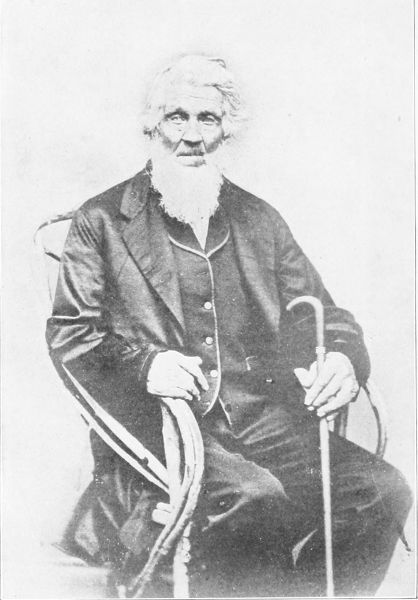
ISAAC BUTLER Pioneer Resident of Springville