Chapter XXXVI · Cedar Rapids (continued 3)
Reading edition
M. S. Starr was assessed with lot 10, block 5, valued at $750.00. This is the property on which T. J. Lowell has his hardware store.
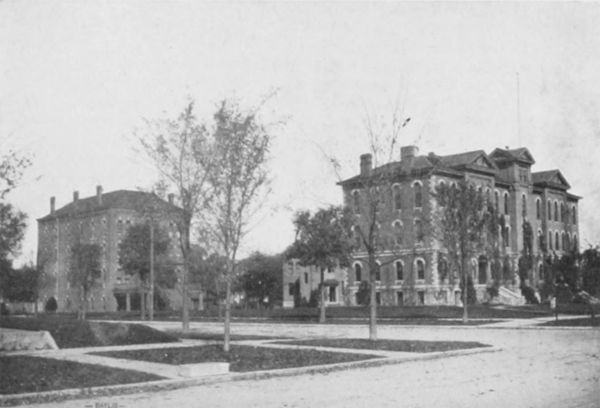
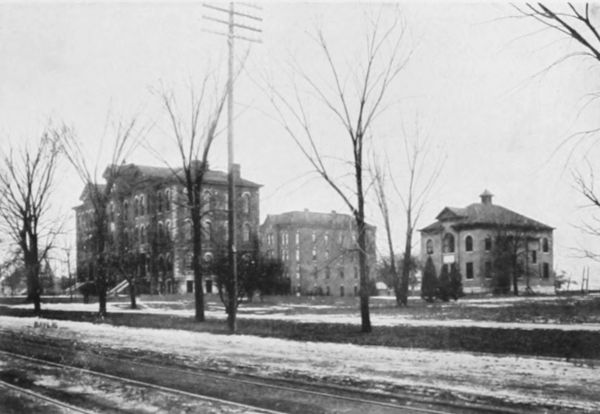
COE COLLEGE BUILDINGS
J. J. Snouffer was the owner of lot 6, block 3. This property was valued at that period at $1,000.00 and is the corner on which the Commercial National Bank is located, and a part of the Denecke Dry Goods store. Mr. Snouffer also owned a lot on North First street opposite the mills, which was assessed at $700.00, also personal property valued at $130.00.
Mr. Snouffer came to Cedar Rapids in 1852, and was engaged in milling under the firm name of W. D. Watrous & Co. He was an alderman from the first ward for many terms and at one time mayor of the city.
D. F. Sprague was assessed with lot 5, block 25, which was listed at $500.00. This is the lot on which the Muskwaki block is located, corner of Second avenue and Fourth street.
Peter Snyder was the owner of lot 6, block 11, valued at $425.00. This property is on the corner of Sixth avenue and Third street.
C. C. Taylor was listed with lot 6, block 32 and valued at $425.00. This is the corner of Second avenue and Fifth street and was the home of B. F. Howland for many years. It is now occupied by the new and beautiful home of the Cedar Rapids Business college.
T. Wood was the owner of several pieces of Cedar Rapids property, in all amounting to $1,650.00, on which he paid a tax of $3.30. His home was on the corner of Fifth street and B avenue. He also was the owner of the lot on which the Y. M. C. A. building is located, which was valued at $900.00; also a lot, corner of Fifth avenue and Sixth street. Mr. Edwin Wood, for many years connected with the J. S. Cook Dry Goods Co., was a son of Mr. Wood.
The Iowa & Nebraska Land Company were assessed with 29 city lots and all valued at $6,875.00, the tax of which was $13.75. The Iowa & Nebraska railroad, from Clinton to this place, was then being built. It was nearly completed to this point and these lots were doubtless purchased for right of way and terminal purposes, as they were all situated on or near where the road was built. The next spring, after the road was open for traffic to this point, lot 1, block 25 was assessed to unknown owner and was valued at $700. This is the lot upon which the First Presbyterian church was built many years ago and remembered by the older residents as the "Little Muddy." The new federal building is now erected on this lot.
Lot 1, block 26 was also assessed to unknown owners and was valued at $575.00. This lot is on the corner of Third street and Third avenue and was used up to a very recent date by the Second Presbyterian church.
Lots 3, 4 and 5, block 30 was also in the unknown list and was valued at $1,075.00 for the entire three lots. Two of these lots were bought about this time and the third one a little later for school purposes and on this ground was erected the first real substantial school building ever built in this city. In this building was grouped the high school and all the other grades from the primary up. This building was used for school purposes until demolished a few years ago to make room for the present Washington high school building.
Lots 6, 7, 8, 9 and 10, block 13 were assessed to unknown owners at a value of $1,100.00. These lots are on Fourth avenue and between Second and Third streets. The new telephone exchange is located on the rear of lot 10.
TEXT OF THE ACT TO INCORPORATE CEDAR RAPIDS
Following is the text of the act incorporating Cedar Rapids, as passed by the legislature of the State of Iowa and approved by Ansel Briggs, Iowa's first governor, January 15, 1849:
An Act to Incorporate the Town of Cedar Rapids, in Linn County.
Section 1. Be it enacted by the General Assembly of the State of Iowa, that all that part of the State of Iowa included within the boundaries of the town of Cedar Rapids in Linn County, as surveyed and recorded in the recorder's office in the said County of Linn, be and the same is hereby constituted a town corporate and shall hereafter be known by the name of the town of Cedar Rapids.
Sec. 2. It shall be lawful for the free male inhabitants of said town having the qualifications of electors to meet at the usual place of holding the elections in said town on the first Wednesday in April next and on the first Wednesday of April annually thereafter at such place in said town as the town council shall direct and then and there proceed to elect by ballot a mayor, recorder and three councilmen, who shall have the qualifications of electors, and reside within the corporate limits of said town, and said mayor, recorder and councilmen shall hold their offices one year, and until their successors are elected and qualified and any three of them shall be a board for the transaction of business, but a less number may adjourn from time to time until a quorum shall assemble.
Sec. 3. That at the first election under this act judges and clerks shall be chosen by the electors present who shall each take an oath faithfully to discharge the duties required by this act and at all subsequent elections the mayor and any two of the councilmen shall sit as judges and the recorder, or in his absence some one of the council pro tempore shall act as clerk and at all such elections the polls shall be opened at 1:00 o'clock, p. m. and close at 5:00 o'clock p. m., of the same day, and at the close of the polls the votes shall be counted and a statement of the result proclaimed at the door by the clerk; the clerk of said elections shall thereupon make out a certificate to each of the persons so elected and the persons receiving such certificate shall, within ten days thereafter take an oath to support the constitution and the laws of the United States and of this state and faithfully discharge his duties according to the best of his abilities, which oath shall be endorsed on the back of said certificate and filed with the recorder of said town.
Sec. 4. The mayor, recorder and councilmen of said town shall be a body corporate and politic with perpetual succession to be known by the name of the mayor and council of the town of Cedar Rapids, and shall be capable in law to acquire property, real, personal and mixed for the use of said town and sell and convey the same. May have a common seal and may alter the same at pleasure. May sue and be sued, plead and be impleaded, answer or be answered unto in any court of law and equity in this state; and when any suit shall be commenced against said corporation a certified copy of any writ issued against said corporation shall be left with the recorder of said town at least ten days before the return day thereof.
Sec. 5. That the mayor, recorder and council, or a majority of them, of whom the mayor or the recorder shall always be one, shall have authority to make, ordain, and publish all by-laws and ordinances not inconsistent with the constitution and laws of the land as they may deem proper for the promotion of morality, interest, safety, health and cleanliness of said town and the citizens thereof; they shall have power to fill all vacancies that may happen by death or otherwise of any of the officers of their board herein named. They shall have power to appoint a treasurer, marshal and such other subordinate officers as a majority of said council may deem necessary, to prescribe their duties and require surety of their performance, to remove them at pleasure, and to establish the fees of all offices not otherwise provided for by this act. They shall have power to impose fines for the breach of their ordinances, which fines may be recovered with costs before any justice of the peace in said town by an action of debt in the name of said corporation. All fines collected in pursuance of this act shall be paid over by the officer collecting the same to the treasurer of the corporation.
Sec. 6. It shall be the duty of the mayor to preside at the meetings of the town council, and it shall be the duty of the recorder to keep a true record of the by-laws and ordinances, to attend all meetings of the council and keep a fair and accurate record of their proceedings and perform such other duties as the council may from time to time require. Said recorder may under his hand and seal appoint a deputy to perform his duties when absent, for whose acts the said recorder shall be responsible.
Sec. 7. That the town council shall have power to assess for corporation purposes an annual tax on all property in said town made subject to taxation by the laws of this state for state and county purposes not exceeding in any one year one per centum on the valuation thereof which value shall be ascertained by an assessor appointed by the town council for that purpose, duplicate of which shall be made out and signed by the recorder and delivered to the collector. They shall have power to equalize any injudicious assessment then made on complaint of the person aggrieved.
Sec. 8. That the town marshal shall be the collector of any tax assessed by said council, and he is hereby authorized and required, by distress and sale of property, as constables on execution, to collect and pay over said tax to the treasurer within three months after the time of receiving the duplicate thereof and the treasurer's receipt shall be his voucher. The town marshal shall make personal demand of every resident charged with tax if to be found, and before sale of property for delinquent tax shall give ten days' notice in advertisement in three of the most public places in said corporation, and if the property or any lot or piece of land for which no personal property can be found shall remain unpaid for three months after the expiration of the time by this act allowed the collector for the collection of the tax shall give notice in the nearest newspaper stating the amount of such tax and the number and description of the lots on which it is due and that the same will be sold to discharge such tax unless the payment thereof be made within three months from the date of such advertisement, and if such tax be not paid within that time the town marshal, after giving twenty days' notice of the time and place of sale at the three most public places in said town shall proceed to sell at public auction so much of said lot or piece of land as will discharge said tax.
Sec. 9. That if the owner of any lot sold for taxes as aforesaid shall appear at any time within two years after such sale and pay the purchase money with interest at thirty per centum per annum thereon he shall be entitled to the right of redemption. If, however, the owner or his agent shall neglect to redeem any real estate sold for taxes under the provisions of this act within the time herein specified, it shall be the duty of the mayor to make and execute a deed to the purchaser countersigned by the recorder under the seal of the corporation. Said deeds shall also be acknowledged before a justice of the peace, and when so executed and recorded in the office of recorder of deeds of Linn County, shall be deemed and taken as valid by law.
Sec. 10. Twenty days before each annual election the town council shall put up in some conspicuous place within said town, an accurate account of the money received and expended by said corporation since the last annual election, with the sources from which they were derived and the objects on which they were expended, which shall be certified by the recorder.
Sec. 11. The said corporation shall have power to regulate all streets, alleys, sidewalks, drains or sewers, to sink and keep in repair public wells, remove nuisances, and make other such needful regulations not incompatible with the laws of the state as shall conduce to the general interest and welfare of the inhabitants of said town. To provide for licensing, taxing and regulating auctions, retailers and taverns, theatrical and other shows of amusement, to prohibit tippling houses, gaming houses and other disorderly houses.
Sec. 12. The by-laws and ordinances of said corporation shall be published in a newspaper in the county or posted up in some public place in said town fifteen days before taking effect thereof, and the certificate of the recorder upon the town records shall be sufficient evidence of the same having been done and every annual election herein authorized shall be preceded by five days' notice thereof put up in three public places in said town.
Sec. 13. That the streets and alleys of said town shall constitute one road district including the several roads leading from said town for the distance of one mile from the corporation limits.
Sec. 14. That the mayor or a majority of the councilmen may call a meeting of the town council whenever in his or their opinion the same may be necessary. The mayor and councilmen shall receive such compensation as shall be voted them by the inhabitants of said town in legal meeting assembled.
Sec. 15. This act shall take effect from and after its publication.
Smiley H. Bonham,
Speaker of House
John J. Selman,
President of the Senate
Approved January 15th, 1849. Ansel Briggs, Governor Secretary's Office, Iowa City, Iowa, March 27th, 1849.
I hereby certify that the foregoing is a true and correct copy of the original act now on file in the said office.
Josiah H. Bonney, Secretary of State
FIRST CITY OFFICIALS OF CEDAR RAPIDS
At 1 o'clock of April 4, 1849, the citizens of Cedar Rapids met at the school house, in accordance with the requirements of the law, and proceeded to elect town officers under a charter issued by the legislature and approved January 15, 1849 (for text of this document see Laws of Iowa, 1849, p. 116). The first election was in the nature of a mass meeting. William P. Harman was made chairman and Arven Kennedy, John H. Brooks, and John G. Cole selected as judges of election. Eber L. Mansfield was clerk of election. These judges certified to choice of votes as follows:
Mayor, Martin L. Barber. Councilmen, Joseph Greene, Stephen L. Pollock, and James Leverich. Recorder, Homer Kennedy.
The mayor immediately took the oath of office before John L. Shearer, justice of the peace.
The first meeting of the council was held May 11, 1849. Action was taken appointing Lowell Daniels treasurer of the town, to give bonds of $20. It was resolved that the municipal seal "shall consist of a raised circle nine-tenths of an inch in diameter, enclosing an equilateral triangle." The first ordinance in preamble declared, that "there exists in the town divers unwholesome cellars, dung heaps, horse stables, cow stables, barns, yards, hogpens, and other nuisances." The object of the enactment was to abate these conditions. In July, 1849, Homer Kennedy resigned as recorder and Porter W. Earle was chosen in his place. A sort of omnibus ordinance was passed October 23, 1849. This prohibited the sale of spirituous liquors, required that shows or other exhibitions should pay license of not less than one dollar nor more than ten dollars. A further section fixed penalties for disturbance of any public meeting. This ordinance was given effective publication by being "posted at G. Greene & Bro.'s store." Other ordinances, we find, were "posted on John Coffman's door." John H. Brooks, marshal of the town, was on November 8, 1849, allowed the sum of $16.73. Getting possession of so much money he immediately resigned, presumably to enjoy it without official cares.
THE SECOND ELECTION
The second election was held at the school house April 3, 1850. For mayor Martin L. Barber received 39 votes and Johnson Hill 27. For recorder John Palmer received 63 and Lawson Daniels 1. Stephen L. Pollock, Thomas Downing and Charles C. Cook were the successful councilmen, the defeated candidates being George H. Ely, Joseph Greene, Isaac Cook, and W. P. Harman.
This new council on April 11, 1850, resolved to form a board of health, but at the next meeting this action was rescinded. In its stead an ordinance was passed for preservation of public health. Enforcement of these provisions rested with the marshal. In May an ordinance was passed permitting Harvey C. Higley to retail ardent spirits, upon giving a good and sufficient bond "to keep a good and orderly house, not permitting any gambling, drunkenness or rioting about his house or premises." Such bond Mr. Higley refused to execute, and the employment of counsel was authorized to commence suit against him for violation of ordinance. July 24 a health board was appointed consisting of Drs. J. F. Ely, S. D. Carpenter, and J. C. Traer. The marshal, under direction of the board, was to abate all nuisances. The first recorders of the city were evidently not of fixed mind or habitation. John Palmer resigned as such December 8, and S. C. Koontz was chosen to fill the vacancy. Isaac Cook was made attorney for the city in pending litigation.
THE FIRST TAX LEVY
The first tax levy mentioned was ordered by action of council December 16, 1850. This amounted to "one and one-half mills on the dollar of all taxable property within the corporation," and Johnson Hill was appointed assessor. Another ordinance to prevent the sale of spiritous and intoxicating liquors was passed December 16, 1850. Any quantity less than a gallon sold "without advice of a physician," rendered the seller liable to a fine of not less than five dollars nor more than twenty-five. A license fee of from one to five dollars was exacted from all peddlers, whether they were footmen with packs or sold goods from wagons.
THE ELECTION OF 1851
Annual town election was again held in April, 1851. At this time Nicholas B. Brown was chosen as mayor. Benjamin Weizer, Michael Bryan, and Joseph A. Love, councilmen, and S. C. Koontz, recorder. William G. Furman was appointed marshal. The personnel of the board of health was also changed. Dr. L. Larrabee, Dr. Thomas, and Dr. John F. Ely constituting the same.
No recorded meeting of council was held from June 20, 1851, to February 24 of the next year. At this latter date N. B. Brown, mayor, by advice and consent of the councilmen, "did grant license to David W. King for free navigation of the Cedar River, opposite this place, for the term of one year from the 1st day of March, 1857, by the said D. W. King paying to the recorder the sum of ten dollars." The council fixed rates of toll as follows: Horse and rider 10 cents; footmen, 5 cents; one horse and wagon, 15 cents; a wagon and two horses, 20 cents; and every additional span of horses or yoke of cattle, 20 cents. Loose cattle not exceeding five in number, he shall be allowed 5 cents per head; if more than that number, 3 cents per head. Hogs, if not exceeding twenty-five in number, shall be 2 cents per head; if more than that number the toll shall be 1 cent per head. Sheep at the rate of 1 cent per head.
THE FIRST SIDEWALK ORDINANCE
The first sidewalk ordinance stipulated: "The sidewalks of Commercial street shall be planked or paved, commencing at the corner of Benton and Commercial streets, northeast side, and ending at the corner of Sugar and Commercial streets. Also on the southwest side of said street, commencing at the southeast side of Rock and Brather's shop and coming up as far us Linn street. In case where planked the plank to be oak and not less than one and one-half inches in thickness, also to be placed upon a good and permanent foundation. In the front of buildings the walk to be made ten feet in width, not less than five stringers to be used. In front of lots or parts of lots not occupied by buildings it is only required that walks be made five feet in width, in which case three stringers are sufficient, but not less than three. All of which must be completed by the 1st of September, 1852."
Samuel Brazelton was appointed marshal, Dr. Koontz treasurer, and Dr. S. D. Carpenter, Wm. D. Wood, and Porter W. Earle, health board.
THE ELECTION OF 1853
In 1853 election was held on Wednesday, April 6. W. W. Smith was chosen mayor; S. C. Bever, Johnson Hill, and J. F. Ely, councilmen; and S. C. Koontz, recorder. Hiram Deem was appointed assessor, Isaac N. Whittam, town marshal. At this same date, May 6, 1853, John F. Ely was made committee to secure a surveyor, "Major McKean, or some other suitable person to take and establish the grades of the city of Cedar Rapids." Pratt R. Skinner was the person selected and his report and profile were presented and adopted July 6, 1853. Hiram Deem was made marshal July 23, Mr. Whittam evidently not having qualified. At this meeting a municipal tax levy of four mills was ordered. Hiram Deem, having accomplished his work as assessor, and now being marshal, was instructed to collect the taxes. He was further directed to order out men to work the roads and streets immediately.
THE CEMETERIES
The beginning of Oak Hill cemetery dates from an ordinance of August 23, 1853. Gabriel Carpenter had purchased 300 acres of land adjoining the city and including the site of the cemetery. The place of burial at that time was upon the ground after owned by Coe College. The ordinance enacted that "the proposition made by G. Carpenter in respect to ten acres of land for purpose of graveyard be filed and accepted. Provided, however, that if the collegiate institute will pay the aforesaid G. Carpenter for the aforementioned ten acres of land, and, further provided, that if the mayor and council hold and possess the power and right to sell and convey the lot of land now occupied by a graveyard (within the corporate limits) and can sell and convey the same to the Collegiate Institute for the sum of three hundred dollars, then the afore-mentioned proposition is accepted."
The legal and other difficulties in the way were surmounted and on February 22, 1854, it was resolved to quit claim the interest of the town in the present burial ground to Smith and Carpenter, at such time as they shall lay off and deed to the corporation a block of ground in the Washington cemetery for a "potter's field," which shall contain at least three acres. It was conditioned also that Smith and Carpenter should give bond for the careful removal of all occupants of the present burial ground before making any use of the land.
ELECTION OF 1854
On April 3, 1854, William W. Smith was elected mayor, William Greene, Abraham Sines, and Daniel Lothian, councilmen, and William M. Wood, recorder. The digging of sand from Iowa avenue was dignified by name of bringing to grade. This was divided into six parts, and two were let to W. W. Smith and E. Robins. These paid five dollars apiece for the privilege. The other sections remained as before and the avenue was rendered impassable. J. J. Snouffer was appointed marshal for ensuing year and R. C. Rock treasurer. The famous "hog ordinance," which was intended to keep swine from the street but failed absolutely in its purpose, was introduced June 28, 1854.
ELECTION OF 1855
George Greene was elected mayor April 4, 1855. Members of the council were first styled aldermen on the tickets for this year and R. C. Rock, Joseph A. Love, and J. F. Charles were chosen. W. D. Watrous was the choice of the voters for recorder. J. H. Atwell was appointed marshal and S. D. Carpenter, treasurer. The council was organized into proper committees, indicating that more business came before the body. The bond of the treasurer had by this time increased to one thousand dollars. A city attorney was elected June 5, 1855, James J. Child being the choice of the council. The report of the finance committee showed a deficit—the city's revenues lacking $75.00 of meeting expenses.
ELECTION OF 1856
Isaac Whittam was elected mayor at the April election in 1856, with Walker, Smith, and Hager, councilmen. The recorder having resigned, D. M. McIntosh was elected by the council to that office. The ferry privileges had passed at death of D. W. King in 1854 to Stephen L. Pollock and afterwards to Bowling & Gilbreath. Both of these failed to pay for license, and the recorder was instructed to collect; Joseph Hollan was appointed road supervisor.
On June 14, 1856, City Attorney James J. Child was instructed to prepare an amended charter to be submitted to the next legislature. This was accepted by council, June 28, 1856. The proposition was then submitted to the voters and adopted 45 to 2. An election for city officers under this new charter was ordered to be held at the office of J. J. Child August 7, 1856. The votes cast were canvassed by the council. It was found that 204 votes were cast for mayor, of which Isaac N. Whittam received 120 and W. W. Smith 84. For recorder and assessor D. M. McIntosh led with 123; F. P. Huntington 73; E. N. Bates and S. C. Koontz one each. For treasurer and collector S. C. Koontz received 121 votes and John P. Conkey 79. Charles Weare was elected marshal by a vote of 131. In vote for aldermen in the first ward J. T. Walker was elected and J. J. Snouffer and H. G. Angle were tied. Alexander Hager and J. F. Charles were chosen to represent the second ward, and Henry S. Ward and W. D. Watrous were duly elected from the third ward.
This closes the official doings under the old town. The records consulted will satisfy and settle all disputed questions as to office-holding and the statements here made are correct beyond all question.
OFFICIALS OF CEDAR RAPIDS FROM 1857 TO 1910
1857 Isaac N. Whittam, mayor; F. P. Huntington, recorder; S. C. Lampson, marshal; S. C. Koontz, treasurer; E. N. Bates, city attorney. Aldermen, J. J. Snouffer, John G. Graves, S. D. Carpenter, J. J. Child, William Richmond, A. Whitenack.
1858 R. C. Rock, mayor; George Seymour, recorder; C. T. Kellogg, marshal; S. C. Koontz, treasurer; A. S. Belt, city attorney. Aldermen, J. J. Snouffer, John G. Graves, D. N. Sprague, R. R. Taylor, William Richmond, S. A. Shattuck.
1859 D. N. Sprague, mayor; George Seymour, recorder; William McMahone, marshal; S. C. Koontz, treasurer; E. N. Bates, city attorney. Aldermen, John G. Graves, T. Z. Cook, D. M. McIntosh, Charles Weare, S. A. Shattuck, G. Livensbarger.
1860 E. H. Stedman, mayor; George Seymour, recorder; Benjamin Darnell, marshal; J. S. Wattles, treasurer; I. N. Whittam, city attorney. Aldermen, T. Z. Cook, A. Hager, W. B. Mack, R. P. Kingman, G. Livensbarger, J. P. Coulter.
1861 Homer Bishop, mayor; M. A. Higley, recorder; Benjamin Darnell, marshal; J. S. Wattles, treasurer; I. N. Whittam, city attorney. Aldermen, S. C. Bever, H. E. Higley, R. P. Kingman, I. W. Carroll, J. C. Adams, George Dewey.
1862 T. Z. Cook, mayor; S. C. Koontz, recorder; J. Hogendobler, marshal; J. S. Wattles, treasurer; A. S. Belt, city attorney. Aldermen, S. C. Bever, H. E. Higley, I. W. Carroll, H. B. Stibbs, George Dewey, S. G. McClelland.
1863 Mowry Farnum, mayor; George C. Haman, recorder; A. Laurance, marshal; Benjamin Harrison, treasurer; no city attorney elected. Aldermen, S. C. Bever, D. Denlinger, H. B. Stibbs, I. W. Carroll, S. G. McClelland, Thomas Slonaker.
1864 Mowry Farnum, mayor; George C. Haman, recorder; A. Laurance, marshal; Benjamin Harrison, treasurer; I. N. Whittam, city attorney. Aldermen, S. C. Bever, E. H. Stedman, D. Denlinger, Joseph Hollan, S. G. McClelland, Thomas Slonaker.
1865 H. Church, mayor; George C. Haman, recorder; T. M. Parsons, marshal; Benjamin Harrison, treasurer; J. J. Child, city attorney. Aldermen, S. C. Bever, E. E. Leach, D. Denlinger, Charles Weare, G. Livensbarger, J. C. Adams.
1866 A. R. West, mayor; George C. Haman, recorder; J. O. Stewart, marshal; Benjamin Harrison, treasurer; J. J. Child, city attorney. Aldermen, J. J. Snouffer, J. Wetzel, H. B. Stibbs, N. S. Mershon, J. C. Adams, J. A. Hart.
1867 A. R. West, mayor; D. A. Bradley, recorder; A. Laurance, marshal; Benjamin Harrison, treasurer; I. N. Whittam, city attorney. Aldermen, J. J. Snouffer, J. Wetzel, H. B. Stibbs, E. Robbins, J. A. Hart, L. Wallace.
1868 J. P. Coulter, mayor; D. A. Bradley, recorder; A. Laurance, marshal; Benjamin Harrison, treasurer; I. N. Whittam, city attorney. Aldermen, J. Wetzel, A. C. Churchill, E. Robbins, E. E. Leach, William Stewart, James Albright.
1869 A. R. West, mayor; George C. Haman, recorder; A. Laurance, marshal; Benjamin Harrison, treasurer; I. N. Whittam, city attorney; P. C. Lusk, chief engineer. Aldermen, A. C. Churchill, E. S. Hill, E. E. Leach, D. Denlinger, William Stewart, J. F. Charles.
1870 William B. Leach, mayor; W. B. Stewart, recorder; A. Laurance, marshal; Benjamin Harrison, treasurer; M. P. Mills, city attorney; George A. Lincoln, chief engineer. Aldermen, E. S. Hill, J. J. Snouffer, E. E. Leach, E. Robbins, William Stewart, Elihu Baker.
1871 T. Z. Cook, mayor; H. J. Harvey, police judge; Benjamin Harrison, treasurer; Hiel Hale, chief engineer: J. C. Stoddard, recorder; A. Laurance, marshal; R. H. Gilmore, city attorney. Aldermen. J. J. Snouffer, I. H. Shaver, E. E. Leach, C. C. Cook, William Stewart, J. L. Bever, James Bell.
1872 E. S. Hill, mayor; A. St. Clair Smith, police judge; Benjamin Harrison, treasurer; George L. Stearns, chief engineer; J. C. Stoddard, recorder; Hiel Hale, marshal; I. N. Whittam, city attorney. Aldermen. J. L. Bever, C. H. Clark, I. H. Shaver, C. C. Cook. W. Stewart, George Dale, G. M. Howlett, E. E. Leach.
1873 J. F. Charles, mayor; A. St. Clair Smith, police judge; Benjamin Harrison, treasurer; George L. Stearns, chief engineer; J. C. Stoddard, recorder; Hiel Hale, marshal; West & Eastman, city attorneys. Aldermen, J. L. Bever, C. C. Cook, C. H. Clark, George Dale, Henry Forsythe, S. T. Wier, G. M. Howlett, W. S. Bradley.
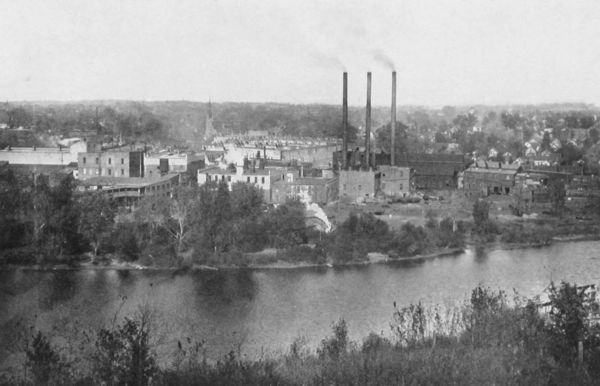
SINCLAIR PACKING PLANT, CEDAR RAPIDS
1874 A. B. Hull, mayor; H. J. Harvey, police judge; Benjamin Harrison, treasurer; E. S. Hill, chief engineer; J. C. Stoddard, recorder; Hiel Hale, marshal; A. D. Collier, city attorney. Aldermen, F. J. Upton, C. C. Cook, C. H. Clark, W. S. Bradley, M. P. Mills, J. H. Smith, E. L. Mansfield, C. H. Clark, George A. Lincoln, S. T. Wier.
1875 J. H. Smith, mayor; I. N. Whittam, police judge; Benjamin Harrison, treasurer; Hiel Hale, chief engineer; A. G. Plum, recorder; Hiel Hale, marshal; F. C. Hormel, city attorney. Aldermen, R. Cornish, A. T. Averill, U. C. Blake, G. A. Lincoln, M. P. Mills, W. S. Bradley, S. T. Wier, C. H. Clark, F. J. Upton, E. L. Mansfield.
1876 J. H. Smith, mayor; I. N. Whittam, police judge; Benjamin Harrison, treasurer; George A. Lincoln, chief engineer; A. G. Plum, recorder; Hiel Hale, marshal; F. C. Hormel, city attorney. Aldermen, J. J. Snouffer, U. C. Blake, E. K. Larimer. W. S. Bradley, A. Mann, O. C. L. Jones, S. T. Wier, M. P. Mills, R. Cornish, D. H. Richards.
1877 W. S. Bradley, mayor; W. B. Leach, superior judge; Benjamin Harrison, treasurer; C. W. Eaton, chief engineer; A. G. Plumb, recorder; Hiel Hale, marshal; F. C. Hormel, city attorney. Aldermen, C. Magnus, E. K. Larimer, A. R. Foote, U. C. Blake, O. C. L. Jones, D. H. Richards, J. J. Snouffer, D. T. Brown, A. Mann, Frank Witousek, D. B. Ramsdell, Samuel Miller.
1878 J. T. Hamilton, mayor; W. B. Leach, superior judge; A. G. Plumb, treasurer; C. W. Eaton, chief engineer; George A. Lincoln, recorder; H. C. Morehead, marshal; I. N. Whittam, city attorney. Aldermen, J. J. Snouffer, C. Magnus, D. T. Brown, W. W. Smith, U. C. Blake, A. R. Foote, O. C. L. Jones, H. G. Bowman, E. R. Earl, Frank Witousek, James Morton, E. L. Mansfield.
1879 O. N. Hull, mayor; W. B. Leach, superior judge; A. G. Plumb, treasurer; C. W. Eaton, chief engineer; J. C. Stoddard, recorder; Spencer Jackson, marshal; I. N. Whittam, city attorney. Aldermen, John Meehan, W. W. Smith, E. R. Earl, John Gates, John Dale, James Morton, A. Van Vleck, L. E. Jenkins, H. G. Bowman, J. J. Snouffer, O. C. L. Jones, E. L. Mansfield.
1880 J. H. Smith, mayor; W. B. Leach, superior judge; A. G. Plumb, treasurer; C. W. Eaton, chief engineer; J. C. Stoddard, recorder; Spencer Jackson, marshal; C. J. Deacon, city attorney. Aldermen, J. J. Snouffer, John Gates, John Dale, P. Mullaly, A. Van Vleck, L. E. Jenkins, William Stewart, James Morton, E. R. Earl, John Meehan, E. L. Mansfield, W. A. Fulkerson.
1881 J. H. Smith, mayor; W. B. Leach, superior judge; A. G. Plumb, treasurer; C. W. Eaton, chief engineer; J. C. Stoddard, recorder; Spencer Jackson, marshal; C. J. Deacon, city attorney. Aldermen, John Meehan, William Stewart, E. R. Earl, John Gates, J. M. Searles, E. L. Mansfield, J. R. Morin, M. P. Mills, James Morton, J. J. Snouffer, A. St. Clair Smith, W. A. Fulkerson.
1882 Charles A. Clark, mayor; W. B. Leach, superior judge; A. G. Plumb, treasurer; G. H. Murphy, chief engineer; J. C. Stoddard, recorder; Spencer Jackson, marshal; J. J. Powell, city attorney. Aldermen, J. J. Snouffer, John Gates, J. M. Searles, P. Martel, J. R. Morin, M. P. Mills, A. Van Vleck, T. M. Giberson, E. R. Earl, John Meehan, C. D. Van Vechten, W. A. Fulkerson.
1883 John W. Henderson, mayor; W. B. Leach, superior judge; A. G. Plumb, treasurer; L. M. Ayers, chief engineer; J. C. Stoddard, recorder; P. H. Francis, marshal; J. J. Powell, city attorney. Aldermen, John Meehan, P. Martel, M. P. Mills, John Gates, A. Van Vleck, James Fair, Frank Kouba, J. M. Searles, T. M. Giberson, J. J. Snouffer, C. D. Van Vechten, W. A. Fulkerson.
1884 C. W. Eaton, mayor; W. B. Leach, superior judge; J. C. Stoddard, treasurer; L. M. Ayers, chief engineer; John D. Blain, recorder; P. H. Francis, marshal; I. N. Whittam, city attorney. Aldermen, J. J. Snouffer, John Gates, W. A. Fulkerson, G. M. Olmsted, Frank Kouba, J. M. Searles, A. Van Vleck, T. M. Giberson, M. P. Mills, John Meehan, C. D. Van Vechten, C. B. Kennedy.
1885 F. C. Hormel, mayor; J. T. Stoneman, superior judge; J. C. Stoddard, treasurer; L. M. Ayers, chief engineer; John D. Blain, recorder; Michael Healy, marshal; A. R. West, city attorney. Aldermen, H. T. Brown, G. M. Olmsted, C. F. Earl, Joseph Moore, John Gates, A. Van Vleck, T. M. Giberson, A. H. Connor, J. W. Shapely, J. R. Morin, A. J. Mallahan, W. A. Fulkerson, A. D. Stevens, E. I. Foster, J. J. Snouffer, M. P. Mills, C. D. Van Vechten, J. F. Vondracek.
1886 C. W. Eaton, mayor; John T. Stoneman, superior judge; J. C. Stoddard, treasurer; L. M. Ayers, chief engineer; John D. Blain, recorder; P. H. Francis, marshal; M. P. Smith, city attorney. Aldermen, H. T. Brown, J. R. Morin, C. F. Earl, Joseph Moore, George W. Bever, J. M. Miles, R. J. Thompson, J. F. Vondracek, A. D. Stevens, John Gates, A. J. Mallahan, M. P. Mills, J. W. Shapely, H. C. Waite, G. M. Olmsted, H. F. Sutliff, C. D. Van Vechten, A. H. Connor.
1887 C. W. Eaton, mayor; John T. Stoneman, superior judge; J. C. Stoddard, treasurer; L. M. Ayers, chief engineer; John D. Blain, recorder; P. H. Francis, marshal; I. N. Whittam, city attorney. Aldermen, George W. Bever, J. M. Miles, R. J. Thompson, J. F. Vondracek, Frank Horak, George A. Lincoln, W. A. Fulkerson, A. Matyk, H. C. Waite, G. M. Olmsted, H. F. Sutliff, M. P. Mills, A. H. Connor, E. I. Foster, John Gates, William King, C. D. Van Vechten, W. C. Byers.
1888 P. Mullaly, mayor; John T. Stoneman, superior judge; J. C. Stoddard, treasurer; L. M. Ayers, chief engineer; John D. Blain, recorder; P. H. Francis, marshal; I. N. Whittam, city attorney. Aldermen, Frank Horak, George A. Lincoln, M. P. Mills, A. Matyk, C. Magnus, J. F. Allison, F. W. Harwood, Edward Roddy, E. I. Foster, John Gates, William King, W. A. Fulkerson, W. C. Byers, H. C. Waite, G. M. Olmsted, H. V. Ferguson, R. J. Thompson, J. E. Lapham.
1889 P. Mullaly, mayor; John T. Stoneman, superior judge; J. C. Stoddard, treasurer; L. M. Ayers, chief engineer; John D. Blain, recorder; P. H. Francis, marshal; I. N. Whittam, city attorney; G. A. Mitchell, city engineer. Aldermen, C. Magnus, J. F. Allison, F. W. Harwood, Edward Roddy, J. J. Snouffer, George A. Lincoln, George W. Noble, F. W. Slapnicka, H. C. Waite, G. M. Olmsted, H. V. Ferguson, R. J. Thompson, J. E. Lapham, F. A. Simmons, Warren Harman, F. J. Shefler, M. Ottmar, W. C. Byers.
1890 J. J. Snouffer, mayor; John T. Stoneman, superior judge; J. C. Stoddard, treasurer; L. M. Ayers, chief engineer; John D. Blain, recorder; J. W. Hayes, marshal; N. W. McIvor, city attorney; J. D. Wardle, city engineer. Aldermen, J. J. Snouffer, M. O'Brien, W. Harman, A. St. Clair Smith, G. A. Lincoln, George W. Noble, F. W. Slapnicka, J. F. Allison, J. B. Henderson, Joseph Zbanek, F. A. Simmons, F. J. Shefler, M. Ottmar, W. C. Byers, J. A. Roach, T. C. Munger, A. B. Van Albada, Frank Dietz.
1891 John B. Henderson, mayor; John T. Stoneman, superior judge; J. C. Stoddard, treasurer; L. M. Ayers, chief engineer; John D. Blain, recorder; J. W. Hayes, marshal; N. W. McIvor, city attorney; J. D. Wardle, city engineer. Aldermen, M. O'Brien, J. F. Allison, P. H. Francis, J. Zbanek, J. J. Snouffer, George W. Noble, F. A. Simmons, F. W. Slapnicka, J. R. Amidon, T. C. Munger, M. Ottmar, Frank Dietz, A. St. Clair Smith, F. J. Shefler, A. B. Van Albada, G. H. Spalding.
1892 John B. Henderson, mayor; John T. Stoneman, superior judge; J. C. Stoddard, treasurer; L. M. Ayers, chief engineer; J. D. Blain, recorder; A. W. West, marshal; N. W. McIvor, city attorney; J. D. Wardle, city engineer. Aldermen, J. J. Snouffer, George W. Noble, F. A. Simmons, F. W. Slapnicka, M. O'Brien, Warren Harman, M. S. Jackson, J. Zbanek, J. R. Amidon, F. J. Shefler, M. Ottmar, A. F. Schindler, A. St. Clair Smith, Ed R. Shaw, L. W. Richards, J. B. Leverich.
1893 William P. Daniels, mayor; Thomas M. Giberson, superior judge; J. C. Stoddard, treasurer; J. D. Blain, recorder; A. R. West, marshal; L. M. Ayers, chief engineer; Lewis Heins, city attorney; J. D. Wardle, city engineer; board of public works, J. L. Hardwick, chairman, C. H. Swab, W. P. Clark. Aldermen, M. O'Brien, Charles Bednar, F. H. Juckett, S. J. Maloney, J. Kozlovsky, D. F. Anderson, J. W. Gerber, F. S. Salda, F. W. Harwood, Ed. R. Shaw, L. W. Richards, J. B. Leverich, A. St. Clair Smith, J. F. Shefler, L. J. Zika, A. F. Schindler.
1894 William P. Daniels, mayor; Thomas M. Giberson, superior judge; J. C. Stoddard, treasurer; L. M. Ayers, chief engineer; J. D. Blain, recorder; Thomas Farmer, marshal; Lewis Heins, city attorney; J. D. Wardle, city engineer. Board of public works, Hosmer Tuttle, chairman. Aldermen, Joseph Kozlovsky, D. F. Anderson, J. W. Gerber, F. S. Salda, G. M. Schumm, George Eakle, F. H. Juckett, S. J. Maloney, F. W. Harwood, F. J. Shefler, L. J. Zika, A. F. Schindler, Charles Weare, S. L. Rudolph, W. A. Smith, J. B. Leverich.
1895 George A. Lincoln, mayor; T. M. Giberson, superior judge; J. C. Stoddard, treasurer; Thomas Farmer, marshal; J. D. Blain, recorder and assessor; William McGowan, chief engineer; Warren Harman, city attorney; E. P. Boynton, city engineer. Board of public works, Charles Weare, chairman. Aldermen, G. M. Schumm, George Yuill, John B. Turner, S. J. Maloney, Ed H. Smith, George Eakle, J. W. Gerber, Joseph Kubicek, F. W. Harwood, V. W. Johnson, James Monilaw, C. F. Hutchens, Charles Weare, S. L. Rudolph, W. A. Smith, J. B. Leverich.
1896 George A. Lincoln, mayor; Thomas M. Giberson, superior judge; Thomas Devendorf, treasurer; William McGowan, Jr., chief engineer; J. D. Blain, recorder; Thomas Farmer, marshal; Warren Harman, city attorney; E. P. Boynton, city engineer. Board of public works, Charles Weare, chairman. Aldermen, Ed H. Smith, George Yuill, W. G. Haskell, S. J. Maloney, W. G. Dows, George W. Eakle, John B. Turner, Joseph Kubicek, F. W. Harwood, V. W. Johnson, James Monilaw, Henry J. Rapps, C. W. Burton, David W. King, Joseph Pitlik, C. F. Hutchens.
1897 George A. Lincoln, mayor; Thomas M. Giberson, superior judge; Thomas Devendorf, treasurer; Thomas Farmer, marshal; J. D. Blain, recorder; J. L. Starman, chief engineer; W. Harman, city attorney; E. P. Boynton, city engineer. Board of public works, Charles Weare, chairman. Aldermen, W. G. Dows, George W. Eakle, W. G. Haskell, John Juza, R. N. Buck, R. D. Mills, Joseph Pitlik, S. J. Maloney, F. W. Harwood, David W. King, J. Y. Kennedy, J. B. Leverich, C. W. Burton, V. W. Johnson, J. H. Rothrock, Jr., Henry J. Rapps.
1898 John M. Redmond, mayor; T. M. Giberson, judge superior court; J. D. Blain, recorder; Thomas Devendorf, treasurer; J. A. Hildebrand, assessor; Joseph Kozlovsky, marshal; John L. Starman, chief of fire department; John N. Hughes, city attorney; G. H. Merridith, city engineer. Aldermen, J. F. Allison, M. Ottmar, R. N. Buck, George T. Hedges, R. A. Wallace, Charles D. Huston, W. G. Haskell, Joseph Pitlik, F. W. Slapnicka, L. M. Rich.
1899 John M. Redmond, mayor; T. M. Giberson, judge superior court; J. D. Blain, recorder; Thomas Devendorf, treasurer; J. A. Hildebrand, assessor; Joseph Kozlovsky, marshal; Joseph P. Cook, chief fire department; Henry J. Achter, auditor; John N. Hughes, city attorney; G. H. Merridith, city engineer. Aldermen, J. F. Allison, M. Ottmar, R. N. Buck, George T. Hedges, R. A. Wallace, Charles D. Huston, W. G. Haskell, J. P. Grissel, F. W. Slapnicka, L. M. Rich.
1900 John M. Redmond, mayor; James H. Rothrock, judge superior court; J. D. Blain, recorder; Thomas Devendorf, treasurer; J. A. Hildebrand, assessor; Joseph Kozlovsky, marshal; Joseph P. Cook, chief fire department; Henry J. Achter, auditor; John N. Hughes, city attorney; G. H. Merridith, city engineer. Aldermen, J. F. Allison, M. Ottmar, R. N. Buck, George T. Hedges, R. A. Wallace, Charles D. Huston, W. G. Haskell, J. P. Grissel, F. W. Slapnicka, L. M. Rich.
1901 Charles D. Huston, mayor; Henry J. Achter, auditor; Thomas Devendorf, treasurer; George L. Mentzer, recorder; J. A. Hildebrand, assessor; Joseph P. Cook, chief of fire department; James H. Rothrock, judge superior court; John N. Hughes, city attorney; T. F. McCauley, city engineer. Aldermen, J. F. Allison, H. Cushman, James H. Hughes, W. L. Cherry, F. E. Cerny, C. H. Chandler, Porter Hamilton, John Easker, F. W. Slapnicka, John F. Powers.
1902 Charles D. Huston, mayor; Henry J. Achter, auditor; Thomas Devendorf, treasurer; George L. Mentzer, recorder; J. A. Hildebrand, assessor; Joseph Kozlovsky, marshal; James H. Rothrock, judge superior court; John N. Hughes, city attorney; T. F. McCauley, city engineer. Aldermen, J. F. Allison, H. Cushman, James H. Hughes, W. L. Cherry, F. E. Cerny, C. H. Chandler, Porter Hamilton, John Easker, F. W. Slapnicka.
1903 Charles D. Huston, mayor; Henry J. Achter, auditor; Thomas Devendorf, treasurer; George L. Mentzer, recorder; J. A. Hildebrand, assessor; Joseph Kozlovsky, marshal; James H. Rothrock, judge superior court; Joseph P. Cook, chief fire department; John N. Hughes, city attorney; T. F. McCauley, city engineer. Aldermen, H. Cushman, C. O. Johnson, James H. Hughes, W. L. Cherry, George Lightner, D. A. Ross, W. C. Byers, F. W. Barta, D. Feiereisen, John F. Powers.
1904 Charles D. Huston, mayor; Henry J. Achter, auditor; Thomas Devendorf, treasurer; George L. Mentzer, recorder; J. A. Hildebrand, assessor; Joseph Kozlovsky, marshal; John N. Hughes, city attorney; T. F. McCauley, city engineer; Joseph P. Cook, chief fire department; James H. Rothrock, judge superior court. Aldermen, H. Cushman, C. O. Johnson, J. H. Hughes, W. L. Cherry, George Lightner, D. A. Ross, W. C. Byers, F. W. Barta, D. Feiereisen, J. F. Powers.
1905 Charles D. Huston, mayor; Henry J. Achter, auditor; Thomas Devendorf, treasurer; H. S. Keffer, recorder; J. A. Hildebrand, assessor; Joseph Kozlovsky, marshal; John N. Hughes, city attorney; T. F. McCauley, city engineer; Joseph P. Cook, chief fire department; James H. Rothrock, judge superior court. Aldermen, H. Cushman, C. O. Johnson, J. H. Hughes, W. L. Cherry, George Lightner, D. A. Ross, W. C. Byers, F. W. Barta, D. Feiereisen, J. F. Powers.
1906-7 Amos H. Connor, mayor; James B. Gourley, auditor; Thomas Devendorf, treasurer; H. S. Keffer, recorder; J. G. Crozer, marshal; Joseph P. Cook, chief fire department; James W. Good, city attorney; T. R. Warriner, city engineer. Aldermen, James H. Hughes, W. G. Rowley, George Lightner, D. A. Ross, W. C. Byers, F. W. Barta, J. K. Starman, D. Feiereisen, L. W. Anderson, Charles H. Campbell.
Mayor Connor died while in office and George S. Lightner was chosen for the unexpired term.
The city went under the commission plan of government in 1908, the officers being as follows: J. T. Carmody, mayor; Leslie J. Storey, clerk; C. D. Huston, H. S. Keffer, Matt J. Miles, and E. A. Sherman, councilmen; John M. Redmond, attorney; Percy P. Smith, engineer.
Mayor Carmody having died, Matt J. Miles was chosen mayor and J. F. Allison councilman to succeed him.
1910 Matt J. Miles, mayor; Leslie J. Storey, clerk; W. H. Chamberlain, attorney; T. F. McCauley, engineer; H. S. Keffer, W. H. Stepanek, Henry Bennett, and Percy P. Smith, councilmen.
H. S. Keffer later resigned, and A. S. Reed was chosen to fill the vacancy.
CITY OF CEDAR RAPIDS AS IT WAS FIFTY YEARS AGO
The following interesting account of early Cedar Rapids is taken from Voice of Iowa for April, 1857, edited by James L. Enos. The article was written by Mr. Enos himself:
"What constitutes the present city of Cedar Rapids, is embraced mainly by sections 21, 22, 27 and 28, in T. 83 N., R. 7 W., in the township of Rapids in Linn county. The location is one of the most delightful to be found in any of the rich valleys of the west, being on the northeast side of the Cedar river, on a plain rising above the river's bed, and reaching back nearly half a mile, with but very slight depressions or uprisings, serving to render the plat one of great convenience for building, and giving a peculiar grace to its appearance.
"In the rear of this table-land a somewhat abrupt elevation, varying from 20 to 40 feet, occurs, which is covered with a luxuriant growth of native oak. Upon this are the most beautiful and romantic sites for residences, being sufficiently elevated to overlook the entire valley for miles in either direction. Back of this the depressions and elevations alternate, making this portion of the city a series of circular, undulating swells.
"The city proper also extends on the west side of the river and embraces numerous other positions which are being occupied with rapidity and improved with taste, and though not embraced within the present city limits, forms of necessity a part of the Valley City.
"Cedar Rapids is situated due west of Chicago, the present emporium of the west, and is the present terminus of the principal trunk railroad from that city penetrating the heart of the northwest. It is 75 miles southwest from Dubuque, 80 miles nearly west from Clinton, about the same distance from Davenport, 55 miles from Muscatine, and about 110 from Des Moines—the capital of Iowa.
NATURAL ADVANTAGES
"Few interior cities are blessed with more natural advantages than Cedar Rapids. The rapids in the Cedar river are the first met with after leaving the Mississippi, and no more occur of any considerable amount for many miles above. These afford one of the best water powers in the west, and with proper dams would afford power sufficient to run all machinery that will ever be required on either side of the river, even though our population should reach fifty thousand. Surrounding the town for miles is one of the richest agricultural districts in the Union, forming a part of the Cedar valley country which Professor Owen has taken as his type of perfection in fertility. There is a plentiful supply of timber for all ordinary uses—numerous groves are scattered upon the surrounding hills—giving the appearance of an enchanted garden—probably unsurpassed in richness by any region of equal extent on the American continent.
"Its position in reference to other towns and cities is such as must of necessity make it a great railroad center, and several are already projected, and one under contract to this city. We shall speak more fully of this class of advantages in another portion of this article.
"In point of healthfulness, it will compare favorably with any of the river towns, the diseases being chiefly of a bilious nature, and yielding readily to very simple treatment. This fact applies with very general truth to all the valleys of Iowa—while the more elevated districts are more free from malaria, they are subject to a disease of a more complex and serious character. This may seem fabulous to the casual observer, but we feel assured that the combined experience of western practitioners will bear testimony to the correctness of our statements.
BLACK HAWK
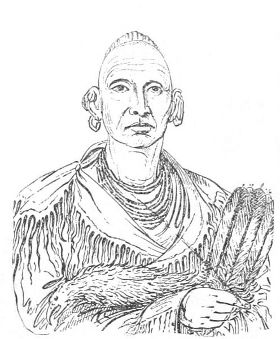
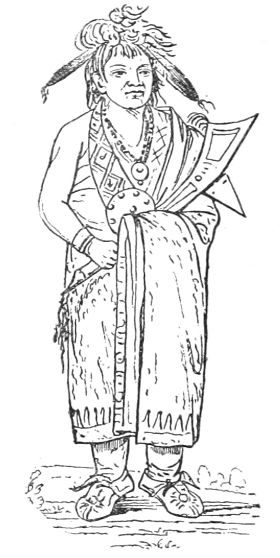
A WINNEBAGO INDIAN
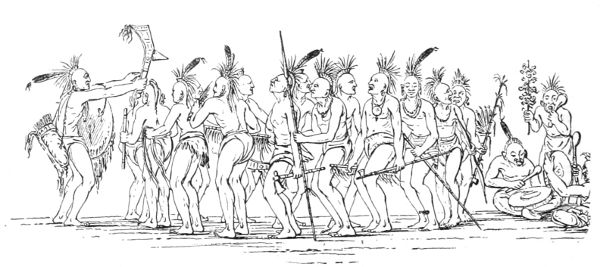
THE SLAVE DANCE OF THE SAC AND FOX
SETTLEMENT
"There is always more or less of interest connected with the early days of any city, and it is not until years after that the record becomes of value. The pioneer suffers privations and trials of which future occupants can realize but little. In fact, the honor paid them is seldom equal to their merits and oftentimes they are as illy prepared to receive as others are to bestow sympathy and praise. Among the first settlers of this city were some men of the first character, and are yet with us, while others have moved farther on, to enjoy what habit has taught them to love, a frontier life, and a few have gone down to the gate of common entry, their years being full and their memories yet linger, and make us glad that we lived with, knew and loved them. Of this number we name that generous and true man, D. W. King. Esq., who departed from our midst in the autumn of 1854.
"The first man, however, who pitched his tent on the ground now occupied by the Valley City, was a counterfeiter and horse thief, of no little notoriety, by the name of Shepard, who took up his abode and erected a log house on what is now Linn street, near the mills, some time in the year 1838.
"D. W. King and Thomas Gainer, the first settlers of any advantage to the country, reached here in 1839 and soon after made a permanent settlement on the west side of the river.
"The house of Shepard was soon found to be the home of a lawless band of outlaws, who secreted much of their plunder on the islands in the river above the city. John Young and a man named Granger were connected with Shepard in their work. They stole at one time six horses and made good their escape with four of them. Granger was afterwards convicted of passing counterfeit money in Chicago and sentenced to the Alton prison for four years. The fate of Young is not known with certainty, yet there is evidence to induce the belief that he was executed for murder, in a neighboring state, though he assumed a different name.
"The privations of the first settlers were at times very great, and though such as are not uncommon in the history of pioneer life, would cause many of our amateurs at the present time to sigh for the home of their childhood and a place at the luxurious tables of their fathers.
PROGRESS
"In 1849 D. W. King established ferries for crossing the Cedar, and continued to run them up to the time of his death. The one doing most of the business was at the Iowa avenue crossing. As it is probable that these boats will soon, if indeed they have not already made their last voyage, a brief note of them may not be out of place in this connection. They were self-propellers, being forced across the river by the power of the current. A wire rope extended across the stream upon which a pulley was placed, and connected by means of two ropes to the boat.
"The first dam across the Cedar was commenced in 1842, and the first saw mill erected in 1843, and is still running.
"In March, 1843, the lands came into the market. The first flouring mill was erected in 1844-5 at a cost of $3,000, by the present owner. In 1845 A. Ely erected the second saw mill, and the second flouring mill the following year, the latter costing about $9,000. In 1848-9 the woolen factory was erected at a cost of about $8,000. The first saw mill was erected in 1850 by Greene, Legare & Co. This has a chair and bedstead factory connected and cost about $4,000. These are all propelled by water power. In 1855-6, Greene & Graves erected a steam saw mill, and containing also a variety of other machinery. The first and only mill erected on the west side of the river went into operation in the summer of 1856. The first steam engine was stationed in this city by A. Hager, in his machine shop, sash, blind, and door factory in 1855. The second by Greene & Graves, and the third by S. L. Pollock.
"The first store was opened by J. Greene, in the building now occupied by the postoffice, on the northwest corner of Iowa avenue and Washington street.
"The second store was opened by Mr. Cleveland, and C. R. Mulford the third. This was located on Commercial street, and was destroyed by fire in 1850, being the first building thus destroyed in Cedar Rapids. No fire occurred thereafter until late in the autumn of 1855, when most of the block embraced on the west side of Commercial street, between Iowa avenue and Linn street, was consumed. No fire has occurred since.
"The postoffice was established in 1847, and J. Greene appointed postmaster.
"The first brick buildings were erected in 1844, the building on the southwest corner of Iowa avenue and Commercial street, and the dwelling house on the northwest corner of Iowa avenue and Washington street. The present Union House was the first hotel.
"The village of Cedar Rapids was laid out and the plat recorded in 1842. At this time, two log buildings constituted the village, and the total population was six persons.
"A public school house was erected in 1846 or '47, and the first school taught by Nelson Felch. This structure is now occupied as a dwelling, on the northwest corner of Eagle and Madison streets. The first church, Presbyterian, was erected in 1850.
"The first newspaper was published in 1851 by D. O. Finch, entitled the Progressive Era. It was continued under this name by various owners and editors until September, 1854, when it was purchased by J. L. Enos and F. A. Wilmans, and its name changed to the Cedar Valley Times by which name it yet flourishes. In politics republican, it is at present published by J. G. Davenport. The second paper was established in January, 1856, under the editorial management of J. L. Enos, entitled the Cedar Valley Farmer, but was discontinued at the close of the first volume. The Cedar Rapids Democrat was the third paper—commenced in June, 1856, by W. W. Perkins & Co. This is still published. Democratic in politics, the Times and the Democrat are both good papers, and appear to be well sustained.
"The Voice of Iowa was commenced in January, 1857, under the auspices of the Iowa Teachers' Association, Phonetic Association, etc., J. L. Enos, editor and publishing agent, assisted by a number of corresponding editors. This journal has met with more than ordinary success, the circulation passing 1,000 during the first three months and commanding nearly $1,000 in advertising patronage, thus showing that the people of Iowa are aroused to the importance of paying due attention to the education of their youth.
"The foundation for a very large graded school was laid in the summer of 1856, but owing to the large amount of work contracted and the scarcity of workmen, the completion was of necessity deferred. It is designed to complete it early the coming summer, and when finished will form one of the finest educational structures in the state.
"During the past two years the growth of Valley City has been equaled by few towns even in the west. It now contains many blocks that would do credit to any eastern city.
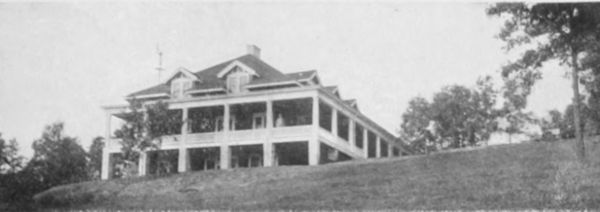
CEDAR RAPIDS COUNTRY CLUB HOUSE
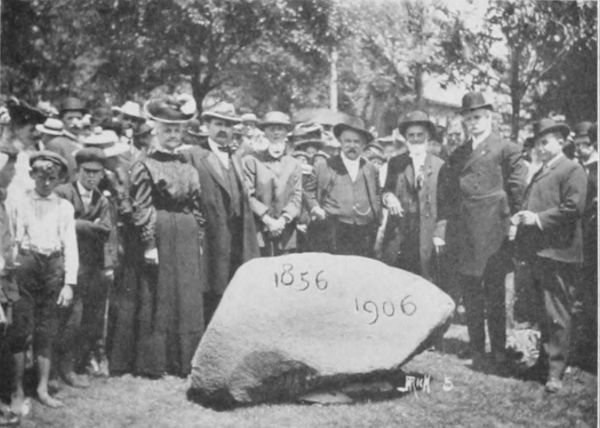
GEORGE GREENE SQUARE, SEMI-CENTENNIAL, 1906
RIVERSIDE PARK
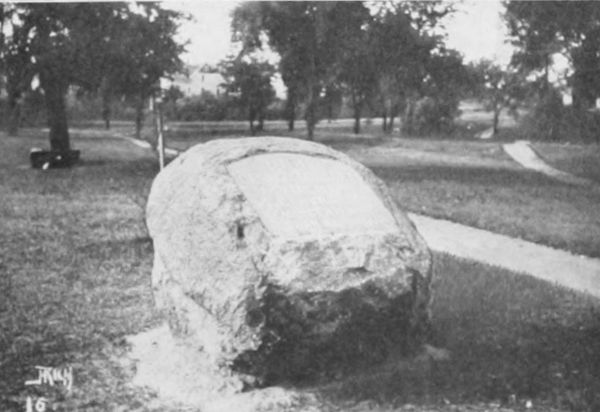
"The present city charter was adopted in the summer of 1856, and Isaac Whittam, Esq., was elected mayor. A free bridge across the Cedar was commenced in 1855, and is now ready for crossing by teams. The chief credit of this structure is due to a few, though many stood manfully by the free bridge and aided liberally in its erection. A charter for a toll bridge was obtained about the time that the free bridge charter was procured, which gave rise to a warm controversy in which much interest was manifest. The free bridge finally triumphed, and its noble arches now span the Cedar with every appearance of remaining for many years a proud monument to the energy and liberality of those who aided in placing it there. We have already intimated that Cedar Rapids is the center of a very large and increasing trade, and though not destined to become a city of the first magnitude, is destined to rank as one of the principal interior cities of Iowa. Its railroad connections—immense water power—the fertility of the surrounding country and the energy of its people will give it rank and importance as a manufacturing city, worthy of note.
"Nor is this imaginary, as the following statistics will show. Cedar Rapids now contains: 4 flouring mills, 2 door, sash and blind, and planing mills, 1 cooper and barrel factory, 5 wagon and carriage factories, 1 iron factory, 2 cabinet furniture and chair factories, 3 plow factories, 3 boot and shoe factories, 2 saddle and harness manufactories, 4 tin, copper and sheet iron establishments, 1 woolen factory, 5 brick yards, 2 agricultural implement manufactories, 3 merchant tailor establishments, 2 wood turning establishments, 3 newspapers and magazines, 1 brick machine factory, 8 grocery and provision stores, 5 clothing stores, 5 dry-goods stores, 1 millinery and fancy goods store, 6 liquor and cigar shops, 4 drug stores, 2 silversmith, clock and jewelry stores, 4 hardware stores, 3 book stores, 1 book bindery, 5 public and private halls, 5 hotels, 4 churches, 4 lumber yards, 3 banking houses, 1 public reading room, 1 shaving and hair dressing establishment.
CEDAR RAPIDS IN 1856
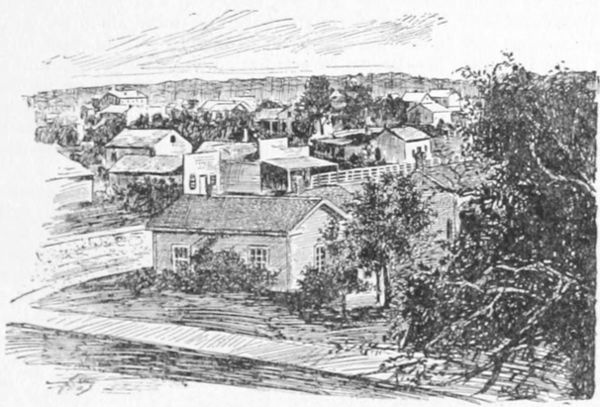
"A paper mill is in contemplation, and there is room and excellent openings for other branches of business.
"A hat and cap manufactory—pork packing establishment—in fact nearly every branch of manufactory not included in the above would do well. There are two nurseries contiguous to town, where nearly every kind of fruit and a large variety of ornamental trees can be procured. The Mound nursery is one of the oldest and most extensive in the country, and the proprietor furnishes orders on very liberal terms."
The following letter to A. T. Hall, as to a gavel, at the meeting of carpenters of America at Des Moines, 1910, gives some interesting facts as to early days in Cedar Rapids:
"Dear Sir: In reply to your request for such information as I have concerning the small mallet or gavel which you had made from a piece of the red cedar shaft, I can only say that there is but little to its history. My father, the late Nicholas Brodhead Brown, came to what is now the city of Cedar Rapids in 1839, but did not remain here at that time. He went as far north as Cedar Falls looking for a mill site, and returned to this location in 1840. After building the first manufacturing plant in Linn county for the Doty brothers, a saw mill in Bertram township, located near the mouth of Indian creek, he began in 1841 to improve the waterfall in the Cedar river at this place. He first built a temporary dam then built a saw mill, the second to be built in the county, for himself. He then began the building of the first flour mill in the county. This mill was completed and in operation either in 1843 or 1844, and from this mill came the cedar shaft from which the little mallet or gavel was made. There is no doubt in my mind about the cedar tree from which the mallet was made was cut very close to, and perhaps within the present limits of Cedar Rapids. Nicholas Brodhead Brown was in all probability the first mechanic who used edged tools, to locate in Cedar Rapids. Nor is there any doubt in my mind about his making the shaft above spoken of. It was the real shaft in the old bolting chest in the mill known as Brown's Mill. Mr. Brown by occupation was a millwright and through force of circumstances worked at that trade for some twelve or fifteen years after his arrival here. He especially did all of the millwrighting that he could do himself on this mill, working twelve and fourteen hours a day for the purpose of getting it into operation as soon as possible, as not only he himself needed its income but the country all about this locality needed a mill.
"Another of the early mechanics to come to Cedar Rapids was Samuel Sherwood, also a millwright. He worked for a time on Brown's flour mill, and on the Alexander Ely flour mill, now known as the Anchor mill. This was the second mill to begin operation in Cedar Rapids. The Ely mill began operating the same year as the Brown's, but later on in the year. Another of the old-time mechanics, a user of edged tools, was Joseph Love. He was the first cabinet-maker to locate in Cedar Rapids. Another was John Vardy; he was the second cabinet-maker to locate in Cedar Rapids, and was the builder of the first house in Cedar Rapids to be constructed of sawed lumber. The house still stands—is in use and owned by the Stary family. John F. Boyce, the father of William and Frank Boyce of this city, was another early mechanic. He also was a cabinet-maker. John Patterson, an uncle of Chas. A. Calder of this city, was another. He also was a cabinet-maker. All of these men worked to a greater or less extent at the carpenter's trade. In those days there were no trade unions and consequently no limitations on the kind of work a mechanic should do. To my mind these men could be classed as carpenters as well as millwrights and cabinet-makers. I should have said that Samuel Sherwood went to Independence from this city and became the founder of the milling industry at that thriving little place. I have diverged largely from the gavel, but believe it will be interesting to yourself and your fraternity to know who the first users of edged tools were in this part of Iowa.
Respectfully yours,
"N. E. Brown."
HOW THE FIRST RAILROAD CAME TO CEDAR RAPIDS
T. DEVENDORF IN THE SUNDAY REPUBLICAN OF JUNE 10, 1906
The population of the city in 1856 was not to exceed 1,200 to 1,500 people. There was little wealth in the community. No manufacturing enterprises had as yet located here. The principal dependence of the people was in the farming community and the bountiful harvests that Iowa never fails to produce.
The one great desire and ambition of the people was for a railroad to the east on which they could transport their surplus product to an eastern market. Railroad building had not been very extensive in the west, the Chicago, Iowa & Nebraska had its track built as far west as the Mississippi river and was formulating plans to bridge the river and extend the road across the fertile prairies of Iowa. Some of our pioneer citizens with shrewd business instincts and confidence in the rapid settlement and development of the state, on the completion of the railroad, became interested in this new project and advocated the granting of a loan to them provided the road should be built to or through our growing city. The subject of giving aid to this new proposed railroad was discussed largely among the people, and on the 1st day of September, 1856, the city council passed a resolution instructing the mayor to call an election of the qualified voters of Cedar Rapids to vote on the question, shall the city in its corporate capacity subscribe sixty thousand dollars to the capital stock of the Chicago, Iowa & Nebraska railroad and pay for same in bonds issued by the city. Said bonds were to bear interest at the rate of ten per cent per annum, and were to mature 20 years after date at the option of the city. The election was called by Mayor Isaac Whittam and held September 22, 1856, and resulted in the very decisive vote of 111 for the proposition and only 2 against it.
THE OLD BLAIR BUILDING, NOW THE SITE OF THE KIMBALL BUILDING
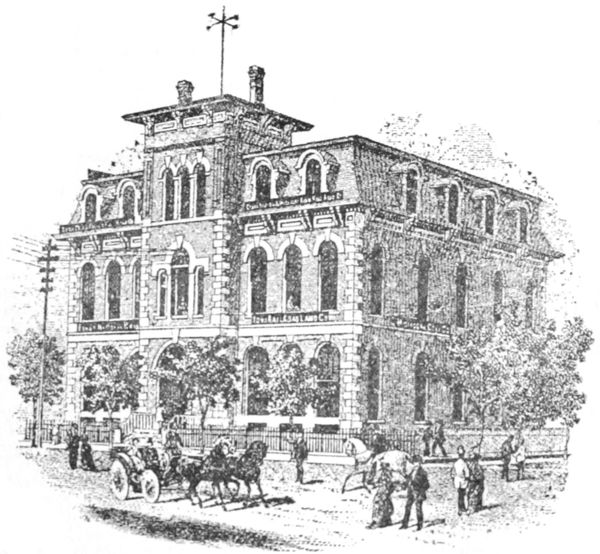
These bonds were to be issued in series as the work on the new road progressed, fifteen thousand dollars worth when the contract was let for building the road from De Witt to Cedar Rapids; the second series of fifteen thousand dollars worth when the first five miles of grading were completed in Linn county; and the balance of thirty thousand dollars worth when the grading was finished into the city of Cedar Rapids and the road in operation and cars running as far west as Mt. Vernon.
On the 20th of February, 1857, Mayor Whittam in a report to the city council made a statement that he, as representative of the city, had attended the meeting of the stockholders of the Chicago, Iowa & Nebraska, held on the 25th day of January, 1857, at Clinton and at that time had passed over to the railroad company the fifteen bonds of one thousand dollars each, to which they were entitled, they giving the required stock certificates for same as per agreement. The railroad company also entered into a contract with the city in which they agreed to pay interest on said bonds and all others to be issued to the railroad until such time as the road should be finished and the cars running into the city of Cedar Rapids.
The mayor also complimented the men in charge of the affairs of the road as men of means, honor, and energy, and finished his report by predicting that when the road was completed it would be of great benefit and advantage to our young but growing city. But notwithstanding the financial aid and the general encouragement given by the people the road advanced westward slowly and while the grading had been nearly completed there were many other things necessary to build a railroad and which could only be had by having the ready money with which to buy such supplies. In June, 1857, another petition was presented to the city council asking that the mayor call an election of the legal voters of the city to vote on the question, shall the city issue its bonds to the amount of forty thousand dollars to aid in purchasing the iron rails to complete the road to Cedar Rapids, the city to be a subscriber to the capital stock of the road to that amount. On July 10, 1857, the mayor called the election to vote on the proposition, shall the city in its corporate capacity issue its bonds for forty thousand dollars, the money to be used to procure iron rails and for no other purpose. The election was held on July 20, 1857, and resulted as follows: For the proposition, 104 votes; against 25 votes.
These bonds were to be issued in series and were to be paid one-quarter in 13 years, one-quarter in 14 years, one-quarter in 15 years, and the balance in 16 years from date.
Some time after these bonds were issued and turned over to the railroad company some legal point was raised touching their validity, and this together with the fact that the financial standing of the railroad company in the east among the iron manufacturers was not first class, made it necessary that some other plan should be adopted to procure the iron rails to build the road to Cedar Rapids. Heretofore they had found it practicable to survey and locate and grade a road and pay for the same in farm products, dry goods and groceries, etc. But when it came to buying iron from the manufacturers it required the cash or a suitable collateral. But our people were ready to meet this unforeseen emergency. Six of our early and more wealthy citizens made notes of $8,000.00 each, each note being signed by each of the other gentlemen, making a joint note of each one and together amounting to the $48,000.00. These notes were to be used as collateral and to strengthen up their credit, so that the iron rails could be bought and the road completed to this city. This was purely accommodation paper and the road contracted that the interest and principal of these notes should be paid by the railroad company from the first net earnings of the company, but in the early years of the road there were no net earnings. It was only by the most economical management that the operating expenses could be met, and several years elapsed before these notes given to aid the railroad were fully paid. The gentlemen aiding in the early construction of the first railroad to Cedar Rapids were Gabriel Carpenter, George Greene, Sampson C. Bever, J. J. Snouffer, and two others whose names are not remembered.
After the railroad was completed and in operation to this place little was said in regard to these city bonds. In the proceedings of the city council June 13, 1860, a resolution was passed authorizing E. H. Steadman, the mayor of the city, to represent the city at the annual meeting of the stockholders of the C., I. & N. Ry., which was to be held in Clinton at a later date.
On January 25, 1861, a committee was appointed consisting of the mayor, I. N. Whittam, and Alderman G. Livensbarger who were to examine into the legal condition of the city in relation to the $100,000.00 worth of city bonds already issued for railroad purposes. What this investigating committee did, and what their conclusions were, are not matters of record. Nothing more is said in any of the proceedings of the city council in regard to this matter until May 8, 1863, when it appears from the preamble of a resolution introduced that the railroad company was calling upon the city authorities to comply with the terms of the contract entered into when the bonds were issued, which was that the city should pay the interest on such bonds after the completion of the road to this place.
The road had been finished and in operation some two years and still no interest had been paid and the city made no efforts to collect any sum for such purpose. At the meeting of the council May 8, 1863, a resolution was introduced asking that a committee be appointed to investigate and report on the recorded facts bearing upon this matter of railroad bonds from its inception to this date. Aldermen McClelland, Denlinger and Slonaker were desirous of having light on the subject and voted for an investigation, but Aldermen Bever, Carroll and Stibbs voted in the negative, and this being a tie vote it was decided by the mayor, who also voted in the negative.
At the council meeting held June 11, 1864, another committee to investigate was appointed who was authorized to procure legal advice in regard to the liability of the city and also meet and confer with the officers of the railroad company, and this committee consisting of Aldermen McClelland and E. H. Steadman reported back to the council that they had procured legal advice in the matter and from all data and facts collected their attorney was of the opinion that the railroad company had no legal claims against the city and that the bonds were illegal and void.
In October of 1864 the same subject came up in the city council and a committee of three consisting of S. C. Bever, H. C. Angle and John Weare were appointed to confer with the railroad company and get the best terms of settlement they could, either by taking reissued stock in payment or a certain amount of money yearly in full settlement. This committee were prompt in their investigations and reported back to the council November 4, 1864. Their report was that they had a conference with the railroad company and the best compromise they could obtain was this:
First. That the city surrender to the company all its claims to stock in said road.
Second. The railroad company would then return to the city $90,000.00 worth of the city bonds already issued together with all coupons on the balance, leaving in the hands of the company $10,000.00 worth with all coupons cut off to date. This surrendering of bonds to in no way affect the legality of the bonds retained, the legal points to be settled later.
At the meeting of the council Alderman Bever introduced a resolution covering all the points made in the report of the committee that the city surrender the stock and that the railroad company return the $90,000.00 worth of bonds, leaving outstanding and in the hands of the railroad company $10,000.00 worth of city bonds.
On the yeas and nays being called the following aldermen voted yea: Bever, Denlinger, Holland and Slonaker, and in the negative, Alderman McClelland, and the resolution was declared adopted.
Alderman McClelland then at once offered his resignation as alderman from the Third ward and his resignation was as promptly accepted and Wm. Richmond elected as his successor.
Nothing more appears in the records of the city council bearing on this question of railroad bonds until June 29, 1866, when Alderman Adams of the Third ward introduced a resolution that a committee of one consisting of Alderman Snouffer be appointed to confer and negotiate with Horace Williams, agent of the Chicago, Iowa & Nebraska railroad, for the surrender of the outstanding bonds, and he was authorized to release and exonerate the railroad company from performing certain acts they had previously agreed to do. One was the grading of Jefferson street and another was the grading of the North city park and the building a fence of oak posts around said park, both of which they had failed to do. These agreements of the railroad company the city would relinquish, provided the railroad company would return the balance of the city bonds in their hands, amounting to $10,000.00.
It is presumed that Alderman Snouffer failed to make these negotiations with Horace Williams as instructed by the city council, at least there is nothing in the records to show that this committee of one ever made any report on this subject to the city council.
At the meeting of the city council held May 15, 1868, another committee was appointed to investigate and try to induce the railroad company to relinquish and return these outstanding city bonds and it is fair to presume that the committee accomplished something in that direction as at a subsequent meeting held June 26, 1868, Alderman Leach moved that the city treasurer be authorized to receive the city bonds now in the possession of the Chicago & Northwestern railroad and receipt for same. This is the last record to be found in the proceedings of the city council bearing on this subject of city bonds.
Going back to the time the railroad was built into Cedar Rapids it will be remembered that little value was placed on the stock. People subscribed for the stock and paid their subscriptions as called for more to encourage the building of the road than for an investment. Nearly every citizen had some few shares of the stock. They had all done their share in getting the road here according to each one's means and financial ability, and held their stock in the road. It was then that men of means with confidence in the rapid growth and advancement of this great state of Iowa began in a private way gathering up this stock of the Chicago, Iowa & Nebraska R. R., buying up from the small holders their stock at prices from 25 to 35 cents on the dollar of the par value and in a few years the small holders had parted with their holdings and in 1865 there was little or no stock of the Chicago, Iowa & Nebraska R. R. to be had and in the latter part of that year the road was merged into the Chicago & Northwestern system. At what price per share the Chicago, Iowa & Nebraska went into the Northwestern is not positively known, but it is generally supposed that one share of the Chicago, Iowa & Nebraska R. R. was good for about three shares of the new consolidated Chicago & Northwestern.
SOME OF THE EARLY BRICK HOUSES IN CEDAR RAPIDS
Charles Weare used to say that there was a brick building on the Y. M. C. A. corner which was torn down many years ago, and which was supposed to be one of the first brick buildings in Cedar Rapids; it was occupied by Ingham Wood as a store building. Porter Earle erected one of the first, if not the first, brick building at the corner of First avenue and Second street where the Union Block is now standing, which was one of the most commodious buildings of its kind in the city for many years. The Michael Bryan family erected one of the first dwelling houses of brick about where N. E. Brown's home now stands in 1849 or 1850, and for many years it was one of the best equipped houses in the city and the west. This house had an open fire place in every room, and consisted of eight rooms. The house was built according to the southern style of architecture. Another member of the Bryan family erected a stone and cement house about the same time at the corner of Third avenue and Second street, which building was later occupied by the family of William Greene.
D. M. McIntosh erected a one-story brick building near the present library in 1850 or 1851, which building is still standing. About the same time the father of James Snyder erected a brick dwelling which stood on South Third street near where the Vardy cottage is located. Greene's Hotel on First street was a brick structure erected between 1854 and 1855; it had an eighty feet front and ran back toward the river about eighty feet. The picture of this building shows that it was a four-story structure, although many claim that it was only a three-story building. This buildup was erected by J. J. Snouffer; for many years it was the largest and best equipped hotel in this part of the west.
Part of the residence of Dr. Skinner was erected by George Berg and was one of the most complete brick structures in this city. Elihu Baker also erected a brick residence on the property now occupied by Dr. H. W. Bender about the early '50s. Sampson C. Bever erected a brick building on the premises where the Rock Island offices now stand, being a two story structure similar to the Spangler residence which was erected later across the street. In this structure Mr. Bever installed the first hot air furnace used in Cedar Rapids, and a great many of the early settlers came to inspect the house, and especially to examine the hot air furnace which was a new thing in those days.
J. S. Cook in the early days erected a brick structure on the corner of A avenue and Fifth street, which was one of the fine homes for many years in this city. S. A. Shattuck built in the early '50s a brick structure on Sixth avenue and Fifth street. John Newell, during the years 1855 and 1856, erected a double brick structure at the corner of Fifth street and Seventh avenue. The old Seabury house on Eighth avenue was erected prior to 1860 and for many years was a landmark in that end of town. The Barthel house which stood where the Majestic Theatre now stands was one of the early brick veneer houses in the city and was occupied by many of the prominent families from time to time.
R. C. Rock, one of the early merchants, erected a brick house in the early days on the premises where George Williams has since erected a magnificent mansion. Dr. Wilman, Dr. J. L. Enos and Dr. S. D. Carpenter erected brick houses in the early days which were landmarks along Second avenue up toward Tenth street. The Lawson Daniels brick residence was on First avenue between Second and Third streets adjoining the Thomas Building, and adjoining this was the dwelling of Dr. Thomas, a friend of J. J. Snouffer and a native of Maryland; Dr. Thomas returned to his native state in the '50s. Adjoining these brick dwellings was also another brick building erected by the old pioneer H. G. Angle and occupied by him as a residence for many years.
Another substantial brick dwelling was erected by John Graves on B avenue and Fourth street, being a two-story brick building with an upper and lower porch. The old Gillette house was on the east side of Fifth street where William S. Bye now resides; it was known as the Gillette house. Mr. Gillette being the brother-in-law of the late W. D. Watrous.
Another large and commodious brick dwelling house was a two-story structure erected on Fifth street between B and C avenues and near what is known now as Whittam Park. Adjoining this was the Koontz house, occupied by Dr. Koontz and his family for many years. The Tryon house was also a brick structure erected near the corner of Third avenue and Second street; Mr. Tryon was a surveyor and well known in the early days.
Nearly all the brick used in the early days was made by a Mr. Geeslan who operated a brick yard near what is now known as the "Lame Johnny" place. Brick was cheap, labor was low and the cost of erecting these dwellings in that day was much lower than later. It is said that Sam Stambaugh in the early days worked as a brick mason and walked home to Bertram every night, the wages paid being about $1.00 a day, which was considered high. It is also said that during the '50s Cedar Rapids had more commodious homes than any other town of its size in Iowa. It was made up largely of a brainy, wide-awake, enterprising lot of men, such as N. B. Brown, H. G. Angle, the Greenes, Earles, Elys, Daniels, Macks, Weares, Bevers, and many others who had drifted into the town and who soon built up an enterprising little town, engaging in various ventures, not always successful, but they had Cedar Rapids before the world so that they finally landed the railroad which henceforth made the town. It is said by the late Charles Weare that "when they first started a newspaper there were no settlers in the town, but they had to use a newspaper to boom the town with."
SOME STRENUOUS DAYS IN THE OLDEN TIMES
FROM THE CEDAR RAPIDS REPUBLICAN, SUNDAY, JUNE 10, 1906
An ordinance creating a fire department was introduced in the council in January, 1869, and it was passed February 12, 1869. This ordinance was lengthy. It stipulated what officers should be appointed, what their duties were, how many fire companies to each engine, how many men to each company and many other details. One of the provisions of this first and original ordinance was that the fire chief should be appointed by the council.
On March 12, 1869, the fire company which had already been organized but not officially recognized by the city council, presented a petition to the council, asking that P. C. Lusk be appointed as fire chief. At a subsequent meeting a vote was taken on the election of a fire chief with the following result:
P. C. Lusk, who was the choice of the fire department, received four votes and J. J. Snouffer one vote. Lusk having received a majority of the votes cast was declared elected chief of the fire department. At the meeting held April 9, 1869, the chief of the fire department presented the names of the members of the first company which was styled "The Steam Fire Engine Co., No. 1." It was organized under Ordinance No. 78. Mr. Lusk reported the names of sixty members, including officers, and asked the council to confirm them, which was done.
The officers of this company were as follows:
Foreman—Geo. A. Lincoln.
Assistant Foreman—M. T. Bell.
Secretary—E. W. S. Otto.
Treasurer—W. B. Stewart.
Hose Captain—D. A. Dingman.
Assistant Hose Captain—N. H. Martin.
Engineer—W. Berkley.
Stoker—H. S. Gilmore.
Some of the "high privates" in this first organized fire company of Cedar Rapids were as follows: Al Jacobs, Richard Cornish, C. E. Calder, Lyman Ayers, Geo. Rhodes, Ed. Buttolph, John H. Smith, H. S. Bever, H. E. Witwer, H. Hale, Geo. Hasse, John Bryan, Walter L. Clark, L. L. Cone, Chas. L. Morehead, A. S. Mershon, Ely E. Weare, James Snyder, John Shearer, Baxter McQuinn, W. J. Wood, Richard Moorhead, Don Harris, Lowell Bressler, N. Rudolph, Ira Taft, and twenty-seven others.
MONTROSE HOTEL, CEDAR RAPIDS
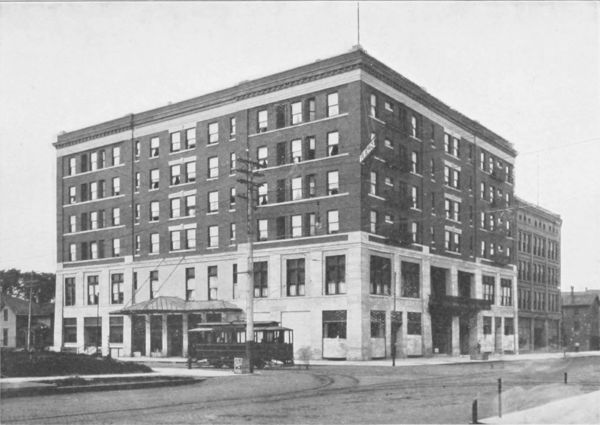
Early in April a hook and ladder company was organized and on April 16, 1869, was confirmed by the council as a part of the fire department of Cedar Rapids. The officers of the company were as follows:
Foreman—S. D. Fleck.
First Assistant—J. S. Dickinson.
Secretary—Geo. A. Gault.
Recorder and Treasurer—J. G. Krebs.
Samuel A. Lilly. H. C. Morehead, James Fowler, P. C. Garrett, J. C. Adams, Samuel Spalding, J. A. Hart, Joseph Lilly, J. M. Chambers, T. Snook, J. J. Calder, G. M. Howlett, C. D. Pettibone and six others constituted the active membership of this organization.
The official life of Chief Engineer Lusk was very brief and was marked by continued strife and dissension among the members of the department. He became persona non grata to the council and charges were preferred against him. July 13, 1869, Alderman Hill introduced a resolution reciting that while the chief engineer could not be declared guilty of intentional fraud he was indiscreet in many things and his influence for good in the department had been so impaired that his resignation was demanded. This did the business, and on July 23 he resigned. W. B. Leach was appointed chief engineer for the remainder of the term, and peace and good feeling prevailed in the department.
In March, 1870, after the inauguration of the new council of which W. B. Leach was mayor, a petition of the fire department was presented in which they asked the council to appoint Geo. A. Lincoln as chief engineer of the department. Another petition was also presented, signed by many citizens, asking that W. D. Watrous be appointed chief engineer of the department. On the 25th of March, a ballot being ordered, Geo. A. Lincoln received three votes and W. D. Watrous three votes, whereupon the mayor voted for Lincoln and declared him elected to the position of chief engineer, and on the 26th day of March he was duly qualified and took the oath of office.
Shortly after Mr. Lincoln assumed the authority vested in the office of chief engineer of the fire department, an element of discord arose in the council and an effort was made to secure by legislation and diplomacy what they had failed to accomplish when the vote was taken in March.
It was thought the original ordinance passed in January, 1869, was faulty and should be amended and the ordinance committee was directed to make such amendments as were necessary or to prepare an entirely new ordinance.
During the summer of 1870 the committee had prepared an ordinance which was practically the same as the old one. The only radical change was in the manner of electing a chief engineer. The new ordinance placed the election of the officer with the electors after the year 1870 and a new section was added which read as follows:
"No person shall be eligible to the office of chief engineer unless he be a resident of said city at least one year and shall have attained the age of twenty-five years."
To understand the force of this last clause in the ordinance it will be necessary to remark that at this time Mr. Lincoln was only twenty-three years old. This ordinance, the records say, was passed July 29, 1870, but it was found necessary to amend it and it was not until ordinance No. 98 was passed on September 30, 1870, that the council felt safe in electing a new chief engineer to take the place of the one so skilfully legislated out of office. On the 15th of October, 1870, A. R. West became the chief engineer of the fire department by the vote of the council. After the election of Mr. Lincoln during the spring and summer of 1870 it was uncertain whether the city of Cedar Rapids had a fire department or not, and it was also a question as to the authority possessed by the chief. There was much discord and bitterness among some of the members of the fire organizations. The city council was far from being harmonious and rarely acted in unison in legislating for the well being of the fire department. The citizens who had labored long and earnestly in this work of procuring fire apparatus felt that they had a right to demand that this bickering and personal contention between the organized fire department and the duly elected city council should be ended, but the strife continued. Early in the administration of Mr. Lincoln as chief of the department a communication was presented to the city council in which the petitioners, after recounting their many grievances, made the claim that the election of Mr. Lincoln was unparliamentary, unfair and contrary to the wishes of the department and to a great majority of the property holders, and that while the petitioners were willing to obey all ordinances of the city and the ruling of any legally appointed officer as chief of the fire department, they did not consider themselves lawfully bound to give any heed or attention to the said Geo. A. Lincoln. That they as members of the fire department would pay no attention to the said unlawfully elected chief engineer nor to any order coming from him. This petition was signed by Sam Neidig, C. W. Eaton, G. M. Howlett, Sam Lilly, Chas. Hubbard, J. C. Adams, Thos. Snook, and fifteen others.
Some time later the chief engineer made a report to the city council as the ordinance directed he should do, giving the necessary information in regard to the efficiency of the department and its probable needs for the future, but the council refused to accept it as the report of the chief engineer, making the broad claim that there was no fire department or a legally elected chief engineer and this was backed up by the opinion of the city attorney. Mr. Lincoln, not to be thwarted by the city council in refusing to listen to his report, was obliged to have it published in the city papers and some extracts are made here, showing the friendly feeling existing between him and some members of the city council. He reported that the steam engine was in good shape excepting that the grate had burned out and the committee on the fire department had refused to get it repaired. The hose was poor and not in condition to stand the pressure necessary in case of a large fire. This was owing to the committee on fire refusing to have the tower on the city hall arranged so the hose could be hung up to dry after having been used. Many small bills for supplies used by the department, and which were necessary for the running of the steamer, were hung up and not allowed, and in speaking of the cistern which the city had built he reports that one of the aldermen had the keys of the same and refused to turn them over to him and as to the amount of water in same he could make no report.
After the election of Mr. A. R. West to the position of chief engineer, the old original No. 1 Fire Engine Company, or a large proportion of its members, at one of its meetings passed the following resolution:
"Whereas, The city council has seen proper to persecute and finally to declare us not an organized fire company, and
"Whereas, We who compose the Fire Engine Company No. 1 have since organization labored faithfully to make the department as efficient as possible and have in all cases discharged our duties as firemen, therefore
"Resolved, That we turn over to the city council all the fire apparatus in our possession. That we refuse to offer our services as firemen so long as any member of the city council who has been persistent in our persecution shall remain in said council.