Chapter XXXVI · Cedar Rapids (continued 2)
Reading edition
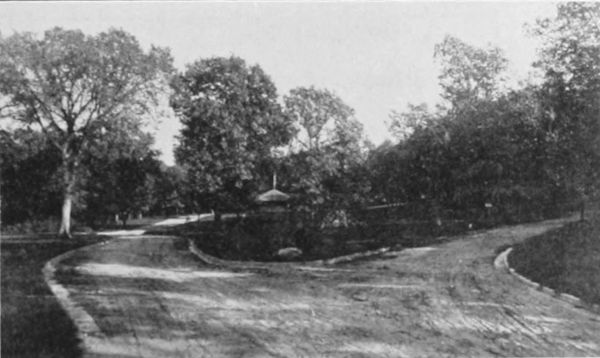
A SCENE IN BEVER PARK, CEDAR RAPIDS
BUSINESS IN 1856
From 1850 to 1860 Cedar Rapids had a marvelous growth, despite the panic of 1857 which wiped out some of the fortunes of those who had invested heavily in wild lands and who had engaged in banking. The Voice of Iowa, a local newspaper, has the following to say of the wealth of the city's business enterprises:
Flouring mills, four; planing mills, sash, doors and blinds, two; cooper, one; wagon and carriage factories, five; iron foundry, one; cabinet and chair factories, two; plow factories, three; boot and shoe factories, three; saddle and harness factories, three; tin, copper and sheet iron workers, four; woolen factory, one; brick yards, five; farm implement factories, two; merchant tailors, two; woodworking, two; newspapers, three; brick machine factory, one; grocery and provision stores, eight; dry goods, fifteen; clothing, five; drug stores, four; jewelers, two; hardware, four; book stores, two; book bindery, one; liquor and cigars, six; public halls, five; hotels, five; churches, four; lumber yards, four; bakery, one; banks, three; barber, one; public reading room, one. The same issue of the paper cites that the town should have a pork packing plant as well as a paper mill. It took a long time before the T. M. Sinclair Company's plant became an assured reality, which has become in time such a factor in the upbuilding of Cedar Rapids and Linn county.
The following list of business firms in Cedar Rapids in 1856 is of interest:
Dry Goods Stores—Shattuck & Dewey, Commercial street; L. Daniels & Co., Commercial street; C. E. Livingston, Carpenter's block, Commercial street; Partridge & Cook, Commercial street; Leach & Wood, corner of Washington and Eagle streets; Elder & McClelland, corner Iowa avenue and Commercial street.
Grocery Stores—C. W. Stebbins, corner Front street and Iowa avenue, Kingston; A. C. Keyes, Carpenter's block, Commercial street; Bever & Rowley, Commercial street; J. H. Atwell, Commercial street.
Clothing Stores—David Kahn, Commercial street; Bangs & Bixby, Commercial street.
Hardware Stores—Rock & Camp, Commercial street; C. P. Spaethe, Commercial street; A. H. Brown & Co., Commercial street.
Drug Stores—J. P. Conkey, No. 3, Commercial block; James L. Enos, No. 4, Iowa avenue.
Jewelry Stores—J. T. Walker, Commercial street; L. H. Keyes, Commercial street.
Book Stores—James L. Enos, No. 4, Iowa avenue.
Banking Houses—Greene & Weare, Commercial street; Ward, Bryan & Co., Commercial street; W. A. Dodge, Carr & Co., Commercial street.
Land and General Agency Offices—Whittam & Belt, Commercial street; Bates & Tousley, Commercial street; Carpenter, Lehman & Co., Commercial street; H. Mount & Co., Washington street.
Furniture Ware Rooms—John Boyce, Iowa avenue; J. Alloway, Commercial street.
Builders, Joiners, Etc.—W. D. Watrous, designer and builder, Carpenter's block; Smith & Williams, S on Madison, W on Washington street; Elihu Robbins, residence Washington street; Hyatt & Moore, shop on Commercial street.
Blacksmith Shop and Plow Factory—Stephen L. Pollock, Linn street.
Lumber Yard—Charles & Carroll, Commercial street.
Carriage Manufacturers—Roswell Tibbetts, Benton street, West side; J. M. Chambers, Linn street.
Hotels—Empire House, W. M. McMahon, corner Washington and Market streets; Greene's Hotel, Coffman & Smith, Commercial street; Rapids Hotel.
Insurance Agents—S. C. Bever, Franklin and Marine; E. N. Bates, Hartford Fire; J. L. Enos, Iowa Insurance Co., Oskaloosa.
Bakery and Restaurant—Alexander Clinton, Commercial street; Walter D. Thompson, No. 6 South Commercial street.
Millinery—Mrs. E. A. Emery, Brown's block, Kingston; Miss Mary E. Stewart, Rapids Hotel.
Physicians—S. C. Koontz, office Carpenter's block; J. H. Camburn, residence Washington street; W. D. Barclay, residence Iowa avenue; J. W. Edes, residence Washington street; Smith & Larrabee, office Commercial street; R. R. Taylor, office Carpenter's block; H. Mount, oculist, Washington street; McCauley & Pulsifer, dentists, Commercial street.
Attorneys and Counsellors—James J. Child, Commercial street; Bates & Tousley, Commercial street; Henry Lehman, Commercial street; D. M. McIntosh, Commercial street.
Nurseries—Central Iowa Nursery, J. B. Gate, proprietor, on west side, near city. Was established 1853. Mound Nursery, George Greene, proprietor, two miles north of the city.
Planing Mill—Alexander Hager, shop 45×50 feet, two engines, one of nine and the other of twenty-four horsepower. Capital invested in plant and machinery, $10,000.
Lumber Mills—Greene & Graves, located at upper end of city. Mill 40×50 feet, two stories high; engine house, 24×60 feet, one story high. Had capacity of 5,000 feet of lumber per day, with lath, shingles, etc., in proportion. This establishment also included a machine shop 35×70 feet, three stories high; foundry of brick, 30×60 feet, and a brick blacksmith and plow shop 25×35 feet. Capital invested, $25,000. J. J. Snouffer, one saw, cutting 200,000 feet of lumber during three months, ending June 30, 1856. A circular saw for plow beams, wagon felloes, etc.
Saw Mill and Chair Factory—Dobbs & Dewey, capacity 10,000 feet of lumber a week. During year had turned out 8,000 chairs, 1,000 bedsteads and other articles. Fifteen hands employed. Capital, $12,000.
Churches—Presbyterian (Old School), Rev. R. H. Morrow, pastor. Worships in Daniels' Hall. Subscription of $2,700 secured for a building, which with site is expected to cost $3,500. Membership, 46. Episcopal, Rev. S. Starr, rector. Church a fine structure and furnished in the neatest manner. Methodist Episcopal, destitute of pastor temporarily. More than one hundred members; largest congregation in city, more than 150 in attendance at Sabbath school. Baptist, West Side, Rev. J. Woodward, pastor. Temporary edifice to be erected present season. Membership between thirty and forty. Presbyterian (New School), Rev. L. F. Dudley, pastor. Church building small; was first to be erected in the city. Affairs in a flourishing condition. Presbyterians (Seceders), Rev. J. H. Sturgeon, pastor. Church edifice just erected and pews sold.
Secret Societies—Cedar Rapids Lodge No. 25, A. F. & A. M. (organized 1850), Hiram Deem, W. M.; Isaac N. Whittam, secretary. Meets first Monday after new moon. Hope Lodge No. 201, I. O. O. F., organized 1851. Hiram Deem, N. G.; Joseph G. Davenport, secretary. Meets every Tuesday evening.
Select Schools—Misses Farnham, in rooms under the Episcopal church; Miss H. Latshaw, on Washington street.
Buildings Erected in Year—William Stewart, brick store, one story; R. C. Rock, brick store, three stories; J. F. Ely, two brick stores, three stories; A. Hager, machine shop, brick, three stories; Gabriel Carpenter, three stores, brick, four stories; S. C. Bever, store, brick, three stories; H. G. Angle, store, brick front, two stories; Bates & Tousley, banking house, brick, three stories; Shattuck & Dewey, two stores, three stories; P. W. Earle, store, three stories above basement; S. L. Pollock, addition to plow factory; Greene & Graves, stone machine shop, three stories; Greene & Graves, blacksmith shop and foundry; public school building, brick, three stories.
Brick Dwellings—F. A. Lee, William Greene, James Bates, B. E. Baker, W. & S. Johnson, Elihu Robbins (two), M. Ohler, Ezra Havens, H. G. Angle, Watrous & Gillett, A. Whitensack.
Frame Dwellings—H. Riefensthall, W. W. Smith, John Graves, Lowell Daniels, G. W. Westlake, H. L. Bryan, A. J. Reed, P. W. Reeder, W. Harvey, Henry Ward, S. A. Shattuck, D. S. Bryan, G. Dewey, Rev. Samuel Starr, Freeman Smith, —— Jordan, J. Crabil, Mary Lucore, Mr. McDougal, Mary Clark, Mr. Coon, Mr. Seabury.
As yet, however, the improvements were confined to but a small portion of the present city. Iowa (First) avenue had been used as a sand bank, at the convenience of builders, and being left in ridges and hollows was impassable to teams. Lot owners on Eagle street (Second avenue) were urged to cut out the underbrush in the street so that wagons might pass, and thus that section of the city become attractive for residences.
From Wolfe's Business Directory for 1869 we may note a few of the business houses and professional men.
Agricultural Implements—Averill & Hamilton, A. C. Churchill, Fleck & Dorwart, Higley Bros., Patterson & Co., F. J. Upton.
Ammunition—J. A. Nye.
Architect—S. S. Spaulding.
Attorneys—Boyd & Smith, J. J. Child, Craft & Sosel, A. V. Eastman, R. H. Gilmore, H. H. Gray, Hubbard & Belt, J. W. Leslie, M. P. Mills, A. St. C. Smith, O. O. Stanchfield, I. N. Whittam.
Baker—P. Seitz.
Banks—City National, First National.
Bankers—Carpenter, Stibbs & Co.
Barbers—Brown & Bolin, W. K. Harris, Lightenberg & Reiss.
Billiard Halls—F. Witousek, D. T. Williams.
Blank Book Makers—J. C. Stoddard, C. Barthel, S. B. Carl, Cook & Funk, J. E. Davis, R. H. Dutton, C. Everlien, C. A. Files, J. Hough, A. S. Mershon, J. M. Nell, Delia Rudolph, L. Turner.
Book and Job Printers—Ayers Bros., W. A. Ballard.
Book Stores—E. R. Derby, J. G. Graves, F. G. Bennett.
Boot and Shoe Dealers—E. R. Bradford, J. Gates, McClelland Bros., J. E. Morrison, P. Necomb, A. G. Plumb, O. Robinson, C. Tomasek, T. S. Wilson, J. Wolfe.
Brewers—C. Magnus, owner of the Eagle Brewery, Will Williams, Cedar Rapids Brewery, owned by Joe Schneider.
Carpenters—Boss & Gray, M. J. Bourne, M. Moore, Null & DeCamp, W. Richmond, S. S. Spalding, J. M. Waldt.
Carpets—I. N. Isham, J. Bell & Co., P. Newcomb.
Clothing—Arnold & Loucheim, Arnold & Levi, Jackson & Lincoln, Otto Co., R. B. Tomlinson, J. Wiener.
Commission Merchants—H. L. Bryan, Charles & Carroll, C. H. Hall, R. L. Porter, J. J. Snouffer & Co.
Dentists—E. Ebi, A. K. Miner.
Drugs—G. C. Haman, J. C. May, L. Roth, A. H. Taylor, W. L. Weller, Wetherby & Bowen.
Flour Mills—Aetna Mills, by J. J. Snouffer & Co., Cedar Rapids Flouring Mills, W. B. Leach & Co., Union Mills, by W. S. Cooper.
Grocers—O. B. Coe, Anderson & Pettinger, Al Jacobs, P. G. Garret, Hildebrand & Lansing, A. C. Keyes, P. Keech, W. Lench, C. L. Lutz, Sam Neidig, G. Parr, F. Plucshel, P. Seitz, J. B. Spry, J. H. Stibbs, T. S. Wilson, J. J. Witwer, Wood & Wolcott.
Six hotels on the east side, and several on the west side, known as Kingston.
The doctors were—C. F. Bullen, J. H. Camburn, G. P. Carpenter, J. P. Coulter, J. W. Edes, Mansfield & Smith, F. McClelland, J. North, Israel Snyder, C. H. Thompson, W. Bolinger.
The live real estate agents were—Carpenter, Stibbs & Co., R. H. Gilmore, St. Clair Smith, O. O. Stanchfield, West & Eastman.
There were about twenty saloons operated.
The wagon makers were—R. C. Hall, John Hesse, Jos. Hrbek, John Mehan, Star Wagon Co., run by Upton, Chambers & Co.
Kingston also boasted of two blacksmith shops, one boarding house, three hotels, several grocers, wagon makers, lumber dealers, etc. The population of Kingston as given by this directory was 300.
LINN COUNTY STATISTICS FOR 1856
General Figures—Number of dwelling houses, 2,518; number of families, 2,612; number of males, 7,911; number of females, 6,791; colored, 6; married, 5,110; widowed, 307; native voters, 2,946; naturalized voters, 236; aliens, 215; militia, 2,795; deaf and dumb, none; blind, 1; insane, 1; idiotic, 14; owners of land, 1,824; paupers, 3; total population of county, 14,792.
Agricultural Statistics—Acres of land improved, 66,132; acres of land unimproved, 155,991; acres of meadow, 3,871; tons of hay, 8,551; bushels of grass seed, 306; acres spring wheat, 14,739; bushels harvested, 212,573; acres winter wheat, 249; bushels harvested, 1,532; acres oats, 5,854; bushels harvested, 180,674; acres corn, 24,251; bushels harvested, 1,025,375.
Live Stock Figures—Number hogs sold, 16,905; value of hogs sold, $127,942; number of cattle sold, 3,284; value of cattle sold, $79,273.
Farm Products—Pounds butter made, 153,646; pounds of wool sold, 14,143; pounds of cheese sold, 25,506; value of domestic manufactures, $7,269; value of general manufactures, $212,795.
Nativity of population—Ohio, 3,758; Indiana, 1,320; Pennsylvania, 1,914; Iowa, 2,770; New York, 1,209; Maine, 111; New Hampshire, 83; Vermont, 189; Massachusetts, 188; Connecticut, 124; Rhode Island, 7; Virginia, 436; Kentucky, 242; Illinois, 453; Michigan, 87; Alabama, 1; Louisiana, 2; Mississippi, 4; North Carolina, 59; South Carolina, 23; Tennessee, 55; Missouri, 40; Georgia, 2; Maryland, 208; New Jersey, 178; Wisconsin, 51; Delaware, 10; England, 166; Ireland, 204; Wales, 4; Scotland, 72; Germany, 278; France, 11; Austria, 36; Russia, 0; Prussia, 5; Norway, 16; Sweden, 2; Holland, 2; on the ocean, 1; Canada, 161; New Brunswick, 11; Switzerland, 6; Denmark, 1; West Indies, 2; Bohemia, 139; Nova Scotia, 52; Prince Edward Island, 8; District of Columbia, 4; Poland, 1; Moravia, 6; Hungary, 5; Unknown, 1.
From "Historical Sketch of the City," in the Cedar Rapids Directory for 1870-71, we cull the following:
"During the year 1838 the first land claim was made by a certain Wm. Stone on what constituted the present site of Cedar Rapids. This was not the first claim made, however, as John Mann, Esq., had the honor of being the first settler in the county, having located at Pine Grove in the early part of the same year.
"The attention of the early pioneers being drawn to the manufacturing resources of the county, the present site was early chosen as most suitable for a city, as the swift current of the river at this place would afford, in all probability, a valuable and extensive water-power. In 1841 the town was laid out, and within a short time thereafter the improvement of the water-power was commenced. The land lying along the margin of the river and commanding the water privileges was soon purchased by Messrs. N. B. Brown, George Greene, H. W. Gray, and others, who early commenced the construction of the dam and the building of those mills and manufactories which have since been the pride of the city and which have contributed so much to its permanent growth and development.
"N. B. Brown, Esq., has added an attractive feature to the city by erecting a costly and elegant hotel on North Commercial street, which, when finished, will be one of the finest west of Chicago. In addition to these, the building of the mammoth machine shops of the Burlington, Cedar Rapids and Minnesota R. R. Company is shortly contemplated. This will involve an expense of several hundred thousand dollars, for which purpose fifty thousand dollars have been appropriated to the company by this city and township.
"... As to educational interests Cedar Rapids has maintained a high position among her sister cities of the state. It is generally conceded that Iowa is the banner state of the Union, regarding her system of free schools and the advantages derived therefrom. This city has no less than thirty-five thousand dollars in school buildings, including the one recently built in West Cedar Rapids. The schools are classified and graded under the latest improved system, and are presided over by an able corps of teachers, chosen with special reference to their attainments and adaptation to impart instruction. James E. Harlan has at present the entire superintendence of the schools, and by his efficiency he is maintaining the high reputation which the schools have before sustained. Over thirteen hundred pupils are in constant attendance, and the number is yearly increasing.
"... The Young Men's Christian Association deserves even more than a passing notice. The rooms of the Association are in Mansfield's Block, over the postoffice, and are opened each morning and evening through the week.
"... The Young Men's Library Association is also a pleasant feature of the city. The enterprise has established a choice and well selected library, consisting of historic, scientific, poetic and biographic works, chosen from the best authors in the land. The library rooms are in charge of Miss Mary Thompson, a lady of rare grace and culture, who takes delight in entertaining her guests and exhibiting the many works of interest that adorn the shelves of her library.
"... The social, moral and religious elements blend here in sweet harmony, and much of the refinement and culture witnessed in eastern cities and in eastern society is equally exhibited here; hence to those wishing to settle in a place combining the advantages of church, schools and refined society, as well as a place of good business facilities will find Cedar Rapids a desirable city in which to locate. We venture the assertion that Cedar Rapids, in the future as in the past, is destined to excel, in wealth and numbers, her neighboring rivals, and evermore sit as queen in the rich valley she so beautifully adorns."
The following obituary appeared in the Cedar Rapids Gazette in March, 1909, and gives a sketch of a person who had passed through much of what is now the history of a thriving city, and is for that reason made part of the history of the county. Mrs. Brown was at her death the widow of one of the foremost men who ever lived in Cedar Rapids.
"Susan Emery, daughter of Nathan Emery and Cornelia Broadhead, his wife, was born August 19, 1824, at Dingman's Ferry, Pike county, Pennsylvania, and died March 4, 1909, at Cedar Rapids, Iowa, thus having lived 84 years, 6 months and 15 days, a period of time much longer than the average allotted to mankind. A woman in her younger days of a noble, perhaps an imperious presence, strong in mental and physical make-up; self-reliant and unswerving in the object sought to be attained by her. Strong in likes and dislikes, no truer, more loyal friend among mankind than she. She came of a long-lived, stubborn warrior race. Through her mother, Cornelia Broadhead, she was descended from Daniel Broadhead, a Yorkshire Englishman, a captain of Grenadiers, who fought for Charles the Second during the civil wars of England, and by him was commissioned to serve under Colonel Nicholls in the expedition to the new world to wrest New Netherlands from the Dutch, that the same might become a new world kingdom for James, duke of York, brother to the king.
"Captain Broadhead was made military governor of a portion of New Netherlands, with his headquarters at the old Indian town of Wiltwyck, called by the Hollanders Esophus and after the English occupation named and is still known as Kingston, in the state of New York. Captain Broadhead died in 1670. A grandson, Daniel by name, in 1733 migrated through the wilderness, down through the Jerseys to the water gap and located there. He with his sons refused to be driven out of the country and off his possessions by the savages during the Indian wars and fought for what they considered their own and won out. From this Daniel were descended three revolutionary soldiers—General Daniel Broadhead, a noted Indian fighter and close friend of George Washington; Luke Broadhead, a captain and friend of LaFayette, and Garret Broadhead, a captain. John Romeyn Broadhead, the historian, was of this family of Broadheads. From this it will be seen that Susan Brown came from no mean stock. In her younger days she was known to be generous and charitable to any worthy poor. Her giving was of the quiet and unostentatious kind, and to a considerable extent. This trait of character remained with her through her old age. She was a woman of strict integrity, spotless purity, and the world and community in which she lived was undoubtedly the gainer for her having lived in it. In 1852 she was married to her kinsman, Nicholas Broadhead Brown (a pioneer of 1840), coming immediately with her husband and sister, Mrs. Hannah E. Higley, to Cedar Rapids and has remained here continuously from that time, thus making her, with possibly one or two exceptions, at the time of her death, the oldest continuous resident of this city. In laying the foundation and the early upbuilding of this city were a number of potent and conspicuous men and women, such as George Greene, Alexander Ely, Addison Daniels, and others, but none more so than Nicholas B. Brown and his wife Susan."
It is entirely proper to make some mention in these pages of Captain Joshua John Snouffer, who came to Cedar Rapids in 1852 when the city contained less than 400 people. He too had an intimate knowledge of what it meant to be a pioneer.
Captain Snouffer was born in Maryland February 24, 1825, and though he was a loyal citizen of Iowa he never ceased to love his native state, nor did he ever forget its history, its traditions, and its people. He entered the Mexican war where he was wounded in the head on the field of battle on November 9, 1847. This wound troubled him all the remaining days of his life. At the time he was wounded he was first sergeant of a company of dragoons, and on several occasions had commanded a company.
As a member of the firm of W. D. Watrous & Company he was closely identified with the milling industry of Cedar Rapids. He superintended the erection of "the brick mill" in 1875. With J. J. Child he was the joint author of the city's charter. He took an active part in the building of the Iowa & Nebraska Railroad, now the Northwestern. He was a prime mover in establishing the water works, and was one of those who gave the city its first street railway. At various times he was a member of the city government both as alderman and mayor. He was a skilled parliamentarian, and an honest man in every sense of the word.
CEDAR RAPIDS TODAY
W. I. Endicott, in The Saturday Record, July 10, 1909:
Cedar Rapids has had a civic existence since January 15, 1849, on which date a town charter was adopted and town officers elected. In 1856, a new city charter was granted by the legislature and under that charter the affairs of the city were conducted until April 6, 1908, when the charter was abandoned and the city went under what is known as the "Commission Plan." Under the provisions of this law all ward lines and divisions were abolished and five men—a mayor and four councilmen or commissioners are elected at large. In the hands of these five men is placed all responsibility for the appointment of the entire city official staff and the management of city affairs.
The new plan is working in a most satisfactory manner in Cedar Rapids and many things are being accomplished under it that were impossible of accomplishment under the old ward system. The improvements under way are all planned with a view to actual necessity and the harmonious building up of the city in all its sections. Modern business methods are in use in the conduct of the city's affairs and unwise or extravagant expenditure of the public money is not permitted. The council meets nearly every day and the citizen who has business to transact with the council is given instant hearing and attention.
Under the law, the mayor is paid a salary of $2,500 and each of the councilmen $1,800 annually, and they devote full time and attention to the work of the city. The city's business is divided into departments and each man is in charge of and responsible for a certain department. The mayor is head of the department of Public Affairs and as such, exercises a general supervision over all phases of the city business. Then there are the departments of Accounts and Finances, the department of Public Safety, the department of Streets and Public Improvements, and the department of Parks and Public Property. The men elected have first to be successful in a wide open primary and then in the regular city election secure a majority of all the votes cast. In the election of 1908 there were 48 candidates for councilman and nine candidates for mayor on the primary ballot. From these names the two who received the highest number of votes for mayor and the eight who received the highest number of votes for councilman were declared the nominees and their names appeared on the ballot at the regular election, the names appearing in alphabetical order on both the primary and regular election ballots, and without any party or other designation.
In 1908 the council accomplished the sale of the old city hall site and the purchase of May's Island for park and public buildings purposes. This island has an area of about six acres, and lying in the Cedar river in the very center of the city, forms an ideal place for a civic center. The city offices are now occupying temporary quarters on the island and as rapidly as possible the low places are being filled with dirt from the various excavations for business buildings, and from other sources, so that what was once a municipal disgrace, is being rapidly transformed into a place of beauty, to say nothing of forever setting at rest any possibility of divisive strife between the two sides of the river.
THE CITY'S ASSETS
The public improvements of the city of Cedar Rapids represent expenditures running into the millions of dollars. Few cities of like size are so thoroughly or excellently paved. On the first of January, 1909, the city had three miles of asphalt, twenty miles of brick, and five miles of macadam paving, or a total of twenty-eight miles. There are now under construction, or already completed on contracts carried over from 1908, two miles of brick and one mile of tar treated macadam, giving Cedar Rapids at the present time thirty-one miles of paving. The contracts let for 1909 will add more than five miles to that total, so the city will have approximately thirty-six miles of paving at the end of the present year.
Sidewalks are practically all of cement construction and laid under city supervision. On January 1, 1909, there were more than 102 miles of walk in the city, and of this more than ninety-six miles were of cement, nearly four miles of brick or stone and only about two miles of wooden construction. The contracts let for this season will represent the construction of about eight miles of walks, giving the city a total of 110 miles of sidewalks.
Cedar Rapids has two systems of sewers, sanitary and storm water. Some of the storm water sewers are of large size, being seven feet in diameter, and one—the Vinton ditch sewer, is even larger.
Cedar Rapids has an excellent fire department, equipped with the best of apparatus. There are five stations—one central station and four outlying hose houses.
In the matter of parks the city has made a most promising start. There are now in the city twenty-eight parks, counting large and small and not including any street parkways. Of this number Bever Park, Ellis Park, Daniels Park, May's Island Park, Riverside Park, and Whittam Park are considerable tracts, while George Greene Square, opposite the union station, with its beautiful display of flowers and rich green lawn, is one of the show spots of the city. Bever Park, the largest of the parks, in the woods to the east of the city, was the gift of James L. Bever, George W. Bever, and John B. Bever, as a memorial to their father, Sampson C. Bever, who was one of the pioneers of the city. Bever Park is flanked one side by picturesque Vernon Heights and on the other by beautiful Ridgewood, forming an almost continuous park of great extent and beauty. Daniels Park is the newest of the city parks. It is located on the Old Marion Road and has been transformed into a beautiful floral park, with well-arranged walks and driveways. Riverside Park is the close-in park, being located on the bank of the river south of Eleventh avenue, and this has been made a play park, with plenty of out-door gymnasium apparatus for the children and young people. Ellis Park, located on the river bank above the city, is one of the most beautiful and attractive of all the parks, and when adequate means of reaching it are installed, it will without question be one of the most popular parks in the city. The river with its excellent boating facilities, gives a charm to Ellis Park that is denied the other breathing places of the city. The city of Cedar Rapids is spending more than twenty thousand dollars each year on its park system, and it is money well spent. There are about two hundred acres in the park system, and a conservative value of the park grounds and improvements is well over $300,000.
The Free Public Library is a most valuable asset to the city and aside from the unmeasurable good done in the dissemination of knowledge, represents a money investment of well toward $150,000. The building proper was the gift of Mr. Carnegie and cost $75,000, the grounds and other items and the contents of the library will add another $75,000 to the valuation. It is supported by a city tax and costs about $12,000 per year to operate. Its affairs are in charge of a board of trustees, appointed by the council.
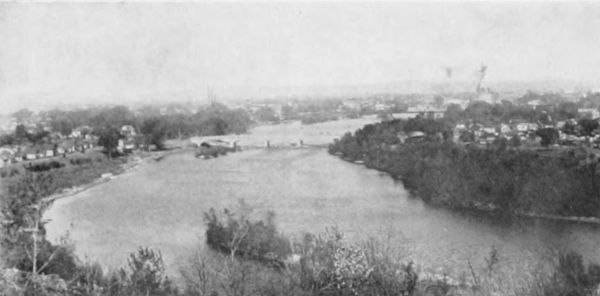
The city owns and maintains five bridges across the Cedar river. Of these bridges four are of steel construction and one—the Second avenue bridge—is a magnificent reinforced concrete bridge of Melan arch design. This bridge is one of the best and most attractive in the middle west. Its cost was more than $100,000.
[The city contracted in 1909-10 a new concrete bridge to replace the old steel bridge on Sixteenth avenue at a cost of $80,000. It is 40 feet wide and 2,600 feet long, and was opened for traffic January, 1910. A new concrete bridge will be contracted in 1911 at Third avenue to replace one of the oldest in the city.]
SIXTEENTH AVENUE BRIDGE, CEDAR RAPIDS
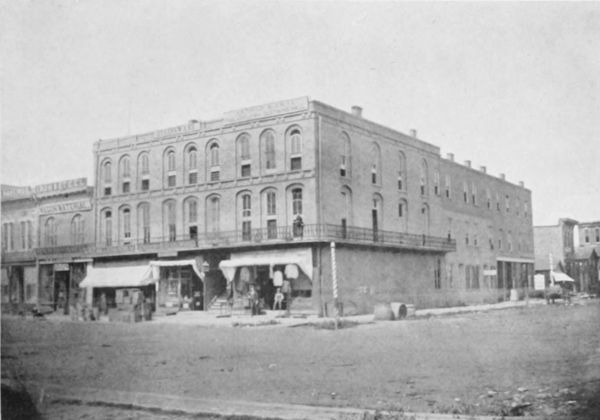
FIRST STREET, CORNER SECOND AVENUE, IN 1869
The city water works are owned by the city of Cedar Rapids, and are managed by three trustees appointed by the council. The plant was purchased from the water company July 1, 1903, at an agreed price of $473,000. Of this amount, $23,000 was paid in cash and the remainder was put in the form of bonds. In the past six years $158,000 of these bonds have been retired, leaving a net indebtedness against the water plant of $315,000. The net earnings of the plant from July 1, 1903, to July 1, 1908, were $79,952.30, and for the year ending July 1, 1909, were almost $25,000. In addition the city gets free hydrant rental and fire protection. A conservative inventory of the water plant will show a valuation of well over $600,000 at the present time. The water is taken from large wells on an island in the Cedar river belonging to the city and located some distance above the C. & N. W. bridge. It is filtered by the Jewell system and is forced through the mains by large pumps. There are three of these pumps in use, one of two million gallons daily capacity, one of three million gallons capacity and one of five million gallons capacity. The necessary power is supplied by two water tube boilers of 350 horsepower each, and three tubular boilers of 70 horsepower each. The filter system has a capacity of three million gallons per day, and an additional reservoir for the filter is now under construction. There are at the present time 390 fire hydrants and an excellent and satisfactory fire pressure is maintained for all fire alarms. A loop of twelve-inch mains encircles the business district and this loop is supplied by a twenty-inch main direct from the pumps, giving the business section a fire protection unexcelled by that of any city in the west.
THE RAILWAYS
Up to 1849 the village of Cedar Rapids had no formal organization. It was simply a township. But the legislature of 1849 granted a town charter and for the next decade the community throve apace. It was during this period of years that Cedar Rapids strove for, and secured, its first line of railway. In the fifties the railway lines to the west left the bank of the Mississippi and pushed their way out into the fertile prairies of Iowa. Among these lines was one known as the Chicago, Iowa and Nebraska, and its purpose was to construct a line of railway from Clinton, across Iowa, to some point on the Missouri river.
Among Cedar Rapids men who were prominently identified with the enterprise and were on the board of directors were John Weare, Jr., William Greene, H. G. Angle and S. C. Bever. The company was organized in 1856, but it was not until June, 1859, that the line was completed from Clinton to Cedar Rapids, a distance of a little over eighty miles, and train service established between the two towns.
Previous to the coming of the railroad, communication with the outside world was maintained by means of stage lines; Dubuque, Clinton, Davenport, Muscatine, Iowa City, and Waterloo being reached by that method. Freight and supplies were brought in by wagon, though in the early days there was some steamboat traffic on the Cedar river as far as Cedar Rapids.
It required hard work, and plenty of it, to get that first new line of railway into Cedar Rapids. Marion, the old, substantial town and the county seat, wanted the road—and came pretty near getting it, too. The next move in railway construction work for the community was the extension of the new line west, on its way to the Missouri river, a line which is today the main artery of the Chicago & Northwestern system, forming an important part of the great highway of steel connecting the Atlantic and Pacific.
The original promoters of the Chicago, Iowa and Nebraska Railway, living in Cedar Rapids, were anxious that that company should build a branch line up the Cedar valley from this point, and thus tap the rich and rapidly growing territory lying to the northwest of Cedar Rapids. But the company had no time or money with which to build side lines or branches. Its objective point was the Missouri river and the great beyond. So Judge George Greene, S. L. Dows, and other prominent public spirited men took up the task of constructing a road from Cedar Rapids to Vinton and Waterloo. Burlington capitalists and promoters joined in the work of extending the line from Cedar Rapids southeast to Burlington, and in a few years the embryo of what later became the Burlington, Cedar Rapids & Northern, the "Cedar Rapids route," with its lines radiating from Cedar Rapids to Clinton, Muscatine, Burlington, What Cheer, Iowa City, Sioux Falls, Watertown, Worthington, Forest City, Albert Lea, St. Paul, Minneapolis, and Decorah, was in existence. The shops, roundhouses and general offices of the road were located in Cedar Rapids, and everybody took pride and a personal interest in speaking of the institution as the "Home Road." The absorption of the Burlington, Cedar Rapids & Northern by the great Rock Island system, thus giving Cedar Rapids direct connections with all stations on that road, is a matter so recent as to be hardly history as yet. This change has been more in name than in reality. The shops are maintained, as in years past. An even larger army of trainmen and operative employes make Cedar Rapids their home, and the general offices for the northern district make use of the general office building constructed by the Burlington, Cedar Rapids & Northern Railway Co.
Cedar Rapids' third railway enterprise was the securing of the Dubuque & Southwestern, locally known as the "Slough Shore," from the manner of its entrance into the town. This railway was built and operated by the Farleys, father and sons, of Dubuque, and for many years, with its connection with the Illinois Central at Farley, maintained the only line of direct communication between Dubuque and Cedar Rapids. In the early days some very peculiar railroading was done on the Farley line, and the incidents and happenings, if gathered together, would make an extended volume.
The Dubuque and Southwestern is now a part of the Chicago, Milwaukee & St. Paul system, and over its tracks trains now run to Chicago, Omaha, Kansas City, Minneapolis, and St. Paul, as well as to the original sleepy little terminus of Farley.
The last steam road to enter Cedar Rapids was the Illinois Central, a line being constructed from Manchester by the late S. L. Dows. This line opens up to the shippers and business men of Cedar Rapids direct connections with the Illinois Central, and is of peculiar value in the traffic in southern and tropical fruits and commodities which come by water to New Orleans.
More recently the interurban between Cedar Rapids and Iowa City has been constructed, and with its hourly service it has won a business which makes certain the building of other and equally as promising lines in the near future.
Cedar Rapids of 1909, from a railroad point of view, is the traffic pivot of the middle west. Centering here are four of the largest railway systems of the country—the Chicago & Northwestern, the Chicago, Milwaukee & St. Paul, the Rock Island, and the Illinois Central. From Cedar Rapids direct lines radiate to Chicago, Peoria, St. Louis, Kansas City, St. Joseph, Council Bluffs, Omaha, Sioux City, Sioux Falls, Watertown, Minneapolis, St. Paul, and Milwaukee, the total mileage of the lines entering Cedar Rapids being about 35,000 miles. Direct service is maintained between Cedar Rapids and nearly 1,750 stations in Iowa, to say nothing of the thousands of stations in other and surrounding states reached by direct train service from this city. More than 225 railway and interurban trains arrive in or depart from Cedar Rapids daily. Approximately 80,000 carloads of freight are handled annually. The freight earnings are about $3,500,000 and the passenger receipts are about $1,200,000 each year. Three express companies, the American, the United States, and the Wells-Fargo, maintain offices in Cedar Rapids.
Recognizing the future of Cedar Rapids as a railroad, manufacturing and distributing center, the railroads have all been expending vast sums of money in the past few years in the acquisition of property for terminal purposes. The Chicago, Milwaukee & St. Paul, the Illinois Central, and the Rock Island now control absolutely the entire section of the city lying between Fifth and Ninth avenues, the river and Third street, and it is only fair to presume that the four blocks between Third and Fourth streets and Fifth and Ninth avenues will also be devoted exclusively to railway purposes. South of the city, along the river bank, the Chicago & Northwestern is expending thousands of dollars in the filling in of a large section of low land and old river bed, and on this made ground new and enlarged terminals and switch yards will be built.
The Chicago, Rock Island & Pacific is now engaged in the construction of its new terminals and freight depot on the blocks lying between Second and Third streets and Fifth and Ninth avenues, and when completed these terminals and depot will be ample for the accommodation of a freight business of a city of hundreds of thousands of population.
In the matter of passenger travel the city is well accommodated in the two depots, both on Fourth street, one occupied by the Chicago & Northwestern and the Rock Island, and known as the Union station, and the other occupied jointly by the Chicago, Milwaukee & St. Paul and the Illinois Central lines.
Mention must also be made of the Cedar Rapids and Iowa City interurban line, which maintains an excellent hourly service between the two cities. This line of road is the pioneer in the interurban field for the city, if the line to Marion be excepted, but is proving daily more and more popular and its business is increasing in such a measure that the building of additional lines of like character is only a question of the near future.
MANUFACTURING
From the days of its very earliest beginnings the people of Cedar Rapids have paid especial attention to the manufacturing industry. A large part of those who settled in Cedar Rapids came from the east where manufacturing leads all other industries and it is but natural that they should embark in their new home in those lines with which they were familiar. The papers and records of the early days tell of a long line of enterprises that have come and gone. There were flour mills, woolen mills, implement works, engine factories, wagon factories, oil mills—the list is a long and interesting one to the delver into local history.
With the coming of the railways, opening up markets for the manufactured products and affording means of collecting and bringing in the raw material, the manufacturing side of Cedar Rapids' activities has grown apace, until today Cedar Rapids, although not the largest of Iowa cities, leads them all in the amount of manufactured goods produced. In 1908 the total ran to nearly if not quite $22,000,000, and the output for 1909 will far exceed that great figure. There are now nearly 100 manufacturing institutions in Cedar Rapids, employing nearly 4,500 hands and paying more than $3,000,000 annually in wages.
Many of our manufacturing institutions are of many years' standing. The great mill of the Quaker Oats Company, the largest milling plant in the world, was originally established years ago as an oat meal mill by George Douglas and Robert Stuart, two thrifty and persevering Scotchmen to whose industry and far-sightedness is due the fact that at least the first course of the world's breakfast (after fruit) comes from Cedar Rapids. The great packing plant of T. M. Sinclair & Co., Ltd., giving employment to 1,200 employees and sending its products to all parts of the world, has done more to advertise Cedar Rapids than any other one agency. It was established by T. M. Sinclair, a young man from Belfast, and from its modest beginning many years ago it has become a plant representing an investment of millions and an ability to supply at least a large portion of the second course of the world's breakfast. Then there is the big starch works of Douglas & Co., the largest independent starch plant in the country—a plant where corn by the train load is daily transformed into starch and gluten feed. In smaller institutions note must be made of the Anchor Mill Co. and the T. G. White Cereal Co., with their specialties in flour and wheat flakes. While on the subject of cereals, note should be taken of the big elevators and cleaning houses of the Cedar Rapids Grain Co., the Clinton Grain Co., Jackson Grain Co., and the Wells-Hord Grain Co. Without doubt, the name "Cereal City" which has been applied to Cedar Rapids is not a misnomer.
In other lines Cedar Rapids leads as well as in those involving the conversion of the native products of agricultural Iowa. This city with its three great pump companies, the Cedar Rapids Pump Co., the Chandler Pump Co., and the Iowa Windmill and Pump Co., control the pump, windmill, iron pipe and plumbing supply business of the middle west. While the collateral lines covered by the Dearborn Brass Co., the Iowa Radiator Co., the Tokheim Manufacturing Co., the Vernier Manufacturing Co., the Smith-Talbott Co., and others add materially to the leadership of Cedar Rapids in these departments.
The Denning Fence works places Cedar Rapids in a leading position in the fence manufacturing business. The Perfection Manufacturing Co., the Hawkeye Skirt and Garment Co., the Welch-Cook Co., and the Clark-MacDanel Co., give Cedar Rapids a high position in the business of manufacturing clothing for both men and women that is not suspected, even by some of the best posted people in the city. Then there are other lines of manufacture. The J. G. Cherry Co., with their line of dairy and creamery supplies; the Cedar Rapids Sash and Door Co., the Williams & Hunting Co., and the Disbrow Sash and Door Co., with their big wood working plants; the various furniture factories, the cement and sand-lime brick plants; the big printing plants, for printing is a most important industry in Cedar Rapids; in short, the list is endless and as this is not a directory of the manufacturing industries of Cedar Rapids, further individual mention will have to be abandoned.
What is manufactured in Cedar Rapids? The list is a long and mixed one. It comprehends all kinds of breakfast foods, flour, starch, gluten feed, all kinds of packing house products, woven wire fence, candy, ice cream, pumps, iron pipe, windmills, plumbers' supplies, steam heating plants, machinery of all kinds, stone and ore crushers, hot air furnaces, cornices, bank, store and office fixtures, camp and lawn furniture, corsets, parlor furniture, mattresses, woven wire springs, undertakers' supplies, egg cases, dairy supplies, butter, concrete fence posts, sand-lime brick, prepared plaster, ice, gasoline engines, store step-ladders, hard wood specialties, electrical supplies, gasoline storage tanks and measuring pumps, manure spreaders, overalls, women's skirts, suits and jackets, shirts, photo paper, brass goods, coffee, spices, extracts, baking powder, sash, doors and blinds, steel baskets, tanks, stoves, school books, umbrellas, vinegar, pickles, wagons, carriages, omnibuses, automobiles, patent medicines, physicians' and hospital supplies, crushed stone, cigars, etc., etc.
It is noteworthy that of the many industries started in Cedar Rapids within the past twenty years, a very large per cent have been financial successes, some of them notably so. Nearly all of them have been launched in modest fashion and while nowhere is it possible for all enterprises to succeed, the few failures in Cedar Rapids have all been brought about by causes purely individual in the management or because of circumstances which seemingly no one could control.
Cedar Rapids has passed beyond the experimental stage as a manufacturing city. It has been demonstrated that industries can be established and operated successfully here and that goods made in Cedar Rapids will find a ready and stable sale in all parts of the world. In fact, Cedar Rapids is but just beginning her epoch of industrial prosperity and growth and she extends to all the invitation to come, see how those here are prospering, and join in the march of events which will in the years to come make Cedar Rapids one of the best known manufacturing communities in the whole United States.
In this connection it is not amiss to speak of the excellent conditions which have always surrounded the labor situation in this city. The manufacturing industry must, of necessity, depend very largely on the element of labor and in many localities strikes and strife and misunderstanding and trouble generally have added to the difficulty of the local situation. There has been but little of this sort of thing in Cedar Rapids. Labor has always been well paid, well treated and well satisfied in this city, and the little differences which have come up between employer and employee have all been settled promptly and satisfactorily. There has been an absence of the grafting labor agitator and all have worked harmoniously together to build up the city and its best interests.
THE STREET RAILWAYS
BY E. A. SHERMAN, EDITOR SATURDAY RECORD
The Marion and Cedar Rapids Improvement Company was incorporated March 8, 1879, to construct street railways on the streets of Cedar Rapids and Marion, and the highway between, known as the "Boulevard."
The incorporators were Addison Daniels, J. L. Crawford, C. C. Cook, and John Meredith Davis.
The officers were John Meredith Davis, president; James L. Crawford, secretary; C. C. Cook, treasurer.
On March 13, 1879, the city council of Marion passed an ordinance authorizing construction of the line in the city of Marion. On May 16th, the city council of Cedar Rapids passed an ordinance granting the Marion and Cedar Rapids Improvement Company the right to construct and operate street railways on Iowa avenue, and also on alternate streets.
October 13, 1879, the name of the company was changed to the Cedar Rapids and Marion Street Railway Company. John Meredith Davis resigned as president and was succeeded by W. M. Hewitt.
November 8, 1879, the city of Cedar Rapids passed another ordinance granting a franchise to the Cedar Rapids and Marion Street Railway Company for lines on Iowa avenue and on alternate streets. Up to this last date the enterprise had been fathered by Milwaukee and Davenport parties, who then dropped out. Construction had already been begun and the work was continued by Marion parties, prominent among whom were Mr. E. Latham, J. L. Crawford, and J. C. Davis. Mr. Latham advanced the money necessary for construction.
On January 8, 1880, Mr. Latham was made president of the company. In March of that year Judge George Greene (always foremost in any enterprise which would help Cedar Rapids) took a controlling interest in the company, and from that time forward, with the financial assistance rendered by Judge Greene, the work went rapidly on so that the line began carrying passengers between Cedar Rapids and Marion on the 3d of May, 1880, by steam motor between Twelfth street in Cedar Rapids and the terminal station in Marion, and from Twelfth street to Fourth street in Cedar Rapids in horse cars.
Both Judge Greene and Mr. Latham died early in the summer of 1880, and although Mr. S. C. Bever, Mr. A. J. McKean and other prominent citizens of Cedar Rapids and Marion afterwards became interested in the enterprise, the Greene family always held a controlling interest and were foremost in management of the company up to the sale in 1890.
Mr. Latham was succeeded as president by William Greene on July 15, 1880.
The board of supervisors forbade the company laying its track on the boulevard, and brought suit to enjoin such construction. The Eighteenth General Assembly (1880) passed an act authorizing street railway tracks on roads 100 feet wide. So the supreme court sustained Judge Shane in refusing the injunction. Early in the spring of 1881, the line was extended across the steam railway tracks at Fourth street to the foot of Iowa avenue. Soon after that date the company were not allowed to bring the steam motors below Fifteenth street, the horse cars carrying the Marion passengers up to that point.
The track between Marion and the city limits of Cedar Rapids were laid with "T" rails weighing sixteen pounds to the yard; afterwards changed to thirty-five pounds per yard. The horse car tracks were laid with flat rails weighing twenty-two to twenty-four pounds per yard, spiked on the top of wooden stringers. The first equipment consisted of two small second hand steam motors and four cars.
The extensions and additions made were: In 1882, track to fair ground from First to B avenue, only operated during fairs and amusements. Line on Adams (now Third) street, First avenue to Fourteenth avenue. Opened September 7, 1882. Line from First avenue and Commercial (now First) street to Third avenue, across Third avenue bridge on Third avenue to Sixth street west; also line on Third street north from Third avenue to A avenue, and south to Seventh avenue west. These west side lines began doing business in the fall of 1882, and early in 1883 car and horse barns were built at Third avenue and Third street west.
In 1884, line extended from Third street and Seventh avenue west to J. C. Young's addition at Sixth street and Fifteenth avenue west and afterwards taken up for want of business.
In 1886, line from First avenue east along Fifth street to Fifth avenue, up First avenue to Tenth street, thence on Tenth street and Mount Vernon road to Oak Hill cemetery; opened for business July 4, 1886.
Fair ground line taken up. New line on Sixteenth street from First to E avenue, built and put in operation November 15, 1886.
As the branch lines of horse railroad within the city of Cedar Rapids paid no profit, the Marion stockholders stoutly objected to the earnings of the Marion line being used for the sole benefit of the people of Cedar Rapids. So the Cedar Rapids and Marion Railway Co., on the 13th of July, 1889, conveyed to John W. Henderson—for the sum of one dollar—all of these branch lines excepting the Sixteenth street line. Mr. Henderson on November 14, 1889, deeded the same to the Cedar Rapids Street Railway, a company organized for the purpose of operating these city lines, and for the further construction of other city lines in Cedar Rapids, of which company C. G. Greene was president, U. C. Blake, vice-president, W. J. Greene, secretary, and George Greene, treasurer.
These city lines failed to earn enough to pay operating expenses and were all conveyed back to the Cedar Rapids and Marion Railway Co. on February 9, 1891. For the year ending June 30, 1884, the number of employes of the company was twenty, the annual wages $11,667.44. In 1889 the number of employes averaged twenty-eight and the annual wages $15,878.00.
During the years 1886 to 1890, the west side lines had been gradually abandoned, so that on December 1, 1890, there was only remaining the one on First street and across the Third avenue bridge to Third street, and thence on Third street southwesterly to Seventh avenue.
The entire equipment at that date consisted of two steam motors, two 28-foot coaches, one open trail car, 20 feet long, one baggage car, one 18-foot, six 12-foot, and eleven 10-foot horse cars, two snow plows, two flat cars and nineteen horses and mules, with the necessary harness and fixtures.
In the autumn of 1890 it came to the knowledge of Mr. J. S. Ely that non-resident parties were investigating the situation with a view of acquiring the property of the Cedar Rapids and Marion Railway, together with the city lines then owned by the Cedar Rapids Street Railway. Mr. Ely believing that it would be best for the interests of the city of Cedar Rapids that control of the transportation facilities be in the hands of resident property owners, who would have a greater interest in a more extensive system and better service, than those seeking merely financial profit, obtained options on a controlling interest in the capital stock of both of the companies. After which Mr. Ely and Mr. Henry V. Ferguson organized a syndicate consisting of Messrs. A. T. Averill, James L. Bever, Chas. H. Clark, Geo. B. Douglas, Walter D. Douglas, C. J. Ives, C. Magnus, P. E. Hall, J. S. Ely, and Henry V. Ferguson, who on December 15, 1890, purchased two-thirds of the entire capital stock of the two companies (the C. R. & M. Ry. and the C. R. Street Ry.) buying out all of the old stockholders except Frances R. Greene, C. G. Greene, S. C. Bever, Geo. W. Bever, and U. C. Blake. Immediately after this change of control, the stockholders paid in money enough to clear up all the floating debt of the companies, and put them on a good financial basis. The stockholders addressed the following communication to the mayor and city council of Cedar Rapids:
"To the Honorable Mayor and City Council of the City of Cedar Rapids, Iowa:
"The undersigned stockholders in the Cedar Rapids and Marion Railway, and in the Cedar Rapids Street Railway Company, respectfully represent to your honorable body that they are the absolute owners of all the stock of the corporations, and all are resident tax payers in said city, largely interested in its general progress and prosperity; that it is their purpose and intention to reconstruct, improve and extend the properties now operated by the said companies and to run the cars on said lines by electric power as soon as the necessary authority and the additional rights and franchises required are granted, and on the granting of the same, we pledge ourselves to take immediate steps toward putting on electric service, and to rebuild, maintain and operate, and from time to time extend the lines in said city to the full extent that ordinary business prudence will warrant.
"We, therefore, petition your honorable body to grant said corporations the necessary authority, rights and franchises to enable them to enter upon and make the changes and improvements above mentioned.
"P. E. Hall, A. T. Averill, Henry V. Ferguson, C. G. Greene, Walter D. Douglas, Jno. S. Ely, Chas. H. Clark, C. J. Ives, Jas. L. Bever, G. B. Douglas, C. Magnus, F. R. Greene, Geo. W. Bever, S. C. Bever, U. C. Blake.
"Dated December 31, 1890."
The franchise asked for by these stockholders was for twenty-five years.
Although the above application was warmly supported by the leading newspapers of Cedar Rapids, the city council refused the franchise so asked for, but instead on May 1, 1891, granted to the Thomson-Houston Electric Co. a franchise for fifty years, for lines covering substantially the same territory on the east side of the river as that served by the horse cars, and also for three miles of new lines on the west side of the river, to be afterwards located.
So these gentlemen who had put up their money to save the city of Cedar Rapids from non-resident ownership of transportation lines, found their purpose frustrated and with a fair prospect of losing their entire investment. Rather than suffer this, a majority decided to acquire this new franchise at the best price obtainable, and then go ahead with construction according to its terms. After this decision Mr. Ives and Mr. Magnus retired from the enterprise and took back their money. Previously, during the negotiation for the franchise, Mr. S. C. Bever and Mr. U. C. Blake had sold out. On the organization of the new company to take over the Thomson-Houston franchise, Mrs. Frances R. Greene, C. G. Greene and Geo. W. Bever sold their interests to the remaining stockholders.
Neither the Cedar Rapids and Marion Railway nor the Cedar Rapids Street Railway ever paid a dividend, so that all of the stockholders who had invested their money in these enterprises went out with entire loss of income, and most of them with considerable loss of principal.
J. P. Messer was superintendent from January 1, 1881, to February 22, 1883, when he resigned and was succeeded by Wm. Elsom, who remained superintendent until after the system had been changed into an electric railway.
CEDAR RAPIDS AND MARION CITY RAILWAY COMPANY
The Cedar Rapids and Marion City Railway Company was organized May 14, 1891, and immediately thereafter purchased the franchise for electric railways in Cedar Rapids recently granted to the Thomson-Houston Electric Co., and also took over all the rights, property and franchises of the Cedar Rapids and Marion Railway. A franchise for twenty-five years for an electric line from the terminal point in the city of Marion to the southwesterly city limits of Marion was granted to this company at about that time. The first officers were: Jas. L. Bever, president; Walter D. Douglas, vice-president; Chas. H. Clark, treasurer; Glenn M. Averill, secretary.
Within a few months Jas. L. Bever and A. T. Averill sold out and retired from the enterprise. After the reorganization resulting from this change in ownership, the officers were: P. E. Hall, president; W. D. Douglas, vice-president; Chas. H. Clark, treasurer; John S. Ely, secretary.
The stockholders were: Chas. H. Clark, Geo. B. Douglas, John S. Ely, J. S. Cook, Walter D. Douglas, Henry V. Ferguson, and P. E. Hall, of Cedar Rapids, Horace Williams, of Clinton, Iowa, J. E. Ainsworth, of Council Bluffs, Iowa, now of Williamstown, Vt., David P. Kimball and L. C. Kimball, of Boston, Mass., and J. Van Deventer, of Knoxville, Tenn.
No change of ownership except through division of estates of deceased stockholders has taken place up to the present time.
The work of construction and reconstruction was begun at once and vigorously pushed during the season of 1891.
All tracks were entirely new excepting from Sixteenth street to Marion. Those across the First avenue bridge were laid with strap rails, nailed to the bridge plank. The balance of the double track with 58 pound girder rails. All other new lines with 45 pound "T" rail. The strap rail was taken off the bridge and girder rail substituted a few years thereafter. The city lines on the east side of the river were open for business in November, 1891, the west side lines in December, 1891, and electric service begun to Marion in February, 1892.
The main line mileage of the road at this date, not counting spur and sidetracks is, within the city of Cedar Rapids 12.85 miles, of which 2.28 miles is double track. From the city limits at Kenwood to Marion, 2.80 miles; total 15.65 miles.
The Marion line above Twentieth street through to Marion has been entirely rebuilt with new rails, the grades cut down, the alignment changed, the track ballasted, a new steel and concrete bridge built over Indian creek; so as to make that portion of the road fully adequate for the business.
Within the last three years all of the girder rail tracks east of the river have been relaid with 60 and 80 pound "T" rails and the number of ties increased fifty per cent.
The service has been increased to once in fifteen minutes each way and extended to twelve o'clock at night on all the lines excepting the Marion line, where the service is once in twenty minutes during the day and up to 12:30 a. m.
The power plant first installed consisted of two 125 horsepower engines connected by belts to two 75 k. w. generators. It now consists of one 400 horsepower engine belted to a 300 k. w. generator, and one 750 horsepower engine directly connected to a 450 k. w. generator. The output of power is equalized by a storage battery of 272 cells. The boilers, smoke stack, switch board, condensers and all minor machinery have been correspondingly increased and improved.
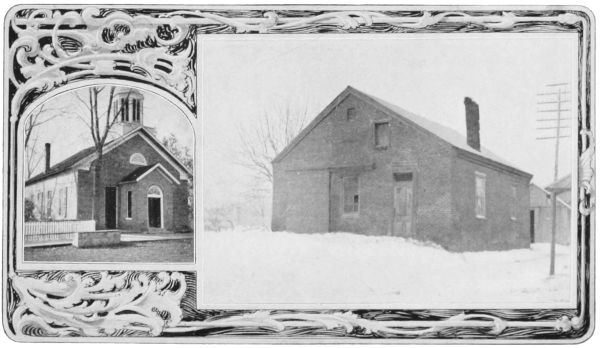
U. B. CHURCH, LISBON Built 1855 FIRST U. B. CHURCH WEST OF MISSISSIPPI RIVER Built and Presented to Members at Lisbon in 1850 by Rev. Christian Hershey
The car barn (originally a wooden iron-clad building 80×140 feet) has been enlarged and new brick buildings erected with shop room for building car bodies and trucks, and making all necessary repairs to cars and electric equipment; so that the present storage shop and office buildings, with storage for lumber and ties, covers six full sized city lots. The company now builds its own car trucks and car bodies.
For the year 1892 (first year of operation of electric lines) the average number of employes was 81, and the total wages paid $37,610.12. For the year 1908 the average number of employes was 143 and the annual wages $84,328.73.
William Elsom was superintendent from the organization of the company until June, 1892, when he resigned and was succeeded by F. L. Diserens, who still holds that position.
The present officers and directors are: P. E. Hall, president; Henry V. Ferguson, vice-president and secretary; John S. Ely, treasurer.
The directors are P. E. Hall, John S. Ely, Henry V. Ferguson, George B. Douglas, and Edward C. Clark, all of Cedar Rapids; Walter D. Douglas, of Minneapolis, Minnesota; and David P. Kimball, of Boston, Massachusetts.
THE COMMERCIAL CLUB
FROM THE SATURDAY RECORD, JULY 10, 1909
The city of Cedar Rapids has had a number of commercial organizations, formed to advance the business interests of the community, in the sixty years of its existence, but all the earlier associations were of a more or less informal character, and while they did good work as long as the enthusiasm lasted, the time came when each and every one passed into history. It was not until 1897 that a permanent commercial club came into being and that organization, which is now known as the Cedar Rapids Commercial Club, has for the past twelve years played a most important part in the upbuilding of the city and the promotion of its best commercial and industrial interests.
The events leading up to the organization of the Commercial Club form an interesting story, and as the editor of The Record was personally identified with them, he here takes the liberty of making the facts a matter of record.
In April, 1897, a meeting of the Fifth District Editorial Association was held at Excelsior Springs, Mo., and as part of the entertainment, a delegation from the Commercial Club of Kansas City, escorted the members of the Editorial Association from Excelsior Springs to Kansas City and devoted a day to showing them Kansas City from every point of view. The stock yards, the packing houses, the fire department, the newspaper offices, the parks were visited, a reception and luncheon were tendered at the Commercial Club rooms and a dinner was served at one of the leading hotels. Following the return of the party to Excelsior Springs, A. N. Palmer, president of the Cedar Rapids Business College and editor of the American Penman, and the editor of The Record were discussing the splendid entertainment of the Kansas City boosters and what it meant to a city to have such a live organization; and it was then and there decided that Cedar Rapids ought to have such a club. The matter was talked over at length and the result was that as soon as possible after returning home, Mr. Palmer issued a letter to some 400 of the business men of the city reciting the need of such an organization in Cedar Rapids and calling a meeting for the purpose of considering its formation. That meeting was held in the assembly room of the Cedar Rapids Business College on the evening of June 8, 1897. It was decided to form the club and at a subsequent meeting, held July 2d, the club was formally organized. A. N. Palmer was chosen the first president and the editor of The Record was elected temporary secretary, serving until the election of the first permanent paid secretary, Ed. R. Shaw, who assumed office July 15th. The first offices of the club were in the Granby building, the rent being a donation from Mr. E. A. Higley. Subsequently, in May, 1901, came the consolidation of the Commercial Club with the Occidental Club and the removal to the Masonic Temple, which has since been the home of the club.
With the consolidation came the addition of the social feature, including reading room, billiards, and later, the inauguration of the noon-day lunch, which latter has proved to be most popular, and which has done much to bring the members in closer touch each with the other.
Ever since organization the Commercial Club has been fortunate in securing as officers men who have been willing and able to give the organization their time, best thought and energy, with the result that it has been and is now a live and potent force in the community. Such men as Palmer, Anderson, Forbes, Newman, Safely, Rall, and others, have filled the presidency with credit to themselves and profit to the club and the city, and in Shaw, Lincoln, Charles, Simmons, Sessions, Shaver, Bell, and Wunderlich the Commercial Club has had secretaries who have labored faithfully to further the best interests of the organization and city. The present officers, J. F. Rall, president, and John Wunderlich, secretary, are making records in their administration and achieving results that speak for themselves.
The work of the Commercial Club is so wide-spreading and presents so many aspects that it is impossible to refer to it in any detail. The idea of the club is to arrange systematic work to be done by the members, as well as by the officers, and with that in view, there are a number of committees in charge of various departments of the work, as follows: Assembly, Civic, Entertainments, Executive, House, Interurban, Legislative, Manufactures, Mercantile, Membership, Navigation on Cedar River, Public Institutions, Trade Extension, Tariff and Transportation, Special Convention, Railway Service, Statistics. These are all regular standing committees. In addition, many special committees are appointed to take up special or emergency matters.
As the result of the labors and aid of the Commercial Club, many prosperous and valuable manufacturing industries have been brought to Cedar Rapids the past twelve years. Many local businesses have been encouraged to start and aided on their way to success. Many established businesses that have needed encouragement have been given it and other businesses that have found difficulties in their pathway have had those difficulties removed through the offices of the Commercial Club and its members. Conventions and public gatherings of many kinds have been induced to hold their meetings in this city through work performed by the Commercial Club. Vexatious local disputes have been adjusted, and when cities like Indianapolis have attempted to entice such organizations as the Order of Railway Conductors away from Cedar Rapids, the Commercial Club has been found stanchly and successfully contesting the removal. When it was found necessary to secure legislation amending some phases of the commission plan law to make it fully applicable to Cedar Rapids, it was the Commercial Club that went before the legislature and secured the needed amendments. It was the Commercial Club that first began the work of running trade excursions, an idea that has grown with each year. The trip of this spring, to Le Mars, via the Illinois Central and return via Sheldon, Mason City, and Calmar on the Chicago, Milwaukee & St. Paul, occupying four days with ninety in the party, was by all odds the best and most profitable of all the series.
Within the past year a new and valuable department has been created in the freight traffic bureau. The work of this department is to bring about an equitable condition in freight rates for Cedar Rapids, as compared with other cities of like location and surroundings and eliminate discriminatory freight rates as compared with other jobbing centers. In the prosecution of the work of this bureau, the Commercial Club has been most successful, for up to the present time adjustments brought about by the bureau represent a saving of about $24,000 per year to the manufacturers, jobbers and business men of the city. In addition to the work of bringing about an equalization of freight rates, an individual service is maintained for the purpose of examining freight claims against the railway companies. In this particular many claims of long standing have been satisfactorily adjusted.
The Commercial Club has a present membership of 280, made up of the leading business and professional men of the city. It is a live, active organization, reflecting the best and most progressive citizenship of the community. The club apartments occupy a large portion of the fourth floor of the Masonic Temple, are commodious and comfortable, and form a gathering place for the discussion of matters which affect the business prosperity of the city. Regular meetings of the board of directors are held every Monday noon, following a lunch served in the directors' room, and at these meetings the docket for the week is cleared up. It is a significant fact that these meetings are attended by practically the entire membership of the directory and that no matter is allowed to drag for want of immediate attention.
The officers and directors of the Commercial Club at the present time are: President, J. F. Rall; first vice-president, F. Junkermann; second vice-president, S. G. Armstrong; secretary, John Wunderlich; treasurer, L. W. Anderson; directors, J. W. Barry, J. S. Broeksmit, W. L. Cherry, J. M. Denning, Kent C. Ferman, J. M. Grimm, W. G. Haskell, Geo. T. Hedges, E. E. Pinney, R. I. Safely, John H. Taft.
WHO PAID THE TAXES IN CEDAR RAPIDS FIFTY YEARS AGO
BY THOMAS DEVENDORF
Cedar Rapids has made many changes and improvements during the past half century. But perhaps no change has been so great as the change in the valuation of property. In 1858 there was a population of only about thirty-five hundred within the city limits, and in the entire county only eighteen thousand. Twenty per cent of the population then resided in Cedar Rapids. Today we claim nearly thirty-five thousand and over fifty per cent of the entire population of the county. At that time the area of the city was very much less than at present. Franklin street, now Eleventh street east, was as far as was platted. Beyond was heavily wooded and used in summers for picnic parties; to the south Carpenter's first addition had already been laid and but very few of the lots had been improved, the lower end, where the packing plant of T. M. Sinclair & Co. is located, was used as a race track, where the local horsemen competed. Kingston, on the west side of the river, was an independent municipality, having its own city government and city officers, and remained so until the year 1870, when it was annexed and became a part of the present Cedar Rapids.
The assessed valuation of the city for the year 1858 was for both real estate and personal the sum of $535,912—what proportion that amount will bear to the real cash value of the property the writer is unable to state. But it is the rule generally adopted by assessors to make the value much less than the price parties would buy and sell the same property for, and on this assessment of $535,912 a levy was made of two mills on the dollar, which, if the collector was diligent and had good luck, would have produced the sum of $1,071.00, which the city officers could use to carry on the affairs of the city—pay salaries, make improvements, grade streets, build crossings, and to meet all other expenses of the city. That this sum was inadequate for the purpose is shown by the fact that the larger share of the taxes of this year were paid in what they denominated "city script," which we call city warrants, so that the city fathers had very little real cash in the city treasury. This city script was issued for work and salaries and such other expenses as were necessary and was not interest bearing, so that a party that had such script was ready to dispose of the same to the best advantage he could, and parties that had taxes to pay would gather up such script at what discount they could get and use it for the purpose of paying their taxes. The larger tax payers all paid in "city script."
The city officials of that time are all dead. R. C. Rock was mayor; George Seymour, recorder; A. S. Koontz, treasurer; A. S. Belt, city attorney.
J. J. Snouffer and John G. Graves were the aldermen from the first ward; D. W. Sprague and R. R. Taylor, aldermen from the second ward; Wm. Richmond and S. A. Shattuck, aldermen from the third ward.
There are only eight residents of this city at the present time whose names appear on the tax list of fifty years ago; the only ones we can remember are the following: James Bird, Isaac Carroll, E. Coulter, C. Fordyce, Jos. Perigo, David Lighty, P. F. Randall, and Wesley Stephens. Some of the above paid a poll tax only. David Lighty paid tax on lot 3, block 28, original town, and has paid taxes on this same lot all the years since and owns the property today. Isaac Whittam paid the taxes on lot 5, block 13, original town. This is the corner lot on which the Montrose Hotel is located. The lot was then valued at $550, and the tax was $1.10. Isaac Carroll paid the taxes on three city lots, the total value of which was $585; also on two horses, value $150; one carriage, value $75; his tax was $1.92, paid in script. E. Coulter paid on a stock of merchandise (drugs) valued at $800.
A few others who are listed on the tax books of half a century ago are known to be living, but have removed to other places.
W. W. Smith, of Minneapolis, who was an active business man at that time, owned five lots on Second street, between Fifth and Sixth avenues east, on which he built a large brick building, intending to use it as a hotel. It was, however, used as a residence property, and was known as the Wadsworth Block. This property was located where the Illinois Central railroad lately erected their fine new freight depot, corner of Fifth avenue and Second street.
S. D. Carpenter, now a resident of Chicago, paid the taxes on the south 280 feet of out lot 4, valued at $850, tax $1.90. This property is located on Third avenue, between Eighth and Tenth streets, and includes the homes of A. Sinclair, Rev. Burkhalter, Ed. Clark, and the late home of Robert Williams.
Geo. Greene was the largest individual taxpayer of that day. He was assessed with some 70 city lots. Many of them were in the business part of town, the total assessed value of these was $28,575, and the tax was $56.40.
In his list were lots 3, 4, 5, 6, block 24 original plat, property on which is now located the Allison hotel, the College Inn and the three business rooms to the west, all on First avenue. Also a lot at corner of Second avenue and Fourth street, now owned by Mr. C. Magnus; these four lots were valued at $2,200 and the tax was $4.40. He owned lots 4 and 5 block 42 assessed at $300 each. These are now the homes of Dr. Geo. Carpenter and Mike Ford. He also paid the taxes on 125 feet on First street lots now occupied by the Rudolph block, the Gazette office, Geo. C. Haman drug store and Geo. Yuill farm implements. The total value of this 125 feet was $3,600, the taxes $7.20. At that time this property was occupied by a large three story hotel called Greene's hotel, and it is said by those who were guests of the house that it was one of the best west of Chicago. The next largest taxpayer was John F. Ely, who was assessed on 38 building lots at an assessed value of $24,800 and on which he paid a tax of $51.16. Lots 1, 2, 3, 4, 5, block 14, original plat, was valued at $3,500.00, tax on same $7.00. This was his home. A comfortable, unpretentious cottage occupied the center of block, surrounded by shrubbery, flowers and many apple trees. These lots are now occupied by the large business houses of Jones & Luberger, Martin Dry Goods Co., the Dows block on the corner of Second street and Second avenue, and also Snowden's, corner of Third street and Second avenue. He also was assessed with the property now belonging to the Churchill estate, corner of First street and Second avenue, value $1,150.00, tax on same $2.30. Lot 10, block 24, original plat, now occupied by the Cedar Rapids National Bank and for many years known as the old Baptist church corner, was assessed at $700.00 and the tax was $1.40.
Mr. Ely was also the owner of lots 4, 5, 8, 9, block 15, which is now the John H. Taft corner, and the store of Ludy & Taylor, all on First avenue, together with the property on which is located the "Oriel" block and part of the next lot to the west, both on Second avenue. These four lots now just in the most valuable part of the business district, were valued at $2,850.00, on which he paid the city tax of $5.70. The lot on the corner of Second avenue and Fifth street on which the Public Library is located, was one of his lots and is one that he continued to own up to the time it was condemned by the library board for the purpose of erecting the library building. This lot was assessed at $425.00, tax paid 85 cents. He was also the owner of lots 8, 9, 10, block 23, original plat. These are on First avenue between Fourth and Fifth streets. These three lots were assessed at $1,350.00, tax paid on same, $2.70.
The lots 1 and 2, block 4, was also included in his district. These are on the corner of First street and Second avenue. It was regarded as valuable property by the assessor of fifty years ago, as he has these two lots assessed at $3,700.00. No other two lots in the city were rated at so high a value as these. This must have been regarded as the best business location of that day.
The next Cedar Rapids tax payer who had to gather up the next largest amount of city scrip with which to pay his city tax was Mr. N. B. Brown, who was assessed with 47 city lots the total value of which was $20,750. This with some personal property, as merchandise, horses, cows and bridge stock made his total property valuation $23,290.00 and on this amount he paid a city tax of $46.58. Mr. Brown was one of the owners of the original plat of the city and many pieces of property which are now very valuable was at that time set off to him as his share of the original town plat.
Lots 3 and 4, block 25, are two valuable pieces of property. These are on Second avenue between Third and Fourth streets and on which is located the Damour Grocery House, and some of the property on which the new government postoffice is erected. These two lots were assessed at $900.00 on which he paid a tax of $1.80. Mr. Brown also was the owner of lots 6, 7, 8, block 23. These were on the north side of First avenue and extended from Fourth street west to where the Grand hotel now is and included the Chicago & Northwestern freight depot, the Pullman House, the Delavan hotel and the property now owned by Mr. Lansing and used as a saloon. These three valuable lots were then assessed at $1,700.00 on which he paid the tax of $3.40.
Another fine piece of property was his home, which was the entire block 38. His fine brick residence was located in the center of the block and was at that day one of the finest dwellings in this part of the state. These ten lots which were all included was valued at $3,250.00. This property has been sold and sub-divided until the only part left is the southeast corner of the block which N. E. Brown his son, now occupies with a fine modern brick dwelling, directly opposite Grace Episcopal church.
He was also the owner of the property on which Gorman's hotel is located. This hotel was built by Mr. Brown and a few years after it was considered the best hotel to be found in this part of the state. The upper story was finished for an amusement place and before the building of Greene's opera house this was the only place that could be used for that purpose.
Mr. Brown was largely engaged in milling at that time and owned and operated a woolen mill and also a flouring mill, the buildings of both are still standing but have not been in operation for some time.
Greene, Merritt & Co. were the bankers of that period and were assessed with one city lot, corner of First street and B avenue, value $700.00, together with their bank capital $20,000. Their city tax was $41.50. The senior member of this firm was Geo. Greene, who was the largest real estate owner of that date and who has been mentioned before in this article. Mr. Merritt, the other member of the banking firm, was a brother-in-law of Mr. Greene. Messrs. Geo. Greene, Wm. Greene and Joseph Greene were brothers and together were largely instrumental in shaping the development and growth of Cedar Rapids. They had faith in its future and did not hesitate to give their money and their time to every effort made to advance, build up and beautify their home city.
Wm. Greene was assessed with some twenty city lots, the value of which was $5,625.00, which with some personal property assessed to him made his total valuation $6,360 and his tax paid in city scrip $12.72. He was the owner of the east 1/2 of out lot 6 and Mr. Merritt was the owner of the west 1/2 of the same out lot. This property was assessed at $19.00, for both Mr. Greene's and Mr. Merritt's part. This out lot is situated between Fourth and Fifth avenues and Eighth and Tenth streets and is now built up with some of the finest homes in the city. A. C. Taylor, Luther A. Brewer, Mrs. N. Bourne, Henry S. Josselyn, Dr. Ruml, Wm. H. Dutton, Geo. A. Mullin, John H. Taft, and many others have homes in this out lot.
Greene Brothers were assessed with eight lots, all well inside the business district, which were valued at $5,085.00; tax on same $10.17; lots 6 and 7, block 16, value $1,300.00; tax $2.60. These lots are on the corner of First avenue and Third street and are now occupied by Tony Naso on the corner for a fruit store and the balance of the lots by the "Fair Company."
Mr. Daniels was another large owner of Cedar Rapids real estate, fifty years ago. The assessor for that year had him listed with 38 city lots besides four entire out lots, together they were assessed at $17,025.00, and the tax on the entire property was $34.05, all paid in the usual city script. Some of this property lying in and near the business part has become quite valuable. Lot 2, block 5, being a lot on Second street between Third and Fourth avenue, was listed by the assessor at $500.00. This piece of property was sold to John Murray some two years ago for some $12,000.00, or thereabouts. This is now occupied by the interurban railway as their depot. Another piece assessed to the same party, lot 6, block 12, corner of Third street and Fourth avenue, the rear part of this lot is being improved this present season by the Bohemian Turners. This lot was assessed at $425. Tax on same, 85 cents. Mr. Daniels was also owner of lots 8 and 9, block 14. These lots are on Third avenue between Second and Third street and are owned by Sam Armstrong and John S. Ely, the assessed value of the two lots was $1,250.00 and tax on lots $2.50.
Lot 10, block 42, value $375.00. This is the corner lot on which the Methodist church is located. Lot 1, block 43, value $350.00. This is the corner on which the Christian church was built.
Lawson and Lowell Daniels, under the firm name of L. Daniels & Co., were assessed with 19 city lots, value of which was $8,775.00. Merchandise, $1,000; five horses, $375.00; three carriages $150.00. The total tax was $21.40.
Lot 5, block 2, is the lot on which the Masonic Temple is now located, and was valued at that time at $2,400.00. They used it then and for many years after as a store room and did a very large business. They sold about everything to be found in a well regulated country store, and were known for many miles around as reliable and enterprising merchants. They were also owners of lot 3, block 15. This is the lot on which the Reps Dry Goods Co. is located and was valued at $700.00. They were also owners of out lot 16, valued at $350.00. This is located between Third and Fourth avenue and Twelfth and Fourteenth streets, is now nearly all improved with fine homes, the new Westminster church is on this block, corner of Fourteenth street and Third avenue.
Harvey Higley and his brother, Henry Higley, under the firm name of Higley & Co., were large owners of city real estate, the larger part of which was in the district now given up to business. They were owners of the lot on which the Granby Block now stands, which at that time was only valued at $700.00. They were also assessed with the property on which the Denecke Dry Goods store is now located. This was assessed at a value of $80.00. On this lot was a large livery stable of which the Higleys were the owners, and which they conducted for many years after. They were also the owners of the lot, corner of First avenue and Second street, now occupied by Oscar Solomon, and ten years after erected the store building now standing thereon. This piece of property was valued at that time at $725.00. They were also assessed with lot 3, block 2, at a valuation of $1,700.00. This is on First street and is now occupied by Kubias & Son, as a harness store.
Sampson C. Bever was assessed with real estate to the value of $9,480.00, and personal property $515.00. On this assessment he paid a tax of $19.99. The most valuable piece of property held by himself that time was the homestead which was located on First avenue and between Fourth and Fifth streets. These five lots were assessed at $2,325.00; the house, which was a large brick structure, stood about where the old B., C. R. & N. Railway erected their general offices a few years since. The Milwaukee railway depot is also located on one of the lots of the Bever home property.
Mr. Bever was also assessed with lot 1, block 3, original town, at a valuation of $1,875.00. This is the lot on which the banking house of the Commercial Savings Bank is located and is a property which the Bever family have paid taxes on for over a half century. A large part of Mr. Bever's property was in lands lying outside of the city limits and which the writer of this article is not able to correctly describe. Mr. Bever located in Cedar Rapids in April, 1852, and for a number of years was engaged as a merchant, after which he became interested in banking and was the head of the private banking house of S. C. Bever & Sons. This bank afterwards became the City National Bank and was the first national bank to be established in Cedar Rapids.
H. G. Angle & Co. paid on a valuation of $4,700.00 real, $3,000.00 personal. They were largely interested in milling and also conducted a large store. The building in which they operated is still standing on the corner of A avenue and First street and is now occupied as a saloon. The company was assessed with twelve city lots.
A. M. Mekeel was assessed with personal property only, value $6,000 and paid into the city treasury the sum of $12.00. He paid the largest tax on money of any one in Cedar Rapids except the bankers on their bank capital.
Geo. Ohler, lot 8, block 11, value $375.00. He paid a tax of 29 cents. This was his home and was located on Sixth avenue and here he and Mrs. Ohler resided for over fifty years. Mr. Ohler died about four years ago and Mrs. Ohler more recently. The only member of the family remaining is Mr. Frank Ohler.
S. Nyere paid on merchandise value of $100.00. Mr. Nyere was a tailor and continued in that business for many years after. He was the father of Geo. Nyere, late candidate for mayor, also of John and Louis Nyere, plumbers, all successful and pushing business men.
Philip Otterbein, one city lot valued at $250.00, tax paid, 50 cents. Henry Otterbein of the west side is a son of Mr. Otterbein.
S. L. Pollock was the owner of a number of city lots, the value of which was $2,340, and on which he paid a tax of $4.58. He owned lot 8. block 2, on which is located Greene's opera house, and valued at that time at $700.00. He also owned a lot on First street about opposite the auditorium valued at $375.00, and also a part of the land on which the auditorium now stands.
Wm. Passmore was assessed with one business lot on First street about the middle of the block on the east side between First and Second avenues, and which was valued at $600.00. This with $535.00 of personal property, made his city tax $2.27.
G. A. Reichenecker was assessed with lots 1, 2, 3, 4 and 5, block 48, which were valued at $1,575 on which he paid a tax of $3.15. These five city lots are located on Second avenue between Sixth and Seventh streets, and on which are located the homes of the late Isaac Shaver and U. B. Sanders and Mrs. Lawson Daniels.
Mr. Sanford, a non-resident, was assessed with out lot 5 at a value of $1,700.00. This out lot is situated between Eighth and Tenth streets, Third and Fourth avenues, and contains the homes of J. S. Frick, David Blakely, Mrs. G. Carpenter, E. E. Pinney, all on Third avenue, and L. Benedict, E. J. Carey, Mrs. L. Wallace, J. C. Pickering, R. M. Garrison, David Lighty and Jas. W. Wiley, all on Fourth avenue. This property at that time contained nothing but native timber and a luxurious crop of sand burrs.
John Weare was the owner of out lot 2 and which was valued at $1,700. This property is on First avenue and between Eighth and Tenth streets, and on which is now located the homes of Col. Clark, John M. Redmond, E. E. Rothrock, Jno, B. Henderson, Henry Soutter, Chas. J. Fox, Wm. J. Greene, and a number of others. Mr. Weare paid taxes on several other lots and also some personal property.
Geo. Parr paid the tax on lot 2, block 21, value $300.00. This was his home lot and on which he had a good brick house. This was on C avenue and has now been entirely taken up by the Quaker Oats mill plant.
C. B. Rowley was the owner of several pieces of city property. Lots 1 and 2, block 31, which was valued at $875.00, was owned by him. The Perfection Manufacturing Company is located on lot 1. He was also the owner of lots 1 and 2, block 47, corner of Third avenue and Sixth street. The Sisters of Mercy now own lot 1 and Jos. F. Kouba resides on and owns lot 2, these two last lots were valued at $575.00. Mr. Rowley was engaged in buying grain and other farm produce. The warehouse was located on ground now occupied by the Quaker Oats plant. He was for a number of years a member of the school board of this city.
S. A. Shattuck was assessed with lots 4 and 5, block 29, which were valued at $650.00. On these two lots he paid a tax of $1.30. Mr. Shattuck built his home on lot 5 over fifty years ago and here he and his wife lived until his death. Mr. Shattuck was one of the pioneer business men of Cedar Rapids. He came here in 1852, and was active in a business way until a very recent date. He was a partner of Geo. Dewey under the firm name of Shattuck & Dewey, and together they had a store on First street. Mr. Shattuck built the three store brick building now standing on First avenue between the alley and Second street and then known as the Franklin block. Frank Kilborn owns one of the store rooms today.
Wm. Stewart became a taxpayer in Cedar Rapids at a very early day. He came here in 1847. Fifty years ago he was the owner of lot 9, block 16, valued at $700.00. This is on First avenue between Second and Third streets, and is now occupied by Russell Confection store. He was also owner of part of the property on which the Y. M. C. A. building is now located. Mr. Stewart was a blacksmith, plowmaker, and had a shop on A avenue. Ex-Alderman Jas. Hughes is now engaged in nearly the same business and in the same building that Mr. Stewart built and occupied fifty years ago.