Chapter XXXVI · Cedar Rapids
Reading edition
Cedar Rapids is not a new town. True, it has not been flourishing for centuries, like the old European cities, with histories which reach back several centuries, but as cities and towns in the middle west are spoken of, it has a lengthy history and one of more or less interest. Young as it is, Cedar Rapids has no definite chronicle as to who was the first actual settler. Dyer Usher claimed that he and a companion gazed upon the beauty of its banks and admired the river at the upper falls as early as 1836. Osgood Shepherd maintained that he was the first actual settler, and that he opened a tavern here in 1837 or 1838. He, at least, sold his squatter right in the embryo town, and made the first property deal involving landed rights in what later became the city. J. Wilbert Stone, also known as Bill Stone and William Stone, was here as early as any white man. He was born in the state of Rhode Island about 1803, and emigrated to Iowa Territory in the early thirties. Stone was a well educated, quiet, and refined man, who possessed all the traits of a trader. He drifted into Davenport and Rock Island, and came to Westport some time after William Abbe. No doubt he came from Rockingham up along the river looking for a place to barter with Indians, and the few white men who might come along as hunters and trappers. He conducted a small trading post at Westport some time in 1837, but whether he was the first storekeeper in the county is not known, as this honor has also been accorded to John Henry. Whether Henry bought Stone out or not is not certain, but this is true, that Stone disposed of his interests and removed ten miles by trail up to the lower rapids, at the bend in the Red Cedar river, where the large packing plant of the T. M. Sinclair Company now stands, and here laid out a squatter town, which he called Columbus. This town site is supposed to have been staked out on the east side of the river. The time must have been in 1837. He quarreled with Shepherd, who either came about the same time, or closely followed Stone. Stone, being a quiet, peaceable person, still single, was compelled to cross the river and take up a claim on the west side. Robert Ellis asserts that he found the first small hut on May 8, 1838, on what became Cedar Rapids, and that it was located on the east side near the packing plant, and was occupied by Philip Hull. Had Shepherd sold this cabin to Hull after having driven Stone across the river? That might be probable, as Shepherd tried the same dodge on Ellis a few months later when he was building a cabin on his claim on the west side of the river. In that instance Shepherd had a prospective purchaser who was willing to go into Ellis's shack, and but for the nerve and presence of mind of Ellis, Shepherd might have succeeded. From Stone's daughter, still living, it would seem that Stone was the first actual settler who came here to trade with the Indians, and the first to lay out the squatter town which later became Cedar Rapids, and that this plat or staking out was on the east and not the west side of the river, all of which would be natural as all the other squatter towns had been staked on the east side, and thus were better defended from an attack of Indians or border ruffians, who were apt to congregate more frequently on the west side of the stream.
Robert Ellis walked into the town and found Hull, and later Shepherd, located in a small cabin, which he called a tavern situated on the river bank on what is now First avenue. Mr. Ellis also found at this time John Young, a Scotchman, Granger, Fisher, and another Scot by the name of Galloway. Shepherd laid claim at that time to nearly all of the land on the east side of the river and especially the land adjoining the dam site and the slough now called Cedar lake. A few hunters and trappers came now and then and remained at the Shepherd cabin for days at a time and then would depart as quietly as they had entered the crude hotel on the river bank. It has been reported that Shepherd harbored border ruffians and it has been said of him that while "he did not willingly steal, he had not scruples about harboring those who subsisted from that kind of traffic." So far as authentic records indicate, we have no written or reliable sources of information except hearsay, till Robert Ellis walked up the river and found the cabins of Hull and Shepherd on the east side of the river, which property rights were claimed by these parties as squatter owners. By this time Stone had removed to the west side of the river and had already erected a cabin. Being a single man he was not at home at all times, and thus might have been away at the time Ellis arrived. Ellis soon discovered from what Shepherd said as well as from what Stone had intimated, that these men were at outs, and the best way to keep peace was to have the river between them. Ellis had been out in the world long enough not to mix in the quarrels of other men and to keep as close-mouthed as possible about the troubles between sworn enemies. They never associated after their quarrel. The daughter of Stone claims that her father told her many times that the reason he sold out and removed to the Iowa river bottom was on account of Shepherd's attitude and that of the members of his gang toward him. These men feared that Stone would inform on them and wanted him out of the way so long as he refused to become an associate of theirs or in any way to approve of their actions.
It would seem plausible that in a community where so many were law violators and enemies of law and order a man like Stone would not be tolerated and the ruffians would do all in their power to get him out of the way by intimidation or otherwise.
N. B. Brown, from what we have been informed by N. E. Brown and others, must have passed through what became Cedar Rapids as early as 1839 but he did not locate here till the following year, when he first realized the full value of the falls and the feasibility of a plan to erect a suitable dam across the river which would furnish power to run saw and grist mills. Galloway, Young, Granger, O. S. Bowling, and a few others were here in the meantime, all holding down claims, but no one thought of any future city to be founded or of any valuable asset in the water power which had never been harnessed to machinery. What appealed to them was the fact that the stream could be forded at this place, that the banks had plenty of timber, and that it was a sort of way station for straggling Indian trappers and hunters. Mr. Brown was not a frontiersman but a mechanic, who was a trained miller and looked into the future and saw that the location was ideal. While he had but little money, he could see far enough ahead that here would be the logical point for mills. Mr. Brown interested George Greene, H. W. Gray, A. L. Roach, and S. H. Tryon, and they purchased from Osgood Shepherd an undivided three-fourths interest for $3,000. The other one-fourth interest was later sold by Shepherd to J. E. Sanford and Addison Daniels. Mr. Shepherd had nothing but a squatter claim to sell, but Brown and the others figured that it would be cheaper to buy him out than to make a fight on him, and so the bargain was made. From an old account book still in the possession of N. E. Brown, we cite the following:
"August 4, 1841. Commenced surveying 'Rapids City.' August 7, 2-1/2 days by N. B. Brown, same, S. Durham, same, J. W. Carson, 1-1/2 days Geo. Greene, same, A. Daniels, 2-1/2 days O. Shepherd."
This proves that after the squatter right was purchased from Shepherd, and the embryo town was first named by Brown the actual work of surveying was commenced in August, 1841. All of the above named persons became later well known in the county. Greene and Tryon were clerks of court about this time, Durham was the newly arrived surveyor, while Daniels became a merchant and prominent business man. Sanford was an attorney and the owner of much land in this county, but died early leaving his estate to his widow and aged father, who resided in Connecticut. It would seem that Cedar Rapids was first called Columbus, next Rapids City, and finally Cedar Rapids, taking its name from the name of the river and the rapids which are formed here by the rock foundations in the river bed.
Shepherd lingered around the place till the next year, when he found that there was nothing further in his line, and that he was not interested in corner lots or in any enterprises such as appealed to Brown, David King, Greene, Sanford, Daniels, and many others. He disposed of all his remaining rights and left for Wisconsin with his family. He was later killed in a railway accident.
John Young also disposed of his squatter rights to Dr. J. R. Richey and J. W. Carson. These purchasers sold again to Brown the following year.
J. L. Enos, a newspaper man, has the following to say of Shepherd, writing in 1866: "The crimes committed by Shepherd and his gang were for years a constant annoyance. John Young and a man by the name of Granger were his immediate companions. The islands in the river, particularly the one above the dam, were used as places to conceal their plunder. A great many horses and much other property were stolen by them, and in many cases they succeeded in hiding their booty. It is known that this gang stole at one time six horses, getting away with four of them. Granger was later caught in Chicago and tried for passing counterfeit money. He was sent to the Alton prison for four years. Young, it is stated on reliable authority, was executed in a neighboring state, having been convicted of murder."
To prove that there is more or less truth in the stories as written of Shepherd by Enos, Mr. Ellis says that shortly after he had located on his claim and while he was building a cabin so as to hold his land, Shepherd and some stranger came along one day and Shepherd insisted that this was his claim and that Ellis should vacate as soon as he could, as there would be trouble in store for a newcomer who had the cheek to jump a claim of this kind. Ellis was much surprised and could not believe that Shepherd, with whom he had stayed for a short time, would come at him with such unfounded accusations. He had heard of the trouble with Stone and knew from Hull that Shepherd was not a very good man. Hull seemed to be all right. Ellis made up his mind that in a game of bluff he would not take a back seat, and that he had not come all the way from Pennsylvania on foot for nothing. He got mad and then did not stop to count noses, but raised his ax and came towards Shepherd, saying in his most emphatic way that the claim was his and that some one would get killed before he gave it up. He said he had picked out and improved the land and by right owned it till such time as the government saw fit to throw it open for settlement. He then accused Shepherd of some of the things he had heard and offered to back it up by proof if he wanted it. He said further, "You have bluffed others out of their claims, but you can't bluff me. You get off my land or I shall be compelled to use my ax." Shepherd moved away and the stranger turned pale and was uncertain whether he should run or stand there with his hands raised. He had never been in such a place before. Never again was Ellis molested, nor did Shepherd again refer to the unpleasant incident.
It was later rumored that Shepherd for a consideration was to locate the stranger on a good claim. He figured that as Ellis had already a cabin partially built this would be a good chance to get a bit of money and he reasoned that a stranger in the country would soon give in. He had not figured on the fact that Ellis was "the bravest of the brave," when it came to a question of asserting his own rights, which he knew were just. From this little episode as to the character of Shepherd as displayed toward Ellis it would seem that Shepherd might have gone at Stone in the same manner in which he tried to treat Ellis, and by force and intimidation made him give up his claim. Shepherd's course while a citizen of Linn county was not an honorable one and few, if any, of his associates speak of him except in an unfavorable light.
In April, 1839, arrived Joe and John Listebarger, who erected a small log house at what is now 818 North First street west and owned by Ferdinand Uebel. A younger brother, Isaac, arrived later the same summer. William Knowles erected a house on what later became known as Mound Farm. John Stambaugh built a log house in what is now Bever Park, which later was disposed of to John G. Cole. The upper part of the west side was settled by Farnham Colby, who came shortly after Ellis had staked out his holdings. During the years 1838-39 came others, such as Thos. Gainor, Joel and James Leverich, P. W. Earle, and many others. It was in July of this year that the family of Isaac Carroll arrived and located a little to the east of what is now Cedar Rapids. A son of Isaac Carroll, the Rev. George R. Carroll, writes as follows in his Pioneer Life: "I cannot now recall anything of importance on the way until we reached Linn Grove, where we found a few log cabins. In conversation with one of the women who occupied one of these primitive abodes we found that her language was so different from anything we had heard, that it left a decided impression on our minds and was a source of no little amusement to us children. Some of her peculiar expressions were by-words with us for many years. She seemed very cordial and ready as everybody was in welcoming newcomers, and she was quite communicative, although her accounts were not always of the most encouraging and inspiring character to the new arrivals.
"It was in the afternoon of July 4th, 1839, when we reached the county seat and the only thing to mark the spot was a bower of bushes under which our nation's birthday had been celebrated in primitive style and in which, judging from hilarious demonstrations of two or three men that we met on the way, whiskey must have played a somewhat conspicuous part. A little at one side of the town L. M. Strong had a little cabin. I do not remember of having seen either the cabin or the tenants at the time but Mr. Strong was for many years after a well known and highly honored citizen of this place. Passing on beyond Marion we crossed Indian creek about a mile north of the present crossings and where there was a beautiful crystal spring, near which was a little cabin occupied by Mr. James W. Bassett. From this point, turning in a southwesterly direction, we found our way by a dim track through the woods reaching, towards night, the little bark shanty of Ephraim T. Lewis, near where now stands the stone barn just south of the boulevard two miles west of Marion. Mr. Lewis and his son-in-law, Nathaniel G. Niece, were there and gave us a most hearty welcome and most cordial invitation to share their hospitality over night, which we gladly accepted.
"The next day we passed a half mile west to the little hut of Mr. Jewell, later occupied by Barnet Lutz. Passing on sixty or eighty rods west of Mr. Jewell's through the tall grass we found Mr. A. B. Mason breaking up prairie on the higher ground just north of the Chicago, Milwaukee and St. Paul Railway at a point forty or fifty rods west of the boulevard crossing at Kenwood. This, I think, was the first furrow plowed between Marion and Cedar Rapids. Passing Mr. Mason, we found ourselves in a few moments on the ground which was to be our future home. At a point of the ridge near the mound, which in later years has been extensively known as Judge Greene's Mound Farm, we pitched our tent, the little brook near by affording us water, and the grove close at hand furnishing wood and poles and bushes for the erection of a bower, which for a few days were to serve us as a kitchen and dining room."
In this company came also B. F. and C. C. Cook, step-sons of Isaac Carroll, and Sarah Carroll, a step-daughter. There were also the following children: Isaac W., George R., and Julia Carroll.
Mr. Carroll, in his interesting recollections of pioneer days, speaks of a number of people who at this time and in the next few years resided in and around Cedar Rapids, such as William Vineyard, who married Sarah Carroll, and various members of the Lewis family, who arrived that same fall. James Ferguson and his family, the Weare family, William Stewart, A. Sines, Arvin Kennedy, Isaac and William Cook, members of the Ely families, Dr. J. W. Traer, J. F. Charles, the Daniels families, and many others came a little later.
Thus within a few years from the time that Brown and others purchased the claims of Shepherd, the scene along the banks of the Red Cedar had changed from an Indian wilderness and a resort of border ruffians to a landscape bearing all the evidences of a high degree of civilization. The old Indian burial grounds became the place of a Christian cemetery, and the pole tepees covered with leaves and skins were removed to make place for commodious log houses, erected by the whites.
In a study of the beginnings in Cedar Rapids it has seemed to the writer that heretofore due amount of credit for his work has not been given to N. B. Brown. His was indeed a constructive genius. He early interested himself in and in many instances began businesses that gave employment to labor, the backbone of any thrifty community. His enterprises were not always successful ones, whose are? All of them, however, were busy institutions for a time, and while they were going they gave employment to many people. It seemed to be the rule to send strangers in the city seeking employment to Nick Brown if no one else had use for their services, they being told that Mr. Brown was sure to give them something to do.
And he always did as it was intimated he would do.
His manufacturing industries were many and varied. He built and operated saw and flour mills, woollen and knitting factories, at one time conducting two saw mills in the city, one on each side of the Cedar. He also at one time ran a saw mill on Indian Creek, south of town. He built a starch factory at McCloud's Run, and when this failed owing to the dismissal by his foreman of the only man who knew the secrets of the manufacture he converted the mill into a distillery, thus making a market for the corn raised in the county.
Some of his early account books are now in the possession of his son, N. E. Brown. They show page after page of names of employes in his various manufacturing enterprises.
It is scarcely possible at this date to give a proper estimate to the value of his services to the infant city. Pioneers of the energy and public spirit manifested by Mr. Brown were indeed of great benefit to the community in which they wrought, and honor and credit ought to be extended accordingly.
We are glad here to testify to the great worth of Mr. Brown along industrial lines in the pioneer days of our beautiful and prosperous Cedar Rapids.
For the first few years the settlers got along as best they could. They had few if any luxuries. Dubuque and Muscatine were the nearest markets. It required from six to fourteen days to make the trip and frequently longer when the roads were bad and when fierce storms overtook the party. Robert Ellis built three flat boats in the winter of 1841 and took a cargo of wheat to Burlington, trading this for a cargo of flour which he delivered safely at New Orleans, in July of that year. He got back during the summer but did not make any money out of the enterprise and never again cared to try the experiment. Many years later he received a settlement with the Burlington firm which was hard pressed for money and could not pay for the 4,000 bushels he had delivered. So while he did not get a fortune he perhaps came out even on this hazardous trip.
While it is true this daring enterprise failed to make Robert Ellis a wealthy man it did stir people up to the possibility of river traffic and that of course helped. The venture was talked over and over time and again, flat boats were built now and then, and a little grain shipped. Small steamers made Cedar Rapids in the early spring of the year, bringing a few groceries and notions, and taking away wheat, oats, pork, and a little corn.
Artificial dams in the river were talked of but that was as far as it went. No one was able to have any pull with the legislatures. Robert Holmes, an old Marion resident, had a grain house at Ivanhoe, and took cargoes of grain down the river in 1844, '46 and '51; Henry Thomson also ran a few flat boats on the river as far as St. Louis.
In 1858 a body of enterprising young men had built the steamer "Cedar Rapids" at Beaver, Pennsylvania, at a cost of $20,000, the stockholders being Wm. and George Greene, J. F. Ely, H. G. Angle, L. Daniels & Co., and W. W. Smith. This steamer ran during much of the spring and summer and late into the fall, and did a big business. But within two years in an accident on the Mississippi river the "Cedar Rapids" ran into another steamer, litigation ensued, and the owners lost everything they had made as well as the steamer.
Thus ended the first big adventure of the Cedar Rapids spirit. In the same year another steamer, the "Black Hawk," was built to run up the river to Waterloo and for a time did fair business. This was owned by W. D. Watrous, J. J. Snouffer, W. W. Smith, J. Stanley, and several others. This steamboat was sold to the government during the war and used as a supply steamer on the Cumberland and Tennessee rivers. At one time N. B. Brown was the owner of the boat. Just as the people were demanding that another company be formed to invest in another steamer enterprise the railways came, and now these daring business men centered their efforts in developing railroads and won out, but not until after many struggles, and after many failures. The people of Linn county surveyed, planned, and talked about several lines before they could realize the benefits of any.
The Chicago, Iowa and Nebraska Railway was organized in what is now Clinton on January 26, 1856, the first officers being Charles Walker, of Chicago, president, James Purdy, of Mansfield, Ohio, vice president, T. T. Davis, of Syracuse, New York, treasurer, R. H. Norton, secretary, and Milo Smith, of Clinton county, engineer. Many Cedar Rapids residents put up money and notes to have the road come through the city. Most of the necessary means were put up by eastern capitalists and especially by John I. Blair, one of the most enterprising of the early railroad promoters in America. Mr. Blair was born in New Jersey in 1802 and passed away in 1892, one of the most noted men of this country. He was at least in an early day the owner of more miles of railways than any other man in the world, and had laid out more town sites and villages in Iowa and Nebraska than any other person in the west. It was John I. Blair who first saw the opportunity of making Cedar Rapids a center on account of its progressive people, the water power, and other advantages which this practical, wide-awake railway man saw here, and which were lacking in other localities. In June, 1859, the road was completed to Cedar Rapids. Its coming was the most important event in the history of the city. It was the beginning of the end in the unique struggle for railways in Linn county, and marks an epoch in the history of the city.
The road was extended west, and by 1862 the trains were running as far as Marshalltown. By 1867 the road was completed to the Missouri river. Both the Iowa and Nebraska and the Cedar Rapids and Missouri River railways have for many years been under one management and are now known as the Chicago and Northwestern Railway, which owns and operates nearly 8,000 miles of road with a capital stock of $130,121,838.
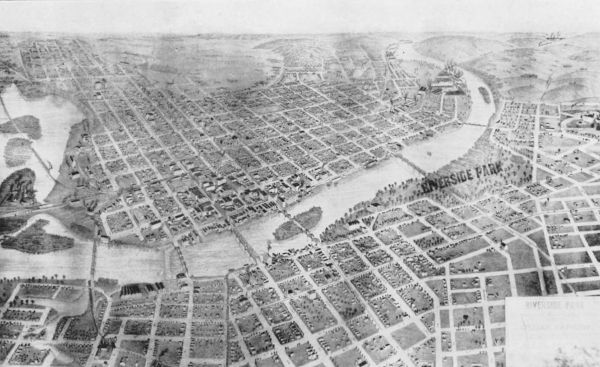
BIRDSEYE VIEW Of CEDAR RAPIDS IN 1889
In 1865 D. W. C. Rowley began grading for the Burlington, Cedar Rapids and Northern Railway, which was organized in Cedar Rapids. A separate company, known as the Cedar Valley Construction Company, was organized to build this line to Waterloo. This company was composed of such men as Dr. J. F. Ely, president, William Greene, superintendent, D. W. C. Rowley, secretary. In December, 1866, another road was incorporated, running to Burlington south via Iowa City. The men connected with this enterprise were J. H. Gear, Burlington, president, J. E. Putnam, Burlington, secretary, directors Dr. S. D. Carpenter, of Cedar Rapids, E. Clark and Peter A. Dey, of Iowa City, and John Bird, Louisa county.
This southern branch did not progress rapidly and there was more or less of a hitch with the plans, and a question as to how the road should run. The articles were changed, leaving out Iowa City, and the board increased to fifteen members, among whom may be mentioned N. B. Brown, George Greene, and Charles Weare, who were added from Linn county. George Greene was elected president and Charles Mason, vice president. By June, 1868, the two roads were united under one name, the Burlington, Cedar Rapids & Northern, Greene becoming president, and D. W. C. Rowley secretary. By January 1, 1871, trains were running between Cedar Rapids and Burlington, and early the following year they reached to St. Paul, thus making one of the first great north and south roads in Iowa. For many years C. J. Ives was president of the road till it was absorbed by the Rock Island system, when the headquarters were transferred to Chicago, the Cedar Rapids office becoming merely a division point.
The Dubuque and Southwestern Railway was operated from Dubuque to Cedar Rapids in October, 1865. This was an important factor in the upbuilding of Marion and other towns along this road and in fact helped Cedar Rapids. Like all small roads, it was not a financial success, and in May, 1878, it was sold to the Chicago, Milwaukee & St. Paul Railway Company and new life put into it. The Milwaukee road in 1883 extended this line to Kansas City. The main line of the Milwaukee was extended to Omaha.
The building of the interurban to Iowa City, a distance of twenty-eight miles, a few years ago concludes the railway building in Linn county, with the exception of the Anamosa and Northwestern, which runs along the northern part of the county; and the extension of the Illinois Central, which runs down from Manchester, connecting with the main line at that place.
We are pleased to give space here to the following account of beginnings in Cedar Rapids. It is from Bailey & Hair's Gazetteer for 1865:
"D. W. King and T. Gainor were the first settlers of any advantage to the county. They reached here in 1839, and soon after made a permanent settlement on the west side of the river.
"The first white man, however, who pitched his tent on the ground, now occupied by the Valley City, was a notorious counterfeiter and horse thief by the name of Shepherd, who took up his abode and erected his cabin on what is now Commercial street, near the mills, in the year 1838.
"Thus early was this location selected as a central point for commercial operations with the surrounding country, and although the character of the operators was worse than some who have followed them in business, it nevertheless indicates their wisdom in making a good location for their enterprise.
"In 1849 D. W. King established ferries for crossing the river, and continued to run them up to the time of his death, in 1854. They were located at Iowa avenue and Linn street crossings. They were self-propellers, being forced across the river by the power of the current. A wire rope or cable extended across the stream upon which a pulley was placed, and connected by ropes to the boat. The first dam across the Cedar river was commenced in 1842, and the first saw mill erected in 1843.
"In March, 1843, the lands came into market. The first flouring mill was erected by N. B. Brown, in 1844-5, at a cost of $3,000. Extensive additions have been made to this mill since. It is still owned and run by Mr. Brown. In 1845, A. Ely erected the second saw mill and the following year the second flouring mill at a cost of $9,000. In 1848-9, the first woolen factory was erected by N. B. Brown. Cost, $10,000. The first steam engine was set in operation in 1855, in the machine shop of A. Hager.
"The first store was owned by J. Greene in the building now standing on the northeast corner of Iowa avenue and Washington street. The second store was opened by Mr. Cleveland, and the third by Mr. Mulford. The proprietor of these stores have all left the city. Mulford's store was destroyed by fire in 1850, being the first building thus destroyed in Cedar Rapids. The second fire occurred in 1855, when the buildings on the west side of Commercial street, between Iowa avenue and Linn street, were mostly consumed. The postoffice was established in 1847, and J. Greene appointed postmaster.
"The first brick building was erected in 1844, on the northwest corner of Iowa avenue and Washington street, by P. W. Earle, and is now occupied by him. The Union House, on the northwest corner of Adams and Market streets, was the first hotel. It was destroyed by fire early in 1865. The first school house was erected in 1847, and the first school taught by Nelson Felch. This structure is now occupied as a dwelling on the north side of Eagle street between Jefferson and Madison. The first white child born was the daughter of John Vardy, now removed to Texas. The first church erected is that commonly known as the 'Muddy,' and is still used as a house of worship. It is a small 'grout' building at the southeast corner of Eagle and Adams streets. The first death was that of a young man by the name of William Brookey, some time in 1843. The first frame building was built by John Vardy.
"The lodge of Free Masons was established in 1850, and James Keeler, an Episcopal minister, was the first W. M. The lodge took the name of Cedar Rapids Lodge No. 25. Its name was changed in 1864 to the more euphonious and Masonic name of Crescent.
"The first newspaper was established by D. O. Finch, in 1854. Three volumes only were issued. D. O. Finch, James J. Child, and James L. Enos, were successively its editors. The Era was purchased in 1854 by James L. Enos, and the name changed to the Cedar Valley Times, by which name it still flourishes. C. M. Hollis, Esq., is the present editor. The second paper was the Cedar Valley Farmer, J. L. Enos, editor. The Cedar Rapids Democrat was the third paper established, by W. W. Perkins & Co., in 1856. The Voice of Iowa was commenced in January, 1857, by the Iowa State Teachers' Association, and J. L. Enos elected editor. This journal reached a large circulation, and did much to give form to the school system of the state. The present public school edifice was erected in 1856-7-8, at a cost of some $15,000. It has six departments, and employs seven or eight teachers.
"Cedar Rapids was incorporated as a city in 1856, and Isaac Newton Whittam, Esq., was chosen the first mayor. A free bridge was constructed across the Cedar in 1855-6, but was soon carried away by the ice. As it fell, a large number were standing on the banks watching the ice as it rapidly tore the stone piers from their positions. Two sisters, daughters of Mr. Black, passed by the guard, which was stationed at the end of the bridge to keep the people from passing on, and had reached about the middle, when the frail fabric went down. Both young ladies were drowned, and the body of one was never recovered. A toll bridge was erected the following year, and though a slender structure, has thus far withstood the action of the ice, though occasionally broken down by cattle passing over it.
"KINGSTON CITY
"Is a place of about 350 inhabitants, situated on the west side of the Cedar river, opposite the city of Cedar Rapids. It is connected with this city by a wooden bridge, and is about one-quarter of a mile from the Cedar Rapids depot of the Chicago and Northwestern railroad. In the year 1838 Robert Ellis and O. Bowling settled on land in the vicinity, and in the year following Messrs. Isaac, John, and Joseph Lichtebarger settled where Kingston now stands. During the summer following David W. King and Thomas Gainor arrived here. The first child born was Mary Jane, daughter of T. and R. Gainor, on the 15th of May, 1840. Rosannah Gainor died on the 8th of June, 1840. This was the first death in the place. There is in the place one paper mill, one saw mill, two blacksmith shops, two groceries, and one dry goods store. There are three religious societies, Methodist Episcopal, Congregationalist, and United Presbyterian. There is also a commodious building for school purposes, and three libraries. This region of country is especially adapted to growing grain. Large quantities are annually shipped to Chicago from this place. The immense water-power will at no distant day make this a large manufacturing town."
The following as to early things in Cedar Rapids is taken from a copy of the Cedar Valley Times, J. L. Enos, editor, in 1865:
"On the 4th day of July, 1841, N. B. Brown began construction of a dam for utilization of the power. Carson, Gray and Roach soon sold their interests to Messrs. Brown and Greene, who became the sole proprietors of the water-power, and constructed the first saw mill in 1842-3. This mill is yet standing in the rear of Brown's flouring mill, which was also the first grist mill, and erected in 1843, and extensively enlarged by the present owner in 1854-5.
"The first blacksmith in the place was Harrison Campbell, who opened a shop in Shepherd's old cabin in 1843. Isaac Cook, Esq., was the first lawyer, John L. Shearer the first justice, and James Lewis the first constable. The name of the first physician seems to be lost from the memory of the 'early day,' though many of his peculiar traits of character are remembered. Like some others in the profession he was disposed to blow his own trumpet, and the stories he told to the uninitiated ones were marvelous in the extreme. Once when he had returned from Muscatine he claimed to have lost forty pounds of quinine in one of the streams which put into the Cedar below the city—the water being unusually high. His credit was evidently then better than afterward, as was also his physical courage. Constable Lewis, at one time called upon him with an execution to secure a judgment, when the doctor becoming wrathy, threw off his coat for a fight. The constable being more intent on collecting the claim than emulous for notoriety as a pugilist, seized the coat and made away with it—finding a sufficient amount of money to pay the debt. Dr. S. M. Brice remained here for a few months and then removed to Center Point. Dr. E. L. Mansfield was the first physician who made a permanent location in this city, and still enjoys a large and lucrative practice. He came here in 1847 and has ever since been engaged in the noble endeavor—to heal the thousand natural ills that flesh is heir to.
"The first brick building was erected in 1844, by P. W. Earle, Esq., on the west corner of Iowa avenue and Washington street. This building is still occupied by Mr. Earle, and shows but little the marks of age. A three-story brick store was erected the same year on the south corner of Iowa avenue and Commercial street. This building has since been removed to make room for the block of stores extending from Iowa avenue down the west side of Commercial street toward Eagle street. Greene's hotel, a fine-appearing brick hotel four stories high, also occupied a portion of this ground. It was erected in 1853-4 by George Greene, and was kept by various persons as a first-class hotel until it was taken down to make room for a new brick block, which was erected in 1862.
"The first store proper was opened in the building now standing on the north corner of Iowa avenue and Washington street, by Joseph Greene. As early as 1842 Mr. Greene had a store in one part of a log building located on the north corner of Commercial and Sugar streets, the other end of the same building being occupied as a boarding house or hotel.
"The first building erected for a hotel was built by William Dwyer in 1847, James Gunning being the first landlord. The building was destroyed by fire in January, 1865. It was known as the Union House and was located on the west corner of Market and Adams streets.
"The Adventists held meetings here as early as 1842-3; a Mr. Baker being the minister. The Protestant and Episcopal Methodists also had organizations at an early day. The Presbyterians organized soon after and erected the first church edifice, known as the 'Big Muddy,' taking its name from the material of which it was composed. It is a grout building, occupying the east corner of Eagle street and Adams street. The Universalists had an organization here quite early and were 'ministered unto' by Rev. Mr. Westfall. In either 1843 or '44 a somewhat noted discussion was held between Mr. Westfall, the Universalist, and Mr. Roberts, Old School Presbyterian, at which Joseph Greene acted as umpire. The discussion continued for four days and nights. The meetings were largely attended and the combatants were sharp and excited. The conflict ended as such discussions usually do—in the victory of both—and this was regarded by nearly all as a drawn game.
"The first school was kept by Miss Emily Coffman. The first school building was erected in 1846-7, by a company consisting of N. B. Brown, George Greene, Alex. Ely, and others, who sold it to the district, and had the satisfaction of being taxed to pay themselves for it. This building was on the north side of Eagle street between Jefferson and Madison. It is still standing and is occupied as a dwelling house. Nelson Felch was among the first teachers, also a Mr. Freeman, who has since been receiving instruction in a state institution located at Fort Madison.
"The second saw mill was erected by Alex Ely in 1844 and the second flouring mill in 1844-5. Mr. Ely died shortly after the completion of this mill. In 1848 N. B. Brown built the first woolen factory. The first steam engine was put up here in 1855 by A. Hager, in his sash, door and blind manufactory. He had an extensive amount of machinery connected with it and employed a number of workmen.
"The second store was established by Mr. Cleveland, and the third by C. K. Mulford. Mulford's store was afterward occupied as a dwelling, on the east corner of Commercial and Linn streets, and was destroyed by fire in 1850. That was the first fire in Cedar Rapids, and none occurred after it until the autumn of 1855, when most of the block on the west side of Commercial street, between Iowa avenue and Linn street, was destroyed. No precautions have been taken to prevent the spread of the destroying element, and were a fire to occur tomorrow no more means would be found of subduing it than existed twenty years ago. It would seem that a wise people would not thus neglect what may at any moment be of such vast importance. But so it is, and so it is likely to remain until a fire shall occur that will lay in ruins a large portion of our city and destroy thousands of dollars worth of property. Personal insurance can best cover a part of this loss and perhaps not one-half are provided with this protection."
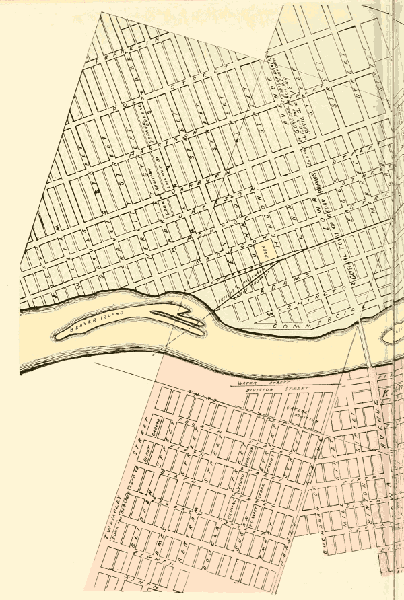
REPRODUCTION of THE FIRST MAP OF CEDAR RAPIDS (Part 1)
REPRODUCTION of THE FIRST MAP OF CEDAR RAPIDS (Part 2)
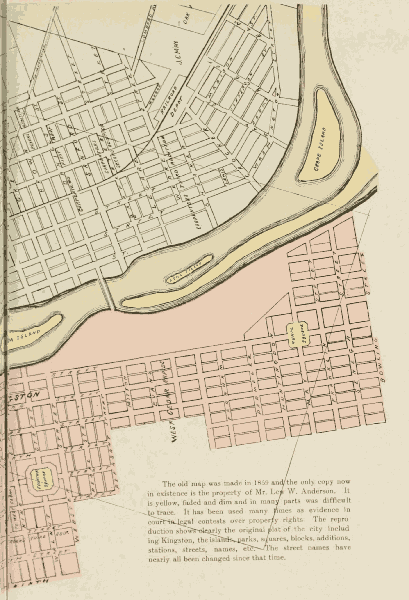
[The old map was made in 1859 and the only copy now in existence is the property of Mr. Lew W. Anderson. It is yellow, faded and dim and in many parts was difficult to trace. It has been used many times as evidence in court in legal contests over property rights. The reproduction shows clearly the original plat of the city including Kingston, the islands, parks, squares, blocks, additions, stations, streets, names, etc. The street names have nearly all been changed since that time.]
Dr. Seymour D. Carpenter, who came to Cedar Rapids in 1849, contributed the below quoted memoirs to a History of Crescent Lodge, J. E. Morcombe, author, and published by the lodge in 1906. It is of value in the consideration of the history of early times in the city and county:
"I wished to read law, but there was a family prejudice against the profession, and I concluded to study medicine and accordingly entered as a student the office of Drs. Boerstler & Edwards, who were among the leading physicians. There for a year I read books that were full of what are now exploded theories and practice, at the end of which time I was sent to the University of Pennsylvania, where two years after I was graduated as a doctor of medicine. Returning home in the spring of 1849, I remained but a few months and then started west 'to grow up with the country.' I again rode to Cincinnati on horseback, took steamer to St. Louis, thence by another boat up the Illinois river to Haverville. Not liking the place, I rode west and crossed the Mississippi at Quincy and went to Kirksville in Missouri. Still not pleased, I turned north and went to Ottumwa, Iowa, where I met Judge Greene, then a member of the supreme bench of Iowa. He persuaded me that Cedar Rapids was in the near future to become a metropolis, and I decided to go there. After four days' hard riding and swimming several swollen streams, I struck the town on the afternoon of the 14th of June, 1849. I crossed the river on a rope ferry operated by David King, who lived in a cabin on the west side. On the other side of the river stood the cabin once the home of a man named Shepherd, and said to have been the resort of thieves in an earlier day. I cannot say that I was very favorably impressed by the thirty or forty mostly one-story unpainted houses that were scattered about near the river. There seemed to be a great deal of sand, and the houses were so situated that there was no sign of a street. There were three two-story houses, one on the river near the foot of what is now Third avenue, called the 'Park house,' in which the Greenes had their store; one on second street in which John Coffman kept a hotel, and one on Third avenue, back of the Dows & Ely block, also a hotel, but keeper's name forgotten. I was discouraged and would have traveled further but only had about ten dollars left, and from necessity had to stop. I put up at the Coffman hotel, which, as I have said, was a two-story structure with a wing. It had been built of unseasoned oak lumber and was not plastered. The whole of the second story of the main building was in one room, and contained eight or ten beds and was the common sleeping room of the guests. The lumber had shrunk and there could be no complaint as to ventilation, however short the accommodations might be in other respects. I had hardly got settled before I was interviewed by old Joe Leverich, a noted character of Linn county of that day. He was known as the 'Bogus Coon,' because, as was alleged, he had to do with counterfeiters. He was a power in politics and was the kind of a man from which the modern 'pop' has evoluted. Joe looked me over, asked where I was from, where I was going, what my business was, etc., etc. I was somewhat indignant and tried to be sarcastic, but Joe, in terminating his interview, squelched me by remarking: 'Young man, a fellow that wears such a hat as you do may pass in this country, but I consider it d—d doubtful.' I unfortunately wore a 'plug' hat which was not the style in Iowa a half century ago. In subsequent years Joe and I became fast friends, and I became quite convinced that the shady stories told of him were the talk of enemies who were jealous of him because he was smarter than the great majority of them. I was with him when he died, and, although a free-thinker, he passed away with all the calmness of a stoic philosopher.
"Within a week I made the acquaintance of all the people of the town. Among the leading persons were William and Joseph Greene, brothers of the judge, Lowell and Lawson Daniels, Homer Bishop and John Weare, all of whom were merchants. The three stores of which they were the proprietors would not compare well with the department stores of today, but all the same they were department stores, and in their miscellaneous stocks the customer could find all he wanted, from castor oil to broad-axes. Pollock & Stewart were the blacksmiths, and the carpenters and wagon-makers were also represented, but I cannot recall their names.
"Dr. Mansfield took me as a partner, and in company with Judge Cook, we had a room, 10×16, in a small one-story building opposite the mill, the other part being occupied by S. L. Pollock and family. His blacksmith shop was near by. Our medicines were kept on a shelf and a store box made a table. Our bunks occupied one side and a few stools and two split-bottomed chairs made up our furniture. We took our meals at the Coffman house. Our field of practice embraced the settlers, not numerous, in the valleys of the Cedar and Iowa rivers and their tributaries. We made very long rides. I was called to see a patient two miles above the present town of Vinton, not then begun. I got lost in the night and waited for daylight under a tree on the bank of the river at the very spot where Vinton now stands. Bilious fever and ague were the prevailing diseases, all the newcomers having to undergo one or both. As patients and clients were not very numerous, we had a good deal of leisure. Judge Cook was a fine reader and we took turns at Shakespeare, a copy of which we fortunately possessed. During the summer Dr. Mansfield and myself built a story and half office on Commercial street, about the middle of the block on which the Daniels store was located. We had a mail three times a week from Dubuque and Iowa City. The Higley brothers did the service in a two-horse hack. I think Joseph Greene was postmaster. John Weare, Sr., was justice of the peace. He was a very original character, fond of company and full of interesting reminiscences extending back to the war of 1812, in which he had lost a leg. His small office was in the rear of Mrs. Ely's residence, which stood on the ground where the Dows & Ely block now is. He gave 'nicknames' to many people and places which stuck to them like burrs. The first Presbyterian or Congregational church building was begun that summer, and as the walls were built of cement, old Mr. Weare named it the 'Muddy,' which it retained to the last day of its existence. Many buildings were put up that year with a corresponding increase in population. All the people were full of hope and ambition. We began to talk of railroads. The people of Dubuque and Keokuk, the leading river towns, started a scheme for a road running through the interior and connecting them. The people along the line, at Cascade, Anamosa, Marion, Cedar Rapids, Washington and Fairfield eagerly endorsed the project, meetings were held and it was resolved to hold two delegate conventions, on the same day, one at Anamosa, the other at Fairfield. We had a rousing meeting in Cedar Rapids. There were nearly a hundred people present, and they resolved to have the railroad forthwith. From our standpoint it was the government's duty to donate land, and for eastern people to furnish the money. Delegates were chosen to both conventions. Dr. John F. Ely and myself were selected to go to Fairfield. Both conventions were to be held on the 6th of December, 1849. We left Cedar Rapids on the 3d of December and after three days' hard and cold travel reached Fairfield. Marion sent Col. I. M. Preston and Dr. Ristine. The convention met in a small school house. All the counties were represented. The Hon. C. W. Slagle, of Fairfield, then a very young man, was chosen president. I was chosen secretary. The little school house was packed, and if any doubt the courage and scope of that convention, let him look up the old file of newspapers of that day and read. Dr. Ballard, of Iowa City, Stewart Goodsel, of Brighton, Joseph Casey, of Keokuk county, and General Van Plank Van Antwerp were present and took active part. We parted for our various homes, thinking the work half done, but sad to relate, Cedar Rapids had to wait ten years longer for the locomotive. These two meetings were, as I think, the first railroad conventions held in the interior of the state. Soon opposition schemes were started for east and west lines, and our project was ignominiously called the 'Ram's Horn.' The next year was quite a stirring one. New people were coming in great numbers, but many were leaving, for the California fever had broken out. Several outfits left Cedar Rapids, and with one of them Dr. Mansfield, my partner, whose place was taken by Dr. S. C. Koontz, a cousin of mine, one well known to the old citizens. That year the first brick buildings were erected, a dwelling on Iowa avenue near Greene's opera house, and a three-story building on Commercial street, by Judge Greene, which for a long time was the show building of the town. We began to put on city airs.
"At this time Martin L. Barber was mayor of the village. It was before the present city organization. Barber was an eccentric character, a millwright by trade. He was nearly as wise as Solomon, with courage to match. A 'bad man' came to the town. He hung about the saloon. It was said he drew a knife and threatened to kill a citizen. The majesty of the law was invoked. It was night. The offender took refuge in the saloon and barricaded the door. The mayor called out the 'posse commitatus' numbering two or three dozen young fellows like myself. He pounded on the door, demanding admittance in the name of the law. No response. We got a piece of timber and battered down the door. The mayor collared the 'bad man' who offered no resistance. He was hurried towards the Coffman house, where the mayor proposed to deal out justice. As we neared the hotel he tore loose from the mayor and made for the river. We in full cry in pursuit. He plunged in just below the mill. We paused at the brink. Gradually he disappeared, and was never seen afterwards. It was the first and last exhibition of the mayor's power.
"In 1850 Miss Mary S. Legare, sister of the Hon. Hugh S. Legare of South Carolina, came to Cedar Rapids. She was a woman of the highest culture, who had moved much in the official circles of Washington, and had considerable wealth. With her came numerous relatives named Bryan, Storey, and McIntosh, the latter a well known lawyer of the early days. She made investments in the town and took up large tracts of land. In the spring of that year we had a very spirited election. The people were divided into two factions, the 'codfish' and the 'catfish.' For mayor the former nominated N. B. Brown, the latter Jacob Bressler. I cannot recall the issues, but only remember that we almost came to blows during the canvass. Less than one hundred votes were cast and Brown was elected. Brown was one of the original owners of the town site, and built the first mills. He was one of the prominent characters in the early history of the town, a modest, quiet, but genial man, with many friends.
"This year, on the 6th of July, I did one of the few wise acts of my life. I married Sarah Weare, the daughter of John Weare, Sr. We went to housekeeping in a small one-story house, near where the old passenger depot stood. It was then the only house east of the present railroad. The next year, 1851, was a very active one for the town. Judge Greene, who had lived in Dubuque, moved to the town. The same year came S. C. Bever, who had driven in a two-horse buggy from Holmes county, Ohio, to Cedar Rapids. By this time I considered myself an old citizen, thoroughly identified with the county and town, and devoted all my leisure time to meeting strangers and exploiting the town and county. I met Mr. Bever soon after his arrival and spent several days with him riding about the country. He made large investments both in country and town. One was 160 acres about a mile from the ferry, at $5.00 per acre. I made the sale for Mr. Addison Daniels of Marion, who was so pleased with my effort that he presented me with a four-bladed penknife. Both Mr. Daniels and myself were satisfied and I have never heard that Mr. Bever regretted the purchase. That same year my father, Mr. Gabriel Carpenter, came out to see the country. After great effort on my part and many misgivings on his, he purchased of Mr. Levi Lewis 300 acres of land adjoining the town plat on the south, for which he paid $2,500. The land embraced the present cemetery. By this time Judge Greene had completed his three-story building, into which the Greene Bros. placed a large stock of goods. The most of their stock was brought up the river in a keel boat of forty or fifty tons capacity. It was rigged with a large square sail, but the principal power was men with poles, who shoved it against the current. They had loaded it with pork and sent it down the river in the spring.
"In 1851 occurred the great flood. Most of the lower parts of the town were under water. The grand lodge met that year at Ft. Madison, and at the time the river was at its highest point. We were cut off from all the neighboring country by the swollen streams, but the lodge thought it must be represented and I was chosen as the delegate. N. B. Brown suggested that I should go down the river in a skiff to a point opposite Muscatine, then by land to that place, which is only ten or twelve miles distant, then by steamer to Ft. Madison. The lodge furnished the skiff. I found a companion. We embarked in the morning and so swift was the current that we reached our destination by nightfall, and I was on time for the meeting. At the meeting I renewed my acquaintance with the grand master and the grand secretary, and met many brethren who became lifelong friends.
"In the spring of 1852 a steamboat came to Cedar Rapids. It was a great event, and brought in people from near and far. She brought a full cargo of freight, among which was the household effects of Mr. Bever and my father, both of whom from that time forward became citizens of the town. This year also came Mr. Daniel O. Finch with a printing press and forthwith started the Progressive Era, the first paper in the Cedar valley. Ezra Van Metre, a talented young lawyer from Cincinnati, Ohio, also came that year. Every one was rejoiced that we had an organ and the editor was overwhelmed with original matter. There were at least a dozen young fellows in the town, myself among the rest, who thought they 'knew it all,' and anxiously rushed into print. The paper changed hands in a year or two, and became the Cedar Valley Times and continued until a few years ago.
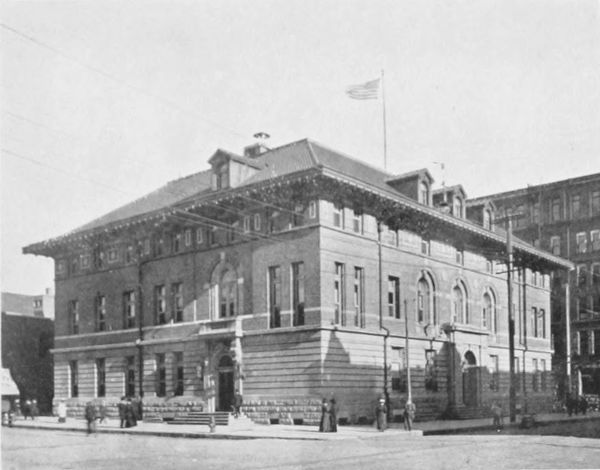
FEDERAL BUILDING, CEDAR RAPIDS
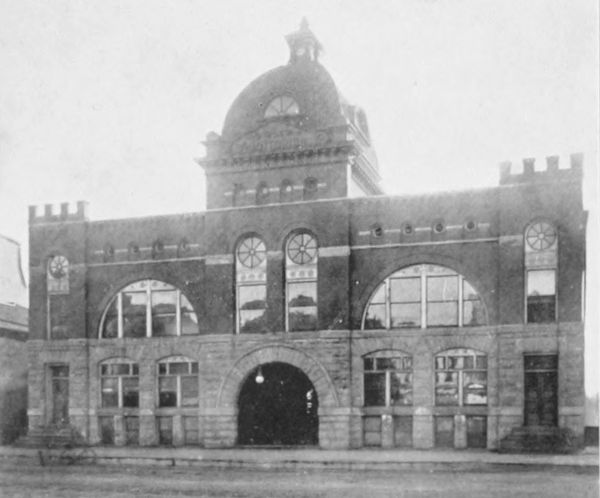
AUDITORIUM, CEDAR RAPIDS
"In the winter of 1852 I had a serious time in a professional way. A young man living at Quasqueton, Buchanan county, was riding across the prairie near that place and met a bear. The bear fled and he pursued. In crossing a strip of ice the horse fell. He was thrown and his foot stuck in the stirrup and he was dragged four miles over the snow, which was about six inches deep. In the mad flight the horse kicked and broke his right leg below the knee in two places. Finally the saddle turned, his foot was released and he was dropped on the lone prairie. The horse found his way home with saddle under his belly. This was on the evening of the 17th of December. A search was organized, but he was not found till the 21st, four days after the accident. Fortunately the weather was not as cold as it sometimes gets, but his hands and feet were badly frozen. Cedar Rapids, about thirty-five miles distant, was the nearest point where doctors could be found. I was sent for and went by the way of Marion, and took with me Dr. Thomas Bardwell, who was then a student in Dr. Ristine's office. There was a road to Center Point. There we struck across the prairie to Quasqueton, eighteen miles distant, without a house. We reached there the evening of the 23d, nearly frozen ourselves, for the weather was bitterly cold. They had got the young man thawed out, but in a most miserable condition. Mortification had set in, and there was no chance for the broken leg. Immediate amputation was the only hope, but I had no instrument but a small pocket case, and delay would be fatal. Necessity is the mother of invention. A butcher had just come to the place and had his tools. He sharpened his knives and filed his saw. A strong handkerchief was twisted, a knot made in the middle, which was placed over the main artery. It was tied tightly and a strong stick thrust under it and twisted till the circulation was shut off. Then with the butcher's tool I amputated the thigh four inches above the knee. Dr. Bardwell administered chloroform, which fortunately we had taken with us, and he encouraged me by word and deed. The young fellow, who was about 21, had never been sick a day in his life, rallied well and improved for about a week, but the other leg, which we hoped to save, began to mortify and there was nothing left but to amputate it. In the meantime we heard of a doctor about thirty miles away, in the direction of Dubuque, who had a case of instruments. I sent to borrow them. He refused to lend them but came back with the messenger and insisted, as he owned the instruments, he should perform the operation. That was not professional, but as I thought the patient had not more than one chance in ten to recover, I was not unwilling to divide the responsibility; so he amputated the other leg below the knee. During that winter I made eight trips between Cedar Rapids and Quasqueton on horseback, and the fellow recovered. He was the son of a well-to-do farmer in Harrison county, Ohio. His father came out in the spring, stole his son away without paying the doctors or the man in whose house he had been during recovery, and to carry ingratitude still further he procured a Methodist preacher to write his life, in which I was depicted as an ignorant butcher. This book he peddled about Ohio in person. I confess that when I heard he had been sent to the penitentiary for committing an aggravated rape I was not very sorry. This experience rather disgusted me with the practice of medicine in a new country. I was, however, in a way compensated, for I sent a history of the case to the New York Tribune, and its publication gave me quite a reputation as a fearless surgeon and thereafter I was called when surgery was required. As I have said before, I was in the habit of showing strangers about the country who wanted to buy land. In that way I became familiar with choice lots of vacant land. Greene and Weare dealt in land warrants, which they sold on a credit at three per cent per month interest. I knew of a section of land in the Iowa river bottom that I thought I should be able to sell. I borrowed the land warrants, entered the section and in less than two months had sold it for $3 per acre cash. That settled the matter. By one transaction I had made more than I had done in any year's practice. I sold out my medicines to Dr. Koontz and thenceforth till the war had nothing to do with medicine.
"About 1853-4 we began to lose confidence in the 'Ram's Horn' railroad project. Congress had made grants of land to aid railroad projects and public opinion seemed to favor east and west rather than north and south lines. Roads from Chicago were approaching the Mississippi river, and a line from Rock Island to Council Bluffs was projected. The people in the tier of counties north of the projected line became stirred up and a railroad convention was called to meet in Maquoketa, Jackson county, to organize a company to build a line in their interest. Cedar Rapids sent a delegation as follows: George Greene, N. B. Brown, Daniel Lothian, I. N. Whittam, Donald McIntosh, Ezra Van Metre, and myself. Marion also sent a large delegation and the counties along the line were well represented. A company was organized to build a line from Savanna on the Mississippi river to a point on the Missouri river not named. A corps of surveyors was put in the field and for two or three years it was the favorite project of Cedar Rapids. The settlements both in town and country were increasing rapidly and we suffered greatly for lack of transportation. Judge Greene, with his usual energy and public spirit, organized a steamboat company in which the prominent citizens became stockholders. This was in the winter. The judge went to Pittsburg, contracted for a boat suitable for our river, which by spring was completed and at the opening of navigation made her first trip, well freighted with all kinds of goods for our own merchants, and those of the surrounding towns. She was kept in commission for two or three years and was a great benefit to the community. The company hired a captain and various stockholders were at different times supercargo. While H. G. Angle was acting in that capacity she collided with and sunk another boat on the Mississippi, which led to a law suit in which our company had to pay large damages, which swept away all our profits. She made her last trip under my charge, and under direction of the company I sold her to parties in St. Louis. By this time a great rivalry had grown up between our town and Marion. Cedar Rapids claimed that she was to be the commercial metropolis and therefore ought to be the political center. The question was brought to an issue by the county commissioners ordering a new court house at Marion, subject to the approval of the voters of the county. Cedar Rapids opposed the measure, believing that the building would insure the permanent location of the county seat. Then ensued a most bitter canvass. The voters were deluged with oratory. Marion put on the stump Judge Isbell, I. M. Preston, Col. Wm. Smythe, N. M. Hubbard, W. G. Thompson, and R. D. Stephens, against whom Cedar Rapids opposed Jas. J. Child, Ezra Van Metre, Donald McIntosh, A. S. Belt, E. N. Bates, I. N. Whittam, and others. Every school district was canvassed and much bitter feeling engendered. The Marion people were more adroit politicians and carried the election, but the result did not discourage our citizens, who asserted that no election could affect 'manifest destiny.'
"About 1852 Major J. M. May came to Cedar Rapids from Janesville, Wisconsin. The major was a stirring man with a head full of schemes. He said that Cedar Rapids was a place of immense possibilities and only wanted enterprise to make it the great town of Iowa. He bought land at the lower part of town adjoining that owned by my father, and land on the west side adjoining the river and below that owned by Dr. King. He platted out town lots on both sides of the river, and induced my father and King to do the same, which were the first additions made to the original town. He also surveyed the island, sent a plat to the general government and took possession of it, much to the chagrin and surprise of the old settlers. Then he began to agitate the question of a free bridge. Every one wanted a free bridge but were undecided as to the location. The major induced my father to subscribe $1,500, and he gave $1,000, which with sums contributed by others in the lower end of the town, secured the location below the island at the narrowest place in the river. The bridge was completed and thrown open to the public, I think, in the late fall of 1852, and proved a great convenience. The construction was defective and when the ice broke up in the spring, the heavy cakes knocked down two of the piers, and destroyed the greater part of the bridge. All the people of the town were collected on the bank of the river watching the event, and two young women who were crossing went down with the structure and were drowned. This was the first bridge built at Cedar Rapids. The next was a bridge of boats at the foot of Iowa avenue which I believe was also swept away by ice. About this time the Rev. Williston Jones, who officiated in the 'Muddy,' and was a very good as well as energetic man, went east on some missionary effort. While there he met a gentleman named Coe, who made a donation of land adjoining the town plat for educational purposes providing the people would also contribute. A meeting was called and the terms complied with and thus Coe college was founded. I was quite honored when with others I was named as a trustee. Not long after this time the Reverend Starr became rector of the Episcopal church, and under the lead of Judge Greene and Mr. Bever, they began the erection of the first Episcopal church, and about the same time the Methodists built a brick church, so you see Cedar Rapids began to get on 'praying grounds and interceding terms.' In the winter of 1856-7 we were surprised and flattered by receiving a communication from a party of railroad men connected with the North-Western railroad, then completed to Fulton, Illinois, asking us to join them and organize a railroad company from Clinton on the west side of the Mississippi river to our town. This was a new proposition, and we had never heard of Clinton, which in point of fact was only a cornfield staked out in town lots, besides we were committed to the line that was to run west from Savanna. We consulted with the Marion people, but they would have nothing to do with it, arguing that we had already applied for the land grant for the Savanna route. After serious deliberation and with considerable misgivings, we decided to send a delegation to spy out the land and be governed by circumstances. John Weare and H. G. Angle were chosen as our representatives. It took them three days to drive to Lyons which was the nearest town to Clinton, the proposed starting point. That was the first time any of our citizens had come in contact with real capitalists, men who built railroads. There they met a party of men from Boston, from Maine, from New York, and Chicago, among whom was Charles Walker of Chicago, then president of the North-Western. Our deputations were swept from their old moorings and immediately joined hands with these men and formed a company, the 'Chicago, Iowa & Nebraska,' to build west from Clinton, by the way of Cedar Rapids to the Missouri river. Cedar Rapids was given first directors as follows: Geo. Greene, John Weare, H. G. Angle, S. C. Bever, and S. D. Carpenter, which positions we held till the road was built to Cedar Rapids. This new departure on the part of Cedar Rapids intensified the feeling of rivalry between her and Marion; a direct line between Clinton and Cedar Rapids would leave Marion off the route, besides the natural obstacles were less from Mount Vernon to the river and thence to Cedar Rapids. The Marionites denounced us as traitors to the original scheme, with a malignant intent to leave them out in the cold. We denied the 'allegation and defied the alligators.'
"We said there was nothing behind the old project, but that ours was a live scheme, with experienced men with bags of money to put it through. Our deputies had pledged $200,000 from Cedar Rapids, which we proceeded to raise, $100,000 by private subscription and $100,000 by city bonds. Greene & Weare, then bankers, subscribed $10,000; George Greene, $5,000; John Weare, $5,000; N. B. Brown, $5,000; S. C. Bever, $5,000; Gabriel Carpenter, $5,000, and numerous others smaller sums to make up the amount. Then a city election was had and the $100,000 voted by an overwhelming majority. Surveys of the route were begun at once and from Mount Vernon and Cedar Rapids, two lines were seen; one by the way of Marion, and the other by the river. It was ascertained that the latter route would be shorter and cheaper by $100,000 than the former, but the company proposed to adopt the Marion route if she would subscribe $100,000, which she declined to do, and the river line was chosen. Work progressed slowly and the first year found the rails no further west than De Witt, Clinton county. Nothing had been done on the Savanna line.
"Meantime the legislature for 1857-8 assembled, and we were astounded to learn that they had passed a bill giving a land grant to that company. I do not remember why we had not looked after our interests, but only know that we were taken by surprise. We thought our enterprise in great jeopardy, and resolved to compromise, if possible, with Marion. I think that Judge Isbell was then president of the Savanna company. Major May, who had favored the Marion line, for what reason I now forget, and myself from a warm personal friendship with Judge Isbell, were chosen ambassadors. We met the judge and the Marion directors of the rival line. They were courteous, but obdurate. They said we had deserted them and run after strange gods, and now that the tables were turned, they proposed to build the road straight west, crossing the river eight miles north of Cedar Rapids, and instead of their building a branch to Cedar Rapids, we if we chose might build the branch from Cedar Rapids, and thus we left them, sad and discouraged. 'Whom the gods would destroy they first make mad,' and thus it turned out with the Savanna route. The company was composed entirely of Iowa men, directors from the various county seats and towns along the line. Very soon after obtaining the grant, they got together and voted each other $25,000 apiece for services rendered in obtaining the land grant. As there were about twenty of them, the scheme was loaded by about $500,000. Then they tried to exploit the enterprise among eastern capitalists. But the hard times of 1857-8 were upon us and money was scarce both east and west. No one would take hold. In the meantime our road was slowly creeping on, and was within thirty miles of Cedar Rapids. The grading contract was let to John G. Wolf, an experienced railroad builder from the east. Most of the money to pay him had to be raised among ourselves and pay day was a most serious time. I remember upon one occasion, the cash entirely failed, but the merchants of the town agreed to honor orders for goods, Mr. Bever among the others. Mr. Bever had been a merchant in Holmes county, Ohio, and brought his stock of goods from there to Cedar Rapids. Among other things he had two or three cases of bell crowned silk hats of a very ancient date. On pay day our citizens were greatly amused to see our streets crowded with Irishmen, all wearing bell crowned hats, and as 'fire water' was plenty, before night a great many of the hats were caved in. Our Marion friends hearing of it said our company was 'busted,' our only assets consisting of bell crowned hats. But we persevered and bided our time. We called a mass meeting in the city preparatory to forming a new company to build the road west from Cedar Rapids to the Missouri river, and appointed a committee to issue a prospectus to all the counties west of us on the proposed line to meet in delegate convention at Cedar Rapids. I had the honor of being chairman of that convention and as such prepared the paper, and if you will examine the file of newspapers of that day you will find a 'Spread Eagle' document that I supposed would move the souls of our frontier friends. They responded nobly and came on the time designated, and we organized the 'Cedar Rapids & Missouri Railroad Company,' at least I believe that was the name. L. B. Crocker, of New York, was made president, with several eastern and western directors, myself among the number. Then as the company to whom the legislature had given the grant of land, had not turned a spadeful of earth, we organized a lobby embracing all our directors on the line west of us; L. B. Crocker, the president, Major Bodfish, a Maine man, and several of our Cedar Rapids directors, myself among the others. When the legislature assembled in 1859-60 we invaded the capital, and established our headquarters in an old hotel near the river, whose name I have forgotten. Major Bodfish was the commissary of the body. We had no money to expend, but determined to be hospitable. The major laid in a barrel of old rye whiskey; as it was before the war, whiskey was cheap, also several boxes of cigars. One of our strongest henchmen was J. M. Woodbury, a leading man from Marshalltown, and with him Peter Hepburn, now an honored congressman, then a very stripling, but showing evident signs of what was in him. John J. Kasson was then a young lawyer in Des Moines, and we secured him as our attorney. Our opponents were not asleep, but were on hand from Marion, east to the Mississippi river, with Platt Smith, a distinguished member of the bar at Dubuque, as their lawyer. Then the fight began, in and out of the state house. Speeches were made by our adherents in both branches, and we buttonholed and dragged to our headquarters all thirsty souls, as well as those who indulged in the milder stimulant. Our strong argument was, that our opponents had done nothing after having the grant for two years, while we had about completed eighty miles of road without help; that we only asked for the grant to apply to the line west of Cedar Rapids, while they would use it for the line from the Mississippi, and that we would be able to accommodate the people with a finished road at least two years before they could. The law makers were not in a hurry, but towards the last of the session they passed our bill, and you may be sure there was great rejoicing in Cedar Rapids. On our return the citizens gave us a grand banquet in Greene's hotel, and we felt that we had at last secured a substantial victory for our city, as in fact it was, for thenceforward Marion could no longer be our rival. The cars came to Cedar Rapids in the summer of 1859, just ten years after we had held our first railroad meeting, and we felt at last that hope had ended in fruition. An immense concourse greeted their arrival from all parts of the surrounding country. General D. N. Sprague, then mayor, welcomed the guests, and the citizens threw open hospitable doors to all comers."
From 1840 to 1846 much work was going on in the thriving little town. Glass had already a small grist mill on McCloud's Run and a saw mill had been started on Indian creek which furnished lumber till the saw mill on the Cedar river was completed. The labor on the dam was a big undertaking and took much time as the enterprising adventurers were not well prepared to cope with so large an undertaking.
Many settlers were coming constantly, all of them full of courage and pleased with the location, which all proclaimed could not be improved upon. There were Alexander Ely, Joseph Greene, Homer Bishop, P. W. Earle, John Vardy, D. Fiddlar, A. Eddy, George Westlake, William Dwyer, James Gunning, Charles Mulford, Isaac Cook, John Shearer, James Lewis, Dr. S. M. Brice, and many others.
Churches were also organized, such as the Methodist, in 1841, by Rev. Hodges, and the Baptist the same year by Rev. G. E. Eberhart. The United Presbyterian church was organized by John Cunningham ten years later. New settlers came and other church organizations were completed and small church buildings were erected by the members.
The following chatty reminiscences of pioneer times is from the Republican of recent date:
"'If two of us wanted to lunch together,' he said, 'we went to a saloon and sat down over some black bread and a little beer. Now you must stand up to drink your beer, and you may eat nothing.'
"In the old days the city and the county politicians met here and talked over the political situation. The professional men met on equal grounds. Now it is all changed.
"There were some interesting places in Cedar Rapids in those old days. In the location where Mr. Armstrong is now about to erect a fine business block there was an old German named Moritz Hoffbeck. It was a sand hill then, but there was a good cellar where Hoffbeck sold beer, gave away good lunches and entertained the crowd. His good wife also served the guests with good things to eat, cooked after her own fashion. Here congregated the best business men of the town after the day's business was over. They went home in the best of spirits, but often it was rather late when they went.
"Some of the city's poets of that day composed a little poem about Moritz which ran as follows:
"Moritz Hoffbeck is my name, Bavaria is my nation. Cedar Rapids I dearly love, For here I get my ration.
"Another German, Sam Leunch, kept a place at Third avenue and First street, which was for many years a meeting place for farmers as well as city men. It also had a reputation for its fine lunches.
"Sych's place was on the present location of the Y. M. C. A. This also was German and German dishes were one of its great attractions.
"Frank Simon had a restaurant where Stark's hotel is now located. It was an eating house; also a drinking house. It was noted in five counties for being the place to get the best oysters in any style. The German fries have never been excelled. When Simon died, Ben Springer married his widow. He retired many years ago and sold the business to the Starks.
"Frank Mark was a Swede who kept a saloon where Denecke's store is located, fronting on Second avenue. It was a small place but it was always full for he served eatables and kept private rooms for his city patrons who wished a quiet place in which to talk things over.
"Pollack's where Severa's store is now located, was the Bohemian restaurant much sought for its good things to eat and for the imported drinks which he kept for his best friends.
"Count Boshon kept a saloon down into prohibition times and ran many saloons in various places. He was known as the King of Bohemia and acted as though he might have been a count. He imported the Philip Best beer from Milwaukee and stored a car or two at a time in ice, and for this he obtained a great reputation. Count Boshon was a chancellor and knew how to secure the good will of prominent persons of the city and of the county officials. He seemed to stand in with all. It is said in his favor that while he may have violated the law in some instance he tried to keep a decent place.
"The young business men would take a Saturday off and go up fishing or hunting or hire Elias Doty and his boat, the 'Climax,' and take a sail on the murky waters on the Red Cedar, sometimes up, and now and then when the water was high, down stream. Now all has changed.
"In the olden times there were dances at the neighbors or other old gatherings. All were common. No dress suits were seen and there was no delay on account of lack of any introduction.
"Doctors would get together and tell stories, lawyers would joke over their trials in court and in every way people were on an equality and truly happy.
"Then people did not devote all their time to making money. They did not spend all the time in business. Young and old had a better time of it, for they worked and played as well. They were really content with the surroundings and with their condition in life.
"In winter time people got together and had a good time, going skating or sleighing—on Christmas there were not so many gifts as now, but what was given was with the best of feeling. Another thing we have lost, and that is, the New Year's day calls. Old and young, married and single, made calls on this day every year.
"It was a fine custom and it ought not to have been dropped. Now people are too busy to call on their neighbors and they seem to fear that society would not approve of it. In the olden days no questions were asked about one's grandfather."
The old founders of Cedar Rapids were strong men in many ways. They were real live wires, and frequently spent money and devoted much of their time to exploit new industries. Such men as Geo. Greene, N. B. Brown, David King, S. D. Carpenter, W. B. Mack, R. C. Rock, P. W. Earle, H. G. Angle, J. E. Sanford, the Daniels family, the Ely family, the Weare family, the Bever family, and many others were men of rare intelligence, aggressive, enterprising, and wide awake, who came here to make a city at all hazards. They were true as steel to their convictions, enthusiastic in booming their town, and the "balance wheels" in time of need which kept things going. Even when some of these men lost heavily in the unfortunate steamboat ventures, in railroad exploitations, in bridges, dams, factory properties, and in other ways, they never complained, although at times it made them "men of sorrow and acquainted with grief." They never lost courage, and expected things to turn, even when they looked the darkest, and won in the end. The early pioneers were men keen to see an opportunity. They were able to look ahead, and for this reason they perhaps hung on when times were hard and when enterprises failed to materialize. It was due to the enthusiastic spirit of those leading citizens that caused the Legare and Bryan families to invest $80,000 in gold in Linn county property. It was no doubt due to the up-to-date, progressive spirit of those citizens that led S. C. Bever to bring $30,000 in gold, which was invested mostly in city property in Cedar Rapids in the early '50s. It was no doubt due to the keenness of mind of the late Judge Greene, that John T. Waterhouse in an early day came to Cedar Rapids and invested much money in choice corner lots on which he erected, for that time, modern business blocks. But outside of a few men, most of the early pioneers came to the county without any means. These acquired in the course of a few years, large holdings which have since doubled in value several times. Few, if any, who invested in real estate in Cedar Rapids and Linn county in an early day and who had foresight enough to hold on to it, ever lost anything on such investments. Values have gradually increased until corner lots which sold for $10 in the early '40s in Cedar Rapids, have now a value of from $2,000 to $10,000, and lands in and around the city which were disposed of at $5 to $10 an acre, have sold at from $250 to $500 an acre, and even higher.
The settlement in Linn county was an event of more or less importance, for it was the last stand of the "free booters," and the last rush for cheap land in the Mississippi valley. The citizens came at an opportune time and took up the cheap lands, which soon rose in value. While during the panic of 1857, many of the farmers were unable to pay taxes on their farms and the value of farm produce was very low, yet they managed to get through. The panic of 1873 was not so disastrous on the farmers of Iowa, because by that time they had acquired more property and could afford to hold their stuff longer than in the panic of 1857. The land values stood still for awhile, but soon they began to move again and the farmer who had paid for an eighty-acre strip of land generally purchased another eighty or two, as he had plenty of help and the banks were willing to loan him the money. This land has more than doubled in the past twenty years, but the value of a season's crop now, as compared to forty years ago, has also more than doubled.
Elias Doty, the son of an old pioneer, contributes the following items regarding Westport:
"The first squatter town in Linn county was Westport, situated on the east bank of the Cedar river, near a spring three-fourths of a mile below the mouth of Indian creek. In 1845 its buildings consisted of one double log cabin, one frame dwelling, one frame storehouse, and one frame grain elevator. My father occupied the storehouse as a pottery, where he made earthenware. The elevator was owned by Robert Holmes and occupied by H. G. Higley and Lawson Daniels, who bought wheat and built flatboats to float it to the St. Louis market. Our family were the only dwellers at the town at that time. Higley and Daniels boarded with us. They built their boats bottom up and when completed turned them over.
"Jacob Leabo lived a half mile below us, and Hiram Deem a half mile above us. I. W. Carroll and C. C. Cook lived at Dairy Dale, where they had started a brick kiln, which was the first in the county so far as I know. The first lime kiln was at Westport, where John Henry burned lime to plaster the houses of the town. The saw mill of the county at that time was near Bertram. It was started by my uncle, Elias Doty, who was killed at its raising in 1841. It was finished by James Briney."
EARLY HOTELS IN CEDAR RAPIDS
While the Shepherd Tavern was the first place where strangers could be entertained in Cedar Rapids, it was not long till several hotels were started. "It has always been a hotel town," said an old settler, "for the reason that when people came here they liked it so well that they did not care to move and they stayed at the tavern as long as money and credit held out."
John Young, who held a claim near Shepherd, erected a small house on Fourth avenue close to the river, which became known as the "Astor House." This was a double log house, 18×26, and one story high, according to the testimony of Robert Ellis, George R. Carroll, and others. This building had several additions built to it during the next five years. A Mr. Verbeck, a native of Vermont, was one of the early landlords. This house was occupied by J. L. Shearer, John Weare, James Hamilton, and several other well known pioneer families. The Listebargers kept a sort of hotel near the Sinclair ice houses in 1839-40, and here Robert Ellis and several other unmarried men boarded. The Listebargers did not keep strangers, only regular boarders.
Wm. Dwyer erected a real up-to-date hotel in 1847, as it was said there was a demand for such a building. It received the name of the Union House, with Jas. Gunning as the first landlord. It was located on Third avenue and Third street, near the present site of the Montrose Hotel. It was well spoken of and much patronized. The building was destroyed by fire in 1865. The American House and Greene's Hotel, both on First street, were well known places, sought by the traveling public. Greene's Hotel was for years one of the leading hotels in Iowa, a four-story building on the corner of First avenue and First street where political rallies were held and banquets were served, and where balls occurred during the winter seasons.
The old Southern or Brown's Hotel was for many years one of the leading hotels. It is still operated under the name of Gorman's Hotel. The old Empire House was another hotel which in the early fifties was a place much frequented by the commercial traveler. It stood on the corner of Third avenue and Second street. Johnson's Hotel, on the west side, formerly Kingston Hotel, was also a well known place of entertainment. On the site of what is now the Cedar Rapids House there was operated for many years a popular little hotel which was always full to overflowing. One of the old clerks here used to reply to the fellow who asked if they were full, "The clerk is, but the house never, come in." Many of the pioneer travelers, who wanted to cross Dave King's ferry, came to stay over night at this place. The river traffic increased hotel trade, so did the gold craze in California, but in 1859, when the railroads reached Cedar Rapids, every other home was turned into a rooming house to accommodate the traveling public.
The Grand, the Clifton, Palace Hotel, the Pullman, were for years busy places, till the Delevan, the Allison, and the Montrose were built.
A city is largely known by its hotels, as the word is generally passed along by the traveling men. Cedar Rapids stands well in the state as a hotel center.
In the Wolfe Directory for 1868 the following hotels are given Cedar Rapids: American House, G. E. Cheny; Chicago House, Nick Pitting; Dubuque House, Anton Christle; Eagle Hotel, R. E. Baldwin; Empire House, J. L. Peak; Valley City House, Harvey & Sherund; Kingston Hotel, William Friis; Dubuque House; National Hotel, Humphrey & Bean.
PART OF ZOO IN BEVER PARK, CEDAR RAPIDS