Chapter III
Reading edition
LACE.
"Je demandai de la dentelle: Voici le tulle de Bruxelles, La blonde, le point d'Alençon, Et la Maline, si légère; L'application d'Angleterre (Qui se fait à Paris, dit-on); Voici la guipure indigène, Et voici la Valenciennes, Le point d'esprit, et le point de Paris; Bref les dentelles Les plus nouvelles Que produisent tous les pays." Le Palais des Dentelles (Rothomago).
Lace[77] is defined as a plain or ornamental network, wrought of fine threads of gold, silver, silk, flax, or cotton, interwoven, to which may be added "poil de chèvre," and also the fibre of the aloe, employed by the peasants of Italy and Spain. The term lacez rendered in the English translation of the Statutes[78] as "laces," implying braids, such as were used for uniting the different parts of the dress, appears long before lace, properly so called, came into use. The earlier laces, such as they were, were defined by the word "passament"[79]—a general term for gimps and braids, as well as for lace. Modern industry has separated these two classes of work, but their being formerly so confounded renders it difficult in historic researches to separate one from the other.
The same confusion occurs in France, where the first lace was called passement, because it was applied to the same use, to braid or lay flat over the coats and other garments. The lace trade was entirely in the hands of the "passementiers" of Paris, who were allowed to make all sorts of "passements de dentelle sur l'oreiller aux fuseaux, aux épingles, et à la main, d'or, d'argent, tant fin que faux, de soye, de fil blanc, et de couleur," etc. They therefore applied the same terms to their different products, whatever the material.
The word passement continued to be in use till the middle of the seventeenth century, it being specified as "passements aux fuseaux," "passements à l'aiguille"; only it was more specifically applied to lace without an edge.
The term dentelle is also of modern date, nor will it be found in the earlier French dictionaries.[80] It was not till fashion caused the passament to be made with a toothed edge that the expression of "passement dentelé" first appears.
In the accounts of Henry II. of France, and his queen, we have frequent notices of "passement jaulne dantellé des deux costez,"[81] "passement de soye incarnat dentellé d'un costé,"[82] etc., etc., but no mention of the word "dentelle." It does, however, occur in an inventory of an earlier date, that of Marguerite de France, sister of Francis I., who, in 1545, paid the sum of VI. livres "pour soixante aulnes, fine dantelle de Florance pour mettre à des colletz."[83]
After a lapse of twenty years and more, among the articles furnished to Mary Stuart in 1567, is "Une pacque de petite dentelle";[84] and this is the sole mention of the word in all her accounts.
We find like entries in the accounts of Henry IV.'s first queen.[85]
Gradually the passement dentelé subsided into the modern dentelle.
Fig. 8.
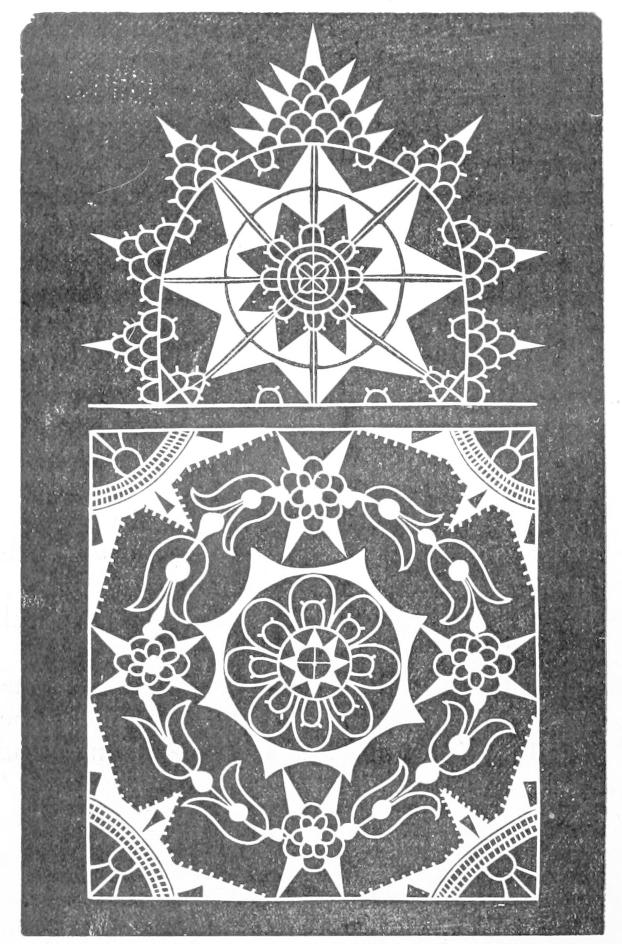
Grande Dantelle au point devant l'Aiguille.—(Montbéliard, 1598.)
It is in a pattern book, published at Montbéliard in 1598,[86] we first find designs for "dantelles." It contains twenty patterns, of all sizes, "bien petites, petites" (Figs. 9, 10, 11, 12), "moyennes, et grosses" (Fig. 8).
Fig. 9. Fig. 10.
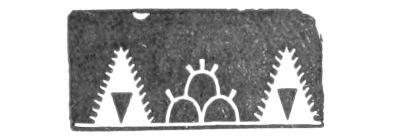
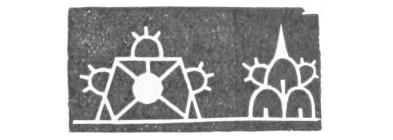
Petite Dantelle.—(1598.) Petite Dantelle.—(1598.)
The word dentelle seems now in general use; but Vecellio, in his Corona, 1592, has "opere a mazette," pillow lace, and Mignerak first gives the novelty of "passements au fuzeau," pillow lace (Fig. 13), for which Vinciolo, in his edition of 1623, also furnishes patterns (Figs. 14 and 15); and Parasoli, 1616, gives designs for "merli a piombini" (Fig. 16).
Fig. 11. Fig. 12.
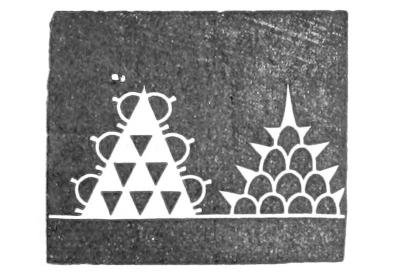
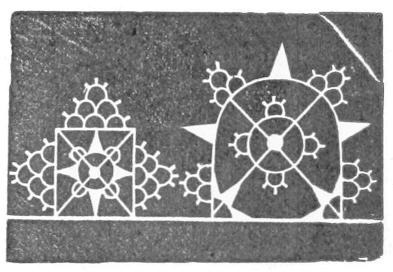
Petite Dantelle.—(1598.) Petite Dantelle.—(1598.)
In the inventory of Henrietta Maria, dated 1619,[87] appear a variety of laces, all qualified under the name of "passement"; and in that of the Maréchal La Motte, 1627, we find the term applied to every description of lace.
"Item, quatre paires de manchettes garnyes de passement, tant de Venise, Gennes, et de Malines."[88]
Lace consists of two parts, the ground and the pattern.
The plain ground is styled in French entoilage, on account of its containing the flower or ornament, which is called toilé, from the flat close texture resembling linen, and also from its being often made of that material or of muslin.
Fig. 13. Fig. 14.
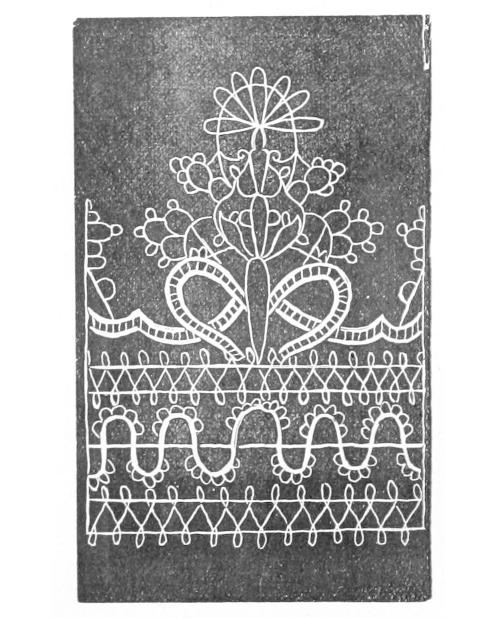
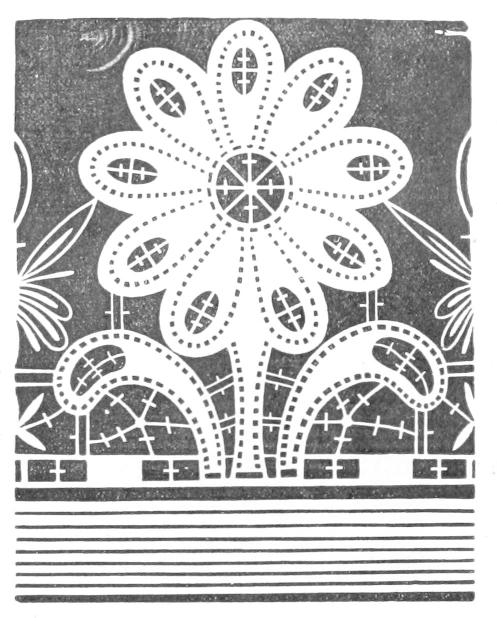
Passement au Fuseau.—(Mignerak, 1605.) Passement au Fuseau.—(Vinciolo, Edition 1623.)
The honeycomb network or ground, in French fond, champ,[89] réseau, treille, is of various kinds: wire ground, Brussels ground, trolly ground, etc., fond clair, fond double, etc.
Some laces, points and guipures are not worked upon a ground; the flowers are connected by irregular threads overcast (buttonhole stitch), and sometimes worked over with pearl loops (picot). Such are the points of Venice and Spain and most of the guipures. To these uniting threads, called by our lace-makers "pearl ties"—old Randle Holme[90] styles them "coxcombs"—the Italians give the name of "legs," the French that of "brides."[91]
Fig. 15. Fig. 16.
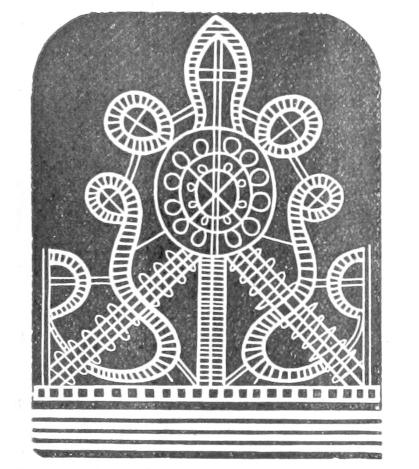
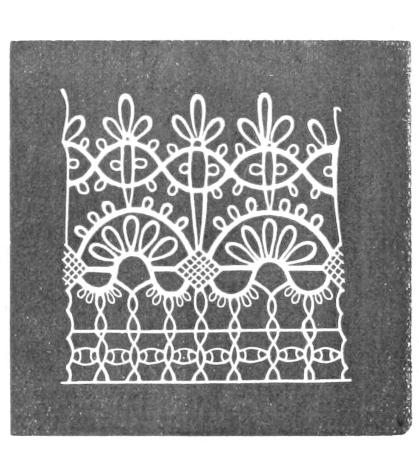
Passement au Fuseau.—(Vinciolo, Edition 1623.) Merletti a Piombini.—(Parasole, 1616.)
The flower, or ornamental pattern, is either made together with the ground, as in Valenciennes or Mechlin, or separately, and then either worked in or sewn on (appliqué), as in Brussels.
The open-work stitches introduced into the pattern are called modes, jours; by our Devonshire workers, "fillings."
All lace is terminated by two edges, the pearl, picot,[92] or couronne—a row of little points at equal distances, and the footing or engrêlure—a narrow lace, which serves to keep the stitches of the ground firm, and to sew the lace to the garment upon which it is to be worn.
Lace is divided into point and pillow (or more correctly bobbin) lace. The term pillow gives rise to misconceptions, as it is impossible to define the distinction between the "cushion" used for some needle-laces and the "pillow" of bobbin-lace. The first is made by the needle on a parchment pattern, and termed needle-point, point à l'aiguille, punto in aco.
The word is sometimes incorrectly applied to pillow-lace, as point de Malines, point de Valenciennes, etc.
Point also means a particular kind of stitch, as point de Paris,[93] point de neige, point d'esprit,[94] point à la Reine, point à carreaux, à chaînette, etc.
"Cet homme est bien en points," was a term used to denote a person who wore rich laces.[95]
The mention of point de neige recalls the quarrel of Gros René and Marinette, in the Dépit Amoureux[96] of Molière:—
"Ton beau galant de neige,[97] avec ta nonpareille, Il n'aura plus l'honneur d'être sur mon oreille."
Gros René evidently returns to his mistress his point de neige nightcap.
The manner of making bobbin lace on a pillow[98] need hardly be described. The "pillow"[99] is a round or oval board, stuffed so as to form a cushion, and placed upon the knees of the workwoman. On this pillow a stiff piece of parchment is fixed, with small holes pricked through to mark the pattern. Through these holes pins are stuck into the cushion. The threads with which the lace is formed are wound upon "bobbins," formerly bones,[100] now small round pieces of wood, about the size of a pencil, having round their upper ends a deep groove, so formed as to reduce the bobbin to a thin neck, on which the thread is wound, a separate bobbin being used for each thread.
Plate VI.
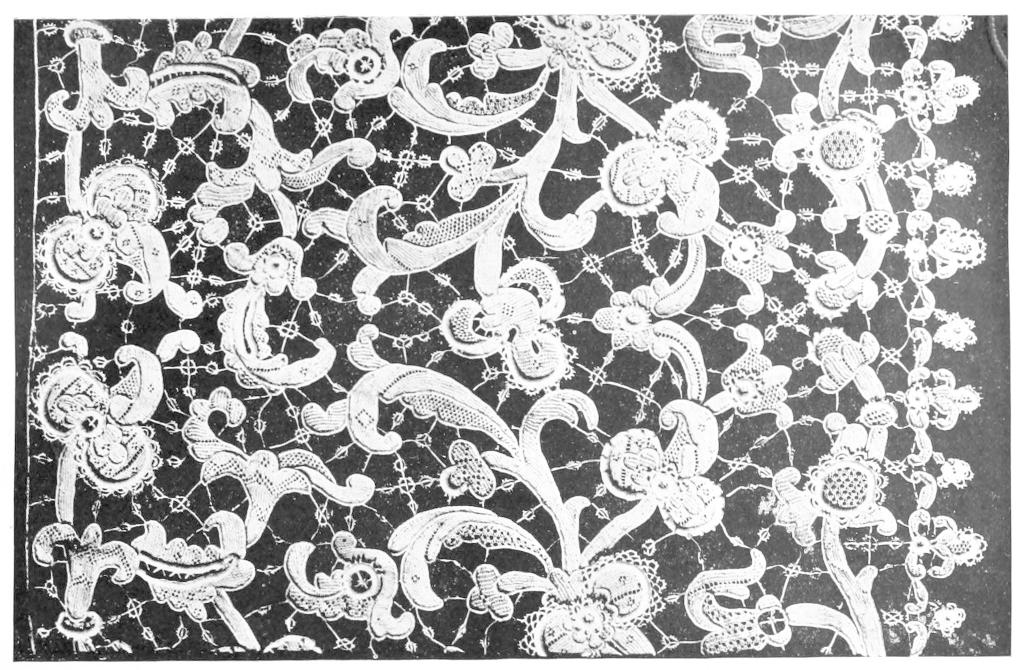
Italian.—Modern reproduction at Burano of Point de Venise à la feuille et la rose, of seventeenth century.
Width, 8 in. Photo by the Burano School.
Plate VII.
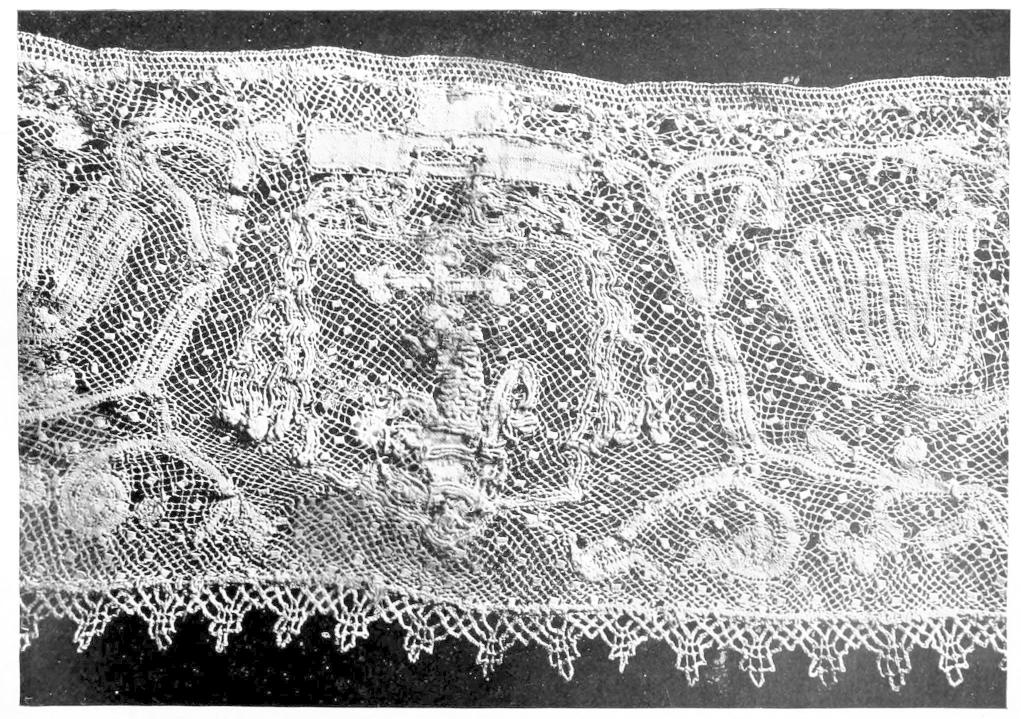
Heraldic (carnival lace), was made in Italy. This appears to be a specimen, though the archaic pattern points to a German origin. The réseau is twisted and knotted. Circ. 1700. The Arms are those of a Bishop.
Photo by A. Dryden from private collection.
To face page 32.
By the twisting and crossing of these threads the ground of the lace is formed. The pattern or figure, technically called "gimp," is made by interweaving a thread much thicker than that forming the groundwork, according to the design pricked out on the parchment.[101] Such has been the pillow and the method of using it, with but slight variation, for more than three centuries.
To avoid repetition, we propose giving a separate history of the manufacture in each country; but in order to furnish some general notion of the relative ages of lace, it may be as well to enumerate the kinds most in use when Colbert, by his establishment of the Points de France, in 1665, caused a general development of the lace manufacture throughout Europe.
The laces known at that period were:—
1. Point.—Principally made at Venice, Genoa, Brussels, and in Spain.
2. Bisette.—A narrow, coarse thread pillow lace of three qualities, made in the environs of Paris[102] by the peasant women, principally for their own use. Though proverbially of little value—"ce n'est que de la bisette"[103]—it formed an article of traffic with the mercers and lingères of the day.
3. Gueuse.—A thread lace, which owed to its simplicity the name it bore. The ground was network, the flowers a loose, thick thread, worked in on the pillow. Gueuse was formerly an article of extensive consumption in France, but, from the beginning of the last century, little used save by the lower classes. Many old persons may still remember the term, "beggars' lace."
4. Campane.[104]—A white, narrow, fine, thread pillow edging, used to sew upon other laces, either to widen them, or to replace a worn-out picot or pearl.
Campane lace was also made of gold, and of coloured silks, for trimming mantles, scarfs, etc. We find, in the Great Wardrobe Accounts of George I., 1714,[105] an entry of "Gold Campagne buttons."
Evelyn, in his "Fop's Dictionary," 1690, gives, "Campane, a kind of narrow, pricked lace;" and in the "Ladies' Dictionary," 1694, it is described as "a kind of narrow lace, picked or scalloped."[106]
In the Great Wardrobe Account of William III., 1688-9, we have "le poynt campanie tæniæ."
5. Mignonette.[107]—A light, fine, pillow lace, called blonde de fil,[108] also point de tulle, from the ground resembling that fabric. It was made of Lille thread, bleached at Antwerp, of different widths, never exceeding two to three inches. The localities where it was manufactured were the environs of Paris, Lorraine, Auvergne, and Normandy.[109] It was also fabricated at Lille, Arras, and in Switzerland. This lace was article of considerable export, and at times in high favour, from its lightness and clear ground, for headdresses[110] and other trimmings. It frequently appears in the advertisements of the last century. In the Scottish Advertiser, 1769, we find enumerated among the stock-in-trade, "Mennuet and blonde lace."
6. Point double, also called point de Paris and point des champs: point double, because it required double the number of threads used in the single ground; des champs, from its being made in the country.
7. Valenciennes.—See Chapter XV.
Fig. 17.
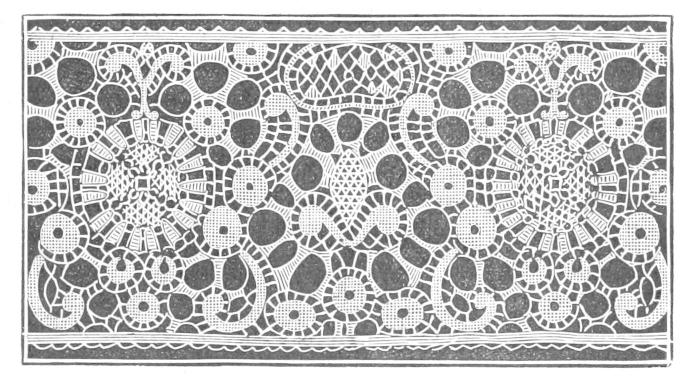
Old Mechlin.
8. Mechlin.—All the laces of Flanders, with the exception of those of Brussels and the point double, were known in commerce at this period under the general name of Mechlin. (Fig. 17.)
9. Gold lace.
10. Guipure.
GUIPURE.
Guipure, says Savary, is a kind of lace or passement made of "cartisane" and twisted silk.
Cartisane is a little strip of thin parchment or vellum, which was covered over with silk, gold, or silver thread, and formed the raised pattern.
The silk twisted round a thick thread or cord was called guipure,[111] hence the whole work derived its name.[112]
Guipure was made either with the needle or on the pillow like other lace, in various patterns, shades and colours, of different qualities and several widths.
The narrowest guipures were called "Têtes de More."[113]
The less cartisane in the guipure, the more it was esteemed, for cartisane was not durable, being only vellum covered over with silk. It was easily affected by the damp, shrivelled, would not wash, and the pattern was destroyed. Later, the parchment was replaced by a cotton material called canetille.
Savary says that most of the guipures were made in the environs of Paris;[114] that formerly, he writes in 1720, great quantities were consumed in the kingdom; but since the fashion had passed away, they were mostly exported to Spain, Portugal, Germany, and the Spanish Indies, where they were much worn.[115]
Guipure was made of silk, gold and silver; from its costliness, therefore, it was only worn by the rich.
Plate VIII.
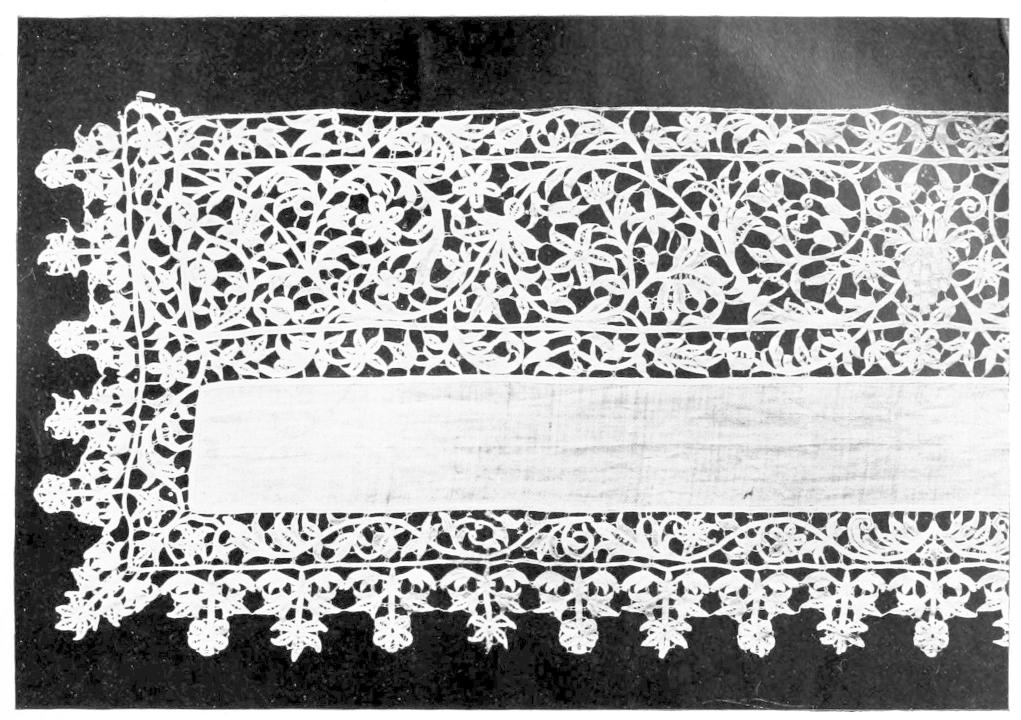
Italian, Venetian, Flat Needle-point Lace. "Punto in Aria."—The design is held together by plain "brides." Date, circ. 1645. Width, 11⅝ in.
Victoria and Albert Museum.
Plate IX.
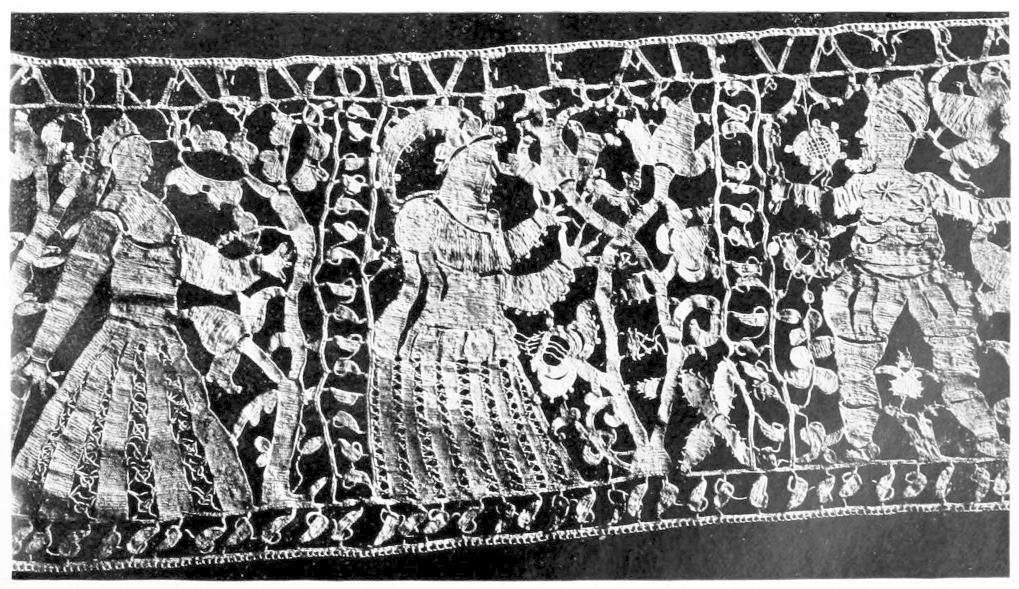
Portion of a Band of Needle-point Lace representing the Story of Judith and Holofernes.—The work is believed to be Italian, made for a Portuguese, the inscription being in Portuguese. Date, circ. 1590. Width, 8 in. The property of Mr. Arthur Blackborne.
Photo by A. Dryden.
To face page 36.
At the coronation of Henry II. the front of the high altar is described as of crimson velvet, enriched with "cuipure d'or"; and the ornaments, chasuble, and corporaliers of another altar as adorned with a "riche broderie de cuipure."[116]
On the occasion of Henry's entry into Paris, the king wore over his armour a surcoat of cloth of silver ornamented with his ciphers and devices, and trimmed with "guippures d'argent."[117]
In the reign of Henry III. the casaques of the pages were covered with guipures and passements, composed of as many colours as entered into the armorial bearings of their masters; and these silk guipures, of varied hues, added much to the brilliancy of their liveries.[118]
Guipure seems to have been much worn by Mary Stuart. When the Queen was at Lochleven, Sir Robert Melville is related to have delivered to her a pair of white satin sleeves, edged with a double border of silver guipure; and, in the inventory of her clothes taken at the Abbey of Lillebourg,[119] 1561-2, we find numerous velvet and satin gowns trimmed with "gumpeures" of gold and silver.[120]
It is singular that the word guipure is not to be found in our English inventories or wardrobe accounts, a circumstance which leads us to infer, though in opposition to higher authorities, that guipure was in England termed "parchment lace"—a not unnatural conclusion, since we know it was sometimes called "dentelle à cartisane,"[121] from the slips of parchment of which it was partly composed. Though Queen Mary would use the French term, it does not seem to have been adopted in England, whereas "parchment lace" is of frequent occurrence.
From the Privy Purse Expenses of the Princess Mary,[122] we find she gives to Lady Calthorpe a pair of sleeves of "gold, trimmed with parchment lace," a favourite donation of hers, it would appear, by the anecdote of Lady Jane Grey.
"A great man's daughter," relates Strype[123] "(the Duke of Suffolk's daughter Jane), receiving from Lady Mary, before she was Queen, goodly apparel of tinsel, cloth of gold, and velvet, laid on with parchment lace of gold, when she saw it, said, 'What shall I do with it?' Mary said, 'Gentlewoman, wear it.' 'Nay,' quoth she, 'that were a shame to follow my Lady Mary against God's word, and leave my Lady Elizabeth, which followeth God's word.'"
In the list of the Protestant refugees in England, 1563 to 1571,[124] among their trades, it is stated "some live by making matches of hempe stalks, and parchment lace."
Again, Sir Robert Bowes, "once ambassador to Scotland," in his inventory, 1553, has "One cassock of wrought velvet with p'chment lace of gold."[125]
"Parchment lace[126] of watchett and syllver at 7s. 8d. the ounce," appears also among the laces of Queen Elizabeth.[127]
King Charles I. has his carpet bag trimmed with "broad parchment gold lace,"[128] his satin nightcaps with gold and silver parchment laces,[129] and even the bag and comb case "for his Majesty's barber" is decorated with "silver purle and parchment lace."[130]
Again, Charles II. ornaments the seats on both sides the throne with silver parchment lace.[131] In many of the inventories circ. 1590, "sylke parchment lace" is noted down, and "red" and "green parchment lace," again, appear among the wares found "in ye Shoppes."[132]
But to return to the word guipure.
In an inventory of the Church of the Oratoire, at Paris, of the seventeenth century, are veils for the host: one, "de taffetas blanc garny d'une guipure"; the other, "de satin blanc à fleurs, avec une dentelle de guipure."[133]
These guipures will have also been of silk. When the term was first transferred to the thread passements which are now called guipure, it is difficult to say, for we can find no trace of it so applied.
Be that as it may, the thread guipures are of old date; many of the patterns bear the character of the rich ornamentation and capricious interlacings of the Renaissance; others, again, are "pur Louis Quatorze" (Fig. 18). The finest thread guipures were the produce of Flanders and Italy. They are most varied in their style. In some the bold flowing patterns are united by brides; in others by a coarse réseau, often circular, and called "round ground."
Fig. 18.
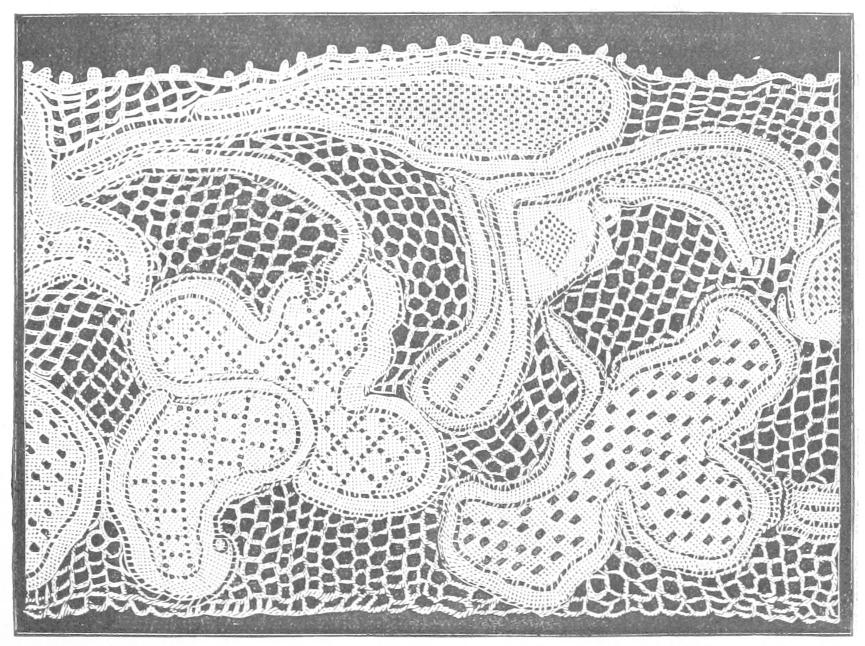
Guipure.—(Louis XIV.)
In that class called by the lace-makers "tape guipure," the outline of the flowers is formed by a pillow or handmade braid about the eighth of an inch in width (Fig. 19).
The term guipure is now so extensively applied it is difficult to give a limit to its meaning. We can only define it as lace where the flowers are either joined by "brides," or large coarse stitches, or lace that has no ground at all. The modern Honiton and Maltese are guipures, so is the Venetian point.
Fig. 19.
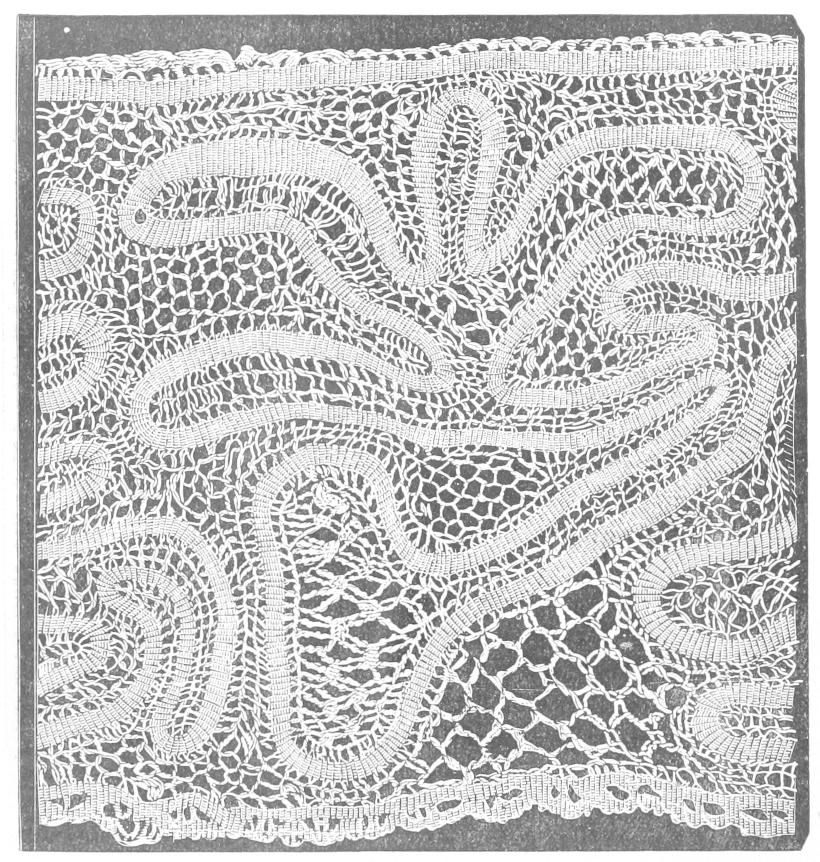
Tape Guipure, Bobbin-made.—(Genoa.)
Most of these laces are enumerated in a jeu d'esprit, entitled "La Révolte des Passemens," published at Paris in 1661.[134]
In consequence of a sumptuary edict against luxury in apparel, Mesdames les Broderies—
"Les Poinctes, Dentelles, Passemens Qui, par une vaine despence, Ruinoient aujourd'huy la France"—
meet, and concert measures for their common safety. Point de Gênes, with Point de Raguse, first address the company; next, Point de Venise, who seems to look on Raguse with a jealous eye, exclaims—
"Encore pour vous, Poinct de Raguse, Il est bon, crainte d'attentat, D'en vouloir perger un estat. Les gens aussy fins que vous estes Ne sont bons que, comme vous faites, Pour ruiner tous les estats. Et vous, Aurillac ou Venise, Si nous plions notre valise,"
what will be our fate?
The other laces speak, in their turn, most despondently, till a "vieille broderie d'or," consoling them, talks of the vanity of this world:—"Who knows it better than I, who have dwelt in kings' houses?" One "grande dentelle d'Angleterre" now proposes they should all retire to a convent. To this the "Dentelles de Flandres" object; they would sooner be sewn at once to the bottom of a petticoat.
Mesdames les Broderies resign themselves to become "ameublement;" the more devout of the party to appear as "devants d'autel;" those who feel too young to renounce the world and its vanities will seek refuge in the masquerade shops.
"Dentelle noire d'Angleterre" lets herself out cheap to a fowler, as a net to catch woodcocks, for which she felt "assez propre" in her present predicament.
The Points all resolve to retire to their own countries, save Aurillac, who fears she may be turned into a strainer "pour passer les fromages d'Auvergne," a smell insupportable to one who had revelled in civet and orange-flower.
All were starting—
"Chacun, dissimulant sa rage, Doucement ploit son bagage, Resolu d'obéir au sort,"
when
"Une pauvre malheureuse, Qu'on apelle, dit on, la Gueuse,"
arrives, in a great rage, from a village in the environs of Paris. "She is not of high birth, but has her feelings all the same. She will never submit. She has no refuge—not even a place in the hospital. Let them follow her advice and 'elle engageoit sa chaînette,' she will replace them all in their former position."
Next morn, the Points assemble. "Une grande Cravate[135] fanfaron" exclaims:—
"Il nous faut venger cet affront, Revoltons-nous, noble assemblée."
A council of war ensues:—
"La dessus, le Poinct d'Alençon Ayant bien appris sa leçon Fit une fort belle harangue."
Flanders now boasts how she had made two campaigns under Monsieur, as a cravat; another had learned the art of war under Turenne; a third was torn at the siege of Dunkirk.
"Racontant des combats qu'ils ne virent jamais,"
one and all had figured at some siege or battle.
"Qu'avons nous à redouter?"
cries Dentelle d'Angleterre. No so, thinks Point de Gênes, "qui avoit le corps un peu gros."
They all swear—
"Foy de Passement, Foy de Poincts et de Broderie, De Guipure et d'Orfévrerie, De Gueuse de toute façon,"
to declare open war, and to banish the Parliament.
The Laces assemble at the fair of St. Germain, there to be reviewed by General Luxe.
The muster-roll is called over by Colonel Sotte Depense. Dentelles de Moresse, Escadrons de Neige, Dentelles de Hâvre, Escrues, Soies noires, and Points d'Espagne, etc., march forth in warlike array, to conquer or to die. At the first approach of the artillery they all take to their heels, and are condemned by a council of war—the Points to be made into tinder, for the sole use of the King's Mousquetaires; the Laces to be converted into paper; the Dentelles, Escrues, Gueuses, Passemens, and Silk Lace to be made into cordage and sent to the galleys; the Gold and Silver Laces, the original authors of the sedition, to be "burned alive."
Finally, through the intercession of Love—
"Le petit dieu plein de finesse,"
they are again pardoned and restored to court favour.
The poem is curious, as giving an account of the various kinds of lace, and as a specimen of the taste of the time, but the "ton précieux" of the Hôtel Rambouillet pervades throughout.
The lace trade, up to this period, was entirely in the hands of pedlars, who carried their wares to the principal towns and large country-houses.
"One Madame La Boord," says Evelyn, "a French peddling-woman, served Queen Katherine with petticoats, fans, and foreign laces." These hawkers attended the great fairs[136] of Europe, where all purchases were made.[137]
Even as early as King Henry III.[138] we have a notice "to purchase robes at the fair of St. Ives, for the use of Richard our brother"; and in the dramas of the sixteenth and seventeenth centuries, we find constant allusion to these provincial markets:—[139]
"Seven Pedlars' shops, nay all Sturbridge fair,[140] will Scarce furnish her."[141]
The custom of carrying lace from house to house still exists in Belgium, where at Spa and other places, colporteurs,[142] with packs similar to those borne by our pedlars, bring round to the visitors laces of great value, which they sell at cheaper rates than those exposed in the shops.[143]
Many travellers, too, through the counties of Buckingham and Bedford, or the more southern regions of Devon, will still call to mind the inevitable lace box handed round for purchase by the waiter at the conclusion of the inn dinner; as well as the girls who, awaiting the arrival of each travelling carriage or postchaise, climbed up to the windows of the vehicle, rarely allowing the occupants to go their way until they had purchased some article of the wares so pertinaciously offered to their inspection.
In Paris, the lace trade was the exclusive privilege of the passementiers.[144]
Plate X.
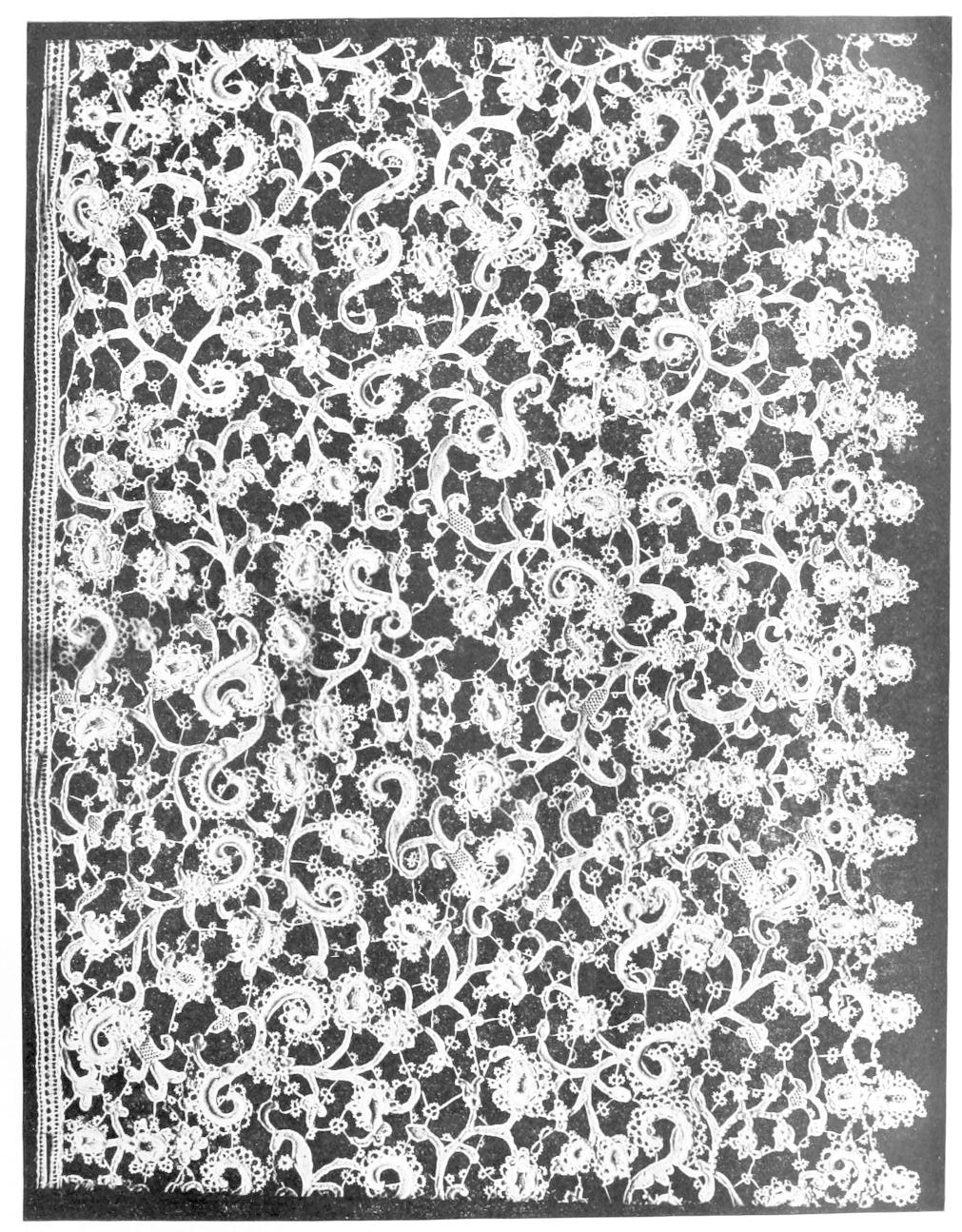
Italian. Point de Venise à la rose. Modern reproduction at Burano of seventeenth century lace. Width, 17 in.
Photo by the Burano School.
To face page 44.