Chapter XX
Reading edition
HOLLAND, GERMANY, SWITZERLAND, AUSTRIA AND HUNGARY.
HOLLAND.
"A country that draws fifty feet of water, In which men live as in the hold of nature, And when the sea does in them break, And drowns a province, does but spring a leak."—Hudibras.
We know little of the early fabrics of this country. The laces of Holland, though made to a great extent, were overshadowed by the richer products of their Flemish neighbours. "The Netherlanders," writes Fynes Moryson, who visited Holland in 1589, "wear very little lace,[689] and no embroidery. Their gowns are mostly black, without lace or gards, and their neck-ruffs of very fine linen."
We read how, in 1667, France had become the rival of Holland in the trade with Spain, Portugal and Italy; but she laid such high duties on foreign merchandise, the Dutch themselves set up manufactures of lace and other articles, and found a market for their produce even in France.[690] A few years later, the revocation of the Edict of Nantes[691] caused 4,000 lace-makers to leave the town of Alençon alone. Many took refuge in Holland, where, says a writer of the day, "they were treated like artists." Holland gained more than she lost by Louis XIV. The French refugees founded a manufactory of that point lace called "dentelle a la Reine"[692] in the Orphan House at Amsterdam.[693]
Plate LXVI.
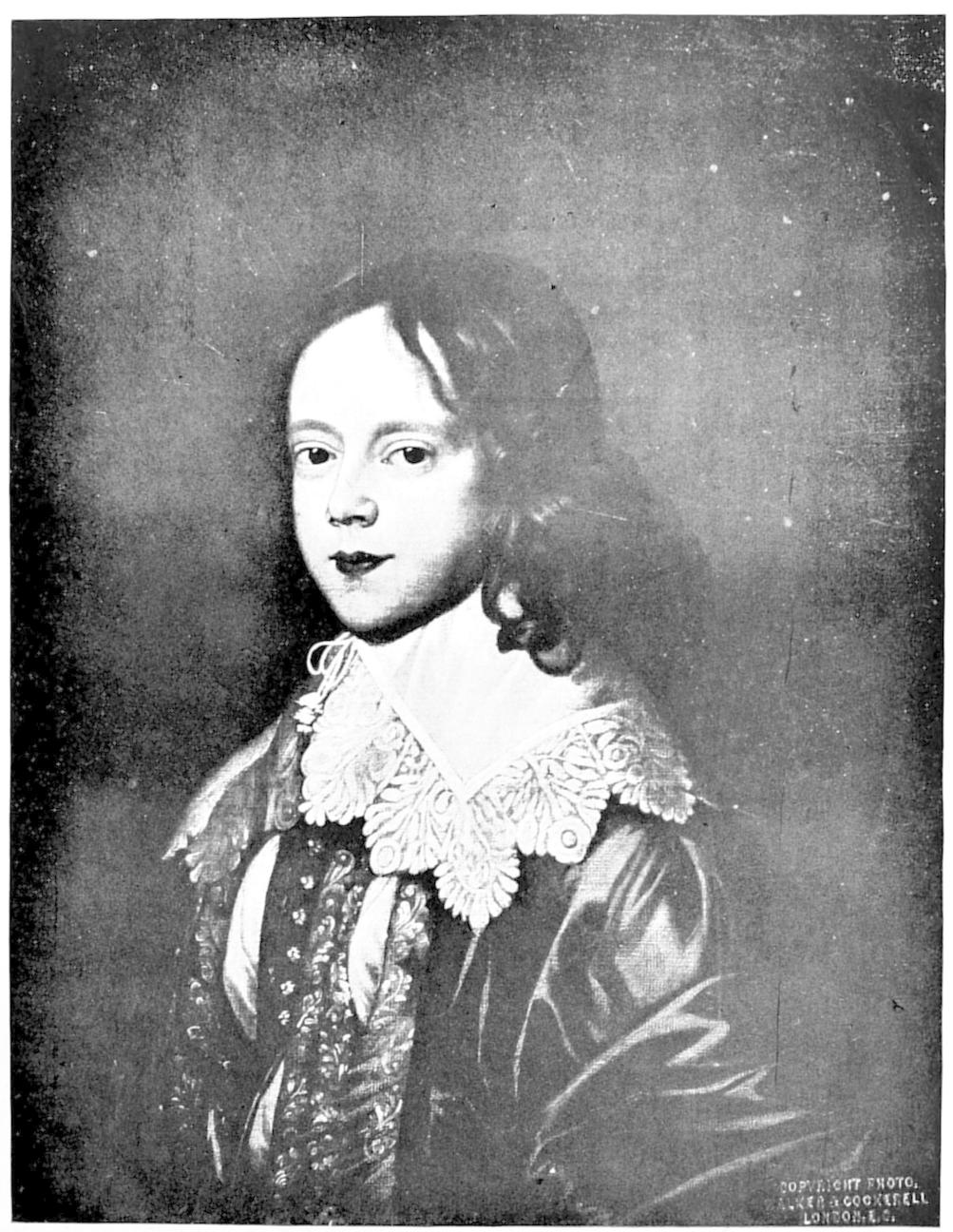
William, Prince of Orange, Father of William III., 1627-1650. School of Van Dyck.
The collar is edged with Dutch lace. National Portrait Gallery.
Photo by Walker and Cockerell.
To face page 258.
A few years later, another Huguenot, Zacharie Châtelain,[694] introduced into Holland the industry, at that time so important, of making gold and silver lace.
The Dutch possessed one advantage over most other nations, especially over England, in her far-famed Haarlem[695] thread, once considered the best adapted for lace in the world. "No place bleaches flax," says a writer of the day,[696] "like the meer of Haarlem."[697]
Still the points of Holland made little noise in the world. The Dutch strenuously forbade the entry of all foreign lace, and what they did not consume themselves they exported to Italy, where the market was often deficient.[698] Once alone in England we hear tell of a considerable parcel of Dutch lace seized between Deptford and London from the Rotterdam hoy. England, however, according to Anderson, in 1764, received in return for her products from Holland "fine lace, but the balance was in England's favour."
In 1770 the Empress Queen (Marie Theresa) published a declaration prohibiting the importation of Dutch lace into any of her Imperial Majesty's hereditary dominions in Germany.[699]
As in other matters, the Dutch carried their love of lace to the extreme, tying up their knockers with rich point to announce the birth of an infant. A traveller who visited France in 1691, remarks of his hotel: "The warming-pans and brasses were not here muffled up in point and cut-work, after the manner of Holland, for there were no such things to be seen."[700]
The Dutch lace most in use was thick, strong and serviceable (Fig. 113). That which has come under our notice resembles the fine close Valenciennes, having a pattern often of flowers or fruit strictly copied from nature. "The ladies wear," remarks Mrs. Calderwood, "very good lace mobs." The shirt worn by William the Silent when he fell by the assassin is still preserved at The Hague; it is trimmed with a lace of thick linen stitches, drawn and worked over in a style familiar to those acquainted with the earlier Dutch pictures.
SAXONY.
"Here unregarded lies the rich brocade, There Dresden lace in scatter'd heaps is laid; Here the gilt china vase bestrews the floor, While chidden Betty weeps without the door." —"Eclogue on the death of Shock, a pet lapdog." Ladies' Magazine. 1750.
"His olive-tann'd complexion graces With little dabs of Dresden laces; While for the body Mounseer Puff Would think e'en dowlas fine enough." —French Barber. 1756.
Fig. 113.
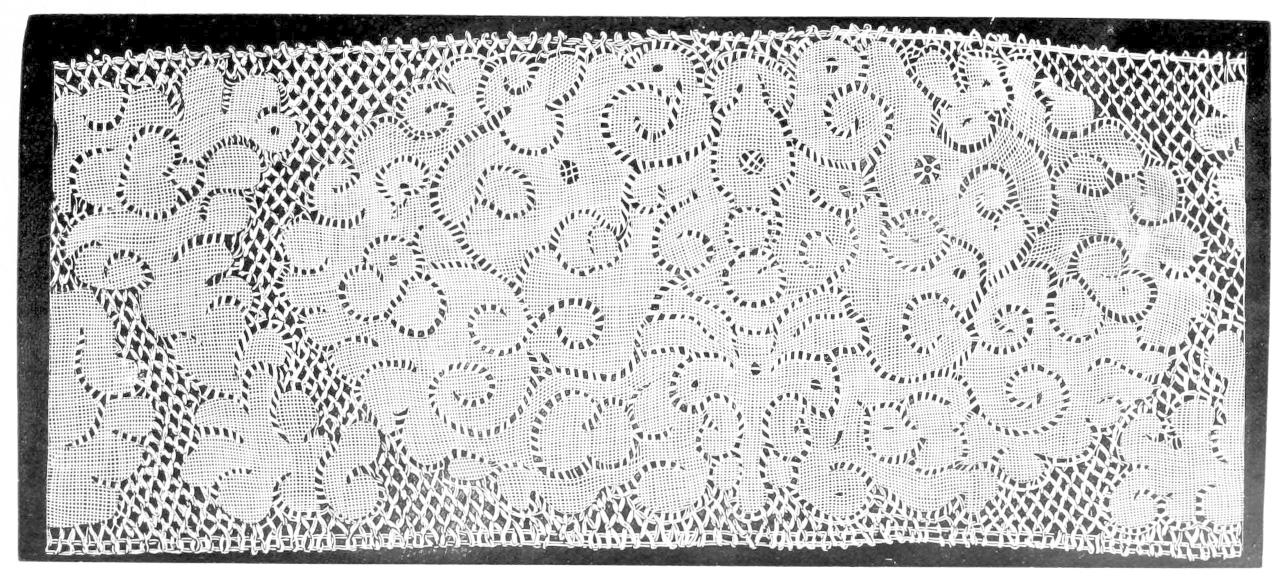
Dutch Bobbin-Lace.—Eighteenth century.
To face page 260.
Fig. 114.
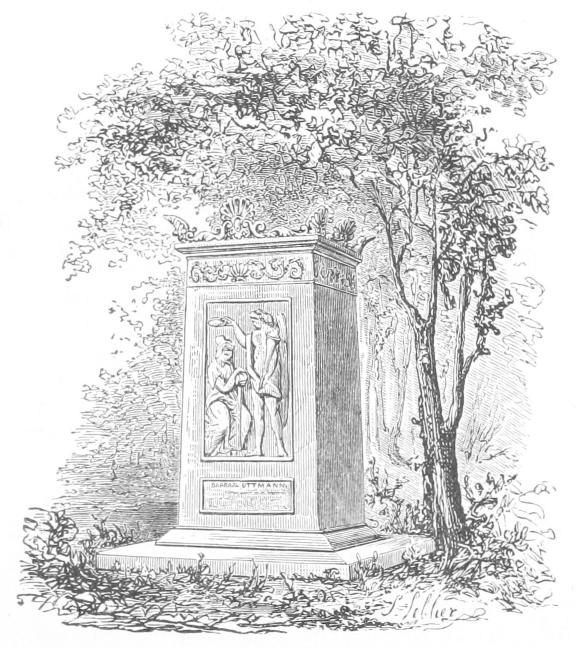
Tomb of Barbara Uttmann, at Annaberg.
The honour of introducing pillow lace into Germany is accorded by tradition to Barbara Uttman. She was born in 1514, in the small town of Etterlein, which derives its name from her family. Her parents, burghers of Nuremburg, had removed to the Saxon Hartz Mountains, for the purpose of working some mines. Barbara Etterlein here married a rich master miner named Christopher Uttmann, of Annaberg. It is said that she learned lace-making from a native of Brabant, a Protestant, whom the cruelties of the Spaniards had driven from her country. Barbara had observed the mountain girls occupied in making a network for the miners to wear over their hair: she took great interest in the work, and, profiting by the experience derived from her Brabant teacher, succeeded in making her pupils produce first a fine knotted tricot, afterwards a kind of plain lace ground. In 1561, having procured aid from Flanders, she set up, in her own name of Barbara Uttmann, a workshop at Annaberg, and there began to make laces of various patterns. This branch of industry soon spread from the Bavarian frontier to Altenberg and Geissing, giving employment to 30,000 persons, and producing a revenue of 1,000,000 thalers. Barbara Uttmann died in 1575, leaving sixty-five children and grandchildren, thus realising a prophecy made previous to her marriage, that her descendants would equal in number the stitches of the first lace ground she had made: such prophecies were common in those days. She sleeps in the churchyard of Annaberg, near the old lime-tree. On her tomb (Fig. 114) is inscribed: "Here lies Barbara Uttmann, died 14 January, 1575, whose invention of lace in the year 1561 made her the benefactress of the Erzgebirge."
"An active mind, a skilful hand, Bring blessings down on the Fatherland."
In the Green Vault at Dresden is preserved an ivory statuette of Barbara Uttmann, four and a half inches high, beautifully executed by Koehler, a jeweller of Dresden, who worked at the beginning of the eighteenth century. It is richly ornamented with enamels and precious stones, such figures (of which there are many in the Green Vault) being favourite articles for birthday and Christmas gifts.
Previous to the eighteenth century the nets of Germany had already found a market in Paris.[701] "On vend," says the Livre Commode des Adresses of 1692, "le treillis d'Allemagne en plusieurs boutiques de la rue Béthizy."
"Dresden," says Anderson, "makes very fine lace," the truth of which is confirmed by nearly every traveller of the eighteenth century. We have reason to believe the so-called Dresden lace was the drawn-work described in Chapter II., and which was carried to great perfection.
"Went to a shop at Spaw," writes Mrs. Calderwood, "and bought a pair of double Dresden ruffles, which are just like a sheaf, but not so open as yours, for two pounds two."
"La broderie de Dresde est très connue et les ouvriers très habiles," says Savary.
This drawn-work, for such it was, excited the emulation of other nations. The Anti-Gallican Society in 1753 leads the van, and awards three guineas as their second prize for ruffles of Saxony.[702]
Fig. 114a.
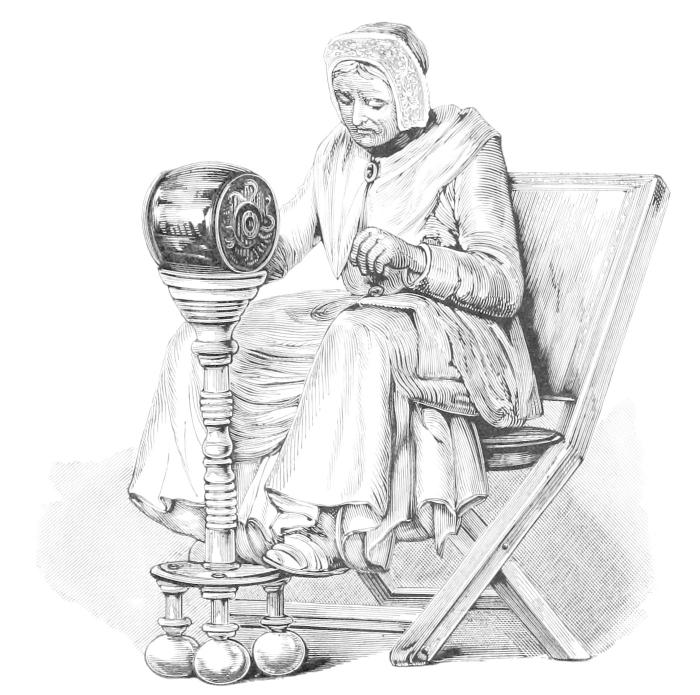
Barbara Uttmann, who introduced the Lace Manufacture into the Erzgebirge. From an ivory statuette by Koehler, Green Vault, Dresden.
To face page 262.
Ireland, in 1755, gave a premium of £5 for the best imitation of "Dresden point," while the Edinburgh Society, following in the wake, a year later presents to Miss Jenny Dalrymple a gold medal for "the best imitation of Dresden work in a pair of ruffles."
In the Fool of Quality,[703] and other works from 1760 to 1770, we have "Dresden aprons," "Dresden ruffles," showing that point to have been in high fashion. Wraxall, too, 1778, describes a Polish beauty as wearing "a broad Medicis of Dresden lace." As early as 1760 "Dresden work" is advertised as taught to young ladies in a boarding-school at Kelso,[704] together with "shell-work in grottoes, flowers, catgut, working lace on bobbins or wires, and other useful accomplishments."
The lace of Saxony has sadly degenerated since the eighteenth century. The patterns are old and ungraceful, and the lace of inferior workmanship, but, owing to the low price of labour, they have the great advantage of cheapness, which enables them to compete with France in the American and Russian markets. In all parts of Germany there are some few men who make lace. On the Saxon side of the Erzgebirge many boys are employed, and during the winter season men of all ages work at the pillow; and it is observed that the lace made by men is firmer and of a superior quality to that of the women. The lace is a dentelle torchon of large pattern, much in the style of the old lace of Ischia.[705]
The Saxon needle-lace of the present day is made in imitation of old Brussels, with small flowers on a réseau. Some is worked in coloured thread, and also black silk lace of the Chantilly type is made: of this the Erzgebirge is the chief centre. This lace is costly, and is sold at Dresden and other large towns of Germany, and particularly at Paris, where the dealers pass it off for old lace. This fabric employed, in 1851, 300 workers. A quantity of so-called Maltese lace is also made, but torchon predominates.
The Museum for Art and Industry, opened at Vienna in 1865, contains several pattern-books of the sixteenth century, and in it has been exhibited a fine collection of ancient lace belonging to General von Hauslaub, Master-General of the Ordnance.
GERMANY (NORTH AND SOUTH).
Germany in the sixteenth and seventeenth centuries was renowned for its lacis, cut-work, and embroidery with thread on net, of which there are several good examples in the Victoria and Albert Museum, together with specimens of early Flemish work from their colonies on the Elbe, established in the twelfth century by various German rulers. The work of these towns is of later date—of the fifteenth century—and has continued to the nineteenth century, when they made cambric caps, embroidered or ornamented with drawn-work, and edged with bobbin-made Tönder lace, in the style of eighteenth century Valenciennes.
"Presque dans toutes sortes d'arts les plus habiles ouvriers, ainsi que les plus riches négociants, sont de la religion prétendue réformée," said the Chancellor d'Aguesseau;[706] and when his master, Louis XIV., whom he, in not too respectful terms, calls "le roi trop crédule," signed the Act of Revocation (1685), Europe was at once inundated with the most skilful workmen of France. Hamburg alone of the Hanse Towns received the wanderers. Lubec and Bremen, in defiance of the remonstrances of the Protestant princes, allowed no strangers to settle within their precincts. The emigrants soon established considerable manufactures of gold and silver lace, and also that now extinct fabric known under the name of Hamburg point.[707]
Miss Knight, in her Autobiography, notes: "At Hamburg, just before we embarked, Nelson purchased a magnificent lace trimming for Lady Nelson, and a black lace cloak for another lady, who, he said, had been very attentive to his wife during his absence."
On the very year of the Revocation, Frederic William, Elector of Brandenburg, anxious to attract the fugitive workmen to his dominions, issued from Potsdam an edict[708] in their favour. Crowds of French Protestants responded to the call, and before many years had passed Berlin alone boasted 450 lace manufactories.[709] Previous to this emigration she had none. These "mangeurs d'haricots," as the Prussians styled the emigrants, soon amassed large fortunes, and exported their laces to Poland and to Russia. The tables were turned. France, who formerly exported lace in large quantities to Germany, now received it from the hands of her exiled workmen, and in 1723 and 1734 we find "Arrêts du Conseil d'Etat," relative to the importation of German laces.[710]
Plate LXVII. Plate LXVIII.
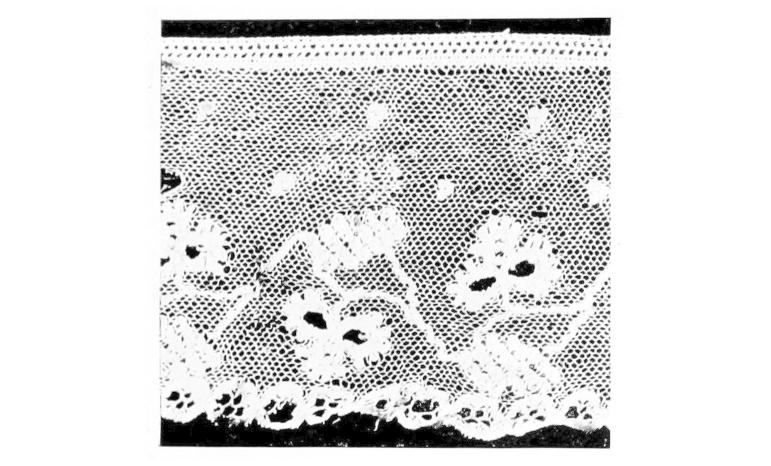
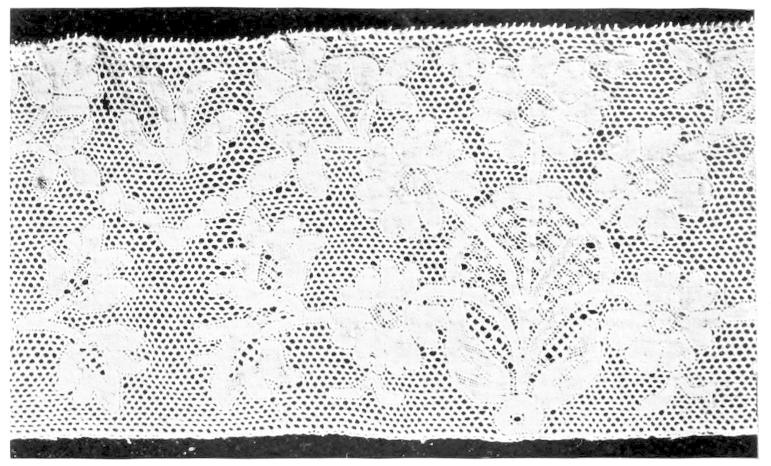
Swiss.—From near Neûchatel. Early nineteenth century. Similar in make to Lille and some Devon lace. German, Nuremberg.—Used by the peasants on their caps. The cordonnet suggests a Mechlin influence, whilst the heavy réseau is reminiscent of some Antwerp and Flemish and Italian village laces of the end of the seventeenth century.
Plate LXIX.
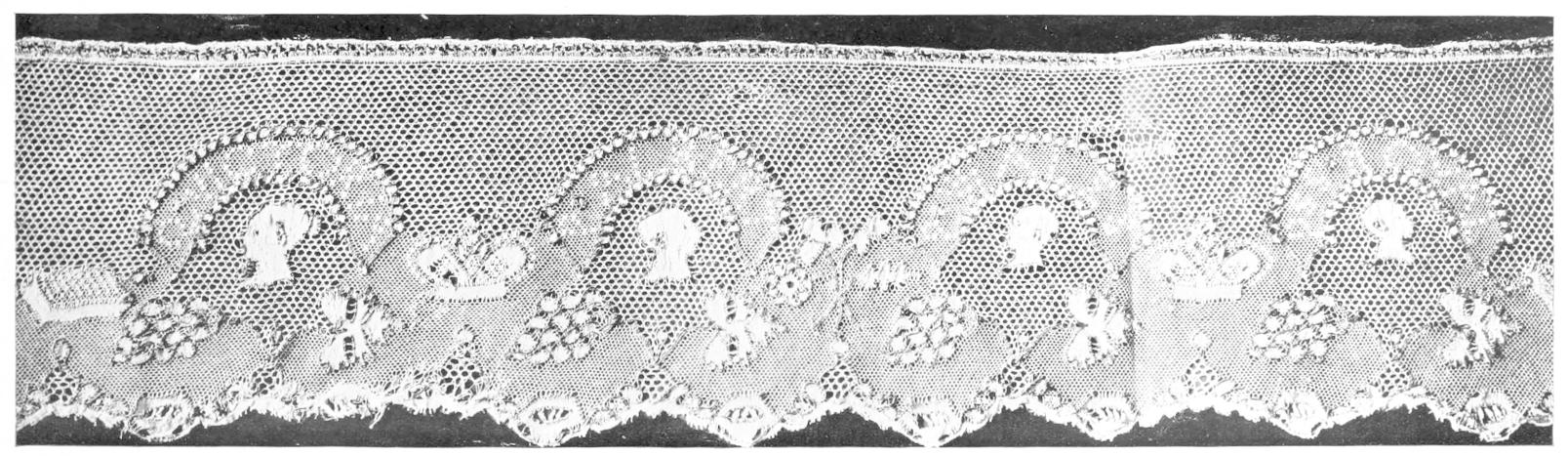
English, Bucks.—A unique piece designed and made by the lace-makers for Queen Victoria in the early years of her reign; from her lady-in-waiting Emma, Lady Portman, it has descended to the present owner, Mrs. Lloyd Baker. The above is a complete section of the design, which is outlined with gold thread.
Photos by A. Dryden from private collections.
To face page 264.
The Landgrave of Hesse also received the refugees, publishing an edict in their favour.[711] Two fabrics of fine point were established at Hanover.[712] Leipsic, Anspach,[713] Elberfeld, all profited by the migration. "On compte," writes Peuchet, "à Leipsig cinq fabriques de dentelles et de galon d'or et argent."
A large colony settled at Halle, where they made "Hungarian" lace—"Point de Hongrie,"[714] a term more generally applied to a stitch in tapestry.[715] The word, however, does occasionally occur:—
"Your Hungerland[716] bands and Spanish quellio ruffs, Great Lords and Ladies, feasted to survey."[717]
All these various fabrics were offsets of the Alençon trade.
Fynes Moryson expresses surprise at the simplicity of the German costume—ruffs of coarse cloth, made at home. The Dantzickers, however, he adds, dress more richly. "Citizens' daughters of an inferior sort wear their hair woven with lace stitched up with a border of pearl. Citizens' wives wear much lace of silk on their petticoats." Dandyism began in Germany, says a writer,[718] about 1626, when the women first wore silver, which appeared very remarkable, and "at last indeed white lace." A century later luxury at the baths of Baden had reached an excess unparalleled in the present day. The bath mantles, "équipage de bain," of both sexes are described as trimmed with the richest point, and after the bath were spread out ostentatiously as a show on the baths before the windows of the rooms. Lords and ladies, princesses and margraves, loitered up and down, passing judgment on the laces of each new arrival.[719]
This love of dress, in some cases, extended too far, for Bishop Douglas[720] mentions how the Leipsic students "think it more honourable to beg, with a sword by their side, of all they meet than to gain their livelihood. I have often," he says, "given a few groschen to one finely powdered and dressed with sword and lace ruffles."
Concerning the manufactures of the once opulent cities of Nuremburg and Augsburg we have no record. In the first-mentioned was published, in 1601, the model book, engraved on copper, of Sibmacher.[721] On the frontispiece is depicted a garden of the sixteenth century. From the branches of a tree hangs a label, informing the world "that she who loves the art of needlework, and desires to make herself skilful, can here have it in perfection, and she will acquire praise, honour, and reward." At the foot of the tree is seated a modest young lady yclept Industria; on the right a second, feather-fan in hand, called Ignavia—Idleness; on the left a respectable matron named Sofia—Wisdom. By way of a preface the three hold a dialogue, reviewing, in most flattering terms, the work.
A museum was founded in 1865 at Nuremburg for works and objects connected with the lace manufacture and its history. It contains some interesting specimens of Nuremburg lace, the work of a certain Jungfrau Pickleman, in the year 1600, presented by the widow Pfarrer Michel, of Poppenreuth.[722] The lace is much of the Venetian character. One specimen has the figures of a knight and a lady, resembling the designs of Vecellio. The museum also possesses other curious examples of lace, together with a collection of books relative to the lace fabric. (Plate LXVIII.)
"In the chapel of St. Egidius at Nuremburg," writes one of our correspondents, "we were led to make inquiries concerning sundry ponderous-looking chairs, bearing some resemblance to confessionals, but wanting the side compartments for the penitents. We learned that they belonged to the several guilds (Innung), who had undertaken to collect money for the erection of a new church after the destruction of the old by fire. For this end the last members sworn in of every trade sat in their respective chairs at the church doors on every Sunday and holiday. The offerings were thrown into dishes placed on a raised stand on the right of the chair, or into the hollow in front. The devices of each trade were painted or embossed on circular plates, said to be of silver, on the back of each chair. One Handwerksstuhl in particular attracted our attention; it was that of the passmenterie-makers (in German, Portenmacher or Posamentier Handwerk), which, until the handicrafts became more divided, included the lace-makers. An elegant scroll-pattern in rilievo surrounds the plate, surmounted by a cherub's head, and various designs, resembling those of the pattern-books, are embossed in a most finished style upon the plate, together with an inscription dated 1718."
Misson, who visited Nuremberg in 1698, describes the dress of a newly-married pair as rich in the extreme—that of the bridegroom as black, "fort chargé de dentelles"; the bride as tricked out in the richest "dentelle antique," her petticoat trimmed with "des tresses d'or et de dentelle noire."
In the Victoria and Albert Museum there are two women's ruffs from Nuremberg belonging to the latter part of the sixteenth or early seventeenth century, and embroidered in blue and black silk and white cotton, and edged with a coarse thread Mechlin lace with a large meshed irregular plaited réseau, probably late seventeenth century.
Perhaps the finest collection of old German point is preserved, or rather was so, in 1840, in the palace of the ancient, but now extinct, Prince-Archbishops of Bamberg.
Several more pattern-books were published in Germany. Among the most important is that printed at Augsburg, by John Schwartzenburg, 1534. It is printed in red, and the patterns, mostly borders, are of delicate and elegant design. (See Appendix.)
Secondly comes one of later date, published by Sigismund Latomus at Frankfort-on-the-Main, 1605; and lastly, that of "Metrepière Quinty, demorāt dempre leglīe de iii roies," a culōge (Cologne), 1527.
In Austria, writes Peuchet, "les dentelles de soie et de fil ne sont pas moins bien travaillées." Many of the Protestant lace-workers took refuge in the cities of Freyburg and Altenburg.
There is a collection in the Victoria and Albert Museum of cuffs embroidered in satin stitch, and edged with bobbin-lace "torchon" of the peasants' work in Slavonia in the eighteenth century. The patterns resemble Cretan and Russian laces.
There is a comparatively modern variety of lace made in Austria and Bohemia which resembles the old Italian bobbin-lace; the school where it is taught is under Government patronage. This industry was established as a means of relieving the distress of the Tyrol in 1850, and continues to flourish.
Austria sent to the International Exhibition of 1874 specimens of needle-point and point plat made in the school of the Grand Duchess Sophie, and specimens of border laces in the style of the Auvergne laces were exhibited from the Erzgebirge and Bohemia.
At the Paris Exhibition, Austria and Vienna both exhibited copies of old needle-point laces.
At Laybach, in Austria, there was at one time a bobbin-lace factory which produced lace much esteemed in the eighteenth century.
The collection of Hungarian peasant lace in the Victoria and Albert Museum collection contains specimens of coarse modern pillow-made lace, with rude floral designs worked in thick thread or yellow silk.
The modern laces of Bohemia are tasteless in design. The fabric is of early date. "The Bohemian women," writes Moryson, "delight in black cloth with lace of bright colours." In the beginning of the nineteenth century upwards of 60,000 people, men, women and children, were occupied in the Bohemian Erzgebirge alone in lace-making. Since the introduction of the bobbin-net machine into Austria, 1831, the number has decreased. There were in 1862 scarcely 8,000 employed in the common laces, and about 4,000 on Valenciennes and points.[723]
Plate LXX.
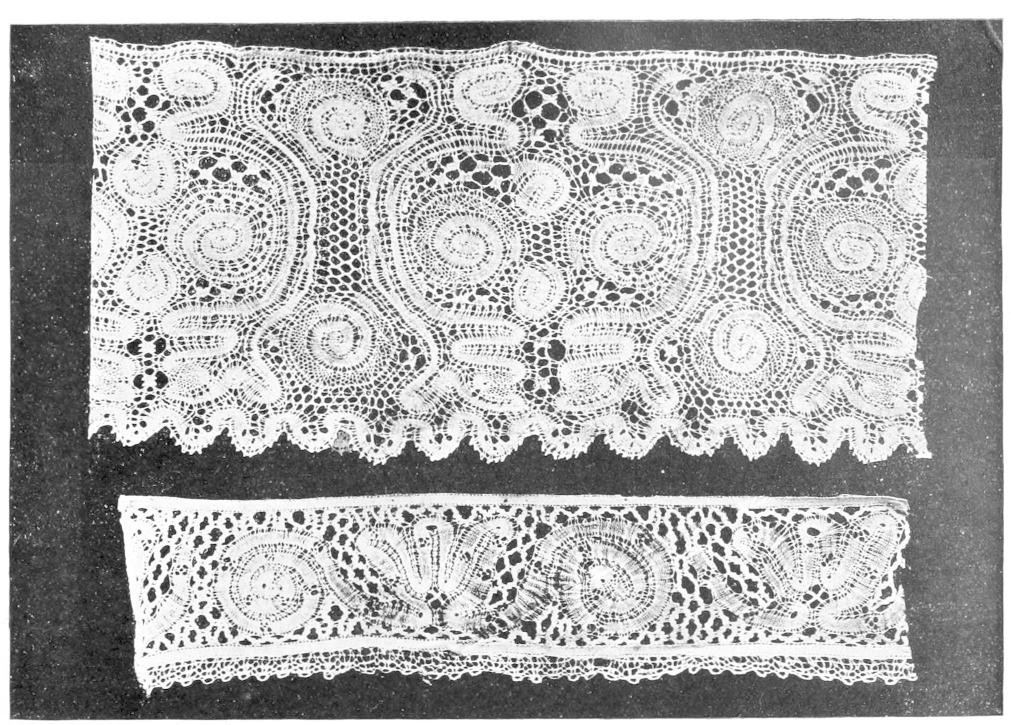
Hungarian. Bobbin Lace.—Latter half of nineteenth century. Widths, 6¼ and 2½ in.
Victoria and Albert Museum.
Plate LXXI.
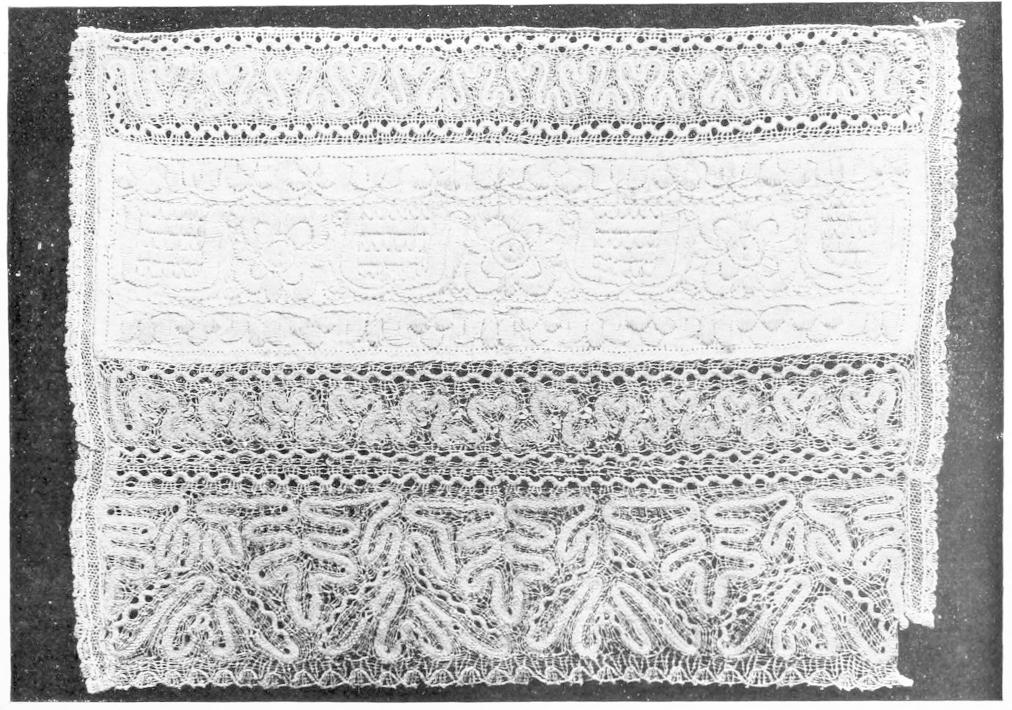
Austro-Hungarian, South Slavonian. Cuff of Linen embroidered in satin stitch in white silk. White silk bobbin lace.—Eighteenth century. Width, 7½ in.
Victoria and Albert Museum.
To face page 268.
SWITZERLAND.
"Dans un vallon fort bien nommé Travers, S'élève un mont, vrai séjour des hivers."—Voltaire.
In the Preface of the Neues Modelbuch of Froschowern, printed at Zurich (see Appendix), occurs the following:—"Amongst the different arts we must not forget one which has been followed in our country for twenty-five years. Lace-making was introduced in 1536 by merchants from Italy and Venice. Many women, seeing a means of livelihood in such work, quickly learned it, and reproduced lace with great skill. They first copied old patterns, but soon were enabled to invent new ones of great beauty. The industry spread itself about the country, and was carried to great perfection: it was found to be one specially suitable for women, and brought in good profits. In the beginning these laces were used solely for trimming chemises and shirts; soon afterwards collars, trimmings for cuffs, caps, and fronts and bodies of dresses, for napkins, sheets, pillow-cases and coverlets, etc., were made in lace. Very soon such work was in great demand, and became an article of great luxury. Gold thread was subsequently introduced into some of it, and raised its value considerably; but this latter sort was attended with the inconvenience that it was more difficult to clean and wash than laces made with flax threads only."[724]
The above account is interesting, not only in its reference to Switzerland, but from its corroborative evidence of the Italian origin of lace.
In 1572, one Symphorien Thelusson, a merchant of Lyons, having escaped from the massacre of St. Bartholomew, concealed himself in a bale of goods, in which he reached Geneva, and was hospitably received by the inhabitants. When, after the lapse of near a hundred and twenty years, crowds of French emigrants arrived in the city, driven from their homes on the Revocation of the Edict of Nantes, a descendant of this same Thelusson took a body of 2,000 refugees into his service, and at once established a manufacture of lace.[725] The produce of this industry was smuggled back into France, the goods conveyed across the Jura over passes known only to the bearers, by which they avoided the custom-house duties of Valence. "Every day," writes Jambonneau, himself a manufacturer, "they tell my wife what lace they want, and she takes their orders." Louis XIV. was furious.[726]
Though lace-making employed many women in various parts of the country, who made a common description while tending their flocks in the mountains, Neufchâtel has always been the chef-lieu of the trade. "In this town," says Savary, "they have carried their works to such a degree of perfection, as to rival the laces of Flanders, not only in beauty but in quality." We have ourselves seen in Switzerland guipures of fine workmanship that were made in the country, belonging to old families, in which they have remained as heirlooms; and have now in our possession a pair of lappets, made in the last century at Neufchâtel, of such exquisite beauty as not to be surpassed by the richest productions of Brussels.
Formerly lace-making employed a large number of workwomen in the Val de Travers, where, during his sojourn at Moutiers, Jean-Jacques Rousseau tells us he amused himself in handling the bobbins.
In 1780 the lace trade was an object of great profit to the country, producing laces valuing from 1 batz to upwards of 70 francs the ell, and exporting to the amount of 1,500,000 francs; on which the workwomen gained 800,000, averaging their labour at scarcely 8 sols per day. The villages of Fleurens and Connet were the centre of this once flourishing trade,[727] now ruined by competition with Mirecourt. In 1814 there were in the Neufchâtel district, 5628 lace-makers; in 1844 a few aged women alone remained. The modern laces of Neufchâtel resemble those of Lille, but are apt to wash thick. (Plate LXVII.)
In 1840, a fabric of "point plat de Bruxelles dite de Genève" was established at Geneva.
By the sumptuary laws of Zurich,[728] which were most severe, women were especially forbidden to wear either blonde or thread lace, except upon their caps. This must have been a disadvantage to the native fabrics, "for Zurich," says Anderson, "makes much gold, silver, and thread lace."
Several pattern-books for lace were published in Switzerland in the later years of the sixteenth century; one, without a date, but evidently printed at Zürich about 1540, by C. Froschowern, is entitled, Nüw Modelbüch allerley Gattungen Däntel, etc. Another one, entitled New Model-buch, printed by G. Strauben, 1593, at St. Gall, is but a reprint of the third book of Vecellio's Corona. Another, called also Sehr Newe Model-Buch, was published at Basle in 1599, at the printing-house of Ludwig Künigs.