APPENDIX.
Reading edition
The Notes marked with an * show that the works referred to have been examined by the Author.[1264]
1.
1527. Cologne. P. Quentell.
Eyn new kunstlich boich, dair yn. C. vnd. xxxviij. figuren, monster ad' stalen befonden, wie man na der rechter art, Lauffer werck, Spansche stich, mit der naͤlen, vort vp der Ramen, vnd vp der laden, borden wirckenn sall, wilche stalen all etzo samen verbessert synt, vnd vyl kunstlicher gemacht, dā dye eirsten, &c. Sere nutzlich allen wapen sticker, frauwen, ionfferen, vnd met ger, dair uns solch kunst lichtlich tzu leren.
D Gedruckt tzu Collen vp dem Doemhoff dwrch Peter Quentell.
Anno. M. D. XXXVJJ.[1265]
Small 8vo, 22 ff., 42 plates.
Title in Gothic letters; beneath, woodcuts representing women at work. On the back of the leaf, a large escutcheon, the three crowns of Cologne in chief; supporters, a lion and a griffin. Below, "O Fœlix Colonia. 1527."
The patterns consist of mediæval and arabesque borders, alphabets, etc., some on white, others on black grounds. Some with counted stitches.
Quentell refers to a previous edition. Brunet and the Marquis d'Adda mention a copy, 1529, with the portrait of Charles V., and a second edition 1532.
2.
1527. Cologne. P. Quinty.
Liure noveau et subtil touchant lart et sciēce tant de brouderie fronssures, tapisseries cōme aultres mestiers quō fait alesguille, soit au petit mestier, aultelisse ou sur toille clere, tresvtile et necessaire a toutes, gens usans des mestiers et ars dessuld, ou semblables, ou il y ha C. et. xxxviij patrons de diuers ouvraiges faich per art et proportion.
En primere a culoge (Cologne) par matrepiere quinty demorāt denpre leglie de iii roies.[1266]
The same cut as the preceding, with the arms of Cologne, which seems to have been engraved for a great Bible printed by Quentell, in 1527, and is no guide for the date. Figs. 164, 165.
Fig. 164.
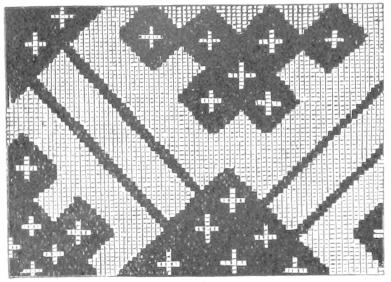
Metre P. Quinty.—Cologne, 1527.
Fig. 165.
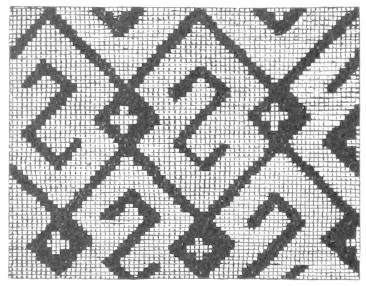
Metre P. Quinty.—Cologne, 1527.
3.
1530. Venice. A. Taglienti
Opera nuova che insegna a le Dōne a cuscire: a raccāmare: e a disegnar a ciascuno: Et la ditta opera sara di grande utilita ad ogni artista: per esser il disegno ad ogniuno necessario: la qual e ititolata esempio di racāmi.[1267]
4to, 23 ff., 36 plates.
Title in red Gothic letters; beneath four woodcuts representing women at work. Two pages of dedication to the ladies, by Giovanni Antonio Taglienti, in which he says his book is for the instruction of each "valorosa donna & tutte altre donzelle, con gli huomini insieme & fanciulli, liquali si dilettarano de imparar a disegnar, cuscir, & raccammar."
Then follows a most miscellaneous collection of what he terms, in his dedication, "fregi, frisi, tondi maravigliosi, groppi moreschi et arabeschi, ucelli volanti, fiori, lettere antique, maiuscoli, & le francesche," etc., three pages very much like the pictures in a child's spelling book, rounds (tondi) for cushions, and two pages representing hearts and scrolls; hearts transfixed, one with an arrow, another with a sword, a third torn open by two hands, motto on the scroll:—
"La virtù, al huomo sempre li resta Nè morte nol pò privar di questa."
On the other page hearts transfixed by two arrows, with two eyes above: "Occhi piangete accompagnete il core. Inclita virtus." Then follow six pages of instructions, from which we learn the various stitches in which these wonderful patterns may be executed, "damaschino, rilevato, a filo, sopra punto, ingaseato, Ciprioto, croceato, pugliese, scritto, incroceato, in aere, fatto su la rate, a magliata, desfilato, & di racammo," to be sewn in various coloured silks, gold and silver thread, or black silk, for "collari di huomo & di donna, camisciole con pettorali, frisi di contorni di letti, entemelle di cuscini, frisi di alcun boccassino, & scufie," etc. On the last page, "Stampa in Vineggia per Giovan Antonio Tagliente & i Fratelli de Sabbio. 1530." Brunet gives an edition dated 1528.
4.
1530. Paris F. Pelegrin.
La fleur de la science de pourtraicture et patrons de broderie. Facon arabicque, et ytalique. Cum priviligio regis.
Frontispiece. Title in Gothic letters. A large figure of Sol (?), with a yoke, his feet chained, a ball, maybe the Earth, at the end of the chain. In one hand he holds a scroll with the legend, "Exitus acta probat." Privilege of "Francoys par la grace de Dieu roy de France," to "Francisque pelegrin de Florence," to publish "ung livre de fueillages, entrelatz et ouvraiges moresques, et Damasquins," for six years. "Dōne a bordeaulx le xvii. jour de Juing. L'an de grace mil cinq cens trēte Et de nostre regne le seiziesme."
Ce present livre a este imprime a paris par jaques nyverd. Le iv. jour daoust. Lan de grace mil cinq cēs xxx. Pour noble hōme messire Francisque Pelegrin de florence.
On les vend a paris En la grant rue sainct Anthoyne devant les tournelles. Au logis de monseigneur le comte de Carpes. Par messire Frācisque pelegrin de florence.[1268]
Small fol., 62 ff., 58 plates, consisting of graceful moresque patterns, no animals or natural objects represented. At plate 33, surrounded by arabesques, is an N, the initial of the printer.
5.
1529. Venice. N. Zoppino.
Esemplario di lavori: dove le tenere fanciulle & altre donne nobile potranno facilment imparare il modo & ordine di lavorare, cusire, racamare, & finalmente far tutte quelle gentillezze & lodevoli opere, le quali pò fare una donna virtuosa con laco in mano, con li suoi compasse & misure. Vinezia, per Nicolo D'Aristotile detto Zoppino MDXXIX. 8vo.[1269] 46 plates.
The Cavre Merli quotes another edition, date 1530, in the possession of the Avvocato Francesco Pianesani, and another he believes of 1529.
6.
1532. Venice. N. Zoppino.
Convivio delle belle Donne, dove con li. Nuovi raccami, &c. In fine: Finisce il convivio delle, &c. Nuovamente stampato in Vinegia, per Nicolo d'Aristotile, detto Zoppino del mese d'Agosto. MDXXXII.
In 4to, ff. 24.[1270]
7.
1537. Venice. N. Zoppino.
Gli universali de i belli Recami antichi, et moderni, ne i quali un pellegrino ingegno, si di huomo come di donna potra in questa nostra eta con l'ago vertuosamente esercitar si. Non ancora da alcuni dati altri inluce.
Frontispiece, two ladies at work; dedication to "gli virtuosi Giovani et gentilissime Fanciulle." At the end styles himself "Nicolo d'Aristotile detto Zoppino." March, 1537.
In 4to, ff. 25, printed on both sides.[1271]
8.
1534. Augsburg. Schartzemberger.
Ain New Formbüchlin bin ich gnandt Allen Künstlern noch unbekandt Sih mich (lieber kauffer) recht an, Findst drefftlich in diser kunff stan Schōn gschnierlet, geböglet, auf gladt, Und gold, auch schōn von premen stadt, Es gibt dir ain prem unb ain kledyt. Wenn mans recht aussainander schneydt, Das kanst schneyden auss der Ellen, Von Samat, Seyden, wie manss wolle, Ich mag braucht wern in allem landt, Wen man mich ersūcht mit verstandt.
(At the end.)
Gedruckt in der Kaiserlichen Riechstatt, Augspurg, durch Johan Schartzemberger. Fomschneyder. 1534.[1272]
Small obl., 20 ff., 38 plates.
Frontispiece. Title in black Gothic letters, at the foot three subjects of women at work, printed in red.
The patterns, consisting of graceful arabesque borders, are also in red (Figs. 166, 167, 168).
Fig. 166. Fig. 167.
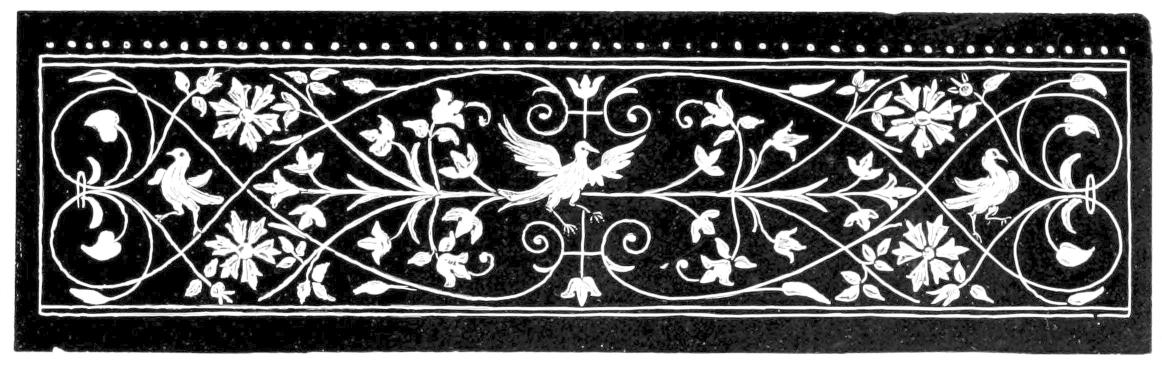
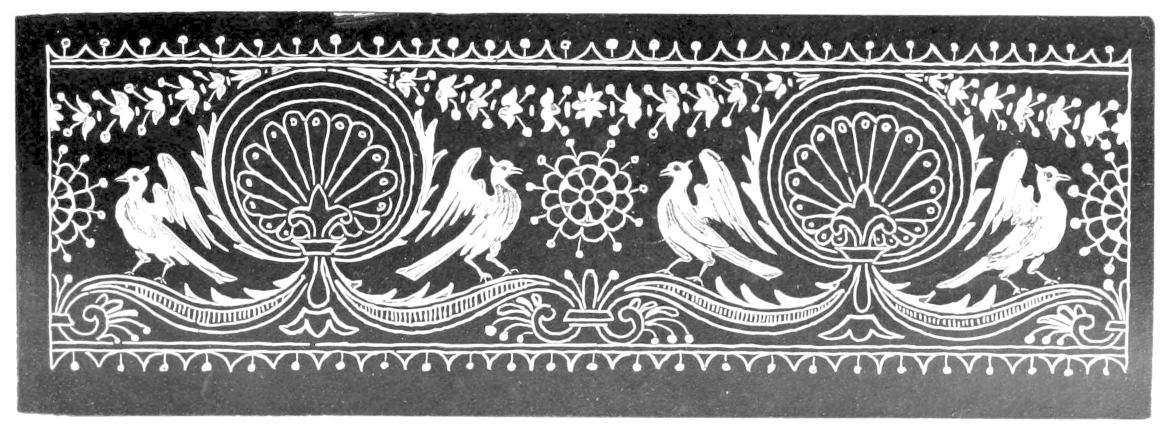
Pattern Book.—Augsburg, 1534. Pattern Book.—Augsburg, 1534. To face page 462.
Fig. 168.
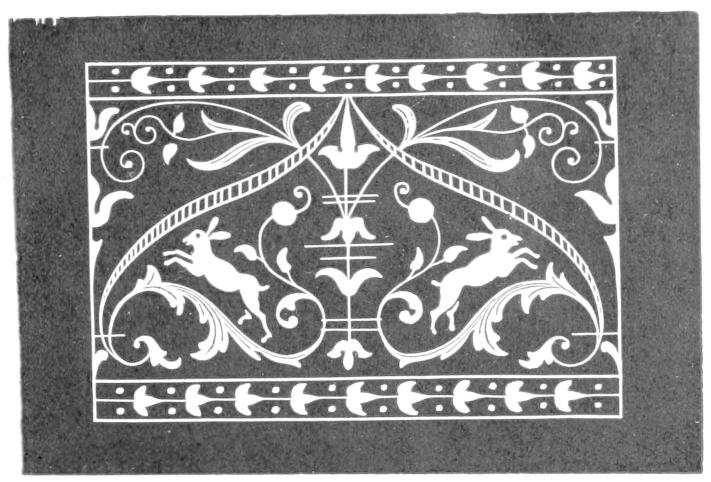
Augsburg. 1534.
9.
N. D. Antwerp. W. Vorsterman.
A neawe treatys: as cōcernynge the excellency of the nedle worcke spânisshe stitche and weavynge in the frame, very necessary to al theym wiche desyre the perfect knowledge of seamstry, quiltinge and brodry worke, côteinynge an cxxxviij figures or tables, so playnli made & set tout in portrature, the whiche is difficyll; and natôly for crafts mē but also for gentlewemē & and iôge damosels that therein may obtayne greater conynge delyte and pleasure.
These books be to sell at Andwarp in the golden Unycorne at Willm̄ Vorstermans.
Gheprent tot Antwerpen in die camerstrate in den gulden eenhoren bey Willem Vorsterman.[1273]
8vo, 24 ff., 46 plates.
Title in Gothic letters, with figures.
P. 1, dorso: Woodcut of a woman at work and a man sitting by her side.
Patterns mediæval, small black squares, arabesques, etc.
Vorsterman worked from 1514 to 1542.[1274]
10.
1542. Venice.
Giardinetto novo di punti tagliati et gropposi, per exercitio et ornamento delle donne. Ven. 1542, in 4to.[1275]
11.
1543. Venice.
Esemplare che insegna alle donne el modo di cucire. Venetia, 1543.[1276]
12.
1544. Venice.
Il Specchio di pensiere (sic), delle belle donne dove si vede varie sorti di punti, cioè, punti tagliati, gropposi, &c. Venetia, 1544.
In 4to.[1277]
13.
1544. Venice.
Ornamento delle belle donne et virtuose: Opere in cui troverai varie sorti di frisi con li quali si potra ornar ciascun donna. Ven. 1544.[1278]
14.
1546. Paris. Gormont.
Le livre de moresques, tres utile et necessaire à tous orfevres, tailleurs, graveurs, painctres, tapissiers, brodeurs, lingieres et femmes qui besongnent de l'aiguille. Paris. Gormont, 1546. Fig. en bois.[1279]
15.
1549. Lyon. P. de Ste. Lucie.
La fleur des patrons de lingerie, a deux endroitz, a point croise, a point couche, et a point picque, en fil dor, fil dargēt, & fil de soye, ou aultre en quelque ouvraige que ce soit, en comprenant lart de broderie et tissuterie. Imprimees a Lyon, en la maison de Pierre de saincte Lucie (dict le Prince, Pres nostre Dame de Confort).[1280]
(At the end.)
Imprimé à Lyon par Piarre de saincte Lucie, dict le Prince. 1549.
8vo, 12 ff., 21 plates.
Frontispiece. Title in Gothic letters, with woodcuts representing people at work. Below, two women sitting at frames; above, two others; and between, a man with a frame in his hand. On each side a shield, one with crowned heart, on the other a lion, three fleurs de lys in chief. Patterns mediæval. At the end, the device of the printer, a mountain, on the top of which is a city against which a youth is placing his hand: motto, "Spero." At the foot of the mountain a cavern in which is seated a Fury. This device is engraved No. 616 in Silvestre, who gives 1530 to 1555 as the date of Pierre de Saincte Lucie.
16.
N. D. Lyon. P. de Ste. Lucie.
Livre nouveau, dict patrons de lingerie, cest assavoir a deux endroitz, a point croise, point couche & point picque, en fil dor, dargent, de soye & autres, en quelque ouvrage que ce soit: comprenant lart de Broderie & Tissoterie. Imprimees a Lyon, chez Pierre de Saincte Lucie, pres nostre Dame de Confort.[1281]
8vo, 24 ff., 44 plates.
Frontispiece. Title in Gothic letters; the same shields as the preceding; two women at work. Patterns mediæval. At the end the same device.
The copy of the Arsenal is a different impression. Instead of "Imprimees," &c, we have, "On les vend," etc.
17.
N. D. Lyon. P. de Ste. Lucia.
Patrons de diverses manieres Inventez tressubtilement Duysans a Brodeurs et Lingieres Et a ceusy lesquelz vrayement Veullent par bon entendement User Dantique, et Roboesque, Frize et Moderne proprement, En comprenant aussi Moresque. A tous massons, menuisiers, & verriers Feront prouffit ces pourtraictz largement Aux orpheures, et gentilz tapissiers A ieunes gens aussi semblablement Oublier point ne veuly auscunement Cōtrepointiers & les tailleurs dymages Et tissotiers lesquelz pareillement Par ces patrons acquerront heritages.
Imprimees a Lyon, par Pierre de Saincte Lucie, dict le Prince, pres nostre Dame de Confort.[1282]
8vo, 16 ff., 31 plates. Title in Gothic letters. Patterns mediæval.
The copy at the Arsenal is a later impression. "On les vend a Lyon, par Pierre de saincte Lucie, en la maison du deffunct Prince, pres," etc. It has only 12 ff., and 23 plates.
18.
N. D. Lyon. Le Prince.
Sensuyuent lis patrons de messire Antoine Belin, Reclus de sainct Martial de Lyon. Item plusieurs autres beaulx Patrons nouveaulx, qui out este inventez par Jeban Mayol Carme de Lyon.
On les vend à Lyon, chez le Prince.[1283]
Small 8vo, 6 ff., 85 plates. Copy at the Arsenal has 12 ff.
The same device of the printer in the frontispiece and at the end of the book. "Finis."
One of the patterns represents St. Margaret holding the cross to a dragon, but in these four books the designs are copied from each other, and are many of them repetitions of Quinty.
19.
N. D. Lyon. D. Celle.
Ce livre est plaisant et utile A gens qui besongnent de leguille Pour comprendre legèrement Damoyselle bourgoyse ou fille Femmes qui out l'esperit agille Ne scauroint faillir nullement Corrige est nouvellement Dung hon̄este hom̄e par bon zelle Son nom est Dominicque Celle Qui a tous lecteurs shumylie Domicille a en Italie. En Thoulouse a prins sa naissance. Mise il a son intelligence A lamender subtillement Taillé il est totallement Par Jehan coste de rue merciere A Lyon et consequemment Quatre vingtz fassons a vrayement Tous de differente maniere.[1284]
28 ff., 27 plates. Title in Gothic letters. Dedication to the Reader, in which it states the book is for the profit of "tant hommes que femmes." Patterns mediæval. At the end of the Preface, "Finis coronat opus."
20.
N. D. Venice. G. A. Vavassore.
Esemplario di lavori: che insegna alle dōne il modo e ordine di lavorare: cusire: e racámare: e finalmēte far tutte q̄lle opere degne di memoria: lequale po fare una donna virtuosa con laco in mano. Et uno documento che insegna al cōpratore accio sia ben servito.[1285]
In 8vo, 25 ff., printed on both sides, 48 plates. Title in red Gothic characters, framed round by six woodcuts similar to that of Vorsterman; at the foot, "fiorio Vavasore fecit."
Then follows the "Documento per el compratore," and an Address to Ladies and Readers, by "Giovandrea Vavassore detto Guadagnino," saying that he had already "fatti alcuni libri di esempli di diverse sorte."
There is no date to this copy; but in the library of Prince Messimo, at Rome, is a copy dated Venice, 18 Feb., 1546, containing 50 plates; and Brunet quotes an edition, "Stampato in Vinezia, 1556;" Cav. Merli also possesses an edition of the same date. Mr. E. Arnold has also a copy with the same date.
The patterns are mediæval, on black grounds, with counted stitches, a large flower pot, mermaid, Paschal lamb, and a double plate representing Orpheus playing to the beasts.
21.
N. D. Venice. G. A. Vavassore.
Essemplario novo di pin di cento variate mostre di qualunque orte bellissime per cusire intitolato Fontana di gli essempli.
Oblong 8vo. No date. 16 ff., 28 plates.
In the frontispiece is a fountain with the motto, "Solicitudo est mater divitiarum," and on each side of the fountain—
"Donne donzelle ch El cusir seguite Per farvi eterne alla. Fonte venite."
On the back of the frontispiece is the Dedication, headed, "Il Pelliciolo alla molta magnifica Madona Chiara Lipomana;" the page finished by a sonnet; in the last leaf, "Avviso alle virtuose donne et a qualunque lettore Giovanni Andrea Vavassore detto Guadagnino." Says he has "negli tempi passati fatto imprimere molto e varie sorte d'essemplari di mostre," etc. At the foot, "Nuovamente stampato."[1286] This work is also described by Count Cicognara with the same title, only with the date 1550. In the Bibliotheca Communitativa, Bologna, is a copy of the same date. In this last edition the author writes his name Valvassore.
22.
N. D. Venice. G. A. Vavassore.
Vavassore Gio. Andrea. Opera nova Universal intitulata corona di ricammi; Dove le venerande donne e fanciulle: troveran̄o di varie opere ꝑ fare colari di camisiola & torniāēnti di letti ēternelle di cuscini boccasini schufioni: cordlli di piu sorte; et molte opere per recāmatori ꝑ dipitore poreuesi: (sic) de lequale opere o vero esempli ciascuno le potra pore in opera secōdo el suo bisogno: con gratia novamente stampata ne la inclita citta di vineggia per Giovanni Andrea Vavassore detto Guadagniō. 36 pp., sm. 4to.
13 ff., 52 designs, none of which are repetitions of the preceding.[1287]
23.
N. D. Venice. G. A. Vavassore.
Vavassore Gio. Andrea detto Guadagnino. Opera nova, etc. ... dove le venerande donne et fanciulle trovaranno di varie opere et molte opere per recamatori et per dipintori; etc. Nuovamente stampata, etc.[1288]
Quite a different collection from the preceding. A little of everything in this volume.
Zoan Andrea Vavassore was the pupil in drawing and engraving of Andrea Mantegna. Towards the beginning of the sixteenth century, he worked on his own account, and his engravings are much sought after. So greedy was he of gain as to obtain for him the name of Guadigno, in Venetian patois, "covetous." He lived to a great age.
24.
N. D. A. Paganino.
Libro questo di rechami per el quale se impara in diversi modi l'ordine e il modo de recamare, cosa non mai più fatta n' è stata mostrata.
By Alessandro Paganino.[1289]
20 plates, with a long explanation how these works are done. (Communicated by Prince Massimo.)
25.
N. D. Paris Vve. Ruelle.
Patrons pour Brodeurs, Lingieres, Massons, Verriers, et autres gens d'esprit. A Paris. Pour la Veuve Jean Ruelle, rue S. Jacques, à l'enseigne Sainct Nicolas.[1290]
4to, 23 ff., 32 plates of mediæval designs. Ornamented title-page.
26.
1548. Venice. M. Pagan.
Il specchio di pensieri delle belle et virtudiose donne, dove si vede varie sorti di Punti, cioè punti tagliati, punti gropposi, punti in rede, et punti in Stuora. MDXLVIII. Stamp. in Venetia, per Mathio Pagan in frezzaria, in le case nove Tien per insegna la fede.[1291]
16 ff.
27.
1551. Venice. M. Pagan.
1. L'honesto Essempio del vertuoso desiderio che hanno le donne di nobile ingegno circa lo imparare i punti tagliati e fogliami. In Venetia per Mathio Pagan in Frezaria al segno della Fedo, M.D.L.[1292]
In the V. and A. Museum is a copy dated 1550.
28.
1551. Venice. M. Pagan.
Giardineto novo di Punti tagliati et gropposi, per esurcitio et ornamento delle donne. At the end, Venetia, Mathio Pagan in Frezzaria, in le case nove (tien per insegna della Fede) MDLI. Dedication, Alla signora Lucretia, Romana Mathio Pagan, salute.[1293] See also No. 38.
29.
1554. Dubois.
Variarum protractionum quas vulgo Maurusias vocant omnium antehac excusarum libellus longe copiasissimus pictoribus, aurifabris, polymilariis, barbaricariis variisque id genus artificibus etiam acu operantibus utilissimus nuncque primen in lucem editus anno 1554. Balthazar Sylvius (Dubois) fecit.
Jo. Theodoret, Jo. Israel de Bry excud.[1294]
In 4to, ff. 23, copperplate.
30.
1555. Padua. Fra Hieronimo.
Triompho di Lavori a Fogliami de i quali si puo far ponti in aere; opera d' Fra Hieronimo da Cividal di Frioli, de l'Ordine de i Servi di Osservantia. Cum gratia et privileggio per anni xi.[1295]
Obl. 4to, 14 ff., 22 pl.
Ornamental title-page. On the top, a female seated in a triumphal car drawn by unicorns, with attendants. On each side of the title are women teaching children to work.
P. 1, dorso. Dedication of the author, "Alla Magnifica & Illustre Signora Isabella Contessa Canossa," whose "Immortal Triompho" is represented in the above woodcut. Fra Hieronimo speaks of preparing "più alte e divine imprese."
Then follow three pages of verses in terzette, and p. 3, dorso, the impresa of the printer, a lion rampant, holding a sword in his fore paws. Below, "In Padou per Jacobo Fabriano, ad instantia de Fra Hieronimo da Cividal di Frioli: de l'Ordine de i Servi di Osservantia 1555."
31.
1556. Venice. Torello.
Lucidario di ricami di Guiseppe Torello. Venezia, 1556.
In 4to.
32.
1556. Strasburg. H. Hoffman.
New Modelbüch, allen Nägerin, unnd Sydenstickern sehr nutzlich zü branchë, vor nye in Druck aussgangen durch Hans Hoffman, Burger und formschneider zu Strassburg. At the end, Zu Strassburg Gedruckt am Kommarckt durch Jacob Frölich. 1556. 4to.[1296]
4to. A to G in fours. (28 leaves.)
Title printed in red and black. On it a woodcut of two women, one engaged in embroidery, the other fringing her some stuff. The last leaf (Giiii.) has on the recto a woodcut of a woman at a frame, the verso blank.
33.
N. D. Zurich. C. Froschover.
Nüw Modelbüch, allerley gattungen Däntelschnür, so diser zyt in hoch Tütschlanden geng und brüchig sind, zu underricht jren Leertöchteren unnd allen anderen schurwirckeren zu Zurych und wo die sind, yetz nüwlich zübereit, und erstmals in truch verfergket durch R. M.[1297]
No place or date, but as appears, both from the title and preface, to be printed at Zurich, by Christopher Froschover. The date probably from 1530 to 1540.
4to. Signatures A to F in fours. 24 leaves. On the title a woodcut of two women working at lace pillows.
34.
N. D. Frankfort.
Modelbüch Welscher, Ober und Niderlandischer Arbait. Getruckt zü Franckfort.
No date, but probably at least as early as 1530. 4to. Signatures A to D in fours. 20 leaves.
Title enclosed in an elegant woodcut border.
35.
1537. Frankfort. C. Egenolffs.
Modelbüch, von erhabener unnd flacher Arbait, Auff der Ramen, Laden, und nach der Zale.
Getruckt zu Franckfort, Bei Christian Egenolffs, Erben.
The date, 1537, occurs on one of the patterns. 4to. AA to HH in fours. 32 leaves. Title in a woodcut border. 178 patterns.
36.
1571. Frankfort on the Mayn. N. Baseus.
New Modelbüch.
Von allerhandt Art, Nehens und Stickens, jetzt mit viellerley Welscher Arbeyt, Mödel und Stahlen, allen Steinmetzen, Seidenstickern und Neterin, sehr nützlich und kunstlich, von newem zugericht.
Getruckt zu Frankfurt am Mayn, 1571.
Device and motto of Nicolas Baseus on title-page. Sm. 4to. (Library V. and A. Museum.)
37.
1568. Frankfort on the Mayn. N. Baseus.
Das new Modelbüch, &c.
Franckfurt am Mayn, 1568, 4to. Printer, Nicholas Baseus, ff. 40.
38.
1569. Frankfort on the Mayn.
Modelbüch; Zweiter Theil: Franckfurt am Mayn, 1569.
4to, ff. 44. Nos. 36 and 37 are cited by the Marquis d'Adda.
39.
1558. Venice. M. Pagan.
La Gloria et l'honore de ponti tagliati et ponti in aere Venezia per Mathio Pagan in Frezzeria al segno della Fede. 1558.[1298]
16 plates. Dedicated to Vittoria Farnese, Duchess of Urbino.
40.
N. D. Venice.
Il Monte. Opera nova di recami intitolata il monte, nella quale si ritrova varie, & diverse sorti di mostre, di punti in aiere, à fogliami. Dove le belle & virtuose Donne protranno fare ogni sorte di lavoro, accommodate alle vera forma misura & grandezza, che debbono essere ne mai piu per l'adietro da alcuno vedute. Opera non men bella che utile, & necessaria.[1299]
Below, the impresa of the printer, an eagle with its young; motto, "Virtute parta sibi non tantum." In Venetia.
4to, 16 ff., 29 plates of bold scroll borders.
41.
1559. Venice. G. A. Bindoni.
Il Monte (libro secondo) Opera dove ogni bella donna potrà fare ogni sorte di lavori cioè colari, fazzoletti, maneghetti, avertadure (berthes), &c., in Venetia, 1560.[1300]
Printer's mark and motto as No. 39: afterwards the dedication dated 1559, "à Vittoria da Cordova Gio. Ant. Bindoni," in which he states "Ho preso arditamente di presentarvi questo secondo Monte." 4to. ff. 16.
42.
1558. Venice.
Bellezze de recami et dessegni opera novo non men bella che utile, e necessaria et non più veduta in luce. Venezia, 1558.[1301]
Ob. 4to. 20 plates of patterns.
43.
1558. Venice. I. Foresto.
Lo Splendore delle virtuose giovani con varie mostre di fogliami e punti in aere. Venezia. Per Iseppo Foresto in calle dell'acqua a S. Zulian all' insegno del Pellegrino, 1558.[1302]
16 plates.
44.
1559. Venice.
Trionfo di Virtù Libro novo da cucir, con fogliami, ponti a fili, ponti cruciati, &c. Venezia, 1559.[1303]
16 plates.
45.
N. D.
Burato.
Consisting of four leaves, with patterns of canvas (tela chiara), in squares, for works in "punta" of various widths, with instructions how to increase or diminish the patterns. See Cutwork.
On the back of the last page is printed in large characters, "P. Alex. Pag. (Paganinus). Benacensis F. Bena. V. V."[1304]
46.
N. D.
Burato ... con nova maestria, gratiose donne, novo artificio vi apporto.
A second edition without date. 4to, ff. 59; frontispiece, ladies at work, verso, Triumph of Fame. Four books of designs of great elegance and taste. The Marquis d'Adda assigns them to Vavassore.
47.
N. D. A. Passerotti.
Passerotti Aurelio Pittore Bolognese dissegnatore e miniatore figlio di Bartolommeo Passerotti circa al 1560. Libro Primo di lavorieri alle molto illustre et virtuosissime gentildonne Bolognesi. Libro secondo alle molto magnifici et virtuosissimi signori.[1305]
In fol. obl.
67 ff., including two dedications and a frontispiece. Designs for embroidery, etc., drawn with a pen. In the title-page of the first book is the device of a sunflower, "Non san questi occhi volgere altrove."
48.
1557. Venice.
Le Pompe. Opera nova di recami dove trovansi varie mostre di punto in aere. Venezia, 1557.[1306]
Probably an earlier impression of the following. 4to, ff. 16.
49.
1559.
Le Pompe, opera nova nella quale si ritrovano varie, & diverse sorti di mostre, per poter far Cordelle over Bindelle, d' Oro, di Seta, di Filo, overo di altra cosa di Dove le belle et virtuose donne potranno fare ogni sorte di lavoro, cioè merli di diverse sorte, Cavezzi, Colari, Maneghetti, & tutte quelle cose che le piaceranno. Opera non men bella, che utile, & necessaria. E non più veduta in luce. 1559.[1307]
Below, the same impresa of the eagle, as in "Il Monte," Nos. 39 and 40.
8vo, 16 ff., 30 plates.
A great variety of borders and indented patterns (merli). (Fig. 169.)
"Si vendeno alla Libraria della Gatta."
Fig. 169.
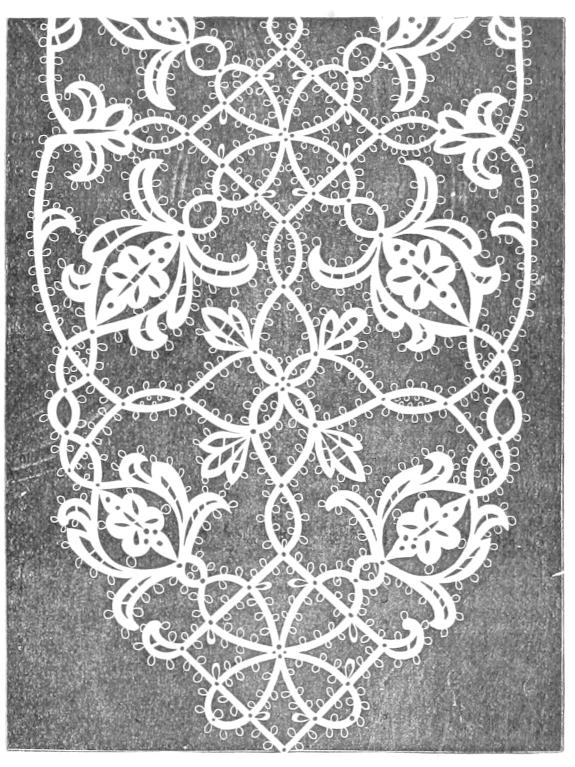
Le Pompe, 1559.
In the Cat. d'Estrées is noted, "Le Pompe, Opera nella quale si retrovano diverse sorti di mostse per poter far cordelle, Bindelle, d'oro di seta, di filo. 1559, fig." Probably the same work.
50.
1560. Venice.
Le Pompe, Libro secondo. Opera nuova nella quale si ritrovana varie e diverse sorti di Mostre, per poter fare Cordelle, ovver Bindelle, d'Oro, di Seta, di Filo, ovvero di altra cosa. Dove le belle & virtuose Donne potranno far ogni sorte di lavoro, coèi Merli di diverse sorte, Cavezzi, Colari, Maneghetti & tutte quelle cose che li piaceno. Opera hon men bello che utile & necessaria e non più veduta in luce.
Impresa of the printer, "Pegasus," and below, In "Venetia 1560."
Obl. 8vo, 16 ff., 29 plates.[1308]
Mrs. Stisted's copy is dated 1562, and there is one at Vienna, in the Imperial Library, of the same date.
51.
1563. Venice. J. Calepino.
Splendore delle virtuose giovani dove si contengono molte, & varie mostre a fogliami cio è punti in aere, et punti tagliati, bellissimi, & con tale arteficio, che li punti tagliati serveno alli punti in aere. Et da quella ch' è sopragasi far si possono, medesimamente molte altre.
In Venetia Appresso Jeronimo Calepino, 1563.[1309]
8vo, 20 ff., 35 plates of scroll patterns in the style of "Il Monte."
Dedication "Alla molto honorata M. Anzola ingegniera succera mia digniss." Francesco Calepino, wishing, he says, to "ristampare la presente opera," he dedicates it to her. In Bib. Melzi, Milan, a copy dated 1567.
52.
1563. Venice. J. Calepino.
Lucidario di recami, nel qual si contengono molte, & varie sorti di disegni. A punti in aere et punti tagliati, & a fogliami, & con figure & di più altre maniere, come al presente si usano non più venute in luce Per lequali ogni elevato ingegno potrà in diversi modi commodissimamente servirsi. In Venetia, Appresso Ieronimo Calepino, 1563.[1310]
8vo, 16 ff., 29 plates of flowing borders like the preceding.
53.
1564. Venice.
I Frutti opera nuova intitulata i frutti de i punti in stuora, a fogliami, nella quale si ritrova varie, et diverse sorti di mostre di ponti in Stuora, a fogliami, & punti in gasii & in punti in Trezola.[1311] Dove ogni bella et virtuosa donna potrà fare ogni sorte di lavoro, cioè fazoletti, colari, maneghetti, Merli, Frisi, Cavezzi, Intimelle, overo forelle, avertadure da camise, & altre sorti di lavori, come piu a pieno potrai vedere, ne mei per l' adietro d' alcun altro fatte & poste in luce.
Opera non men bella, che utile et necessaria a ciascuna virtuosa gentildonna. In Vinegia, 1564.[1312]
Obl. 8vo, 16 ff., 30 plates of patterns either in dots or small squares.
54.
1564. Paris.
Patrons pour brodeurs, lingières, massons, verriers, et autres gens d'esperit; nouvellement imprimé, à Paris, rue Saint-Jacques, à la Queue-de Regnard M.DLXIIII.[1313]
55.
1564. Venice. D. de Franceschi.
Fede (Opere nova) intitulata: Dei Recami nella quale si contiene varie diverse sorte di mostre di punti scritto, tagliato, in Stuora, in Rede, &c. In Venetia, appresso Domenico de Franceschi in Frezzaria, all' insegna della Regina. M.DLVIII.
In 4to, ff. 16. In his Avis au Lecteur, Franceschi alludes to three other works he had published, styled La Regina, La Serena, and La Speranza.
56.
1564. Venice. D. de Franceschi.
Serena opera nova di recami, nella quale si ritrova varie et diverse sorte di punti in stuora et punti a filo. In Venetia, Domenico di Franceschi. 1564.
Obl. 4to, ff. 16. Nos. 55 and 56 cited by Marquis d'Adda.
57.
1581. Lyon. J. Ostans.
Le trésor des patrons, contenant diverses sortes de broderies et lingeries; pour coudre avec grande facilité et pour ouvrer en diverses sortes de piquer avec l'ésguille, pulveriser par dessus et faire ouvrages de toutes sortes de points &ct par Jean Ostans. Lyon, Ben. Rigaud. 1581, in 4-to.[1314]
58.
1567. Venice. J. Ostans.
Ostans Giovanni. La vera perfettione del disegno di varie sorti di Recami, et di cucire, &c. ... punti a fogliami punti tagliati punti a fili et rimessi punti in cruciati, punti a stuora, et ogni altra arte che dia opera a disegni. Fatta nuovamente per Gio. Ostans. Vittoria, con gratia et privilegio dell' Illus. Senato Venetiano per anni.[1315] In Venetia appresso Gio. Ostans, 1567.
4to obl., 4 cahiers of 8 ff., 74 plates. Letter of Ostans to Lucretia Contarini; verso, an engraving of Lucretia Romana, surrounded by her women, signed Jose. Sal. (Joseph Salviati), who furnished the design, two sonnets, and Aves. A striking example of the borrowing between France and Italy in the sixteenth century, probably of the school of Fontainebleau. Grotesques like A. du Cerceau, scrolls after E. de Laulne, fresco of figures from G. Tory. Brunet describes a copy dated 1591.
59.
1584. Venice. Valvassore's heirs.
Ostans. La vera perfettione del desegno &ct. Venetia M.DLXXXIIII., presso gli heredi Valvassori e Gio. Dom. Micheli al segno dell' Ippogrifo.
In 4to obl. (Cited by Marquis d'Adda.)
60.
1582. B. Tabin.
Neues Künstlicher, Modelbuch von allerhand artlichen und gerechten Mödeln, &c., bei B. Tabin.[1316]
61.
Paris. 1584. D. de Sera.
Le livre de Lingerie, composé par Maistre Dominique de Sera, Italien, enseignant le noble & gentil art de l'esguille, pour besongner en tous points: utile & profitable à toutes Dames & Damoyselles, pour passer le temps, & euiter oysiveté.
Nouvellement augmenté, & enrichi, de plusieurs excelents & divers patrons, tant du point coupé, raiseau, que passement, de l'invention de M. Jean Cousin, Peintre à Paris.
A Paris. Chez Hierosme de Marnef, & la veufve de Guillaume Cauellat, au mont S. Hilaire à l'enseigne du Pelican. 1584. Avec privilege du Roy.[1317]
In the Cat. d'Estrées; No. 8848, is Livre de Pourtraicture de Jean Cousin. Paris, 1637, in 4 fig.
4to, 28 ff., 51 plates of mediæval design.
Frontispiece, three women and a child at work, on each side of the title a man and a woman at work under a trifoliated canopy.
Privilege for three years to H. de Marnef, "juré libraire en l'Université de Paris."
"L'auteur aux lecteurs." He takes his pen to portray what he has seen "en Italie, Espagne, Romanie, Allemagne, & autre païs, dont je ne fais aucune mention à cause de trop longue plexite," that he gives at least eighty designs for the use and singular profit of many, "hommes tant que femmes." Below, "Finis coronat opus."
Then follows a "Balade" of 28 lines. On the last page, the impresa of Cavellat, a pelican in its piety, "Mors in me vita in me."
62.
1596. G. Frano.
Frano Gio. Libro delle mostre da ceuser per le donne.
16 engravings on wood and 8 on copper. (Cited by Marquis d'Adda.)
63.
Bologna. A. Parisini.
Danieli Bartholomeo Recamatore libro di diversi disegni per Collari, punti per Fazzoletti et Reticelle divarie sorte. Agostino Parisini forma in Bologna.
15 leaves obl. 8vo, entirely engraved au burin, towards the end of the sixteenth century.[1318]
64.
N. D.
Ornamento delle belle et virtuose donne opera nova nella quale troverrai varie sorti di frisi, con li quali si potra ornar ciascuna donna, & ogni letti con ponti tagliato, ponti gropposi, & ogni altra sorte di ponti per fare quelle belle opere che si appartengono alle virtuose & lodevoli fanciulle.
On a scutcheon, with 3 figures below, "Libro Primo." Lib. Victoria and Albert Museum.
65.
1587. Paris. 1st Edit. 1st Part. F. Vinciolo.
Les singuliers et nouveaux pourtraicts et ouvrages de Lingerie. Servans de patrons à faire toutes sortes de poincts, couppé, Lacis & autres. Dedie a la Royne. Nouvellement inventez, au proffit & cōtentement, des nobles Dames & Damoiselles & autres gentils esprits, amateurs d'un tel art. Par le Seigneur Federic (sic) de Vinciolo Venitien. A Paris. Par Iean le Clerc le ieune, ruë Chartiere, au Chef Sainct Denis. 1587. Avec privilege du Roy.[1319]
2nd Part.
Les singuliers et nouveaux pourtraicts et ouvrages de Lingerie ou est representé les sept planettes, & plusieurs autres figures & pourtraitz servans de patrons à faire de plusieurs sortes de Lacis. Nouvellement inventez, au proffit & cōtentement des nobles Dames & Damoiselles & autres gentils esprits, amateurs d'un tel art. Par le Seigneur Federic de Vinciolo Venitien. A Paris. Par Iean le Clerc le ieune, ruë Chartiere, au Chef Sainct Denis. 1587. Avec privilege du Roi.
(At the end.)
Privilege for nine years to "Iean le Clerc le ieune, 'tailleur d'histoires,' à Paris," signed 27 June, 1587. "De l'Imprimerie de David le Clerc Rue Frementel à l'Estoille d'Or."
4to.
The first part consists of 40 ff., 36 of patterns and 4 preliminary pages.
P. 1. The title-page with decorated border, in which are two ladies at work. (See Title-page of this work.)
P. 2. Dedication of "Le Seigneur Federic de Vinciolo aux Benevolles Lecteurs," in which he sets forth that several authors before him having published certain patterns for work that "les Seigneurs, Dames, & Damoyselles ont eu pour agréable," he, to show "la bonne volonté que je porte à la France, laquelle m'ayant été douce et favorable, depuis certain temps que j'ay quitté Venize, païs de ma nativité," wish to portray the present "pourtraicts d'ouvrages magnifiques tous differēs, & non encor usitez en cette cōtree ni aultres, & que j'ay tenus cachés & incōgnus jusques à maintenant," feeling assured that if the first you had seen "on engendré quelque fruit & utilité, ceux cy en aporteront d'avantage," and if I see this my invention pleases you, I will "vous faire participer d'un aultre seconde bande d'ouvrages."
P. 3. Dedication "A la Royne," Louise de Vaudemont, by Le Clerc, saying that having received from Italy some rare and singular patterns, and "ouvrages de l'ingerie & en ayāt invēte quelques uns, selon mon petit sçavoir, j'ay pensé puis que ces choses là appartienent principallement aux Dames," that he cannot do better than present them to the Queen, as if these patterns are useful (as he hears some less perfect and more rudely sketched have served and profited before), they ought to be offered to her Majesty. Signed last day of May, 1587.
P. 4. A sonnet.
Aux Dames Et Damoiselles. "L'un sefforce à gaigner le cœur des grāds seigneurs Pour posséder enfin une exquise richesse, L'autre aspire aux Estats pour monter en altesse, Et l'autre par la guerre alléche les honneurs. Quand à moy, seulement pour chasser mes langueurs, Je me sen satisfait de vivre en petitesse, Et de faire si bien, qu'aux dames je délaisse Un grand contentement en mes graves labeurs. Prenez doncques en gré (mes Dames), je vous prie, Ces pourtrais ouvragez lesquelz je vous dédie, Pour tromper vos ennuis, et l'esprit employer. En ceste nouveauté, pourrés beaucoup apprendre, Et maistresses en fin en cest œuvre vous rendre. Le travail est plaisant. Si grand est le loyer." "Morir assidouamente per virtu, Non morirè."
Then follow the 36 patterns set off in white on a black ground, viz., 20 "Ouvrages de point Couppé," the first plate with the double λλ, according to the fashion introduced by Francis I. of using Greek monograms, standing for Queen Louise. On the second page are two escutcheons, one of France, the other with the letter H for Henry III. Then follow eight "Passemens de point Couppé," which are succeeded by eight more "Ouvrages de point Couppé."
Part 2, 24 ff. Same decorated frontispiece and 22 plates of subjects in squares for stitches like the German patterns of the present day. These consist of the Seven Planets, Sol, Luna, Mars, Mercury, Jupiter, Venus and Saturn. Four in squares of various designs; two of Amorini shooting stags and birds; Neptune and the winds; an arabesque with impresa of a column with circle and double triangle; five borders and squares, and two "bordures à carreaux," diamond-shaped meshes. The last page contains the Extract from the Privilege.
This is the original edition of Vinciolo, of which we know but one copy existing—that in the Library at Rouen.
It was followed the same year by two other editions, with alterations.[1320]
66.
1587. 2nd Ed. 1st Part. F. Vinciolo.
Les singuliers et nouveaux pourtraicts pour les ouvrages de Lingerie. Nouvellement augmentez de plusieurs differens pourtraits servans de patrons à faire toutes sortes poincts couppé, Lacis, et autres reseau de poinct conté. Dedié à la Royne. Le tout inventé, au proffit & contentement des nobles Dames & Damoiselles & autres gentils esprits, amateurs d'un tel art. Par le Seigneur Federic de Vinciolo Venitien. A. Paris. Par Iean le Clerc le ieune, ruë Chartiere, au Chef Sainct Denis, pres le college de Coqueret. Avec privilege du Roy. 1587.
2nd part.
Les singuliers et nouveaux pourtraicts pour les ouvrages de Lingerie ou avons augmēté plusieurs nouveaux & differens portraitz de reseau, tout point conté, plusieurs nouvelles bordures et autres sortes differentes.
Nouvellement inventez au proffit & cōtentement des nobles Dames & Damoiselles & autres gentils esprits amateurs d'un tel art. Par le Seigneur Federick de Vinciolo Venitien. A Paris. Par Iean le Clerc le ieune, Ruë Chartiere, au Chef Sainct Denis, pres le college de Coqueret. Avec privilege du Roy. 1587.[1321]
1st Part, 40 ff. The same frontispiece, dedications, date, and sonnet, as the first, the same number of patterns, only the eight styled in the first "Passemens" are here all called, like the others, "Ouvrages" de point couppé. (See Fig. 4.)
2nd Part, 32 ff. This part has 30 patterns, comprising the 24 of the first edition, and six additional ones, consisting of squares and two hunting subjects.
67.
1587. 3rd Edit. No. 1. Parts 1 and 2.
Les singuliers et nouveaux Pourtraicts, du Seigneur Federic de Vinciolo Venitien, pour toutes sortes d'ouvrages de Lingerie. Dedie a la Royne. Derechef et pour la troisieme fois augmentez Outre le reseau premier et le point couppé et lacis, de plusieurs beaux et differens portrais de reseau de point cōté avec le nombre des mailles, choze non encor veue ni inventée. A Paris. Par Iean le Clerc le ieune, ruë Chartiere, au Chef Sainct Denis, pres le College de Coqueret. Avec privilege du Roy. 1587.[1322]
This must be the first impression of the third edition.
1588. 3rd Edit. No. 2. 1st Part.
Les singuliers et nouveaux pourtraicts, du Seigneur Federic de Vinciolo Venitien, pour toutes sortes d'ouvrages de Lingerie. Dedié a la Royne. Derechef et pour la troisiesme fois augmentez, outre le reseau premier & le point couppé & lacis, de plusieurs beaux et differens portrais de reseau de point cōté, avec le nombre des mailles, chose non encor veuë, ny inventée. A Paris. Par Iean le Clerc le ieune, au mont Saint Hilaire, du Chef Sainct Denis, pres le Clos Bruneau. Avec privilege du Roy. 1588.[1323]
68.
2nd Part.
Les singuliers et nouveaux pourtraicts, du Seigneur Federic de Vinciolo Venitien, pour toutes sortes d'ouvrages de Lingerie. Dedié a la Royne. Derechef et pour la troisiesme fois augmentez, outre le reseau premier & le point couppé & lacis, de plusieurs beaux et differens portrais de reseau de point cōté, avec le nombre des mailles, chose non encor veuë, ny inventée. A Paris. Par Iean le Clerc le ieune, au mont Saint Hilaire, au Chef Sainct Denis, pres le Clos Bruneau. Avec privilege du Roy. 1588.[1324]
This must be subsequent to the Brussels impression, as Jean le Clerc has changed his address.
In the third edition, dorso of pp. 1 and 2, we have the addition of portraits of Louise de Vaudemont and Henry III., with a complimentary stanza of four lines under each.
In his Advertisement au lecteur, Vinciolo says that having promised, since the first impression of his book, to give a "nouvelle bande d'ouvrages," and not to disappoint certain ladies who have complained that he has not made "du reseau assez beau à leur fantaisie," I have wished for the third time to place before their eyes many new and different patterns of "reseau de point conté que j'ay cousus et attachez à la fin de mes premières figures," beneath which I have put the number and quantity of the stitches. Same dedication and sonnet as before. Privilege for nine years dated Paris, 25 May, 1587. "De l'Imprimerie de David le Clerc, ruë S. Jacques, au petit Bec, devant le College de Marmouttier."
1st Part, 40 ff., 36 plates, 27 of point couppé, two stomachers, and seven "Passemens" de point couppé; the same lettered "Ouvrages" as in the preceding impression.
2nd Part, 36 ff., 50 plates. The thirty already published in the second edition, after which follow the twenty additional of "reseau de point conté," announced in the Preface, consisting of "6 Quarrés, 2 Coins de Mouchoir, 2 Bordures, 6 animals: Lion, Pelican, Unicorn, Stag, Peacock, and Griffon"; and the Four Seasons. "Déesse des fleurs, representant le Printemps," etc.
These last twenty have the number of stitches given. (See Fig. 5.)
On the last page is an escutcheon with the arms of France and Poland.
69.
1588. 3rd Edit. No. 3. Parts 1 and 2.
A later impression still.
Same title, date, portraits, dedication, and sonnet, only the Privilege is dated "ce douzième jour de Novembre 1587. De l'Imprimerie de David le Clerc, Rue S. Jaques, aux trois Mores."[1325]
34 ff. 30 plates, 1st part; 50 plates in 2nd.
70.
1595. 3rd Edit. No. 4. Parts 1 and 2.
Les singuliers et nouveaux pourtraicts, du Seigneur Frederic de Vinciolo, Venitien, pour toutes sortes d'ouvrages de Lingerie. Dedie à la Royne Douairière de France.
De Rechef et pour la troisiesme fois augmentez, outre le reseau premier & le point couppé & lacis, de plusieurs beaux & differens portrais de reseau de point cōté, avec le nombre des mailles, chose non encore veuë ny inventée.
A Paris. Par Iean le Clerc, ruë Saint Jean de Latran, à la Salemandre. Avec privilege du Roy. 1595.[1326]
This impression is dedicated to Louise de Vaudemont, now "Reine Douairière," Henry III. having died in 1589.
71.
1606. 3rd Edit. No 5. Parts 1 and 2.
The same title as that of 1595—differing only in date.[1327]
Privilege for six years, "donné à Mantes, le 3 Juillet 1593." At the foot, "De l'Imprimerie de David le Clerc au Petit Corbeil 1606."
The 1st part has 32 ff. and 36 plates; 32 "Ouvrages de poinct couppé," and 4 stomachers.
The 2nd part 46 plates, same as those of 1588, only four less.
On the last page the escutcheon of France and Navarre.
72.
1589. 4th Edit. Turin. Parts 1 and 2.
Les singuliers et nouveaux pourtraicts, du Seigneur Federic de Vinciolo Venitien, pour toutes sortes d'ouvrages de Lingerie. Dedie a la Royne. Derechef et pour la quatrieme fois augmentez, outre le reseau premier et le point couppé et lacis, de plusieurs beaux et differens portrais de reseau de point conté, avec le nombre de mailles, chose non encore veue ni inventee. A Thurin. Par Eleazaro Thomysi. 1589.[1328]
Described in Cat. Cicognara with the date 1658. The 1st part 44 ff. and 39 plates; the 2nd with 36 plates.
The editions of 1613 and 1623 are described in their chronological order. Nos. 64 and 71.
That of 1603 we have not seen; but M. Leber states it to be equally rich with that of 1623.
The copies of Vinciolo in the Bodleian bear the dates of 1588, 1603, and 1612.
Baron Pichon has a copy of an impression of 1612.
One at Bordeaux, in the Bib. de la Ville, is dated 1588.
In a book sale at Antwerp, March, 1864, there was sold the following:—
Lot 528. Livre de Patrons de Lingerie dediè a la Royne, nouvellement invente par le seignr Frederic de Vinciolo, Venitien. Paris, Jean le Clerc, 1598.—Les singuliers et nouveaux pourtraicts pour toutes sortes d'ouvrages de Lingerie. Paris, Ibid., 1598.—Les secondes œuvres et subtiles inventions de Lingerie. Paris, Ibid., 1598.—Nouveaux pourtraicts de Point coupé et Dantelles en petite moyenne et grande forme. A. Montbeliard, Jacques Foillet, 1598. 4 tom. 1 vol. in-4. v. anc. fig. sur bois.
It went for 440 francs to a Mr. Ross. We do not know the editions of 1598.
As M. Leber observes, the various editions of Vinciolo, published by Le Clerc and his widow, from 1587 to 1623, and perhaps later, are only impressions more or less varied of the two distinct books, the one of point coupé, the other of lacis.
The work of Vinciolo has been reprinted in several countries. In England it has been translated and published by Wolfe. (See No. 72.) At Liege, by Jean de Glen. (See No. 79.) Mr. Douce says that it was reprinted "at Strasburg, 1596, and at Basle, 1599, with a second part, which is rare, and sometimes contains a portrait by Gaultier of Catherine de Bourbon."
In the Bib. Nat. (Grav. B. c. 22), a volume headed Vinciolo (Federigo) Peintre Venitien et ses imitateurs, contains, with "La pratique," etc., of Mignerak (See No. 93), a German copy of the "nouveaux pourtraits," the work printed by Ludwig Künigs, at Basle, 1599 (See No. 85); and a German work headed "Broderies sur filet," 50 plates engraved upon copper.
73.
1591. London. Wolf.
New and singular patternes and workes of Linnen. Serving for patternes to make all sortes of Lace edging and Cut-workes. Newly invented for the profite and contentment of Ladies, Gentlewomen, and others that are desirous of this Arte. London: Imprinted by J. Wolfe and Edward White, 1591.[1329]
EPISTLE TO THE READER.
Having framed a body of the best and rarest manner in true perfection of sundrie sortes of deuises or workes, as well for frame-workes as other needle-workes, I devised with all diligence and industrious studie to sattisfy the gentle mindes of vertuous women by bringing to light things never before as yet seene nor committed to print; All which devises are soe framed in due proportion as taking them in order, the one is formed or made by the other, and soe proceedeth forward; Whereby with more ease they may be sewed and wrought in Cloth, and keeping true accompt of the threads, maintaine the bewtey of the worke. And more, who desyrith to bring the worke into a lesser forme, let them make the squares lesse. And if greater, then inlarge them, and so may you worke in divers sortes, either by stitch, pouncing, or pouldering upon the same as you please. Alsoe it is to be understood that these squares serve not onely for cut-workes, but alsoe for all other manner of seweing or stitching, noteing withall that they are made to keepe the work or deuise in good order and even proportion—And even if ye will that squares be greater, make of two, one, four, two, and soe they will be larger. And in this manner may you proceed in all.
God prosper your desires.
Then follows the dedication:
To the Right Worshipful Gentlewoman, Mistress Susan Saltonstall, wife to the right Worshipfull Mr. Richard Saltonstall, Alderman of the City of London (afterwards Lord Mayor, and knighted in 1597).
It being my chance (Right Worshipfull) to lighten upon certaine paternes of cut-worke and others brought out of Foreign Countries which have bin greatly accepted of by divers Ladies and Gentlewomen of sundrie nations and consequently of the common people; This seemed unto mee a sufficient instance and argument to bestowe likewise some paines for the publishing thereof, But being in suspense of the dedication two causes induced mee to imbolden myselfe to present it unto your acceptation and patronage: First because that rare devises and inventions are for the most part more agreeable and gratefuller accepted, than ordinarie and common things, although of great price and value, Secondlie because these workes belong chiefly to Gentlewomen for to passe away their time in vertuous exercises Wherefore to fit and accommodate the dedication aright to the contents and subject of the book I thought it not amisse to offer it unto your worship in token of thankfullness for so many benefites which I have received so bountifullie at your hands Assuring myselfe moreover that as these patternes will bring sufficient contentment and profite to all well-willers, that are desirous of this Arte, soe they shall for ever acknowledge themselves to be beholden chiefly unto you, being the chiefest occasion of the publishing and setting forthe thereof. And therefore uppon hope that you will take these inventions in good parte, which in time I am purposed (If God permit) to increase and augment with more paternes of worke. In the meantime I pray God give to your Worship a happie prosperous and long life with a full accomplishment of all your vertuous desires.
Your worshipps most dutiful Servant and Kinsman, Adrian Poyntz.
74.
1591. Bologna. T. Pasini.
Fiori di ricami nuovamente posti in luce ne i quali sono varii, et diversi dissegni di lavori; Come Merli, Bauari, Manichetti, & altre sorti di opere, che al presente sono in uso, utilissimi ad ogni stato di Donne. Seconda Impressione.
Impresa of Mercury. Below—
In Bologna, per Giovanni Rossi. MDXCI. Ad instanza di Tomaso Pasini.[1330]
Obl. 8vo, 20 ff., 18 plates like Vecellio, one "bavaro."
Dedicated by the author to "La Signora Silveria Rossi Ghisolieri."
Mostly indented patterns on black grounds.
75.
1591. Venice. F. di Franceschi.
Prima Parte de' fiori, e disegni di varie sorti di Ricami moderni come merli, bavari, manichetti, & altri nobili lavori che al presente sono in uso.
A figure of Peace. Below—
In Venetia, Appresso Francesco di Franceschi Senese all' insegna della Pace 1591.[1331]
Obl. 8vo, 20 ff., 17 plates in the style of Vecellio.
Dedication to "La Signora Gabriella Zeno Michele," signed "Di Venetia alli 19 di Marzo, 1591, Giovanbattista Ciotti." The last plate a figure of Fortune, with "Finis in Venetia 1591. Appresso Nicolo Moretti, ad instantia di Francesco di Franceschi."
76.
1591. Venice. F. di Franceschi.
La vera perfettione del disegno di varie sorti di ricami & di cucire ogni sorti de punti à foglami, punti tagliati, punti a fili & rimessi, punti incrociati, punti à stuoro & ogn' altre arte, che dia opera à disegni. E di nuovo aggiuntovi varie sorti di merli, e mostre, che al presente sono in uso & in pratica.
Impresa of Peace differing from the preceding.
In Venetia, Appresso Francesco di Franceschi Senese all' insegna della Pace. 1591.[1332]
Obl. 8vo, 86 ff., 72 plates.
Dedicated to "Signora Lucretia Contarini, per matrimonio Priula Nobile Gentildonna Venetiana," by Giovanni Ostans.
A woodcut of Lucretia working with her maidens, signed Jose Sol. 1557.
Patterns, Small Squares, Gorgets, Youth, Paris, Pyramus and Thisbe, Arabesques, Grotesques, and an Alphabet.
On the last leaf, dorso, A. B. C. D. "tutte sono quaderni." A figure again of Peace, and "In Ven. 1590."
77.
1592. Venice. 1st Book. C. Vecellio.
Corona delle nobili et virtuose donne. Libro primo. Nel quale si dimostra in varij Dissegni, tutti le sorti di Mostre di punti tagliati, punti in aria, punti à Reticello, e d' ogni altra sorte cosi per Freggi come per Merli, & Rosette, che con l' Aco si usano hoggidì per tutta l' Europa. Et molte delle quali Mostre possono servire anchora per Opere à Mazzette. Aggiuntivi in questa Quarta impressione molti bellissimi dissegni non mai più veduti.
Then follows the printer's impresa of the stork and serpent. "Voluptatum et malorum effetuu dissipatio," with a lady at work on each side, and below—
Con privilegio. In Venetia, Appresso Cesare Vecellio in Frezzaria nelle Case de' Preti. 1592.[1333]
Which is repeated in the 2nd and 3rd Books.
Obl. 4to, 32 ff., 28 plates.
Dedication of Vecellio "Alla Clarissima, et Illustrissima Signora, Viena Vendramina Nani, dignatissima Consorte dell' Illustamo Sig. Polo Nani, il Procurator di S. Marco," in which he refers to his work on costume, and says that he dedicates this book to her for the delight she takes in these works and "in farne essercitar le donne di casa sua, ricetto delle piu virtuose giovani che hoggidì vivano in questa città." Signed: Venice, Jan. 20, 1591.
Beautiful designs, among which are three corners for handkerchiefs, the last lettered: "Diverse inventioni p. cantoni dee fazoletti."
On Plate 3, within a point coupé border, is a statue of Venus standing upon a tortoise, with other figures, and above, "Conviensi, che della Donna la bontà, & non la bellezza sia divulgata," and underneath:—
"Veneer io son, de le mirabil mani Del dotto Fidia d' un bel marmo finta. In me vedete atti gentili, e humani, Ch' esser dè Donna à gentilezza accinta. Io sopra una Testugine dimora, Perchè stia in Casa, e sia tacita ogn' hora."
2nd Book.
Corona delle nobili et virtuose donne. Libro secondo.
Nel quale si dimostra in varij Dissegni, tutte le sorti di Mostre de puute tagliati, punti in aria, punti à Reticello, e d' ogni altra sorte, cosi per Freggi, come per Merli, & Rosette, che con l' Aco si usano hoggidì per tutta l' Europa. Et molti delle quali Mostre possono servire anchora per Opere à Mazzette. Aggiuntivi in questa Quarta Impressione molti bellissimi dissegni non mai più veduti. Con Privilegio. In Venetia, Appresso Cesare Vecellio, in Frezzaria nelle Case de' Preti. 1592.
28 ff., 26 plates.
The dedication of this and the next book, though differently worded, are addressed to the same lady as the first. This is dated Jan. 24, 1591.
Among the patterns are two designs for handkerchiefs, and on the last plate a statue of Vesta, within a point coupé border.
3rd Book.
Corono delle nobili et virtuose donne. Libro terzo. Nel quale si dimostra in varii dissegni molte sorti di Mostri di Punti in Aria, Punti tagliati, Punti a reticello, and ancora di picciole; cosi per Freggi, come per Merli, & Rosette, che con l' Aco si usano hoggidi per tutta l'Europa. Con alcune altre inventione di Bavari all' usanza Venetiana. Opera nouva e non più in luce. Con privilegio. In Venetia Appresso Cesare Vecellio, stà in Frezzaria nelle Case de' Petri. 1592.
Dedication dated June 15, 1591. Vecellio says he has added "alcune inventioni di bavari all' usanza nostra." In the copy (Bib. de l'Arsenal, 11,955 bis) are added instructions to transfer the patterns upon parchment without injuring the book. The last plate shows how to reduce the patterns and how to prick them (Fig. 170). This is sometimes given at the end of the first book instead of the third.
28 ff., 26 plates, two of bavari.
Fig. 170.
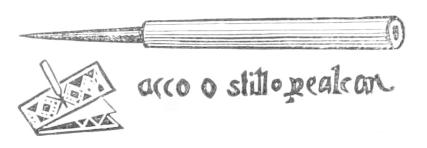
Manner of Pricking the Pattern.—(Vecellio.)
On Pl. 27, woman with a torch and Cupid. At Pl. 28, in a point coupé border, is a fox holding the bust of a lady, the conceit of which is explained by the verses to be, that sense is better than beauty:—
"Trovò la Volpe d' un Scultore eletto Una testa sì ben formata, tale, Che sol le manca Spirito havresti detto, Tanto l' industria, e l' arteficio vale, La prende in man, poi dice; O che perfetto Capo, e gentil; ma voto è d' inteletto."
78.
1594. Venice. C. Vecellio.
Gioiello della corona per le nobili e virtuose donne. Libro quarto. Nel quale si dimostra altri nuovi bellissimi Dissegni di tutte le sorte di Mostre di Punti in Aria, Punti tagliati & Punti à Reticello; così per Freggi, come per Merli, & Rosette, che con l' Aco si usano hoggidì per tutta l' Europa. Et molte delle quali mostre possono servire anchora per opere à Mazzette Nuovament posto in luce con molte bellissime inventioni non mai più usate, nè vedute. Con privilegio. In Venetia, Appresso Cesare Vecellio, in Frezzaria nella Casa de i Preti. 1594.
Same impresa of the stork and serpent.
Dedicated to the Sign. Isabella Palavicina Lupi Marchesa di Soragana, dated "Venetia alli 20 Novembrio 1592." Cesare Vecellio. 30 plates.[1334]
Vecellio, author of the Corona and Gioiello, also published a work on costume styled Degli Habiti Antichi et Moderni. In Venezia, 1590. Presso Damian Zenero. In the frontispiece is a salamander; on the last leaf a figure of Vesta. It has been reproduced by F. Didot, Paris.
He was not, as is often incorrectly stated, a relation, or even of the same family as Titian.
These are the earliest impressions we have had an opportunity of examining of Vecellio's works, which appear to have been widely circulated. The Bib. de l'Arsenal possesses two copies of the Corona (No. 11,955), from which we have described. In the other (No. 11,155 bis), Book 1 "ultima," Book 2 "quarta," are both dated 1593; and Book 3 "nuovamente ristampata la quarta volta," 1592. The plates all the same.
The Library of Rouen (No. 1,315) has a volume containing the Corona and Gioiello. Book 1 "quarta Imp.," Book 2 "ultima," both dated 1594; and Book 3 "quinta," 1593. The Gioiello, 1593.
In the Bodleian is a copy of the three books, date 1592; and another, date 1561, was in the possession of the late Mrs. Dennistoun of Dennistoun.
At Venice, in the Doge's Library, is a volume containing the three books of the Corona and the Gioiello, dated 1593.
Mrs. Stisted, Bagni di Lucca, also possesses the three books of the Corona, dated 1597, and the Gioiello, 1592.
At Bologna the Library has one volume, containing the first and second books only, evidently the original impressions. The titles are the same as the above, only to each is affixed, "Opera nuova e non più data in luce," and "Stampata per gli Hered' della Regina. 1591. An instantia di Cesare Vecellio, Stà in Frezzaria."
The same Library also possesses a volume, with the three books of the Corona, the first and third "ottava," the second "quarta," and the Gioiello, "nuovamente posto in luce." All "In Venetia appresso gli heredi di Cesare Vecellio, in Frezzaria. 1608."
At Vienna, in the new Museum for Art and Industry, is a copy of the five books, dated 1601.[1335]
Cav. Merli cites from a copy of the four books, dated 1600.
The various impressions, therefore, date from 1591 to 1608.
We see these different parts, like those of Vinciolo and all these old collections, have been printed and reprinted independently of each other, since the third part was at its fifth impression in 1593, while the first, which ought to have preceded it, was only at its fourth in 1594.[1336]
79.
1593. St. Gall. G. Strauben.
New Model Buch darinnen allerley Gattung schöner Modeln der newen aussgeschitnen Arbeit auff Krägen, Hempter, Jakelet und dergleichen zu newen, so zuvor in Teutschlandt nicht gesehen. Allen thugentsamen Frawen und Jungkfrawen, Nätterinnen, auch allen audern so lust zu solcher kunstlichen Arbeit haben, sehr dienstlich.
Getruckt in uerlegung George Strauben, von S. Gallem, Anno 1593.[1337]
Translation.
New Patternbook, in which are all sorts of beautiful patterns of the new cutwork for collars, shirts, jackets, and such like, such as never before were seen in Germany. Most useful to all virtuous dames and such artistic works, very respectfully dedicated.
Printed for the publisher, G. Strauben.
A reprint of the third book of Vecellio's Corona.
80.
N.D. Lindau am Bodensee.
Neu Model-Buch, darinnen allerley gattung schöner Modeln der neuen, etc.
Probably a reprint of No. 79.
27 plates.
81.
1597. Liége. J. de Glen.
Les singuliers et nouveaux pourtraits, pour toutes sortes de lingeries de Jean de Glen, dediés à Madame Loyse de Perez; à Liége, chez Jean de Glen, l'an 1597.[1338]
Obl. 4to, 39 plates, mostly borrowed from Vinciolo, as well as the title.
82.
1596. Florence. M. Florini.
Fior di Ricami nuovamente porti in luce. Fiorenze, 1596, ad instanza di Mattheo Florini.
4to obl., 24 plates and 2 leaves of text.[1339]
83.
1603. Siena. M. Florini.
Fiori di Ricami nuovamente porti in luce nei quali sono varie et diversi disegni di lavori, como merli, bavari, manichetti e altre sorte di opera. Siena, appresso Matteo Florini, 1603.
4to obl., 24 pages.[1340]
84.
1603. Siena. M. Florini.
Giojello, &c. Nel quale si di mostra altri novi bellissimi disegni di tutte le sorte, di mostre &c. ... di punti &c., cosi per fregi come per merli et rosette che con l' aco si usanno hoggi di per tutte l' Europa. Opere a Mazzetto nuovamente posta in luce con motte bellissime inventioni non mai più usate ne vedute. In Siena, Matteo Florini MDCIII.
4to obl. (Cited by Marquis d'Adda.)
85.
1597. Nuremberg. B. Laimoxen.
Schön neues Modelbuch von allerley lüstigen Mödeln naczunehen zu würken un zu sticke; gemacht im Jar Ch. 1597, zu Nürmberg, bey Balthaser Laimoxen zu erfragen.[1341]
Translation.
Fine new Patternbook of all sorts of pleasant patterns for sewing, working, and embroidering: made in the year of Christ 1597, at Nurmberg: to be had of Balthasar Laimoxen.
Obl. fol., 27 ff.
5 sheets, title-page, and poem, signed J. S. (Johann Sibmacher.)
Mr. Gruner has communicated to us a work with the same title, dated 1591.[1342]
86.
1598. Montbéliard. J. Foillet.
Nouveaux pourctraicts de point coupé et dantelles en petite moyenne et grande forme nouvellement inventez & mis en lumiere Imprimé a Montbéliard par Jacques Foillet clↄlↄxciix (1598).[1343]
Small 4to, 82 ff., 78 plates.
Frontispiece with borders composed of squares of point coupé.
"Avertissement aux dames," of three pages, stating these works are all composed of "point devant l'esguille, de point en toille, en bouclages, & de cordonnages." The writer gives patterns of roses of all sizes, "very little, middling, large, and very large," with from one to nine pertuis, or openings, holes. Also Carreaux in different forms, and lastly dantelles. "Je n'ay voulu omettre de vous dire que pour faire des dantelles, il vous fault jetter un fil de la grandeur que desiré faire vos dantelles, & les cordonner, puis jetter les fils au dedans, qui fera tendre le cordon & lui donnera la forme carrée, ronde, ou telle forme que desires, ce qu'estant faict vous paracheverès facilement. Enoultre vous verrez qu'estant bien petites deviennent peu a peu bien grandes jusques a la fin. Elles vous enricheront & embelliront vos ouvrages en les applicant aux bords d'iceux." Directions, we confess, perfectly enigmatical to us. The author finishes by exhorting the ladies to imitate Minerva and Arachne, "qui ont acquis un grand renom, pour avoir (cōme à l'envie l'une de l'autre) travaillé de l'esguille."
The avertissement is followed by an "Exhortation aux jeunes filles." in verse, of 21 lines, beginning—
"Si nuisible est aux humains la paresse," etc.
40 patterns of "roses," of point coupé.
And 18 of "Carreaux," variously disposed.
Then follow 20 patterns of lace, of "bien petites, petites, moyennes, & grosses," all "au point devant l'Esguille." (See Figs. 8 to 12.)
At the end: "La fin courone l'œuvre." This is the earliest pattern-book in which the word "dantelle" occurs.
87.
1598. Montbéliard. J. Foillet.
New Modelbuch darinnen allerley ausgeschnittene Arbeit, in kleiner, mittelmässiger und grosser form erst neulich erfunden. Allen tugenden Frawen vnnd Jungfrawen sehr nutzlich. Gedruckt zu Mumpelgarten durch Jacob Foillet, 1598.[1344]
88.
1599. Basle.
Fewrnew Modelbuch von allerhandt Künstlicher Arbeidt, nämlich Gestricht, Aussgezogen, Aussgeschnitten, Gewiefflet, Gesticht, Gewirckt, und Geneyt: von Wollen, Garn, Faden, oder Seyden: auff der Laden, und Sonderlich auff den Ramen, Jetzt Erstmals in Teutschlandt an Tag gebracht: Zu Ehren und Glūcklicher Zeitvetreibung allen dugentsamen Frawen, und Jungfrawen Nächerinen, auch allen andern, so lust zu solcher Kunstlicher Arbeit haben sehr dienstlich. Getruckt zu Basel.
In verlegung Ludwig Kūnigs MDXCIX.[1345]
Small obl., 33 ff., 32 plates.
Frontispiece border of point coupé. Title in Gothic red and black. Patterns, mostly borders, number of stitches given, "Mit xxxxvii., Bengen," etc. "Ende dieses modelbuchs."
89.
1601. Paris.
Béle Prérie contenant divers caracters, et differentes sortes de lettres alphabetiques, à sçavoir lettres Romaines, de formes, lettres pour appliquer sur le reseuil ou lassis, et autres pour marquer sur toile et linges, par Pier. le Bé. Paris, 1601.[1346]
In 4to obl.
90.
1601. Nuremberg. Sibmacher.
Modelbuch in Kupfer gemacht, Nürmberg, bei Michel Kuisner, 1601, by J. Sibmacher.[1347]
91.
1604. Nuremberg. J. Sibmacher.
Newes Modelbûch fûr Kûpfer gemacht, darinnen allerhand art newen Model von dem Mittel und Dick ausgeschniden duer Arbeit auch andern kunstlichen Nahework zu gebrauchen mit Fluss fur druck verfertigt. Mit Röm. Kais. Maj trentich Nürmberg 1604.[1348]
Translation.
New book of patterns (on copper) in which are copied out all kinds of new patterns for thick and thin materials, to be used also in the making of other artistic needlework.
Obl. 4to, 58 plates carefully engraved upon copper.
Title-page surrounded by a richly ornamented border, with two figures, one sewing, the other at embroidery; also a second ornamented frontispiece, dedication to Maria Elizabeth, Electress Palatine, dated 1601. Nuremberg, J. Sibmacher, citizen and engraver.
Then follow five pages of dialogue, given page 6, note 24, and 227.
A printed title to the next plate. "The following pattern may be worked in several different ways, with a woven seam, a flat, round, or crossed Jew stitch."[1349] It is probably meant for cut-work made on thin materials.
Then follow 58 leaves of patterns, the greater number of which have the number of rows written over each pattern. Pl. 38, with two patterns, is inscribed, "The following patterns are for thick cut-work." In the upper pattern, on the first leaf, are the arms of the Palatine; on the second, those of Juliers and Mark.
92.
1600. Venice. I. C. Parasole.
Pretiosa gemma delle virtuose donne dove si vedono bellissimi lavori di ponti in aria, reticella, di maglia e piombini disegnati da Isabella Catanea Parasole. E di nuovo dati in luce da Luchino Gargano con alcuni altri bellissimi lavori nuovamente inventati. Stampata in Venetia ad instantia di Luchino Gargano MDC.[1350] See also No. 99.
93.
N. D.
Allerhand Model zum Stricken un Nähen.[1351]
Obl. 4to, 64 plates. No date.
94.
1604. Padua. P. P. Fozzi.
A book of models for point coupé and embroidery, published at Padua, October 1st, 1604, by Pietro Paolo Fozzi. "Romano."[1352]
95.
1605. Frankfort on the Mayn. S. Latomus.
Schön newes Modelbuch von 500 schönen aussor wählten, Kunstlichen, so wol Italiähnischen, Frantzösischen, Niederländischen, Engelländischen, als Teutschen Mödeln, Allen, Näher.... hstichern, &c., zu nutz. (Some of the words are illegible.)
Livre des Modelles fort utile à tous ceux qui besoignent à l'esguille.
At the foot of last page recto is, "Franckfurt am Mayn, bey Sigismund Latomus, 1605."[1353]
Small obl. 100 plates (Fig. 171), and coloured title-page with figures.
Fig. 171.
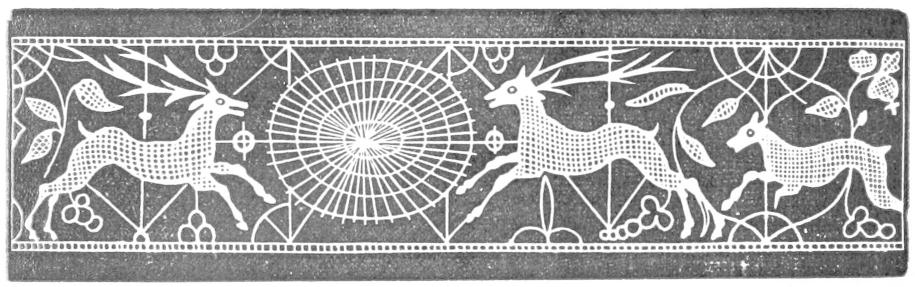
Frankfort-on-the-Main, 1605.
In the first plate is an escutcheon with this monogram (Fig. 172) surrounded with embroidery.
Fig. 172.
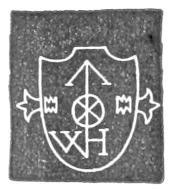
Monogram.
In the Nuremberg copy it is at p. 83.
96.
1607. Frankfort on the Mayn. S. Latomus.
Schön newes Modelbuch, Von hundert vnd achtzig schönen kunstreichen vnd gerechten Mödeln, Teutsche vnd Welsche, welche auff mancherley Art können geneet werden, als mit Zopffnath, Creutz vnnd Judenstich, auch auff Laden zu wircken: Dessgleichen von ausserlesenen Zinnigen oder Spitzen. Allen Seydenstickern, Mödelwirckerin, Näderin, vnd solcher Arbeitgeflissenen Weibsbildern sehr dienstlich, vnd zu andern Mustern anleytlich vnd verstendig. Franckfurt am Mayn, In Verlegung Sigismundi Latomi. M.D.C.VII.[1354]
Small 4to obl. 180 patterns.
Sheets A-O (the last has only 3 leaves). On the title-page are two ladies, one working at a pillow, the other at a frame; in the back-ground, other women employed at various works. Another copy dated 1629. Mr. Arnold and Mr. F. S. Ellis.
97.
1605. Paris. M. Mignerak.
La pratique de l'aiguille industrieuse du très excellent Milour Matthias Mignerak Anglois, ouvrier fort expert en toute sorte de lingerie ou sont tracez Divers compartimens de carrez tous differans en grandeur et invention avec les plus exquises bordures, desseins d'ordonnances qui se soient veux jusques à ce jourd'hui tant poetiques historiques, qu'au tres ouvrages de point de rebord. Ensemble Les nouvelles invencions Françoises pour ce qui est de devotion et contemplation. A la Tres-Chrestiene Roine de France et de Navarre. Avec privilege 1605 du Roy.[1355]
A Paris, par Jean Leclerc, rue St.-Jean de Latran, à la Salamandre roialle.
Extract from "Discours Du Lacis." "Ce chef d'œuvre divin n'est pas à l'adventure Mais par art composé, par nombre, et par mesure; Il commence par un, et va multipliant Le nombre de ses trouz qu'un nœud va reliant, Sans perdre aucunement des nombres d'entresuitte, Croissant, et decroissant d'une mesme conduitte: Et ainsi qu'il commence il acheve par un, Du monde le principe et le terme commun. Si l'on veut sans faillir cet ouvrage parfaire, Il faut multiplier, adjouster, et soustraire: Il faut bien promptement assembler, et partir, Qui veut un beau Lacis inegal compartir. Mais se peut il trouver, souz la voute azurée, Chose plus justement en tous sens mesurée? Ouvrage ou il y ait tant de proportions, De figures, de traicts et de dimensions? D'un point premièrement une ligne l'on tire, Puis le filet courbé un cercle va descrire, Et du cercle noué se trouve le quarré Pour lequel retrouver tant d'esprits ont erré. De six mailles se faict une figure egale, De trois costez esgaux, pour forme pyramidale: Et l'ouvrage croissant, s'en forme promptement Une autre dont les deux sont egaux seulement. Si l'on tire un des coings, se forme une figure. D'un triangle en tout sens, d'inegale mesure. Le moule plus tiré faict les angles pointuz, Et l'ouvrage estendu faict les angles obtuz. De mailles à la fin un beau quarré se faict, Composé de quarrez, tout egal, et parfaict, Quarré qui toutesfois se forme variable, Or en lozange, et or en figure de table. La bande de Lacis recouvert, à nos yeux, Est comme un beau pourtraict de l'escharpe des cieux, Dont chaque endroit ouvré nous represente un signe, Le milieu, les degrez de l'Eclyptique ligne; Le quarré, des vertus le symbole, et signal De science du livre et bonnet doctoral, Nous va representant l'Eglise et la Justice. La façon de lacer figure l'exercice D'enfiler une bague on bien l'art d'escrimer. . . . . . Le lacis recouvert sert de filet aux dames Pour les hommes suprendre et enlacer leurs ames, Elles en font collets, coiffures, et mouchoirs, Des tentures de lits, tauayoles, pignoirs, Et maint autre ornement dont elles les enlacent, C'est pourquoi en laçant les femmes ne se lassent."
In 4to, 76 ff., 72 plates.
Frontispiece: Two ladies, with frames in their hands, labelled "Diana" and "Pallas." On the top, an escutcheon per pale France and Medicis, supported by Cupids. Beneath, Cupids with distaff and winding reels. Between the sides of a pair of scissors is a cushion on which is extended a piece of lacis, a "marguerite" in progress. (See Fig. 6.) Above, "Petrus Firens fecit, I. le Clerc excud." Below, "A Paris par Jean le Clerc Rue St. Jean de Latran à la Salamandre royalle."
Dedication of Jean le Clerc "A la royne," then Marie de Medicis, stating: "J'avois recouvré d'un personnage Anglois tres-expert en toute sorte de Lingerie;" but who this Milour Mignerak may be, history tells not.
Then follows the "Discours du Lacis," a poem, of which we give an extract.
The privilege is signed Aug. 2, 1605.
The patterns consist of the Queen's arms and cypher, 4 Scripture subjects: Adam and Eve, the annunciation, Ecce Homo, and Magdalen; 4 Elements, 4 Seasons; Roman Charity, Lucretia, Venus, and "Pluye d'or;" 6 Arbes à fruit, 6 Pots à fleurs, 30 Carrés grands, moyens et petits; 6 Bordures, and, what is quite a novelty, 6 "Passements faits au fuseau." (See Fig. 13): the first mention of pillow lace in any of the French pattern-books.
98.
1613. Paris. F. Vinciolo.
Les secondes œuvres, et subtiles inventions de Lingerie du Seigneur Federic de Vinçiolo Venitien; nouvellement augmenté de plusieurs carrez de point de rebort. Dediée à Madame, sœur unique du roy. Ou sont representees plusieurs figures de Reseau, nombres de Carrez et Bordures tous differents, le tout de poinct conté, avec autres sortes de Carrez de nouvelles inventions non encore vues.
A Paris. Par Jean le Clerc, rue sainct Jean de Latran, à la Salemandre, 1613. Avec privilege du Roy.[1356]
A scarce and valuable volume, the fullest edition of the second part of Vinciolo's work.
4to, 68 ff., 61 plates.
It contains a—
Sonnet aux Dames & Damoyselles. "Esprits rarement beaux qui fuyez la paresse, Je vous fais un present qui la pourra chasser, Quand vous desirez de gayement passer Vostre temps, et monstrer de vostre main l'adresse. Le present est utile et plein de gentillesse, Il monstre les moyens de bien entrelasser. Et faire au point couppé tout ce qu'on peut penser. Cet exercise plaist à Pallas la Deesse. Par ses enseignemens, avec l'esguille on fait Des fleurons, des oyseaux, en ouvrage parfait, Des chiffres et des nœuds, tels que l'amour desire. Aymez cet exercise, et vous y occupez, Et puis vous cognoistrez que sur les points couppez En diverses façons quelque portrait se tire."
The author's address to the reader, and a
Dedication to "Madame, sœur unique du roy" (Catherine de Bourbon, sister of Henry IV., married, 1599, to the Duc de Bar), signed by Le Clerc.
On the second plates are her arms, a lozenge, France and Navarre with crown and cordelière, and the same lozenge also surmounts the decorated frontispiece, supported on either side by a genius (?) working at a frame and point coupé drapery.
7 Scripture subjects: The Salutation, St. Sacrement, Passion, Crucifixion, Adoration of the Kings, etc.; the number of the stitches given to each.
2 Stomachers, and various patterns of "carrez " and borders. 2 of "Point de rebort."
At the end is the "Discours du Lacis," already printed by Mignerak.
99.
1616. Rome. E. C. Parasole.
Teatro delle nobili et virtuose donne, dove si rappresentano varij disegni di lavori novamente inventati et disegnati da Elisabetta Catanea Parasole Romana.
Dedicata alla Serenissima Principessa Donna Elisabetta Borbona d' Austria, Principessa di Spagna, da E. C. Parasole. Data di Roma a di 5 Marzo 1616.[1357] Other editions, 1620, 1625, and 1636. The last is dedicated to the Grand Duchess of Tuscany, and has the Medici and Della Rovere arms in the title-page.
Obl. 4to, 47 ff., 46 plates (44 in Prince Massimo's copy) beautifully executed, the titles printed to each plate, as "Lavori di punti in aria, Merletti di ponti reticella, Merletti a piombini," etc. (See Fig. 15.)
100.
1600. Venice. I. C. Parasole.
Pretiosa gemme delle virtuose donne dore si vedono bellisimi lavori di ponto in aria, reticella, dimaglia e piombini disegnati da Isabella Catanea Parasole. E di nuovo dati in luce da Luchino Gargano con alcuni altri bellisimi lavori nuovamente inventate. Stampata in Venetea ad instantia de Luchino Gargano MDC.[1358]
101.
1625. Rome. I. C. Parasole.
Gemma pretiosa delle virtuose donne, dore si vedono bellisimi lavori de Ponti in Aria, Reticella, di Maglia, e Piombini disegnatida Isabella Catanea Parasole.
In Rome, appreso Guliegno Facciotti, 1625.
102.
1618. Frankfort on the Mayn. D. Meyer.
Zierat Buch, von allerhandt Kutschnur, Schleyer deckel, Krägen, Leibgürtel, Passmenten, Händschug, Wehrgeheng und Schubenehen, Messerscheyden, Secklen, Früchten, Blumen und ands. mehr.
Allen Perlenbefftern, Nederin, Lehrinngen und andern welche lust zu dieser Kunst tragen, sehr nützlich.
Inn diese Format zusammen ordiniert und gsetzt durch Daniel Meyer Mahlern. 1ster Theil.
Franckfuhrt am Mayn, bey Eberhardt Kusern zu finden.
11 ff., 9 plates.
Translation.
Decoration book of all sorts of Cords, Veil covers, Collars, Belts, Laces, Gloves, Shoulder knots, shoe-seams (?), Knife sheaths, Bags, Fruit, Flowers, and other things besides. Very useful to all Beadworkers, Seamstresses, Apprentices, and others, who take a pleasure or are fond of this art. Arranged and put into this form by D. M. M. 1st part.
103.
1619. Leipsic. A. Bretschneider.
New Modelbŭch Darinnen allerley kunstliche Virsirung und Müster artiger Zŭege und schöner Blŭmmen zu zierlichen Ueberschlagen, Haupt Schurtz Schnŭptüchern Hauben Handschuhen, Uhren (?) gehenzen, Kampfütern ŭnd dergleichen auf Muhler naht und Seidenstŭcker arbeit gantz Kunstlich gemahlt und vorgerissen, dergleichen sie bevorn noch nie in Druck ausgegangen. 16 Leipzicht 19.
Inn Verlegŭng Henning Grosseren, de Jŭngeren Andreas Bretschneider Mahller.[1359]
Translation.
New pattern-book, in which all sorts of artistic ornamentations and patterns of pretty stuffs and beautiful flowers for covers for Head, Aprons, and Pocket-handkerchiefs, Caps, Gloves, Clock cases, Comb Cases, and such like, artistically sketched from painter and silk embroiderer's work, and which have never before gone out of print.
Small folio, 53 plates, and half a sheet of text, containing the dedication of the work to Madame Catherine von Dorstats, née Löser. There appear to be 3 plates wanting.
104.
1624. London.
A Schole House for the Needle. 1624.[1360]
Obl. 4to. Was sold at the White Knight's sale for £3 15s.
105.
1620. Venice. Lugretia Romana.
Corona delle nobili et virtuose donne. Libro terzo. Nel quale si dimostra in varii dissegni tutte le sorti di Mostre di punti tagliati e punti in aria, punti Fiamenghi, punti a Retcello, e d' ogn' altra sorte, Cosi per Fregi, per merli e Rosette, che con Aco si viano hoggidi per lutta l'Europa. E molte delle quali Mostre porsono Serviri ancora per opera à Mozzete. Con le dichiarationi a le Mostre a' Lavori fatti da Lugretia Romana. In Venetia, appresso Allessandro de Vecchi, 1620.[1361]
27 ff., obl. 8vo.
106.
1625. Venice. Lugretia Romana.
Corona delle Nobili et Virtuose Donne, Libro primo, nel quale si dimostra in varij Dissegni tutte le sorti di Mostre di punti tagliati, punti in Aria, punti Fiamenghi, punti a Reticello, e d' ogni altre sorte, cosi per Freggi, per Merli, e Rosette, che con l' Aco si usano per tutta l'Europa. E molte delle quali Mostre possono servire ancora per opere a Mazzete. Con le dichiarazioni a le Mostre, a Lavori fatti da Lugretia Romana.
In Venetia appresso Alessandro de Vecchi MDCXXV. Si vendono in Venetia al Ponte de' Baretteri alla libreria delle tre Rose.[1362]
Lady Wilton, in her Art of Needlework, quotes a copy dated 1620.
Obl. 4to, ff. 27. Portrait of Maria d'Aragon.
107.
N. D. Venice. Lucretia Romana.
Ornamento nobile, per ogni gentil matrona, dove si contiene bavari, frisi d' infinita bellezza, lavori, per Linzuoli, Traverse, e Facuoli, Piena di Figure, Ninfe, Satiri, Grotesche, Fontane, Musiche, Caccie di Cervi, Uccelli, ed altri Animali. Con ponti in aria, fiamenghi, et tagliati, con Adornamenti bellissimi, da imperare, per ogni Virtuosa Donna, che si diletta di perfettamente cucire. Opera, per Pittori, Scultori, e disegnatori giovevole alle lor professioni, Fatta da Lucretia Romana, il quinto volume di Suoi lavori. Dedicato alle Virtuose donne, in Venetia.[1363]
Fol., 20 plates.
Frontispiece, in point coupé frame. A woman in classic attire is represented under a Doric porch, standing on a tortoise, symbol of a home-loving woman. (See No. 77.) She holds a ball of thread in her hand. Behind, on the left, are two women at work; on the right, a sculptor chiselling a statue of Minerva.
The plates, which are rich and beautiful, are each accompanied by a short explanation, as "Degna de esser portata de ogni imperatrice;" "Hopera bellissima che per il piu il Signora Duchesa et altre Signore si servano per li suoi Lavori;" "Questa bellissima Rosette usano auco le gentildonne Venetiane da far traverse," etc. (Fig. 173.)
The bavari are executed in three different stitches: punto d' aieri, p. flamingo, and p. tagliato. This author and Vecellio give Flemish patterns (punti Fiamenghi). They consist mostly of rosettes and stars (gotico).
108.
1623. Paris.
Les excellents eschantillons, patrons et modelles du Seigneur Federic de Vinciolo Venitien, pour apprendre à faire toutes sortes d'ouvrages de Lingerie, de Poinct couppé, grands et petits passements à jour, et dentelles exquises. Dediez à la Royne. A Paris. Chez la Veufve Jean le Clerc, ruë Sainct Jean de Latran, à la Salamandre Royalle. Avec Privilege du Roy, 1623.[1364]
In 4to, 56 ff.
The old frontispiece and same "Avertissement."
Dedication to the Queen, Anne of Austria.
The Goddess Pallas invented "les ouvrages de lingerie, le poinct couppé, les grands and petits passements à jour, toutes sortes de dentelles, tant pour se desennuyer que se parer, par l'artifice de ses ingenieuses mains. Araciné s'y adonna, and bien qu'inferieure se voulant comparer à elle & en venir à l'experience, mais sa presomption fut chastiée." Many illustrious ladies have delighted in this "honneste exercise." Fastrade and Constance, wives of the Emperor Charlemagne and of King Robert, "s'employèrent de cette manufacture, & de leurs ouvrages ornèrent les églises & les autels." This royal "mestier" has reached perfection through the works of Vinciolo. I reprint and again increase his work, which I dedicate to your Majesty, to whom I presume they will be agreeable; the subject of which it treats is "une invention de déesse & une occupation de Royne—vous estant autant Royne des vertus que vous l'estes de deux royaumes." Signed, "la Veufve de feu Iean le Clerc."
Same sonnet.
Privilege for six years, dated Paris, last day of March, 1623.
55 ff., 58 plates, 24 ouvrages de point couppé and 8 of "Passements au fuzeau" (see Figs. 14 and 15), and alphabet.
Fig. 173. Bavaro di Ponto d' Aiere, di gran bellezzi.—Con figure di moiti strumenti che sonano a musica, con rosete d'intorno di bella e vaga vista per ogni Principessa.
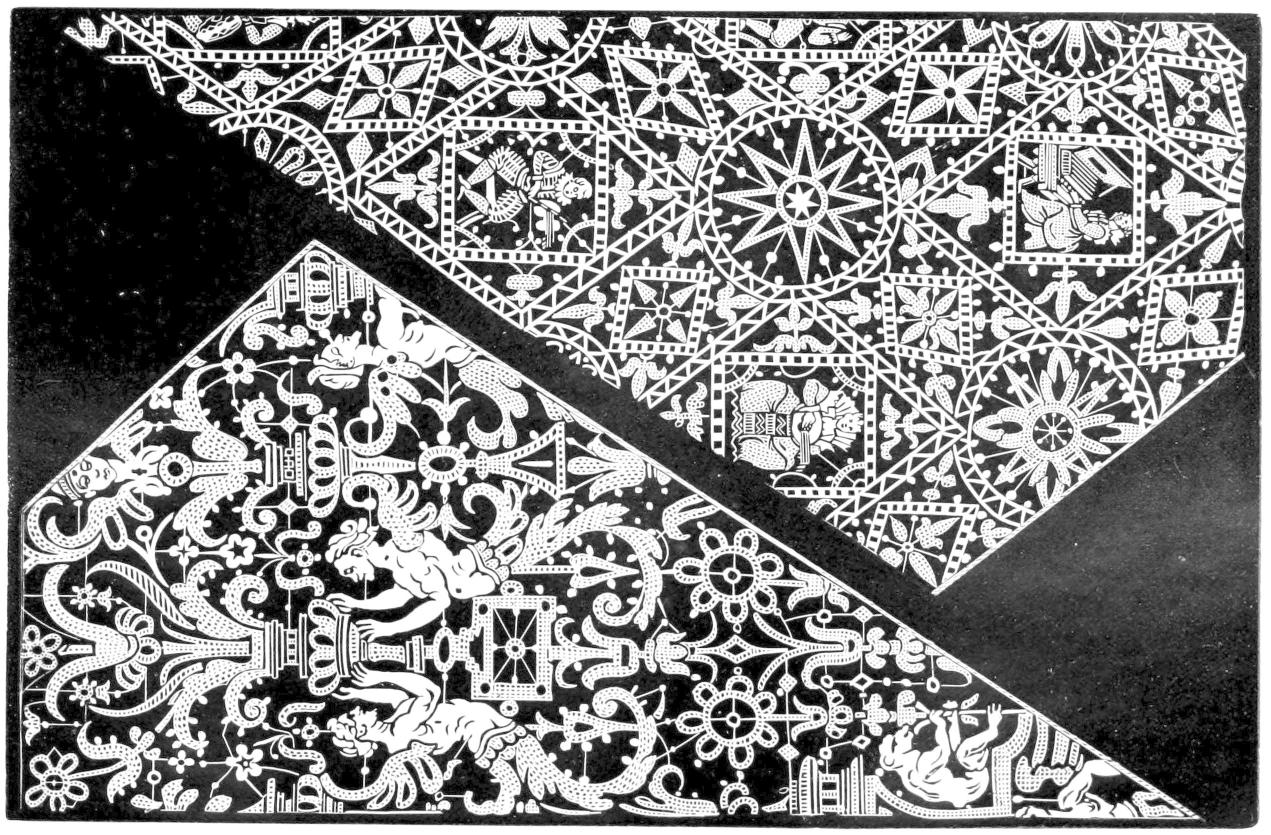
Bavaro di Ponto d' Aere.—Con belissime figure ed altri flori.
"Bavari."—From Ornamento mobile of Lucretia Romana.
To face page 498.
109.
A Schole Howse for the Needle. Teaching by sundry sortes of patterns and examples of different kindes, how to compose many faire workes; which being set in order and forme according to the skill and understanding of the workwoman will, no doubt, yield profit unto such as live by the needle and give good content to adorne the worthy. London printed in Shoe Lane at the "Faulcon" by Richard Shorleyker, 1632.
To the Reader.
Gentle Reader, I would have you know that the Diversities of Examples which you shall find in this "Schoole-howse for the Needle" are only but patternes which serve but to helpe and inlarge your invention. But for the disposing of them into forme and order of Workes that I leave to your own skill and understanding. Whose ingenious and well practised wits will soe readily (I doubt not) compose them into such beautiful formes as will be able to give content, both to the workers and the wearers of them. And againe for your behoafe I have in the end of this booke made two scales or checker patternes which by enlarging or contracting into greater or lesser squares you may enlarge or make lesser any of the saide patternes and examples in the booke or any other whatever.
Vale!
And because I would not have any one mistaken in any of these patternes contayned in this Booke, for some peradventure will look to find workes set out in order as they should be wrought with the needle or florished upon the Tent, &c. But as I have said before in the beginning of this Booke, that, that is here published are only but diversitie of patternes, out of which the workwoman is to take her choice of one or more at her pleasure and so have them drawne out into forme and order of worke. Of which skill if it may be I would have serving-men (such as have time enough) to practice and be skilful in which will be quickly learned if they would, with a little patience applie their mindes to practise it. A quarter of the time that they spend in playing at cards, tables, quaffing and drinking would make them excellent in this knowledge especially such as are ingenious and indued with good wits, as for the most part all of them have; Againe it is a thing that no doubt would yield them both praise and profit, beside the pleasure and delight it would be unto them, and a good inducement to drawe on others of their own ranke and qualitie to the like practice and imitation.
110.
1632. London.
Here followeth certaine patternes of Cut-workes; and but once Printed before. Also sundry sorts of Spots, as Flowers, Birds, and Fishes, &c., and will fitly serve to be wrought, some with Gould, some with Silke, and some with Gewell (sic) or otherwise at your pleasure.
London; Pinted (sic) in Shoe-lane, at the signe of the Faulcon, by Richard Shorleyker. 1632.[1365]
Obl. 4to.
The copy in the Bodleian is probably due to the above. It has no date and varies in title: "Newly invented and never published before," with "crewell in coullers," etc.; and "Never but once published before." Printed by Rich. Shorleyker.
33 patterns and title.
111.
1640.
The needles excellency, a new booke wherein are divers admirable workes wrought with the needle. Newly invented and cut in copper for the pleasure and profit of the industrious. Printed for James Boler, &c., 1640.[1366]
"Beneath this title is a neat engraving of three ladies in a flower garden, under the names of Wisdom, Industrie, and Follie. Prefixed to the patterns are sundry poems in a commendation of the needle, and describing the characters of ladies who have been eminent for their skill in needlework, among whom are Queen Elizabeth and the Countess of Pembroke. These poems were composed by John Taylor, the Water Poet. It appears the work had gone through twelve impressions.... From the costume of a lady and gentleman in one of the patterns, it appears to have been originally published in the reign of James I."—(Douce.) From this description of the frontispiece, it seems to be copied from Sibmacher.
"The Needle's Excellency, or a new Book of Patterns, with a poem by John Taylor, in Praise of the Needle." London, 1640. Obl. 4to, engraved title, and 28 plates of patterns. Sold, 1771, £6 17s. 6d. (Lowndes, Bibliographer's Manual. New edit., by H. Bohn). Another copy of the same date, marked 12th edition, is in the Library of King's College, Cambridge. It consists of title, four leaves with the poem, subscribed John Taylor, and 31 leaves of copper cuts of patterns.
112.
1642 Pistoja. P. A. Fortunato.
Le Pompe di Minerva, per le nobili e virtuose donne che con industriosa mano di trattenersi dilettano di far Rezze, maglia quadra, punti in aria, punti in tagliati, punti a reticello, cosi per fregio come per merletti e rosette di varie sorti, si come oggidi con l'aco di lavorar usati per tutto l'Europa, arrichite di bellissimi et vaghi intagli cavati da più celebri autori di tal professione. In Pistoja, per Piero A. Fortunato.
In 8vo obl., dedicated to Caterina Giraldini, in Cellesi. August 20 1642.[1367]
113.
1666. Nuremberg.
Dass Neue Modelbuch von schönen Nädereyen, Ladengewerk und Soterleins arbeit. Ander theil. Nürnberg, bey Paulus Fürsten Kunsthändler.
Obl. 4to, 3 sheets of text, 50 plates.
Dedicated to the Princess Rosina Helena. Nürnberg, March 20, 1666.[1368]
114.
In the Bib. Imp. (Gravures, L. h. 4. c.) is a vol. lettered "Guipure, gravures burin," containing a collection of patterns engraved on copper, 43 plates, four of which are double, pasted in the book, without title or date. Pomegranates, narcissus, lilies, carnations, most of them labelled "Kreutzstick, Frantzösischenstick, and Fadengewürck" (thread work), the number of stitches given, with Clocks (Zwickel) of stockings and other patterns.
115.
1676. Nuremberg. C. Gerharts.
Model Buch, dritter Theil von unterschiedlicher Vögeln, Blumen und Früchten &cte. Von und in Verlegung Rosina Helena Fürtin. Nürnberg, Christoff Gerharts, 1676.
4to obl., engraved title and printed list; 42 wood plates, 4 large.
116.
1722. Paris.
Methode pour faire une infinité de desseins differens, avec des carreaux mi-partis de deux couleurs par une ligne diagnonale ou observations du père Dominique Donat, religieux carme de la province de Touleuse sur une mémoire inserée dans l'histoire de l'Académie royale des sciences à Paris, l'année 1704, presenté par le Rev. Père Sebastien Truchet. Paris, 1722.[1369]
72 geometric squares, with directions how to make them useful to architects, painters, embroiderers, "tous ceux qui se servent de l'aiguille," and others.
117.
1784. Nuremberg and Leipzig. Christoph Weigel.
Neues Neta- und Strickbuch fur das schöne Geschlecht, worinnen allerhand Zierrathen, wie auch viele neue Zwickel, nebst Buchstaben und Zahlen, sowohl zum Nähen als Stricken in zierlichen Nissen und Mustern befindlich sind. Mit vielen Kupfertafeln. Nürnberg und Leipzig, der Christoph Weigel und Schneider. 1784.[1370]
118.
N. D. Nuremberg. F. M. Helmin.
Continuation der kunst- und fleisz-übenden Nadel-Ergötzung oder des neu ersonnenen besondern Nehe-Buchs dritter Theil, worinnen fleiszige Liebhaberinnen deeser nöthig und nützlichen Wissenchaft, ihr kunstliches Nadel-Exercitium, beij unterschiedlich vorfallenden Belegenheiten zu haben allerhand noch nie vorgekom̄ene Muster zu Deso gebrauch, vorlegt und en die Hand gegeben werden von Fr. Margaretha Helmin, zu finden in Nürnberg bei Joh. Christoph Weigel. Nürnburg. No date.[1371]
Oblong fol.
119.
N. D. Nuremberg. J. Chr. Weigel.
Zierlich webende Minerva, oder neu erfundenes Kunst- und Bild-Buch der Weber- und Zeichner-Arbeit, worinnen treue Anweisung geschieht, wie man kunstlich wirken und schöne Arbeit verfertigen soll, von der vierschäfftigen an, bis auf zwey und dreissig-schafftige. Nurnberg (Johann Christoph Weigel). No date.[1372]
49 plates in sheets.