Volume 3 — CHAPTER XI. REPUBLIC OF COSTA RICA. 1841-1856.
Reading edition
Rule of Carrillo Continued—Plots for its Overthrow—Invasion of Morazan—Change of Government—Morazan's Policy—Opposition—Revolts—Morazan's Defeat and Death—Satisfaction of the Oligarchs—Measures of the Victors—New Constitution—Subsequent Amendments—Sedition—Castro's Administration—Costa Rica Declared a Republic—Recognition by Spain—Relations with Other Powers—Boundary Questions with Nicaragua and Colombia—President Juan Rafael Mora—His Repressive Measures.
Carrillo, believing himself clothed with unlimited authority, on the 8th of March, 1841, issued what he called a 'ley de garantias,' giving himself a life tenure of office and inviolability.[XI-1] The supreme government was made to consist of the executive, and two chambers, named respectively 'consultiva' and 'judicial,' whose members were to be chosen by electoral colleges.[XI-2] Intending to celebrate with éclat the inauguration of the cámara consultiva, Carrillo recalled from exile Juan Mora and four others.[XI-3] The consultiva, following Carrillo's wishes, elected Manual Antonio Bonilla segundo jefe.[XI-4] The enemies of the present ruler were numerous, and increasing. They called Morazan to their aid, through General Bermudez of Peru.
MORAZAN AND SARAVIA.
Morazan sailed from Chiriquí in Panamá, and after visiting several places in Central America landed with about 500 men at Caldera[XI-5] on the 7th of April, 1842. With him were generals Saget, Cabañas, Saravia, and Rascon.[XI-6] Carrillo heard of the invasion in the evening of the 8th, and at once assumed personal command of the troops to operate against the enemy, turning over the executive office to Bonilla, the vice-jefe,[XI-7] and providing other measures for an active campaign. Nearly 1,000 men under Colonel Vicente Villaseñor composed the expedition, among whose captains and lieutenants were some of the wealthiest persons in the country.[XI-8] Morazan had issued a manifesto assuring the Costa Ricans that his policy would be one of order, union, and progress, to accomplish which Braulio Carrillo must be ousted from power. As the government forces approached the invaders, Villaseñor made known its contents to his command, and asked whether they were for fighting or for a peaceable arrangement. Both officers and men almost unanimously[XI-9] favored the latter, and a convention was concluded at Jocote on the 11th of April, by virtue of which the two forces fraternized, becoming one army. It was further agreed that a constituent assembly should be called to reorganize the state, the government meanwhile remaining in charge of Morazan, or in his absence in that of Vicente Villaseñor.[XI-10] This convention was accepted on the next day at San José by Carrillo, with a few additions which did in no wise vitiate it, and Morazan afterward ratified the whole at Heredia.[XI-11] He was enthusiastically welcomed at Alajuela and Heredia, and with an augmented force marched on San José, which he entered without hindrance. As jefe supremo provisorio he made José Miguel Saravia his sole minister of state, and issued a proclamation embodying complete forgetfulness of all past political offences, and tendering an asylum in Costa Rica to all persons, of whatever party, suffering persecution in the other states.[XI-12] He next appointed a committee to revise the laws enacted by Carrillo, with the view of repealing such as were deemed unwise or arbitrary, and a number of them were accordingly annulled, the preposterous one of March 8, 1841, not being, of course, excepted. The state constitution of January 21, 1825, was revived, and the people were called upon to elect a constituent assembly, which was to meet at San José on the 10th of July.[XI-13] This body, composed of thirteen members, one of whom was the distinguished ex-jefe Juan Mora, was installed on the appointed day under the presidency of José F. Peralta, deputy for Cartago, and on the 15th of July unanimously elected Morazan provisional jefe of the state.[XI-14]
The great political change thus effected in Costa Rica greatly alarmed the reactionists; and specially those of Guatemala, who lost no time in adopting measures to destroy Morazan. This chief, on the other hand, took steps toward the reorganization of Central America, equipping troops therefor. Some of his measures were deemed too severe, giving rise to rebellion in some localities. There were intimate relations between Carrera of Guatemala and General Antonio Pinto of Costa Rica, as well as between the serviles of both states, who, together with the clergy, worked to promote a revolt. An attempt in Guanacaste by Colonel Manuel A. Molina failed, and caused his arrest, trial, and execution at Puntarenas.[XI-15] Colonel Molina was a son of Pedro Molina, the noted champion of free principles, and however legal his execution may have been, it was certainly impolitic. His sentence might have been commuted, thus averting the disruption which at once broke out in the liberal ranks.[XI-16]
WAR AND REBELLION.
Saget was at Puntarenas attending to the embarkation of 45 officers, 200 men, 2,000 or 3,000 muskets, and about 1,300 pounds of powder and lead. At Alajuela were 300 recruits of that department and 100 of Cartago, all commanded by Florentin Alfaro. This officer was won over by Morazan's enemies, and revolting on the 11th of September marched upon San José, where the people followed his example. The revolutionists then called General Pinto to the command.[XI-17] Morazan's body-guard of forty Salvadorans thrice repulsed the assailants, but finally had to retreat to the chief barracks.[XI-18] The jefe, together with Cordero, Cabañas, and Saravia, and 80 men sustained another terrible onslaught on the 12th. The besiegers were constantly on the increase till they numbered 5,000, and the besieged on the decrease by death and desertion.[XI-19] Chaplain José Antonio Castro came to propose a capitulation based on Morazan's abandonment of the country, and a pledge of security to his supporters. Believing that his loyalty and military honor were at stake, Morazan declined the propositions.[XI-20] Pinto's secretary, Vicente Herrera, was very virulent, demanding Morazan's blood; and the chaplain reported that the jefe wanted war, refusing to recognize any authority on the part of his adversaries to give pledges, which enraged their commander and his secretary all the more.[XI-21] The fight continued, and blood flowed freely.[XI-22] Mayorga, comandante at Cartago, rebelled, and Morazan's situation had become a desperate one on the 13th. No reënforcements could reach him, and provisions were exhausted. Juan Mora and Chaplain Castro endeavored to bring about an arrangement, but the terms offered, being oppressive, were rejected. The firing was resumed between one and two o'clock in the morning of the 14th. Morazan and his handful of supporters, worn out by fatigue, hunger, and wounds, made their way through the besiegers and reached Cartago,[XI-23] Cabañas covering the retreat with 30 men. Mayorga's wife, who disapproved her husband's disloyalty, sent them word of their danger. But it came too late. Morazan and the rest were surrounded and captured. Young Francisco Morazan and Saravia, arriving a little later, were also secured. Deception toward Cabañas was used,[XI-24] and treachery toward Morazan, who was promised his life.
BLOODY WORK.
Early the next morning, an officer named Darío Orozco came to inform Morazan and his companions that they were to be put in irons, by demand of the troops. Saravia rose and seized a pistol to blow his brains out; but Morazan prevented the suicide, though only for a few moments. He then walked a while smoking, and finally submitted to have the shackles put on his feet, and just as it was being done he had a horrible convulsion which ended in death. It is said that he had swallowed poison. The shackles were riveted on a corpse![XI-25] Villaseñor stabbed himself with a dagger, and fell to the ground covered with blood, unfortunately for him, not dead. Morazan was shackled. The prisoners were at once taken to San José. Morazan, though wounded, rode on horseback, and Villaseñor was carried in a hammock; but on arriving at the Cuesta de las Moras, Captain Benavides, a Peruvian who commanded their guard, made them walk to the court-house. Morazan on the way conversed with Pardo and Vijil, and remembering that it was the 15th of September, remarked to Vijil, "How solemnly we are keeping the anniversary of independence!" The other prisoners were confined in the building called Los Almacenes, and Morazan was left with Villaseñor as his sole companion.
Moderate men strongly urged a strict observance of law, aside from prejudice or passion;[XI-26] but their voice was drowned in the uproar of the enemies of Morazan,[XI-27] clamoring for his death without form of trial, regardless of the requirements of the constitution of 1825, and of the fact that he was the legitimate chief of the state.[XI-28] But nothing availed to save his life. Pinto, like his prototype Pontius Pilate, after a slight hesitation, signed the order of execution of both Morazan and Villaseñor, to be carried out within three hours. Morazan then summoned his son Francisco, and dictated to him his last will and testament; some of its clauses are epitomized below.[XI-29] After placing in charge of Montealegre a handkerchief and a few other objects for his wife, so soon to become a widow, he walked with dignity and a firm step to the place of execution. Villaseñor, who was nearly dead from his wound, was carried in a chair. On arriving at the fatal spot Morazan embraced Villaseñor, saying, "My dear friend, posterity will do us justice." Barrundia thus describes the last moments of the ex-president: He gave the order to prepare arms, saw that a good aim was taken, then gave the command to fire, and fell to the ground. Still raising his bleeding head, he cried out: "I am yet alive;" when a second volley despatched him. Thus on the 15th of September, the anniversary of Central American independence, just as the sun was sinking in the west, the soul of the noble patriot returned to the region whence it came.[XI-30]
MORAZAN'S GREATNESS RECOGNIZED.
Morazan's death caused much satisfaction to the ruling powers of Guatemala and Honduras.[XI-31] In Guatemala it was an occasion for rejoicing, with high mass and other religious ceremonies.[XI-32] The time came, however, when Morazan's greatness was recognized in Guatemala and Honduras, when the servile element no longer had a voice in public affairs.[XI-33] Relations had been suspended by the Guatemalan government with that of Costa Rica, while the latter recognized Morazan as its chief.[XI-34] Treaties of union and mutual defence had been made by the states of Guatemala, Salvador, Nicaragua, and Honduras against Costa Rica on the 7th and 16th of October.[XI-35] After Morazan's downfall an attempt was made to prevail on the new government to subscribe to these treaties, but it failed.[XI-36]
CONSTITUENT ASSEMBLY.
On the 23d of September the civil and other authorities at San José passed acts setting aside the supreme powers that had ruled the state since its occupation by Morazan, and proclaiming J. M. Alfaro as jefe provisorio, with Antonio Pinto as comandante general.[XI-37] These acts were subsequently confirmed by the people of the state.[XI-38] Among Alfaro's first measures were to forbid the return of political exiles, including Carrillo; to check attempts at rebellion; to invite Morazan's soldiers to return to their homes;[XI-39] to restore confiscated property; to establish an official journal; and to raise a forced loan.[XI-40] Disregarding the remonstrances of Guatemala, the government, of which José María Castro was now minister-general, by its decree of the 5th of April, 1843, called upon the people to send deputies to a constituent assembly. This body was installed on the 1st of June, and soon after adopted the groundwork upon which was to be erected the fundamental law of the state.[XI-41] The assembly likewise enacted a law declaratory of the rights of man; and another on freedom of the press under certain limitations. Among the other acts worthy of mention passed by this body were the following: The jefe, Alfaro, was to hold his office till the promulgation of the constitution and the election of his successor under it. All his acts were approved, and a vote of thanks was awarded him. A similar vote was given to General Pinto. Francisco M. Oreamuno was chosen segundo jefe, and a short time afterward he was called to fill the executive chair, upon leave of absence being given to Alfaro.[XI-42] The assembly adjourned on the 22d of September, to meet again on the 13th of November. The constitutional bases, nicknamed by the conservatives "de los tribunos," did not meet the approval of the government. The assembly then adopted a constitution, which made provision for two chambers, the executive authority being exercised by a jefe, as formerly, and all the functionaries constituting the supreme powers being chosen by the whole people. The promulgation of the new fundamental law was made on the 11th of April, 1844,[XI-43] and all officers were required to take an oath to support it. Pinto, the comandante general, refused to do so without first consulting Alfaro and others. He tried to make an armed opposition, but did not succeed, and was dismissed, Colonel José María Quiroz superseding him.[XI-44]
The publication of the new fundamental law was celebrated with feasts for three days. But the fact of Pinto's dismissal from the command of the forces caused serious divisions in families,[XI-45] which has been felt ever since in the political events of the country. The two chambers decreed by the constituent assembly complicated the political machinery, and the enemies of the new constitution exaggerated its defects. The necessity of a senate in Costa Rica was not clear, for the composition of the house of deputies was such that it required impulsion rather than checks. Therefore, what would be the mission of the senate?[XI-46]
MOYA, GALLEGOS, AND ALFARO.
Alfaro reassumed the duties of the executive office on the 28th of June, on which date Castro resigned his position of secretary-general,[XI-47] to take a seat in the chamber of deputies, which was installed on the 3d of July. The first duty of this body was to count the votes for senators; but the returns were coming in very slowly, so that the senate did not assemble till the 12th of November.[XI-48] Both houses then on the 15th declared Francisco María Oreamuno duly elected jefe of the state. He took possession of the office with reluctance.[XI-49] The spirit of localism which caused so much trouble in 1835 was still rampant, and Oreamuno found himself confronted by it. Whatever measure was proposed in favor of any one locality was certain to displease the others. Rather than contend with such difficulties, he tendered, on the 26th of November, his resignation, which was not accepted; but he was resolved to retire, and one day, being more than usually disgusted, he abandoned his post and went off to his home in Cartago.[XI-50] His successor was Rafael Moya, then president of the senate,[XI-51] who exerted himself to do away with localism, and to promote harmony between the several sections; but his senatorial term expiring on the 30th of April, 1845, he could no longer continue holding the executive authority, and the chamber of deputies called to assume its duties Senator José Rafael Gallegos,[XI-52] who was made chief of the state at the expiration of Juan Moran's second term. He took the chair on the 1st of May. An ominous cloud could already be descried away in the horizon. The new constitution had thus early become an object of abuse, even by the men who had enthusiastically proclaimed it, and acrimoniously censured Pinto for refusing it recognition.[XI-53]
During the elections a bloodless revolt of four regiments simultaneously occurred, on the 7th of June, 1846, at San José, Cartago, Heredia, and Alajuela, to overthrow the organic law. The movement was seconded at once by the people,[XI-54] and José María Alfaro was summoned to assume the reins of government, Gallegos returning to the presidency of the senate. Every one recognized Gallegos as an upright man, against whom no complaint was made.[XI-55] Alfaro accepted the rôle, went into office on the 9th, and immediately proceeded to carry out the purposes of the revolution. Elections took place under the existing constitution, Alfaro being chosen jefe, and José M. Castro vice-jefe and secretary-general. The latter being the intellectual superior of Alfaro, every branch of the administration finally fell under his control.
The constituent assembly met on the 15th of September, and completed, on the 21st of January, 1847, the new constitution, which was promulgated at once, to have effect from and after the 7th of March.[XI-56] Experience having shown that several clauses of this instrument were practically inexpedient, and that others were not clearly worded, under article 187 of the same congress subsequently adopted a number of amendments, which had been asked for by a majority of the municipalities.[XI-57] The elections for supreme authorities, decreed on the 17th of February, took place; the constitutional congress assembled on the 1st of May, and after counting the votes for president and vice-president on the 5th, declared Castro duly elected for the first position and Alfaro for the second. They were inducted into office on the 8th.[XI-58]
Castro's administration had to overcome serious obstacles which might bring on political convulsions in the near future.[XI-59] Indeed, several disturbances broke out at Alajuela, headed by Alfaro and his friends, which were, however, easily quelled by President Castro, and once by Vice-president Mora, when the president was absent.[XI-60] The last of these troubles caused some bloodshed.[XI-61] Albeit the revolts were put down, the state continued much agitated. Inflammatory writings against the president were secretly circulated, which the government gave importance to, and the official press tried to counteract their influence. Castro concluded to resign his office, but congress by a unanimous vote refused to accept the resignation.[XI-62] Costa Rica having by the act of her congress, on the 30th of August, 1848, declared herself a sovereign and independent nation, under the title of República de Costa Rica, that body, on the 29th of the following September, adopted a flag, coat of arms, and seal.[XI-63]
INDEPENDENCE DECLARED.
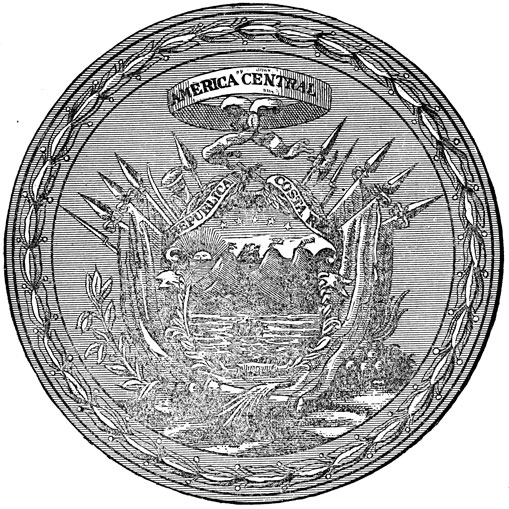
Arms of Costa Rica.
Costa Rica was the first state of Central America to be recognized as an independent nation by Spain, which was done in the treaty of May 10, 1850, which was ratified by Costa Rica March 6, 1851. The republic made a concordat with the Roman pontiff, for the understanding of ecclesiastical affairs, on the 7th of October, 1852. She has endeavored to maintain cordial relations with the powers of Europe and America. To that end she concluded treaties with the United States of America, the Hanseatic Towns, France,[XI-64] Great Britain, Belgium, Holland, Italy, Germany, and several of the Spanish-American republics. With Guatemala a treaty was entered into in February 1850, and the government awaited the result of the efforts of the other three states to constitute themselves under one nationality; and when they failed, and the states assumed the rôle of independent republics, it made similar diplomatic arrangements with them as foreign nations.[XI-65]
THE BOUNDARY QUESTION.
The boundaries of Costa Rica with Nicaragua on one side, and with Panamá, one of the states of Colombia, on the other, have been a source of constant anxiety, repeatedly occupying the minds of the diplomates of the three countries. Fortunately, the points in dispute have been peaceably discussed by the governments, though the press and politicians have not always touched upon them with the same spirit. The district of Nicoya or Guanacaste, at one time under the government of Nicaragua, became annexed to Costa Rica in 1824. This annexation was accepted by the Costa Rican assembly, and the federal congress allowed it, in a decree of December 9, 1825, as a provisional arrangement, to be in force till an opportunity was had to run the boundary between the two states. This congress took no further action in the premises; and since the dissolution of the Central American union, the district remained attached to Costa Rica. Nicaragua never assented to the segregation, though she made no attempt to recover the territory by force of arms. She has, however, endeavored to sustain her right to it in repeated diplomatic negotiations.[XI-66] The time came when Nicaragua, being invaded by William Walker's filibusters, and the independence of all Central America threatened, the citizens of the five republics at once saw the necessity of having the question amicably settled.[XI-67] The other republics, more particularly Salvador, brought their influence to bear, and a treaty was concluded, duly ratified, exchanged, and published as the law, to govern the boundary between Nicaragua and Costa Rica.[XI-68] Under its second article, both contracting parties ceded a portion of their claims, Costa Rican territory not reaching the lake, nor the Flor River, but merely the centre of Salinas Bay. On the other hand, Nicaragua no longer claimed territory to the Salto or Alvarado River, but limited it to the aforesaid bay, and to the line prescribed in the treaty.[XI-69] The acts of several congresses of Nicaragua in after years indicated that the treaty was recognized beyond cavil or dispute. Not a word was officially uttered by Nicaragua in seven years against its validity. After such a period had elapsed, Tomás Ayon, her minister of foreign affairs, in a report to the national congress, disputed its validity, and the boundary question was reopened,[XI-70] giving rise to grave diplomatic discussions, and no little ill feeling between the citizens of both countries from 1868 to 1883.[XI-71] At last, early in 1883, a treaty was signed in Granada by plenipotentiaries of both countries to bring the dispute to an end.[XI-72] President Cárdenas, in laying the treaty before the Nicaraguan congress early in 1885, urged its favorable consideration; but no action was taken.
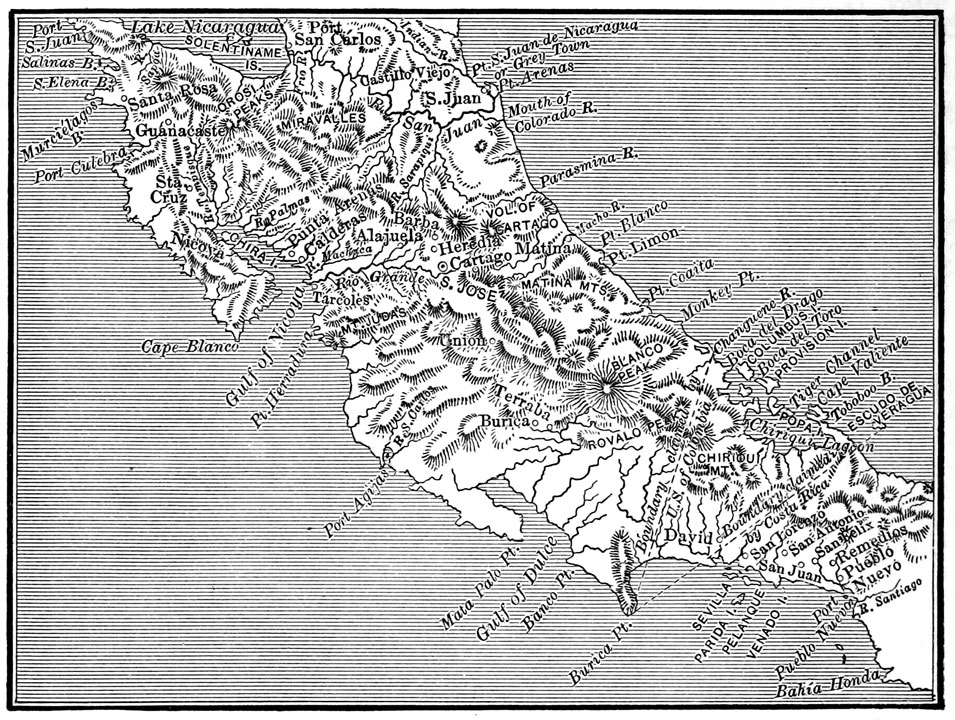
Costa Rica.
DIVERS TREATIES.
DISPUTED TERRITORY.
Under the Gual-Molina treaty, concluded at Bogotá, March 15, 1825, the Provincias Unidas del Centro de América and the Republic of Colombia agreed to respect the boundaries then existing between them, and to enter at an early convenient opportunity into a special convention directed to fix the dividing line.[XI-73] The antecedents of the subject will be found in a note at foot.[XI-74] All subsequent royal provisions, down to 1803, tend to confirm the limits of Costa Rica that were fixed for Cherino on the Atlantic side. But on the 20th of November, 1803, a royal order placed the island of San Andrés, and the coast of Mosquito from Cape Gracias á Dios to the River Chagres, under the supervision of the viceroy at Bogotá. Nueva Granada, now República de Colombia, has maintained that this royal order made a new territorial division between the capitanía general of Guatemala and the vireinato of Nueva Granada; and to the latter belongs all the territory alluded to in the royal order, and that said territory was recognized as hers by the Gual-Molina treaty. On behalf of Costa Rica, it has been alleged that the Spanish crown never made a territorial division with a mere royal order. The division of provinces, vice-royalties, and captain-generalcies was effected under a pragmatic sanction, a royal decree, or a royal cédula. The royal order aforesaid made no division of territory, but merely placed San Andrés and the Mosquito Coast under the care of the viceroy at Bogotá because Spain at that time had military and naval resources at Cartagena. Nevertheless the order had no effect; it became a dead letter, the viceroy never having protected that coast. Such was the impression of the Central American negotiator of the treaty of 1825.[XI-75] With this same understanding the federal government of Central America made a contract in 1836 to settle an Irish colony in the region of Boca del Toro,[XI-76] which was not carried out because the New Granadan authorities drove away the settlers, and have ever since held control of the region, disregarding Costa Rica's claims.[XI-77]
Several diplomatic efforts were fruitlessly made to fix the boundary.[XI-78] The last one was made at San José on the 25th of December, 1880, in the form of a convention to refer the settlement of the question at issue to the arbitration of a friendly power, namely, the king of the Belgians or the king of Spain, and in the event that neither of them could or would undertake it, then the president of the Argentine confederation.[XI-79] It is understood that the matter was finally submitted to the king of Spain, and that the resolution was long pending.
PRESIDENT MORA.
Political disturbances continuing in 1849, Castro resigned the presidency on the 16th of November,[XI-80] before congress, which had met in extra session October 2d; his resignation was accepted,[XI-81] and the same day Juan Rafael Mora was chosen vice-president, and on the 24th president of the republic, being inducted into office on the 26th of November.[XI-82] One of his first acts was to grant an amnesty for political offences. The bonds of discipline and subordination having become relaxed, Mora had before him a difficult task to restore peace and order.[XI-83] He dealt severely with the authors of revolutionary movements. Castro became a fugitive, and the others were exiled. For his efforts to restore order, congress, on the 25th of June, 1850, granted him the title of benemérito de la patria.
The president's policy was one of repression by all means; but finding himself opposed in the chamber, he resigned the executive office, and his resignation not being accepted, took upon himself to dismiss the congress, calling on the people to choose new representatives.[XI-84]
The continued revolutionary attempts placed the government in a difficult position, and prompted the president to adopt severe measures; hence the orders of exile issued against prominent citizens.[XI-85]