Volume 3 — CHAPTER IX. SALVADOR, NICARAGUA, AND COSTA RICA. 1824-1840.
Reading edition
Salvador State Government—Liberals Overthrown—Secession from the Union—San Salvador as the Federal Seat of Government—Guatemala Imposes her Will—Jefe Cañas and Comandante Malespin—Nicaragua's Early Troubles—Siege and Bombardment of Leon—Organization of State Government—Dissensions and Warfare—Eruption of Cosigüina—Secession from the Confederation—Costa Rica as a Confederated State—Juan Mora's Administration—Towns' Bickerings Settled—Braulio Carrillo's Rule—Final Secession from the Central American Republic—Prosperity of the State.
Salvador, from the earliest days that utterance was given to the idea of liberty and independence from Spain, was ready to echo and champion it, and was the first to effect an organization for self-government.[IX-1] The state was divided into four departments, San Salvador, San Vicente, San Miguel, and Sonsonate.[IX-2] Under the direction of the constituent assembly a state government was organized, with Juan Vicente Villacorta as jefe,[IX-3] and Mariano Prado as vice-jefe. After installing a superior court, the constituent assembly adjourned sine die on the 23d of November, 1824.
For a long time past there had been differences between Guatemala and Salvador upon ecclesiastical matters. The latter not only claimed an authoritative voice in the political affairs of Central America, but also to be placed upon an independent footing as regarded the ecclesiastical. Hence the anxiety to have a bishopric erected at San Salvador. This matter assumed a threatening aspect, and engaged the attention of ecclesiastics and statesmen, as well as the public at large in both sections of the country. The details will be given in a separate chapter treating of the church in Central America. It is in order to state here, however, that the disputes about the diocese of San Salvador had a deep influence in the country's politics. The contending parties had taken up the question. The liberals in both states sided with José Matías Delgado, who had been appointed by the Salvador legislature the first bishop. The servile element, on the other hand, supported the archbishop of Guatemala. But after a time Delgado, who was not unmindful of his purposes, supported President Arce, thus forsaking his former friends, and joining the servile party. A marked change occurred soon after, however, the relations between Arce and Delgado becoming cold because the latter suspected that Arce really sympathized with the archbishop. The liberals failed not to strengthen that suspicion, nor to fan the flame.[IX-4]
Jefe Villacorta, owing to impaired health, surrendered the government to the vice-jefe, Mariano Prado,[IX-5] whose first act was one of opposition to the national government, by repealing Arce's convocation of October 10th for a new congress, and issuing one of his own, on December 6, 1826, appointing Ahuachapan, in Salvador, as the place of assemblage. Prado now began the military preparations which were followed by a war between Salvador and the federal government, and which terminated with the overthrow of the servile party by Morazan.
RULE OF CORNEJO AND PRADO.
A liberal policy was for a short time pursued in Salvador under the rule of José M. Cornejo, who had become the jefe in January 1829,[IX-6] and peace reigned during the next three years. But in 1832 it was again disturbed. The government of the state, becoming dissatisfied with its former hero, Morazan, attempted to secede from the union, but was brought under subjection.[IX-7] Cornejo was deposed, and, together with those who aided him in the rebellion, was sent to Guatemala as a prisoner, to be dealt with according to law.[IX-8] Elections for authorities were then held, and Mariano Prado was chosen jefe,[IX-9] and Joaquin San Martin y Ulloa vice-jefe. A period of liberalism now commenced, like that of Guatemala in 1829. Several liberal measures were adopted, one of which was the establishment—decreed August 21, 1832—of a single, very moderate, direct tax.[IX-10] This enactment, intended to relieve the exhausted treasury, met with violent opposition in San Salvador, and sedition broke out on the 24th in several wards; but the rioters were dispersed. Prado issued a proclamation expressing his resolution to uphold the law and maintain order; but as the excitement continued, he ordered that the supreme authorities should transfer themselves to the villa de Cojetepeque on the 31st.[IX-11] On the 14th of November there was also a seditious movement in San Miguel, which was quelled by Colonel Benitez.
The vice-jefe, San Martin, was in accord with the revolutionists, and kept up a correspondence with Galvez in Guatemala, who wanted Prado overthrown. This was known in San Salvador, and gave encouragement to the remnants of Cornejo's party. The removal of the capital was not sufficient. Another revolt broke out at San Salvador early in 1833, and Prado, together with the members of the co-legislative bodies and of the superior court, had to abandon their places. On the 13th of February the state followed the example of Nicaragua and seceded from the union. The vice-jefe, San Martin, who had gone into hiding on the 9th of February to save himself from harm, was called by the revolutionists to assume the executive authority.[IX-12] In July a revolt broke out among the Indians of Santiago Nonualco. Headed by Anastasio Aquino, they formed the plan of exterminating the white and colored population, and installing a government of natives.[IX-13] The utmost cruelties characterized this war of races, which was fortunately soon suppressed. Most of the ringleaders, among them Aquino, were captured. The chief was executed on the 24th of July, 1833, at San Vicente.[IX-14] But peace did not follow the suppression of this rebellion. Salvador, always jealous of Guatemala, insisted on having the federal government removed from her rival's territory. At last, in February 1834, the federal authorities came to reside in Sonsonate, and later, in June, at San Salvador. It was a great mistake to expect harmony. Before the month was out there was a street fight of several hours between troops of the two powers. The federals were victorious, and the state's jefe, San Martin, was deposed.[IX-15] The executive authority was assumed first by Cárlos Salazar, commander of the federal forces, and afterward by Gregorio Salazar, the vice-president of the republic. Neither of them had a legal title.[IX-16] From this time the state remained wholly under the control of the federal government and the liberal party, which became still more cemented when in 1835 the capital was made the federal district. In the great struggle between Morazan and Carrera, of which a detailed account has been given in a former chapter, Salvador had to rely entirely on her own resources when her territory was invaded in 1838 and 1839.
MORE TROUBLE AT SAN SALVADOR.
After Morazan's signal defeat at Guatemala, Salvador no longer was disposed to make sacrifices; indeed, she was too exhausted to raise a new army. However, she was by no means willing to uphold the victorious Carrera; but being unable to resist, had for a while to submit to the force of circumstances, and to recognize the government placed over her.[IX-17] But as soon as Carrera went back to Guatemala, that government was overthrown by the people, and the jefe, José Antonio Cañas, had to resign,[IX-18] Norberto Ramirez becoming the jefe provisional.[IX-19] More than any other of the Central American states, Salvador needed a period of peace to recover from the wounds inflicted in nearly twenty years of warfare. She had upheld the principles of liberty and union long after the others had given them up, and now required a prudent and wise government to restore her almost extinct life and strength.
While the other provinces experienced but few difficulties in organizing themselves after the separation from Spain and Mexico, Nicaragua suffered for years from intestine strife. This was not exactly a contest between two political parties, but rather between towns, and between the partisans of one leader and another; in other words, the results partly of sectional hatred, and partly of personal ambition. Persecutions for political causes were of daily occurrence.[IX-20] A junta gubernativa, recognized by the general government, had been installed at Leon,[IX-21] where Basilio Carrillo was the commander of the forces, and claimed the right to rule the province; but there was another junta at Granada, where the notorious Cleto Ordoñez held sway in accord with the jefe político, Juan Argüello, which, of course, ignored the pretensions of the Leonese authorities. Managua, though siding with Leon, had become the headquarters of the anti-republicans, with Bishop García at their head, who strove to rid the place from Leonese influence. Most of the other towns were in a similar condition; so that it may be asserted that the whole province was in a state of anarchy. The junta gubernativa of Leon accepted, on the 2d of July, 1823, the decree of the national government of March 29th, calling for a national congress, and declared Nicaragua united with the other provinces that had formerly been the reino de Guatemala.
NICARAGUAN COMPLICATIONS.
On the 13th of January, 1824, a popular uprising in Leon caused the junta gubernativa to remove Basilio Carrillo from his command, replacing him with the jefe político, Cármen Salazar.[IX-22] Early in the same year Justo Milla came with the appointment of intendente from the general government, and with instructions to pacify the country; but his mission failed.[IX-23] On the 22d of July Ordoñez had himself proclaimed comandante general by the garrison and populace. Some of the wards of Leon attempted, on the 6th of August, to overthrow Ordoñez and restore Melendez, the successor of Milla; but they were overpowered, and the city was sacked.[IX-24] On the 14th the forces of Managua, under Colonel Crisanto Sacasa, captured portions of the city of Granada. After twenty days of incessant fighting the besiegers retired in good order. On the other hand, a division of Leonese and Granadans attacked Managua on the 24th of August, with the same result.
A junta gubernativa had been installed on the 9th of the month at El Viejo, in opposition to that of the capital,[IX-25] and organized a force of 2,000 men, intended to lay siege to Leon. The united forces of El Viejo and Managua, commanded by Sacasa and the Colombian Juan José Salas, assaulted Leon, captured the suburbs, and penetrated to the plazuela de San Juan. The garrison, composed of Leonese and some Granadans, now found itself confined to the chief plaza and contiguous blocks. During the siege, which lasted 114 days, there was incessant fighting, both besiegers and besieged exhibiting bitter animosity. Sacasa was mortally wounded, and died twelve days after. The fighting often took place inside of the houses, and even of the churches. Upwards of 900 houses were either demolished or burned, and the number of dead and wounded on both sides was large, probably over 900 killed. The contest ceased only on the 4th of January, 1825, when the besieging forces retired.[IX-26]
The villa de Managua laid down its arms on the 22d of January, 1825, peaceably receiving Manuel José Arce, who had entered Nicaragua with an auxiliary force from Salvador, and with instructions to pacify the state. In consequence of his arrival, the dissensions were quieted for a time.[IX-27] Arce, without bloodshed, also disarmed the troops of Ordoñez at Granada, and despatched him, together with Bishop García, to Guatemala. After having made arrangements for elections, the peace-maker returned to Salvador, leaving, however, a portion of the force at Leon.
RULE OF ARGÜELLO.
On the 10th of April, 1825, preliminary arrangements being completed, the first constituent assembly of Nicaragua met under the presidency of Juan Manuel Zamora, and ten days later Manuel Antonio de la Cerda was installed as jefe of the state,[IX-28] and Juan Argüello as vice-jefe. Unfortunately there were disagreements on the part of Cerda with both the constituent assembly and Argüello, which delayed the labors on the state constitution, so that it was not decreed till the 8th of April, 1826.[IX-29]
The convention then adjourned sine die, and the regular or ordinary assembly met on the 13th of August, at Leon, but in the middle of the following month removed to Granada.[IX-30] Meantime the dissatisfaction with Jefe Cerda had assumed such proportions that the legislative body resolved to impeach him. He was, accordingly, suspended, and Argüello placed temporarily in charge of the executive authority. New elections were also decreed.[IX-31] But Argüello had not fostered all these troubles merely to surrender the government to a new man, and by intrigues contrived to bring about, in February 1827, the dissolution of the assembly.[IX-32]
The indefatigable Colonel Cleto Ordoñez made, with the aid of troops of Leon and Senator Hernandez, an unsuccessful attempt[IX-33] to seize the government, declaring Argüello suspended. An effort was also made by the president on behalf of Cerda, but it was defeated by Herrera, the jefe of Honduras. The state of war continued; Arce reluctantly had removed, at Argüello's request, the few men of Salvador that had been stationed in Nicaragua since 1825,[IX-34] and thus the only adversary of importance Argüello had was Cerda. The contest remained for a long time undecided. Argüello took Granada, while Cerda's headquarters were first at Managua, and, when that place seceded, at Rivas, the ancient town of Nicaragua.
In September 1828, Cerda's party had made so much headway that Argüello and his followers had vessels in readiness to effect their escape should the jefe gain another victory. But the priests, who worked against the latter, inspired the disheartened Argüellistas with renewed courage, and in another encounter they were victorious. Cerda's star now waned. A revolt planned by two of his officers was quelled, and the leaders were shot.[IX-35] This severity, and the heavy taxes he levied, increased his foes.[IX-36] At last, on the 8th of November, 1828, when Rivas was almost without troops, one of his officers, who was a relative, named Francisco Argüello, made him a prisoner, and before his troops could come from Jinotepe to his rescue, a force of the vice-jefe entered Rivas. A military court was at once organized, and Cerda, being subjected to its action,[IX-37] was sentenced to death, and executed.[IX-38]
HERRERA'S RULE.
Argüello was now free from his strongest adversary; but the struggle went on as new pretenders sprang up, and its effects in the course of time were most disastrous. It brought the state to a condition of desolation unequalled in Central America. Dionisio Herrera, chief of Honduras, undertook, under instructions of the federal government, in 1829, the task of pacifying Nicaragua. He visited Leon, and succeeded in conciliating parties and restoring order; and when new elections took place in May 1830 he was himself chosen its jefe.[IX-39] Managua, the last place to hold out, was finally, without the use of force, prevailed upon to recognize the newly constituted authorities, and in June was already enjoying the benefits of peace. In order to consolidate the peace throughout the state, Herrera made the leaders of parties leave its territory. His rule was a quiet one for the next two years, and until Nicaragua was called upon by the national government to furnish her contingent of troops to suppress revolutionary movements beyond her boundary.[IX-40]
The revolutionary spirit showed itself again in 1832. On December 3, 1832, the state assembly attached the federal revenue, and refused further recognition of the general government. A few months later a revolt broke out against Herrera. The movement originated in Managua, and was seconded in Masaya and Matagalpa. Granada and Leon opposed it. Jefe Herrera at first was loath to resist it, and laid his resignation before the legislature, and it was accepted on the 1st of March, 1833. But that body, under popular pressure, four days after revoked the resolution, and recalled Herrera to hold the executive authority, with the extraordinary powers that had been decreed him on the 8th of February previous.[IX-41]
The insurrection had spread also in Metapa, Chocoyos, Nandaime, San Jorge, and throughout the department of Nicaragua. At the head of the movement was an ecclesiastic. Herrera exhausted all peaceful means, and had to employ force, and Managua was taken on the 29th of June, 1833.[IX-42] Nicaragua and other places accepted the amnesty tendered them.[IX-43] But it seemed almost impossible to maintain peace for any length of time. In May 1834 Granada and Metapa rebelled, under one Cándido Flores. The rebels were successful for several months, and took possession of Managua. But on the 13th of August they were defeated; a few days later Granada was recovered, and four of the ringleaders were shot.
A GREAT EARTHQUAKE.
In the morning of the 20th of January, 1835, there was an eruption of the volcano Cosigüina,[IX-44] attended by one of the most terrific earthquakes ever experienced in Central America.[IX-45] The event was a memorable one for the Nicaraguans, and its abatement was attributed to the efficacious intercession of their saints; and in commemoration of it they still have a feast of thanksgiving every year on the 23d of January.[IX-46]
A short period of peace followed. Puny are the efforts of man at killing each other when heaven fires its artillery! The exhausted state seemed unable to continue its suicidal course. The tranquillity was broken, however, though only for a short time, in 1837.[IX-47] The assembly had, on the 21st of February, 1835, recognized José Zepeda and José Nuñez as the duly elected jefe and vice-jefe respectively. Colonel Zepeda was a distinguished patriot, who had rendered important services to the cause of liberty. His election was hailed with approval in Nicaragua, and in the other states of the union. He took possession of office April 23, 1835.[IX-48] The government experienced no serious difficulty during 1836 in the administration of public affairs. It was engaged in improving the public roads, and in other matters of general utility. But 1837 was inaugurated with infamous crimes, with the murders of the jefe Zepeda, and of the citizens Roman Valladares, Evaristo Berríos, and Pascual Rivas, which resulted from a revolt of the garrison at Leon.[IX-49] The movement was promptly suppressed, and the ringleader, Braulio Mendiola, executed. The vice-jefe, Nuñez, assumed rulership, and during his administration a second constituent assembly was convened, and commenced its labors on the 31st of March, 1838.[IX-50] One month later, on the 30th of April, the state seceded from the federation, an act which may be called a mere formality, inasmuch as Nicaragua had not taken part, to any notable degree, in the affairs of the general government. Nominally, however, the idea of a union of the Central American states was upheld, and still expressed in the new state constitution framed by the assembly and confirmed on the 12th of November, 1838.[IX-51] All this was pure affectation, however, for Nicaragua lent her hearty aid to eradicate the last remnants of the federation. The coveted sovereignty was attained at last. Later events will show whether or not it brought Nicaragua prosperity. The present generation had grown up midst the noise of war, hearing the battle-cry of one or another contending party, and it could hardly be expected that it could appreciate the blessings of peace.[IX-52]
EVENTS IN COSTA RICA.
Costa Rica, owing to her geographical position, was almost isolated, politically, from the rest of Central America. It would be wrong, however, to infer that her participation in the general affairs of the republic had been one of mere formality or policy for her own convenience or safety. Nowhere had the idea of a union been more warmly embraced. Four months only had elapsed after the bases for the organization of the state had been adopted by the national constituent convention, when Costa Rica's first assembly met,[IX-53] and on the 21st of January, 1825, decreed a state constitution.[IX-54] In the middle of April the first ordinary legislature began its labors, and on the 24th of September Juan Mora was installed as chief of the state.[IX-55] This was a happy choice; for during his rule Costa Rica escaped the evils which protracted warfare wrought in the other states of the union. Following the example of Salvador, a decree was passed in September creating a bishopric independent from Nicaragua, and appointing Fray Luis García the first bishop; but the decree became a dead letter.
The first effect of Mora's quiet rule was the enlargement of Costa Rican territory. Dissatisfied with the jefe, Cerda of Nicaragua, the district of Guanacaste, or Nicoya, which formerly belonged to that state, declared its separation, and asked to be incorporated with Costa Rica.[IX-56] The arrangement was approved by the federal congress on December 9th, and since then Nicoya formed one of the five departments of that state.[IX-57] Nicaragua protested; Costa Rica refused to restore the territory, and the matter remained an open subject of discussion, but never leading to hostilities.[IX-58]
Early in 1826 an attempt was made[IX-59] by a Spaniard named José Zamora, at Alajuela, to overthrow the government. He attacked the quarters of the garrison, but after several hours' fighting was repulsed, with most of his followers slain, wounded, or made prisoners. A few days afterward he was captured and shot.[IX-60] During several years this was the only public disturbance. The struggle between serviles and liberals in the other states did not affect Costa Rica, which prudently maintained neutrality. She endeavored, however, to bring on peace between the belligerents, by accrediting, in 1828, Manuel Aguilar as special envoy to Guatemala and Salvador; but his mission proved fruitless, chiefly owing to the success of the Salvador arms, and the irreconcilable feeling thereby engendered.[IX-61] It was the unsatisfactory result of this effort, which in a great measure prompted Costa Rica, after Mora's reëlection in 1829, to secede from the union till the federal authority should be reorganized. When this took place, the secession act was revoked in January 1831.
In March 1833 the second term of office of Mora expired; and in acknowledgment of his beneficent and wise policy, the assembly decreed that his portrait should be placed in the hall of sessions, with a highly complimentary inscription.[IX-62] Costa Rica had made great progress from both the material and intellectual points of view. A number of clergymen endeavored to introduce a decree of the ecclesiastical authorities of Guatemala to burn certain so-called forbidden books. They failed, the result being the importation of a large number of the denounced works. Jefe Mora treated the pious proposal with the contempt it deserved.[IX-63]
RULE OF GALLEGOS AND CARRILLO.
Mora's successor duly elected was José Rafael Gallegos, who assumed his duties in April 1833.[IX-64] The state at this time was enjoying liberty, and perfect freedom of the press.[IX-65] It was the asylum of the exiles from other Central and South American states. It was not, however, altogether exempt from the spirit of localism. Cartago had been the capital, and wanted to recover that position. San José felt as a loss the absence of the supreme authorities. Heredia and Alajuela would not be less than the other two places. Guanacaste was the only one out of the question. Hence the resolution adopted[IX-66] that the state capital should alternately be at San José, Cartago, Heredia, and Alajuela. A later law, of June 9th, prescribed that the residence of the supreme authorities at each of said places should be for the period of four years. Gallegos' rule was of short duration. He resigned in March 1834.[IX-67]
Braulio Carrillo was elected jefe, and went into office in April 1835.[IX-68] In his time several liberal innovations were made, in addition to those introduced some time previously; namely, suppression of tithes and decrease of holidays;[IX-69] those enactments aroused the clergy, and prompted them to fan, in retaliation, the flame of discord existing between San José and Cartago, which culminated in an open revolt on the 24th of September, 1835.
An alliance was entered into by Cartago with Alajuela and Heredia, to refuse recognition to the government, and to convoke a new assembly with equal representative rights for the different towns.[IX-70] The allied forces marched upon San José, then the seat of government; but were defeated in several encounters, and they again submitted.[IX-71] The result of this revolt was the further strengthening of San José, to which place was conveyed all the armament of the state. The government was equally successful in the following year, when an armed force from Nicaragua, led by the Costa Rican Manuel Quijano, formerly in his country's military service, Pedro Abellan, and Manuel Dengo, entered the department of Guanacaste, and marched upon its chief town, where they expected to find support; but they only met with disappointment. They were first repulsed by the inhabitants, and afterward routed by the troops.[IX-72]
REVOLT IN COSTA RICA.
The peace thus restored was not of long duration. Braulio Carrillo was succeeded as jefe of the state[IX-73] by Manuel Aguilar, in April 1837. A plot intended to overthrow the government was soon after detected, and the authors were sent into exile.[IX-74] But Carrillo had also been disappointed at Aguilar's election, and being influential with the soldiery, he had but little difficulty in getting together a party with which, on the 27th of May, 1838, he deposed this official, sending him, together with the vice-jefe, Juan Mora, into banishment.[IX-75] This was the first instance in Costa Rica when the legitimate government of the state was overthrown by force of arms. It cannot be said that the change was altogether for the worse. Under Carrillo's active and energetic rule the country made rapid progress in a material point of view.[IX-76] He saw at once the hopelessness of reëstablishing the Central American confederation,[IX-77] or of reorganizing it so as to render it beneficent to the several states; and therefore, instead of making fruitless efforts in that direction, strove rather to isolate Costa Rica. This policy he impressed on the second constituent convention, which met on the 1st of November, 1838,[IX-78] and on the 15th the formal separation was declared, the convention still manifesting a willingness to maintain a sort of union by means of special treaties.[IX-79]
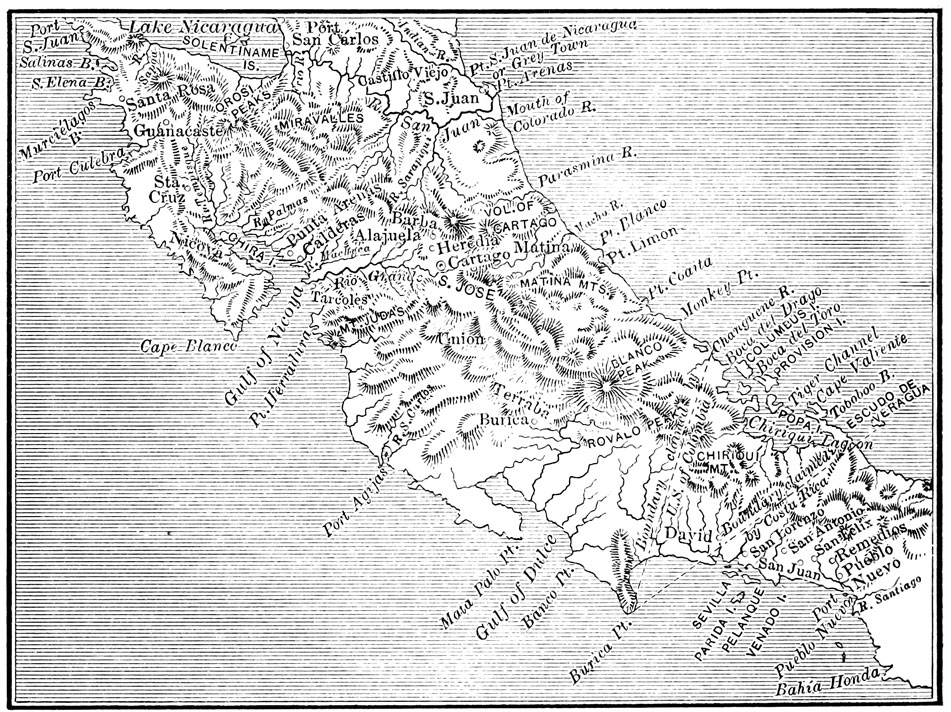
Costa Rica.
He also took effective steps to pay off Costa Rica's share of the foreign debt, contracted by the Central American republic. The state was for a long time exempted from the afflictions and consequent injurious results which visited the other states during the bitter last struggle in 1840 between Morazan and Carrera for the existence of the republic. The other states were impoverished and brought to the verge of ruin, whereas Costa Rica, with comparative tranquillity, was constantly marching forward.
COAT OF ARMS AND FLAG.