Unforgotten Women
Reading edition
Some of Many Who Left a Record of Brilliancy, Service or Sacrifice.
The stars that shine in the galaxy of the heavens do not all glow with the same lustre. One is gifted with a steady and dependable splendor, another scintillates and fades to shine afresh. So, it is, that the women of Fredericksburg have in their individual ways added to the glories of the town and well sustained its deserved reputation, as being the home of capable, brilliant, and beautiful women. A distinguished French officer once said, after meeting one of the women of Fredericksburg, “If such are the matrons of America, well may she boast of illustrious sons.” This was at the great Peace Ball, given in the town in 1783, to which, of course, the mother of Washington was especially invited. The simple manner and appearance of the great woman, surprised the gallant officers present, and provoked from one of them the remark.
Clad in a plain but becoming garb, that characterized Virginia women of her type, she received the many attentions paid to the Mother of the idolized Commander-in-Chief with the most unaffected dignity and courtesy. Being accustomed to the pomp and splendor which is attached to Old World royalty, it was a revelation to them to behold such a woman. How could she live in the blaze of glory which irradiated her illustrious offspring, and still preserve her simple dignity of manner, so barren of self pride and hauteur!
The “Rose of Epping Forest”
But this daughter of Colonel Joseph Ball, of Lancaster County, this “Rose of Epping Forest” which budded into existence on March 6, 1708, this unassuming woman, who on the anniversary of her natal day in 1730, gave her heart and hand to the master of Wakefield, this thrifty and systematic young housewife and widowed mother at Pine Grove, in Stafford County, this matron of Fredericksburg, possessed qualities individual to her who became the author of the being of the greatest and best loved character figuring on the pages of American history. Her last home selected for her by General Washington, stands today, on the corner of Charles and Lewis Streets, the same home with the characteristic simplicity of years ago. The Association for the Preservation of Virginia Antiquities, to which Society it now belongs, has restored in part the interior with its wainscoting and paneling and its period furniture. The interesting old brick floored kitchen, with its huge fireplace, and its crane, iron pots, skillets and equipment of former days, all seem today in perfect accord with her reception of her cherished offspring in 1783. After an enforced cessation of visits to his aging mother for a long period of seven years, she at length was told by an orderly that “His Excellency” had arrived, and was at her very door. Turning quietly to her faithful, ebony maid, she said with her habitual self control, “Patsy, George has come, I shall need a white apron.” But beneath this calm exterior, her embrace of her first born son was overflowing with fervent mother-love, and hidden away in the deep recesses of her heart was the swelling pride in his glory. Senator Daniel truthfully said, “The principles which he applied to a nation were those simple and elementary truths which she first imprinted upon his mind in the discipline of home.”
The splendid granite monument, erected to her, with its simple inscription, “Mary, the Mother of Washington,” and on the reverse side: “Erected by her Countrywomen,” rises from a massive foundation to a distance of 59 feet. Her ashes lie beneath, in a spot of her own selection, (which in her lifetime was a part of the Kenmore estate) and her favorite resting place. Nearby are the two rocks upon which she used to sit and read her Bible. These are known as “Meditation Rocks.”
Susan Savage and Anne Maury
The name of Susan Metcalf Savage will always be held in the highest veneration by those of Fredericksburg who realize and appreciate the many sacrifices, heart-aches, self-denials and home-longings experienced by those who give their lives in heathen lands. Brought up in an atmosphere of love and unselfishness, and herself devoted to every call of duty, it was no surprise to her many friends to learn that soon after her marriage to Reverend Dr. Savage in 1838 she would sail with him for tropical Africa, one of the first woman missionaries from our land. Though her life in this then unusual field of usefulness was less than two short years, her labors were not in vain, and her works and her example will live for years to come.
Ann Herndon, who became the wife of the great scientist, Matthew Fontaine Maury, was born in the house on the corner of Princess Anne and George Streets, erected by her father, Dabney M. Herndon. Her loveliness of face and character was equalled by her charming manner, and attractive personality, and whether in Fredericksburg, or Lexington, Va., whether in Washington or London, her home was the spot where the savant, the scientist, the literati and men and women representing every phase of culture and social distinction, were wont to assemble. The beautiful jewels presented to her by the crowned heads of Europe, (her illustrious husband, being an officer in the United States Navy, was restricted from accepting gifts, else his admirers would have showered them upon him), were deservedly famous. After the death of Commodore Maury a plan was conceived by a member of one of the royal courts of Europe, and initiatory steps had already been taken, to raise a munificent sum of mony with which to honor the widow of the man to whom all educated nations were to pay homage. But when their project reached her ear, she refused to accept it, though recognizing and appreciating fully the compliment to her devoted husband.
President Arthur’s Wife
One of the captivating belles of the town was Ellen Lewis Herndon, daughter of the Naval Commander, Captain William Lewis Herndon, who in 1857 met his death in the Gulf Stream. Being possessed of a rich contralto voice, Miss Herndon made frequent visits to the National Capitol, and delighted the congregations at old St. John’s Church with her sweet, rich tones. It was here that the young attorney, Chester A. Arthur, afterwards President, became infatuated with the pretty young singer. Those old days were the parents of these days, and many were the whispers of conjecture and surmise as to the outcome of those frequent visits of the handsome Mr. Arthur to the home of Ellen Herndon, (that still strikingly pretty residence on Main and Charlotte Streets), and shortly before the War between the States, a pretty wedding was solemnized in New York City, and Ellen Herndon became the bride of Chester A. Arthur.
In the heart-rending times of 1861-’65, the women of Fredericksburg with untiring energy and courage, in the midst of the agony of war, assumed the laborious task of ministering alike to soldiers in blue and gray, and many burdens of sorrow were in some way lightened and many a physical pain lessened or a soul cheered. Perhaps the women of Fredericksburg were inspired to great deeds by the example of that splendid specimen of womanhood, Clara Barton, who for sometime was stationed near Chatham, carrying on her splendid ministration to the sick and suffering Federal soldiers.
Of Woman’s Work
It was on May 10, 1866, that the women of Fredericksburg, urged by Mrs. Frances Seymour White, (widow of an officer in the U. S. Army, who died as the war began), assembled in the lecture room of St. George’s Church to form an association to care for the memory of the noble Southern heroes, whose graves were then scattered over battlefield and farm. This was the first step towards the formation of the Ladies Memorial Association the work of which organization, begun so earnestly and lovingly, has so successfully been fulfilled. Mrs. John H. Wallace, was elected President and Mrs. Frances Seymour White, Vice-President. On Mrs. Wallace’s death, Mrs. White was chosen President, and continued until 1882, when she was succeeded by her daughter, Mrs. Francis B. Goolrick, who continued to act as President for eleven years. Mrs. Maria K. Daniel followed next for seventeen years, and Mrs. Frances B. Goolrick, who was elected in 1912 is still President.
With the financial assistance of about all the Southern States and a good deal from the North the bodies of the Confederate soldiers have been re-interred in the Confederate cemetery, and each is marked with a solid granite headstone. Later with some financial assistance the splendid monument “To the Confederate Dead,” was erected in the center of the cemetery. The base is of gray granite, quarried in Spotsylvania County, and the life-like statue of the Confederate soldier on dress parade, which surmounts the apex, is of bronze.
The Memorial Association
The beautiful custom of Memorial Day sprang from Mrs. Frances Seymour White’s idea and spread from this city all over the nation. The name of “The Ladies Memorial Association” was adopted and in the Spring season each year, this impressive service is continued. Following those true hearted women who conceived the task of rescuing from oblivion the memory of those brave and fallen heroes, the United Daughters of the Confederacy, and the women of Fredericksburg branch of the American Red Cross, have each in their respective spheres, earnestly and lovingly performed their tasks.
The recent passing from our midst of the material presence of a worthy representative of the women of Fredericksburg, inspired the glowing tribute to the women of Virginia, appearing as an editorial in a local paper. The writer says in part, “We shall ever cherish the recollection that old Virginia had a womanhood of whom the people of the nation must be proud. Lest we be misunderstood we would have it known that we boast today of our womanhood and are honored by those now among us; yet no one can successfully deny that the type of women of the Old Dominion of the bygone years was of an exceptional character. They were the result of the very environment in which they were born and reared. For purity of purpose, for modesty of demeanor and conversation, for unselfish devotion to home where there was real happiness, for gentleness, for refinement, for self abnegation, for love of God and the Church, for unostentatious charity, and for high motherhood, she has never had superiors. For all the essential attributes and elements which go to form a splendid woman without guile and without reproach, we hazard nothing in declaring that Virginia—in the World’s Hall of Fame—gives to her womanhood of olden days her laurel of immortal glory.”
Mary Washington Hospital
Another work which will always be a tribute to woman’s indefatigable and preserving efforts, is the Mary Washington Hospital, beautifully situated on the river’s bank immediately facing the lawns and Terraces of Chatham, and when the trees are bare in winter, affording a view of the imposing mansion. Here, since 1897, thousands of sick have been cared for and nursed back to health and strength with more scientific care and almost as much loving attention as they could receive in their own homes. In 1897 the corner-stone was laid and from that time the Hospital has steadily grown and progressed, gaining in strength and usefulness, and now is recognized as essential to the city and surrounding counties. The idea of establishing the Hospital was originated by two or three ladies and the work put actively in motion by Mrs. W. Seymour White and Mrs. M. F. Tankard, who constituted themselves a committee to form an auxiliary society, which supported by Mr. W. Seymour White, who was at that time Mayor of the City, obtained a sufficient sum to purchase a lot and build a small house of a few rooms. A Hospital Association was formed, and the women did almost phenomenal work in struggling through many discouragements, never losing faith, but pressing forward and overcoming every obstacle until their efforts were crowned with success and the Hospital established on a firm foundation. Now the few rooms have grown into a commodious building accommodating thirty or forty patients, a Nurses Home and corps of young women in training. Mrs. W. Seymour White became the first president—elected because of her interest in establishing it, and in recognition of the strong support given it by her husband as Mayor, who in that capacity was able to weild an influence that helped materially towards its success.
Mary Washington Monument
The Mary Washington Monument has a history too long to be embraced in this volume and only a brief sketch of it will be appropriate. “The Building of a Monument” was written by Miss Susan Riviere Hetzel, and published in 1903. She was at the time Secretary of the National Mary Washington Memorial Association, following her mother Mrs. Margaret Hetzel, its first Secretary.
The idea of erecting a new monument to Mary Washington seemed to spring up simultaneously in Fredericksburg and in Boston, and spread like wild-fire over the country. Miss Hetzel claims priority for her mother, while the actual first published movement took place in Fredericksburg. Two letters were written and published on the same date in the Washington Post. Both letters were written in the spring just at the time of the Johnstown flood, and held in the newspaper office, probably overlooked, until October. On October 13th the movement crystalized into a large meeting in Fredericksburg. The writers of the two letters became acquainted through a mutual interest. Mrs. Goolrick’s letter proposed a National Organization with a President and one Vice-President for each State. Mrs. Hetzel’s letter suggested that “every woman as far as able give one dollar to the proposed monument with the Washington Post as Treasurer for the fund, and to acknowledge daily the donations received.” On the appearance of the letters in the Washington Post Mrs. Hetzel wrote to Mrs. Goolrick, congratulating her on the plan she proposed, stating that such a plan was then practically in operation, and had been worked up during the summer, Mrs. Waite, wife of Chief Justice Waite, was made president, but they wished no publication or mention made of it until they obtained their Charter. On November 8th, 1889, the Fredericksburg Association received its Charter. The National Association was chartered February 22nd, 1890. On the 10th of May, 1894, the Mary Washington Monument was dedicated, with great form and ceremony and with the largest crowd ever gathered in Fredericksburg. Visitors flocked from all over the country. The streets were in gala attire. American, and Virginia State flags fluttered everywhere with the buff, blue and gold insignia of the Ball family, which floated before the homes of Mary Ball’s decendants. A special train from Washington arrived at ten o’clock bringing the President of the United States, Grover Cleveland, the Chief Justice, members of the Cabinet and other invited guests with the ladies of the National Mary Washington Memorial Association, the Daughters of the American Revolution, and the Marine Band. Military Companies from Richmond, Alexandria and other cities were present, and with the various orders of the city made an imposing spectacle. The Grand Lodge of Masons from this and other places closed the procession, with the Grand Master of the Grand Lodge of Virginia, and the Grand Secretary of the Grand Lodge of the District of Columbia following in its wake. On the immense rostrum near the Monument were seated all the officials, and Societies, with seats reserved for the descendants of Mary Ball who were specially invited by the National Association. They had been summoned from the East and from the West, one invitation going to Japan to Paymaster Mason Ball, U. S. N.
Dedication of Monument Lawrence Washington’s Talk
The ceremonies opened with a prayer by Rev. James Power Smith. Mayor Rowe next welcomed on the part of the city the President, Governor and other distinguished guests. He gave a brief account of the first monument and laying of the corner stone by President Andrew Jackson, with an eloquent tribute to the Mary Washington Association and “the noble women in various sections, some of whom grace this occasion by their presence today.” The President of the United States was welcomed by Governor Charles T. O’Ferrall on behalf of the Commonwealth of Virginia. An impressive address was then delivered by the President. The Monument was then dedicated by the Grand Master of Masons of Virginia—Mann Page and the Grand Lodge of Virginia, assisted by Fredericksburg Lodge No. 4 where Washington was made a Mason, and the Grand Lodge of Alexandria, of which he was the first Master. Mr. Lawrence Washington was introduced by the President as a lineal descendant of Mary, the Mother of Washington. He gave an interesting sketch of her life, home, parentage, widowhood and the character of her children. The President next introduced the orator of the day, Hon. John W. Daniel. He is said to have pronounced on this occasion the ablest oratorical effort of his life.
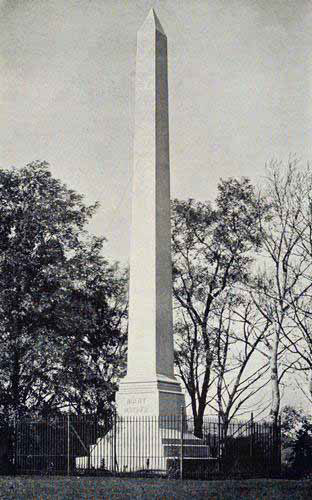
Mary Washington Monument Standing at the Spot that She Selected for Her Grave. The Only Monument Built By Women to a Woman
Governor O’Ferrall at the request of the Fredericksburg Mary Washington Monument Association read a set of engrossed resolutions which were presented to Mrs. Waite as President of the National Society. This concluded the ceremonies. President Cleveland after holding a general reception on the monument grounds was entertained at the home of Hon. W. Seymour White, editor of the Free Lance, and afterwards Mayor of the city. It was a brilliant gathering, Cabinet Officers and their wives, the Governor of Virginia and Staff, and distinguished citizens of the town and elsewhere to greet them. The ladies of the National Board were entertained at the home of Mrs. V. M. Fleming, president of the local association. President Cleveland repaired to the Mary Washington House where he requested he should receive all the descendants of the Balls and Washingtons. “There he had the satisfaction of grasping the hands and enjoying the conversation of the nearest living relatives of his first and greatest predecessor, in the home of his honored mother.”
A banquet was given by the citizens in the Opera House, and a large Ball that night in the same place. Thus closed a memorable day in the annals of Fredericksburg.
The land on which the monument is built, on the same site as that occupied by the first monument, was given by Mr. George Shepherd, a prominent and wealthy merchant, to the Fredericksburg Mary Washington Monument Association, and was transferred at the dedication of the monument by a conditional deed to the National Association.
Story of Older Monument
The first monument to the memory of Mary Washington was partly erected by Silas Burrows of New York, who as rumor has it, fell in love with one of the Gregory girls—great nieces of George Washington. It was of handsome design, but never finished, and the marble shaft lay prostrate for many years, cracked and discolored, while the base, with its beautiful four carved columns was a target for both armies during the Civil war.
The corner stone of this first monument was laid in 1833, with much pomp, the President of the United States—Gen. Andrew Jackson—taking part with Cabinet Officers and escorts. The people of Fredericksburg previous to Mr. Burrows’ offer, had made efforts to raise money for a memorial to Mary Washington. Hearing of this he wrote to the Mayor, offering to give and erect the monument himself. The monument had reached completion with the exception of placing the shaft, when Mr. Burrows went abroad and never reappeared, the same Madam Rumor attributing it to the disappointment he experienced at the failure to win the hand of Miss Gregory, the daughter of Mildred Washington, the niece of the immortal George.
The present monument is splendidly cared for by the National Association with the Secretary of the Association, a Fredericksburg lady in charge and living on the grounds in a beautiful cottage built by the National Mary Washington Monument Association.