At the Rising Sun
Reading edition
Where Famous Men Met; and Mine Host Brewed Punch and Sedition.
Standing back a few feet from the Main Street of Fredericksburg, the Rising Sun Tavern looks out on the automobiles and trucks that hurry by over the concrete streets. Silk and woolen mills and “pants” factories spin and weave and rumble, while the old tavern, with the dignity of its century and a half calmly flaunts the sign of the rising sun with its radii of red light. The knocker that felt the hand of almost every famous American of early days still hangs kindly out.
Built in 1750 or 1760, the Rising Sun Tavern is at least 160 years old. In the days when American men were slowly being forced from their English allegiance it stood in an open space, surrounded by green trees. The road on which it was built ran out from Fredericksburg toward Falmouth and the “upper county,” and the tavern was outside the city limits.
If one could stand and see the tavern as in a movie “fade out,” the modern houses about it would dim, and, fresh in making and painting, the old tavern would stand alone beside a rutted road alongside which a footpath runs through the grass. Oak trees line the road, and reach down to the river. On the porch, or passing up and down the steps are gentlemen of the Northern Neck, the Potomac plantations, and the Rappahannock Valley, in splendid broadcloth, laced ruffles, black silk stockings, with buckles at the knees and the instep, powdered hair and the short wigs then the fashion, and ladies in the fashionable red cloaks and long, full dresses with the “Gypsy bonnets” tied under their chins, and hair “crimped” and rolled at each side.
At the back yard of the tavern in the old garden grew a profusion of tulips, pink violets, purple iris, hyacinths and the flowering almond and passion fruit, with here and there rose bushes. Inside in the front room flamed the log fire and at the rear of this was the dining-room, where for men and women and boys, the old negro slave who served the gentle folk had mint juleps, or claret that had thrice crossed the ocean, or brandy and soda.
When Weedon Was the Host
Virginia in the days between 1760 and 1776 reached the “golden age,” and it was during these times that George Weedon, host of the Rising Sun, made that hostelry famous for its hospitality, and made himself famous for his constant advocacy of American liberty. Of Weedon, who was later to become a general and win commendation at the Battle of Brandywine, the English traveler, Dr. Smith, wrote: “I put up at the tavern of one Weedon, who was ever active and zealous in blowing the flames of sedition.”
Weedon, one of the pioneers of the movement for freedom, made his Tavern the gathering place for all the gentlemen of the “neighborhood” of which Dr. Smith says: “The neighborhood included all of Westmoreland County, the Northern Neck and all other counties as far as Mount Vernon.”
John Davis, a Welshman who came to America to teach, has left us a sketch of the tavern of that day and of the people who frequented it, and a part of what Mr. Davis wrote is well worth quoting: “On the porch of the tavern,” he says, “I found a party of gentlemen of the neighboring plantations sitting over a bowl of toddy and smoking cigars. On ascending the steps to the piazza, every countenance seemed to say, ‘This man has a double claim to our attention, for he is a stranger in the place.’ In a moment room was made for me to sit down, and a new bowl of punch called for, and every one addressed me with a smile of conciliation. The higher Virginians seem to venerate themselves. I am persuaded that not one of that company would have felt embarrassed at being admitted to the presence and conversation of the greatest monarch on earth.”
Where Famous Men Often Met
Attracted by its hospitality and by the constant meeting before the wood-fire of men whose influence was great, gentlemen from all Virginia came to the Rising Sun. George Mason, who Gillard Hunt of the Library of Congress says was “more than any other man entitled to be called the Father of the Declaration of Independence,” was frequently there. The young man from Monticello, Thomas Jefferson, who was Mason’s pupil in politics, spent much time at Gunston and was often at the tavern.
George Washington, whose home was in Fredericksburg, knew the tavern well, and Hugh Mercer, a young physician, and brother-in-law of mine host Weedon (they having married the two Misses Gordon), spent a great deal of time there. Other guests who heard the news and who read of events when the weekly stage brought the belated mail from Williamsburg, to the Tavern Postoffice, where “Light Horse” Harry Lee and Charles Lee, from their near-by home at Wakefield, Charles Carter, son of the mighty “King” Carter, who came from “Cleve”; John Marshall, Dr. Mortimer, the Tayloes, of “Mt. Airy”; John Minor, (afterwards general,) of Hazel Hill; young James Monroe, practicing as an attorney in Fredericksburg and acting as a member of the town council and vestryman of St. George’s Church; Samuel, Charles and John Augustine Washington, brothers of George, as well as Fielding Lewis, who married George’s sister Betty, and was afterwards a general in the revolutionary army. Many of the frequenters of the tavern held high commissions during the war.
It is a matter of undoubted record that these, and half a hundred other young men, whose names were to become synonymous with freedom, discussed at the Rising Sun Tavern the topics of the day, chief among which was the rights of the colonist. The fiery Irishman, George Weedon, arranged and organized conferences and wrote numerous letters, and long before men had ceased to respect the English king, he was bold enough to propose for the first time the toast, “May the Rose grow and the Thistle flourish, and may the Harp be attuned to the cause of American liberty,” thus expressing his desire that his native land, and Scotland, should aid America. And he was not disappointed, for afterwards he would say that he was “ever proud that besides himself, America had for generals such Irishmen as ‘Mad Anthony’ Wayne, Sullivan, Moylan and Irvine.”
In these talks at the Rising Sun, where sometimes the great men of the time met night after night, those principles that went in the Bill of Rights of Virginia—were fully discussed before freedom from England was demanded; and here, where gathered lawyers and planters and men of profession, many of them members of the House of Burgesses, there must have been conceived a great many principles that afterwards went to make the Constitution. This was the true “cradle” of American liberty.
John Paul Jones when only thirteen years old, heard the first discussion of such things, probably, when he called at the tavern post-office for mail for his brother, William Paul, who kept a tailor shop and grocery.
First “Rebellions” Troops
When Lord Dunmore seized the powder at Williamsburg in 1775, the first troops organized in Virginia to fight against the authority of the king, started from Fredericksburg. It seems certain that the plans were made at the Rising Sun Tavern, and George Weedon was the leading spirit. Hugh Mercer was elected colonel, Mordecai Buckner, lieutenant-colonel, and Robert Johnson, major.
But the apex of the tavern’s glory was reached when the great peace ball was held officially to celebrate the end of the war, and Washington led the minuet in the Fredericksburg town hall. Of those who came, tradition says, none failed to visit General Weedon’s tavern, though the genial Irishman was now about to leave it and move into the home left without a head when General Mercer fell.
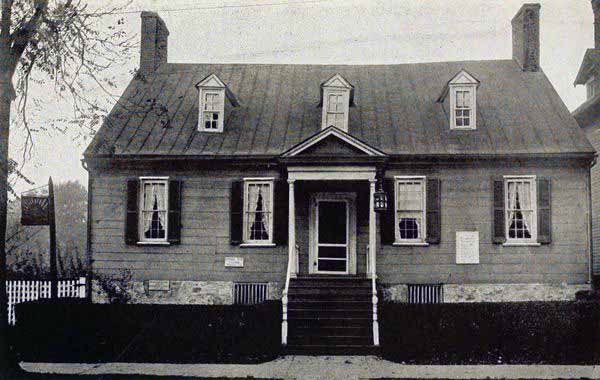
Rising Sun Tavern Where the Great Men of Pre-Revolution Days Gathered, and Freedom Was Discussed
Among those who came to Fredericksburg and were at some time guests at the famous old inn, besides those named were Brigadier General Stephen Moylan, another Irishman who served as Washington’s aide, as commissary general and as commander of troops at Yorktown; Brigadier-General Irvine, Irish too, and here at Weedon’s insistence; Count Beaumarchais, author of the “Barber of Seville” and general in the American army; the Marquis de Lafayette, the Viscounts d’Nouvalles, Count d’Estang, Baron Viominel, and many others.
Beautiful Colonial Belles
But who were the ladies then? History does not say, but the dancing master, Mr. Christian, who taught the “gentle young ladies” through the “neighborhood,” and has left sketches of their personal manner and dress, has described for us a host of them, many of them misses of 15 and 16, who now would be called girls but were quite young ladies then.
Miss Lucy Lightfoot Lee was “tall and stately” (at 16), Mr. Christian says, “wearing a bright chintz gown with a blue stamp, elegantly made, a blue silk quilt, and stays, now said to be the fashion in London but to my mind a great nuisance.” While Miss Hale danced in “a white Holland gown, quilt very fine, a lawn apron, her hair crimped up in two rolls at each side and a tuft of ribbon for a cap.”
It is easy to surmise that the charming Gregory girls, now married, were there, and that little Maria Mortimer, who on the night following the Peace Ball, at 15 years of age, was hostess for all the great gentlemen, was also a guest, as well as Miss Betsy Lee, Martha Custis, and Posey Custis, Molly Posey, Anne Mason, Alice Lee, and Mary Ambler (later to become the wife of Chief Justice Marshall), Sally Patton, “lately come from England to teach,” the two Turberville girls, Priscilla Carter, Jenny Washington and the Lewis girls, the Taylor girls, and the Fitzhughs, of Boscobel and Chatham.
Names of Great Virginians
The old tavern is well-preserved and is taken care of by the Association for the Preservation of Virginia Antiquities. Not much change has been made in it since the days of its glory, when at its hospitable hearth young James Monroe argued for the emancipation of slaves, George Mason spoke his views on the rights of man, Weedon talked forever “sedition” with Mercer, who hated England since he had felt defeat at the disaster of Colloden and crept from Scotland a hunted man, Jefferson discussed his broad principles, and the Randolphs, Blands, Byrds, Harrisons, Moncures, Taliaferros, Fitzhughs, Lewises of Marmion, Carters of Cleve, Raleigh Travers (of Sir Walter’s family) of Stafford, Peter Daniel of “Crows Nest,” Thomas Fitzhugh, Selden of Salvington, Brent of Bellevue, Ludwell Lee of “Berry Hill,” Richard Henry Lee of “Wakefield,” and other famous men gathered, in those crowded days before the Revolution.