Old Court Records
Reading edition
Staid Documents, Writ by Hands That Are Still, Are History For Us.
For simple beauty of line there is probably no Court House in Virginia that equals that at Fredericksburg. While to the casual eye its grace is obvious, to artists’ and architects’ it makes the stronger appeal, and it is from those familiar with the lines of new and old world buildings that the Court House receive highest praise. Inside, in a modern vault, are many interesting records of the past. The Court House was completed in 1852, at a cost of about $14,000, William M. Boggeth of Baltimore being the contractor, and J. B. Benwick, Jr., of Baltimore, the architect, and its completion marked the end of a thirty years factional fight in the City, which was divided over the issue of building or not building a court house. The decision to build was made by the Council in spite of a petition against such action, signed by one hundred and seventy-two voters.
Building a New Courthouse
The second Court House, a small brick building, stood back from the street, on a part of the ground the present structure occupies, and had taken the place of the first plank Court House. But, as early as 1820, the second structure was complained of by the Court, which went so far as to “order” the Council to provide funds for a new structure, to which the Council paid no attention. On June 14, 1849, the Court, composed of Mayor Semple and Justices William H. White and Peter Goolrick, issued an order and appointed a committee, as follows: “Thomas B. Barton, John L. Marye, Robert B. Semple, Wm. C. Beale and John J. Chew, to examine and report to this Court some plan for the enlargement and repairs or rebuilding of the Court House of this Corporation.”
But in spite of some excitement following this unusual step of the Court, the Council continued its way undisturbed. The Court, however, called before it “the Justices for this Corporation” and at the next session eight Justices—R. B. Semple, Robert Dickey, Beverly R. Welford, William C. Beale, William H. White, Peter Goolrick, William Warren and William Slaughter answered the summons. The report of the committee appointed at the previous session of the Court was made and the Court finally took this action:
“That, in obedience to the act of the General Assembly, which requires that Courts for the Corporations’ within this Commonwealth should cause to be erected one good, convenient court house, and it being necessary to build a court house for this corporation,” etc., the Court “appoints a commission, consisting of Mayor Semple, Beverly R. Welford, William H. White, Thomas B. Barton and John L. Marye to contract for a court house.”
But, despite this, and because of the divided sentiment of the people and the inaction of the Council, the Court did not build a court house, and at a later meeting voted four to four on a motion to rescind their previous order. After various moves and counter moves, the issue was carried into a regular election held in March, 1851, and a Council in favor of a new Court House was chosen. The erection of the present structure in 1852 ended a thirty years disagreement, which built up bitter factions in the town and left animosities, which did not subside until the Civil War came on. For many years, until the new Fire House was built, the old hand-drawn fire apparatus was housed in the south wing of the building.
The bell which is now in the tower of the Court House, formerly hung in the second court house, and sounded the call to public meetings, as it does today, and the alarms of fire and war. It was presented to the town by Silas Wood in 1828, and has his name and that date on it, as well as the name of the maker, “Revere, Boston.”
How Debtors Were Treated
From the earliest times, debtors who could not pay their bills were imprisoned in the jail in Court House square or, more properly, slept in the jail and were imprisoned in the square; for they were allowed the freedom of the whole square and the adjacent streets, but were not allowed to enter any store or building on the opposite sides of the streets. Many men of prominence, it is said, spent short periods in this “Debtors’ Prison,” awaiting the time when their release could be secured under the “Poor Debtors’ Law,” which gave them freedom when by a schedule of their property they proved they had no means to meet their obligations. In 1840, the Court extended the bounds of the “Debtors’ Prison” to include four blocks in the center of the city, and the “footways adjoining them”; but to go beyond these bounds was contempt of Court.
No existing records establish what Courts held session in Fredericksburg prior to the Revolution, and it is probable that successors of Mayor Lawrence Smith were empowered as Governors and Judges until 1727, after which time the Trustees of the town may have chosen magistrates, or the colonial Governors may have done this.
History of the Courts
It is established that the first Court in Fredericksburg was created by the General Assembly in 1781, when Fredericksburg was incorporated and given a Common Council and a Hustings Court. The first session of this Hustings Court was held April 15, 1782, with the following Justices present: Charles Mortimer, William McWilliams, James Somerville, Charles Dick, Samuel Ruddy, and John Julien, “the same being Mayor, Recorder and Aldermen of the town.” This continued the only Court until 1788, when nineteen District Courts were established in the State by the General Assembly, and one of them was located at Fredericksburg. These courts were presided over by two of the ten Judges of the General Court at Richmond. Among the many men of prominence who appeared before this District Court were James Monroe, Edmund Randolph, and Francis Brooke. This District Court was abolished in 1809 and a Circuit Court took its place. This new court was now presided over by one of the Judges of the General Court at Richmond. With some changes these courts continue to the present, but are presided over by specially chosen Circuit Judges. But the Circuit Court is not held at Fredericksburg.
The Hustings Court, meanwhile, was the local court for Fredericksburg until 1870, when it became the “Corporation Court” over which, instead of three Justices of the Peace, the Assembly now provided there be a Judge “who shall be learned in law.” Judge John M. Herndon was the first Judge of this Court, in 1870, and was succeeded by Judge John T. Goolrick, 1877, Judge Montgomery Slaughter followed him, Judge A. Wellington Wallace presided for some years, and Judge Embry served until Judge John T. Goolrick was again chosen Judge and has continued on the bench for the last 16 years.
A more remarkable record is that of the men of the Chew family, who for ninety-nine years and eleven days were the Clerks of this Court, succeeding each other by appointment and election in direct lineal line. Henry Armistead, first Clerk of the Court, died August 1, 1787, and on August 6, 1787, John Chew, Jr., was appointed to the vacancy. In 1806 his son, Robert S. Chew, succeeded; In 1826 the latter’s son John J. Chew succeeded; In 1867, the latter’s son, Robert S. Chew succeeded and held office until his death in 1886. Mr. J. Willard Adams is now Clerk of the Corporation Court.
There are many interesting documents in the vaults of the Court House, many of them mere scraps, as that which tells of an inquest in 1813 over the “Body of a sailor from the Frigate ‘Constitution,’” who was drowned here in the river, and which indicates that the famed old boat was once at Fredericksburg Wharf.
Among the oldest and most interesting documents in the archives of the Court House, is a “List of Males Capable of Militia Duty—1785,” and of the two hundred and sixty-five then listed, (which would indicate a population of about 1,300 in the city at that time). There are few names now known in Fredericksburg, nevertheless, there are some, and of these familiar names the following are examples:
“Dr. Mortimer, Dr. Brooke, Dr. French, Dr. Hall, Dr. Gillis, Dr. Hand” and “Bradford, Taylor, Yates, Walker, Maury, Minor, Herndon, White, Brent, Johnson, Wheeler, Gray, Jenkins, Allen, Crutchfield, Ferneyhough, Brown, Chew, Weedon, Colbert, Washington, Brooks, Ingram, Middleton, Spooner, Payne, Gordon, Young, Thompson, Berry, Slaughter, Lewis, Clarke,” and many others whose descendants are well known in this city and vicinity.
Mary Washington’s Will
The will of Mary Washington, written by James Mercer, an attorney who was also Chief Justice of the General Court, (the highest court of Virginia) and signed by Mary Washington, is preserved in the Court House and has been seen by hundred of callers. The will was made May 20, 1788, and was filed after the death of Mrs. Washington.
“In the name of God, Amen. I, Mary Washington, of Fredericksburg, in the County of Spottsylvania, being in good health, but calling to mind the uncertainty of this life and willing to dispose of what remains of my earthly estate, do make and publish this, my last will, recommending my soul into the hands of my Creator, hoping for a remission of all my sins through the merits and mediation of Jesus Christ, the Saviour of Mankind. I dispose of all my worldly estate as follows:
Imprimis: I give to my son, General George Washington, all my lands on Accokeek Run, in the County of Stafford, and also my negro boy, George, to him and his Heirs forever; also my best bed, bedstead and Virginia cloth curtains, (the same that stands in my best room), my quilted Blue and White quilt and my best dressing glass.
Item: I give and devise to my son, Charles Washington, my negro man Tom, to him and his assigns forever.
Item: I give and devise to my daughter, Betty Lewis, my phaeton and my bay horse.
Item: I give and devise to my daughter-in-law, Hannah Washington, my purple cloth cloak lined with shay.
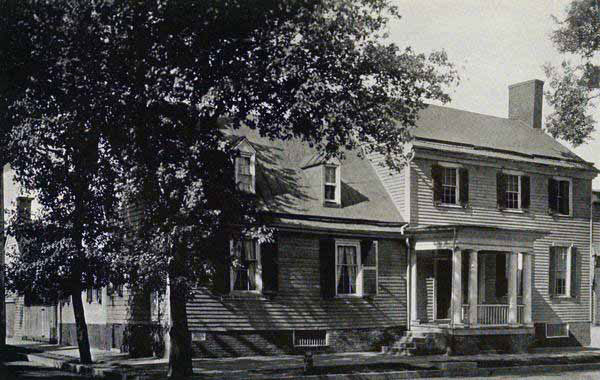
Mary Washington’s Home In the Garden Mrs. Washington Greeted Young Lafayette. She Lived And Died Here
Item: I give and bequeath to my grandson, Corbin Washington, my negro wench, Old Bet, my riding chair and two black horses, to him and his assigns forever.
Item: I give and bequeath to my grandson, Fielding Lewis, my negro man, Frederick, to him and his assigns forever; also, eight silver table spoons, half of my crockery ware, and the blue and white Tea China, with book case, oval table, one bedstead, two table cloths, six red leather chairs, half my pewter, and one-half my iron kitchen furniture.
Item: I give and bequeath to my granddaughter, Betty Carter, my negro woman, Little Bet, and her future increase, to her and her assigns forever; also my largest looking glass, my walnut writing desk with drawers, a square dining table, one bed, bedstead, bolster, one pillow, one blanket and pair of sheets, white Virginia cloth counterpane, and purple curtains, my red and white china, teaspoons and other half of my pewter, crockery ware, and the remainder of my iron kitchen furniture.
Item: I give to my grandson, George Washington, my next best dressing glass, one bed, bedstead, bolster, one pillow, one pair of sheets, one blanket and counterpane.
Item: I devise all my wearing apparel to be equally divided between my granddaughters, Betty Carter, Fanny Ball and Milly Washington; but should my daughter, Betty Lewis, fancy any one, two or three articles, she is to have them before a division thereof.
Lastly: I nominate and appoint my said son, General George Washington, executor of this, my Will, and as I owe few or no debts, I desire my Executor to give no security nor to appraise my estate, but desire the same may be allotted to my devisees with as little trouble and delay as may be, desiring their acceptance thereof as all the token I now have to give them of my love for them.
In Witness Whereof, I have hereunto set my hand and seal this 20th day of May, 1788.
Mary Washington.
Witness: John Ferneyhough.
Signed, sealed and published in our presence, and signed by us in the presence of the said Mary Washington, and at her desire.
J. Mercer Joseph Walker.”
Among the orders of the Court, found on the Order Books, are some which are of interest as bearing on old customs of the town. One of the first of these was entered March 1, 1784, when the Court “proceeded to settle the allowances to the officers of the Corporation” as follows: “Mr. John Minor, Jr., Attorney for the Commonwealth, two thousand pounds tobacco; Mr. Henry Armistead, Clerk, twelve hundred pounds tobacco; John Legg, Sergeant, twelve hundred pounds tobacco; Henry Armistead, for attending all Courts of inquiry, four hundred pounds; sergeant for same, five hundred and seventy pounds; Wm. Jenkins, goaler, three hundred and sixty-four pounds.”
February 7, 1785, “Robert Brooke” (afterwards Governor of Virginia in 1794-96, and still later Attorney General) and Bushrod Washington, (Uncle of George Washington and later Chief Justice of the Supreme Court) were admitted to practice law.
April 25, 1801, the first “watchman” (policeman) was appointed for the town.
Burial in Streets Stopped
In a peculiar report, made March 27, 1802, the Grand Jury took steps to put a stop to “a nuisance, the numerous obstructions in the streets, particularly in St. George Street lot; burying the dead in George and Princess Anne Streets; also the irregular burying in the ground west of and adjoining Prince Edward.” These graves, the report shows, were on George, Princess Anne, and in Hanover Street, west of Princess Anne, and on George Street between Main and the river.
After twenty-two years, the Court issued its first authorization for a Minister of the Gospel (none but the Church of England ceremony was before recognized) to perform the marriage ceremony, December 24, 1804, to “Benj. Essex,” Methodist. Others followed in this order: Samuel Wilson, Presbyterian, September 22, 1806; William James, Baptist, June 13, 1811.
The undisputed fact that John Forsythe, who was in his generation one of America’s most famous men, and a sketch of whose life is given elsewhere, was born in Fredericksburg, is contained in this entry, dated January 12, 1832.
“The Court orders it to be certified that it was proved to their satisfaction, by the evidence of Francis S. Scott, a witness sworn in Court, that Major Robert Forsythe of the Revolutionary army, had two children, one of whom, Robert, died under age and unmarried, and the other, John, is now alive, being a Senator in Congress from Georgia.”
Court Set Liquor Price
Among the Court’s first acts after establishment, the Hustings Court, on May 20, 1782, thus fixed the prices of certain commodities in the “Taverns”: “Good West India Rum, one pound per gallon; bread, ten shillings; whiskey, six; strong beer, four; good West India rum toddy, ten shillings; brandy toddy, seven shillings six pence; rum punch, fifteen shillings; brandy punch, twelve; rum grog, six; brandy grog, five. Diet: one meal, one shilling six pence; lodging, one shilling and three pence; ‘stablidge’ and hay, two shillings; oats and corn, nine pence per gallon.”
The prices of intoxicants is hard to explain. Rum is at the rate of $5.00 per gallon, but apparently whiskey is only $1.25. A later ordinance of prices, made May 10, makes various changes.
“Breakfast, fifty cents; dinner, fifty; supper, fifty; lodging, twenty-five; grain, per gallon, twelve and one-half; stablidge and hay per night, twenty-five; Madera Wine, per quart, one dollar; Champagne, per quart, one dollar and fifty cents; other wine, per quart, fifty cents; French brandy, twelve and one-half cents per gill; Rum, twelve and one-half cents per gill; Gin, twelve and one-half cents per gill.”
Some of the Judges
A pure judiciary is one of the best assurances of good government, and Virginia is proud of her Judges, who on the average, have been and are men of learning, and acknowledged ability.
In this book, we can only chronicle briefly the names of some who have presided in the Circuit Courts of this circuit.
First is the name of John Tayloe Lomax, who had occupied a chair in the law school at the University of Virginia, and who had written several books treating on law, before he came to preside as judge here.
Richard Coleman, of the distinguished family of that name from Caroline County;
Eustace Conway, one of the very youngest men elected by the people, and who died in a few months after he had assumed the duties;
John Critcher, who soon resigned the judicial office to become an officer in the Confederate Army;
William Stone Barton, who was a splendid Judge, a fearless soldier and a Christian;
John E. Mason, who executed all the duties of his high office intelligently and conscientiously.