At Chancellorsville
Reading edition
The Struggle in the Pine Woods when death struck at Southern hearts
From the close of the battle at Fredericksburg in December 1862, until the spring of 1863, General Burnside’s Army of the Potomac and General Lee’s Army of Northern Virginia lay in camp; the first on the north and the second on the south bank of the Rappahannock. The little town, now fairly well repopulated by returned refugees, lay between the hosts. The Northern lines practically began at Falmouth, where General Daniel Butterfield had headquarters, and at which spot young Count Zeppelin and his assistants were busily arranging to send up a great Observation Balloon with a signalling outfit. Southward, Lee’s army stretched over thirty-three miles, from the fords of the Rappahannock, where the hard riding cavalrymen of Stuart and W. H. F. Lee watched, to Port Royal, Jackson’s right.
Burnside’s headquarters were the Phillips house and Chatham, (recently owned by the famous journalist, Mark Sullivan and where he and Mrs. Sullivan made their home for some years). Hooker, part of the time, was at the Phillips house, Lee in a tent, near Fredericksburg, while General Jackson had headquarters first in an outbuilding at Moss Neck, now the home of Count d’Adhemar and later in a tent. It was here that he became fond of little Farley Carbin, who came every day to perch on his knee and receive little presents from him. One day he had nothing to give her, and so, ere she left, he tore the gold braid from the new hat that was part of a handsome uniform just given him by General “Jeb” Stuart, and placed it like a garland on her pretty curly head. During the winter the General, who from the beginning of the war never slept at night outside his army’s camp, nor had an hour’s leave of absence, saw for the first time since he left Lexington, and for next to the last time on earth, his wife and little daughter, whom he so fervently loved. They spent some weeks near him at Moss Neck.
Christmas at the Front
Christmas Eve came. In the Southern camp back of the hills down the river road, up towards Banks Ford, out at Salem Church, and even in the town, hunger and cold were the lot of all. General Lee, wincing at the sufferings of his “tatterdermalion” forces, wrote and asked that the rations of his men be increased, but a doctor-inspector sent out by the often futile Confederate Government reported that the bacon ration of Lee’s army—one-half a pound a day, might be cut down, as “the men can be kept alive on this.” General Lee himself wrote that his soldiers were eating berries, leaves, roots and the bark of trees to “supplement the ration,” and although at this time the Confederate Government had a store of bacon and corn meal that would have fed all its armies a half year, Lee’s ragged soldiers starved throughout the winter. It is worthy of note here that when Lee’s starving army moved, foodless, toward that last day at Appomattox, they marched past 50,000 pounds of bacon alone, which the Confederate commissary, at Mr. Jefferson Davis’ orders, burned next day.
We spoke of Christmas Eve, when in the long lines of the two camps’ great fires beamed, voices rose in songs and hymns, and bands played. Late in the evening, when dusk had settled, a band near Brompton broke out defiantly into “Dixie,” and from the Washington Farm a big band roared out “The Battle Hymn.” There was a pause and then, almost simultaneously, they began “Home, Sweet Home,” and catching the time played it through together. When it was done, up from the camps of these boys who were to kill and be killed, who were to die in misery on many a sodden field, rose a wild cheer.
Hardly could two great armies ever before have lain for months’ within sight of each other as these two did in almost amicable relations. There was no firing; the cannon-crowned hills were silent. Drills and great reviews took place on either bank of the river and in the Confederate ranks there went on a great religious “revival” that swept through the organization. Along the banks of the river where pickets; patrolled by day, and their little fires flamed in the night, trading was active. From the Union bank would come the call softly:
“Johnny.”
“Yea, Yank.”
“Got any tobacco?”
“Yes, want ’t trade?”
“Half pound of coffee for two plugs of tobacco, Reb.”
“’right, send ’er over.”
They traded coffee, tobacco, newspapers and provisions, sometimes wading out and meeting in mid-river, but as the industry grew, miniature ferry lines, operated by strings, began to ply.
Soldiers and Generals passed and repassed in the streets of Fredericksburg, where wreckage still lay about in confusion, houses presented dilapidated fronts, and only a few of the citizens attempted to occupy their homes.
Once, in midwinter, the armies became active when Burnside attempted to move his army and cross the river above Fredericksburg; but only for a few days, for that unfortunate General’s plans were ruined by a deluge and his army “stuck in the mud.” General Hooker took his place.
The Coming of Spring
About April 26 Hooker’s great army, “The finest army on the planet,” he bombastically called it, moved up the river and began crossing. It was his purpose to get behind Lee’s lines, surprise him and defeat him from the rear. On April twenty-ninth and thirtieth, Hooker got in position around Chancellorsville, in strong entrenchments, a part of his army amounting to 85,000 men, but the Confederate skirmishers were already in front of him.
It was the Northern Commander’s plan for Sedgwick, left at Fredericksburg with 40,000, to drive past Fredericksburg and on to Chancellorsville, and thus to place the Southern forces between the two big Federal armies and crush it.
The First Aerial Scout
Before the great battle of Chancellorsville began, this message came down from the first balloon ever successfully used in war, tugging at its cable two thousand feet above the Scott house, on Falmouth Heights:
Balloon in the Air, April 29, 1863.
Major-General Butterfield, Chief of Staff, Army of the Potomac.
General: The enemy’s line of battle is formed in the edge of the woods, at the foot of the heights, from opposite Fredericksburg to some distance to the left of our lower crossing. Their line appears quite thin, compared with our forces. Their tents all remain as heretofore, as far as I can see.
T. C. S. LOWE, Chief of Aeronauts.
But the force did not “remain as heretofore” long, though the tents were left to confuse the enemy, for on April 29 General Anderson moved to Chancellorsville, followed on April 30 by General McLaws; and under cover of darkness “Stonewall Jackson” moved to the same place that night, with 26,000 men. On May 1, then, Hooker’s 91,000 at Chancellorsville were being pressed by Lee’s army of 46,000.
General Early’s command of 9,000 and Barksdale’s brigade of 1,000 and some detached troops were left to defend Fredericksburg against Sedgwick’s corps, which was now crossing the Rappahannock, 30,000 strong. At 11 A. M., May 1, General Lee’s army, with Jackson’s corps on his left, began the attack at Chancellorsville, of which this dispatch speaks:
Balloon in the Air, May 1, 1863.
Major-General Sedgwick, Commanding Left Wing, Army of the Potomac.
General: In a northwest direction, about twelve miles, an engagement is going on.
T. C. S. LOWE, Chief of Aeronauts.
Fight at Chancellorsville
Before evening of May 1 Hooker’s advance guard was driven back, and the Confederate forces swept on until within one mile of Chancellorsville, and there, stopped by a “position of great natural strength” (General Lee) and by deep entrenchments, log breastworks and felled trees, they ceased to progress. It was evident at nightfall that with his inferior force the Southern commander could not drive Hooker, and that if he failed to do so, Sedgwick would drive back the small force in Fredericksburg and would come on from Fredericksburg and crush him.
Jackson and Lee bivouaced that night near where the Old Plank Road and the Furnace Road intersect, and here formulated their plans for the morrow. From Captain Murray Taylor, of General A. P. Hill’s staff, they learned that a road existed, by advancing down which (the Furnace Road) then turning sharply and marching in a “V” Jackson’s plan to turn Hooker’s right might be carried out, and at Captain Taylor’s suggestion they sent for “Jack” Hayden, who could not be gotten at once, and who, being an old man, was “hiding out” to avoid “Yankee” marauders.
Lee and Jackson slept on the ground. Jackson, over whom an officer had thrown his overcoat, despite his protests, waited until the officer dozed, gently laid the coat over him and slept uncovered, as he had not brought his own overcoat. Later, arising chilled, he sat by the fire until near dawn, when his army got in motion.
When Jackson moved away in the early hours of May 2 there were left to face Hooker’s 91,000 men on the Federal left, Lee’s 14,000 men, attacking and feinting, and nowhere else a man. Jackson was moving through tangled forests, over unused roads, and before 5 o’clock of that memorable afternoon of May 2 he had performed the never-equalled feat of moving an army, infantry and artillery of 26,000 men sixteen miles, entirely around the enemy, and reversing his own army’s front. He was now across the Plank Road and the Turnpike, about four miles from Chancellorsville, facing toward Lee’s line, six miles away. And Hooker was between them!
Jackson’s Stroke of Genius
It was 5:30 when Jackson’s command (Colston’s and Rhodes’ Divisions, with A. P. Hill in reserve) gave forth the rebel yell and sweeping along through the woods parallel to the roads, fell on Hooker’s right while the unsuspecting army was at supper. The Federals fled in utter disorder.
Before his victorious command, Jackson drove Hooker’s army through the dark pine thickets until the Federal left had fallen on Chancellorsville and the right wing was piled up and the wagon trains fleeing, throwing the whole retreating army into confusion. At 9 o’clock he held some of the roads in Hooker’s rear, and the Northern army was in his grasp.
Hill was to go forward now. He rode to the front with his staff, a short distance behind Jackson, who went a hundred yards ahead of the Confederate lines on the turnpike to investigate. Bullets suddenly came singing from the Northern lines and Jackson turned and rode back to his own lines. Suddenly a Confederate picket shouted “Yankee cavalry,” as he rode through the trees along the edge of the Plank Road. Then a volley from somewhere in Lane’s North Carolina ranks poured out, and three bullets struck Jackson in the hand and arms. His horse bolted, but was stopped and turned, and Jackson was aided by General Hill to dismount. Almost all of Hill’s staff were killed or wounded.
There was trouble getting a litter, and the wounded man tried to walk, leaning on Major Leigh and Lieutenant James Power Smith. The road was filled with men, wounded, retreating, lost from their commands. Hill’s lines were forming for a charge and from these Jackson hid his face—they must not know he was wounded. A litter was brought and they bore the sufferer through the thickets until a fusilade passed about them and struck down a litter-bearer, so that the General was thrown from the litter his crushed shoulder striking a pine stump, and now for the first time, and last time, he groaned. Again they bore him along the Plank Road until a gun loaded with canister swept that road clear, and the litter-bearers fled, leaving General Jackson lying in the road. And here, with infinite heroism, Lieutenant Smith (see sketch of life) and Major Leigh lay with their bodies over him to shield him from missiles.
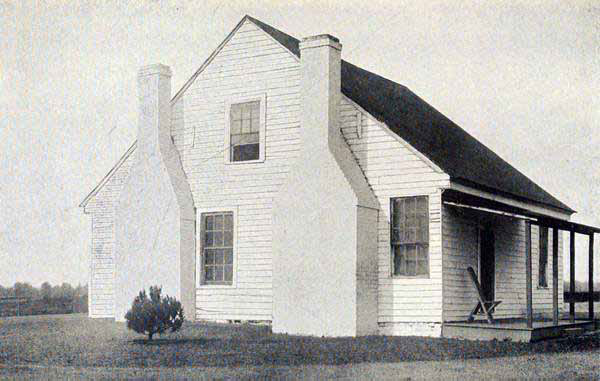
Where “Stonewall Jackson” Died In the Room on the Lower Floor, the Window of Which Looks Out on the Little Bush, The South’s Hero Passed Away
The Death of “Stonewall”
Later the wounded officer was gotten to a field headquarters near Wilderness Run, and Dr. Hunter McGuire and assistants amputated one arm and bound the other arm and hand. Two days later he was removed to Mr. Chandler’s home, near Guineas, where, refusing to enter the mansion because he feared his presence might bring trouble on the occupants should the Federals come, and because the house was crowded with other wounded, he was placed in a small outbuilding, which stands today. The record of his battle against death in this little cabin, his marvelous trust in God and his uncomplaining days of suffering until he opened his lips to feebly say: “Let us pass over the river and rest under the shade of the trees” is a beautiful story in itself. He died from pneumonia, which developed when his wounds were beginning to heal. The wounds only would not have killed him and the pneumonia probably resulted from sleeping uncovered on the night before referred to. Mrs. Jackson and their little child, Dr. Hunter McGuire, Lieutenant James Power Smith, his aide-de-camp; Mrs. Beasley and a negro servant were those closest to him in his dying hours.
Hill succeeded Jackson, and in twenty minutes was wounded and Stuart succeeded him, and fighting ceased for the night.
On May 3, General Lee attacked again, uniting his left wing with Stuart’s right, and a terrific battle took place that lasted all day, and at its end Hooker’s great army was defeated and dispirited, barely holding on in their third line trenches, close to the river; that worse did not befall him was due to events about Fredericksburg. (We may note here that Hooker lost at Chancellorsville 16,751 men while Lee lost about 11,000.)
Battle at Salem Church
For Sedgwick, with 30,000 men, took Marye’s Heights at 1 o’clock of this day, losing about 1,000 men, and immediately General Brooks’ division (10,000) marched out the Plank Road, where on each successive crest, Wilcox’s Alabamians, with a Virginia battery of two guns (4,000 in all) disputed the way. At Salem Church, General Wilcox planted his troops for a final stand.
Here at Salem Church the battle began when Sedgwick’s advance guard, beating its way all day against a handful of Confederates, finally formed late in the afternoon of May 3, prepared to throw their column in a grand assault against the few Confederates standing sullenly on the pine ridge which crosses the Plank Road at right angles about where Salem Church stands. Less than 4,000 Alabama troops, under General Wilcox, held the line, and against these General Brooks, of Sedgwick’s corps, threw his 10,000 men. They rushed across the slopes, met in the thicket, and here they fought desperately for an hour. Reinforcements reached the Confederates at sundown, and next morning General Lee had come with Anderson’s and McLaw’s commands, and met nearly the whole of Sedgwick’s command, charging them late in the afternoon of May 4, and driving them so that, before daybreak, they had retreated across the river. Then, turning back to attack Hooker, he found the latter also crossing the river.
Unique in the history of battles are the two monuments which stand near Salem Church, erected by the State of New Jersey and gallantly uttering praise of friend and foe.
They mark the farthest advance of the New Jersey troops. The first, on the right of the Plank Road as one goes from Fredericksburg to Chancellorsville, is a monument to the Fifteenth New Jersey troops, and on one side is inscribed:
“The survivors of the Fifteenth New Jersey Infantry honor their comrades who bore themselves bravely in this contest, and bear witness to the valor of the men who opposed them on this field.”
Monument at Salem Church
The other monument stands on the ridge at Salem Church, close to the road, and about where the charge of the Twenty-third New Jersey shattered itself against the thin lines of Wilcox’s Alabamians. It stands just where these two bodies of troops fought hand to hand amidst a rolling fire of musketry, bathing the ground in blood. In the end the Confederates prevailed, but when the State of New Jersey erected the monument they did not forget their foe. It is the only monument on a battlefield that pays homage alike to friend and enemy.
The monument was unveiled in 1907, Governor E. Bird Gubb, who led the Twenty-third New Jersey, being the principal speaker. Thousands were present at the ceremonies.
On one side of the splendid granite shaft is a tablet, on which is engraved:
“To the memory of our heroic comrades who gave their lives for their country’s unity on this battlefield, this tablet is dedicated.”
And on the other side another tablet is inscribed:
“To the brave Alabama boys, our opponents on this battlefield, whose memory we honor, this tablet is dedicated.”