Men of Modern Times
Reading edition
Soldiers, Adventurers and Sailors, Heroes and Artists, mingle here.
A prophet without honor in his own country was Moncure Daniel Conway because, a Fredericksburger and a Southerner, he opposed slavery. But his genius won him world praise, and later, honer in his own country.
Born in 1832, near Falmouth, to which village his people moved later, the child of Walker Peyton Conway and Marguerite Daniel Conway he inherited from a long line of ancestry, a brilliant intellect and fearlessness to tread the paths of freedom.
The difficult studious child was too much for his teacher, Miss Gaskins, of Falmouth, so he was sent, at the age of ten, to Fredericksburg Classical and Mathematical Academy, originally John Marye’s famous school, and made rapid progress.
His hero was his great uncle, Judge R. C. L. Moncure, of Glencairne, and his early memoirs are full of loving gratitude for the great man’s toleration and help. The Methodism of his parents did not hold him, for he several times attended the services at St. George’s Church.
The wrongs of slavery he saw, and after he entered Dickinson College, at Carlisle, in his fifteenth year, he found an anti-slavery professor, McClintock, who influenced him and encouraged his dawning agnosticism. His cousin, John M. Daniel, editor of the Richmond Examiner, became, in 1848, a leading factor in Conway’s life, encouraging his literary efforts and publishing many of his contributions.
All beauty, all art appealed to him. Music was always a passion, and we also find constant and quaint references to beautiful women and girls. It seemed the superlative compliment, though he valued feminine brains and ability.
His great spiritual awakening came with his finding an article by Emerson and at the age of twenty, to the delight of his family, he became a Methodist minister.
His career as such was not a success. After one of his sermons, in which he ignored Heaven and Hell, his father said: “One thing is certain, Monk, should the Devil aim at a Methodist preacher, you’d be safe.”
He moved to Cambridge. The prominence of his Southern family, and his own social and intellectual charms gave him entre to the best homes and chiefest among them, that of his adored Emerson, where he met and knew all the great lights of the day. His slavery opinions, valuable as a Southern slave owner’s son, made him an asset in the anti-slavery propaganda of the time.
Conway’s Famous Friends
Among his friends were the Thoreaus, Hawthorne, Longfellow, Oliver Wendell Holmes and Agassiz.
I must hurry over the charm of those college days to Moncure Conway’s first Unitarian Church, in Washington. So pronounced were his sermons on anti-slavery that his father advised him not to come home on a visit. He did come and had the humiliation of being ordered from Falmouth under pain of tar and feathers, an indignity which cut him to his soul. His success in Washington was brilliant, but he found trouble, owing to his abolitionist opinions, and had to resign. In 1856 he accepted a call to a Cincinnati church, whose literary and artistic circles made much of the new preacher. The wealth of that larger population enabled Conway to establish several charitable homes. He married there Ellen Davis Dana, and there published his first book, “Tracts For Today.” He edited a paper, The Dial, to which Emerson contributed.
He went to England to the South Place Chapel, London, an ethical society, and the round peg seemed to have found its proper hole at last. Here he labored for twenty years, and became known through all Europe. His personal recollections of Alfred Tennyson, the Brownings their courtship; of Carlyle, are classics. A very interesting light is thrown on Freud. He was intimate with the whole pre-Raphaelite school and gives account among others of Rossetti and his lovely wife, all friendships he formed in Madam Brown’s charming home.
Burne Jones, Morris, Whistler, Swinburne, Arthur Hughs, DeMaurier (was there ever such a collection of genius in one country) are all described in Conway’s vivid pen pictures. Artemus Warde was his friend, and Conway conducted the funeral services over that world’s joy giver, and in his same South End Chapel, preached memorial addresses on Cobblen, Dickens, Maurice, Mazzanni, Mill, Straus, Livingstone, George Eliot, Stanley, Darwin, Longfellow, Carlyle, the beloved Emerson, Tennyson, Huxley and Abe Lincoln, whom he never admired, though he recognized his brain and personality. He accused him of precipitating the horrible war for the sake of a flag and thus murdering a million men.
Samuel Clemens (Mark Twain) and his wife visited England in 1872 and Moncure Conway and his wife knew them intimately and afterwards visited them in this country. Joseph Jefferson, John Motley, George Eliot, Mrs. Humphrey Ward (whose book, Robert Elsmere, he flays) and W. S. Gilbert, all were his friends. The man was a genius, a social Voltaire; a master of thought and phrase. Where before did an exile from his own country ever achieve a friendship circle where the names now scintillate over all the world?
He Travels Through Russia
He visited Paris in 1867 and the story of his travels in Russia later are full of charm, of folk lore and religious mysticism. But before long we find him back in his South Place Chapel. His accounts of several woman preachers there are interesting, as is that of Annie Besant—the wondrous before-her-time—whom Mrs. Conway befriended in her bitter persecution by her parson husband for agnosticism. In 1875 Conway returned to America, and Falmouth town, grieving over the war ravages and his lost boyhood friends. He toured through the West, lecturing on Demonology, and the great Englishmen he knew. The death of his son, Dana, and of his wife in 1897, were blows, and his remaining years were spent in Europe with several visits between to his brother, Peter V. D. Conway, of Fredericksburg, and friends in America. His life ended in 1907 in Paris. A great man, a brilliant and a brave one. He fought for his beliefs as bravely as ever did any warrior or explorer in unknown lands.
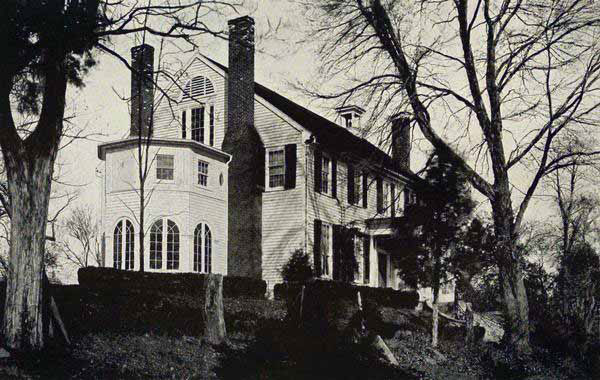
Beautiful “Belmont” On Falmouth Heights, Now the Home of Mr. and Mrs. Gari Melchers
A Great American Artist
Gari Melchers
Crowning a hill, which is the triumphant result of a series of terraces rising from the town of Falmouth, opposite Fredericksburg, is Belmont, the home of Gari Melchers, an American artist, who has been more honored abroad than any of our living painters, with the exception, perhaps, of John Singer Sargent.
Born in Detroit, Gari Melchers left America when he was seventeen, to pursue his studies in Europe.
His apprentice days were spent in Dusseldorf and Paris, where his professional debut in 1889 gained for him the coveted Grand Prix—Sargent and Whistler being the only other American painters similarly honored.
Italy had to resign to Holland the prestige of lending her country to the genius of Mr. Melchers, for he intended to reside in Italy, but owing to the outbreak of the cholera there he settled at Engmond instead. His studio borrowed the interest of the sea on one side and the charm of a lazy canal on the other, and over its door were inscribed the words: “Wahr und Klar” (Truth and Clarity). Here he worked at those objective and realistic pictures of Dutch life and scenes; and free from all scholastic pretense, he painted the serene, yet colorful panorama of Holland.
Christian Brinton says of the art of Gari Melchers that it is explicit and veracious. Prim interiors are permeated with a light that envelopes all things with a note of sadness. Exterior scenes reflect the shifting of seasons or the precise hour of day. He paints air as well as light and color. Without exaggeration, he manages to suggest the intervening aerial medium between the seer and the thing seen.
Mr. Melchers has no set formula.
In 1918 there was a wonderful “one man” display of his art at the Corcoran Art Gallery, and in 1919, the Loan Exhibition, held by the Copley Society at the Boston Art Club, was the second of the two important recent events in the artist’s career since his returning to America. Here his work has undergone some perceptible change, gaining lightness and freshness of vision, which shows his reaction to a certain essential Americanism. Mr. Melchers attacks whatever suits his particular mood, and his art is not suggestive of a subjective temperament.
“The Sermon”—“The Communion”—“The Pilots”—“The Shipbuilders”—“The Sailor and His Sweetheart”—“The Open Door” are some of his well-known canvases. His reputation as a portrait painter rests upon a secure foundation.
His awards include medals from Berlin, Antwerp, Vienna, Paris and Munich, Ansterdam, Dresden, Pennsylvania Academy of Fine Arts, and many other medals for art exhibitions.
He is an officer of the Legion of Honor, France; officer of the Order of the “Red Eagle,” Prussia; officer of the Order of “St. Michael” Bavaria; officer of the Order of the “White Falcon,” Saxe-Weimar.
Mr. Melchers himself is frank and not chained by minor conventions. He has a powerful personality and a charming wife, who dispenses a pleasant hospitality, in a home that leaves nothing to be desired.
John Elder’s Great Work
John A. Elder
Fredericksburg gave John A. Elder, the gifted painter to the world, for he saw the light of day in this town in February, 1833; and here he first felt that call to art which had its beginnings when Elder would, as a mere boy, make chalk drawings on the sides of the buildings, and took the time, while doing errands for his father, to give rein to his imagination through some interesting sketch, which would finally drift into the possession of his friends. His father’s opposition to an artistic career for his son did not long retard his progress, as so great was the urge within him that he borrowed from a fellow townsman, Mr. John Minor, the money to study abroad, and before long Dusseldorf, Germany, claimed him as a student, and there the love of line and color which he had inherited from his mother’s family gained definition. Details of his life in Dusseldorf are too vague to chronicle but he returned to this country at the beginning of the Civil War, with a knowledge of his art which gained him instant recognition, and success followed in his footsteps.
Elder was a man whose sympathetic personality drew the love of his fellow-men, and his studio was the rendezvous of such men as Attorney-General R. T. Daniel, Lord Grant, Peterkin, Fred Daniel, who represented the United States as consul to Rome for fourteen years, and many others.
His experiences in war gave to him a sureness and truth in detail, which, when added to his technique, produced results which challenged the admiration of all who saw his work.
Some of Elder’s Paintings
His “Battle of the Crater” and “Scout’s Prize” were inspired by scenes in which he had figured. The former hangs on the walls of the Westmoreland Club, in Richmond, Va., and his canvas “After Appomattox” adorns the State Library in the same city, along with many portraits which trace their origin to him.
His “Lee” and “Jackson” are in the Corcoran Art Gallery in Washington, and there is a portrait of Mr. Corcoran himself which owes its existence to his gifted brush.
He visited Jefferson Davis at “Beauvoir” and painted him there.
Of ordinary height and rather thick set, Mr. Elder’s appearance was characterized by distinction and force. His eyes were dark and very expressive; he wore a moustache and “imperial” and in all his photographs we notice the “artistic flowing tie.” On the left of his forehead was a scar, the result of some encounter in Germany, and as the artist never married, one is apt to read a romance into his life. However, this is pure speculation, as there is nothing to substantiate such an assumption.
“Jack” Elder was a master of the foils, and on one occasion when a noted Frenchman engaged him in a “bout” Elder disarmed him with ease, and the Frenchman’s foil was thrown against the ceiling.
The artist returned to Fredericksburg, where he lived six years prior to his death, which occurred on February 25, 1895, and in these last years he was ministered to by his nieces and nephews, who showed him much devotion.
Rev. James Power Smith
Rev. James Power Smith was not born in Fredericksburg, but he preached here for thirty years, at the Presbyterian Church, aiding the poor and sick, and always smiling. He was highly successful in his church achievements and in his years of editorship of the Central Presbyterian.
One night in his life proved him to be minted of fine metal, and that night inscribed his name forever in history. It was the fearful night when Stonewall Jackson received his death blow.
Captain Smith (now Reverend) was a theological student when war broke out, and was immediately made a military lieutenant (not a chaplain). Throughout the war he followed close to Jackson, on his staff. Religion brought them together and their friendship was deep.
When Jackson Was Wounded
When in the darkness of the trees that overhang the Chancellorsville road, “Stonewall” Jackson was mortally wounded and others about him killed by their own troops there were a few men, among them General A. P. Hill, at hand to help him. He had hardly been taken from his horse when two aides, Lieutenant Morrison and Lieutenant Smith, arrived. With General Hill directing, they arrested the bleeding. General Hill had to hurry back to form his men for an attack. Lieutenant Morrison had just seen a field piece, not 200 yards away, pointing down the Plank Road. There was no litter, and General Jackson offered to walk to the rear. Leaning on Major Leigh and Lieutenant Morrison, he began struggling toward his lines. They had just placed Jackson on a litter that had been sent up, when the Federal cannon began to rake the road with canister. Every figure, horse or gun toward the Confederate lines disappeared. They tried to take him back, but a litter-bearer was struck down and the Great Leader was dropped and bruised.
In a moment, on the dark road swept by awful fire, there were but three men, and, as the subject of this sketch, Lieutenant Smith, was one of them, it is apropos to quote what Prof. R. S. Dabney says in his Life of Jackson:
“The bearers and all the attendants, excepting Major Leigh and the general’s two aides, had left and fled into the woods. While the sufferer lay in the road with his feet turned toward the enemy, exposed to the fire of the guns, his attendants displayed a heroic fidelity which deserved to go down in history with the immortal name of Jackson. Disdaining to leave their chief, they lay down beside him, leaning above him and trying as far as possible to protect him with their bodies. On one side was Major Leigh, on the other Lieutenant Smith. Again and again was the earth torn by volleys of canister, and minnie balls hissed over them, the iron striking flashes from the stones about him.”
Finally when the firing ceased, General Jackson was removed from the battlefield to a hospital, and then to Mr. Chandler’s house at Guinea Station, where he died, May 10, 1863.
Lieutenant Smith became The Reverend when war ceased, and married Miss Agnes Lucy Lacy, a daughter of Major J. Horace Lacy.
He was well known in Fredericksburg. For thirty years he was pastor here; for fifty years Secretary of the Presbyterian Synod, and for years editor of the Central Presbyterian. Many know his works. All men know the deep, immovable courage it took that night to lie as a barrier, to take whatever death might be hurled down the shell-swept road toward “Stonewall” Jackson.
He still lives, in 1921, in Richmond. His voice is low, his smile soft, and his religion his life. He is the last surviving member of “Stonewall” Jackson’s staff.
Major J. Horace Lacy
There are many living now who remember him. The strong, stolid figure, the fine old face traced with the lineage of gentility, the cane that pounded down the sidewalks as he went where he willed. There are some left who knew the power and poetry and kindliness of the man.
Major Lacy was a graduate of Washington and Lee and an attorney at law, though he seldom practiced. He was married in 1848 at Chatham, when he was twenty-four years of age, to Miss Betty Churchill Jones, and later became the owner of “Chatham” and of the “Lacy House,” about each of which clings grim traditions of war; both the Wilderness place and Chatham became known in those two battles as “The Lacy House.”
Washington Irving was his guest while spending some time in Virginia; General Robert E. Lee was his guest, and many other widely known men.
His service in war was well done. He was made a lieutenant at the beginning and promoted to major on the field of battle at Seven Pines. He served under General Joseph E. Johnston until the latter surrendered, some time after Appomattox.
When the war was ended he went North to do a brave thing. He spoke through Pennsylvania and Maryland, pleading for funds to bury and put grave stones over the Confederate dead. He had experiences there. But his splendid oratory and the courage of his presence usually kept order.
Winning a Hostile Audience
He spoke once at Baltimore, and among his audience was an Irish Federal regiment, clad half in uniform, half in civilians, as forgotten ex-privates usually are. Major Lacy was told that most of the audience was hostile and threatening.
He walked on the platform and spoke a few words about the unknown men he came to get funds to decently bury, of the women away where the starlight was twinkling over cabin and home, of those who waited, listening for a step; of those who were never again to see the men they loved.
Shuffling feet and laughter dulled the simple pathos of his words. Then turning half away from his audience he recited a poem called “The Irish Immigrant’s Lament”:
“I am sitting on the stile, Mary, Where we sat, side by side, On that bright May morning long ago, When first you were my bride.”
He began it thus, and into his voice, filled with the sorrows of the “Mary’s” who wept down in his Southland, he put the full strength of his expression. The hostile audience was silent as he finished.
“And often in the far-off world, I’ll sit and close my eyes, And my heart will travel back again To where my Mary lies. And I’ll think I see the little stile Where we sat, side by side, Mid the young corn on that bright May morn When you were first my bride.”
The Irishmen who had fought against the cause which Lacy loved were quiet now, and when he said, “Wouldn’t you want a bit of a stone for ‘Mary’ to remember you,” they yelled and rushed to grasp his hand. From his “hostile” audience he collected $14,000.00 that night. In the whole tour he gathered a great sum for Confederate cemeteries.
During his later years, with his wife, who represented the ladies of another era, as he did its men, he lived on Washington Avenue, in Fredericksburg. To few did he ever show the deeper side of his character, but those who knew him until he died in 1906, knew how much kindly manliness dwelt therein.
Major General Daniel Ruggles
Although Major General Daniel Ruggles was born in Massachusetts, he married Miss Richardetta Mason Hooe, a great granddaughter of George Mason, and the greater part of his life was spent in Fredericksburg, of which he became a citizen and in which he died.
During his life in Fredericksburg he concerned himself with the business of the town, and was known to almost all of its residents.
He was graduated into the army from West Point in 1883 and lead a small band into the west and explored the Fox river the same year.
General Ruggles’ Career
When the Seminole Indian war broke out Lieutenant Ruggles with fifty men penetrated the everglades and was commended for his services. In the Mexican war he stopped the Mexican advance at Palo Alto and was promoted to Captain on the field.
Captain Ruggles and his men reached Chapaultepec, drove into the city, made a determined stand and were the first of the advancing American Army to raise the American flag over the fort. He was breveted Major by President Polk “for gallant and meritorious conduct at Chereubusco” and a little later was made Lieutenant Colonel “for gallant and conspicuous bravery at Chapaultepec.” In 1861 he joined the Confederate Army.
The Real “First Battle”
Placed in command of the most important of the Southern departments at Fredericksburg, the “gateway to the South,” he organized and equipped a small army. When the Confederacy found that they had no gun caps, necessary on the old “muzzle loaders,” and no copper from which to make caps, General Ruggles invented a cap made from raw hide and dried in the sun (specimens are in the National Museum), which were used by the whole Southern Army during the first three months of the war.
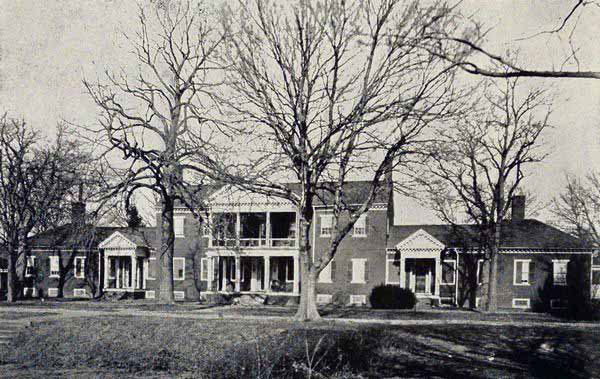
Old “Chatham” One of the Most Characteristic of All Virginia Colonial Mansions
General Ruggles planted artillery and, using these caps with match heads to explode them, drove off the Union gunboats and a lading force at Aquia Creek May 31, 1861, nine days before “Big Bethel”, and weeks after Virginia seceded. He thus fought and won the first battle of the Civil war.
His career during the war won him wide recognition. His movements won the battle of Shiloh through finding a weak point in the enemy’s line. He was made Major General March 25, 1865, and surrendered at Augusta, Ga., after Appomattox. Although he fought in five Indian wars, the Mexican war and the Civil war, from the start to finish, and was recognized as a man who would lead his men anywhere, he never received a wound of any kind in his life.
Many people in Fredericksburg remember him now, with his fine face, his erect figure and his long gray whiskers. In his latter days some people laughed at him, not understanding that there was genius in the man, because of his first experience with “rainmaking.” He invented the method which is used now by the United States Government, under his patent. He earned the name of “raincrow” which sometimes reached his ears. He patented the first propeller which was ever used on a steam boat (model in the National Museum). He also invented the first principles of the telephone. He invented in 1858 a system whereby an electric bell on a ship would ring on the approach of the ship to any rock or point on the shore equipped with the same apparatus. This was tested by the navy and proclaimed impractical, but it contained the principles of wireless telegraphy. It is used by the American navy today.
John Roger Clark, Explorer
Though a monument has just been erected in another city which claims him as a citizen, there is excellent evidence of the fact that John Roger Clarke, reclaimer of the great Northwest, and also his brother, William Clarke, who with Merriweather Lewis, explored the Mississippi, were born in Spotsylvania County and lived near Fredericksburg. According to Quinn’s History of Fredericksburg, Maury’s History of Virginia and letters from descendents, the two famous Clarke brothers were sons of Jonathan Clarke, who lived at Newmarket, Spotsylvania County, where John Roger Clarke was born. Jonathan Clarke was clerk of the County Court of Spotsylvania and afterwards moved to Fredericksburg, where it may be probable, the younger son was born. Later they moved to Albemarle County, near Charlottesville, where the two sons grew to manhood.
The history of the two Clarkes’ is so well known, even by school children, that it is needless to go into it here, the purpose of this reference being to establish their connection with the town.
Major Elliott Muse Braxton
Major Elliott Muse Braxton is widely known, as he was once Congressman from this district. He was born in the County of Middlesex, October 2, 1823, was a grandson of Carter Braxton, one of Virginia’s signers of the Declaration of Independence. His father was also Carter Braxton, a successful lawyer in Richmond.
In 1851 he was elected to the Senate of Virginia. So ably and efficiently did Major Braxton represent his constituents that he won another election without any opposition.
In 1854 he married Anna Marie Marshall, a granddaughter of the great expounder of the Constitution, Chief Justice Marshall. In 1859 he adopted Fredericksburg as his home, where he was when “war’s dread alarm,” came. He organized a company of infantry, of which he was unanimously elected captain, from which position he was soon promoted to that of major, and assigned to the staff of General John R. Cooke. On the conclusion of hostilities he again engaged in the practice of law, forming a co-partnership with the late C. Wistar Wallace, Esq. In 1870 he was nominated at Alexandria by the Democrats for Congress, the City of Fredericksburg being then a constituent of the Eighth District.
He continued to practice his profession of law until failing health admonished him to lay its burdens down.
On October 2, 1891, he died in his home at Fredericksburg, and Virginia mourned a son who was always true, loyal and faithful. Elliott Muse Braxton was a Virginia gentleman and in saying that a good deal is comprehended. Courteous in manner, considerate in tone and temper, clean in character, loyal to State and to Church, cherishing with ardor as the years went by, the obligations and the responsibilities of old Virginia, he fell asleep.
Dr. Francis P. Wellford
“But a certain Samaritan as he journeyed came where he was and when he saw him, he had compassion on him—and went to him and bound up his wounds.” In this way we are told the tender story of the Good Samaritan.
In 1877 Dr. Francis Preston Wellford, of Fredericksburg, was living in Jacksonville, Florida, when a scourge of yellow fever invaded Fernandina. Almost all of its physicians were victims of the disease, or worn out with work. Dr. Wellford volunteered for service, which was almost certain death, fell a victim, and died, on the same day and in the next cot to his fellow-townsman, Dr. Herndon.
“For whether on the scaffold high, Or in the battle’s van, The noblest death that man can die; Is when he dies for man.”
Over his grave in the cemetery at Fredericksburg, there is an imposing monument, with this simple inscription:
“Francis Preston Wellford, Born in Fredericksburg, Virginia, September 12, 1839.”
On the beautiful memorial window in St. Peter’s Church, Fernandina, Florida, erected by Dr. J. H. Upham, of Boston, who felt that their memory should not be neglected, one reads:
“Francis Preston Wellford, M. D. Born in Fredericksburg, Virginia, Sept. 12, 1839, James Carmicheal Herndon, M. D. Born in Fredericksburg, Virginia, Sept. 22, 1821, Died in the faithful discharge of their duties at Fernandina, Florida, Oct. 18, 1877.”
Dr. James C. Herndon
When surgeons were needed for the Confederate Army, the Dr. Herndon above mentioned left his practice and went, although exempted by law. He served through four years of war, and when peace was declared, made his home in Florida.
He was state physician there, when Fernandina was stricken by the dread yellow fever, and the population was almost helpless.
Deeming it his duty, Herndon voluntarily went into the city of the dying. He had worked but a few days when he was stricken, and death followed.
He died as bravely as a man may die, and few have died for so good a cause. He sleeps in the silent cemetery in Fredericksburg, his home.
Hon. A. Wellington Wallace
Among the men whose writings have added to Fredericksburg’s fame is Hon. A. Wellington Wallace, at one time Judge of the Corporation Court of Fredericksburg and, later chosen President of the Virginia Bar Association. Judge Wallace never sought political office and his abilities therefore never were fully publicly known in that line, but some of his literary compositions have been widely read and favorably criticised. The most important of his work, perhaps, is his epitome on the intents, purposes and meaning of the constitution. Though brief it clearly and sharply defines and analyses the important document under which we are governed, and gives to the reader an intelligent conception of what its framers aimed at and hoped to do, such as could not be gained in pages of lengthier reading.
Hon. A. P. Rowe (1817-1900)
One of the best known and most beloved characters of the after-the-war period was Absalom P. Rowe, affectionately known as “Marse Ab.” He served as Quartermaster, Confederate States Army, throughout the Civil War, and after its close, played a leading part in restoring order and system out of the terrible desolation with which this section was inflicted. He was prominent in all matters pertaining to the civic and State governments and was a powerful influence in all the stirring events of that period.
“Marse Ab” represented the district comprising Fredericksburg and Spotsylvania county in the State Legislature for the session 1879-1880, and served as Mayor of Fredericksburg continuously from 1888 to 1900, with the exception of one term, and had just been re-elected for another term at the time of his death.
Fredericksburg was then under its old charter and the police court was presided over by the Mayor. “Marse Ab’s” court was known far and wide, and his characteristic method of dealing out justice was the cause of fear to offenders and a source of amusement to large numbers of onlookers who always attended the sessions of court. “Marse Ab’s” decisions were quickly reached and swiftly delivered, and the penalties inflicted were tempered with the wisdom and discretion of his long experience and his rare qualities as a judge of human nature.
Mayor Rowe was the father of Captain M. B. Rowe, ex-Mayor J. P. Rowe, Messrs. A. P. Rowe and Alvin T. Rowe, all prominent business men of the city today.
A Famous “Tramp Comedian”
Nat C. Wills
Not only has Fredericksburg contributed men who took high rank in the political, economic and scientific up-building of the country, but it has furnished at least one of those who ranked highest as an amuser of the Nation. This was Nat Wills, nationally known to the American theater going public as the foremost exemplifier of the tramp. Wills’ real name was Matthew McGrath Wills. When still a young man he went from Fredericksburg and made his home in Washington. There he humbly began a stage career as a tramp comedian that ended, when he was at the pinnacle of success, with his sudden death in New York some eight years ago.
Merely to have been a successful “Tramp Comedian” does not imply fame. But Wills was more than merely a tramp comedian. He was creator of a new art on the American stage and those who now caricature the lowly denizen of the cross ties, are followers of the lead he took. In mannerism, type and action they copy Wills’ conception of what a true tramp should be, but none yet has succeeded in portraying the character with the humor that Wills put into his work.
Technically speaking Wills was a low comedian, but his wit and humor and art are not suggested by that term. Dressed in clothes that were themselves a burlesque of the world’s kindness, he represented with dramatic humor a character that went through life unconscious of his rags, careless of the present and unafraid of the future, but with a kindness of heart and a philosophy that is true only to those who have viewed life from close to its rougher aspects. After he had achieved success his plays were especially written for him and he had a large part in their making. His lines were witty and clever and as curtain encores he sang parodies he had written on whatever were the popular songs of the day, and these were brilliant satires on the original themes.
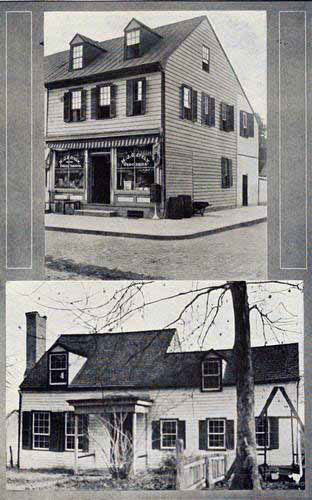
John Paul Jones Home Above: A Grocery Since 1760. Below, Stevens House
Wills never forgot the city of his nativity. Whenever close enough to be appreciated, he always told a joke that permitted him to bring in his connection with the town. His sudden death was a shock to theater goers, and no one has since supplanted in their affections the particular character he essayed. Though dead he remains master of the art he created.
The Gallant Herndon’s Death
Commander Wm. Lewis Herndon
It is not so much because of his life as of his death, that every Fredericksburger cherishes the memory of Commander William Lewis Herndon. He was born here in 1813, and fifteen years afterwards was made a midshipman and in 1855 reached the rank of Admiral. Commander Herndon made the first exploration of the Amazon, amidst great dangers, and his book on this subject became a standard.
With 478 souls aboard, Commander Herndon started from New York for South America in 1857 on the big passenger ship “Central America.” She sailed proudly out, the flying fish fleeing her prow down the Gulf Stream through sunny days, until suddenly in the Gulf of Mexico the ship shattered against a rock.
Standing with his sword in his hand, Commander Herndon saw the boats lowered one by one until each woman and child was safely on the sea in life boats. Ordering his men to continue disembarking passengers he went below to put on his dress uniform, and coming back directed the making of rafts. Hundreds of men jumped and nearly 150 were lost. Commander Herndon stood last on the ship upon the Bridge that is a Captain’s castle, the gold of his uniform losing its glow as the sun fell behind the far off shore lines. Still hovering near, the sailors in a half dozen boats in which were women and children, cried out to him to come over. He bent his head a moment in prayer then doffed his cocked hat, and smiling, went down as his ship plunged bow forward into the Gulf waters. There is no tradition of our Navy more glowing than this one, which Commander Herndon, of Fredericksburg, added to its legends.
Men of the Old Navy
Captain Rudd, U. S. Navy
Captain John Rudd was a resident of our City after his retirement from the U. S. Navy. He was too old to serve in the Confederacy and lived in a house next to the old Citizens Hall, near where the Catholic Church now stands.
He sailed many years in the old Navy, and had many tales to tell to the young people of his neighborhood concerning his adventures.
Commodore Theo. R. Rootes
Commodore Theo. R. Rootes resigned from the U. S. Navy in 1861, and was immediately named as commander in the Confederate Navy. He was stationed in Richmond in the early part of the war and in 1864 was given the command of the ironclad “Fredericksburg” of the James river fleet. He took part in the expedition against the U. S. fleet on the James river and was a member of the Naval Brigade which after the evacuation of Richmond was surrounded at Sailors Creek, April 6, 1865. He lived in the old Scott house, now owned by Charles Cole, Esq., on the corner of Prince Edward and Amelia Streets.
Two Great Naval Officers
Rear Admiral Griffin
Of the men whom Fredericksburg has sent forth in its more modern era, Rear Admiral Robert S. Griffin, who was born in 1857, entered as a cadet engineer at Annapolis and was graduated in 1878, is among the most notable. Admiral Griffin has spent no fewer than fourteen years of a busy career on sea duty, and has been for a decade a recognized authority on naval engineering. In his position as Chief of the Bureau of Naval Engineering he is responsible for the innovations and improvements in our capital ships, the electric drive for cruisers, the turbine reduction gear for destroyers.
The high state of efficiency in the Engineering Department is due to Admiral Griffin’s constant efforts and his tact in overcoming Naval and Congressional opposition is a personal accomplishment.
Admiral Griffin resigned from the Bureau on September 21, 1921, and was retired September 27, 1921.
He lives in Washington, but is a valued visitor to his former City from time to time. Admiral Griffin’s record is almost unexcelled. He rose by hard work and brains and has for years been a source of pride to Fredericksburg. He is one of the few men still living whom we may class as “great.”
Captain Barney, U. S. Navy
Captain Joseph N. Barney was born in Baltimore in 1818. He graduated from Annapolis first in his class in 1834 and spent many years at sea until 1861, when he resigned to offer his services to the Confederacy.
He commanded the “Jamestown” at the Battle of Hampton Roads, March 8th and 9th, 1862, and, on April 11th, was sent in to capture vessels under the guns of the Monitor, hoping to provoke the latter to come out and fight.
He commanded a battery at the fight at Drury’s Bluff, and later in the war took part in the operations at the Sabine pass and was sent to command the C. S. Cruiser Florida, but was prevented by ill health. He was purchasing agent for the Confederacy at the cessation of the hostilities, and after the war made one voyage in the command of a commercial steamer. Captain Barney made his home in Fredericksburg from 1874 to 1899, when his death occurred. His career was a distinguished one and he had in his later years, spent here, a host of friends in Fredericksburg.
Captain Lynch, U. S. Navy
Captain M. F. Lynch was born near Fredericksburg, in 1801 was appointed a midshipman in the U. S. Navy in 1819, promoted to Lieutenant in 1828, and shortly afterwards made an important scientific investigation of the topography of the Dead Sea Valley in Palestine. He made the first correct maps and soundings of the Jordan and the Dead Sea, and his report was published by the United States Government and much valued by the scientific world. He was made a Captain in 1856 and held this rank when he resigned to enter the Confederate Navy. His work with the Virginia Navy in the defenses of Aquia Creek and the Potomac was complimented by his opponents, and later he took part in the defense of the coast of North Carolina, winning much credit by his zealous action at the battles of Hatteras Inlet and Roanoke Island.
In 1864 Captain Lynch was transferred to duty on the Mississippi River, where he aided in the preparation of the famous ram, the Arkansas, for her brilliant career. He died in Baltimore, October 17, 1865.
Commander George Minor, C. S. N.
Commander George Minor resigned from the United States Navy in April, 1861, and was immediately put in command of the newly created Bureau of Ordinance and Hydrography at Richmond. This Bureau was of invaluable service to the young Confederacy, sending out 220 guns in the first year. Commander Minor was instrumental in establishing the arsenals at Atlanta and New Orleans and other points. He spent his last years in our City, well remembered by many of the present generation. He died in 1878. While residing in Fredericksburg he lived in what was the late College Building.
Commander Robert D. Thurman
Commander Robert D. Thorburn was a member of the old Naval Service, coming to Virginia in 1861, and being at once named to take part in the defenses of the Potomac under Captain Lynch. He later was detailed to duty on the Gulf Coast, and after the war came to Fredericksburg where he died in 1883. He resided in the house on lower Princess Anne Street, now occupied by W. D. Scott, Esq.
Major Edward Ruggles
Major Edward Ruggles was graduated from Annapolis in 1859, came South in 1861 and offered his services to the State of Virginia, before that State joined the Confederacy. He was later transferred to the Confederate Army, and served on the staff of General Daniel S. Ruggles in the engagements at Aquia Creek, being present at the first engagement of the Civil War, June 1, 1861. Later he served with the Army of Tennessee and after the war lived in King George and Fredericksburg, where he died in 1919, at his residence on lower Main Street. He was one of three men who aided John Wilkes Booth to cross the Rappahannock at Fort Royal, and directed him to the Garrett barn, where Booth met his death.
Colonel Richard L. Maury
Colonel Richard L. Maury, a son of Commodore Matthew Fontaine Maury, was born in Fredericksburg in 1840. Upon the outbreak of the War between the States he at once offered his services to his native State, and his Naval Career, though short, is notable. Detached from Company F, Richmond, 1st Va. Regiment, by order of the Secretary of the Navy, he took part in the capture of the St. Nicholas and other vessels on the Potomac and Chesapeake. He was afterwards returned to the Army and served with the 24th Va. Infantry until Appomattox. After the War he resided in Lexington and Richmond, in which latter city he died a few years ago.
Commodore Domin
Commodore Thomas Domin, U. S. N., like many other officers of the old Navy, often left his family in Fredericksburg while absent on the long tours of sea duty, sometimes two and even three years in length. Thus, while a native of Ireland, where he was born in 1801, Commodore Domin called our town “home” for many years.
Entering the U. S. Navy in 1818, after many voyages to all parts of the world he was with Admiral Perry when the latter forced his way into the Japanese harbors. When the war between the States was imminent, he retained his place in the old Navy, with the promise that he would not be ordered to action against his adopted State.
He served on the Light House Board at Baltimore for the duration of the war, and upon his retirement in 1870 lived in Fredericksburg, for a time. He died in Savannah, Ga., in 1873.
He resided, when in Fredericksburg, in the house now owned by Dr. C. Mason Smith on Prince Edward Street.
William Henry Beck
Surgeon William Henry Beck, U. S. Navy, came to Virginia from England as a lad of twelve in 1800. Some years later he entered the Navy as an Assistant Surgeon, and made several voyages in the old sailing ships to various ports of the world.
He married Miss England, of Stafford, and made his home in Fredericksburg.
He lived in what was then a northwestern suburb, near the present basin, and this section was known as “Becksville.” He was at one time a police officer in our town, and as the result of an injury in arresting a prisoner, lost an arm.
He died in the fifties, and was buried in St. George’s Churchyard. A son bought and lived for years on what is known by our old citizens as “Beck’s Island,” now owned and occupied by Mr. J. A. Emery.
John Randolph Bryan
Lieutenant John Randolph Bryan, U. S. Navy, born in 1806, in Georgia, was educated in Virginia, and married at Chatham in 1830, Elizabeth Coalter, daughter of Judge John Coalter, of the Virginia Supreme Court. Leaving Yale in 1823, Lieutenant Bryan was appointed to the Navy, became midshipman in 1824, and was ordered to the Peacock.
He resigned in 1831 and took charge of his estate at Wilmington Island, and later an estate in Gloucester County, Virginia.
In 1862, he offered his services to the Confederate Navy, but was judged too old. He was the ward of John Randolph, who made a deep impression upon his mentality.
Lieutenant Bryan was noted for his courtesy and charm of manner. He spent his latter years in the house of his daughter in Fredericksburg, Mrs. Spotswood W. Carmichael. He died at the University of Virginia, while on a visit, on September 13, 1887.
The name of Mrs. Spotswood W. Carmichael will recall to many Dr. Carmichael, that splendid physician and gentleman of “the old school” who ministered to the sick of a previous generation and had a host of loyal friends.
Captain Thom, U. S. M. C.
Captain Reuben Thom, of the Confederate Marine Corps, was the son of “Postmaster Thom” and was born in Fredericksburg. He entered the war at Norfolk in 1861, and in 1862 was in command of the Marines on the famous Merrimac in the battle of Hampton Roads. Captain Thom took part in the engagement at Drury’s Bluff. After the war Captain Thom moved to Baltimore where he died.
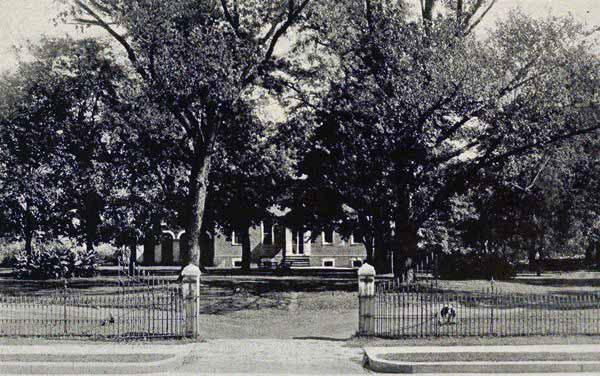
Betty Washington’s Home “Kenmore” Where George Washington’s Sister Lived After Her Marriage. Her Mother’s Home Is Close By