LATIN TRANSLATION AT SIGHT (continued 5)
Reading edition
The Sultan Constitution. It had as little endurance as that of Cromwell, and was finally destroyed in 70 B.C. during the consulship of Pompeius and Crassus.
B19
Speech of Lepidus against Sulla, 78 B.C.
Nam praeter satellites commaculatos quis eadem volt? aut quis non omnia mutata praeter victorem? Scilicet milites, quorum sanguine Tarulae Scyrtoque, pessumis servorum, divitiae partae sunt! Itaque maxumam mihi fiduciam parit victor exercitus, cui 5 per tot volnera et labores nihil praeter tyrannum quaesitum est. Nisi forte tribuniciam potestatem evorsum profecti sunt, per arma conditam a maioribus suis, utique iura et iudicia sibimet extorquerent, egregia scilicet mercede, cum relegati in paludes et 10 silvam contumeliam atque invidiam suam, praemia penes paucos intellegerint. Quare igitur tanto agmine atque animis incedit? Quia secundae res mire sunt vitiis obtentui; quibus labefactis, quam formidatus est, tam contemnetur; nisi forte specie 15 concordiae et pacis, quae sceleri et parricidio suo nomina indidit; neque aliter rempublicam et belli finem ait, nisi maneat expulsa agris plebes, praeda civilis acerbissima, ius iudiciumque omnium rerum penes se, quod populi Romani fuit. Quae si vobis 20 pax et concordia intelleguntur, maxuma turbamenta reipublicae atque exitia probate, annuite legibus impositis, accipite otium cum servitio et tradite exemplum posteris ad populum Romanum suimet sanguinis mercede circumveniundum. 25
Sallust, Hist, Orat. M. Lepidi.
1 Nam, sc. ‘His luck is not so great as he supposes, for. . .’
7-8 tribuniciam . . . evorsum, i.e. by the Leges Corneliae 81 B.C.
9 iudicia. Sulla restored the judicial functions to the Senate (from the Equites).
10 relegati in paludes. Sulla established 120,000 soldiers in military colonies in different parts of Italy, but their roaming adventurous life had unfitted them for agricultural pursuits.
13-14 Quia . . . obtentui = because prosperity serves in a marvellous manner to cover a man’s faults of character.—Holden. For obtentui cf. draw a veil over.
16 parricidio = treason.
18 nisi . . . agris, i.e. Sulla’s confiscations of estates, especially of those Italians who had fought against him.
24-25 ad p. R. circumveniundum = for oppressing (enslaving) the people of Rome.
M. Aemillus Lepidus, Consul 78 B.C., a disappointed Optimate, jealous of Sulla’s power, but without Sulla’s ability. He posed as leader of the democratic party, took up arms against the State, but was defeated by Q. Catulus at the Milvian Bridge, 77 B.C.
B20
WAR WITH SERTORIUS IN SPAIN, 78-72 B.C. (1)
Sertorius and his Fawn.
Huic Sertorio cerva alba eximiae pulchritudinis et vivacissimae celeritatis a Lusitano quodam dono data est. Hanc sibi oblatam divinitus, et instinctam Dianae numine colloqui secum, monereque, et docere, quae utilia factu essent, persuadere omnibus instituit: 5 ac, si quid durius videbatur, quod imperandum militibus foret, a cerva sese monitum tum praedicabat. Id cum dixerat, universi, tamquam si deo, libentes parebant. Ea cerva quodam die, cum incursio esset hostium nuntiata, festinatione ac tumultu consternata 10 in fugam se proripuit, atque in palude proxima delituit; et postea requisita perisse credita est. Neque multis diebus post inventam esse cervam Sertorio nuntiatur. Tum, qui nuntiaverat, iussit tacere: ac, ne cui palam diceret, interminatus est: 15 praecepitque, ut eam postero die repente in eum locum, in quo ipse cum amicis esset, immitteret: admissis deinde amicis postridie, visum sibi esse ait in quiete cervam, quae perisset, ad se reverti, et, ut prius consueverat, quod opus esset facto praedicare. 20 Tum servo, quod imperaverat, significat. Cerva emissa in cubiculum Sertorii introrupit; clamor factus et orta admiratio est: eaque hominum barbarorum credulitas Sertorio in magnis rebus magno usui fuit. 25
Gellius, Noctes Atticae, xv. 22.
1 alba = a dull white as opp. to ater = dull black. Cf. candidus = shining white as opp. to niger = shining black.
3 instinctam = fired, animated.
15 interminatus = he forbade with threats. inter + minor, freq. in Plautus and Terence.
23-25 ‘Sertorius did not disdain to turn to account the superstition of the ruder Spanish tribes, and to have his plans of war brought to him as commands of Diana by the white fawn of the goddess.’—M.
Character of Sertorius. ‘He was the only democratic (Marian) officer who knew how to prepare and to conduct war, and the only democratic statesman who opposed the furious doings of his party with statesmanlike energy. His Spanish soldiers called him the new Hannibal, and not merely because he had, like that hero, lost an eye in war. He in reality reminds us of the great Phoenician by his equally cunning and courageous strategy, and by the quickness of his ingenuity in turning to good account his victories and averting the consequences of his defeats.’—M.
B21
WAR WITH SERTORIUS IN SPAIN (2)
A. A New Hannibal.
Sertorius, exsul et profugus feralis illius tabulae, vir summae quidem sed calamitosae virtutis, malis suis maria terrasque permiscuit; et iam Africae, iam Balearibus insulis fortunam expertus usque in Oceanum Fortunatasque insulas penetravit consiliis, 5 tandem Hispaniam armavit. Viro cum viris facile convenit. Nec alias magis apparuit Hispani militis vigor quam Romano duce. Quamquam ille non contentus Hispania ad Mithridatem quoque Ponticosque respexit regemque classe iuvit. Et quid futurum 10 fuit satis tanto hosti, cui uno imperatore resistere res Romana non potuit? Additus Metello Gnaeus Pompeius. Hi copias attrivere viri prope tota Hispania persecuti. Diu et ancipiti; semper acie pugnatum est nec tamen prius bello quam suorum scelere 15 et insidiis extinctus est.
Florus, III. xxii. 2-6. A.
1 feralis illius tabulae = from that fatal list, i.e. Sulla’s list of proscribed Marians 82 B.C.
9-10 ad Mithridatem . . . iuvit. In 75 B.C. he concluded a formal treaty of alliance with Mithridates, and sent him the propraetor M. Marius to lead his troops. Cf. alliance between Hannibal and Philip.
14-15 Diu et ancipiti semper acie pugnatum est, e.g. the defeat of Pompey near Lauro. (For a graphic account of the strategy by which the battle was won see Frontinus, Strat. ii. 5.)
B. The Death of Sertorius.
M. Perpenna praetorius e proscriptis, gentis clarioris quam animi, Sertorium inter cenam Oscae interemit Romanisque certam victoriam, partibus suis excidium, sibi turpissimam mortem pessimo 20 auctoravit facinore. Metellus et Pompeius ex Hispaniis triumphaverunt.
Vell. Paterc. ii. 30.
17 M. Perpenna praetorius (= ex-praetor), with the remnant of the army of Lepidus (defeated by Pompey in 77 B.C.) joined Sertorius in Spain. After serving under Sertorius for some years, through jealousy, he brought about his leader’s assassination.
21 auctoravit = he brought about. More usu. as auctorari = to hire oneself out for some service, e.g. of gladiators.
The Death of Sertorius. ‘So ended one of the greatest men that Rome had hitherto produced—a man who under more fortunate circumstances would perhaps have become the regenerator of his country.’—M.
B22
Character and Early Career of Lucullus.
Magnum ingenium L. Luculli, magnumque optimarum artium studium, tum omnis liberalis et digna homine nobili ab eo percepta doctrina, quibus temporibus florere in foro maxime potuit, caruit omnino rebus urbanis. Ut enim admodum adolescens, 5 cum fratre pari pietate et industria praedito, paternas inimicitias magna cum gloria est persecutus, in Asiam quaestor profectus, ibi permultos annos admirabili quadam laude provinciae praefuit: deinde absens factus aedilis, continuo praetor: licebat 10 enim celerius legis praemio: post in Africam: inde ad consulatum: quem ita gessit ut diligentiam admirarentur omnes, ingenium cognoscerent. Post ad Mithridaticum bellum missus a senatu non modo opinionem vicit omnium quae de virtute eius erat, sed 15 etiam gloriam superiorum. Idque eo fuit mirabilius, quod ab eo laus imperatoria non admodum exspectabatur, qui adolescentiam in forensi opera, quaesturae diuturnum tempus, Murena bellum in Ponto gerente, in Asiae pace consumpserat. . . . 20 In eodem tanta prudentia fuit in constituendis temperandisque civitatibus, tanta aequitas, ut hodie stet Asia Luculli institutis servandis et quasi vestigiis persequendis.
Cicero, Academica, ii. 1.
1-3 ingenium, studium, doctrina, subjects of caruit.
3-5 quibus temporibus . . . urbanis = all this was divorced (caruit, lit. was cut off from) from the business of the capital, at the season when he might have had a specially brilliant career in the forum.—J. S. Reid.
6 paternas inimicitias = his father’s quarrel. The first appearance of Lucullus in public life was as the accuser of the Augur Servilius who had procured the banishment of his father.
7-9 in Asiam . . . praefuit, i.e. as Sulla’s quaestor in the first Mithridatic War, 88-84 B.C. and then till 80 B.C. in charge of the province of Asia (= orig. Kingdom of Pergamus, N.W. part of Asia Minor).
11 legis praemio = owing to a privilege conveyed by statute. J. S. R.
13-14 ad Mithridaticum bellum, i.e. the 3rd M. War, which he carried on for eight years (74-66 B.C.) with great success, until superseded by Pompeius in 66 B.C.
19-20 Murena . . . gerente. Lic. Murena, anxious for distinction, provoked the disastrous 2nd Mithridatic War, 83-81 B.C., when by the peremptory orders of Sulla the peace was renewed.
23 stet . . . servandis = persists in maintaining (lit. stands by) the ordinances of L.—J. S. R.
Reference. For Character of Lucullus, see Mommsen, vol. iv. pp. 337-8. Cf. also Vell. Paterc. ii. 32.
B23
A. A Soldier of Lucullus.
Luculli miles collecta viatica multis Aerumnis, lassus dum noctu stertit, ad assem Perdiderat; post hoc vehemens lupus, et sibi et hosti Iratus pariter, ieiunis dentibus acer, 30 Praesidium regale loco deiecit, ut aiunt, Summe munito et multarum divite rerum. Clarus ob id factum donis ornatur honestis, Accipit et bis dena super sestertia nummum. Forte sub hoc tempus castellum evertere praetor 35 Nescio quod cupiens hortari coepit eundem Verbis, quae timido quoque possent addere mentem: ‘I, bone, quo virtus tua te vocat, i pede fausto, Grandia laturus meritorum praemia. Quid stas?’ Post haec ille catus, quantumvis rusticus, ‘Ibit, 40 Ibit eo quo vis qui zonam perdidit,’ inquit.
Horace, Ep. II. ii. 26-40.
26 viatica = savings (cf. prize-money). viaticum = originally travelling-money.
28 vehemens lupus = a very wolf in his fury. Cf. Vergil’s simile for a forlorn hope—‘lupi ceu | Raptores.’—Wickham.
32 donis honestis = gifts of honour—i.e. the corona muralis, the mural crown, such as is worn by the goddess Cybele.
33 nummum (= nummorum) = in hard cash.
39 catus = shrewd, witty, a Sabine word, = acutus.
39-40 Ibit . . . quo vis, the original of Juvenal’s ad caelum, iusseris, ibit.
40 zonam = purse. The zona here was a broad belt made double or hollow to carry money in.
B. The Wealth of Lucullus.
20 Chlamydes Lucullus, ut aiunt, Si posset centum scaenae praebere rogatus, ‘Qui possum tot?’ ait; ‘tamen et quaeram, et quot habebo Mittam’: post paulo scribit sibi milia quinque Esse domi chlamydum; partem vel tolleret omnes.
Horace, Ep. I. vi. 40-44.
Subject. Horace says ‘I am like Lucullus’ soldier—when his pocket was empty he would volunteer for forlorn hopes; when it was full again he would do so no more. It was poverty that made me write verses.’—W.
40 Chlamydes. The Chlamys was the light short mantle of the Greeks, here wanted for a pageant on the stage.
44 tolleret. The subj. is the praetor or person giving the show.—W.
Reference. For the magnificence of his Villas at Tusculum and near Neapolis, see Cicero De Fin. ii. § 107, De Leg. iii. § 30, Pliny, N. H. ix. 170.
B24
WAR WITH SPARTACUS, 73-71 B.C.
Spartacus and his Gladiators.
Spartacus, Crixus, Oenomaus effracto Lentuli ludo cum triginta aut amplius eiusdem fortunae viris erupere Capua; servisque ad vexillum vocatis cum statim decem amplius milia coissent, homines modo effugisse contenti iam et vindicari volebant. 5 Prima sedes velut rabidis beluis mons Vesuvius placuit. Ibi cum obsiderentur a Clodio Glabro, per fauces cavi montis vitineis delapsi vinculis ad imas eius descendere radices et exitu inviso nihil tale opinantis ducis subito impetu castra rapuerunt. Adfluentibus 10 in diem copiis cum iam esset iustus exercitus, e viminibus pecudumque tegumentis inconditos sibi clipeos et ferro ergastulorum recocto gladios ac tela fecerunt, Indo iam consulares quoque aggressus in Appennino Lentuli exercitum percecidit, apud 15 Mutinam Gai Cassi castra delevit. Tandem enim totis imperii viribus contra mirmillonem consurgunt, pudoremque Romanum Marcus Crassus asseruit: a quo pulsi fugatique hostes in extrema Italiae refugerunt. Ibi circa Bruttium angulum clusi cum 20 fugam in Siciliam pararent neque navigia suppeterent ratesque ex trabibus et dolia connexa virgultis rapidissimo freto frustra experirentur, tandem eruptione facta dignam viris obiere mortem, et quod sub gladiatore duce oportuit, sine missione 25 pugnatum est. Spartacus ipse in primo agmine fortissime dimicans quasi imperator occisus est.
Florus, III. xx. 3-14 (sel.).
1 Spartacus, by birth a Thracian, who had served among the Thracian auxiliaries in the Roman army, had deserted and become a chief of banditti. He was taken prisoner and sold to a trainer of gladiators.
Crixus, Oenomaus, the slave-names of two Celts.
1-2 effracto ludo = broke out of the gladiators’ school.
8 vitineis vinculis = by means of ropes made of vine-branches.
9 inviso = unknown, lit. unseen.
13 ergastulorum = from the slaves’ work-houses.
17 mirmillonem. The Mirmillones were a class of gladiators usually matched with the Thraces or the retiarii (net-fighters).
18 Marcus Crassus, the Triumvir of 60 B.C.
asseruit = maintained. Cf. our assert.
21 in Siciliam, where the slaves had risen in 133 and 104 B.C., and only waited an impulse to break out a third time.
25 sine missione = without quarter. Cf. missio = the discharge from service of soldiers and gladiators.
B25
THE THIRD MITHRIDATIC WAR, 74-63 B.C. (1)
Lucullus Ponticus.
Quoniam de genere belli dixi, nunc de magnitudine pauca dicam. Atque ut omnes intellegant me L. Lucullo tantum impertire laudis, quantum forti viro et sapienti homini et magno imperatori debeatur, dico eius adventu maximas Mithridatis 5 copias omnibus rebus ornatas atque instructas fuisse urbemque Asiae clarissimam nobisque amicissimam, Cyzicenorum, obsessam esse ab ipso rege maxima multitudine et oppugnatam vehementissime, quam L. Lucullus virtute, assiduitate, consilio summis 10 obsidionis periculis liberavit: ab eodem imperatore classem magnam et ornatam, quae ducibus Sertorianis ad Italiam studio inflammata raperetur, superatam esse atque depressam; magnas hostium praeterea copias multis proeliis esse deletas patefactumque 15 nostris legionibus esse Pontum, qui antea populo Romano ex omni aditu clausus fuisset; Sinopen atque Amisum, quibus in oppidis erant domicilia regis, omnibus rebus ornatas atque refertas, ceterasque urbes Ponti et Cappadociae permultas uno 20 aditu adventuque esse captas; regem spoliatum regno patrio atque avito ad alios se reges atque ad alias gentes supplicem contulisse: atque haec omnia salvis populi Romani sociis atque integris vectigalibus esse gesta. 25
Cicero, pro Lege Manilia, 20, 21.
5-6 maximas . . . fuisse. M. had 140,000 well-trained men, Roman officers sent by Sertorius, 16,000 cavalry, a war-fleet of 400 ships, and abundance of stores.
7-11 urbemque . . . liberavit. The city of Cyzicus stood on the S. side of the island of the same name in the Propontis (Sea of Marmora), close to the shore of Mȳsia, to which it was joined by two bridges.
12-14 classem . . . depressam, i.e. probably the Battle of Tenedos 73 B.C., in which Marcus Marius and the ablest of the Roman emigrants met their death, and the whole Aegean fleet of Mithridates was annihilated.
15 multis proeliis, e.g. of Cabira, 72 B.C.; Tigranocerta, 69 B.C.
18 Sinopen. Sinope, on the W. headland of the great bay of which the delta of the R. Halys forms the E. headland, was the birthplace and residence (domicilia) of M.
22 ad alios reges, e.g. to his son-in-law, Tigranes of Armenia.
23-24 salvis . . . vectigalibus, i.e. without ruining the provincial by forced contributions and requisitions.
Reference. For Siege of Cyzicus, see Mommsen, vol. iv. pp. 326-328; Frontinus, Strat. ii. 13. 6.
B26
CN. POMPEIUS MAGNUS, 106-48 B.C.
His Character, and Career to 66 B.C.
Iam vero virtuti Cn. Pompei quae potest oratio par inveniri? Quid est quod quisquam aut illo dignum, aut vobis novum aut cuiquam inauditum possit adferre? Neque enim illae sunt solae virtutes imperatoriae, quae vulgo esistimantur, labor in 5 negotiis, fortitudo in periculis, industria in agendo, celeritas in conficiendo, consilium in providendo, quae tanta sunt in hoc uno, quanta in omnibus reliquis imperatoribus, quos aut vidimus aut audivimus, non fuerunt. Testis est Italia, quam ille ipse 10 victor L. Sulla huius virtute et subsidio confessus est liberatam: testis est Sicilia, quam multis undique cinctam periculis non terrore belli, sed consilii celeritate explicavit: testis est Africa, quae magnis oppressa hostium copiis eorum ipsorum sanguine 15 redundavit: testis est Gallia, per quam legionibus nostris iter in Hispaniam Gallorum internecione patefactum est: testis est Hispania, quae saepissime plurimos hostes ab hoc superatos prostratosque conspexit: testis est iterum et saepius Italia, quae 20 cum servili bello taetro periculosoque premeretur, ab hoc auxilium absente expetivit, quod bellum exspectatione eius attenuatum atque imminutum est, adventu sublatum ac sepultum: testes nunc vero iam omnes orae atque omnes exterae gentes ac nationes. 25
Cicero, pro Lege Manilia, 29-31.
10-12 Testis est Italia . . . liberatam. In 83 B.C. Pompeius, aged twenty-four, raised three legions in Picenum, gained several advantages over the Marian generals, and was saluted by Sulla as Imperator.
12-14 testis est Sicilia . . . explicavit. In 82 B.C. Pompeius, sent as propraetor to Sicily, quickly took possession of the island for Sulla.
14-16 testis est Africa . . . redundavit. In 81 B.C. Pompeius defeated at Utica the Marian Ahenobarbus (allied with Hiarbas of Numidia), and was, though a simple Roman eques, granted a triumph by Sulla and saluted as Magnus.
16-18 testis est Gallia . . . patefactum est. In 77 B.C., on his way to Spain as proconsul against Sertorius, he had to cut his way through the Transalpine Gauls, and laid out a new and shorter road over the Cottian Alps.
21 servili bello. On his return from Spain he cut to pieces the scattered remnants of the army of Spartacus.
21-23 ab hoc . . . imminutum est. Cic. assumes that the enemy was crippled even by the mere notion of sending for Pompeius.
References. Plutarch, Pompeius; Vell. Paterc. ii. 29.
B27
GAIUS IULIUS CAESAR (1)
The Man Caesar.
Fuisse traditur excelsa statura, colore candido, teretibus membris, ore paulo pleniore, nigris vegetisque oculis, valetudine prospera; nisi quod tempore extremo repente animo linqui atque etiam per somnum exterreri solebat. Armorum et equitandi 5 peritissimus, laboris ultra fidem patiens erat. In agmine nonnunquam equo, saepius pedibus anteibat, capite detecto, seu sol seu imber esset; longissimas vias incredibili celeritate confecit. In obeundis expeditionibus dubium cautior an audentior, 10 exercitum neque per insidiosa itinera duxit umquam nisi perspeculatus locorum situs. A Brundisio Dyrrachium inter oppositas classes hieme transmisit cessantibusque copiis, quas subsequi iusserat, cum ad accersendas frustra saepe misisset, 15 novissime ipse clam noctu parvulum navigium solus obvoluto capite conscendit, neque aut quis esset ante detexit aut gubernatorem cedere adversae tempestati passus est, quam paene obrutus fluctibus. Ne religione quidem ulla a quoquam incepto absterritus 20 umquam vel retardatus est. Cum immolanti aufugisset hostia, profectionem adversus Scipionem et Iubam non distulit. Prolapsus etiam in egressu navis, verso ad melius omine Teneo te, inquit, Africa.
Suetonius, Divus Iulius, 45, 57-59 (sel.)
4 animo linqui = he was subject to fainting-fits.
8 capite detecto, so Cyrus the Younger and Hannibal.
9 incredibili celeritate, cf. Cic. Ep. ad Att. viii. 9 hoc τέρας (= prodigy) horribili vigilantia, celeritate, diligentia est. Cf. also Napoleon the Great.
14 cessantibusque copiis = and when the troops delayed their coming. Caesar did not then know that Antonius had himself been attacked at Brundisium by a Pompeian fleet, and had shown great skill in baffling it, and forcing it to put to sea again. Once more Antonius set sail with 4 legions and 800 horsemen, and fortunately a strong S. wind carried him safely to the port of Lissus (N. of Dyrrachium).
18-19 gubernatorem . . . passus est. ‘Quid times? Caesarem vehis!’ was Caesar’s famous exhortation to the pilot. (Florus.)
21-22 Cum . . . hostia: if the victim even tugged at the rope when being led to sacrifice, it was considered unfortunate, and hence a long slack rope was used. Cf. Juv. xii. 5 Sed procul extensum petulans (butting) quatit hostia funem.
24 According to Frontinus his words were ‘Teneo te, terra mater.’
The man Caesar. ‘We may picture him as a man the dignity of whose bodily presence was in due proportion to the greatness of his mental powers.’—Warde Fowler.
B28
GAIUS IULIUS CAESAR (2)
Captured by Pirates. Studies Oratory at Rhodes, 76-75 B.C.
Composita seditione civili Cornelium Dolabellam consularem et triumphalem repetundarum postulavit; absolutoque Rhodum secedere statuit, et ad declinandam invidiam et ut per otium ac requiem Apollonio Moloni clarissimo tunc dicendi magistro 5 operam daret. Huc dum hibernis iam mensibus traicit, circa Pharmacussam insulam a praedonibus captus est, mansitque apud eos, non sine summa indignatione, prope quadraginta dies cum uno medico et cubicularis duobus. Nam comites servosque 10 ceteros initio statim ad expediendas pecunias, quibus redimeretur, dimiserat. Numeratis deinde quinquaginta talentis, expositus in litore non distulit quin e vestigio classe deducta persequeretur abeuntis, ac redactos in potestatem supplicio, quod saepe illis 15 minatus inter iocum fuerat, adficeret. Vastante regiones proximas Mithridate ne desidere in discrimine sociorum videretur, ab Rhodio quo pertenderat, transiit in Asiam, auxiliisque contractis et praefecto regis provincia expulso, nutantes ac dubias civitates 20 retinuit in fide.
Suetonius, Divus Iulius, 4.
1 Composita seditione civili, i.e. after the abortive attempt of Lepidus to make himself master of the state 77 B.C.
C. Dolabellam, impeached for illegal extortion during his government of Macedonia.
Repetundarum (sc. pecuniarum), post-Aug. for de repetundis (pecuniis), used i. of money extorted by an official and to be returned, ii. of money extorted as a bribe. Caesar lost his case, but succeeded in showing that Sulla’s senatorial judges were corrupt.
4 Apollonio Moloni, the famous rhetorician, whose pupil Cicero was both at Rome and at Rhodes. Very possibly Caesar took this step by the advice of Cicero.
7 circa Pharmacussam insulam: S.W. of Miletus (= mod. Farmako).
8-9 non sine summa indignatione: Plutarch, Caes. gives a picturesque account of his adventures as their prisoner.
10 cubicularis (cubiculum) = lit. chamber-servants.
11 pecunias . . . Velleius says that Caesar’s ransom was paid out of public funds.
14 e vestigio (= statim) = immediately.
Caesar at Rhodes. ‘Caesar, from what we know of his taste and character, could hardly have found the same delight as Cicero in his studies at Rhodes. He nevertheless became one of the greatest orators of his day, and according to some accounts, second only to Cicero. It is characteristic of Caesar, but unfortunate for us, that he never took any pains to collect and preserve his speeches.’—Warde Fowler.
B29
CICERO PROSECUTES VERRES, 70 B.C.
A Roman Citizen maltreated.
Quid ego de P. Gavio, Consano municipe, dicam, indices? Aut qua vi vocis, qua gravitate verborum, quo dolore animi dicam? Quod crimen eius modi est ut, cum primum ad me delatum est, usurum me illo non putarem; tametsi enim verissimum esse 5 intellegebam, tamen credibile fore non arbitrabar. Quid nunc agam? Rem in medio ponam: quae tantum habet ipsa gravitatis ut neque mea, quae nulla est, neque cuiusquam ad inflammandos vestros animos eloquentia requiratur. 10
Caedebatur virgis in medio foro Messanae civis Romanus, iudices; cum interea nullus gemitus, nulla vox alia illius miseri inter dolorem crepitumque plagarum audiebatur, nisi haec, Civis Romanus sum. Hac se commemoratione civitatis omnia verbera 15 depulsurum, cruciatum a corpore deiecturum arbitrabatur. Is non modo hoc non perfecit ut virgarum vim deprecaretur, sed cum imploraret saepius usurparetque nomen civitatis, crux, crux, inquam, infelici et aerumnoso comparabatur. 20
O nomen dulce libertatis! O ius eximium nostrae civitatis! O lex Porcia legesque Semproniae! O graviter desiderata et aliquando reddita plebi Romanae tribunicia potestas! Hucine tandem omnia reciderunt ut civis Romanus in provincia populi Romani, 25 in oppido foederatorum, ab eo qui beneficio populi Romani fasces et secures haberet deligatus in foro virgis caederetur?
Cicero, in Verrem, ii. 5. 62.
1 Consano municipe = a burgess of Consa, on the borders of Lucania.
22 Lex Porcia. Passed by M. Porcius Cato, 197 B.C., forbade the execution or scourging of a Roman citizen.
Leges Semproniae, a code of laws passed by C. Sempronius Gracchus, 123 B.C. One of these declared it to be the sole right of the people to decide capital cases.
22-24 O graviter desiderata . . . potestas! Sulla (Dictator 82-79 B.C.) took from the tribunes the right of proposing laws, and left them only their original right of Intercessio or veto. In 70 B.C. Pompeius, who had formally accepted the democratic programme, gave back to the tribunes the power to initiate legislation.
The Orationes In Verrem. Cicero, as patronus of the Sicilians, undertook the prosecution of the Senator C. Verres for his gross misconduct as governor of Sicily, 73-71 B.C.
B30
CN. POMPEIUS MAGNUS, 106-48 B.C.
The Lex Gabinia, 67 B.C.
Converterat Cn. Pompei persona totum in se terrarum orbem et per omnia maior cive habebatur. Qui cum consul perquam laudabiliter iurasset se in nullam provinciam ex eo magistratu iturum idque servasset, post biennium A. Gabinius tribunus 5 legem tulit, ut cum belli more, non latrociniorum, orbem classibus iam, non furtivis expeditionibus, piratae terrerent, quasdamque etiam Italiae urbis diripuissent, Cn. Pompeius ad eos opprimendos mitteretur essetque ei imperium aequum in omnibus 10 provinciis cum proconsulibus usque ad quinquagesimum miliarium a mari. Quo decreto paene totius terrarum orbis imperium uni viro deferebatur; sed tamen idem hoc ante biennium in M. Antoni praetura decretum erat. Sed interdum persona ut exemplo 15 nocet, ita invidiam auget aut levat: in Antonio homines aequo animo passi erant; raro enim invidetur eorum honoribus, quorum vis non timetur: contra in iis homines extraordinaria reformidant, qui ea suo arbitrio aut deposituri aut retenturi videntur 20 et modum in voluntate habent. Dissuadebant optimates, sed consilia impetu victa sunt.
Velleius Paterculus, ii. 31.
3-5 Qui cum consul . . . servasset. Pompeius, consul with Crassus in 71-70 B.C., thought it beneath his dignity to accept a consular province, and waited in Rome as a simple citizen until an opportunity should be offered him to play an extraordinary part.
5 A. Gabinius, a client of Pompeius, a man ruined in finances and character, but a dexterous negotiator, a bold orator, and a brave soldier. In 57 B.C. did excellent service as proconsul of Syria.
6-9 ut cum belli more . . . diripuissent. ‘For twenty years the sea had been rendered unsafe by these curses of human society.’ The commerce of the whole Mediterranean was in their power.
13-15 sed tamen . . . decretum erat. In 74 B.C. M. Antonius, son of the orator and father of the triumvir, was entrusted by the Senate with the task of clearing the seas from the corsairs. In spite of his extensive powers, the utter incapacity of Antonius, and the mismanagement of the Senate, caused the expedition to end in failure and disgrace.
Result. ‘The Gabinio-Manilian proposals terminated the struggle between the senate and the popular party, which the Sempronian laws (133-123 B.C.) had begun. As the Sempronian laws first constituted the revolutionary party into a political opposition, the Gabinio-Manilian first converted it from an opposition into a government.’—M.
B31
CN. POMPEIUS MAGNUS, 106-48 B.C.
Pompeius clears the Seas of Pirates, 67 B.C.
Quis enim umquam aut obeundi negoti aut consequendi quaestus studio tam brevi tempore tot loca adire, tantos cursus conficere potuit, quam celeriter Cn. Pompeio duce tanti belli impetus navigavit? Qui nondum tempestivo ad navigandum mari Siciliam 5 adiit, Africam exploravit, in Sardiniam cum classe venit, atque haec tria frumentaria subsidia rei publicae firmissimis praesidiis classibusque munivit. Inde cum se in Italiam recepisset, duabus Hispaniis et Gallia transalpina praesidiis ac navibus confirmata, 10 missis item in oram Illyrici maris et in Achaiam omnemque Graeciam navibus Italiae duo maria maximis classibus firmissimisque praesidiis adornavit, ipse autem, ut Brundisio profectus est, undequinquagesimo die totam ad imperium populi Romani 15 Ciliciam adiunxit: omnes, qui ubique praedones fuerant, partim capti interfectique sunt, partim unius huius se imperio ac potestati dediderunt. Ita tantum bellum, tam diuturnum, tam longe lateque dispersum, quo bello omnes gentes ac nationes 20 premebantur, Cn. Pompeius extrema hieme adparavit, ineunte vere suscepit, media aestate confecit.
Cicero, pro Lege Manilia, 34, 35.
4 tanti belli impetus, fig. for an attacking fleet of such force, which from its size would ordinarily sail slowly.—Wilkins.
5-8 Qui . . . munivit. Early in the year (nondum tempestivo ad navigandum) Pompeius cleared of pirates the Sicilian, African, and Sardinian waters, so re-establish the supply of grain from these provinces to Italy.
14-18 undequagesimo . . . dediderunt. The bold Cilician seakings alone ventured to face the Roman fleet in the offing of Coracesium (at the W. frontier of Cilicia), but were completely defeated. Forty-nine days (undequinquagesimo) after Pompeius had appeared in the Eastern seas, Cilicia was subdued, and the war at an end. ‘In all about 1300 piratical vessels are said to have been destroyed: besides which the richly filled arsenals and magazines of the buccaneers were burnt. Of the pirates, about 10,000 perished (interfecti); upwards of 20,000 fell alive (partim capti—partim se dediderunt) into the hands of the victor.’—M.
22 ineunte vere . . . confecit. ‘In the summer of 67 B.C., three months after the beginning of the campaign, commerce resumed its wonted course, and instead of the former famine abundance prevailed in Italy.’—M.
This was the first trial of rule centralised in a single hand, and Pompeius fully justified the confidence that was placed in him.
B32
THE THIRD MITHRIDATIC WAR, 74-63 B.C. (2)
Pompeius subdues Mithridates and Tigranes.
Pompeius interea memorabile adversus Mithridaten, qui post Luculli profectionem magnas novi exercitus vires reparaverat, bellum gessit. At rex fusus fugatusque et omnibus exutus copiis Armeniam Tigranenque generum petit, regem eius temporis, 5 nisi qua Luculli armis erat infractus, potentissimum. Simul itaque duos persecutus Pompeius intravit Armeniam. Prior filius Tigranis, sed discors patri, pervenit ad Pompeium: mox ipse supplex et praesens se regnumque dicioni eius permisit, 10 praefatus neminem alium neque Romanum neque ullius gentis virum futurum fuisse, cuius se societate commissurus foret, quam Pompeium; non esse turpe ab eo vinci, quem vincere esset nefas, neque inhoneste aliquem summitti huic, quem fortuna super 15 omnes extulisset. Servatus regi honos imperi, sed multato ingenti pecunia, quae omnis, sicuti Pompeio moris erat, redacta in quaestoris potestatem ac publicis descripta litteris. Syria aliaeque, quas occupaverat, provinciae ereptae, et aliae restitutae populo 20 Romano, aliae tum primum in eius potestatem redactae, ut Syria, quae tum primum facta est stipendiaria. Finis imperi regi terminatus Armenia.
Velleius Paterculus, ii. 37.
Context. In 66 B.C. Lucullus, of whom Mommsen says ‘hardly any other Roman general accomplished so much with so trifling means,’ was superseded by Pompeius. By the Lex Manilia Pompeius obtained, in addition to the extensive powers conferred upon him by the Lex Gabinia 67 B.C., the military administration of Asia as far as Armenia. ‘Never since Rome stood had such power been united in the hands of a single man.’—M.
3-4 rex fusus . . . copiis, i.e. in Lesser Armenia, on S. bank of R. Lycus, where Pompeius afterwards founded Nicopolis.
5 Tigranenque generum petit. Tigranes had married Cleopatra, the daughter of Mithridates.
17-19 quae omnis . . . litteris, i.e. paid into the Roman treasury. Cf. Lucan ix. 197 Immodicas possedit opes, sed plura retentis | Intulit sc. in aerarium.
The End of Mithridates. After his defeat at Nicopolis the aged king took refuge in his Northern capital of Panticapaeum (on the Cimmerian Bosporus). Here, when all turned against him, he took poison, 63 B.C. ‘In him a great enemy was borne to the tomb, a greater than had ever yet withstood the Romans in the indolent East.’—M.
Syria made a Roman Province, 65 B.C.
B33
GAIUS IULIUS CAESAR (3)
A. Curule Aedile, 65 B.C.
Aedilis praeter comitium ac forum basilicasque etiam Capitolium ornavit porticibus ad tempus exstructis, in quibus abundante rerum copia pars apparatus exponeretur. Venationes autem ludosque et cum collega et separatim edidit, quo factum est, 5 ut communium quoque impensarum solus gratiam caperet, nec dissimularet collega eius Marcus Bibulus evenisse sibi quod Polluci: ut enim geminis fratribus aedes in foro constituta tantum Castoris vocaretur, ita suam Caesarisque munificentiam unius Caesaris 10 dici.
Suetonius, Divus Iulius, 10.
1 Aedilis. As curule-aedile Caesar exceeded all previous expenditure. This was meant to secure the favour of the democracy, and gain the position of its leader, which was in fact vacant; for Crassus was never popular, and Pompeius was absent in the East.
basilicas (βασιλική sc. οἰκία and στοά: regia) = halls.
2 porticibus: these acted as booths, in a grand fair, as we should say.
4 Venationes, here of the combats with wild beasts.
7 M. Bibulus, also Caesar’s colleague in his first consulship, 59 B.C.
B. Propraetor in Further Spain, 61 B.C.
Ex praetura ulteriorem sortitus Hispaniam, retinentes creditores interventu sponsorum removit, ac neque more neque iure, ante quam provinciae ornarentur, profectus est; pacataque provincia, pari 15 festinatione, non expectato successore, ad triumphum simul consulatumque decessit. Sed cum, edictis iam comitiis, ratio eius haberi non posset nisi privatus introisset urbem, et ambienti ut legibus solveretur multi contradicerent, coactus est triumphum, 20 ne consulatu excluderetur, dimittere.
Suetonius, Divus Iulius, 18.
Context. In 69 B.C. Caesar was elected to a Quaestorship (the lowest step in the ladder of official life) and discharged his judicial duties in Further Spain with tact and industry.
13 retinentes . . . removit = freed himself from his creditors, who were for detaining him, by the help of sureties. Caesar is said to have borrowed from Crassus 830 talents.
14-15 ante quam provinciae ornarentur: a regular phrase used of supplying the newly chosen magistrate with money, arms, attendants, etc.
18 ratio . . . posset = his candidature could not be considered.
Propraetor in F. Spain. ‘His governorship enabled him partly to rid himself of his debts partly to lay the foundation for his military repute.’—M.
B34
THE CONSPIRACY OF CATILINE, 63 B.C. (1)
Cicero declaims against the Audacity of Catiline.
Quo usque tandem abutere, Catilina, patientia nostra? Quam diu etiam furor iste tuus nos eludet? Quem ad finem sese effrenata iactabit audacia? Nihilne te nocturnum praesidium Palati, nihil urbis vigiliae, nihil timor populi, nihil concursus bonorum 5 omnium, nihil hic munitissimus habendi senatus locus, nihil horum ora voltusque moverunt? Patere tua consilia non sentis? Constrictam iam horum omnium scientia teneri coniurationem tuam non vides? Quid proxima, quid superiore nocte egeris, 10 ubi fueris, quos convocaveris, quid consilii ceperis, quem nostrum ignorare arbitraris? O tempora! O mores! Senatus haec intellegit; consul videt: hic tamen vivit. Vivit? immo vero etiam in senatum venit: fit publici consilii particeps; notat at designat 15 oculis ad caedem unum quemque nostrum. . . . Castra sunt in Italia contra rem publicam in Etruriae faucibus collocata: crescit in dies singulos hostium numerus; eorum autem castrorum imperatorem ducemque hostium intra moenia atque 20 adeo in senatu videmus intestinam aliquam cotidie perniciem rei publicae molientem. Si te iam, Catilina, eomprehendi, si interfici iussero, credo, erit verendum mihi ne non hoc potius omnes boni serius a me quam quisquam crudelius factum esse dicat. 25
Cicero, in Catilinam, i. §§ 1, 2, 5.
1 Quo usque tandem abutere = how long, pray, will you presume upon? Catiline had been declared hostis patriae, and yet dared to appear in the Senate.
4 praesidium Palati: in the case of any threatening danger the Mons Palatinus was occupied as one of the most important military points in the city.
6-7 senatus locus, i.e. the temple of Jupiter Stator, on the N. slope of the Palatine, chosen as the safest meeting-place, and near Cicero’s house.
17-18 castra . . . collocata, the camp of Manlius (one of the veteran centurions of Sulla) was planted at Faesulae (Fiesole), a rocky fastness three miles N.E. of Florence.
19 imperatorem: ironical, as though Catiline were the legally appointed general of the Republic.
In L. Catilinam Oratio i. ‘This splendid oration, in its fiery vigour and mastery of invective, is unsurpassed except by the Second Philippic.’—Cruttwell.
Its effect on Catiline. Tum ille furibundus ‘quoniam quidem circumventus’ inquit ‘ab inimicis praeceps agor, incendium meum ruina restinguam.’ Sall. Catil. 31. That night Catiline left Rome for the camp of Manlius.
B35
THE CONSPIRACY OF CATILINE, 63 B.C. (2)
The End of Catiline.
Sed confecto proelio tum vero cerneres, quanta audacia quantaque vis animi fuisset in exercitu Catilinae. Nam fere, quem quisque vivus pugnando locum ceperat, eum, amissa anima, corpore tegebat. Pauci autem, quos medios cohors praetoria disiecerat, 5 paulo divorsius, sed omnes tamen advorsis volneribus conciderant. Catilina vero longe a suis inter hostium cadavera repertus est, paululum etiam spirans ferociamque animi, quam habuerat vivus, in voltu retinens. Postremo ex omni copia neque in 10 proelio neque in fuga quisquam civis ingenuus captus est. Ita cuncti suae hostiumque vitae iuxta pepercerant. Neque tamen exercitus populi Romani laetam aut incruentam victoriam adeptus erat; nam strenuissumus quisque aut occiderat in proelio, aut 15 graviter volneratus discesserat. Multi autem, qui de castris visundi aut spoliandi gratia processerant, volventes hostilia cadavera, amicum alii, pars hospitem aut cognatum reperiebant; fuere item, qui inimicos suos cognoscerent. Ita varie per omnem 20 exercitum laetitia, maeror, luctus atque gaudia agitabantur.
Sallust, Bellum Catilinae, 61.
5 cohors praetoria: a corps d’élite, specially organised as a bodyguard of the general (praetor = praeitor, prae + eo), dating from the time when the praetores was the older name of the consuls (= colleagues).
8 etiam (= adhuc) = still. Cf. Verg. Aen. vi. 485 etiam currus etiam arma tenentem.
11 civis ingenuus, i.e. a free citizen born of free citizens.
12 Ita cuncti . . . pepercerant = so unsparing had they all been alike of their own and their opponents’ lives.—Pollard.
21 laetitia = joy manifested, gaudia = joy felt.
luctus = grief shown by outward signs, e.g. by dress.
maeror = grief shown by inward signs, e.g. by tears, or a sad face.
The Battle of Pistoria (Pistoia, N.W. of Faesulae). ‘Catiline showed on this day that nature had destined him for no ordinary things, and that he knew at once how to command and how to fight as a soldier. At length Petreius, with his bodyguard, broke the centre of the enemy, and then attacked the two wings from within. This decided the day.’—M.
The character of Catiline. ‘He was one of the most wicked men in that wicked age. He possessed in a high degree the qualities which are required in the leader of a band of ruined and desperate men—the faculty of enjoying all pleasures and of bearing all privations, courage, military talent, knowledge of men, indomitable energy.’—M. Cf. Sall. Catil. 5.
B36
GAIUS IULIUS CAESAR (4).
Forms the First Triumvirate: Consul, 60-59 B.C.
Hoc igitur consule inter eum et Cn. Pompeium et M. Crassum inita potentiae societas, quae urbi orbique terrarum nec minus diverso quoque tempore ipsis exitiabilis fuit. Hoc consilium sequendi Pompeius causam habuerat, ut tandem acta in 5 transmarinis provinciis, quibus, ut praediximus, multi obtrectabant, per Caesarem confirmarentur consulem, Caesar autem, quod animadvertebat se cedendo Pompei gloriae aucturum suam et invidia communis potentiae in illum relegata confirmaturum 10 vires suas, Crassus, ut quem principatum solus adsequi non poterat, auctoritate Pompei, viribus teneret Caesaris. Adfinitas etiam inter Caesarem Pompeiumque contracta nuptiis, quippe Iuliam, filiam C. Caesaris, Cn. Magnus duxit uxorem. In 15 hoc consulatu Caesar legem tulit, ut ager Campanus plebei divideretur, suasore legis Pompeio: ita circiter XX milia civium eo deducta et ius urbis restitutum post annos circiter CLII quam bello Punico ab Romanis Capua in formam praefecturae 20 redacta erat. Bibulus, collega Caesaris, cum actiones eius magis vellet impedire quam posset, maiore parte anni domi se tenuit: quo facto dum augere vult invidiam collegae, auxit potentiam. Tum Caesari decretae in quinquennium Galliae. 25
Vell. Pat. ii. 44.
1-2 inter eum . . . societas, the famous First Triumvirate. ‘It was at first an expedient to secure, as we should say, a working majority for a vigorous democratic policy, but the bitterness of its enemies transformed the coalition itself from an honourable union into the semblance of a three-headed tyranny.’—Warde Fowler.
4-7 The ultra-senatorial party (after Pompeius’ great act of renunciation, when he dismissed his victorious veterans in 62 B.C.) had checked and worried Pompeius by refusing to ratify his arrangements in the East, and by criticising and opposing his plans for rewarding his veterans. Thus they deliberately drove him once more into the arms of Caesar and the democracy.
10 relegata = attributed, imputed, lit. removed (re + lēgo).
21 Bibulus, collega Caesaris: cf. Suet. Divus Iulius 20:
Non Bibulo quicquam, nuper sed Caesare factum est: Nam Bibulo fieri consule nil memini.
Caesar’s First Consulship. Among his other acts was the famous Lex Iulia de pecuniis repetundis (against official extortion in the provinces), which won strong praise even from Cicero himself.
B37
THE GALLIC WAR, 58-50 B.C. (1)
‘That day he overcame the Nervii,’ 57 B.C.
Caesar ab decimae legionis cohortatione ad dextrum cornu profectus, ubi suos urgeri signisque in unum locum collatis duodecimae legionis confertos milites sibi ipsos ad pugnam esse impedimento vidit—quartae cohortis omnibus centurionibus occisis, 5 signifero interfecto, signo amisso, reliquarum cohortium omnibus fere centurionibus aut vulneratis aut occisis, in his primipilo P. Sextio Baculo, fortissimo viro, multis gravibusque volneribus confecto, ut iam se sustinere non posset; reliquos esse tardiores et nonnullos 10 ab novissimis deserto proelio excedere ac tela vitare, hostes neque a fronte ex inferiore loco subeuntes intermittere et ab utroque latere instare, et rem esse in angusto vidit neque ullum esse subsidium quod submitti posset, scuto ab novissimis 15 militi detracto, quod ipse eo sine scuto venerat, in primam aciem processit; centurionibusque nominatim appellatis reliquos cohortatus milites signa inferre et manipulos laxare iussit, quo facilius gladiis uti possent. Cuius adventu spe illata militibus ac 20 redintegrato animo, cum pro se quisque in conspectu imperatoris etiam in extremis suis rebus operam navare cuperet, paulum hostium impetus tardatus est.
Caesar, de B. G. ii. 25.
Context. The Nervii, the bravest of the Belgae, surprised Caesar’s men while at work on their camp. There was no time to think: they took station where they could. The 9th and 10th legions on the left broke and pursued the enemy in front of them, and the two legions in the centre stood firm. But on the right there was a gap, and the Nervii were rapidly surrounding the two legions huddled together here, and the fight threatened every moment to become a second Cannae, when Caesar restored the fight. Labienus sent back the victorious 10th, who took the enemy in their rear, and the cavalry completed the victory.
14-15 neque ullum . . . posset: the rear guard, the 13th and 14th legions, had not yet come up.
18-19 signa . . . laxare = to charge and (thus) open out the ranks.
22-23 operam navare = to do their very best. navo (orig. gnavo; cf. γνώσκω) = lit. to make known, to exhibit.
The Battle of the Sambre. One of the most desperate that Caesar ever fought. The memory of it lived in Caesar’s mind so vividly that he seems to fight the battle over again as he describes it, in language for him unusually strong and intense.—W. F.
Result of the Battle, the submission of North West Gaul.
B38
THE GALLIC WAR, 58-50 B.C. (2)
Naval Battle with the Veneti, 56 B.C.
Una erat magno usui res praeparata a nostris,—falces praeacutae insertae affixaeque longuriis non absimili forma muralium falcium. His cum funes qui antemnas ad malos destinabant comprehensi adductique essent, navigio remis incitato praerumpebantur. 5 Quibus abscisis antemnae necessario concidebant; ut, cum omnis Gallicis spes in velis armamentisque consisteret, his ereptis omnis usus navium uno tempore eriperetur. Reliquum erat certamen positum in virtute, qua nostri milites facile 10 superabant atque eo magis, quod in conspectu Caesaris atque omnis exercitus res gerebatur, ut nullum paulo fortius factum latere posset; omnes enim colles ac loca superiora, unde erat propinquus despectus in mare, ab exercitu tenebantur. Disiectis, ut diximus, 15 antemnis, cum singulas binae ac ternae naves circumsteterant, milites summa vi transcendere in hostium naves contendebant. Quod postquam barbari fieri animadverterunt, expugnatis compluribus navibus, cum ei rei nullum reperiretur auxilium, fuga 20 salutem petere contenderunt. Ac iam conversis in eam partem navibus quo ventus ferebat, tanta subito malacia ac tranquillitas exstitit ut se ex loco movere non possent. Quae quidem res ad negotium conficiendum maxime fuit opportuna; nam singulas 25 nostri consectati expugnaverunt, ut perpaucae ex omni numero noctis interventu ad terram pervenerint, cum ab hora fere quarta usque ad solis occasum pugnaretur.
Caesar, de B. G. iii. 14, 15.
Context. In the winter of 57-6 Roman officers, who came to levy requisitions of grain, were detained by the Veneti. Caesar’s attack on their coast-towns failed to reduce them to submission: so he determined to wait for his fleet. This he entrusted to Decimus Brutus, an able and devoted officer. At first the Roman galleys were powerless against the high-decked strong sailing-vessels of the Veneti, but the use of the murales falces, and the opportune calm, enabled Brutus to annihilate their fleet.
11-12 quod . . . gerebatur. Napoleon (Caesar, vol. ii. p. 6) thinks that Caesar was encamped on the heights of Saint Gildas overlooking Quiberon Bay.
23 malacia = a calm, but μαλακία = softness, L. mollities.
Result of the Victory—the surrender of the Veneti and of all Brittany. The earliest historical naval battle fought on the Atlantic Ocean.—M.
B39
THE GALLIC WAR, 58-50 B.C. (3)
Caesar’s Bridge across the Rhine, 55 B.C.
Rationem pontis hanc instituit. Tigna bina sesquipedalia paulum ab imo praeacuta, dimensa ad altitudinem fluminis, intervallo pedum duorum inter se iungebat. Haec cum machinationibus immissa in flumen defixerat fistucisque adegerat—non sublicae 5 modo derecte ad perpendiculum, sed prone ac fastigate, ut secundum naturam fluminis procumberent—eis item contraria duo ad eundem modum iuncta intervallo pedum quadragenum ab inferiore parte contra vim atque impetum fluminis conversa statuebat. 10 Haec utraque insuper bipedalibus trabibus immissis, quantum eorum tignorum iunctura distabat, binis utrimque fibulis ab extrema parte distinebantur; quibus disclusis atque in contrariam partem revinctis, tanta erat operis firmitudo atque 15 ea rerum natura ut, quo maior vis aquae se incitavisset, hoc artius illigata tenerentur. Haec derecta materia iniecta contexebantur ac longuriis cratibusque consternebantur; ac nihilo setius sublicae et ad inferiorem partem fluminis oblique agebantur, quae 20 pro ariete subiectae et cum omni opere coniunctae vim fluminis exciperent; et aliae item supra pontem mediocri spatio, ut, si arborum trunci sive naves deiciendi operis essent a barbaris immissae, his defensoribus earum rerum vis minueretur, neu ponti 25 nocerent.
Caesar, de B. G. iv. 17.
Context. The year 55 B.C. appears to have been marked by a general movement in the migration of the German tribes. An advance, consisting of two tribes, the Usipetes and Tenctri, crowded forward by the more powerful Suevi, crossed the Lower Rhine into N. Gaul. Caesar drove them back across the Rhine, bridged the river, followed them up into their own territories, and fully established the supremacy of the Roman arms.—Allen and Greenough.
5 fistucisque adegerat = and had driven them home (ad-) with rammers. For Plan of Bridge see Allen’s Caesar, p. 103.
11-14 Haec . . . distinebantur = these two sets were held apart by two-feet timbers laid on above, equal (in thickness) to the interval left by the fastening of the piles (quantum . . . distabat), with a pair of ties (fibulis) at each end.—A. & G.
17-18 Haec . . . contexebantur = these (i.e. the framework of timber) were covered over by boards (materia) laid lengthwise.
longuriis = with long poles.
The Bridge (prob. near Bonn). ‘With extraordinary speed (in ten days) the bridge was completed. It was a triumph of engineering and industry.’—W. F.
B40
THE GALLIC WAR, 58-50 B.C. (4)
Cassivellaunus. Second Invasion of Britain, 54 B.C.
Cassivellaunus, omni deposita spe contentionis, dimissis amplioribus copiis, milibus circiter quattuor essedariorum relictis itinera nostra servabat: paulumque ex via excedebat locisque impeditis ac silvestribus sese occultabat, atque eis regionibus quibus 5 nos iter facturos cognoverat pecora atque homines ex agris in silvas compellebat; et cum equitatus noster liberius praedandi vastandique causa se in agros eiecerat, omnibus viis semitisque essedarios ex silvis emittebat; et magno cum periculo nostrorum 10 equitum cum eis confligebat atque hoc metu latius vagari prohibebat. Relinquebatur ut neque longius ab agmine legionum discedi Caesar pateretur, et tantum in agris vastandis incendiisque faciendis hostibus noceretur quantum in labore atque itinere 15 legionarii milites efficere poterant. . . . Cassivellaunus hoc proelio nuntiato, tot detrimentis acceptis, vastatis finibus, maxime etiam permotus defectione civitatum, legatos per Atrebatem Commium de deditione ad Caesarem mittit. 20
Caesar, de B. G. v. 19, 22.
Context. The First Invasion of Britain (55 B.C.) was only a visit of exploration; but in the Second Invasion (54 B.C.) Caesar aimed at a partial conquest. He had been hearing of Britain ever since he came to Gaul, and knew it to be a refuge for his Celtic enemies and a secret source of their strength. He set sail from the Portus Ittius (mod. Wissant, some twelve miles W. of Calais) and after drifting some way to the N.E., made his way to his former landing-place, probably near Romney. Some severe fighting followed, till at length Caesar crossed the Thames (apparently between Kingston and Brentford) and entered the country of Cassivellaunus, who gave Caesar much trouble by his guerilla tactics. Deserted by his allies, Cassivellaunus offered his submission, which Caesar gladly accepted.
1 Contentionis, i.e. of a general engagement with Caesar.
12 Relinquebatur ut = the consequence was that . . .
17 hoc proelio, i.e. the storming by Caesar of his fortified camp, perh. St. Albans.
18-19 defectione civitatum, espec. of the Trinobantes (chief place Camulodunum, later Colonia castrum = Colchester).
19 Commium, Caesar had made him King of the Atrebates (N.W. Gaul).
Caesar In Britain. ‘What he tells us of the geography and inhabitants of the Island comprises almost all we know, except from coins, down to the time of its final conquest by Clodius 51 A.D.’—W. F.
B41
THE GALLIC WAR, 58-50 B.C. (5)
The Gallic uprising. Fabian tactics of Vercingetorix, 52 B.C.
Vercingetorix tot continuis incommodis acceptis suos ad concilium convocat. Docet ‘longe alia ratione esse bellum gerendum atque antea gestum sit; omnibus modis huic rei studendum ut pabulatione et commeatu Romani prohibeantur: id esse 5 facile, quod equitatu ipsi abundent et quod anni tempore subleventur; pabulum secari non posse; necessario dispersos hostes ex aedificiis petere; hos omnes cotidie ab equitibus deleri posse. Praeterea, salutis causa rei familiaris commoda neglegenda; 10 vicos atque aedificia incendi oportere hoc spatio quoqueversus, quo pabulandi causa adire posse videantur. Harum ipsis rerum copiam suppetere, quod quorum in finibus bellum geratur eorum opibus subleventur: Romanos aut inopiam non laturos aut 15 magno cum periculo longius a castris processuros; neque interesse ipsosne interficiant an impedimentis exuant, quibus amissis bellum geri non possit. Praeterea, oppida incendi oportere quae non munitione et loci natura ab omni sint periculo tuta; ne 20 suis sint ad detrectandam militiam receptacula, neu Romanis proposita ad copiam commeatus praedamque tollendam. Haec si gravia aut acerba videantur, multo illa gravius aestimari debere, liberos, coniuges in servitutem abstrahi, ipsos interfici; 25 quae sit necesse accidere victis.’
Caesar, de B. G. vii. 14.
Context. On his return from Britain, Caesar found the N. Gauls in open revolt. The division of Sabinus (at Aduatuca, near Liège) was annihilated by Ambiorix, and Caesar was only just in time to relieve Q. Cicero at Charleroi. To prevent all further support to the Gauls from the Germans across the Rhine, Caesar again made a military demonstration across the river, and put an end to all the hopes of the Germans of breaking through this boundary. In the winter of 53-2 B.C., during his absence in Cisalpine Gaul, a general uprising of the S. and Central Gauls took place under the Arvernian Vercingetorix, the hero of the whole Gallic race.
6-7 anni tempore, i.e. scarcely yet spring, when no crops could be got off the land.
11-12 hoc spatio quoqueversus, quo = so far in every direction as.
19 oppida incendi: only Avaricum (Bourges) was to be spared.
22 proposita = offered to be captured by the Romans.
The tactics of Vercingetorix. ‘He adopted a system of warfare similar to that by which Cassivellaunus had saved the Celts of Britain.’—M.
B42
THE GALLIC WAR, 58-50 B.C. (6)
Siege of Gergovia. Petronius dies to save his men, 52 B.C.
Cum acerrime comminus pugnaretur, hostes loco et numero, nostri virtute confiderent, subito sunt Aedui visi ab latere nostris aperto, quos Caesar ab dextra parte alio ascensu manus distinendae causa miserat. Hi similitudine armorum vehementer 5 nostros perterruerunt. Eodem tempore L. Fabius centurio quique una murum ascenderant circumventi atque interfecti de muro praecipitabantur. M. Petronius, eiusdem legionis centurio, cum portas excidere conatus esset, a multitudine oppressus ac sibi desperans, 10 multis iam volneribus acceptis, manipularibus suis qui illum secuti erant, ‘Quoniam,’ inquit, ‘me una vobiscum servare non possum, vestrae quidem certe vitae prospiciam, quos cupiditate gloriae adductus in periculum deduxi. Vos data facultate vobis consulite.’ 15 Simul in niedios hostes irrupit, duobusque interfectis reliquos a porta paulum submovit. Conantibus auxiliari suis, ‘Frustra,’ inquit, ‘meae vitae subvenire conamini, quem iam sanguis viresque deficiunt. Proinde abite dum est facultas vosque ad 20 legionem recipite.’ Ita pugnans post paulum concidit ac suis saluti fuit.
Caesar, de B. G. vii. 50.
Context. With a half-starved army Caesar stormed Avaricum after a most obstinate defence, and then laid siege to the Arvernian capital of Gergovia, in hope of destroying Vercingetorix and ending the war. As the town was too strong to be taken by storm, he resolved to try a blockade, but he failed, as at Dyrrachium in 49 B.C., from want of sufficient troops.
A last desperate attack on the town was repulsed, and Caesar, defeated for the first time, was forced to raise the siege.
3 ab latere nostris aperto: as a soldier carries his shield on the left arm, leaving the sword hand free, this (right) side is called latus apertum.—Compton.
4 manus distinendae causa = for the purpose of diverting (distinendae, lit. hold off) the enemy’s force.
6 perterruerunt: this was all the more natural, as the Aeduan contingent was only awaiting the result of the blockade, to openly join the insurgents.
9 excidere = to cut away, hew down, i.e. from within.
Gergovia, 4 miles S. of Clermont. This famous stronghold consists of a rectangular plateau nearly a mile in length, and some 1300 feet above the plain through which the Allier flows, and descending steeply on all sides but one to the ground.
Caesar’s failure. ‘The fact was that chiefly owing to the nature of the ground and their own ardour, Caesar’s men were not well in hand.’—W. F.
B43
THE GALLIC WAR, 58-50 B.C. (7)
Siege of Alesia. The Last Fight of Vercingetorix, 52 B.C.
Vercingetorix ex arce Alesiae suos conspicatus ex oppido egreditur: crates, longurios, musculos, fasces, reliquaque quae eruptionis causa paraverat profert. Pugnatur uno tempore omnibus locis atque omnia temptantur; quae minime visa pars firma est huc 5 concurritur. Romanorum manus tantis munitionibus distinetur nec facile pluribus locis occurrit. . . . Labienus, postquam neque aggeres neque fossae vim hostium sustinere poterant, coactis XI cohortibus, quas ex proximis praesidiis deductas fors obtulit, 10 Caesarem per nuntios facit certiorem quid faciendum existimet. Accelerat Caesar ut proelio intersit. Eius adventu ex colore vestitus cognito (quo insigni in proeliis uti consuerat), turmisque equitum et cohortibus visis quas se sequi iusserat, ut de locis 15 superioribus haec declivia et devexa cemebantur, hostes proelium committunt. Utrimque clamore sublato excipit rursus ex vallo atque omnibus munitionibus clamor. Nostri omissis pilis gladiis rem gerunt. Repente post tergum equitatus cernitur: 20 cohortes aliae appropinquant. Hostes terga vertunt; fugientibus equites occurrunt: fit magna caedes: pauci ex tanto numero se incolumes in castra recipiunt.
Caesar, de B. G. vii. 84, 87, 88.
Context. After his successful defence of Gergovia, Vercingetorix allowed his judgment to be overruled, and attacked Caesar’s army (now united to the division of Labienus) on the march. Caesar shook off the enemy with the help of his German cavalry, and turned their retreat into a rout. V. then threw himself with all his forces into Alesia. Caesar constructed an inner line of investment and an outer line of defence, and was thus able to wear out the besieged and beat back the relieving host of the Gauls.
1 suos, i.e. the host (some 250,000) of the relieving army of Gauls.
2 musculos (dimin. of mus) = pent-houses or sheds.
4 omnibus locis, i.e. along the whole length of Caesar’s outer line of defence, where it ran along the slope of Mont Réa, to the N.W. of Alesia. This, as the relieving Gauls were quick to see, was the weakest point of the whole line.
13 ex colore vestitus, i.e. the purple or scarlet paludamentum.
Vercingetorix. The Celtic officers delivered up V. to Caesar, to be led in triumph five years later, and beheaded as a traitor. In 1865 a statue was erected on the summit of Alesia, in honour of the heroic Gaul.
The fall of Alesia decided the fate of Gaul.
B44
CICERO IN EXILE, March 58 B.C.-August 57 B.C. (1)
His Banishment.
Per idem tempus P. Clodius, homo nobilis, disertus, audax, quique dicendi neque faciendi ullum nisi quem vellet nosset modum, malorum propositorum exsecutor acerrimus, cum graves inimicitias cum M. Cicerone exerceret (quid enim inter tam 5 dissimilis amicum esse poterat?) et a patribus ad plebem transisset, legem in tribunatu tulit, qui civem Romanum non damnatum interemisset, ei aqua et igni interdiceretur: cuius verbis etsi non nominabatur Cicero, tamen solus petebatur. Ita vir optime 10 meritus de re publica conservatae patriae pretium calamitatem exili tulit. Non caruerunt suspicione oppressi Ciceronis Caesar et Pompeius. Hoc sibi contraxisse videbatur Cicero, quod inter xx viros dividendo agro Campano esse noluisset. Idem intra 15 biennium sera Cn. Pompei cura, verum ut coepit intenta, votisque Italiae ac decretis senatus, virtute atque actione Anni Milonis tribuni pl. dignitati patriaeque restitutus est. Neque post Numidici exilium ac reditum quisquam aut expulsus invidiosius 20 aut receptus est laetius: cuius domus quam infeste a Clodio disiecta erat, tam speciose a senatu restituta est.
Velleius Paterculus, ii. 45.
6-7 a patribus . . . transisset. When Cicero refused to throw in his lot with the Triumvirs, Publius Clodius was (by the aid of Caesar as Pontifex Maximus) hurriedly transferred from a patrician to a plebeian gens, and then chosen a tribune of the people for the year 58 B.C. Clodius was thus enabled to satisfy his private hatred of Cicero, and Caesar was enabled to get rid of the man who persisted in opposing him.
7-8 qui . . . interemisset: aimed at Cicero for his share in the summary execution of the Catilinarians 63 B.C. Mommsen calls it a judicial murder. Undoubtedly the Senate had not the power of sentencing citizens to death. But Cicero argues that the legal effect of the Senatus consultum ultimum was to disenfranchise Lentulus and his associates, and to place them in the position of outlaws.
12-13 Non caruerunt . . . Pompeius: Caesar having in vain tried to win him over abandoned him to his fate, and Pompeius basely deserted him.
15 dividendo agro Campano, i.e. by Caesar’s Agrarian Law of 59 B.C., to provide for Pompey’s veterans.
18 Anni Milonis: the bravoes of Milo protected from disturbance the voters engaged in sanctioning the decree for the recall of Cicero.
19 Numidici, i.e. Q. Caecilius Metellus, general against Jugurtha, superseded by Marius and forced to retire to Rhodes.
B45
CICERO IN EXILE, March 58 B.C.-August 57 B.C. (2)
His Return.
Pr. Nonas Sextiles Dyrrachio sum profectus, ipso illo die, quo lex est lata de nobis; Brundisium veni Nonis Sextilibus: ibi mihi Tulliola mea fuit praesto natali suo ipso die, qui casu idem natalis erat et Brundisinae coloniae et tuae vicinae Salutis; quae 5 res animadversa a multitudine summa Brundisinorum gratulatione celebrata est. Ante diem vi Idus Sextiles cognovi, cum Brundisii essem, litteris Quinti, mirifico studio omnium aetatum atque ordinum, incredibili concursu Italiae legem comitiis 10 centuriatis esse perlatam: inde a Brundisinis honestissimis ornatus iter ita feci, ut undique ad me cum gratulatione legati convenerint. Ad urbem ita veni, ut nemo ullius ordinis homo nomenclatori notus fuerit, qui mihi obviam non venerit, praeter eos 15 inimicos, quibus id ipsum, se inimicos esse, non liceret aut dissimulare aut negare. Cum venissem ad portam Capenam, gradus templorum ab infima plebe completi erant, a qua plausu maximo cum esset mihi gratulatio significata, similis et frequentia 20 et plausus me usque ad Capitolium celebravit, in foroque et in ipso Capitolio miranda multitudo fuit. Postridie in senatu, qui fuit dies Nonarum Septembr., senatui gratias egimus.
Cicero, Ep. ad Att. iv. 1.
1 Dyrrachio (formerly Epidamnus, mod. Durazzo), a town in Illyria, on a peninsula in the Adriatic. It was the usual port of landing and departure from and for Brundisium (distant about 100 miles).
3 Tulliola, Cicero’s dearly-loved daughter Tullia, the only one of his family of whose conduct he never complains, and his tender and sympathising companion in all his pursuits.
4-5 qui casu . . . coloniae. Brundisium was founded 244 B.C. The Via Appia terminated here.
5 tuae vicinae Salutis, the Temple of Salus on the Quirinal was near the house of Atticus.
9 Quinti (sc. Ciceronis): Cicero’s only brother, a gallant soldier (e.g. as legatus to Caesar in Gaul), but a man of violent temper. Proscribed by the Triumvirs, and put to death in 43 B.C.
11-12 a Brundisinis . . . ornatus = having received attentions from the most respectable men of Brundisium.
13 legati = deputations, i.e. from the various towns en route.
14 nomenclatori (= lit. one who calls by name, cf. καλ-έω, Cal-endae): a confidential slave who attended his master in canvassing, and on similar occasions, and told him the names of the people he met.
18 ad portam Capenam (Porta S. Sebastiano), by which the Via Appia led to Capua. ‘Cicero, perhaps for effect, followed the line of triumphal procession.’—Impey.
B46
CICERO’S RECANTATION, 56 B.C.
In praise of Caesar.
Itaque cum acerrimis nationibus et maximis Germanorum et Helvetiorum proeliis felicissime decertavit: ceteras conterruit, compulit, domuit, imperio populi Romani parere assuefecit, et quas regiones, quasque gentes nullae nobis antea litterae, 5 nulla vox, nulla fama notas fecerat, has noster imperator nosterque exercitus et populi Romani arma peragrarunt. Semitam tantum Galliae tenebamus antea, patres conscripti; ceterae partes a gentibus aut inimicis huic imperio, aut infidis, aut 10 incognitis, aut certe immanibus et barbaris et bellicosis tenebantur; quas nationes, nemo umquam fuit, quin frangi domarique cuperet; nemo sapienter de republica nostra cogitavit iam inde a principio huius imperi, quin Galliam maxime timendam huic 15 imperio putaret; sed propter vim ac multitudinem gentium illarum numquam est antea cum omnibus dimicatum. Restitimus semper lacessiti. Nunc denique est perfectum, ut imperii nostri terrarumque illarum idem esset extremum. 20
Cicero, de Provinciis Consularibus, § 33.
3 compulit = checked, usu. = to constrain.
5 nullae litterae = no book.
8 Semitam tantum Galliae = it was but a strip of Gaul.—W. F. Semita (se + mi = go aside, cf. meo, trames) = lit. a narrow way, path.
13-14 nemo . . . cogitavit = there never has been a prudent statesman.—W. F.
17 cum omnibus, i.e. with the Gauls as a nation.
19-20 ut imperi . . . extremum, i.e. that our Empire extends to the utmost limits of that land.
Cicero’s Recantation (παλινῳδία). The time for the struggle between the Senatorial party (the Optimates) and the Triumvirs, weakened by their mutual jealousy, seemed to have come. Accordingly Cicero proposed in a full house to reconsider Caesar’s Agrarian Law (of 59 B.C.) for the allotment of lands in Campania; while Domitius Ahenobarbus (candidate for next year’s Consulship) openly declared his intention to propose Caesar’s recall. Caesar acted with his usual promptness, and the Conference at Luca restored an understanding between the three regents. Pompeius then crossed to Sardinia, and informed Q. Cicero that he would be held reponsible for any act of hostility on the part of his brother. Cicero had no choice but to submit, and delivered in the Senate his oration de Provinciis Consularibus, a political manifesto on behalf of Caesar and Pompeius—the Recantation alluded to in Ep. ad Att. iv. 5, and elaborately explained in Ep. ad Fam. i. 9 (to Lentulus Spinther).
B47
CARRHAE, 53 B.C. (1)
‘Quem deus vult perdere, prius dementat.’
Dum Gallos per Caesarem in septentrione debellat, ipse interim ad orientem grave volnus a Parthis populus Romanus accepit. Nec de fortuna queri possumus; caret solacio clades. Adversis et dis et hominibus cupiditas consulis Crassi, dum Parthico 5 inhiat auro, undecim strage legionum et ipsius capite multata est. Primum enim, qui solus et subvehere commeatus et munire poterat a tergo, relictus Euphrates, dum simulato transfugae cuidam Mazzarae Syro creditur. Tum in mediam camporum 10 vastitatem eodem duce ductus exercitus, ut undique hosti exponeretur. Itaque vixdum venerat Carrhas cum undique praefecti regis Silaces et Surenas ostendere signa auro sericisque vexillis vibrantia. Tunc sine mora circumfusi undique equitatus in 15 modum grandinis atque nimborum densa pariter tela fuderunt. Sic miserabili strage deletus exercitus. Ipse in colloquium sollicitatus signo dato vivus in hostium manus incidisset, nisi tribunis reluctantibus fugam ducis barbari ferro occupassent. Filium 20 ducis paene in conspectu patris eisdem telis operuerunt. Reliquiae infelicis exercitus, quo quemque rapuit fuga, in Armeniam Ciliciam Syriamque distractae vix nuntium cladis rettulerunt.
Florus, III. xi. 1-10 (sel.)
Context. By the conference of the Triumvirs at Luca, it was arranged to secure the succession of Crassus to the government of Syria, in order to make war on the growing strength of the Parthian Empire beyond the Euphrates. Consul with Pompeius in 55 B.C. he set out for his province even before the expiration of his consulship ‘eager to gather in the treasures of the East in addition to those of the West.’
7-14 Primum enim . . . vibrantia. The Arab prince Abgarus induced Crassus to leave the Euphrates, and cross the great Mesopotamian desert to the Tigris. When at length the enemy offered battle some 30 miles to the S. of Carrhae (Harran, not far from Edessa), by the side of the Parthian vizier stood prince Abgarus with his Bedouins.
15-17 Tunc sine mora . . . exercitus. The Roman weapons of close combat, and the Roman system of concentration yielded for the first time to cavalry and distant warfare (the bow).
20-21 Filium ducis: his young and brave son Publius, who had served with the greatest distinction under Caesar in Gaul.
22 Reliquiae: out of 40,000 Roman legionaries, who had crossed the Euphrates, not a fourth part returned: 20,000 fell, and 10,000 were taken prisoners.
Carrhae. ‘The day of Carrhae takes its place side by side with the days of the Allia, and of Cannae.’—M.
B48
CARRHAE, 53 B.C. (2)
After the Battle.
A. Temporis angusti mansit concordia discors, Paxque fuit non sponte ducum; nam sola futuri 100 Crassus erat belli medius mora. Qualiter undas Qui secat et geminum gracilis mare separat Isthmos Nec patitur conferre fretum: si terra recedat, Ionium Aegaeo frangat mare: sic, ubi saeva Arma ducum dirimens miserando funere Crassus 105 Assyrias Latio maculavit sanguine Carrhas, Parthica Romanos solverunt damna furores. Plus illa vobis acie quam creditis actum est, Arsacidae: bellum victis civile dedistis.
Lucan, Pharsalia, i. 98-108.
98 Temporis . . . discors = the short-lived concord endured, but it was a jarring (discors) concord.—Haskins.
101 Isthmos, sc. of Corinth: Caesar planned to cut it, and thus to secure a direct route by sea, connecting Italy and the East.
102 Nec patitur . . . fretum = and suffers it (mare, l. 101) not to join its waters, i.e. the Corinthian and Saronic gulfs.
B. Milesne Crassi coniuge barbara Turpis maritus vixit, et hostium (Pro curia inversique mores!) 8 Consenuit socerorum in armis Sub rege Medo Marsus et Apulus, Anciliorum et nominis et togae Oblitus aeternaeque Vestae, 12 Incolumi Iove et urbe Roma?
Horace, Odes III. v. 5-12.
Nearly 10,000 Roman prisoners were settled by the victors in the oasis of Merv, as bondsmen compelled after the Parthian fashion to render military service (in armis, l. 8).
8 Consenuit: Carrhae (53 B.C.) was fought 26 years before this Ode was written (27 B.C.).
10-11 Anciliorum, aeternae Vestae, pledges of the immortality of Rome.
10 togae, i.e. the Roman people, the gens togata.
12 Iove, Jove’s temple on the Capitol.
C. Crassus ad Euphraten aquilas natumque suosque Perdidit, et leto est ultimus ipse datus. “Parthe, quid exsultas?” dixit dea, “signa remittes, 468 Quique necem Crassi vindicet, ultor erit.”
Ovid, Fasti, vi. 465-468.
467-468 During the last few months of his life, Caesar was occupied with the preparations for his expedition against the Parthians. In 36 B.C. Antonius carried on a disastrous campaign against Phraates, King of Parthia, but in 20 B.C. Augustus received from the King the Eagles (signa, l. 467) and prisoners captured at Carrhae.
B49
CICERO, GOVERNOR OF CILICIA, 51-50 B.C.
His humane Administration.
Ipse in Asiam profectus sum Tarso Nonis Ianuariis, non mehercule dici potest, qua admiratione Ciliciae civitatum maximeque Tarsensium; postea vero quam Taurum transgressus sum, mirifica exspectatio Asiae nostrarum dioecesium, quae sex 5 mensibus imperii mei nullas meas acceperat litteras, numquam hospitem viderat. Illud autem tempus quotannis ante me fuerat in hoc quaestu; civitates locupletes, ne in hiberna milites reciperent, magnas pecunias dabant, Cyprii talenta Attica CC, qua ex 10 insula—non ὑπερβολικῶς, sed verissime loquor—nummus nullus me obtinente erogabatur. Ob haec beneficia, quibus illi obstupescunt, nullos honores mihi nisi verborum decerni sino; statuas, fana, τέθριππα prohibeo, nec sum in ulla re alia molestus 15 civitatibus, sed fortasse tibi, qui haec praedicem de me. Perifer, si me amas; tu enim me haec facere voluisti. Iter igitur ita per Asiam feci, ut etiam fames, qua nihil miserius est, quae tum erat in hac mea Asia—messis enim nulla fuerat—, mihi optanda 20 fuerit: quacumque iter feci, nulla vi, nullo iudicio, nulla contumelia auctoritate et cohortatione perfeci, ut et Graeci et cives Romani, qui frumentum compresserant, magnum numerum populis pollicerentur.
Cicero, Ep. ad Atticum, v. 21.
1 in Asiam, i.e. to the districts N. of the Taurus range, which belonged geographically to Asia in the Roman sense, but were politically attached to Cilicia.—Watson.
Tarso = on the R. Cydnus, about twelve miles above its mouth. Pompeius made Tarsus the capital of the new province of Cilicia, 66 B.C.
6-7 nullas meas . . . viderat = had never received demands (litteras) from me, never seen a man billeted on them. The hospites = soldiers or public officials.
8 fuerat in hoc quaestu = had been devoted to gain in the following fashion.—Tyrrell.
9 ne in hiberna milites reciperent: Mommsen says ‘A town suffered nearly to the same extent when a Roman army took up winter quarters in it as when an enemy took it by storm.’
15 τέθριππα = statues in chariots drawn by four horses.
20-21 mihi optanda fuerit: i.e. because it gave him the opportunity of showing the effect of his personal influence.—T.
23 compresserant = had stowed away; lit. kept back, rare.
Cicero as Governor. His administration seems to have been just, considerate and popular.
For Cicero’s Ideal of a Roman Governor, see Ep. ad Q. F. i. 1 (Q. Cicero governed Asia as Propraetor 62-58 B.C.)
CAUSES OF THE CIVIL WAR.
Nec quemquam iam ferre potest Caesarve priorem Pompeiusve parem. —Lucan.
56 B.C. By the Conference at Luca it was arranged:—
(i) to give Caesar a new term of five years’ government in which to complete his work in Gaul (until March 1, 49);
(ii) to give Pompeius the government of the two Spains, and Crassus that of Syria, for five years also.
It was further agreed that Pompeius and Crassus should have the consulship for 55 B.C.
52 B.C. Pompeius Sole Consul. So things continued until 52 B.C., when the constant rioting (Clodius v. Milo), and utter lawlessness prevailing in Rome gave Pompeius his opportunity. The Senate in their distress caused Pompeius to be nominated sole Consul, with supreme power to meet the crisis. The death of Julia in 54 and of Crassus in 53 had removed the two strongest influences for peace, and from 52 onwards the breach between Pompeius and Caesar began to widen.
During Caesar’s long absence from Rome his opponents, with Cato at their head, were waiting their chance to impeach him for numerous acts in his province, as soon as he appeared in Rome for the consular elections. He would then be merely a private citizen, and as such amenable to prosecution. Now Caesar’s proconsulship of Gaul was to terminate on March 1, 49, and the consular elections would take place at the earliest in the following summer. There would therefore be an interval between the two offices, and Caesar would be exposed to the utmost peril, if he gave up province and army on March 1, 49. Caesar had long foreseen this. When the law was passed in 55, which added a fresh term of five years to his government, Pompeius seems to have inserted in it (doubtless in accordance with a previous promise to Caesar) a clause prohibiting the discussion of a successor before March 1, 50. Caesar therefore could not be superseded except by the consuls of 49, and these would not be able to succeed him (as proconsuls) till Jan. 1, 48. He would thus be able to retain his army and government throughout the year 49.
Caesar’s canvass for the Consulship. As the law stood, he would have to come in person to Rome. But early in 52 a decree was promulgated, with the support of Pompeius, which relieved him from the necessity of canvassing in person. Caesar might now feel himself safe: he would retain both army and provinces throughout 49, and would not be forced to return to Rome until he was safe from prosecution as Consul.
Lex Pompeia de iure magistratuum. But this did not suit Caesar’s enemies. Pompeius and the Senate combined to alter the whole legal machinery for appointing provincial governors. There was to be an interval of five years between a consulship and a proconsulship, which would prevent Caesar, even if he were duly elected Consul in 49, from obtaining a fresh provincial governorship until five years from the end of 48. When the bill became law (as it did in 51) there would be an interval of some years before any consuls would be qualified under it for provinces: and to fill up the governorships during the interval, the Senate was authorised to appoint any person of consular rank who had not as yet proceeded to a proconsulship. Thus Caesar’s resignation both of his army and his province could be demanded on March 1, 49.
50 B.C. Caesar’s overtures for peace. Caesar let it be known to the Senate through Curio that he was willing to resign his army and provinces if Pompeius would simultaneously do the same: and the Senate voted a resolution in this sense by a majority of 370 to 22. The presiding Consul, Gaius Marcellus, broke up the meeting in anger, and with the two Consuls elected for 49 (Claudius Marcellus and Lentulus Crus) requested Pompeius to put himself at the head of the two legions stationed at Capua and to call the Italian militia to arms.
Caesar had completely attained the object of devolving the initiative of Civil War on his opponents. He had, while himself keeping on legal ground, compelled Pompeius to declare war, and to declare it not as the representative of the legitimate authority, but as general of a revolutionary minority of the Senate, which overawed the majority.—Adapted from Long, Mommsen, and Warde Fowler.
B50
CIVIL WAR, 49-45 B.C. (1)
Caesar crosses the Rubicon, 49 B.C.
Fonte cadit modico parvisque impellitur undis Puniceus Rubicon cum fervida canduit aestas, 215 Perque imas serpit valles et Gallica certus Limes ab Ausoniis disterminat arva colonis. Tunc vires praebebat hiemps atque auxerat undas Tertia iam gravido pluvialis Cynthia cornu Et madidis Euri resolutae flatibus Alpes. 220 Primus in obliquum sonipes opponitur amnem Excepturus aquas; molli tum cetera rumpit Turba vado faciles iam fracti fluminis undas. Caesar, ut adversam superato gurgite ripam Attigit Hesperiae vetitis et constitit arvis, 225 ‘Hic’ ait ‘hic pacem temerataque iura relinquo; Te, Fortuna, sequor; procul hinc iam foedora sunto, Credidimus fatis, utendum est iudice bello.’ Sic fatus noctis tenebris rapit agmina ductor Impiger; it torto Balearis verbere fundae 230 Ocior et missa Parthi post terga sagitta Vicinumque minax invadit Ariminum, et ignes Solis lucifero fugiebant astra relicto. Iamque dies primos belli visura tumultus Exoritur; seu sponte deum, seu turbidus Auster 235 Impulerat, maestam tenuerunt nubila lucem.
Lucan, Pharsalia, i. 213-235.
Context. On Lentulus Crus and Claudius Marcellus, the Consuls for 49 B.C., must rest the immediate blame of the Civil War. On Jan. 1st Caesar’s tribune Curio once more presented proposals from Caesar, which startle us by their marvellous moderation (cf. Suet. Caesar, 29, 30), but Lentulus would not allow them to be considered. On Jan. 7th the Senatus consultum ultimum was decreed, and a state of war declared. Caesar crossed the Rubicon, the narrow brook which separated his province from Italy, to pass which at the head of an army was high treason to the State.—W. F.
214 puniceus = dark red: Rubicon, as if from ruber.
216 limes, i.e. until the time of Augustus, by whom Italy was extended to the R. Varus, the boundary between Gallia Narbonensis and Italy.
218 I.e. prob. the third night after the change of moon; gravido = surcharged with rain.—Haskins.
219 Alpes = mountains, not the Alps.
225 temerata, i.e. by Pompeius and the senatorial party.
229 verbere = the thong, i.e. of the sling (fundae).
231 Ariminum (Rimini), at this period the frontier town of Italy.
The Passage of the Rubicon. ‘When after nine years’ absence he trod once more the soil of his native land, he trod at the same time the path of revolution. Alea iacta est.’—M.
B51
CIVIL WAR, 49-45 B.C. (2)
Caesar defends himself before the Senate, April 49 B.C.
His rebus confectis Caesar, ut reliquum tempus a labore intermitteretur, milites in proxima municipia deducit; ipse ad urbem proficiscitur. Coacto senatu iniurias inimicorum commemorat. Docet se nullum extraordinarium honorem appetisse, sed exspectato 5 legitimo tempore consulatus eo fuisse contentum, quod omnibus civibus pateret. Latum ab x tribunis plebis contradicentibus inimicis, Catone vero acerrime repugnante et pristina consuetudine dicendi mora dies extrahente, ut sui ratio absentis haberetur, ipso 10 consule Pompeio; qui si improbasset, cur ferri passus esset? qui si improbassetA, cur se uti populi beneficio prohibuisset? Patientiam proponit suam, cum de exercitibus dimittendis ultro postulavisset; in quo iacturam dignitatis atque honoris ipse facturus 15 esset. Acerbitatem inimicorum docet, qui, quod ab altero postularent, in se recusarent atque omnia permisceri mallent, quam imperium exercitusque dimittere. Iniuriam in eripiendis legionibus praedicat, crudelitatem et insolentiam in circumscribendis 20 tribunis plebis; condiciones a se latas, expetita colloquia et denegata commemorat. Pro quibus rebus hortatur ac postulat, ut rem publicam suscipiant atque una secum administrent.
Caesar, de B. C. i. 32.
Context. After his passage of the Rubicon, Caesar quickly made himself master of Italy. Town after town opened its gates to him. Corfinium (held in force by Domitius for Pompeius) surrendered, and the captured troops enlisted in his ranks. An attempt to blockade Pompeius in Brundisium was skilfully foiled. On the last day of March Caesar arrived at Rome. The Senate was legally summoned by the tribunes Antonius and Cassius, and was invited to unite with him in carrying on the government.
2 municipia, i.e. Brundisium, Tarentum, Hydruntum (Otranto).
10 ut sui . . . haberetur, i.e. allowing him to stand for the consulship in his absence.
15 iacturam dignitatis = sacrifice of prestige.—Long.
19 eripiendis legionibus, i.e. in 50 B.C. Caesar was required to send home a legion he had borrowed of Pompeius, and contribute another himself, ostensibly for the Parthian War; but the legions were detained by Pompeius in Italy, and the Parthian War was quietly dropped.
Caesar in Rome. All Caesar’s acts after the crossing of the Rubicon were entirely unconstitutional. But when he told the senators that he was prepared to take the government on himself, he was justified to himself by the past, and to posterity by the result.—W. F.
B52
CIVIL WAR, 49-45 B.C. (3)
The Campaign round Lerida: the Soldiers fraternise, 49 B.C.
Dixit et ad montes tendentem praevenit hostem. Illic exiguo paulum distantia vallo Castra locant. Postquam spatio languentia nullo 170 Mutua conspicuos habuerunt lumina voltus, Et fratres natosque sues videre, patresque; Deprensum est civile nefas. Tenuere parumper Ora metu, tantum nutu motoque salutant Ense suos; mox ut stimulis maioribus ardens 175 Rupit amor leges, audet transcendere vallum Miles, in amplexus effusas tendere palmas. Hospitis ille ciet nomen, vocat ille propinquum, Admonet hunc studiis consors puerilibus aetas; 179 Nec Romanus erat, qui non agnoverat hostem. 196 Pax erat, et miles castris permixtus utrisque Errabat; duro concordes caespite mensas Instituunt et permixto libamina Baccho; Graminei luxere foci, iunctoque cubili 200 Extrahit insomnes bellorum fabula noctes, Quo primum steterint campo, qua lancea dextrum Exierit. Dum quae gesserunt fortia iactant, Et dum multa negant, quod solum fata petebant, Est miseris renovata fides, atque omne futurum 205 Crevit amore nefas.
Lucan, iv. 167-179, 196-205.
Context. On leaving Rome Caesar set out for Spain to encounter the veteran army of Pompeius under his legati Afranius and Petreius. If this were crushed, he felt he would be free to take the offensive against Pompeius in the East. Round Lerida (Ilerda) on the R. Segres (a tributary of the Ebro) he fought the most brilliant campaign of all his military life. After severe losses and hardships, Caesar outmanœuvred the Pompeians, cut them off from their base on the Ebro, and forced a surrender on most generous terms.
167 Dixit, sc. Caesar.
ad montes, i.e. the rocky hills through which the retreating Pompeians had to pass before they could reach the Ebro valley. Caesar, by a wonderful march, outstrips (praevenit) them and blocks the way.
169 spatio (sc. interposito) languentia nullo = not failing (languentia) owing to the distance, i.e. they were so near they could not fail to recognise one another.—Haskins.
173 metu, i.e. of their leaders.
175 Rupit leges = burst the bonds of discipline.—H.
178 Admonet . . . aetas = one is reminded of his friend by the time passed together in boyhood’s pursuits.—H.
200 Extrahit = whiles away.
Result of the Campaign. The whole of the western half of the Empire was now in Caesar’s power, with the single exception of Massilia.
B53
CIVIL WAR, 49-45 B.C. (4)
Siege of Massilia. A Treacherous Sortie, 49 B.C.
A. Iam satis hoc Graiae memorandum contigit urbi Aeternumque decus, quod non impulsa nec ipso 390 Strata metu tenuit flagrantis in omnia belli Praecipitem cursum, raptisque a Caesare cunctis Vincitur una mora. Quantum est quod fata tenentur, Quodque virum toti properans imponere mundo Hos perdit fortuna, dies!
Lucan, iii. 388-394.
Context. Caesar’s appeal to the leading citizens to espouse his cause was at first successful, but the arrival of Domitius (whom he had treated so generously at Corfinium) with a fleet caused the Massiliots to change their mind. Unable to remain himself, Caesar entrusted the siege to Trebonius, supported by Dec. Brutus with the fleet. He has, however, left us a detailed account of their skill and energy, and of the heroic defence of the citizens, marred by a treacherous sortie under a truce. He returned to receive its final submission, and left the city unharmed, as a tribute ‘rather to its ancient renown than to any claim it had on himself.’
389 non impulsa = not urged by others, i.e. by Pompeius and his adherents. But cf. Caesar, de B. C. i. 34.
391 raptis = speedily won.—H.
B. At hostes sine fide tempus atque occasionem fraudis ac doli quaerunt; interiectisque aliquot diebus, nostris languentibus atque animo remissis, 10 subito meridiano tempore, cum alius discessisset, alius ex diutino labore in ipsis operibus quieti se dedisset, arma vero omnia reposita contectaque essent, portis se foras erumpunt, secundo magnoque vento ignem operibus inferunt. Hunc sic distulit 15 ventus, uti uno tempore agger, plutei, testudo, turris, tormenta flammam conciperent, et prius haec omnia consumerentur, quam quem ad modum accidisset animadverti posset. Nostri repentina fortuna permoti arma, quae possunt, arripiunt; alii ex castris 20 sese incitant. Fit in hostes impetus eorum, sed muro sagittis tormentisque fugientes persequi prohibentur. Illi sub murum se recipiunt, ibique musculum turrimque latericiam libere incendunt. Ita multorum mensium labor hostium perfidia et vi 25 tempestatis puncto temporis interiit.
Caesar, de Bello Civili, ii. 14.
13 contecta: i.e. the shield kept in a leather casing.
16 plutei = screens or mantlets of hurdles covered with raw hides.
17 tormenta (torqu + mentum) = artillery, engines for throwing missiles by twisted ropes; e.g. the ballista, catapulta.
24 musculum = sapping-shed.
turrim latericiam = brick tower.
25 multorum mensium, i.e. from May to August 49 B.C.
B54
CIVIL WAR, 49-45 B.C. (5)
‘Nothing in his life Became him like the leaving it.’
Quid nunc rostra tibi prosunt turbata forumque 800 Unde tribunicia plebeius signifer arce Arma dabas populis? Quid prodita iura senatus Et gener atque socer bello concurrere iussi? Ante iaces quam dira duces Pharsalia confert, 804 Spectandumque tibi bellum civile negatum est. Libycas en nobile corpus 810 Pascit aves nullo contectus Curio busto. At tibi nos, quando non proderit ista silere A quibus omne aevi senium sua fama repellit, Digna damus, iuvenis, meritae praeconia vitae. Haud alium tanta civem tulit indole Roma, 815 Aut cui plus leges deberent recta sequenti. Perdita nunc urbi nocuerunt saecula, postquam Ambitus et luxus et opum metuenda facultas Transverso mentem dubiam torrente tulerunt; Momentumque fuit mutatus Curio rerum 820 Gallorum captus spoliis et Caesaris auro. Ius licet in iugulos nostros sibi fecerit ense Sulla potens Mariusque ferox et Cinna cruentus Caesareaeque domus series; cui tanta potestas Concessa est? Emere omnes, hic vendidit urbem.
Lucan, Pharsalia, iv. 799-804, 809-end.
Context. In 49 B.C. Curio was sent by Caesar to wrest the corn-province of Africa from the Pompeians. He won a signal success over Varus (allied with Juba) at Utica, but allowed himself to be surprised on the plain of the Bagradas, and, when all was lost, died sword in hand.
800 tribunicia arce = from the citadel of the tribune, i.e. the inviolability of the office and the right of veto. As tribune Curio played an all-important part in the crisis of 50 B.C.
801 prodita iura senatus, i.e. of the right of the senators to appoint governors of the provinces.—Haskins.
802 gener atque socer: by the early death of Julia (54 B.C.)—a beloved wife and daughter—the personal relation between Pompeius and Caesar was broken up.
812 senium (senex) = decay (of lapse of time).
813 digna . . . vitae = such a panegyric (praeconia) as thy life deserves.—H.
815-818 As tribune Curio for a time played the part of an independent republican, till his talent induced Caesar to buy him up.
819 momentum (= movi + mentum) rerum = that which turned the scale of history.—H.
824 vendidit: perh. referred to by Verg. Aen. vi. 621-2:
Vendidit hic auro patriam dominumque potentem Imposuit; fixit leges pretio atque refixit.
B55
CIVIL WAR, 49-45 B.C. (6)
Dyrrachium. Caesar’s line of circumvallation, 48 B.C.
Erat nova et inusitata belli ratio cum tot castellorum numero tantoque spatio et tantis munitionibus et toto obsidionis genere, tum etiam reliquis rebus. Nam quicumque alterum obsidere conati sunt, perculsos atque infirmos hostes adorti aut proelio superatos 5 aut aliqua offensione permotos continuerunt, cum ipsi numero equitum militumque praestarent; causa autem obsidionis haec fere esse consuevit, ut frumento hostes prohiberent. At tum integras atque incolumes copias Caesar inferiore militum 10 numero continebat, cum illi omnium rerum copia abundarent; cotidie enim magnus undique navium numerus conveniebat, quae commeatum supportarent, neque ullus flare ventus poterat, quin aliqua ex parte secundum cursum haberent. Ipse autem consumptis 15 omnibus longe lateque frumentis summis erat in angustiis. Sed tamen haec singulari patientia milites ferebant. Recordabantur enim eadem se superiore anno in Hispania perpessos labore et patientia maximum bellum confecisse, meminerant ad 20 Alesiam magnam se inopiam perpessos, multo etiam maiorem ad Avaricum maximarum se gentium victores discessisse.
Caesar, de B. C. iii. 47.
Context. In Jan. (48 B.C.) Caesar set sail from Brundisium and landed safely in Epirus. After a junction with Antonius, who followed him from Brundisium with reinforcements, Caesar established himself close to Dyrrachium (Durazzo), the key of the whole military situation. Pompeius refused to fight, and encamped on a hill close to the sea at Petra, a short distance S. of Dyrrachium, where his fleets could bring him supplies. Caesar now determined to hem him in by a line of circumvallation.
2 tanto spatio: eventually the whole circuit of circumvallation covered at the least 16 miles: to this was afterwards added, just as before Alesia, an outer line of defence.
6 aut aliqua offensione permotos = or demoralised by some other mishap (offensione, lit. stumbling, and so failure).
12-15 Pompeius still had undisputed command of the sea.
Caesar’s lines broken. Pompeius was informed by Celtic deserters that Caesar had not yet secured by a cross wall the beach between his two chains of entrenchment on his left (200 yards apart), leaving it possible to land troops from the sea into the unprotected space. Troops were landed by night: Caesar’s outer line of defence was carried, and his lines broken through. ‘Like Wellington at Burgos in 1812, Caesar failed from want of a sufficient force. In each case the only safe course was a retreat: in each case the retreat was conducted with admirable skill.’—W. F.
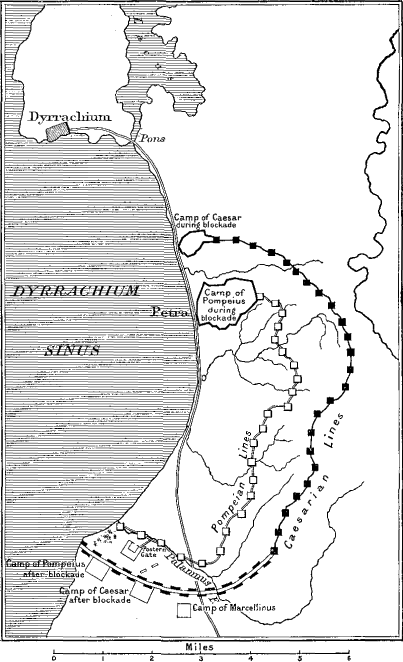
Dyrrachium. [To face p. 216.
B56
CIVIL WAR, 49-45 B.C. (7)
The Eve of Pharsalus. Dream of Pompeius.
At nox, felicis Magno pars ultima vitae, Sollicitos vana decepit imagine somnos. Nam Pompeiani visus sibi sede theatri 10 Innumeram effigiem Romanae cernere plebis, Attollique suum laetis ad sidera nomen Vocibus, et plausu cuneos certare sonantes. Qualis erat populi facies clamorque faventis, Olim cum iuvenis primique aetata triumphi 15 Post domitas gentes quas torrens ambit Hiberus, Et quaecumque fugax Sertorius impulit arma, Vespere pacato, pura venerabilis aeque Quam currus ornante toga, plaudente senatu, Sedit adhuc Romanus eques: seu fine bonorum 20 Anxia venturis ad tempora laeta refugit, Sive per ambages solitas contraria visis Vaticinata quies magni tulit omina planctus, Seu vetito patrias ultra tibi cernere sedes Sic Romam fortuna dedit. Ne rumpite somnos. 25 Castrorum vigiles, nullas tuba verberet aures. Crastina dira quies et imagine maesta diurna Undique funestas acies feret undique bellum. Unde pares somnos populi noctemque beatam? O felix, si te vel sic tua Roma videret.
Lucan, Pharsalia, vii. 7-29.
9 Pompeiani theatri. Pompeius built the first stone theatre at Rome, near the Campus Martius, capable of holding 40,000 people.
10 Innumeram . . . plebis = the image of the countless Roman people. innumeram which belongs to plebis is transferred to effigiem.—Haskins.
14 Olim . . . triumphi, i.e. over Africa 79 B.C. when only 24, and adhuc Romanus eques (l. 19). It was not until 71 B.C. that he triumphed over Spain, after the murder of Sertorius. Lucan confuses the two triumphs.
16 impulit = set in motion (lit. drive forward).
17-18 pura venerabilis . . . toga = no less worshipful in pure white gown than (he would have been) in that which usually adorns the car of triumph, i.e. the toga picta.—H.
20 anxia (sc. quies) = his repose full of anxiety for the future.—H.
21-22 solitas . . . vaticinata = foretelling the opposite of his visions i.e. by the plausus of which he dreamed, the planctus which was in store for him was foreshadowed.—H.
25 nullas = at all. Cf. Cic. Ep.: nullus venit = he never came.
26 Crastina . . . diurna = to-morrow’s night of horror haunted by the sad image of the day’s events.—H.
29 sic, i.e. in dreams.
The Dream of Pompeius. Macaulay says ‘I hardly know an instance of so great an effect produced by means so simple.’
B57
CIVIL WAR, 49-45 B.C. (8)
Pompeius ill-advised at Pharsalus, 48 B.C.
Inter duas acies tantum erat relictum spatii, ut satis esset ad concursum utriusque exercitus. Sed Pompeius suis praedixerat, ut Caesaris impetum exciperent neve se loco moverent aciemque eius distrahi paterentur; idque admonitu C. Triarii 5 fecisse dicebatur, ut primus excursus visque militum infringeretur aciesque distenderetur atque in suis ordinibus dispositi dispersos adorirentur; leviusque casura pila sperabat in loco retentis militibus, quam si ipsi immissis telis occucurrissent, simul fore, ut 10 duplicato cursu Caesaris milites exanimarentur et lassitudine conficerentur. Quod nobis quidem nulla ratione factum a Pompeio videtur, propterea quod est quaedam animi incitatio atque alacritas naturaliter innata omnibus, quae studio pugnae incenditur. 15 Hanc non reprimere, sed augere imperatores debent; neque frustra antiquitus institutum est, ut signa undique concinerent clamoremque universi tollerent: quibus rebus et hostes terreri et suos incitari existimaverunt. 20
Caesar, de Bello Civili, iii. 92.
Context. Caesar made for Apollonia, where he left his wounded, and then marched S.E. into Thessaly, where he joined Domitius Calvinus. (He had been sent with two legions E. into Macedonia, to stop reinforcements for Pompeius under Scipio, Pompeius’ father-in-law.) Pompeius followed Caesar, and encamped on the slope of a hill facing Caesar’s position near Pharsalus. Here he offered battle, his better judgment overruled by the clamorous Senators in his camp.
4-5 aciem . . . paterentur = so as to allow their (advancing) line to become disorganised (distrahi), by the force of its onset.
7 in suis . . . dispositi = by maintaining their proper distances.
Scene of the Fight. The battle was fought near the town of Pharsalus, while the territory of the town was named Pharsalia. Cf. Catull. lxiv. 37:
Pharsalum coeunt, Pharsalia late frequentant.
The Battle. Pompeius had 47,000 infantry and 7000 cavalry against Caesar’s 22,000 infantry and 1000 cavalry. Pompeius stationed his cavalry and archers on his left, and confidently expected to outflank his enemy’s right. But Caesar, foreseeing the defeat of his cavalry, had stationed behind it in reserve 2000 of his best legionaries. When Caesar’s cavalry fell back outnumbered, this reserve ran forward at the charge, not discharging their pila, but using them as spears, and driving them against man and horse. Taken aback by so unusual an infantry attack, the Pompeian cavalry wavered and fled. Caesar’s third line (forming a rear-guard) was now sent forward to support the two front lines, and this decided the battle.—Result. Submission of the East to Caesar.
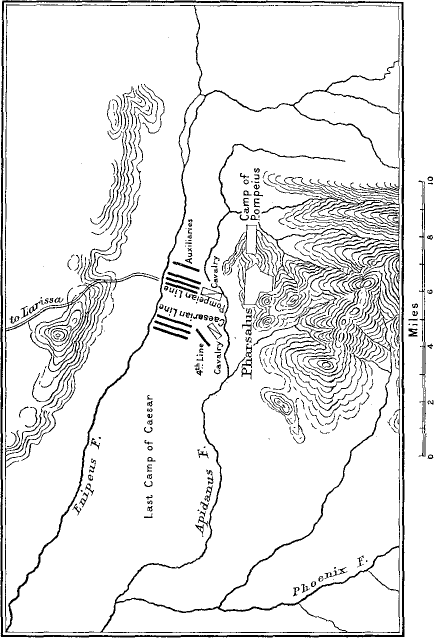
Pharsalus. [To face p. 218.
B58
CIVIL WAR, 49-45 B.C. (9)
A. Pharsalus and Cannae compared.
Non aetas haec carpsit edax monimentaque rerum Putria destituit: crimen civile videmus Tot vacuas urbes. Generis quo turba redacta est 400 Humani? Toto populi qui nascimur orbe Nec muros implere viris nec possumus agros; Urbs nos una capit. Vincto fossore coluntur Hesperiae segetes, stat tectis putris avitis In nullos ruitura domus, nulloque frequentem 405 Cive suo Romam, sed mundi faece repletam Cladis eo dedimus, ne tanto in tempore bellum Iam posset civile geri. Pharsalia tanti Causa mali. Cedant feralia nomina Cannae Et damnata diu Romanis Allia fastis. 410 Tempora signavit leviorum Roma malorum: Hunc voluit nescire diem.
Lucan, Pharsalia, vii. 397-411.
397-398 monimentaque . . . destituit = and has abandoned to decay the monuments of the past.—Haskins.
402 vincto fossore = by a chained digger (delver), in consequence of the dearth of free labour. Cf. Juv. xi. 80 squalidus in magna . . . compede fossor.
404 in nullos ruitura = ready to fall, but on the heads of none.—H.
405 faece = dregs. Cf. Juv. iii. 60, 61 Non possum ferre Quirites | Graecam urbem (a Greek Rome); quamvis (and yet) quota portio (how small a fraction) faecis Achaei?
406-407 ne tanto . . . geri = lit. so that during the long time since, it is impossible to wage civil war, i.e. from the dearth of genuine Roman soldiers.