WOLFGANG AMADEUS MOZART.
Reading edition
BY MRS. JOHN LILLIE.
In the month of May, 1765, an advertisement appeared in London announcing that a concert would be given at Hickford's Rooms, Brewer Street, Golden Square, "for the benefit of Miss Mozart, aged thirteen, and Master Mozart, of eight years of age, prodigies of nature, a concert of music, with all the overtures[2] of this little boy's own composition."
Suppose one had been able to go to that concert in May, 1765. It would have been a charming sight. I am sure there was a great deal of jostling about of Sedan-chairs and footmen; and in the spring twilight—they gave concerts earlier then than now—the gorgeously dressed ladies and gentlemen must have looked very much like a picture. Let us follow them into the "rooms."
We find ourselves in a large well-lighted hall, with chairs and benches, and a big platform containing some instruments and a good harpsichord. Then out comes old Papa Mozart, a dignified gentleman from Salzburg, leading a child by each hand, one a charmingly pretty little girl in the quaint dress we are reviving to-day; the other, a boy of eight, of the most striking grace and beauty, and dressed like a little court gentleman, that is, with knee-breeches, silken hose, shoe-buckles, a little satin coat with lace ruffles, and a little sword at his side.
The little boy makes his bow to the enthusiastic audience; he sits down to the piano, and forthwith begins one of his own sweet, child-like, yet harmonious compositions. Then Nannerl plays. Presently the two young prodigies vanish, the fine audience move away, the lights are out, and the boy's London fame has begun. As we go through dingy Golden Square to-day, a hundred and fifteen years later, we think of all the music he left for us to hear and feel and play between that night when he played "his own little compositions," and the day of his early death, in 1791, at the age of thirty-five years.
WOLFGANG AMADEUS MOZART.
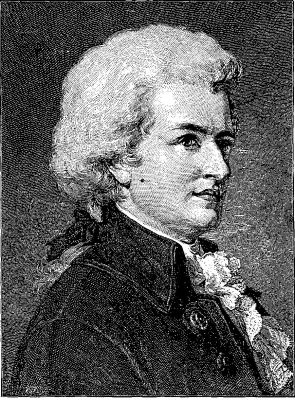
Wolfgang Amadeus Mozart was born at Salzburg in 1756. His father had possessed musical talent, but in him it was genius. At three years of age he learned to play; before he was five he had composed a great many little melodies, which his father wrote down for him. I remember seeing in the studio of an English artist in London,[3] himself the son of a great musician, a picture representing the baby Mozart, a charming little figure, leading a visionary choir of angels. It seemed to me the very embodiment of what Mozart must have been as a child—beautiful, fascinating, angelic, and a musician to his very soul.
His sister Anna, or "Nannerl," as she was called, also played marvellously, and when the children were very young their father started with them on a concert tour, during which they played in London. Everywhere they went they were fêted and caressed in a way which would have spoiled even Mozart's sweet, sunny nature, but for his father's watchful care.
Innumerable presents were made them, some of rich jewelry. This their father insisted upon keeping in a box, only allowing them to take it out on rare occasions and enjoy looking at it for a little while.
It was during that London visit that the father fell ill. They were in lodgings in Chelsea, which was then an open country with blooming gardens and green lanes. The little Mozarts had to keep very quiet during this illness of their father's. The harpsichord was closed, and the children took to running about the pretty suburban place, no doubt enjoying the rest from practicing. But it was during this enforced idleness that Mozart composed his first symphony (Opus 15). He was then in his tenth year. Think of the amount of scientific knowledge as well as the genius the boy must have possessed! Soon after, they gave more concerts, playing among other things duets for four hands on the harpsichord, which was then (in 1765) a great novelty.
During the latter part of the London visit a series of entertainments were given at home, where for two shillings and sixpence people could come and "test the youthful prodigies at the harpsichord." They were lodging in a quaint old inn down in the part of London known as Cornhill, and there they delighted hundreds of admiring and curious visitors.
Passing from this time of sunny though precocious childhood to a boyhood in which he worked indefatigably, we find Mozart in Italy, studying, composing, performing, and writing the most delightful letters home, chiefly to his dear Nannerl, who was by this time more devoted to domestic duties than music.
One of the most interesting experiences of the Mozarts took place in 1775. The Elector of Bavaria had invited Mozart to write an opera for the Carnival, and so when the work was completed—La Tinta Giardiniera—the father and son, with pretty Nannerl, set off for Munich, where court life was then very gay.
In the old market-place of Munich lived a very respectable widow, and Nannerl was lodged there, the father and son having to go nearer to the court. It must have been a delightful visit. Nannerl was all excitement about the opera, and her brother darted in and out half a dozen times a day to report progress. Finally the grand night came. The opera-house was crowded to excess; the court was there in full splendor, and Mozart, the youthful maestro, fine, in a new suit of lace and satin, sat by his father's side, with Nannerl, waiting not a little timidly, no doubt, for the performance to begin. The success was tremendous. The boy—for he was scarcely more in years—became the object of the wildest enthusiasm, and from that hour his musical fame was established.
But we must not feel that all Mozart's days were so cloudless and so joyful. Times of anxiety and heart-sickness were not wanting in his short and busy life. The little family circle was so centred in Mozart that when he started out on a second tour, and the father could not accompany him, the mother left her household duties to Nannerl and set forth with her son. An adoring fondness for his parents was one of the most lovely traits in Mozart's beautiful nature. On this trip he wrote home with pride how careful he was of his mother, and she, good woman, watched him tenderly, giving up everything to his pleasure and profit.
He spent the winter in Mannheim, where his letters show how very busily he was employed. He writes that he rose early, "dressed quickly," and after breakfast composed until twelve; then wrote until half past one, when he dined. At three he began to give lessons, which continued until supper-time; after which he read, unless he was among his friends. Of course he had a large circle wherever he was, but in Mannheim during this winter he formed friendships which shadowed all his life.
The Weber family were there—brilliant musicians, agreeable, and witty. There were five daughters, and Mozart straightway fell in love with the eldest, Aloysia—a beautiful girl, who was studying for the stage. She was well pleased with the young composer's attentions, and he went to Paris half, or, as he considered it, wholly engaged. That was a sad visit to Paris. His mother, wishing to economize for her son's sake, took rooms in a cold, poor quarter of the town, and there fell ill with a fatal disorder. Poor Mozart wrote home the most pathetic letters. We can fancy how he tried to save her, but it was in vain. The careful, tender, self-sacrificing mother faded from his life, her last thoughts being to commend this beloved son to God's keeping.
Full of sadness, the poor young fellow hastened to Mannheim, where he hoped Aloysia Weber would console him. She had gone to Munich, and thither he followed her. There the true selfishness of the Weber family was shown to him. They had become prosperous, and Mozart, although famous, was far from being rich, so that the family of his betrothed received him coldly. Aloysia herself scarcely listened to the first words he said. He had entered the Weber parlor full of hope and anxiety to see his future wife and tell her the story of his sorrow. He must have looked noble and manly, with the tenderness of his grief in his handsome face, but Aloysia turned aside coldly—there were others there, to whom she talked. Mozart hesitated a moment, and then seating himself at the piano, sang in his rich clear voice: "Ich lasse das Mädchen das nicht will" (I leave the maiden who leaves me). And before the evening was over, the engagement was at an end.
We could wish that his intimacy with the Webers had also ended, but later he renewed acquaintance with them, and in spite of much opposition from his anxious father and Nannerl, he married Constanza, Aloysia's younger sister. With her he tried to be happy, but even in his tenderest letters we see that she was ill-tempered, cold, and selfish. But Mozart's nature was so uniformly sweet that it took a great deal to make him positively wretched, and unkind he could not be.
When he was in the midst of many worries, one summer, he used to ride out every morning for exercise, and leaving his wife sleeping, he never failed to pin a little note to her pillow, that she might find it on awaking. It was always a sweet word of love and care for her, and it is hard to think Constanza was not worthy of it.
There is so much to tell of Mozart, I wish that we might linger an hour more over his sweet story. His successes were so many that it is hard to think of him as so often in trouble about money.
In 1791 his beautiful opera of The Magic Flute was produced with tremendous success at Vienna. Constanza came on to hear it, and was thoroughly frightened by Mozart's altered looks. He was ashy pale, worn, and thin. She seems to have been full of a really tender feeling for him then. He was writing his famous mass, the "Requiem," and continued it even after he took to his bed, and while Constanza sat beside him watching with tears the feeble hand at work, he told her that his heart and soul were full of thoughts of the dear Lord who had died for him.
The Magic Flute was drawing crowded houses, while Mozart lay dying not far off. In the evenings he would time the performance, saying to Constanza and her sister Sophie, and some musical friends always with him, "Now they are singing this or that part."
The day before his death he read over the score of the Requiem, and asked the friends near him to try and sing it with him. They did so, Mozart coming in with his part in a sweet faint voice. Suddenly, at the Lacrimosa, he burst into tears, and laid down the score for the last time. That evening he murmured to Constanza, "Oh, that I could once more hear my Magic Flute!"
Constanza glanced at Roser, a musician who was with them, and, blinded by his tears, Roser sat down to the piano, and sang one of Mozart's favorite airs. It was almost the last sound his closing ears received. The next morning, Sunday, December 5, 1791, at the age of thirty-five, Mozart died.[4]
He left behind him so many works that I hardly know which to speak of first. His operas, Don Giovanni, Figaro, and The Magic Flute are known and prized all the world over; but besides there are the masses, the sonatas, the symphonies, and the quartettes. In the sonatas especially the young pianist may find the greatest advantage. As reading they are admirable, and for practice with four hands I know of nothing better, unless it be some of Haydn's quartettes.
STRATEGY.