A CHERRY-TREE LESSON.
Reading edition
BY S. S. CONANT.
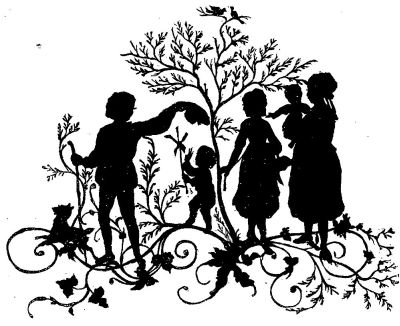
A naughty little city boy was taken to a farm, To spend the summer holidays, away from heat and harm; Where he could roll upon the grass, or chase the little chicks, Or tease the piggies in the pen by poking them with sticks. To pull the peacock's feathers out to him was lots of fun; The geese stretched out their necks and hissed, and made him turn and run; He didn't dare to plague the dog, for fear that he would bite; But he was in all sorts of scrapes from morning until night. One day he climbed a cherry-tree that in the garden grew, Because it was the very thing he'd been told not to do; The cherries they were red and ripe, and tasted very sweet— That naughty boy he swallowed them as fast as he could eat. But when he'd eaten all he could, and scrambled down again, He sat upon the ground, and soon began to scream with pain; And when at last the doctor came he very grimly said, "Give him a dose of castor-oil, and put him right to bed." "It isn't nice," said his mamma, "to lie in bed all day; I hope 'twill be a lesson, Tom, and teach you to obey." Tom promised solemnly no more that cherry-tree to climb; And his mamma was very sure he meant it—at the time.
A CHEAP CANOE.
So many lads have written to Our Post-office Box asking for advice and information as to how to build a cheap canoe, that Messrs. Harper & Brothers have just reprinted in a circular the article on this subject which appeared in Harper's Young People April 27, 1880. Messrs. Harper & Brothers will mail the circular and working plans to any address on receipt of a three-cent postage stamp.
Warm Weather.—Why, of course, dears. But we need the sunshine to ripen the corn, and make the apples round and red, and paint the yellow pears, and kiss the green grapes until they grow large and purple. Let me tell you a secret. It isn't worth while to fan, and fan, and keep saying "Oh, dear! I wish a breeze would come! When will this heat be over?" Neither is it a good plan to drink a great deal of ice-water. The more you drink, the more you will want. Try to forget the heat, and get some pleasant thing to do, sitting in the coolest place you can find. Paint a picture, draw some Wiggles, make a puzzle for Harper's Young People, or write a letter to Our Post-office Box; help auntie dust the parlor, gather flowers to fill the vases, read an interesting book, arrange your specimens or stamps, or tell a story to please your little sister. If you do something that you like to do, or that will make others happy, the warm day will be gone before you know it.
Fort Bayard, New Mexico.
I am a little boy eight years old. I have taken Young People for over a year. I like New Mexico very much. I have a little burro (that is Mexican for donkey) that I ride or drive. My father has three deer-hounds and one stag-hound. One of the deer-hounds is mine; I call him Thor. The names of the rest of the hounds are Hilda, Maida, and Jarl; Jarl is the stag-hound. Day before yesterday Hilda was hooked by a cow, Thor had a cut in his foot, and Jarl had a sliver in his leg two inches long. When Jarl was a puppy, he had a bad fall from a railroad trestle. Papa was going to shoot him, but one of the soldiers said, "Don't shoot, sir; he is all right." We have a pointer called Roy. I have been to the Santa Rita copper mines, and have seen the stamps that they crush the ore with. I take German lessons from the librarian of the Twenty-third Infantry. My mother has twelve hens—two sitting, and two with little chickens. I have nothing more to tell about now, but I will write again. I liked "Toby Tyler" and "Tim and Tip," and I like "Mr. Stubbs's Brother" very much; and oh, I liked "Scrap" so much! and "The Boys' Tea Party" was splendid. I would like to send my love to the Postmistress.
W. Swift M.
The Postmistress sends you hers in return.
Glassborough.
I have begun to make a collection of curiosities, and have three butterflies, one moth, a hornets' nest, and two birds' nests; in them are three eggs. My only pet is a kitten named Bunthorne, but I am lamenting the loss of a horned toad from Mexico. It refused to eat, and after three months of captivity it quietly died. They are called by the Mexicans el taurusita del Vergita, meaning the little bull of the little Virgin.
P.S.—Will you tell me the difference between a maiden and a spinster?
H. S. W.
What a pity about the poor toad! Perhaps he pined for home.
Any unmarried woman is a maiden. A spinster is a person who spins. In olden times the young ladies of the family used to spin and weave the household linen, and so they were called spinsters. Really a maiden and a spinster are the same.
Gallipolis, Ohio.
I am a little girl twelve years old. I have been taking Harper's Young People two years, and like it very much. I have been afflicted for years, and have to walk on crutches. I have two sisters, who are away at school; a week more and they will be at home, and I will be happy. I have a canary-bird; his name is Pedro. The bottom of his cage dropped out, and he flew away, and was gone a day and night; a boy caught him, and brought him back to me. I have a tortoise-shell cat and kitten. The old cat is named Spot, and the kitten Hot. I will exchange twelve foreign and United States stamps for the same number of gilt cards or glass buttons. I have a button string of over a thousand glass buttons; I have also six hundred cards.
Mary V. Cox.
Although you have to walk on crutches, you have happy times, I am sure, for a contented heart triumphs over all difficulties.
Sherburne Four Corners, New York.
I am a girl twelve years old, and am not very large for my age. I have five sisters and one brother. Two of my sisters are married, and each has a little boy. The oldest boy is four years old, and the youngest is not two weeks old yet. My birthday was last May, on Decoration-day. I am collecting cards, and now have 370. We have four horses and two colts; and I have a very nice cat.
Fannie A. H.
A very little girl with a very big hat, And a dear little boy with a pail, They were going to the beach to play in the sand, And then off with papa for a sail.
Little Confectioners.—Several little girls have asked me to give them some receipts for making chocolate caramels and other candies. I hope they will remember that in candy-making, as in other cooking, it is necessary to be very exact in measuring the different ingredients; neither sugar nor flavoring can be left to chance. And the little cook must keep a sharp eye on her fire, and watch her pan and its contents, so as to remove them at just the right moment. Sugar must be made into a syrup by adding water to it, and boiling it until it is smooth and thick. It is then called clarified sugar.
Chocolate Caramels.—Dissolve four ounces of chocolate in as little water as possible, and add it to one pound of clarified sugar, stirring it for a few minutes before taking it off. If you wish a richer caramel mixture, then take half a pound of chocolate, two cups of sugar, half a cup of milk, and a small lump of butter. Scrape the chocolate in the milk, add it to the boiled sugar, and stir in the butter. When your caramels are done pour them into a flat pan or a sheet of tin which you have oiled or buttered, so that they will not stick fast to it. When cool enough to be dented with the finger, cut the caramels into the shape you desire with a knife. If you do not eat your caramels on the day they are made, keep them in a tightly closed jar.
Everton taffy is a favorite with children. It is made in this way:
Everton Taffy.—Melt three ounces of butter in a brass skillet, and add one pound of brown sugar; boil the mixture over a clear fire until the syrup, when dropped into cold water, breaks between the teeth without sticking to them. Pour it into pans which have been rubbed with buttered paper, and set it away to cool. If you wish, you may add the grated rind of a lemon when the sugar is half done.
Plain Taffy.—Boil a quart of molasses slowly for half an hour over not too fierce a fire, stirring it constantly. Add to it half a tea-spoonful of bicarbonate of soda (baking-soda). Try the candy by dropping a spoonful in cold water. If brittle, it is done.
You may, if you wish, make molasses candy very white by pulling it in your hands, first flouring them or buttering them, so that the candy will not stick fast to your fingers.
Now, dear little housekeepers, although I have given you these receipts, I do not advise you to spend a great deal of time in candy-making in midsummer. I would rather hear that you had been riding on the hay, or gathering apples, fishing with your brothers, or going over the hills for blackberries. But if you do make candy, be sure to write me word whether or not it turns out finely and tastes good.
Weatherford, Texas.
I am a little boy seven years old. I have never been to school yet, but I learn at home. I like my books very much. I had several nice books given to me, and I have read them all but one. I have just had a nice trip with my papa, going on the Texas and Pacific Railroad to Colorado City. It is in Western Texas, on the Colorado River. The river was very high, and I saw some horses swim across it. I saw a great many prairie-dogs. They burrow in the ground, and have a rattle-snake, an owl, and a rabbit with them. I also saw a panther. I wanted a prairie-dog for a pet, and a gentleman promised to send me one. I see where little Susie has told you about her pet, a horned toad. There are a great many of them here. They do not hop like a toad, but run almost as fast as a lizard. I catch them, and put them in the garden to destroy the bugs. My pet is a little rat terrier named Snip. I saw a little printing-office at Colorado City, where a paper called the Nut-Shell is printed. It is about as large as a big sheet of writing-paper. Its editor is Johnny Tolar, a boy about fifteen years old. I take it and Harper's Young People. I wrote this letter by myself, and then got mamma to show me the mistakes.
Howard L.
A VISIT TO FORT PICKENS.
I will first tell where Fort Pickens is. It is on Santa Rosa Island. The island is surrounded by the Gulf of Mexico and Pensacola Bay, and is a large uninhabited island. On the 25th of May the Presbyterian Sabbath-school from Pensacola gave a picnic. We left the wharf for Fort Pickens about half past nine. We had a very nice time going over; we played games and talked all the way over. We arrived at the Fort at about ten or half past ten o'clock. As soon as we had landed, we went right to the Fort, where we staid for about half an hour resting, after which we walked through the Fort. We then went back to where our parasols and baskets were. We got our parasols, and started with a few other girls and boys to walk round the parapets of the forts. A few boys and girls went over to the Gulf to gather shells, but it was so warm that I thought it best to wait until afternoon before I went over to the Gulf. About twelve o'clock we went into one of the large, cool case-mates and danced and decorated our hats with ferns and wild flowers gathered inside the Fort. At one o'clock we had dinner, which we enjoyed very much. We had everything necessary to eat at a picnic. After dinner we spent the time until half past two much the same as in the morning. At half past two a crowd of ladies, gentlemen, and children went over in a sail-boat to Barrancas to visit the light-house. I did not go over with them for fear of getting seasick. After I had seen the boat leave the wharf I went back to the Fort, where I met several girls who were going over to the Gulf. I went with them. When we got over to the Gulf we pulled off our shoes and stockings and went in wading. When tired of that we walked up the beach gathering shells, until we thought it time to go back to the Fort. After a sail on the Gulf we returned to Pensacola, and arrived there about half past six. We were very tired.
Nannie L. W.
Washington, D.C.
I am a little girl six years old. I have no brother nor sister, but have as many as six dolls. Fanny is nearly as old as I am. Her nose is almost flat. I keep Etta dressed all up pretty. Santa Claus has had two big books made with my Harper's Young People. I hope he won't forget to call for them again this year. I have taken them every one. I have a blackboard; I print, and can add and take away. I am in the Second-Reader. Mamma and I are going to Maine next month to stay till it is real cool here. There we go out fishing. We pick blueberries, blackberries, and cranberries. I have four little cousins who go from here. We all have the same grandpa and grandma. We ride on the hay, and dig clams. Papa will go down to bring us home. Every Tuesday night he reads me the stories from Harper's Young People. I like the letters very much, and everything in them. When papa sees a letter from his little girl, he will open his eyes. I have never been to school. I think Toby Tyler is just as nice as any other of my friends. I am wondering if you will have room for this in my Harper's Young People; it is a very long letter.
One of your little girls, Olive E. B.
Thank you, dear, for printing your letter so beautifully.
Hartford, Connecticut.
An amusing game which I have seen played is the following: Take four handkerchiefs and tie them like dolls, to represent four persons; then tie a thread to each, and put them (the threads) over the chandelier, and give each thread to a person, who must try to conceal himself behind a door or something else; and then, while some one plays on the piano, those who have the threads keep them jerking, letting the dolls hang so that they come down to the floor. If well done, it is quite a good representation of dancing.
S.
Lexington, Kentucky.
As I have not seen a letter from Lexington, I thought I would write one. I have two little puppies; one is named Sport, and the other Preston. I have a hen, and she lays eggs. I have a little brother, and he is named Hugh. He has two kittens; one is a Maltese, and one a common cat. I can ride a bicycle, and last year I took the certificate at the fair for good riding.
E. Sayre C.
Waukesha, Wisconsin.
I am twelve years old, and have taken the Young People from the beginning. I like it very much; I can hardly wait a week for it to come, because the continued stories all leave off in such interesting places.
I haven't any pets to tell you about, for they all died. I had five cats, a mother and four little ones, and some one killed the mother, and two little dwarfs, as I called them, had to be drowned, because they could not live without her; then one of the remaining two fell into the well and drowned itself, and the horse stepped on the other one; so that is the fate of my five cats.
My mamma, papa, and little brother have all been to California, and left me here with some friends; they were gone nearly a year, and sometimes I felt very lonesome. My brother is ten years old, and we have a nice big yard to play in. My brother's name is Earle, and we both like "Mr. Stubbs's Brother" very much.
Winnie W.
Admirer.—Newfoundland is pronounced with the accent on the first syllable. I do not know who wrote the exercise in alliteration which you mention. It is clever, but you could no doubt compose an equally excellent one yourself. Whether to use plain or ornamental note-paper is a matter to be decided by your own taste. The exquisite little butterfly painted by yourself in the corner of your sheet is a decided addition to the beauty of your letter. I would not waste such decorations on an envelope, however, as that has to pass through many hands, and is less private than the inclosure.
Violet S.—Your teacher has discovered a very pleasant way of teaching her pupils how to write compositions. Although most schools are now taking their summer recess, I will state her method. She takes ten words from a lesson which the girls have recently studied, and writes them on the blackboard, after which she gives them fifteen minutes with their slates and pencils. At the end of fifteen minutes each is asked for her composition.
The smallest black-and-tan terrier in the world is supposed to belong to a lady in Chicago. It weighs from a pound to a pound and a half. Its skin is like the finest silk, its eyes project like marbles, its legs resemble lead-pencils, and its feet are the most perfect and curious things alive. It reposes in a basket lined with gold and cardinal satin, wears a collar studded with diamonds and emeralds, with "Baby Mine," its pet name, on a gold plate tipped with a gold bell, and is fed from a saucer of Dresden china.
Bettie.—Keep powdered borax on your wash-stand, and use it when washing your hands; it will make them soft and white. Lemon juice is also good to whiten the hands. But the Postmistress does not object to a healthy brown color in summer either on hands or face.
C. Y. P. R. U.
This article on the making of anagrams, which we ask you to read carefully, was prepared by a gentleman who has had a great deal of experience with puzzles and puzzlers. Perhaps you will try your own skill in transposing sentences after this ingenious fashion:
MODERN ANAGRAMS.
BY KOE.
In a former issue of Young People a writer told the younger readers of the old-fashioned amusement of making anagrams on the names of acquaintances and public characters. The author gave several illustrations of famous anagrams made many years ago; but there have been some truly wonderful anagrams published in this country during the last four or five years, and I shall endeavor to give you a few of the most interesting ones.
There is a certain understanding among contributors to puzzle columns that an anagram is a word, name, place, or event so transposed that it will relate in some way to the original subject; while if merely so transposed that it will produce other words not relative to the original, it is called a transposition; but transpositions are usually made of a single word, as, for instance, the following by a lady of Toledo, Ohio, who signs herself "Mazie Lane":
"Transpose a musical anthem grand, And find a picture by a red man's hand."
The answer is Motet—Totem.
Here is one by a young man of Boston, who signs himself "Sphinx":
"Gay, pretty flowers of the spring, Transposed will stipulators bring."
Answer: Primroses—Promisers.
These are good examples of transpositions, as they are called, while the word Astronomers, which is turned into moon-starers, is an excellent example of word-anagram. One of the best, and probably only word in the English language of which so perfect an anagram can be made, is a word I discovered in my dictionary not long since. It is the word stum, and turned into the anagram of must. The definition of each word is the same—"unfermented grape juice or wine."
As the following anagrams were when published signed by their authors with a nom de plume, or assumed name, I will give due credit by giving the name of each.
A contributor who signed himself "Wilkins Micawber" sent me the following in 1879:
"We all can say, and speak the truth, How well we knew her in our youth." The door ring tided ill.
Surely every one of my readers has heard or read of this little girl who, while on her way to her grandmother's house, met the fierce wolf in the woods. The words in italics represent the anagram, and I am confident some of the bright little readers would soon discover in the above line their well-known friend Little Red Riding-hood. Is not this an excellent anagram?
A gentleman of New Haven, Connecticut, who uses the nom de plume of "O. Possum," is the author of the following—and I fancy some of the older members of the family would have to assist to solve it, being an anagram of a well-known book that few of the little folks read:
Past homes of Italy pied. "Of days gone by, a story written By Sir Edward Bulwer Lytton."
The answer is The Last Days of Pompeii.
From the landing of the Pilgrims down to the present day the history of our country is full of grand events that afford most excellent subjects for anagrams, and many of my friends have utilized some of them. I could fill several pages with the anagrams I have collected, but lack of space compels me to give only a few of the best.
A contributor who uses the nom de plume of "Jim Jam" was the first to use the event of Washington crossing the Delaware for an anagram, with the following result:
A hard, howling, tossing water scene.
Soon after receiving this a friend, now dead, sent me the following on the same subject. His nom de plume was "Graham":
Lo! see rash acting with dangers won.
One "Percy Vere" also used this subject, with this result:
"Read this event on history's page— The cold waters swashing on in rage."
While "Edwin Drood's" attempt resulted as follows:
Watch a soldier hang on, steering s.w.
This was sent to me more as a joke, and the answer given as "Crossington washing the Delaware," but both answers can be found. I will here say that a true and perfect anagram should not contain a single letter to represent words, as in the one given above; nor should any but proper abbreviations be used, and these as rarely as possible.
The two following were composed by "Traddles," who, by-the-way, is looked upon as quite an expert in this amusement:
Horror flee! Rude war's better ended.
"The surrender of Robert Edward Lee," which also ended the war of the rebellion.
A French site. 'Tis blotted out, eh?
"The destruction of the Bastile," a terrible state-prison, which was destroyed by the people of Paris on the 15th of July, 1789.
O! glad boy finds rich metal in clay of shoal river.
This, by "Percy Vere," is considered one of the best and most correct of anagrams. The answer is, "The discovery of gold in California by Marshall." This author is also the writer of the following:
O! all in ban. March!
Answer: Abraham Lincoln.
Sirs, 'tis alone.
Answer: Solitariness.
The following two are so good that I am sure my readers will excuse me for the additional time I take from their play to present them. They are both by the same author, a gentleman of Ohio:
Often noisy I when I enable aching wives to hem.
Answer: Invention of the sewing-machine by Elias Howe.
Pooh! we can find ten errors; they never hit.
Answer: The weather predictions of Henry Vennor.
The above will give you all an idea of how an anagram should be made. All are excellent specimens of American work—in fact, I am certain no better were ever composed. The puzzle column in this paper, I am sure, would publish some anagrams if my young readers will take the trouble to try and make them. Let us see who will have the first one published.
Before closing I wish to give you a treat, illustrating how a word can be twisted and twirled. It is from Maitland:
"'How much there is in a word—monastery,' says I. 'Why, that makes nasty Rome;' and when I looked at it again, it was more nasty—a very vile place, or mean sty.
"'Ay, monster,' says I, 'you are found out.'
"'What monster?' said the Pope.
"'What monster?' said I. 'Why, your own image there—stone Mary.'
"'That,' he replied, 'is my one star, my Stella Maria, my treasure, my guide.'
"'No,' said I, 'you should say my treason."
"'Yet no arms,' said he.
"'No,' quoth I; 'quiet may suit best, as long as you have no mastery—I mean money arts.'
"'No,' said he again, 'those are Tory means, and Dan, my senator, will baffle them.'
"'I don't know that,' said I; 'but I think one might make no mean story out of this one word monastery.'"
We would call the attention of the C. Y. P. R. U. this week to Mrs. Lillie's article "Wolfgang Amadeus Mozart," and to "Parsee Merchants of Bombay," by Colonel Thomas W. Knox. In "How to Lay out Lawn Tennis Courts" Sherwood Ryse offers some hints that young tennis-players will find very useful.
PUZZLES FROM YOUNG CONTRIBUTORS.
No. 1.
DOUBLE ACROSTIC.
1. A pronoun. 2. A tree. 3. Another pronoun. 4. A kind of fuel. 5. A boy's name. 6. A preposition. 7. A verb. 8. A smaller portion. Primals and finals compose the name of a book by Louisa M. Alcott.
Doxy.
No. 2.
NUMERICAL ENIGMA.
I am composed of 19 letters, and am a famous navigator.
My 1, 4, 11, 12, 15, 19 is a show.
My 2, 7, 10 is an agricultural tool.
My 3, 13, 17 is to steal.
My 5, 18, 17, 16, 4, 6 is to yield.
My 8, 9, 4, 14 is a boy's nickname.
My whole is the name of a famous navigator.
R. B. B.
No. 3.
TWO WORD SQUARES.
1.—1. A jeweller's measure. 2. Nimble. 3. A fire-arm. 4. To grant. 5. Prongs.
2.—1. A tree. 2. A weapon. 3. To verify. 4. A friend. 5. Pitchers.
Empire City.
No. 4.
AN EASY ENIGMA.
In cat, not in dog.
In stick, not in log.
In find, not in lose.
In eats, not in chews.
My whole is a country over the sea.
Pray what is my name—can you tell me?
Joco.
No. 5.
A SMALL SQUARE.
1. A domestic animal. 2. A number. 3. A swelling.
Alfred W.
No. 6.
TWO CHARADES.
1.—My first is fragrant, my second is a name, and my whole is a beautiful flower.
2.—My first is an animal, my second is part of an animal, and my whole is a flower.
Empire City.
No. 7.
WHO AM I?
I went to the Crimea; I stopped there; I didn't go there; I was sent home because I didn't go there.
ANSWERS TO PUZZLES IN No. 138.
No. 1.
Nelson, Sydney, Montpelier, Lena, Hobart, Mattery, Cashmere, Brussels, Morocco, Orange, Worms, Fear, Cologne, Sandwich Islands, Orange County, Farewell.
No. 2.
Bennington. Hop-Scotch.
No. 3.
P
RBAT
DAYBALES
RAVENPALFREY
YEATERRA
NSEA
Y
No. 4.
PANIC
ATONE
NOVEL
INERT
CELTS
Correct answers to puzzles have been received from Fannie T. Metzgar, Julia Jackson, Eddie Flack, Mary Rice, May Fanning, "I. Scycle," Russel B. Beals, Henry Aron, Eva Stevenson, Rose M. Benedict, "Sister Grace," "Prickly-Pear," Mary B. Lavely, Hugh Leslie, Arthur Aird, Jack Trumbull, E. L. Jones, "Lady Clare," "Cricket," Samuel Price, Fred White, A. H. Brown, Edgar Seeman, Richard Venino, "Neptune," Maude Motley, Eddie S. Hequembourg, Cornelia Gateson, Charlie O. Rose, Willie Black, Griffith Williams, Harry, Tom, and Pussy, "Eureka," Maud H. H., Willie and Emily, Alice and Amelia, Roger Franklin, King Albert.
[For Exchanges, see 2d and 3d pages of cover.]
"They come, the merry summer months of beauty, song, and flowers."—William Motherwell.