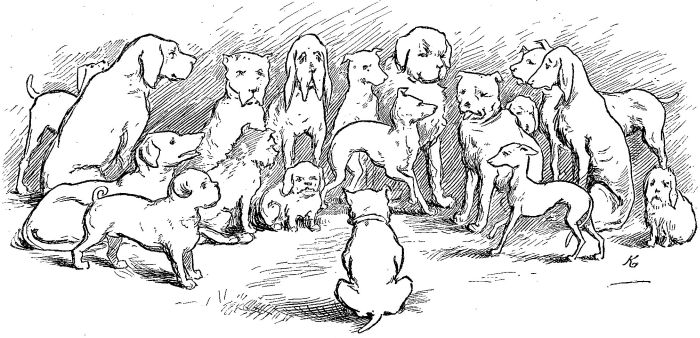
A LITTLE SCAMP.
Reading edition
BY JOSEPHINE POLLARD.
He's off on a tramp, Like the little scamp That he is, for we did not bind him; And with hurrying feet Up and down the street We've followed, but can not find him. There are gypsies about, Who will steal him, no doubt, And keep him in horrible places; And changing his name, Our darling will claim, Who misses our fond embraces. The dear little scamp, What made him decamp In this way, without any warning? He can not speak plain, And we've sought him in vain, Why, ever since yesterday morning. He was saucy and pert, And will surely get hurt In some of his comical capers; And hoping to get Our runaway pet, We've advertised him in the papers. We've mentioned his size, The color of his eyes, And his hair—'twas a beautiful yellow; And offered reward, All we could afford, To whoever restores the dear fellow. His meals he will take Very nicely, and cake He is almost as fond of as candy. If he crosses your track, Won't you please bring him back? He's a dog, and he answers to—Dandie.
BARBERS' POLES.
In the records of the English Parliament for the last century we read that Lord Thurlow, when he opposed the Surgeons' Incorporation Bill in the House of Peers, on the 17th July, 1797, stated that by a statute still in force, the barbers and surgeons were each to use a pole. The barbers were to have theirs blue and white striped, with no other appendage; but the surgeons', which were the same in other respects, were likewise to have a gallipot and a red rag to denote the particular nature of their vocation.
The origin of the barbers' pole is to be traced to the period when the barbers were also surgeons, and practiced bleeding. To assist this operation, it being necessary for the patient to grasp a staff, a stick or a pole was always kept by the barber-surgeon, together with the fillet or bandage he used for tying the patient's arm. When the pole was not in use, the tape was tied to it, that they might be both together when wanted.
On a person coming in to be bled, the tape was disengaged from the pole and bound round the arm, and the pole was put into the person's hand. After the operation was concluded, the tape was again tied on the pole, and pole and tape were often hung at the door for a sign or notice to passers-by that they might there be bled. Doubtless the competition for custom was great, for our ancestors believed thoroughly in bleeding, and they demanded the operation frequently. At length, instead of hanging out the identical pole used in the operation, a pole was painted with stripes round it, in imitation of the real pole and bandage, and thus came the sign.
That the use of the pole in bleeding was very ancient appears from an illumination in a missal of the time of Edward I. In other ancient volumes there are engravings of the like practice. "Such a staff," says Brand, who mentions these graphic illustrations, "is to this very day put into the hand of patients undergoing phlebotomy by every village practitioner."
The Chairman. "We are here, gentlemen, to start a Crusade against Dog-catchers, and we wish every Dog's help, both small and great."