FOURTH OF JULY AT BEAVER BROOK.
Reading edition
BY ADA CARLETON STODDARD.
"Not a fire-cracker," Mr. Marden had said, looking around on his half-dozen boys—"not a single fire-cracker, nor pin-wheel, nor rocket this year, boys. You come pritty nigh burnin' up the hull town last Fourth, an' I don't want to run no more sech risks. Enj'y yourselves as well's you can other ways 'n that. Now mind!"
That was how and why—because of this interdiction of everything that goes to make a Fourth of July different from a fourth of August or any other day—the boys happened to think of going up the river fishing.
They were down on the river-bank, lying at full length on the green grass, when Jed Harden said, meditatively, tossing a pebble into the water, "There'll be no fun staying here, boys, 'thout we can fire off things."
Bud Rose laughed. He could never be serious. "It's because we fired off Jennings's barn last Fourth that everybody's so down on our celebrating this year," said he. "I wonder how the old thing got afire, anyhow?"
"Easy enough," rejoined Jed; "there was a heap of straw all round it, and I don't s'pose we were over 'n' above careful. The old shanty wasn't worth ten cents, but it came near burning up everybody else's buildings."
"So it did. After all, I don't blame folks much. There ain't such a sight of fun in snapping crackers, anyhow."
"But what shall we do?"
Charley Stevens looked up then. All this time he had not spoken, but lay gazing out on the river. "I move we go fishing up on Beaver Brook," said he. "Start before daylight, and stay till after dark."
"Second the motion. Hooray!"
All was animation now. The boys sat bolt-upright. Charley laughed. "Moved and seconded that we, the stirring youth of Brayton, celebrate to-morrow by going fishing. All who favor this will please say—"
"Ay!"
"The motion is unanimously carried," said Charley, shaking back his hair.
I think it was myself. So would you if you could have heard that roaring assent. There was no half-way work with the Brayton boys. They were all on hand the next morning, with their lunch baskets, not exactly before daylight, but sufficiently early; and they could not resist the temptation to give several prolonged whoops as they shoved the old scow out from shore.
"That'll let 'em know we're 'round," laughed Charley Stevens. "There, boys, back up. I've left my pails."
"What pails?"
"Why," said Charley, "I promised to save some of the smallest fish, if they weren't hooked too much, for Laurie's aquarium, and I brought along a couple of pails to keep 'em alive in. There they are on the bank. Backwater."
"Nonsense!"
But Charley was firm; and Jed and Bud and Vet, who were taking the first turn at the paddles, pulled a rod or two back to the shore, not without a little grumbling, and brought away the pails. Afterward they all had very good reason to remember and be thankful for this. Then they pulled steadily away up the river, through the light fog which the rays of the morning sun had not yet scattered, trolling their lines, and catching a few fish by the way.
"I would have brought a frying-pan," said Dean Marden, pulling in a speckled trout, "but father said 'twouldn't do to make a fire this weather. Everything's dry as tinder."
"And Beaver Brook isn't more'n two miles from the village, through the woods," said Charley, meditatively. "Wind blows right that way, too."
"It's four miles by the river, if it's an inch," said Vet Adams; for the river certainly made a wide detour.
"It's crooked as a ram's horn," declared Jeff Gammon, wiping the perspiration from his face. "A fellow has to pull all the way round Robin Hood's barn to get anywhere."
Charley laughed. "We're almost to the mouth of the brook now," said he. "There's the old pine."
And in a few minutes the scow, propelled by three pairs of stout arms, swept grandly around the point of land and into Beaver Brook, on one side, just as a light birch-bark canoe, holding two men, shot out on the other side.
"Indians!" exclaimed Charley, in a tone of great disgust. "There's a camp of 'em down the river somewhere. We won't get any fish here, boys."
Charley was right. They fished for half an hour, waiting patiently for a nibble, which they did not get.
"We'll have to go further up the brook," said Charley; and accordingly the old scow was once more set in motion.
How pleasant it was! They ran along in the shade of the willows that skirted the brook, their paddles dipping lazily, and their fishing-lines trailing in the deep still water. It was very warm in the sun, but there was a smart breeze blowing, and a prospect of showers later on.
Suddenly Charley felt a jerk on his line that, taking him unawares, nearly pulled him off his seat.
"Gracious! boys, hold on," he said, in an excited whisper. "I've got a ten-pounder."
It was not half of that, nor had Charley got his fish; but the paddles were quickly and quietly shipped. Charley pulled in a nice trout, and Bud Rose another.
"Ain't they beauties!"
"We're right in a school of 'em," said Bud, rebaiting his hook. "I say, fellows, ain't this a long chalk better'n fire-works?"
For no matter how many times a country boy may have been a-fishing, nor how many fish he may have caught, the sport must always be exciting.
An exclamation of alarm from one of their number, as Bud finished speaking, startled the boys; and they were a good deal more startled, and not a little provoked, to see Charley catch up one of the heavy paddles and plunge it into the water with a long sweeping stroke, the impetus of which sent the scow forward a dozen feet.
"Now look here!"
"Boys," cried Charley, flushed and anxious in a minute, "we may have the fire-works yet. See there!"
Around a bend in the stream a thin blue line of smoke was seen curling up through the trees, and even as the boys gazed, it appeared to increase in volume and density.
"The Indians must have left it!" exclaimed Charley, hurriedly. "Boys—"
There was no need nor time for words. Instantly the two remaining paddles were seized, and the scow was headed up and around the bend. It came to them all in a flash how strong the wind was blowing from the west; that the woods of Dunn Township, altogether proprietors' land, adjoined Brayton, extending to the top of the hill that overlooked the village; and each boy's heart turned pale at the prospect.
"It's all black growth, too," groaned Charley, "and full of old dry tops, where they've been lumbering year after year—just a regular tinder-box. This wind'll carry fire from it a mile anyway. Pull, boys, pull!"
And they pulled. But the fire was getting under good headway when they reached the spot. The smoke was rolling up blacker and thicker, and through it the boys could see the red flickering tongues of flame.
"Take the pails—your hats—anything that'll hold water," cried Charley, "and wet your jackets—wet yourselves all over."
"PAILFUL AFTER PAILFUL OF WATER WAS DASHED UPON THE FIRE."
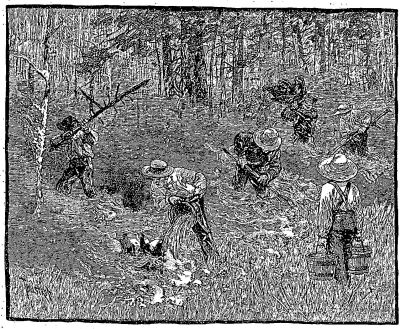
He was obeyed. Pailful after pailful of water was dashed upon the fire, which had been built beside an old dry pine stub; and they were really subduing it, when a sudden tempestuous flurry of wind scattered the burning embers in all directions; and presently, before the boys were able fairly to realize that the mischief had been done, a dozen tiny puffs of smoke started up around. In reality everything was dry as tinder.
"We've got to fight it—fight it hard, boys," said Charley, between his gritted teeth. "I'd like to wring the necks of those Indians."
Well, and how they battled the fire that scorching July day! They stamped it out; they smothered it with earth; they dashed water over it; they stifled it with their wet jackets, blistering faces, hands, and feet without for a moment minding the pain. More than once they were sure they had conquered, and made the woods ring with a shout of triumph, only to see, almost before the echoes died away, another puff of smoke starting up, and another. Their throats were parched, and rattled when they tried to speak, and their eyes were smarting and inflamed with the smoke.
"It's no use, boys; we can't do it," one or another would say; and then they would fall to work with greater vigor than before, if that were possible.
It was no boys' play, I can tell you. For two long hours they fought the flames, with blistering hands and faces begrimed with smoke and cinders. And when they saw the fire was gaining inch by inch, they worked still.
"We'll do all we can," panted Charley. "Oh, boys, why won't it rain! The thunder-clouds all go round. Oh, boys!"
As he spoke, a long fiery tongue lapped at the foot of a dry tree, and the flames went up, up, to the top, with a hissing, rushing roar which turned the boys' hearts sick with dread.
"It's gone," said Charley. "We can't do any more."
But at the same moment came a growl of distant thunder. A dense, black cloud was growing in the west. Through it there darted a vivid gleam of light.
"Thunder and lightning!" yelled Bud. "Up, boys, and at it again! We'll have plenty of help before long."
So it proved. The cloud swept over the sky with surprising rapidity, and in a very short time the rain fell in sheets. And out in the storm, the thunder crashing, and the lightning playing about them, stood ten smoke-blackened, drenched boys, with little rivers of rain wearing channels down their sooty faces, hurrahing with might and main. If a few tears of thankfulness and relief mingled with the rivers of rain, I do not think any boy need have been at all ashamed of them.
"Well," said Charley, "we've had our Fourth-of-July fire-works with a vengeance." This was when the rain had nearly ceased falling, and the boys had embarked for home.
"We've had the fire anyhow," laughed Bud, plying his paddle leisurely.
"And I'm sure we've had the work."
"You don't suppose 'twill start up again?", asked Jed Marden, looking behind a little anxiously, as the old scow moved slowly down the stream.
"No," answered Charley, and he drew a deep breath of relief; "it can't after such a soaking. But 'twas a close shave, I tell you, boys."
So the towns-people thought when they heard the story.
"'Twas a fust-rate day's work for us," said Mr. Marden at the corner grocery next morning. "Nothin' on earth would ha' saved the place ef the fire'd come through there. It's somethin' to brag about. I'm proud o' the boys—I am so."
"They've paid up for burning Jennings's old barn," said Mr. Stevens, carefully weighing out four ounces of tea.
"So they hev," assented Mr. Marden.
And so the good folks of Brayton have each and every one of them resolved that next year the boys shall have such a Fourth-of-July celebration as Brayton has never yet seen.