Part 1 — UP IN A WATER-SPOUT.
Reading edition
ONE OF THE OLD SAILOR'S YARNS.
BY W. J. HENDERSON.
The Old Sailor sat on the end of the pier, but he was restless and ill at ease. He looked often at the southwestern sky, where heavy blue-black clouds were massing themselves in low and writhing shapes. He shook his head solemnly, rose to his feet, and walked nervously up and down.
"This are the werry identical kind o' day it were," he muttered, "an' ef we don't see some on 'em to-day, w'y, I'm a bloomin' marine, that's wot."
"See some of what?" inquired a voice behind him; and turning, he saw the two boys.
"Waal, waal, waal!" he exclaimed; "you two infants is a-gettin' 'most as weatherwise as tree-frogs."
This exclamation was not unnatural, for the two boys were clad in long sea-boots, oil-skins, and sou'westers.
"Ye look like a pair o' sunflowers," said the Old Sailor, with admiration in his tone, "an' I reckon ye don't worry much about the rain wot are a-comin'."
"No; I guess we will not get wet," said Henry, laughing.
"But s'posin'—now mind I don't go fur to say it'll happen—but s'posin' ye was to go fur to come fur to git carried up aloft."
"What ever do you mean?" asked George.
"Look down yonder—quick!" exclaimed the Old Sailor, pointing to the southern horizon.
The boys saw an immense blue-black cloud, from which hung down a great dark cone. A similar cone, point upward, rose from the sea, and the two were joined by a slender wavering black column.
"Oh, what is it?" cried George.
"I know," exclaimed Henry. "It's a water-spout."
"It's going out to sea," ejaculated George.
"Werry good; werry good indeed," said the Old Sailor, sagely; "it sartainly are a-goin' out to sea. 'Cos w'y, it can't go on land, 'cos it are a water-spout an' not a landspout, w'ich the same there ain't none, 'ceptin' them on the sides o' houses fur rain to go down, an' them mostly leaks."
The three stood and watched the dreaded monster of the sea—a rare sight indeed near shore—until it passed out of sight.
"It are gone," said the Old Sailor, "an' it 'ain't took nothin' with 't 'ceptin' wind an' water."
"Do they ever take anything else with them?" asked George.
"W'ich the same they do," answered the Old Sailor; "an' wot they takes ain't never come back but oncet, as I knows on. I knowed we'd see some on 'em to-day; 'cos w'y, this are the kind o' day wot breeds 'em, an' it are the werry identical kind o' day wot it all happened on."
So saying, the Old Sailor sat down on the end of the pier, and the boys seated themselves beside him.
"This 'ere yarn wot I'm a goin' fur to tell ye," began the Old Sailor, "are a most ser'ous tale, an' I hopes as how 't won't go fur to give ye no nightmare. I were fust mate o' the barkentine Herrin' Bones, bound from Rio Janeiro to New York. She were a wall-sided hooker, with double to'-gallants, an' a werry disrepitable habit o' goin' to leeward."
"What was her cargo?" asked George.
"I allers tells ye wot the cargo were, my son, but this 'ere wessel didn't have no cargo; she were flyin' light, an' preehaps 'twould 'a' bin better ef she'd had more ballast aboard. Her Cap'n were Gawge W. Smoke, an' her second mate were a long-legged feller from New Orleans, named Pierre Crust, an' a werry crusty Pierre he were too. Waal, to git right down to the business part o' this 'ere yarn wot I'm a-tellin' ye, I'll say that we didn't have nothin' but fair weather an' good to'-gallant breezes till we got right up atwixt St. Thomas an' Bermooda, an' then it rained an' blowed squalls an' thunder-storms fur two days an' nights all round the compass. Cap'n Gawge W. Smoke, sez he to me, sez he, 'It ain't no fittin' weather fur to be buggaluggin' round here.' An' sez I to he, sez I, 'It ain't, but here we be, an' we can't fly away,' sez I, jess like that, him bein' Cap'n an' me fust mate, an' the barkentine bein' the Herrin' Bones. But ef I'd knowed wot were a-comin', I'd never said nothin'.
"Waal, them squalls an' thunder-storms kep' a-gettin' thicker an' blacker, till byme-by the hull sky all round were jess like it were down yonder a leetle while ago. An' Cap'n Gawge W. Smoke he allowed that we'd best stand by fur water-spouts. Sure 'nuff, 'twere jess about six bells in the forenoon watch o' the second day o' this 'ere cantankerous weather, w'en the lookout sung out, 'Water-spout on the weather bow!' 'Fore we had time to look at it another hand sighted one on the lee bow, an' some one else seed one on the weather-quarter. In less 'n five minutes we sighted seven on 'em to wind'ard an' six to leeward, makin' thirteen, w'ich the same that are a werry unlucky number.
"Waal, we clapped on a leetle more sail, hopin' fur to run out o' this 'ere convention o' water-spouts. But, bless ye! ye might as well 'a' tried to git away from a express train by runnin' down the track ahead o't. They was comin' down on us at a powerful gait. W'en the biggest one were about half a mile away, we could see it whirlin' round an' round like a big wheel, an' it roared like Niagarer Falls, w'ich the same ye 'ain't never seed, but ye see pictures of 'em in your geoggerfy. Pierre Crust, our second mate, he got so skeered he jess went an' hid his head under a deck bucket. Cap'n Gawge W. Smoke he give orders to clew up the to'-gallants, so's to stop the vessel, hopin' that the spout'd pass ahead on us. But, bless ye! the bloomin', bleedin', blasted thing turned out of its course, an' kep' a-comin' right fur us.
"'We're bound for Davy Jones's locker,' sez Cap'n Gawge W. Smoke, sez he. 'It are a-goin' to break right on top o' us.'
"'Werry good, sir,' sez I. 'Axin' your parmission, I'll put on a life-persarver.'
"''Twon't do ye no good,' sez he. 'W'en she breaks on us she'll drive us twenty fathom down. Here it comes! Stan' by, all hands, to go under hatches.'
"Roarin' like a thunder-storm, an' loomin' over us like a iceberg turned black, the water-spout come to the barkentine. We all shut our eyes, an' held our breath, an' waited to be buried under a million tons o' water. But may I never live to see lobscouse agin ef the bloomin' thing busted at all! We felt the ship give a lurch an' a jump, an' then she started off at the rate o' thirty knots an hour.
"'Wot are it?' yelled the Cap'n.
"'The water-spout!' I yells back. 'She's picked us up!'"
The Old Sailor paused to gaze around the horizon, and the two boys gazed at one another in breathless amazement. In a moment their remarkable friend resumed his narrative.
"It weren't no sort o' pickle fur a decent old barkentine to be in, an' the Herrin' Bones knowed it, but there she were. She were a-sailin' round and round like a chicken with its head off. Her keel were in the water o' the spout, an' her masts was a-stickin' out sideways like toothpicks out o' old Bill Smorkey's mouth arter dinner. W'y, blow me fur a farmer ef I don't b'lieve she'd 'a' fell off the bloomin' thing sideways ef it hadn't bin that the wind wot the spout made a-goin' round filled the sail she had spread, an' so kep' her up.
"'Clew up the foretops'l!' hollered Pierre Crust.
"'Let it alone,' sez Cap'n Gawge W. Smoke, sez he. 'D'ye want to fall off this 'ere marine buzz-saw an' git drownded?'
"'Stop the ship; we're out o' our course,' sez Tobias Kitten, the carpenter, w'ich the same he ort to bin a tailor, 'cos w'y, he didn't know no more about a ship nor a feller wot sits cross-legged onto a table an' mends pants fur a livin'.
"'Out o' our course!' sez the Cap'n, sez he. 'I wish the bloomin' water-spout were out o't.'
"All hands was a-layin' flat on deck, with our feet agin' the lee rail—leastways it ort to bin the lee rail, 'cos it were the one wot were down, but it weren't, 'cos the wind were blowin' up, an' things was ginerally goin' back end fust, like a Chinese junk in a head-sea.
"'D'ye think she'd right herself ef we cut away the masts?' Cap'n Gawge W. Smoke sez he to me.
"'Mebbe she would,' sez I to he; 'but ef she did we'd have water on top o' us, an' then good-by.'
"'Then I'm blowed ef I know wot to do with her,' sez he to me, sez he. An' me not knowin' wot to say back, I didn't say nothin', but hung on with both hands.
"'Oh my! oh my!' sez Pierre Crust; 'we're a-goin' up this 'ere dreadful thing. Look down!'
"An', sure 'nuff, w'en I looked over the side I seed a ship away down below us on the sea, an' her Cap'n were a-lookin' at us through a telescup, he were.
"'Salt me down fur a mackerel,' sez Cap'n Gawge W. Smoke, 'ef ever I thought that any ship o' mine would go fur to turn herself into a bloomin' balloon!'
"All the time we was a-sailin' round an' round the spout like it was a corkscrew worked by steam, an' we was a-goin' up an' up.
"'I wonder ef there's water 'nuff up there to float the old hooker?' sez Pierre Crust.
"'Waal,' sez Cap'n Gawge W. Smoke, 'she can't go aground in the clouds, anyhow, an' there ain't no rocks either.'
"'Waal,' sez I to he, sez I, 'w'ere d'ye think she will go?'
"An' he jess looks at me fur a minute, an' then sez he, 'Preehaps you'd like to get out a chart an' figger out yer position,' sez he to me, him bein' Cap'n an' me fust mate.
"All this time the Herrin' Bones were a-sailin' around an' around the bloomin' water-spout an' goin' up an' up. Now you know, 'cos you jess seed a werry short time ago, that them water-spouts widens out at the top till they just spreads right out into the flat clouds. Waal, we all commenced fur to wonder wot'd happen to us ef the Herrin' Bones kep' on a-goin' up. Putty soon she beginned fur to lean over so that her deck weren't no safe place to stay on, an' then Cap'n Gawge W. Smoke he orders all han's fur to go b'low.
THE PRECARIOUS POSITION OF THE "HERRIN' BONES."
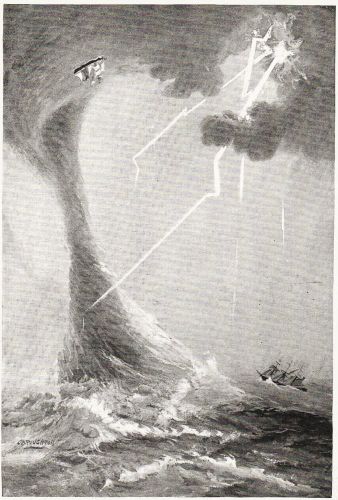
"'Might as well go to the clouds comf'table,' sez he. We all went b'low an' shut all the hatches. Then there weren't nothin' to do 'ceptin' fur to wait developments, as the old hen said w'en she sot down on the duck's egg. Byme-by the bark were hove over so fur that we was all a-settin' on her side, with the decks risin' up like walls on both sides of us. We could hear the ballast tumblin' over itself down in the hold, an' our stores was mixed up into the werry wust sea-salad wot any one ever seed.
"'Oh my! oh my!' sez Pierre Crust, sez he, hidin' his head in a cracker-box, 'we're a-goin' to fall out o' the clouds upside down an' be all smashed up.'
"He were a werry ostridge sort o' man, he were, 'cos he allers thort as how he were out o' danger ef he had his measly old head hid. Howsumever, we all thort putty much the same as he did, an' we weren't in no partikler humor fur to dance hornpipes about it.
"'She's a gittin' furder over!' yelled Tobias Kitten.
"An' so she were. We couldn't stay on the sides o' her any more, but had to sit down on the under sides o' the decks—wot shore-folks would call the ceilin'. An' the furniture in the cabin, bein' screwed fast, were all a-hangin' down from overhead.
"'Waal, may I be squilgeed inside an' out with a paint brush,' sez Cap'n Gawge W. Smoke, sez he, 'ef ever I expected fur to be master o' any wessel wot were so undecent as to sail on her head.'
"'Tobias Kitten,' sez I, 'slide back the hatch an inch an' tell us what ye can see.'
"An' Tobias he laid down flat on his face, slid the hatch back, and peaked out. Then he shut it with a bang, an' turned paler'n he were afore.
"'S'help me gracious goodness!' sez he; 'yo can't see nothin' 'cept white steam.'
"Then we knowed we was up in the clouds fur sure, an' we all felt putty ser'ous; 'cos w'y, w'd never bin there afore, an' we didn't know nothin about the rules an' regulations o' livin' up there. All on a suddent there were a most fearful crash o' thunder.
"'By the great hook block!' sez Cap'n Gawge W. Smoke, sez he, 'we're in a thunder-cloud.'
"'An' mebbe w'en it begins for to rain,' sez I, 'we'll git rained down to 'arth agin.'
"'Oh my! Oh my!' hollered Pierre Crust, out o' the cracker-box. 'On our heads! Oh dear! We're all dead men, sure.'
"Waal, arter that fur half an hour it were not possible fur to carry on any werry improvin' conwersation, 'cos w'y, it were a-thunderin' an' a-lightnin' an' a-roarin' all around us, sech as no one never heerd afore. Then all on a suddent the bloomin' deck dropped right from under us, an' we was kinder floatin' around, a-grabbin' right an' left at things, all 'ceptin' Pierre Crust, an' he jess kep' his head in the cracker-box an' kicked out with his feet.
"'We're a-fallin'! We're a-fallin'!' he yelled.
"An' so we wuz. An' w'ile we wuz a-fallin' I seed the side o' the wessel come under me, an' then slide around till the floor o' the cabin were under me, an' then—boom! There were a most awful thump, an' a squash like wot ye hear w'en yo throw a stone into a mud-puddle, an' there we was."
"Where?" cried both boys.
"In the blessed Atlantic Ocean," said the Old Sailor, solemnly, "about a hundred miles this side o' Bermooda. An' Pierre Crust he pulled his head out o' the cracker-box an' bounced on deck, an' sez he:
"'Wot was all you men so scared about? Turn to, now, an' get the cloth on her, an' we'll make Sandy Hook Light-ship in two days.'
"An' so we did, too. An' w'en we got to New York we read in the papers as how the Cap'n o' the ship Beeswax had seen a cur'ous mirage of a ship sailin' round an' round a water-spout. But we never could get nobody to b'lieve as how 'twere us."