Part 1 — From Calamus to Quill.
Reading edition
It is most interesting to trace the evolution of the pen, beginning with the calamus and stilus—the reed and erasing bodkin—and ending with a fountain-pen of the most improved make. In ancient days great care was taken in the selection of the choicest reeds, the best-cured parchment, and the daintiest waxen tablets. Egypt grew the best reeds, though they were also found in Armenia, Persia, and Italy. The modern Turks and Moors prize the Persian reeds above all others, splitting the points in the same manner as our grandfathers prepared their goose-quills. The oldest account known respecting quills is found in a work of St. Isidore's, who died in 636. Alcuinus, who lived in England, speaks of his pen, so the familiar article must have been in use almost as long as the art of writing was known in the country. Perhaps steel pens would have been more popular when first introduced if all had known that the quills were pulled from the living geese!
Dr. Warner told his stationer that with one quill pen, old when he took it up, he wrote an "ecclesiastical history," two volumes folio, and a "dissertation on the Book of Common Prayer," both first and final draughts. Byron wrote the "Bride of Abydos" in one night, without once mending his quill, while Andrew Borde, physician to Henry VIII., and the original "Merry Andrew," wrote a book of nearly three hundred pages, 12mo., in the same manner. Camden wrote of the quill with which he composed the Britannia,
"With one sole pen I wrote this book, Made of a gray goose quill; A pen it was when I it took, And a pen I leave it still."
Launcelot Claymore.
What Shakespeare Studied when at School.
Mr. William J. Rolfe, the Shakespearian student, has written most entertainingly of the Avon bard's school days. "The training in an English free day school in the time of Elizabeth," he writes, "depended much on the attainments of the master, and these varied greatly, bad teachers being the rule and good ones the exception. In many towns the office of schoolmaster was conferred on 'an ancient citizen of no great learning.' Sometimes a quack conjuring doctor had the position, like Pinch in the Comedy of Errors." What did William study in the grammar-school? Not much except arithmetic and Latin, with perhaps a little Greek and a mere smattering of other branches.
The Latin grammar used was certainly Lily's, the standard manual of the time, as long before and after. In The Taming of the Shrew (I., 1, 167) a passage from Terence is quoted in the modified form in which it appears in this grammar.
This fact, slight as it is, seems to have its bearing on the Baconian controversy. "Can we imagine," asks Mr. Rolfe, "the sage of St. Albans, familiar as he was with classical literature, going to his old Latin grammar for a quotation from Terence, and not to the original works of that famous playwright?"
We often hear people speak of "good old times," as if present times were worse. But good old school times of the sort described here were certainly not better than present times.
Asked to Cease Soaring a Moment.
Mrs. Phelps-Ward has just related an amusing story of John Greenleaf Whittier and Lucy Larcom. They were driving together one day, and discussing the Bible, the future life, and kindred topics. The poet was a spare man, as of course you know, while the author, whose stories and poems you so well remember, was portly, and had withal an easy-going temperament, which led her to take things as they came, disturbed by nothing. She was, when interested in a subject, generally quite oblivious to all else around her. Driving along, they came to a rather steep hill that had a bad gully in it. The horse was none too easy to manage, and the carriage swayed uncomfortably toward the heavy side—that borne well down by the portly woman. Mr. Whittier was trying his best to control the horse and keep his seat, but his companion talked on.
"Lucy," said the poet, sternly, and with not too much composure, "if thee doesn't stop talking long enough for me to control this horse, thee'll find thyself in heaven before thee wants to."
Kinks.
No. 30.—An Oblong Star.
If the cross-words are rightly guessed the central letters of the right-hand hour-glass, reading downward, will spell the name of the Grecian painter from whose untiring industry is derived the proverb, Nulla dies sine linea ("No day without a line"). The central letters of the left-hand hour-glass will spell the name of a renowned Greek sculptor who was born about the time of the battle of Marathon.
1. Upper Diamond.—1. In drawling. 2. A Japanese coin worth about four-fifths of a cent. 3. A word occurring frequently in the Psalms. 4. A deceiver. 5. The inferior pole of the horizon. 6. A form of a personal pronoun. 7. In drawling.
2. Lower Diamond.—1. In drawling. 2. Mournful. 3. The pyramidal roof of a tower. 4. Insulting. 5. Scorched. 6. To finish. 7. In drawling.
3. Left-hand Hour-glass.—1. Spotted. 2. Fences sunk below the ground. 3. A mite. 4. In drawling. 5. The dado. 6. A map. 7. Calcined gypsum.
4. Right-Hand Hour-glass.—1. Revolves. 2. Writing material. 3. A couch. 4. In drawling. 5. A beverage. 6. To step. 7. To sparkle.
Vincent V. M. Beede, R.T.F.
No. 31.—A Heterogeneous Pie.
A maniac in a Canadian asylum once requested his keeper to bring him a pie composed of the following ingredients:
One object1 which once bore the words, "For the fairest," won by Venus; one cup of one2 who rides the main; three cups of an appropriate name3 for a hard-headed animal; a morsel of a rod4 little used in billiards; a nickname5 applied to a New England State; one pound of the fish6 that struggles; a goodly quantity of the fruit7 from which a mechanic in one of Shakespeare's comedies derives his name; a dash of the nom de plume8 of James W. Morris; forty incites9; a heaping measure of the substance10 indicated by the blank.
"Not a —— But shows some touch in freckle, streak, or stain, Of his unrivall'd pencil."—Cowper. Xentrique.
No. 32—Beheading.
1. Behead a fruit, and leave a fruit; behead once more, and leave our ancestors; behead again, and leave a part of our ancestors.
2. Behead a tree, and leave past; behead again, and leave to depart.
3. Behead a fruit, and leave a vegetable; behead again, and leave to adorn.
4. Behead a plant, and leave slack; behead again, and leave that wherewith the plant might have been cut.
Answers to Kinks.
No. 28.—A Musical Mélange.
1. Beethoven. 2. Chopin. 3. Handel. 4. Bull (Taurus). 5. Rossini. 6. Thomas. 7. Albani. 8. Crotch. 9. Lasso. 10. Mason. 11. Potter. 12. Purcell. 13. Fiddle. 14. Spinet. 15. Flute. 16. Bugle. 17. Trumpet. 18. Bagpipes. 19. Kettle-drums. 20. Fife. 21. Horn. 22. Lyre. 23. Harpsichord.
No. 29.
1. Burns. 2. Scott. 3. Herbert. 4. Willis. 5. Spenser. 6. White. 7. Dryden. 8. Hemans. 9. Pope. 10. Goldsmith. 11. Cowper. 12. Southey.
Not Good Form.
Care for what one says ought always to be exercised, without regard to whether or not it may be heard by those for whom it is not intended. Here is a story that emphasizes this lesson:
An officer of the Law Division of the New York Custom-house walked into the Collector's office a few days ago, while the Collector was talking with a tall man, whose back was turned toward the door.
"What is it?" asked the Collector. "Anything important?"
"Oh no," returned the officer. "Only another blunder in the long list of blunders committed by that Secretary of the Treasury of ours." The tall man laughed.
"Mr. Blank," said the Collector, "let me introduce you to Mr. Carlisle, Secretary of the Treasury."
The Secretary turned, still laughing, and shook the hand of the law officer, who, red in the face, stammered a half-heard apology—and got out as quickly as possible.
A Good Amateur Newspaper.
The Scribbler has completed its first year, and it makes quite an unnecessary apology for its past shortcomings. This latter is really the poorest thing about its past—this apology. Many a public speaker, after giving a good address, mars it by apologizing for it. The Scribbler has done well, and of course will do better. Its address is: Easton, Pa., and its manager, Norman E. Hart. You should see a copy. It is neat and Interesting.
Questions and Answers.
John C. Cone, 519 South Seventh Street, Hamilton, O., wants to receive sample copies of amateur newspapers. The Table has not published a description of the badge, dear Sir Sidney Mulhall, and has now none in stock. Evelyn T. Jones: Yes, the Table is glad to receive descriptions of places, industries, outings, etc., and asks correspondents to try to see how excellent they can make such morsels—correct grammar and spelling, avoidance of unnecessary words, and careful selection of descriptive adjectives. Letters from foreign places, if filled with information of general interest, are published when space permits. Good "Kinks" will be published, but new ideas are wanted, not merely new material in old forms.
Arthur J. Johnston, Box 136, Dartmouth, N. S., says, "I am much interested in politics, and would like to correspond with members of the Table, especially those living in Canada, on that subject." Cyrus Williston, Vernon, N. Y., wants to hear from members of the Order, any subject, and Louis O. Brosie, 3405 Butler Street, Pittsburg. Pa., has some quite old numbers of Harper's Young People which he does not want. He mentions the fact upon seeing inquiries in this column for these old copies, no longer in the publishers' stock. Aaron Spong asks where he can find a collection of college songs. There are several to be had. Ask for Carmina Princetonia; Columbia College Song-Book; Harvard College Song-Book. Go to your bookseller or to a music-store. Any dealer can get collections for you upon order, but Chicago dealers will have them in stock without doubt.
Henry F. French asks for information concerning the earliest national books. The Pentateuch is the oldest of books. In Greece the most ancient writings are Homer's Iliad and Odyssey, date about 900 b.c. In Latin, Plautus wrote his comedies 200 b.c. The first British author was Gildas, 500 a.d., who wrote a Conquest of Britain. At the same date Venan Fortunatus, in France, wrote the first work of that country—a book of Latin poetry. The Koran is the earliest work of any Arabian, Persian, or Turk. It was written a.d. 600. The first of Germany's literature was Walafred Strabo's book of poems and theology, 841 a.d. In Russia, Yaroslaff in the year 1000 a.d., compiled a code of laws, while Monez (1100 a.d.) is the first Portuguese author. The other countries are represented as follows: Italy, Accursius, writer of jurisprudence, 1182-1260 a.d.; Sweden, Eric Olai, author of A History of the Goths and Swedes, 1400 a.d.; Poland, Vinc Kadlubek, writer of a history of Poland, 1226 a.d. Arvine names Benjamin Thompson our "pioneer in letters." He was called "ye renowned poet of New England, learned schoolmaster and physician."
This department is conducted in the interest of stamp and coin collectors, and the Editor will be pleased to answer any question on these subjects so far as possible. Correspondents should address Editor Stamp Department.
Specialization has led to the cataloguing of innumerable minute varieties in perforations, water-marks, papers, shades, and impressions from more or less worn or retouched plates, to say nothing of "freaks." The result has been the immense catalogues with which we are all so familiar, and albums containing a multitude of spaces for stamps which not one collector in a thousand can ever expect to fill. This has led to a reaction, and the average collector will hereafter not be puzzled by minute varieties of no interest to any one except the small group of rich men in each country to whom they are due. These advanced collectors do not use printed albums, and special catalogues can easily be made for them. All the large dealers hereafter will make albums and catalogues which the average collector will have a chance of filling up at reasonable rates.
Unique or very rare stamps in such albums will probably be represented by photographs of the costly originals.
W. MacFarlane.—The 2c. U.S. Revenues are extremely common, hence have no value.
S. Manning.—The old U.S. Special Delivery stamps are worth 15c. each, used. The yellow one will probably prove to be the scarcest.
H. M. Crossman.—The 1892 Columbian half-dollar can be bought for 75c. The 1893 one is in common use. The Columbian quarter is worth $1.75.
H. H. C.—The ordinary U.S. quarter for 1853 with rays on the reverse can be bought for 35c. The rare variety of the same date for $3.50.
F. M., Jun.—The 50c. Mortgage U.S. Revenue is worth 5c.; the 50c. Entry of Goods and Conveyance, 1c. each: the $1 Inland Exchange, 1c. These prices are for perforated stamps; if unperforated they are worth $1 each upward.
Will Kelsey.—All sheets of the current issue have one outside row of stamps unperforated on one side, and all the 1c., 2c., etc., have two rows of stamps unperforated on one side. Such partly perforated stamps have no special value. The 1875 reprint of the 1869 3c. stamp is worth $15 unused. This reprint can be known by the snow-white paper on which it is printed. Many of the 1869 stamps show no signs of grilling, owing to a very light pressure of the grills. Such stamps have no greater value than the grilled ones.
Nyack.—I do not know what the stamped paper made for use in the American colonies is worth. I know of one copy which was bought by the holder for $50. There were no adhesive stamps made for the 1765 stamp act.
T. A. Wessman.—It is impossible to pass any opinion on rare Chinese coins without seeing a rubbing. They are considered as simple curios here, and can be bought very cheap if the dealer has any.
A. F. Berlin.—Apply to any of the larger dealers for price.
A. B. C.—My remarks applied to Spanish stamps only. The West Australian cancelled stamps with punched holes were those issued by the colonial authorities to the imperial (i.e., Great Britain) authorities for official use. Most of these imperial officials were in charge of the convict camps in West Australia, and doubtless some of the stamps were given by them to prisoners in their charge, as it seems fairly well established that some letters from prisoners were pre-paid by punched stamps.
C. S. Smith.—Dealers offer U.S. dollars of 1800 for $2; half-dollar 1811, 1812, 1818, seventy-five cents each.
C. Rawson, 3421 North Nineteenth Street, Philadelphia, Pa., wishes to exchange stamps.
H. D. Graham.—"Local" stamps are those used by postmasters and by private firms who carried letters in competition with the U.S. mails. They have all been suppressed by the U.S. government. The early Boyd's Express, Blood & Co.'s, Honour City Post, etc., are very scarce. Hussey's Post and the later Boyd's Express are very common. Many have been reprinted, and others have been counterfeited.
N. P. Coppedge.—The English penny is quite a common coin. It has no value in this country, and in England can be bought for threepence.
Philatus.
"Health is the vital principle of bliss, and exercise, of health."
No health—there is no hope of bliss, No exercise—and health soon flies, No bath with Ivory Soap—you miss The best results of exercise.
Copyright, 1896, by The Procter & Gamble Co., Cin'ti.
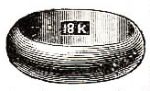
GOLD RINGS FREE!
We will give one half-round Ring, 18k Rolled Gold plate & warranted to anyone who will sell 1 doz. Indestructible Lamp Wicks (need no trimming) among friends at 10cts. each. Write us and we will mail you the Wicks. You sell them and send us the money and we will mail you the Ring.