Part 1 — THE VOYAGE OF THE "RATTLETRAP."
Reading edition
BY HAYDEN CARRUTH.
VI.
Besides the cactus, another form of vegetation which began to attract more and more of Ollie's attention was the red tumbleweed. Indeed, Jack and I found ourselves interested in it also. The ordinary tumbleweed, green when growing, and gray when tumbling, had long been familiar to us, but the red variety was new. The old kind which we knew seldom grew more than two feet in diameter; it was usually almost exactly round, and with its finely branched limbs, was almost as solid as a big sponge, and when its short stem broke off at the top of the ground in the fall it would go bounding away across the prairie for miles. The red sort seemed to be much the same, except for its color and size. We saw many six or seven feet, perhaps more, in diameter, though they were rather flat, and not probably over three or four feet high.
The first one we saw was on edge, and going at a great rate across the prairie, bounding high into the air, and acting as if it had quite gone crazy, as there was a strong wind blowing.
"Look at that overgrown red tumbleweed!" exclaimed Jack. "I never saw anything like that before. Jump on the pony, Ollie, and catch the varmint and bring it back here!"
OLLIE AND THE TUMBLEWEED.
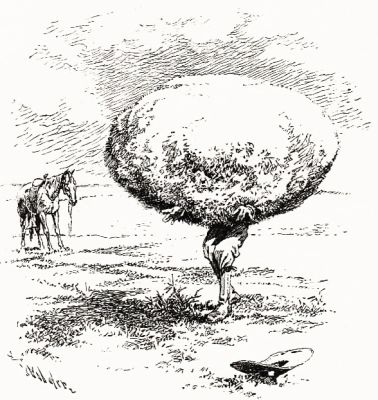
Ollie was willing enough to do this, and the pony was willing enough to go, so off they went. I think if the weed had had a fair field that Ollie would never have overtaken it, but it got caught in the long grass occasionally, and he soon came up to it. But the pony was not used to tumbleweed-coursing, and shied off with a startled snort. Ollie brought her about and made another attempt. But again the frightened pony ran around it. Half a dozen times this was repeated. At last she happened to dash around it on the wrong side just as it bounded into the air before the wind. It struck both horse and rider like a big dry-land wave, and Ollie seized it. If the poor pony had been frightened before, she was now terror-stricken, and gave a jump like a tiger, and shot away faster than we had ever seen her run before. Ollie had lost control of her, and could only cling to the saddle with one hand and hold to the big blundering weed with the other. Fortunately the pony ran toward the wagon. As they came up we could see little but tumbleweed and pony legs, and it looked like nothing so much as a hay-stack running away on its own legs. When the pony came up to the wagon, she stopped so suddenly that Ollie went over her head. But he still clung to the weed, and struck the ground inside of it. He jumped up, still in the weed, so that it now looked like a hay-stack on two legs. We pulled him out of it, and found him none the worse for his adventure. But he was a little frightened, and said:
"I don't think I'll chase those things again, Uncle Jack—not with that pony."
"Oh, that's all right, Ollie," said Jack. "I'm going to organize the Nebraska Cross-Country Tumbleweed Club, and you'll want to come to the meets. We'll give the weed one minute start, and the first man that catches it will get a prize of—of a watermelon, for instance."
"Well, I think I'll take another horse before I try it," returned Ollie.
"Might try Old Browny," I said. "If he ever came up to a tumbleweed he would lie right down on it and go to sleep."
"Yes, and Blacky would hold it with one foot and eat it up," said Jack. "Unless he took a notion to turn around and kick it out of existence."
We looked the queer plant over carefully, and found it so closely branched that it was impossible to see into it more than a few inches. The branches were tough and elastic, and when it was tossed up it would rebound from the ground several inches. But it was as light as a thistle ball, and when we turned it loose it rolled away across the prairie again as if nothing had happened.
"They're bad things sometimes when there is a prairie fire," said Jack. "No matter how wide the fire-break may be, a blazing tumbleweed will often roll across it, and set fire to the grass beyond. They've been known to leap over streams of considerable width, too, or fall in the water and float across, still blazing. Two years ago the town of Frontenac was burned up by a tumbleweed, though the citizens had made an approved fire-break by ploughing two circles of furrows around their village and burning off the grass between them. These big red ones must be worse than the others. I believe," he went on, "that tumbleweeds might be used to carry messages, like carrier-pigeons. The next one we come across we'll try it."
That afternoon we caught a fine specimen, and Jack securely fastened this message to it and turned it adrift:
"Schooner Rattletrap, September —, 188-: Latitude, 42.50; Longitude, 99.35. To Whom it may Concern: From Prairie Flower, bound for Deadwood. All well except Old Blacky, who has an appetite."
The night after our stop by the unfinished house we again camped on the open prairie, a quarter of a mile from a settler's house, where we got water for the horses. This house was really a "dugout," being more of a cellar than a house. It was built in the side of a little bank, the back of the sod roof level with the ground, and the front but two or three feet above it.
"I'd be afraid, if I were living in it, that a heavy rain in the night might fill it up, and float the bed-stead, and bump my nose on the ceiling," said Jack.
"CARRYING EVERYTHING THAT WAS LOOSE BEFORE IT."
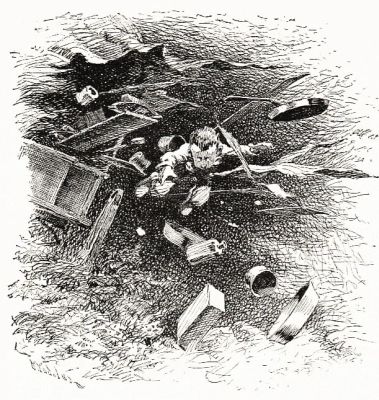
It had been a warm afternoon, but when we went to bed it was cooler, though there was no wind stirring. The smoke of our camp-fire went straight up. There was no moon, but the sky was clear, and we remarked that we had not seen the stars look so bright any night before. The front of our wagon stood toward the northwest. We went to bed, but at two o'clock we were awakened by a most violent shaking of the cover. The wind was blowing a gale, and the whole top seemed about to be going by the board. We scrambled up, and I heard Jack's voice calling for me to come out. The cover bows were bent far over, and the canvas pressed in on the side to the southwest till it seemed as if it must burst. The front end of the top had gone out and was cracking in the wind. I crept forward, and as I did so I felt the wagon rise up on the windward side and bump back on the ground. I concluded we were doomed to a wreck, and called to Ollie to get out as fast as he could. I supposed a hard storm had struck us, but as I went over the dashboard I was astonished to see the stars shining as brightly as ever in the deep, dark sky. Jack was clinging to the rear wagon wheel on the windward side, which was all that had saved it from capsizing. He called to me to take hold of the tongue and steer the craft around with the stern to the gale. I did so, while he turned on the wheel. As it came around, the loose sides of the cover began to flutter and crack, while the puckering-string gave way, and the wind swept through the wagon, carrying everything that was loose before it, including Ollie, who was just getting over the dashboard. He was not hurt, but just then we heard a most pitiful yelping, as Jack's blankets and pillow went rolling away from where the wagon had stood. It was Snoozer going with them. The yelping disappeared in the darkness, and we heard frying-pans, tin plates, and other camp articles clattering away with the rest. The Rattletrap itself had tried to run before the gale, but I had put on the brake and stopped it. The three of us then crouched in front of it, and waited for the wind to blow itself out. We could see or hear nothing of the horses. There was not a cloud in sight, and the stars still shone down calmly and unruffled, while the wind cut and hissed through the long prairie grass all about us. It kept up for about ten minutes, when it began to stop as suddenly as it had begun. In twenty minutes there was nothing but a cool, gentle breeze coming out of the southwest. We lit the lantern and tried to gather up our things, but soon realized that we could not do much that night. We found the unfortunate Snoozer crouched in a little depression which was perhaps an old buffalo wallow, but could see nothing of the horses. We concluded to go to bed and wait for morning.
When it came we found our things scattered for over a quarter of a mile. We recovered everything, though the wagon-seat was broken. The horses had come back, so we could not tell how far they had gone before the wind.
"I've read about those night winds on the plains," said Jack, "and we'll look out for 'em in the future. We'll put an anchor on Snoozer at least."
This intelligent animal had not forgotten his night's experience, and stuck closely in the wagon, where he even insisted on taking his breakfast.
The road we were following was gradually drawing closer to the Niobrara, and we began to see scattering pine-trees, stunted and broken, along the heads of the cañons or ravines leading down to the river. There was less sand, and we made better progress. The country was but little settled, and game was more plentiful. We got two or three grouse. We went into camp at night at the head of what appeared to be a large cañon, under a tempest-tossed old pine-tree, through which the wind constantly sighed. There was no water, but we counted on getting it down the cañon. A man went by on horseback, driving some cattle, who told us that we would find a spring down about half a mile.
"Can we get any hay down there?" I asked him. "We're out of feed for the horses, and the grass seems pretty poor here."
"Down a mile beyond the spring I have a dozen stacks," answered the man, "and you're welcome to all you can bring up on your pony. Just go down and help yourselves."
We thanked him and he went on. As soon as we could we started down. It was beginning to get dark, and grew darker rapidly as we went down the ravine, as its sides were high and the trees soon became numerous. There was no road, nothing but a mere cattle-path, steep and stony in many places. We found the spring and watered all the horses, left Blacky and Browny, and went on after the hay with the pony, Jack leading her, and Ollie and I walking ahead with the lantern. It seemed a long way as we stumbled along in the darkness, all the time down hill.
"I guess that man wasn't so liberal as he seemed," said Jack. "The pony will be able to carry just about enough hay up here to make Snoozer a bed."
We plunged on, till at last the path became a little nearer level. It crossed a small open tract and then wound among bushes and low trees. Suddenly we saw something gleam in the light of the lantern, and stopped right on the river's bank. The water looked deep and dark, though not very wide. The current was swift and eddying.
"We've passed the hay," I said. "It must be on that open flat we crossed."
We went back, and turning to the right, soon found it. I set the lantern down and began to pull hay from one of the stacks, when the pony made a sudden movement, struck the lantern with her foot, and smashed the globe to bits.
"There," exclaimed Jack, "we'll have a fine time going up that badger-hole of a cañon in the dark!"
But there was nothing else to do, and we made up two big bundles of hay, and tied them to the pony's back.
"She'll think it's tumbleweeds," said Ollie.
"If she'd headed in the right direction I hope she will," answered Jack.
We started up, but it was a long and toilsome climb. In many places Jack and I had to get down on our hands and knees and feel out the path. The worst place was a scramble up a bank twenty feet high, and covered with loose stones. I was ahead. The heroic little pony with her unwieldy load sniffed at the prospect a little, and then started bravely up, "hanging on by her toe-nails," as Ollie said. When she was almost to the top she stepped on a loose stone, lost her footing, went over, and rolled away into the darkness and underbrush. Jack stumbled over a little of the hay which had come off in the path, hastily rolled up a torch, and lit it with a match. By this light we found the pony on her back, like a tumble-bug, with her load for a cushion and her feet in the air, and kicking wildly in every direction. While Ollie held the torch, Jack and I went to her rescue, and after a vast deal of pulling and lifting, got her to her feet just as the hay torch died out. Again she scrambled up the bank, and this time with success. We went on, found the other horses, and were soon at the wagon. We voted the pony all the hay she wanted, and went to bed tired.
The next day, the ninth out from Yankton, though it was a long run, brought us to Valentine, the first town on the railroad which we had seen since leaving the former place. Before we reached it we went several miles along the upper ends of the cañons, down a long hill so steep that we had to chain both hind wheels, forded the Niobrara twice, followed the river several miles, went out across the military reservation, which was like a desert, saw six or eight hundred negro soldiers at Fort Niobrara, and finally drove through Valentine, and went into camp a mile west of town. On the way we saw thousands of the biggest and reddest tumbleweeds, and two or three new sorts of cactus. The colored troops surprised Ollie, as he had never seen any before.
"It's the western winds and the hot sun that's tanned those soldiers," said Jack. "We'll look just that way, too, before we get back."
Ollie was half inclined to believe this astonishing statement at first, but concluded that his uncle was joking.
We went into camp on the banks of the Minichaduza River, a little brook which flows into the Niobrara from the northwest. It gurgled and bubbled all night almost under our wheels. A man stopped to chat with us as we sat around our camp-fire after supper. We told him of our experience in getting the hay the night before. He laughed and said:
"Ever steal any of your horse feed?"
"We haven't yet," answered Jack. "We try to be reasonably honest."
THE YOUNG FELLOW WILTED RIGHT DOWN ON THE GROUND.
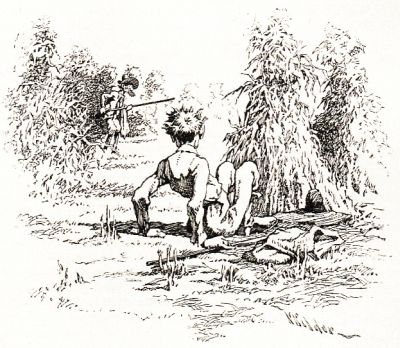
"Some don't, though," replied the man. "Most of 'em that are going West in a covered wagon seem to think corn in the field is public property. A fellow camped right here one afternoon last fall. He was out of feed, and took a grain sack on one arm and a big Winchester rifle on the other, and went over to old Brown's corn-field. He took the gun along not to shoot anybody, but to sort of intimidate Brown if he should catch him. Suddenly he saw an old fellow coming toward him carrying a gun about a foot longer than his own. The young fellow wilted right down on the ground and never moved. He happened to go down on a big prickly cactus, but he never stirred, cactus or no cactus. He thought Brown had caught him, and that he was done for. The old man kept coming nearer and nearer. He was almost to him. The young fellow concluded to make a brave fight. So he jumped up and yelled. The old man dropped his gun and ran like a scared wolf. Then the young fellow noticed that the other also had a sack in which he had been gathering corn. He called him back, they saw that they were both thieves, shook hands, and went ahead and robbed old Brown together."
The man got up to go. "Well, good-night, boys," he said. "Rest as hard as you can to-morrow. You'll strike into the sand hills at about nine o'clock Monday morning. Take three days' feed, and every drop of water you can carry; and if you waste any of it washing your hands you're bigger fools than I think you are."
[to be continued.]

[The series of four papers on the Science of Football, by Mr. W. H. Lewis of the Harvard Football Team of 1893, begun in this Department last week, is continued in the present issue.]
The subject of position-play in football may best be covered by taking up and discussing each individual of the team in turn. The end rusher, therefore, should be chosen for agility, speed, endurance, and good judgment. The first three qualifications are necessary to enable him to avoid, break up, and worm his way into, through, or around the interference, tackle into its very midst, or take advantage of occasional fumbles. His duty on the offensive, or when his own side has the ball, will depend upon his assignment in the particular play. Generally the end should stand much nearer his tackle when on the offensive, so as to be able to get into every play. In plays through tackle and end, or around the end on his own side of the line, he may help the tackle to block or pocket the opposing tackle. If a half-back comes into the line between tackle and end, the end should remember to take the inside man, as he is the more dangerous, because uncovered and nearest to the play.
FIG. 1.
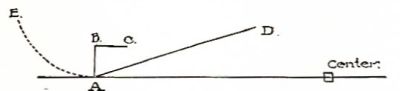
The great bulk of the end's work comes in the defensive game. He is to prevent the long runs or open plays. He should never run behind his own line, because of the danger of leaving his side of the line open to criss-cross or some trick play. The end's primary duty is to turn the runner in. He therefore should go in as quickly and on as sharp an angle as possible, so that he can meet the interference before it gets well formed and started. He should take the direction of A D (shown in Fig. 1), A B C if he must, but never A E. If the opposing end plays up in the line opposite him, the only direction possible will be A B C.
He should meet the interference with body well forward, the arms extended straight and stiff, so as not to be hit by the interference, being careful to keep a little to the outside of it. In plays through the middle of the line, or pile up, the ends should keep out of the scrimmage, so as to be sure that the runner does not come out of the pile.
Tackle.—If there is any one position in the line harder to play than another, that position is tackle. The tackle must look out for territory on both sides of him, and be ready to help either guard or end, as the emergency requires. The great majority of the plays are aimed at him. His constant study must be how to meet each particular play in every style of offence. He should stand about four feet from his guard, and should not allow himself to be drawn out further than six feet; the wider his line is drawn out, the weaker it will be and the more territory he will have to cover. The offensive work of the tackle depends largely upon the play and his assignment in it. In blocking he should always take the man nearest the centre, as he is the nearest to the starting-point of the play, and therefore the most dangerous. In that case he should call in his guard to take his man. On plays through and around the other side of the line, the tackle should momentarily block his man, and then get into the push or interference.
When the tackle himself takes the ball, he should be careful not to give his intention away. He should, without notice, shift his position and bring his feet pretty close together, to enable him to start quickly. He should take off by giving his tackle a push in his chest with the open hand. The end should go into the opposing tackle the moment his tackle takes off, so as to prevent his opponent from following. When his own side is going to kick, the tackle should block his man long enough to prevent his stopping the kick, and then get down the field so as to help the ends prevent a return. The tackle should go nearly straight, so as to protect the centre of the field, the ends taking care of the sides.
The great bulk of the tackle's work is on the defensive. His duty is to tackle everything in sight. Clean, sharp breaking through is imperative in a tackle. The first thing a tackle should do when he steps into the line on the defence, is to notice his opponent's style of blocking, and adapt his method of breaking through accordingly.
Plays directed on the tackle call for great judgment and great strength. The tackle should, if possible, shove his man back and into the play. His next best plan to meet it is to go down in front of it good and stiff and pile it up. He should go into the mass head and shoulders or sideways, but never upon any pretext turn his back to it. In defending his territory against trick plays, the best and only advice that can be given to a tackle is to keep the eyes open, notice the alignments of the opposing back's, the way they stand, their facial expression, and movement, and try to divine which way the ball is going. When the opposing side is going to kick, the tackle should spread a little so as to give himself a better chance of getting through.
FIG. 2.
Guard.—The two guards and the centre make up the proverbial stone wall into which the opposing backs are supposed to ram their heads to no effect.
A guard should stand with the foot next to centre forward if possible, but if a man starts quicker with that foot back, why, stand that way. He should be careful not to allow himself to be drawn out too far from the centre. If his man goes out far he should tell the quarter-back, and have him send a play through guard and centre, and his opponent will probably move in again. As long as the inner foot of the opposite guard is inside of the outer foot of the guard blocking, the latter ought to be able to take him the moment the ball starts, and run him out to the side lines. The guard should also keep a sharp lookout for the opposing quarter, and if he comes up into the line between him and centre, push him out with open hand.
After having made a hole if called for, or blocked his man, the next duty of the guard is to get into the push or interference himself. Get hold of the runner; if possible, pull him along. Give him a chance to use you in warding off would-be tacklers. One of the first duties of a guard is to line up quickly. He should be right beside his centre the moment the ball is down. The play cannot start without some one to guard it. When his side is going to kick, the guard should move in close to the centre so that no little quarter or stray back can come through and stop the kick. He must block well, and almost until he hears the ball booted, because the path through the centre is the straightest line, and hence the shortest distance to the kicker, as will be seen in Fig. 3, line A B. The exact moment when he can let his man through must be determined by the quickness of the man in front of him and the kicker, as will be seen in Fig. 3. After having blocked long enough to insure the kicks getting away, he should get down the field with the other forwards to help prevent return of the ball.
FIG. 3.
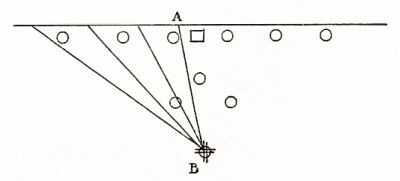
On the defense there is an immense amount of hard work for the guard. He is primarily responsible for the ground between him and tackle, and secondarily for that between him and centre. In going through, this fact should be kept in mind. The fact that a guard must stand lower than tackle, and has less and different kind of territory to cover, will prevent him ordinarily from using as many methods of breaking through as a tackle. He must take some method of getting through that will enable him to use the body of his opponent to cover the territory between him and centre, and to enable him to get out and back up tackle, and that will put him through back to back with his man before the runner reaches the line.
Centre Rush.—The position of centre rush is comparatively a new one. Until a few years ago the middle position in the line was occupied by a snap-back, whose only duty was to put the ball in play. After that he was merely a passenger. From the snap-back the centre rush has been evolved by gradual enlargement of his duties. To-day he is chief of forwards, there being no duplicate to his position, as there is of tackle and guard. Every play starts from the centre rush, and depends upon him for a large share of its success or failure. The position is one requiring painstaking, conscientious hard work, admitting of very little glory, although the centre handles the ball more than any other player. On the offensive, the first duty of the centre rush is to put the ball in play. Much depends upon this. The team can play no faster than he does. If he is slow, the whole thing is slow. He must follow the ball closely, and the moment it is down, take it from his back and put it down for the next play. When the ball goes out of bounds, he must be the first man on the side lines, to take it in on the jump for the next play. The line forms on him, and to have his team line up quickly he must be doubly quick.
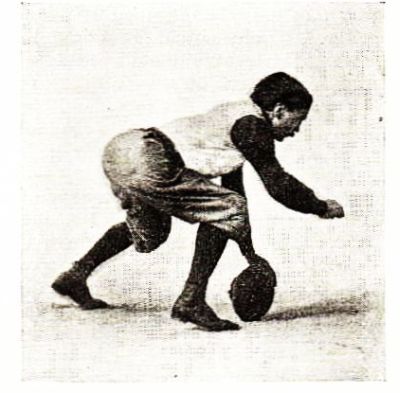
To snap the ball back, the body should be just low enough to reach the ball with the snapping arm, and no lower nor higher. The distance between the forward and rear foot must be obtained by practice. The rear one, in general, should be just far enough back to give him a good start. The centre should straddle only enough to keep from wobbling from side to side. The centre should never stand flat-footed. The feet should be at right angles to the gridiron lines. The position is much like that of a sprinter on his mark, as is shown in Fig. 2.
Different Methods of Snapping.—First, the flat, or side, snap, or snap on the longer axis of the ball. Place the ball upon the ground about two inches from the forward foot. Turn the lacing in. Have the seams of the ball parallel with the gridiron lines. Take a firm grip of the ball. Let the fingers be well over the front of it. The ball is sent back to the quarter with a downward motion of the wrist and arm. Place the ball as far under you as possible; it shortens the distance. The advantage of the side snap is that the snapper can balance himself partly on the ball, so that he can ofttimes put the ball into play under very trying circumstances.
Second, the end-over-end, or snap on the shorter axis. This snap is in most general use at present. It requires more skill in handling than the other. It has the advantage that it is quicker when well executed, and enables the quarter to be of considerably more aid in the interference. To use this style of snapping, place the ball on the end, the head out a little, although the exact angle must be acquired by practice. The ball is put into play by a delicate wrist motion back and downward.
The defensive-work of the centre is almost illimitable. He can be of as much or of as little use to his side as he has a mind to. He has more opportunity for brilliant tackles than any other man on his side, for the sole reason that he is not expected to do anything, and is the unaccounted-for man. His own man is handicapped by having to snap the ball, and he has no other assignment except that man. He should remain in his position long enough to see whether the play is coming at him or not. This will, of course, be determined by his shrewdness in guessing the play. If the play is at him, by keeping his man away from him, he can get under and into either hole. If his own position is not attacked, he should take the hole nearest the runner. He can often go through between guard and centre by having his guard break to the outside, and the opposing guard, following him, makes the hole for centre to go through.
The Half-Back.—The function of the half-back is to carry the ball. The advance into the enemy's territory must be made by him, except that a tackle may occasionally be called on for a run. The position is a difficult, trying, and exhausting one. The back must be sent time and again without let-up. With reference to his own proper function, a half-back should be chosen for speed, endurance, sand, and a cool, quick judgment. There are two distinct styles of backs—the "plunging back" and the "wrigglers," or "dodgers." It is desirable to have one of each upon a team. The former is better in line-breaking as a rule, and the latter excels in "broken fields" and end-running. The backs should be drilled carefully in the Fundamentals, especially those connected with their immediate duties, such as tossing, catching, kicking, and tackling. Standing starts and short dashes are also invaluable as preliminary practice.
As to the form of the half-back, it should be such as will not give away the direction in which he intends to run, yet such as will enable him to start at once upon the snap of the ball or signal. Many of the best backs give away the point of attack by unconscious glances and movements, things that should be studiously avoided. False starts are also to be guarded against, as they spoil the whole play and slow up the game. The backs should take, as far as possible, the same position in the given play every time. The body should be angular in form and carried well forward, much like the position of the standing start of a sprinter, with this difference, that the rear foot should not be quite so far back. The position must be one in which the backs can start quickly in either direction. Backs generally stand perfectly square, with toes of both feet on a line. Before they can get away from that position they must take either a short step back or forward. This step is unnecessary and shows a man up.
In going through the line, the general rule is to go low. In running low, the runner should bend his neck so that he can see and take his holes cleanly. When going through the middle of the line, it is best to carry the ball in both hands. Take the ball in the pit of the stomach, the legs and trunk forming a basket or angle, and then grapple it to you with both hands. Do not carry the ball too far under the arm. The ball should be carried so that it may be shifted in order to use the nearest arm to ward off would-be tacklers. It is surprising how many tacklers can be warded off by using that arm like a piston-rod against every man that comes up. In line-breaking, the back should remember to keep his feet and fight for the last inch of ground. If he can only keep his feet and give his own side a chance to push, he is bound to gain ground.
Full-Back.—No player has cut so much ice in the winning or losing of big matches in the last two seasons as the full-back. The holding of big teams to small scores by inferior ones has been largely owing to good men in this position. Hence the growing appreciation of the demands of this position and its vital importance to the success of the eleven. Kicking to-day has come to be a part of the offensive game, and the full-back, consequently, the biggest ground-gainer of all the backs. The full-back should be chosen almost solely for his ability to kick. Other qualifications are desirable, to be sure, but the ability to kick is the prime requisite. The preliminary training of the full-back should be one continuous kick.
FIG. 4.
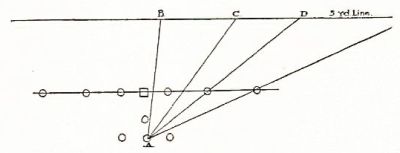
The position of the full-back on the offence will be generally midway between the two backs, or a little in advance of them, near enough to touch either with the out-stretched arm. In runs around the end the full-back will generally be called on either to lead the interference or to block some particular player on the other side—a half-back or an end, most likely. In bucking the centre, the full-back should put his head down and go low and hard. He should make up his mind where he is going, and then go there without halting and hesitating. While as a general rule it is hard to gain through a good centre, a short gain through that territory is all the more valuable. The line through the centre is a straight line, and therefore the shortest distance to the required five yards, as will be seen in Fig. 4, the base of a right-angled triangle being always shorter than the hypothenuse.
The Quarter-Back.—The first essential qualification of a quarter-back is brains. He should be able to take in a situation at a glance, to think quickly, and to put that thought into execution at once. He should be cool without being deliberate, enthusiastic without being excitable. He should be brimful of nervous force and energy and of tireless activity. He should be absolutely fearless, and of positive force of character. The quarter-back should have constant, painstaking practice in handling and passing the ball. All spare moments on and off the field can most profitably be put in by him in receiving the snap from his centre and passing to some back. By that practice he gets used to his centre and learns intuitively when and where the ball will come every time.
The two ways commonly used in putting the ball into play are the "end" and "flap" snap. Take the position of quarter in receiving the "flap" snap first: The quarter stands, or rather kneels without touching his knees, close up behind the centre, about a foot from him.
The position is such that he can start quickly in the opposite direction from the one he is facing to receive the ball. Turning to the rear is easily and quickly done by using the balls of the feet as a pivot and swinging the body around on them. The ball should be picked up cleanly. It ought to require no more changing to throw than a baseball. The ball is picked up with the fingers over one end of it, the other end is bound to point along the arm, and thus it is ready for throwing. When the ball is snapped end over end, the quarter-back takes an entirely different position. He should stand squarely behind the centre, both feet being nearly on a line. He should stand near enough to take the ball on the first bound just the moment before the ball reaches the point where it begins to fall. His distance is about from two to three feet.
Upon the defence, the quarter with the other two backs form a kind of second rush-line. The play of the quarter-back on the defence, unless some special assignment is made him, is that of a free lance, a pirate to mix up things generally and break through where he is least expected. He generally stands behind the centre, and the moment the play starts, takes the nearest hole. Oft-times the guard and centre can make a hole to let the quarter through.
When an individual enters a competition which is held by any association for the purpose of determining which player has the strongest claim, by reason of his skill, to represent that association at a competition to be held by some other (and, usually, greater) organization at some future date, he takes upon himself, as a man of honor, the obligation, in case he wins, of representing the first body in the contest to be held by the second body. This more or less ethical and undoubtedly wordy definition I hope is clear; but in case it is not, let me put it in another and possibly more colloquial way: If the Scholastic School holds a golf tournament for the purpose of selecting a man to represent the Scholastic School at the University College golf tournament, every man who enters the Scholastic School tournament pledges himself (in spirit, of course, he being an honorable amateur), in case he is a winner, to appear and compete, to the best of his ability, at the University College golf tournament as the representative of his school.
In other words, any person who wins at a preliminary event, and fails to fulfil at the final contest the obligations he has thus assumed, is guilty of a breach of faith. He is guilty of a breach of faith unless he is physically unable to stand the bodily strain of the contest he has entered for, and in such a case he should at once notify both the body he represents (that it may send a substitute if it chooses) and the officers of the organization for whose competition he is entered, that the latter may not be placed in a false position toward the public and the other competitors.
Mr. C. W. Beggs, of the Lawrenceville School, entered the Princeton Interscholastic Tennis Tournament as a representative of Lawrenceville—and won. By this victory Mr. Beggs became Princeton's representative at the National Interscholastic Tennis Tournament to be held at Newport, and accepted the obligation and responsibility of representing Princeton on that occasion, just as fully and as unequivocally as a football-player or a baseball-player accepts the responsibility of playing his position in the final match game of the season when he earns a place on his school's eleven or nine. Mr. Beggs did not fulfil his obligations toward Princeton. He did not appear at Newport on the day of the tournament, and, so far as I am able to learn, he did not notify the officers of the national event of his intended and perhaps entirely unavoidable absence.
By acting in this manner he disarranged the programme of the national event, he lessened the interest in the play of the tournament, and he deprived Princeton of a possible victory. It is possible that Mr. Beggs was prevented by illness from appearing on the courts at Newport, but illness alone can be accepted as a valid excuse for his absence. Having undertaken to be present, not travels nor "occasions of a life-time" should have kept him away—should have allowed him to break his faith.
These few words are not aimed in censure at Mr. Beggs. He is not alone in such conduct. But he is a vivid example of an unsportsmanlike act (unsportsmanlike unless he had the excuse of illness, and, even so, inconsiderate if he did not notify the National L.T.A., and it does not appear that he did), and the ethics of sport can only be taught to most of us by the display of a striking example. The interests of interscholastic sport may best be maintained by a strict adherence to obligations assumed.
"TRACK ATHLETICS IN DETAIL."—Illustrated.—8vo, Cloth, Ornamental, $1.25.
The Graduate.