Part 1 — ADVERTISEMENTS.
Reading edition
A cream-of-tartar baking powder. Highest of all in leavening strength.—Latest United States Government Food Report.
Royal Baking Powder Co., New York.


This Department is conducted in the interest of Bicyclers, and the Editor will be pleased to answer any question on the subject. Our maps and tours contain many valuable data kindly supplied from the official maps and road-books of the League of American Wheelmen. Recognizing the value of the work being done by the L.A.W., the Editor will be pleased to furnish subscribers with membership blanks and information so far as possible.
Copyright, 1896, by Harper & Brothers.
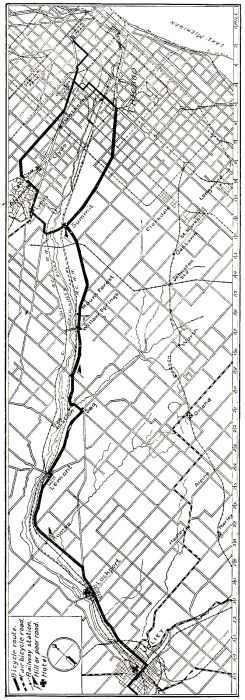
The route given in the next three weeks will be one of the best trips in the vicinity of Chicago, extending from Chicago itself to Joliet, thence to Ottawa, and thence to La Salle, and return. Like the great majority of trips taken from Chicago, this one depends largely upon the time at the rider's disposal, for you may either start from Chicago itself, or if the time is too short you can take the train for Ottawa and ride from there, or it is possible to get off the train at Joliet and ride on. But if time is not so important a matter, it is by all means best to ride all the way from Chicago. A choice of roads leads out of the city. You can go by the Archer Road to Joliet viâ Summit, Mount Forest, Willow Springs, Sag, Lemont, Romeo, and Lockport. In going the other way, take the Washington Boulevard west to Des Plaines Avenue, and then south to Riverside. This route leads along the old Illinois-Michigan Canal, Des Plaines River, and the new drainage canal, and it gives an excellent opportunity for you to examine the work on this large engineering undertaking.
There is still one other route to Joliet, which is a good road if the weather is good, but which after rain it would be unwise to attempt. This route is as follows: Start south on Western Avenue, or go down through Pullman City, turning westward to arrive at Blue Island. Here it will be necessary to make inquiry for the Blue Island and Orland Road, which runs southwest through Orland Station on the Wabash railway to Joliet. Part of this secondary route is not on the map, but it can be traced from Orland through Alpine, Hadley, and on into Joliet. The most attractive route, however, is the second one—that is, through Riverside, Summit, Willow Springs, etc.
On this first stage to Joliet the road to Summit is easily found, except that on passing through Summit a sharp turn to the left should be made, instead of crossing the track and the canal, up a hill, the road then being perfectly clear through Mount Forest and Willow Springs to Sag Station, with one hill about midway between the two latter places. At Sag Station turn to the left and run down to Sag, less than a mile away; then, turning sharply to the right, run to Lemont. Thence, keeping always on the southern and eastern side of the tracks and the river, follow the road to Romeo, with a hill as you enter the town, and run thence through Lockport to Joliet. The distance is close upon forty miles. If the trip is made in a day, a good place to stop is at Sag. If, however, the wheelman decides to run to Ottawa in one day, Joliet would make a stop a little less than half the distance; though this run to Ottawa of about ninety miles is a little too much for the average rider, and Joliet being a good place to stop overnight, he is advised to make a two days' trip of the journey. In case Joliet is too far, there is a good hotel at Lockport, six or seven miles nearer Chicago than Joliet, and the stop might be made there, although that leaves a long ride for the next day.
Note.—Map of New York city asphalted streets in No. 809. Map of route from New York to Tarrytown in No. 810. New York to Stamford, Connecticut, in No. 811. New York to Staten Island in No. 812. New Jersey from Hoboken to Pine Brook in No. 813. Brooklyn in No. 814. Brooklyn to Babylon in No. 815. Brooklyn to Northport in No. 816. Tarrytown to Poughkeepsie in No. 817. Poughkeepsie to Hudson in No. 818. Hudson to Albany in No. 819. Tottenville to Trenton in No. 820. Trenton to Philadelphia in No. 821. Philadelphia in No. 822. Philadelphia-Wissahickon Route in No. 823. Philadelphia to West Chester in No. 824. Philadelphia to Atlantic City—First Stage in No. 825; Second Stage in No. 826. Philadelphia to Vineland—First Stage in No. 827; Second Stage in No. 828. New York to Boston—Second Stage in No. 829. Third Stage in No. 830; Fourth Stage in No. 831; Fifth Stage in No. 832; Sixth Stage in No. 833. Boston to Concord in No. 834. Boston in No. 835. Boston to Gloucester in No. 836. Boston to Newburyport in No. 837. Boston to New Bedford in No. 838. Boston to South Framingham in No. 839. Boston to Nahant in No. 840. Boston to Lowell in No. 841. Boston to Nantasket Beach in No. 842. Boston Circuit Ride in No. 843. Philadelphia to Washington—First Stage in No. 844; Second Stage in No. 845; Third Stage in No. 846; Fourth Stage in No. 847; Fifth Stage in No. 848. City of Washington in No. 849. City of Albany in No. 854; Albany to Fonda in No 855; Fonda to Utica in No. 856; Utica to Syracuse in No. 857; Syracuse to Lyons in No. 858; Lyons to Rochester in No. 859; Rochester to Batavia in No. 860; Batavia to Buffalo in No. 861; Poughkeepsie to Newtown in No. 864; Newtown to Hartford in No. 865; New Haven to Hartford in No. 866; Hartford to Springfield in No. 867; Hartford to Canaan in No 868; Canaan to Pittsfield in No. 869; Hudson to Pittsfield in No. 870. City of Chicago in No. 874. Waukesha to Oconomowoc in No. 875; Chicago to Wheeling in No. 876; Wheeling to Lippencott's in No 877; Lippencott's to Waukesha in No. 878; Waukesha to Milwaukee in No. 879.
Any questions in regard to photograph matters will be willingly answered by the Editor of this column and we should be glad to hear from any of our club who can make helpful suggestions.
HOW TO SALT PAPER.
Salting paper is the process by which photographic paper is coated with chloride of sodium (common salt), chloride of ammonium, or chloride of barium, and salted paper is pure photographic paper which has been immersed or floated in a salting-bath and then dried. Paper prepared especially for photographic use is the best; but paper which is free from impurities may be used. Whatman's drawing-paper is a good paper. The paper is first salted, and when dry the sensitizing solution is applied.
To salt paper with chloride of sodium, take 20 oz. of water and 30 grs. of common salt; dissolve the salt in the water and filter; put this solution in a flat dish larger than the sheets of paper to be salted. Select the smoothest side of the paper, and turn back two corners diagonally opposite to each other. Take hold of the paper by these corners and lower the sheet of paper gently into the solution. See that every portion of the surface is thoroughly wet, but do not let the paper touch the bottom of the dish. Let it remain in the solution for one minute; then, if it appears to be thoroughly covered, pin it up to dry, with the side which was salted turned outward. To sensitize this paper, take nitrate of silver, ½-oz., and water, 10 oz. After it is dissolved take out 3 oz., and to the remaining 7 oz. add strong ammonia-water, drop by drop. A brownish precipitate will form, but keep adding the ammonia till the solution is nearly or quite clear, then turn in the other 3 oz. and filter. This solution may be put in a flat dish, and the paper be sensitized by floating it on the solution, or it may be spread on with a brush, according to directions given in No. 869.
To salt paper with chloride of ammonium make a solution as follows:
Chloride of Ammonium32grs.
Water4oz.
Gelatine8grs.
Put the gelatine in the water, and set the vessel containing it in a dish of hot water until the gelatine is dissolved. When it is cold add the chloride of ammonium, and either float according to directions just given, or apply the solution with a brush.
To sensitize, take 1 oz. of water and 60 grs. of nitrate of silver. Dissolve thoroughly and brush the paper with this solution. Brush evenly and lightly both ways of the paper, so as to avoid a streaked appearance. Print and tone the same as for aristo prints. The combined toning-bath gives good results. The tone of the prints closely resembles platinum prints.
Another process for salting paper is:
Chloride of Ammonium3grs.
Chloride of Sodium3grs.
Water2oz.
Apply this solution with a brush, or float the paper on the bath. To sensitize, take 60 grs. of nitrate of silver and 1 oz. of water. Add ammonia-water, drop by drop, till 25 drops have been used. The solution at first turns muddy, but continue dropping the ammonia till it clears. If it does not clear after the 25 drops have been added clear by filtering. Sensitize as per former directions.
This paper is very easily prepared, is inexpensive, and gives fine delicate prints. Do not print much deeper than is desired for the finished print. One may use a toning and fixing bath combined, or a separate toning and fixing bath may be used.
One can sensitize a strip at the head of a letter or a corner of a visiting-card; and print the same as any paper.
The paper can be bought ready salted, but it is not always fresh. It is very little trouble to salt paper and to sensitize it, and the cost is much less than when paper is bought ready prepared. The plain paper should be used within two or three days after sensitizing with the silver, but the salted paper keeps well, and may be sensitized as needed.
Mark the sensitized paper on the wrong side lightly, as it is hard to distinguish the sensitive side. When dry these prints are so flat and the paper is so thin that they make nice book illustrations.
Sir Knights Fred. W. Long and Fred. D. Rose wish to know in what numbers of the Round Table the "Papers for Beginners" may be found. In Nos. 812, 813, 814, 816, 817, 818, 821, 822, 823, 824, 825, 826, 832, 838, 840, and 842. See also the late numbers for "Chemistry for Amateur Photographers."
E. Lester Crocker, Tarrytown-on-Hudson, New York, wishes to be enrolled as a member of the Camera Club.
ILL-TEMPERED BABIES
are not desirable in any home. Insufficient nourishment produces ill temper. Guard against fretful children by feeding nutritious and digestible food. The Gail Borden Eagle Brand Condensed Milk is the most successful of all infant foods.—[Adv.]