Part I.
Reading edition
Dear young folks of Harper's Round Table, I have been invited by my friend, the Editor, to write for you a series of stories in which I shall tell you of some of the adventures that have happened to me in the great equatorial forest which begins on the west coast at the sea-shore and stretches far to the east on both sides of the equator, adventures which I have not told in Stories of the Gorilla Country, Lost in the Jungle, Wild Life Under the Equator, My Apingi Kingdom, and The Country of the Dwarfs, five books which I wrote especially for you.
During my travels I have had so many strange adventures, I have endured so many days of hunger and starvation, I have had so many hair-breadth escapes, I have seen so many strange sights, I have met face to face so many savage and fierce men and still more savage and dangerous beasts, that I could spend days in recounting to you the adventures of my life.
Africa is a wonderful country. There are great sandy deserts, extensive ranges of mountains, immense prairies, vast tracts of brushwood, swampy lands, great rivers and lakes; but the wonder of that large continent is the great equatorial forest I discovered, and which contains so many wild animals and interesting tribes of people.
What an immense forest it is—a sea of trees, if I may use the expression! No one knows how wide it is, neither do we know its exact length.
What gigantic trees are seen in that forest! Some rival in size the great California trees. These are the giants of the forest, and they rise two or three hundred feet above the other trees, upon which they look down. They are like sentinels watching over the country. Some of these big trees are worshipped by the natives. Under the roof of the mighty branches is the thick jungle, where no man can penetrate easily. The jungle is the undergrowth of the forest. It is made up of younger trees: lianas, thorny creepers, kinds of bamboo and rattan, thorny trees, sword-grass that cuts like a razor, and aloes plant in the swampy parts. In many places the explorer cannot see a yard off from where he stands.
What beautiful butterflies and queer insects, rare birds—some with brilliant plumage—lovely and strange flowers and orchids the traveller will meet as he explores this unknown land! Though all alone in that great solitude, he will seldom feel lonely, for his mind will be occupied all the time.
HIDDEN SNAKES THE CHIEF DANGER OF THE FOREST.
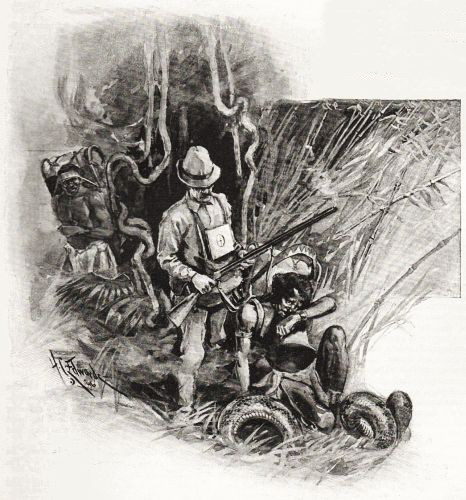
There are also many disagreeable things in the forest. The most dangerous, for they are often enemies unseen, are the snakes. There are snakes that live chiefly in the water. I used to keep a sharp lookout for them when I bathed in the clear little streams which run through the woods. There are tree snakes, those who pass a great part of their time on trees and feed on squirrels, birds, and monkeys; and also land snakes—that is, snakes that never climb trees and seldom go into the water. The biggest of them is the python. Often they are coiled along the trunk of a tree waiting to spring upon a passing gazelle. But there are so many venomous snakes, it makes me shudder as I think of them with their triangular heads. What fangs they have, especially the Clotho nasicornis, a thick short snake! Its fangs for all the world look like fish bones. In color that snake can hardly be distinguished from the ground and dead leaves on which it crawls. It is of great thickness round the middle; its head is very huge and hideous, being triangular in shape, and having an erect proboscis or born rising from the tip of its nose. Besides snakes, there are centipedes, so-called because, I suppose, they have about a hundred legs. Their sting is poisonous, and in some cases fatal; those that are very dark in color are much dreaded.
Then the scorpions! you find them everywhere, even between the leaves of your books!
What narrow escapes I have had with snakes, scorpions, centipedes! I wonder sometimes that I am alive to tell of the things I have seen. I never used to lie down without looking for these creeping things. You think, naturally, that a man's life must be miserable on that account. Not at all; one gets accustomed to everything in the world. At last I did not mind it at all, I got so used to doing this every day.
There were also many kinds of flies—called by the natives the mboco, ntchoona, the eloway. The mosquitoes will often plague us. We shall meet the terrible bashikonay ants. When they spread in the forest, they attack every living animal. All flee before them—gorilla, leopard, and elephant.
In that great forest are many tribes of men; some of them wear no clothing whatever. These people worship idols, good and evil spirits; dread witchcraft, and put to death all those who they think are wizards or witches. They are constantly engaged in warfare against each other. The most fierce looking of all are the cannibal tribes. How horrid they look with their sharp-pointed teeth, which have been made so by being filed! What magnificent-looking warriors they are! What brave hunters! It was in their country that I shot my first gorilla.
The strangest people I discovered were the dwarfs or pygmies, a race of people very diminutive in size. They looked so queer, especially the white-headed old folks. None of their houses is more than three feet in height. These pygmies, like the monkeys, lived chiefly on the fruits, berries, and nuts of the forest; they never cultivated the soil. But they knew the use of fire, knew how to trap game and cook their meat.
All these tribes thought Friend Paul was a Moguizic, a supernatural being who had come from some part of the sky. Many believed that I had descended from the moon, and that I came to see the world and its inhabitants. They believed that I could do all kinds of supernatural things, and in many tribes where guns were unknown they thought I held thunder and lightning in my hands, and when I fired a gun they all fell low on the ground.
Highways of communication and roads are unknown in this great dark Africa. But there are numerous paths going in every direction, so the traveller, if the natives are willing to guide him, can go from the west coast to the east coast, and from the Cape of Good Hope to Egypt, Morocco, and Algeria, or vice versa, for every village and tribe has paths leading towards the other. Often the paths leading from one village to another are very difficult to follow, for the jungle is so rank; and often they are closed for months on account of wars among different tribes.
Such paths you have never seen—narrow, just wide enough for a man to go through the thick jungle. The branches of trees often join together. Here a big tree has fallen across the path, and you must either bend yourself to pass under it, or climb over it. If you cannot do either, then you must go around it. You have to walk over the roots of trees until your feet are sore. Sometimes then you fall in the midst of sword-grass, or under the canelike bamboos or palms, or have to walk in swamps filled with aloes. I still walk in a stooping manner, the result of my being obliged to bend constantly under branches of trees, or under fallen ones. Often a stream is your only path.
Day after day, my dear young folks, Friend Paul spent travelling in that forest without hearing the chatter of a monkey or the shrill cry of a parrot. The only noise he could hear was now and then the falling of a leaf or the gentle murmur of a little stream wending its way towards some big unknown river which he hoped some day to find.
I walked thousands and thousands of miles on foot under its shady trees. The foliage was so thick that sometimes I was several weeks without being able to see the sun, the moon, or the stars, for my eyes could not penetrate the dense and thick leaves. How glad I was when I came to a river or an open space, and could see once more the sun, the moon, and the stars! I loved the stars, for without them and the moon I could not have known where I was; they showed me the way all through my travels.
Not only had I to travel on foot, but everything I had to take with me had to be carried on the backs of men, for no beasts of burden are to be found in the big forest. There are no camels, no donkeys, no horses, no oxen; and had I taken some with me they would have died of starvation, for there were no pastures, and they could not have lived on the different leaves of the trees or of the jungle. Besides, they could not have gone through the narrow crooked path of the great forest.
Rain falls almost every night for hours, accompanied by such thunder and lightning as you have never heard or seen in our country. The claps of thunder are so terrific that often they made me jump from my bed of leaves. The lightning at times is so vivid that it pierces the foliage of the trees; and as to the heavy rain, it often falls like a solid sheet of water for hours, and this happens almost every night for nine months of the year. After the rainy season comes the dry season—cold, for sometimes the thermometer falls to 66° Fahrenheit. I felt then this low temperature very much. Not a drop of rain falls during the dry season; but far in the interior, in the mountain regions, it rains twelve months of the year, but during three months of that time no thunder is heard.
If the men are strange, the beasts roaming in that great forest are still more wonderful to behold. The huge elephant roams everywhere on its rivers and lakes, the hippopotami are numerous in the sluggish streams, and the lakes are filled with crocodiles of huge size. The great gorilla, which I discovered, is the terror of the natives, and is called by them the Giant of the Forest. The strong man of the woods wanders continually in search of fruits, berries, and nuts. When night comes he sleeps at the foot of a tree, while his wife, the female gorilla, is sleeping on its branches. The gorilla never makes a shelter or a house for himself. Those who describe them as making houses mislead you. Friend Paul killed many of these gorillas, and was the first white man who ever hunted them and saw them in their wild state.
Besides the gorilla, Friend Paul saw several other wonderful kinds of man-like apes, also the common chimpanzee, called by the natives nshiego. Then he discovered three new species or varieties of the chimpanzee family, known to the natives under the names of Nshiego-mbouve, apes with bald heads and black faces; the Nshiego-nkengo, whose faces always remain yellow; and the Kooloo-kamba. All these apes are very shy, and the hunter to approach them has to be very wary.
Dear friends, we are to travel together in that great African forest. We will carry no tents with us; we will build a new camp every day when we are on the march, and we will protect ourselves from the rain by building slanting roofs, covered with large leaves put on the top of each other as we do with shingles, slates, or tiles at home. We will protect ourselves from the wild beasts by burning all night large fires—the wild beasts are afraid of fire. These fires will protect us also from snakes and voracious ants.
When we cannot find game we will be hungry together, and, like the monkeys, we will have to eat the wild berries, nuts, and fruits of the forest. When we cannot find these we will starve together until Providence comes to our rescue. At other times, when food is very scarce and it becomes a matter of life and death, we will be obliged to eat snakes, or sometimes leopards. When we have plenty, we will eat elephants, hippopotami, crocodiles, buffalo, wild boar, antelope, gazelles, and other animals. Often we will feast on monkeys—these at certain times of the year are delicious. Then, when we get into regions where no animals are to be seen, and fruits, nuts, and berries cannot be found—then we will drink water, which will help us to keep body and soul together. At times we will lie down under some big tree, ill with fever or weak from starvation. Then we shall think of the sweet home that is so far away, and wonder if we will ever return there again.