THE POLE VAULT.
Reading edition
From Instantaneous Photographs of C. T. Buchholz, Inter-collegiate Champion.
1.
2.
3.
4.
5.
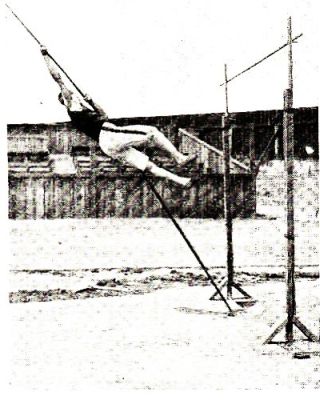
6.
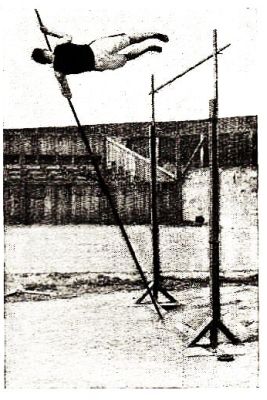
7.
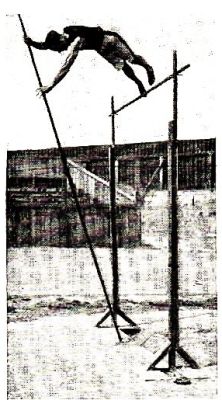
8.
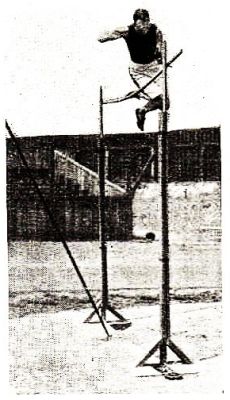
9.
10.

Training for pole-vaulting should begin in the gymnasium early in the winter. The arm and chest and dorsal muscles are the ones that must be developed, and these may best be strengthened by work on the chest weights, rope-climbing, dipping on the parallel bars, and by using the travelling parallels. If you have no gymnasium to work in, a good exercise is to stand four or five feet off from the wall of your room, and to fall forward on your hands, and then push yourself back into an erect position. Do this a few times at first, increasing the number as you grow stronger. Sprinting is also as necessary an exercise for the pole vaulter as it is for the broad jumper. When the weather moderates, work should be begun and continued daily out-of-doors.
For practice the vaulter must have two square posts similar to those used by the high jumpers, only higher, bored with holes two inches apart above six feet, then one inch apart up to eight feet, and half an inch apart from there up. The pegs should be between two and three inches long, and the bar, of one-inch pine, should be about eleven feet long. I say the "bar," but it were better to say the "bars," for the vaulter will do well to buy a dozen at a time, as they break very easily.
The posts are placed ten feet apart at the end of the runway, which should be from eight to ten feet wide, and as long as possible, say fifty feet. Like the high-jumping and broad-jumping runways, it is made of cinders rolled down hard, and must be kept well dampened so that it may be springy. Beyond the posts the earth should be turned over and raked, so as to make a soft landing-place. This landing-box is usually divided from the cinder path by a board sunk into the ground running perpendicular to the upright posts, and across their bases.
The costume for a pole-vaulter should consist of an entire jersey suit, although many of the best men of late seem to prefer linen trousers. The advantage of jersey trousers, or tights, however, is that they keep the legs warm, and consequently the muscles more limber. The shoes are the regular jumping shoes—made of kangaroo-skin, and fitted with six spikes in the toes, and two spikes in the heel of the foot that takes off. These two spikes should be fixed at the extremities of a diagonal drawn through the centre of the heel, to prevent stone-bruising.
The best vaulting poles are made of selected, straight-grained spruce, and are somewhat expensive, on account of the number of sticks that have to be destroyed in the making of one good one. A good pole costs from $4 to $5. It should be sixteen feet long, and fitted with an iron spike at the lower end. Having purchased your pole, wind it with tape for a distance of three or four feet along that part where it is to be held by the hands in vaulting.
When you first begin to vault, it is best to place the bar at about six feet, and to work over this height until you have mastered the knack of the event, which is undeniably a complicated one. As in high and broad jumping, the athlete must lay out his take-off and his run. No rule can be set down for either of these things. Some vaulters like a long run, and depend entirely upon speed to carry them over the bar, while others take a short sprint, and throw all their force and energy into the leap. But whichever method is adopted, both the take-off and the starting-point remain fixed spots on the runway, and must be experimented with until found, and then carefully fixed.
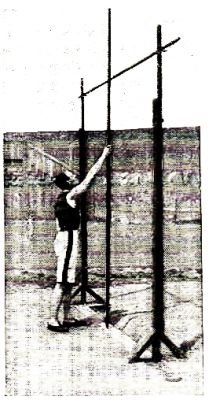
Whether in practice or in competition, and no matter what height the bar may be, always measure your pole before vaulting. This is done by stepping up to the posts and holding the pole upright until it touches the bar. Let it fall back then, and grasp it with the lower hand one foot below the point where it touched the cross-piece. For a vaulter who takes off with the left foot, the lower hand is the left hand. For a man who takes off with the right foot, it is just the other way. For the sake of convenience and clearness, let us understand that we are now speaking of one who takes off with the left foot.
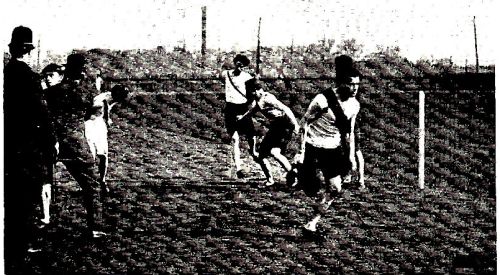
THE PHILADELPHIA INTERSCHOLASTIC RELAY RACES. End of Second Relay in Pennington-Hill-Brown-York Race.
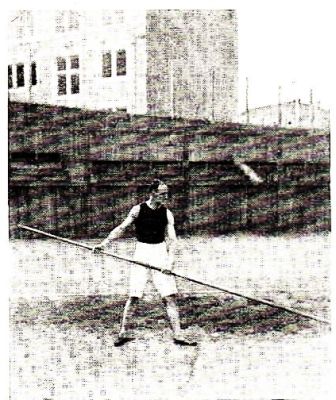
Having measured the pole, the athlete seizes it with both hands, thumbs up, the left hand forward at the spot indicated, and the right hand from two and a half to three feet further up. He then retreats to the spot which he has determined upon as his starting-point. He stands in the middle of the runway, with the pole pointing straight at the uprights, and he fixes his eyes on the bar. From this moment he does not remove his gaze from that pine stick, or from the handkerchief which may be hanging from it, until he has made his leap. He should never look to see where he is placing the pole to vault, for this will interfere with the success of his leap. The pole will take care of itself.
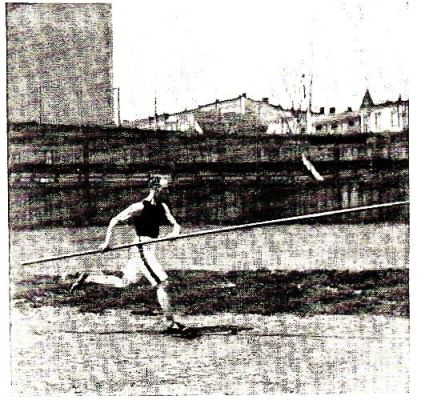
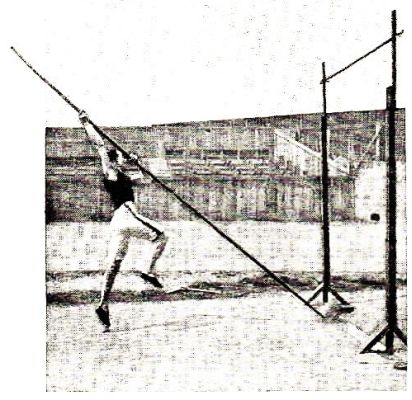
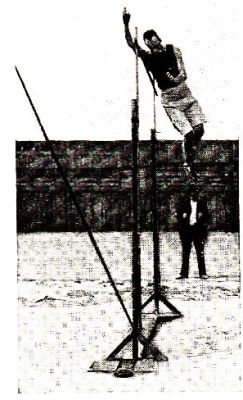
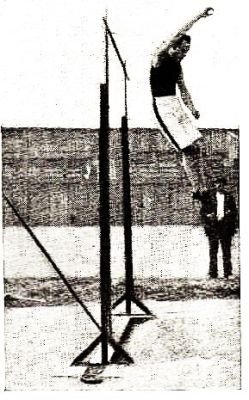
For going down the runway with the pole styles differ. Some vaulters hold the pole well up over the chest, while others (like Mr. Buchholz in the accompanying illustrations) hold the pole well down. The novice will find it better to keep his right or higher hand well up under his head. The athlete starts down the runway at full speed, and when he reaches his take-off he plants the pole firmly into the ground with all his force, and springs straight for the cross-piece. The moment his body leaves the ground, the right arm stretches taut (illustration No. 4), and his body swings towards the pole.
The motion of the body as it rises is a turning one, the object being to twist and face the pole, so that when the proper height is reached the back will be towards the bar, that the heels may be lifted over. The fifth illustration shows the vaulter half-way up from the ground to the bar, which in this case was placed at nine feet. He has turned half around, and by the time he has nearly reached this height he is still further around. Illustration No. 6 shows the beginning of the working of the arms and of that twist which is so necessary to carry the body over at great heights. The working of the arms begins just before this twist is made, and consists of pulling with the right arm, and pushing with the left. This lifts the body, and the twist carries it over, together with a strong push against the pole at the last moment, when the athlete feels his upward motion is changing to a fall.
After the pole has been let go, all is plain sailing. You have either made your vault or you have not, and all you have to do is to fall free, or bring down the bar with you. No effort that the athlete can now make to avoid the bar will avail him, as the motion in mid-air is practically uncontrollable after the pole has been abandoned. It is easy to learn how to fall limp into the soft earth below, and there is never any danger attending this drop. It will be noticed in the illustration that the twisting motion imparted on the hither side of the bar turns the body so that the athlete falls with his back to the posts, having performed one complete gyration in mid-air. This is not by any means a necessary element of the event, however, for many men drop facing the runway.
It is not permissible in vaulting in America to move the upper hand on the pole. The lower hand may be brought up, and Hoyt, the Harvard athlete who won the vault at the Olympic games of 1895, usually does this. In England, "climbing the pole" is allowed, and athletes there frequently bring the lower hand up above the other. Some of them manage to make better records by this method too.
When training for this event the novice should not vault oftener than fifteen times a day, and he should never work with the pole more frequently than three times a week. On the intervening days he should do light work at sprinting. Take every height three times, and then raise the bar, for it is frequently possible for a man to clear a higher mark after failing at the point below. On one day each week try to see how high you can go.
Speaking of pole-vaulting, it is encouraging to record that at the Drisler games, a week ago Saturday, both Hurlburt of Berkeley and Paulding of Black Hall, Connecticut, broke the New York scholastic record for the pole vault. This was 9 ft. 10 in.; but on this occasion Hurlburt cleared 10 ft. 6 in., and Paulding took second with 10 ft. 4 in. Hipple lowered Meehan's scholastic record in the half-mile from 2 min. 9 sec. to 2 min. 7-4/5 sec. These were the only notable performances, except, perhaps, Moore's time of 10-2/5 sec. in the 100, which deserves mention. The Berkeley team carried off the honors of the day in points—an achievement which is somewhat prophetic for the Interscholastics next week.
Of the fifteen relay races held on Franklin Field, Saturday, April 25th, seven were competed in by scholastic runners. The contests were exciting, but not so much so as they would have been if the school athletes had been in any kind of condition. Hardly any of the runners were fit, and over half a dozen fainted outright at the relay mark. Many staggered along the last fifteen or twenty yards, as though they could barely lift one foot ahead of the other, plainly showing that they had not made proper preparation for the kind of work they were attempting to perform.
The races in their order, and the time made in each case, are given here for the sake of record:
First Race—Won by Adelphi Academy; second, De Lancey; third, Episcopal; fourth, Hamilton School. Time, 3 m. 49 sec.
Third Race—Won by Wilmington High-School; second, Norristown High-School; third, Camden High-School. Time, 3 m. 58-2/5 sec.
Fifth Race—Won by Friends' Central; second, Haverford Grammar School; third, Swarthmore Grammar; fourth, Cheltenham. Time, 3m. 54 sec.
Seventh Race—Won by Pennington; second, Hill School; third, Brown Preparatory; fourth, York Collegiate. Time, 3 m. 50-4/5 sec.
Ninth Race—Won by Germantown Academy; second, Penn Charter; third, Abington Friends' Central; fourth, Eastburn Academy. Time, 3 m. 50-1/5 sec.
Eleventh Race—Won by West Chester Normal School; second, South Jersey Institute; third, Drexel Institute; fourth, Temple College. Time, 3 m. 55-2/5 sec.
Thirteenth Race—Won by Central High-School; second, Roman Catholic High-School; third, Manual Training School. Time, 3 m. 44-1/5 sec.
The Adelphi team had an easy time of it for first place, the real contest being among the three other schools. A hot struggle was that between the Hill School and Pennington, in which the latter won. Kiefer, who ran the last lap for the Hill, had twenty yards to kill to get even with his opponent. He made a pretty fight, but Finnegan was too much for him, and defeated him in the last ten yards. In the ninth race Germantown met its old rival, Penn Charter, and took it into camp. Eastburn Academy took the lead at first, beating Penn Charter by three yards on the lap, with Germantown, Abington, and Friends' School puffing along in that order. But Eastburn's second man lost the advantage won, and soon dropped to the rear. Germantown then passed Penn Charter, finished first in the second relay, and kept the lead to the end. The last race—that between Central High, Catholic High, and Manual Training—was uninteresting, all three schools maintaining the order given from start to finish.
ACADEMIC ATHLETIC LEAGUE'S FIELD DAY, BERKELEY, CALIFORNIA, APRIL 18, 1896.
Event.Winner.Performance.
100-yard dashDrum, L.H.-S.11sec.
220-yard dashDrum, L.H.-S.24-2/5"
440-yard dashWoolsey, B.H.-S.56-1/5"
Half-mile runShaw, L.H.-S.2m.12-4/5"
Mile runCutler, L.H.-S.5"7¼"
120-yard hurdlesCheek, O.H.-S.17-4/5"
220-yard hurdlesWarnick, B.H.-S.29-1/5"
Running high jumpHoffmann, O.H.-S.5ft.5in.
Running broad jumpParker, B.H.-S.20"7"
Pole vaultHoffmann, O.H.-S.10"
Throwing 16-lb. hammerSmith, Hoitt's.103"10½"
Putting 16-lb. shotCheek, O.H.-S.37"5¼"
Event.Second.Third.
100-yard dashLippman, Hoitt's.Jenks, O.H.-S.
220-yard dashJenks, O.H.-S.Switzer, St. M.
440-yard dashOsborn, St. M.Smith, P.H.-S.
Half-mile runSteele, O.H.-S.Manley, St. M.
Mile runHaseltine, B.H.-S.Smith, O.H.-S.
120-yard hurdlesColby, B.H.-S.————-
220-yard hurdlesDawson, O.H.-S.Parker, B-H.-S.
Running high jumpGrant, P.H.-S.Man, P.H.-S.
Running broad jumpCheek, O.H.-S.Simonds, B.H.-S.
Pole vaultCheek, O.H.-S.Woolsey, B.H.-S.
Throwing 16-lb. hammerLynch, O.H.-S.Johnson, St. M.
Putting 16-lb. shotWoolsey, B.H.-S.Goodale, B.H.-S.
Relay race, one mileLowell.Oakland.
Points.
Oakland High-School42
Berkeley High-School38
Lowell High-School26
Hoitt's8
St. Matthew's6
Polytechnic High-School5
—-
Total125
N.B.—The odd point in the 120-yard hurdles was left unscored, there being but three men in the race, and one of them, Dawson, O.H.-S., being disqualified.
O.H.-S., Oakland High-School; B.H.-S., Berkeley High-School; L.H.-S., Lowell High-School of San Francisco; P.H.-S., Polytechnic High-School of San Francisco; St. M., St. Matthew's School; Hoitt's, Hoitt's School.
The Spring Field Day of the Academic Athletic League of the Pacific Coast was held on the University of California track at Berkeley, Saturday, April 18th, with the results as shown on the preceding page. It was a bad day for track sports—cold, and eventually rainy, with a cross wind that brought no help to the racers. Nevertheless, the performances were noteworthy in several cases, and a glance at last year's record of the California schools' games will show that the tendency of the records is downwards. Drum took the 100 after a hot fight with Jenks, and also scored a win in the 220. Jenks had been looked upon as a pretty sure winner for the longer sprint, having equalled the Coast record in his heat; but Drum was too much for him, and Switzer came near cheating him out of second honors. These two defeats seemed to discourage the O.H.-S. man, for although entered he did not compete in the quarter. This race went to Woolsey, who got his points through heroic treatment of his distance. He wanted to save himself for the relay, and yet take the quarter too, which he felt confident he could do, having covered the distance in 54½ sec. So he set a hot pace from the start, covering the first 220 in 25-1/5. The field followed close, but the pace killed them, and Woolsey came home in the excellent time of 56-1/5 sec. The A.A.L. record is only 1/5 sec. lower.
Steele, O.H.-S., had trained to run his first quarter of the half-mile in 60 sec., counting on these tactics to slaughter the rest. But the bunch fastened on, and at the end of the second lap Shaw of Lowell showed unexpected endurance and crept ahead. He and Steele then ran within a yard of one another to the tape, which Shaw breasted first in 2 m. 12-4/5 sec. There was a big field for the mile run, and a remarkably tight one. At the end of the third lap Haseltine hit up the pace, but Cutler of Lowell was good for it, and rushed in a winner. Dawson was unfortunate in the hurdles. Some one has taught him a bad trick in practice—to run around an obstacle after knocking the previous one or losing his stride—and he suffered for it. He knocked the top bar off the eighth hurdle, played his trick of dodging the ninth, took the tenth, and beat Cheek to the tape. Of course he was disqualified, but as an O.H.-S. man won, his error was of less consequence than it might have been. It is always better to work in practice just as the rules require that you work in competition. Then you have an advantage over the other man.
In the high jump Grant, P. H.-S., proved a surprise. His form is wretched, but he has springs in his feet. He tied with Hoffmann for first place, and lost the honor on the toss. Cheek could have done better in the shot after he won it, in going for a record, but forbore on account of his other events. The hammer throw was somewhat complicated by the failure of the judges to mark accurately Lynch's sixth and last throw. The least they could give him was the 102 ft. 9 in., but to make the thing square all three were allowed a seventh throw. Smith and Johnson did not improve their marks, but Lynch threw 109 ft. In doing so, however, he fouled by overstepping an inch, and the event went to Smith of Hoitt's.
In the relay race the Berkeley team led all the way, and won in 3 min. 31 sec., which is within 10 seconds of the Pacific Coast record, made by U. of C. in 1894. Drum did the best work for O.H.-S., but his mates were not in condition, and the event was lost to them.
Every school that competed at the meeting scored. This fact is especially creditable for Polytechnic H.-S., St. Matthew's, and Hoitt's, all being new members of the A.A.L., and not so seasoned in athletics as some of the other schools. Their teams give good promise, and if they keep on as they have begun, Oakland and Berkeley will have to look sharp!
The Princeton Interscholastic tennis tournament was not held last Saturday, as had been announced. The date was considered too early in the season, none of the school players having yet had sufficient time to get into tournament form. The date now proposed is May 23d.
George W. Rollins, Boston, Mass.—The best kind of training for a ten-mile bicycle race is to take short spins of a mile or two at speed on a track, and long rides of from fifteen to eighteen miles on the road, on alternate days, for two or three weeks previous to the date of the race. If you can ascertain what road the race is to be run over, it is well to become as familiar with it as possible; but do not try to ride the distance on time more frequently than once in ten days.
F. J. Chapman, New Richmond, Wis.—See answer above for your question on training. Cold baths are good, if you rub down well afterward. Never continue exercising when you begin to feel the slightest fatigue. It is not well to go to bed immediately after exercising; and it is better to run early in the morning rather than in the evening.
The Graduate.