SPORT AMONG THE MOONFAYS.
Reading edition
Clear the way! Clear the way! This is the Moonfays' Racing Day; And the terrapin will race the hare From the oaken-tree to the dodo's lair; And this is the end of the second heat, To see which terrapin is most fleet; For since that time, long years ago, When the hare was covered with dreadful woe, When terrapin beat Brer Rabbit fleet, The hares have been So full of chagrin, They've wanted another chance to win. And now to-day, this afternoon. They're going to race by the light of the moon, For a golden prize— Two pumpkin pies. So clear the way! Clear the way! So that all hands may have fair play. P.S.—Don't wager upon the hare Till you have heard the conditions there; Brer Terrapin carries his home with him, And to make things even the rabbit slim Must race shut up in a ragman's sack, With his hind legs strapped up over his back.
PERHAPS SHE HAD.
A colored "auntie" seeing the child of a white acquaintance for the first time, exclaimed:
"Law, massa, how like she is to you! She done got all yore symptoms."
Two negroes were fighting on a wharf in a little Southern town, and although apparently desperate in their intentions, the actual fighting was rather mild. A timid bystander, not accustomed to the harmlessness of such fights, and fearing that the under man would be seriously hurt, called out:
"Let him up. Can't you see you'll hurt him?"
At this both the negroes burst out laughing, and the one on top cried:
"Yah! yah! Let him up! Why, boss, Ise had too much trouble to git 'im down. Hi! hi!"
Teacher. "What is the principal product of value derived from the seal?"
Johnny (unhesitatingly). "Sealing-wax."
"Ma, where is Atoms?"
"Athens, you mean, my boy; don't you?"
"No, ma'am; I mean Atoms; because when a person is in a boiler explosion, they always say he is blown to Atoms."
THE RULE OF THE ROAD.
In England the "rules of the road" require foot-passengers to keep to the right, and horsemen and vehicles to keep to the left. Some years ago a learned justice looked into the matter, and thus explained it: "The foot-traveller," he observed, "in ancient times passed to the right in order that the shield, which was carried on the left arm, might be interposed to ward off a treacherous blow, while the right arm, or the sword-arm, was left free for action. Horsemen, on the other hand, were accustomed to wearing suits of mail for the protection of their bodies, and it was believed that there was greater safety in having the arm actively employed in defence and attack nearer to the enemy than to have to strike at him across the horse's neck; hence the horseman passed to the left, and vehicles were naturally required to do the same." This seems like a plausible reason, but in the United States it has been considered safer to have the rules of the road the same for pedestrians as well as for horsemen and vehicles; hence in this country the rule of the highway is to pass to the right. Possibly we choose the right in preference to the left on the simple proposition that if you turn to the right you cannot go wrong.
A portly old gentleman was with difficulty making his way down the street on a very windy day. The strong gusts occasionally carried him from side to side in a tacking sort of fashion, which finally brought him up with a crash against an Irishman who was plastering show-bills on a fence. The old gentleman very politely begged the bill-poster's pardon, and hoped he had not inconvenienced him much by getting in his way. So much politeness puzzled the bill-poster, and in a rich Irish brogue, he replied,
"Faith, if yez ain't in yer own way, yer not in moine!"
A DEEP VOICE.
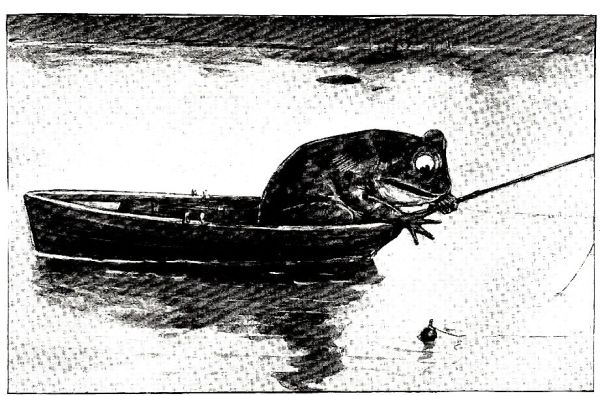
a luckless bull-frog lost his voice while talking in his sleep, and now he'll never fish it out—his voice it is so deep.