HOW MAGIC IS MADE.
Reading edition
BY HENRY HATTON.
III.
There is no trick that makes a better impression on an audience, and requires less practice on the part of the performer, than that known as "The Protean Pitcher."
The performer has on his table an ordinary quart pitcher filled with water, and a dozen or more tumblers. To prove that it is pure water, a glass is filled and offered to the audience, and the performer drinks of it.
All suspicion being thus set at rest, the trick is begun by alternately filling with water and wine the glasses, which stand in a row at the front of the table.
"This may seem strange," says the performer, "that I can pour from this pitcher, which certainly is not prepared in any way, water or wine at pleasure. The fact is, however, that when once the fumes of the wine have thoroughly permeated the atmosphere, it is a difficult matter for the ordinary spectator to tell positively what I do pour out. No doubt many of you imagine that I have filled these glasses with water and wine, while others are just as positive that there is nothing but wine. The pitcher is empty, nothing in it, as all can see. Let us pour the contents of the glasses back." Here he empties the water and wine into the pitcher. "And now what have we? Wine, wine, wine—nothing but wine." Filling the glasses again. "Again return it to the pitcher"—which he does, "and this time, on refilling the glasses, there seems to be nothing but water. No, I am wrong, for here is a glass of wine."
For a third time he returns the contents of the glasses to the pitcher, and this time pours out nothing but wine, and finally, for a fourth time, goes through the same routine, and ends the trick by pouring water, water—nothing but water.
Let us suppose that sixteen glasses are to be used in the trick. Six are left clean; in each of six others is put one drop of a strong tincture of iron about half an hour before beginning the performance. Two other glasses are about half filled with a saturated solution of oxalic acid in water, and in still another glass is poured some strong ammonia. To prevent the fumes of the ammonia from escaping into the room this glass must be covered with a handkerchief folded several times, or, what is still better, with a piece of transparent mica cut to fit the top. Lastly a glass is quarter filled, with a saturated solution of tannin in water. Beginning with a clean glass, the six clean glasses and the six containing the iron are placed alternately in a row at the front of the table. Behind them, in the following order, stand the tannin glass, an acid glass, the ammonia glass, and the second acid glass.
The performer begins by filling a clean glass and the tannin glass with water from the pitcher. The clean glass he offers to the audience to taste, or sips of it himself. Then he pours the contents of both glasses into the pitcher.
Now if he fills the clean glasses and the iron glasses from the pitcher, they will appear to be filled alternately with water and wine. Pouring the contents back and immediately refilling the glasses, they are all filled with wine.
Before filling the twelfth glass, however, the performer picks up an acid glass, covering it with his hand so as to conceal its contents, and, filling it, remarks: "All wine. No, here is water, and here again"—filling the twelfth glass—"is wine."
When the contents of the glasses are poured into the pitcher this time, the action of the acid will bleach the solution completely, and on filling the glasses this time there appears to be nothing but water.
Again, however, the performer picks up another glass, the one with the ammonia, and filling this, it appears to contain wine, but of a lighter color than before.
This time, on emptying the glasses into the pitcher, it will appear to be filled again with wine, the ammonia counteracting the effect of the acid.
Once more the glasses are filled with wine, all but one, the second acid glass, which the performer has filled.
For the last time the pitcher is again filled, and when the contents are poured out there is nothing but water. "For," as the performer remarks, "having begun with water, it is only right we should end with it."
As the strength of the various ingredients varies a great deal, the amateur will do well to experiment for the proper proportions of tannin, acid, and ammonia before attempting to exhibit the trick, bearing in mind that the smaller the quantity used the better it will be.
Mr. Kellar, who is rather an exhibitor of stage illusions than a sleight-of-hand performer, since his "feats of prestidigitation," to quote the language of the show-bill, are of the most simple character, has made quite a name by offering what he is pleased to call "mental phenomena." In one of the most surprising of these he almost instantly tells the day of the week on which any date of the present century falls.
An attempt to explain this has been made by a certain magazine, which seriously informs its readers that "the secret 'of the how' is neither a remarkable 'gift,' nor surprising mental or mathematical ability, as is usually supposed.
"The performer holds concealed in his hands tablets on which formulas are engraved, or they may be written on his shirt cuffs. He raises a hand to his head, as though meditating, and can thus, unnoticed, glance over the tabulated formulas. Or he stands before the audience with folded arms, coat sleeves drawn well back, which gives ample opportunity for a quick yet careful glance at the unpretending cuffs; but instead of gazing at the floor in deep thought, as is commonly supposed, he is studying the formula dexterously concealed from the audience."
All this sounds very learned, but as there are no less than six tables given as absolutely necessary for the accomplishment of the trick—one of them of thirty-one lines and eight columns—the performer who should attempt it on that plan would require, instead of eyes, what Sam Weller calls "a pair o' patent double million magnifyin' gas microscopes of hextra power."
I know of three different short methods of arriving at this calculation, by which any one with a fair memory and an elementary knowledge of mental arithmetic can answer almost instantly the question, On what day of the week does a certain date fall? The easiest and best of these is as follows: First memorize the following couplet:
123456
TimeFliesFastMenWiselySay;
(Tuesday)(Friday)(Friday)(Monday)(Wednesday)(Saturday)
789101112
ManyThink,Alas,Time'sFooledAway.
(Monday)(Thursday)(Sunday)(Tuesday)(Friday)(Sunday)
These twelve words stand for the twelve months of the year, while their initial letter or letters represent the days of the week, as shown by the lines in parentheses, Sunday being represented by A.
To find out the day of the week on which a certain date falls in a leap-year, take half of the last two figures of the given year, divide by 7, and the remainder gives the date. For example, 1880: The half is 40; divided by 7, equals 5, with 5 remaining. Therefore, March 5th would fall on a Friday; June 5th on a Saturday; September 5th on a Sunday; and so on. To get the other dates is a matter of simple addition.
According to this, January 5th would be Tuesday, and February 5th Friday, but in leap-year the remainder must be increased one; therefore January 6th would be Tuesday, and February 6th Friday.
In non-leap-years, take the previous leap-year, and subtract one for each year past that leap-year. For example: Let us suppose that some one asks on what day of the week July 29, 1895, fell. The previous leap-year was 1892; the half of 92 equals 46; subtract one for each year past—i.e., 3—which would be 43; this, divided by 7, would leave a remainder of 1. So that July 1st fell on a Monday, and adding 28 days, four full weeks, gives us Monday, which your calendar will show you is right.
If in dividing the last two numbers of the given year there should be no remainder, the date is 7.
"But how are we to know the leap-years, without stopping to figure them out?" some one may ask.
Very easily, if you will bear in mind that in the years having the odd decades, such as 50s, 70s, 90s, the leap-years end in 2 or in 6, as 1852, 1876; while those with even decades end in 0, 4, or 8.
With very little practice any bright boy or girl can soon master this, and while it will tend to surprise their friends, it will prove excellent mental exercise.
Mr. Kellar has recently exhibited what he terms "Karmos." In its original form this trick, an imported one, as are most of the tricks he exhibits, was really very ingenious and baffling, though a little slow. To overcome this objectionable feature Kellar put on his thinking-cap, or had some other fellow to cudgel his brains, and the result was the following:
Mrs. Kellar sits blindfolded on a platform erected on the stage, and gives the cube and square roots of numbers chosen or designated by the audience, but apparently unknown to her. These Mr. Kellar writes on a blackboard set up at one side of the stage in full view of the audience.
The lady also tells the names of cards dealt off from a thoroughly shuffled pack, spells out the word selected from a dictionary and gives its definition, reads a check held up against the blackboard, tells its amount, and the name of the one who drew it.
There is no hesitation, no mistakes, and the answers and descriptions are given with the greatest rapidity.
How is it done? The lady certainly cannot see, and the quickness with which the answers are given preclude the idea that Kellar conveys the information by such signals as walking in a certain way, tapping the blackboard, etc.
The method is so simple that many of "the profession" consider it inartistic, but the public seems to like it.
Every one who has attended a magical entertainment will have seen a narrow platform extending from the stage to the auditorium, by means of which the performer passes to and from the audience.
This platform is known technically as a run or slip-stage. With Sir Kellar this run crosses the footlights and goes over a short distance on the stage, where it is slightly elevated, and is boxed in at the sides. A hole is cut in the stage, and through this hole, shielded from view by the run, sits Mr. Kellar's assistant. With the help of an ordinary opera-glass he can see everything that is written on the blackboard or is placed against it, and by a simple mechanical means, either of a speaking-tube leading under the stage from his hiding-place to the back of Mrs. Kellar's chair, or some similar arrangement, he can at once convey to her the needed information. If the cube root or square root of any number is asked for, he has merely to turn to some such work as Haswell's Engineer's Companion to find the answer; should a word be selected from the dictionary, he refers to a second copy of the dictionary, which he has at hand, apply his mouth to the speaking-tube, and Mrs. Kellar answers:
"The ninth word in the second column on the steen-hundredth page is vicarious, and the definition is, 'acting, performing, or suffering for another.'"
Let us hope this word may never be selected, as it would be too suggestive.
FIG. 1.
The reader will understand that there is scarcely a limit to what Mrs. Kellar (? or the assistant) can tell.
As this trick is not practicable for the drawing-room, let me give one that my young friends will be able to accomplish. For the want of a better name I will call it "The Flying Watch."
A watch is borrowed, and to prove that it is not obtained from a confederate, one of the audience is allowed to select paper of such color as he may prefer in which to have it wrapped, and another to choose the ribbon with which the package is to be tied. The packet is then placed in a handkerchief and handed to some one to hold. At word of command the watch leaves the handkerchief, and is found in the innermost box of a nest of three boxes, each of which is tied with tape and sealed.
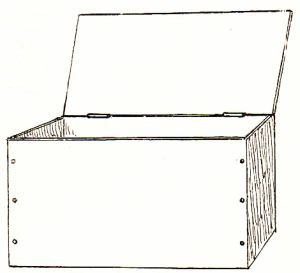
For this trick are needed: 1. A large handkerchief with a cheap watch sewn in a sort of pocket at one corner. This pocket must be sewn carefully and strongly on all sides so that the watch cannot slip out. 2. A nest of three small plain boxes, each a trifle larger than the other, and the smallest of a size to easily hold a watch—that is, about 3½ in. long, by 3 in. wide, by 2 in. high.
FIG. 2.
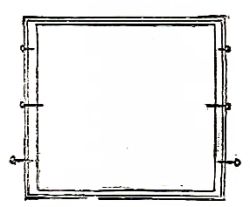
This smallest box is most conspicuously nailed, see Fig. 1, but on one side the two top nails are mere dummies, not going through, all but the heads being cut off. The two bottom nails are short, and can easily be pulled partly out, while the two centre ones act as pivots on which the side swings, as shown in Fig. 2. This box is filled loosely with some wool. The lid is put down, the bottom nails of the loose side are pulled partly out, the top is pressed in, when the side will open at the bottom. A wad of paper is put in to prevent it closing, other wads are put at the sides so that the loose nails may not be accidentally pushed in, and finally the box is bound with tape and sealed.
FIG. 3.
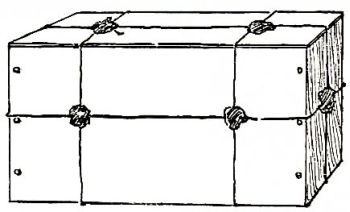
This box is placed, with the open side uppermost, in No. 2, in which it loosely fits, and that one is closed, bound up, and sealed. It, in turn, is placed in No. 3, which is also bound with tapes and sealed. The whole package, which somewhat resembles Fig. 3, is stood on a table before beginning the trick.
When the borrowed watch has been wrapped in red, white, or blue tissue-paper, as the audience may select, and bound with a colored ribbon, also chosen, the performer pretends to wrap it in the handkerchief, but really folds the handkerchief around the prepared corner, and gives it to some one to hold. The borrowed watch he slips into a pocket which he has sewed to the back of the right leg of his trousers in such place that his hand can readily reach it.
As the dummy watch is ticking, the one who holds the handkerchief will not suspect anything. The performer, approaching him, catches hold of the handkerchief and gives it a shake. "Go!" he cries, and as nothing falls to the floor, the watch is supposed to have vanished.
The sealed box is now shown, and some one is asked to cut the tapes. The second box is taken out, and as it is securely bound, everything appears right. Now comes the critical part. The performer takes the two boxes to his table, and while going there gets hold of the watch with his right hand, and sets it on the table back of the larger box, which conceals it. The second box he places on top of the first, cuts the tapes of No. 2, and as he throws back the lid, lifts the watch with his right hand, and at almost the same moment drops it into the open side of the smallest box. To lift this box out, and at the same time to press the bottom nails into place is easy. The box can now be shown, the tapes cut, and the watch returned to be identified by the owner.