IN THE TOWER OF MANY STORIES.
Reading edition
HENRY THE EIGHTH.
(In Two Parts.)
BY MRS. LEW. WALLACE.
I.
ANNE'S CROWN.
here was once a King of England whose family name should have been Bluebeard, but it happened to be Henry Tudor, and a proud old name it was too. Born in 1501, Prince Henry was just eighteen when he came to the throne, and his subjects were well pleased to see an end to the long Wars of the Roses, because in him were united both lines, the White and the Red, and that meant peace. He had a most fortunate start—riches, power, health, friends. Life lay fair before; what would he do with it? His unpopular father's avarice had massed an immense fortune, and the son was quite ready to spend it. He was well educated, a bold huntsman and dashing rider, full of spirit and energy, and with a turn for letters and business. He must have had wonderful strength, for his armor weighed ninety-two pounds. It is in London Tower yet, is of German-work, silvered and engraved over with saintly legends and scroll-work, and the initials H. and K. for Henry and Katharine of Aragon.
The King was exceedingly attractive. An Ambassador from Italy, the land of beauty, wrote: "Nature could not have done more for him. He is much handsomer than any other sovereign of Christendom—a good deal handsomer than the King of France—very fair, and his whole frame admirably proportioned. He is fond of hunting, and never takes his diversion without tiring eight or ten horses, which he has stationed beforehand along the line of country he means to take; and when one is tired he mounts another, and before he gets home they are all exhausted. He is extremely fond of tennis, at which game it is the prettiest thing in the world to see him play, his fair skin glowing through a shirt of the finest texture."
HENRY VIII.
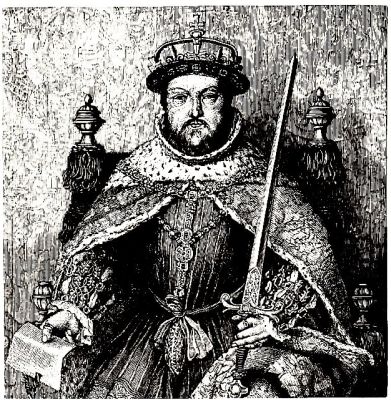
Bluebeard had six wives. The second is the one whose woful tale I have to tell. Early in his reign he married Katharine of Aragon, a noble Princess, daughter of Ferdinand and Isabella, whose girlhood had been spent among the orange gardens and tinkling fountains of the Alhambra.
She had a maid of honor named Anne Boleyn, a light-hearted damsel, skilled in music, singing delightfully, full of repartee, with a laugh gay as her costumes and dances. Her favorite dress was blue velvet starred with silver, a mantle of watered silver lined with minever, and on her little feet blue velvet shoes flashing each with a diamond star; around her head a gold-colored aureole of gauze above a fall of ringlets rich and rare. A toilet that well became her dimples, her fresh lips, her teeth like hailstones, and her witching glance. Tall and slender was she, a true daughter of the Howards, and so "passing sweet and cheerful" that every man who looked on her was her lover.
At the midnight ball given to the French Ambassador, the King chose her for his partner in the dance, and Mistress Anne's pretty head was wellnigh turned by the royal flatterer's whispers of sparkling eyes and twinkling feet and the fairest hand he ever touched, and then he kissed her.
Soon he began to write letters, beginning "Mine own Sweetheart," and sent her a jewel valued at fifteen thousand crowns. Then he would ride out to visit her in the chestnut avenues of Hever Castle, gallantly prancing along the greenwood, and sounding his bugle to announce his approach, for he went unattended.
At first Anne resented such close attention from one already married, King though he was; but the letters came often and the writer came oftener, and in the dewy springtime they strolled through flowery gardens together, and heard the nightingale's love-song to the rose, and the cuckoo pipe her pretty note telling her name to the meadow-larks, till the fair maid forgot her honor and began to think wild thoughts. Woodland scents and sounds were sweet, but perfumed palace chambers were sweeter, and court minstrel and laureate sang as never did bird in summer.
What a fine thing it would be, by-and-by, to sit on the throne of England in the place of the faded old Queen, six years older than her husband, the magnificent monarch Henry the Eighth! Evidently he tired of the wife of his youth, and plotted separation from her who had faithfully loved and obeyed him more than twenty years.
The tale of divorce is too long to tell here; enough that it was done by the help of the Church, and Queen Katharine was ordered to leave the court. She made a dignified speech before her judges, declaring herself daughter of a King and still Queen of England, and should so continue to the end of her days. She then retired to the palace assigned her, degraded—no, not degraded, but shorn of her rank, and yet loving him without change. Her last message written in banishment was, "I make this vow, that mine eyes desire you above all things."
Henry admitted that Kate had been the best of wives; but the old love was off, the new one was on, and a private marriage with Anne Boleyn took place—just when and where is not known. The coronation was proclaimed May, 1534, and London, in sleepless preparation, made ready to hail Anne Boleyn Queen Consort of England.
The Tower was at that time palace as well as prison and fortress, and the Thames was crowded with every sort of craft, full of crews who flocked to behold the like of which has not been seen before or since in that greatest city on the earth. Bells chimed, music floated over the water, and thousands of flags saluted when Anne came out of Greenwich Palace clad in cloth of gold, attended by her maidens—a beauteous sight to see. When she reached the Tower in the state barge a mighty peal of guns was shot off. The tremendous wave of sound broke over the barriers of Katharine's retreat, and oh, how the salute smote the ear of the neglected and forgotten Queen, where she sat mourning for her dead sons and worse than dead husband!
The roofs and bridges were alive with men and boys, musicians playing divers instruments, and making a far-reaching melody of trumpets. The Lord Mayor and officers of the city were in crimson and scarlet, with gold chains round their necks, and there was no end of velvet, ermine, and jewels. Carpets of Persia and India hung from windows and balconies, and there was such splendor as tongue cannot tell, or minstrel sing, or painter paint.
Henry met the bride at the water's edge, showy in white and green, the livery colors of his family. We can imagine he looked right kingly, for he was of heroic height, and had not reached the swinish shape that in later years made him the likeness of a prize pig at the fair, a monstrous brute. He kissed Anne, called her the desire of his heart and the delight of his eyes, and vowed to love her and none other while woods grow and rivers run to the sea.
Days of merriment and revel welcomed her to the palace, and then the coronation came. The streets were gravelled from Tower to Temple Bar, and freshly hung with purple. The crown of Edward the Confessor was too heavy for the girlish brow, and a new one was made for the new Queen, mainly of rubies red as blood. You may see it in the jewel-room of the Tower with the other crowns and the Kohinoor of Queen Victoria.
There were vast processions of horsemen, Ambassadors with badges and decorations, and so many collars set with gems it was said whole estates were carried on men's shoulders. A fountain ran wine, and any—the way-side beggar with the rest—might put in his cup and drink his fill. Even the cooks wore satin that day.
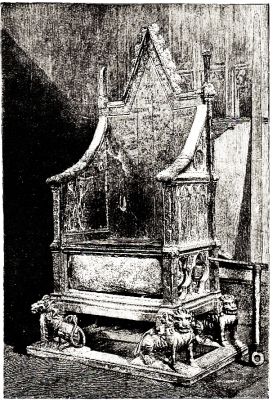
THE CORONATION CHAIR.
But all else was of slight interest—Duke and Earl, belted knight and high-born gentleman—beside the lady for whom the parade was ordered. She was seated in an open litter covered with cloth of gold shot with white. Her robe was silver tissue under a mantle of ermine, auburn ringlets flowing on her shoulders below the ruby crown. The ladies attending were mounted on palfreys with trappings that shone with gold and crimson. It was in bridal June, when merry England is merriest, and with shoutings and trumpetings Anne entered Westminster, and was crowned at the high altar of the Abbey. Royal purple took the place of crimson robes, and the unholy marriage was preceded by the Holy Sacrament, and made a sinful mockery with vows solemn and binding. Countesses and marchionesses were the Queen's train-bearers, and the world seemed at her feet. No warning prophet was there to foretell that the triumph would pass like a vision of the night, and when the blossoming hedges had showered their snows three times she would slip from her high place and, for her sweet lord's pleasure, fall a headless corpse.
Bluff King Harry was highly pleased with the coronation show, and the bride, radiant with bloom and happiness, held his fickle fancy for a time. She was used to admiration, and knew the art of pleasing. Studying the moods and tenses of her fitful master, she bent her finer nature down to his. Did he wish to ride, she could try the mettle of his best jennet, her glossy brown hair mingling with the floating plumes of her hat, making a sunlit picture. Would his Majesty walk, in banquet-hall or bower, on greensward or under silken pavilion, she was ready to trip with fairy tread. Did he want music, she charmed with lute and song. If the stormy ruler preferred silence, she could sit still as chiselled marble till his varying temper brought her lord to her side again.
Her study was difficult, for absolute power makes tyrants, and the King subdued to his humor every one about him. No man ever ventured to ask why do you so. He varied court gayeties, and maintained them also, by plundering churches and abbeys; and burning at slow fires sainted men as high above him as the heavens are above the earth, because they presumed to differ from him in opinion of the body and blood of Christ. He grew meaner and more cruel every day, fattened and bloated into a hateful beast, and to this most Christian King belongs the fame of being the first to torture women with machines made expressly to grind and twist human bones. In London Tower to-day you may see these infernal devices, and the rack where an undaunted woman was stretched till the tormentor refused to turn the wheels again; then she was carried in a chair to a fire and burned alive.
And this was free and merry England three hundred years ago!
Where were the people?
The strangest part of history is their submission to bloody despotism. The time was rich in heroes—nobles come of generations born to command, who had looked death in the face on land and sea, and knew no fear; they were as silent slaves. Thoughtful men grown gray in the service of the state were tortured, maimed, and crippled. The princely Buckingham was sent to the block, and gallant chiefs and captains were racked for heresy, and the pleasure of the King was the pain of dying men.
It was not the oppression of an army or a mob of enraged persecutors, as in France two centuries later, but a one-man power, a Tudor reign of terror. So the years went by, and King Henry went on fattening till he could hardly see.
It was written of him a generation afterward: "If all the patterns of a merciless tyrant had been lost to the world, they might have been found in this Prince." Royal blood was precious in those evil days; all below the highest were mere worms. The court poet wrote verses that made Henry the brightest star of a constellation composed of Hector, Cæsar, Judas Maccabæus, Joshua, Charlemagne, King Arthur, Alexander, David, Godfrey de Bouillon; and the satisfied monarch believed whatever was said or sung in his praise, and loaded minstrel and troubadour with costly presents, jewelled badges, and decorations.