PRACTICAL GOLF.
Reading edition
BY W. G. van TASSEL SUTPHEN.
(In Five Papers.)
II.—DRIVING.
All golf is divided into three parts—driving, approaching, and holing out—and of these three, driving, or free hitting, either with wood or iron, is by far the most pleasing. It is a delightful sensation to feel the ball slip away almost by itself as the club head swings through, and then to watch it describing its graceful curve of, say, one hundred and fifty yards through the air, or skimming like a swallow, straight and low over that dreaded bunker. Without driving, indeed, there would be very little golf, and happy is the man who may always count upon being both far and sure.
Now although style cannot drive a ball, there is still a right and a wrong way of going at the problem, and the first thing is to clearly understand the conditions of that problem. Let the player imagine himself at the centre of a circle, the radius of which is the length of his arms plus the club shaft, and upon whose circumference is resting the ball that is to be swept away. Remember, too, that it is to be a swing and not a hit, that the club head should be treated as though it were a bit of lead attached to a string, and consequently dependent for its effectiveness on speed and not on weight. Obviously, if the circle in which it swings is not perfect, if at any point the string is suddenly lengthened or shortened, the ball will either be missed altogether or the force will be imperfectly applied, resulting in a loss of power. Take a piece of lead and a bit of string, and try the experiment for yourself. It will at least show you how clearly distinct the golf swing is from the hit of a baseball bat, and how speed may become equivalent to weight.
It is customary to advise beginners to use clubs with very stiff shafts, but I am inclined to think that the reformed baseball-player will do better with a springy driver. With a very stiff club there is an irresistible inclination to hit at the ball, and this is exactly what you must not do. You must be able to feel the club head swinging at the end of the shaft, as though it were really the bit of lead on a string. The instant that you attempt to hurry that swing you throw it out of time and true, and the result is failure. Weight and brute strength may drive a baseball, but for the golf-ball it is speed and accuracy that are needed.
THE "ADDRESS."
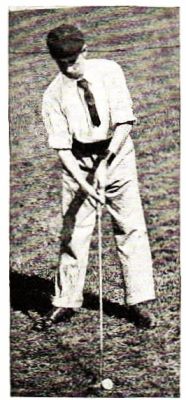
Having determined, then, that the stroke shall lie a swing and not a jerk nor a hit, the first thing is to take up our position to the ball, technically called "addressing" it. Clubs are all about the same length, but they may vary in their "lie" or in the angle made by the club head and the shaft. Generally speaking, a tall player will need a more upright club than his shorter brother, in order that the sole of the club head may rest flatly on the ground.
It is a rough-and-ready rule that when the club is placed with its heel behind the ball the end of the handle should just touch the left knee of the player standing upright. Other authorities say that the club should be grounded with its centre and not its heel opposite to the ball. As a matter of fact, the difference of the inch involved amounts to nothing. You want to be far enough away to get in all the power of your swing and yet keep steady on your feet. No one can measure that distance for you; you must accustom yourself to take it without thinking about it.
As for the position of the ball, it should be just in advance of the imaginary line drawn from the left eye over the hands and down the shaft to the face of the club head. In other words, let left eye, hands, club shaft, and the striking face of the head be in the same plane, with the ball a quarter of an inch in front. This, again, should be arrived at instinctively. If you try to measure it by a foot-rule you will be wrong.
The proper position of the feet, or the "stance," is a question about which the doctors disagree. According to one authority, you should stand squarely opposite the ball, with both feet equally distant from the line of fire. Another teacher advises that the right foot should be slightly advanced in the old or "open" style. According to the modern school, the right foot should be drawn back two or three inches. Which is right?
As a matter of fact, good golf is possible in all three styles, but it is generally acknowledged that the last-named position is the most commanding of the three, and it is the one generally adopted by the modern school and the majority of professionals. But it should not be exaggerated, or the power will be gained at the expense of accuracy. The most important thing is that the "stance" should be absolutely firm. The "straddle" should be taken naturally, with the feet neither too far apart nor too close together.
BEGINNING OF FULL SWING.
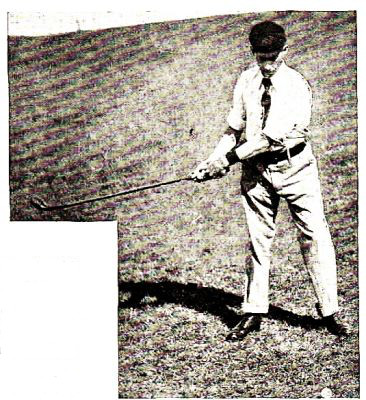
The proper grip was illustrated in last week's paper. It is not the natural position for the hands when at rest, but experience has decided that it is the best for the swing. In particular the left hand should be well over the club, or freedom of motion is impossible. Get your grip by grasping the club as though you were about to strike a blow straight down upon an anvil, and then swing gently two or three times directly over the ball, describing a flourish that shall resemble an elongated eight. This is called the "waggle," and its purpose is to assist the hands to settle into position. Finally ground the club close behind the ball for an instant, and then swing back for the real business of the stroke. About an inch of the shaft should be left above the grip to give greater command over the club. The thumb may lie along the shaft or be wrapped around it, or one thumb may be around and the other along the handle. In any case the grip of the left hand must be absolutely firm and close so that there may be no possibility of the club turning at the moment of impact. The right hand may be comparatively loose, but, generally speaking, that hand will take care of itself. Finally, keep the left wrist as taut as possible, and remember that every inch that separates your hands on the shaft takes off yards from the length of the drive. Let the arms be naturally bent, and keep your hands low. The end of the shaft should point well below the waistcoat.
Coming now to the swing proper, it is a safe rule not to attempt too much at first. If you watch a professional making a full drive, you will see his body turn and his left heel come well off the ground, while the club will appear to wind completely around him. But if you attempt to imitate him you will soon find yourself in difficulty. Instead of turning your body, you will be inclined to sway it over the right leg; rising on the left toe will throw you off your balance, and you will only be able to get a long swing back by bending your wrists. Now all these things are wrong, and tend to inaccuracy and feebleness. The thing for you to do is to take a short or half-swing back, and trust to practice to lengthen it. It is very important that your up swing should be slow, so that the arms may go freely out from the body. "Slow back," as it is called, is a cardinal principle. Otherwise you are sure to make the swing too straight up and down. Let the swing finish itself out, as the fly fisherman does when casting, and let the return be swift and even. Keep your shoulders loose and your body firm, and as your swing lengthens your body will turn to accommodate it. But it must turn on its own axis, as does a rudder-post, and not sway from side to side after the fashion of a boom. And all the time you must have your eyes fixed upon the ball or you will never hit it cleanly.
END OF FULL SWING.
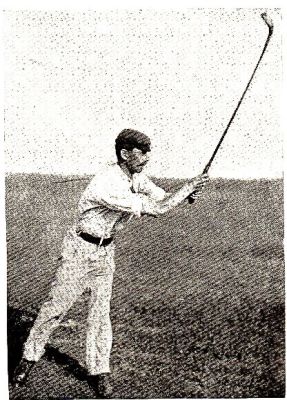
It is a poor practice to make one or two false swings, pulling up short just before reaching the ball. It is certain to get you in the bad habit of "nipping," or not following through after the ball. This after-swing is fully as important as the first part, although no one knows exactly why. Let the club swing through and with the arms freely flung out from the body.
Make your tees low. There is no advantage in perching the ball upon a pyramid of sand that resembles a chicken croquette, and it will incline you to "top" (hitting the ball above the centre instead of below it) from the ordinary lies of the green.
You will say that it is impossible to remember all these things, and you are right. But if you will read over what I have said with attention, it will help you to understand the few absolutely indispensable conditions upon which good driving depends. Here they are:
1. Stand firm.
2. Don't sway your body.
3. Keep the left wrist taut, and grip hard with that hand.
4. Ground your club close behind the ball before swinging.
5. Swing back slowly, letting your arms well out.
6. Follow through freely, and keep your eye on the ball.