NEW YORK'S DEFENCES ON THE SOUND.
Reading edition
BY WILLIAM HEMMINGWAY.
One of the most interesting questions in a recent examination at the Royal Naval Academy at Woolwich, England, was: "How would you capture New York, approaching by way of Long Island Sound?" There is only one question that interests us more, and that is, How would New York's defenders along the Sound repel our enemy? The news from Washington that thrilled this country only a few days ago, and the possibility that we might after all really come to war, make the defence of the greatest city of America a problem of the most intense concern to every one of us.
Captain Howard Patterson told the readers of the Round Table, on March 13th of last year, how New York would be successfully defended from Sandy Hook. The arrangements for removing a fleet of men-of-war from the waters of New York Bay are so complete that no fair-minded invader could really ask for more.
But suppose some one should declare war against us to-morrow, and promptly send a fleet to take our richest city. Would the enemy walk into the trap so thoroughly prepared for him at Sandy Hook? The chances are rather that he would come down from Halifax and try to dodge in by way of Long Island Sound, where he thinks that very little has been prepared to check his advance. It is true, unfortunately, that the works to the eastward of New York are not nearly so efficient as those to the southward; yet there would be found in time of need enough men and guns to drive back the most formidable invasion any one might undertake.
If you will look at your map of Long Island Sound you will find several small islands scattered between Connecticut and the Long Island shore. Chief among them are Fishers and Plum islands. Upon every one of these islands mortar batteries will soon be placed, while the channels of the Sound itself will be full of submarine mines ten yards apart. For years the great drawback to the improvement of our coast defences has been the childish confidence of certain inland Congressmen that "American ingenuity" will always find a way to defend American interests. The haste that is being made to fortify our coasts to-day shows how ill-advised that confidence has been. If you speak about "American ingenuity" to an army or navy man, he probably will glare at you and turn purple. It has been their stumbling block for a very long time. Still, we are not quite so unprepared as our enemies believe.
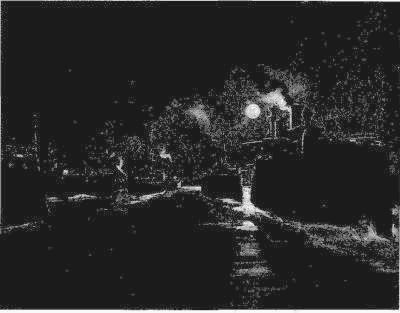
Massachusetts. New York. Iowa. Texas. Indiana. AMERICAN NAVY PROCEEDING UP EAST RIVER TO THE SOUND.
Imagine that the hostile fleet has arrived off the mouth of Long Island Sound on its errand of destruction and plunder. Its array of ships almost staggers belief. There are twelve battle-ships—veritable mountains of iron and steel—armed with rifled cannon of prodigious bore and wonderfully long range, as well as smaller guns of every degree. With them have come twenty-four armed cruisers, twelve torpedo-catchers—boats that run twenty-eight or thirty miles an hour—and a swarm of ordinary torpedo-boats that one might well describe as innumerable. The proud armada sails westward flaunting the enemy's ensign and trailing plumes of black smoke like vast banners. The attacking Admiral knows that beneath the dancing waters of the Sound there are hidden mines of deadly power, awaiting only the pressure of an electric key from the shore or the touch of a passing keel to blow his great ships into fragments. He sends out scouts—that is, lines of torpedo-boats twenty or thirty feet apart, trying to determine the channel. It is the duty of the crews of these swift, light-draught boats to drag for and explode the hidden mines, which are submerged at a depth of twenty feet so as to strike only the keels of great ships.
Where are the forts that shall check the invaders? From the conning-towers of the ships there can be seen no sign of fortification. The little islands lie peacefully basking in the balmy sunshine. The grass on their round-browed hills quivers gently in the breeze. But behind every one of those hills is a modern fort—a gigantic circular pit in the sand, with four arms running out from it at right angles. At the end of each arm is a pit big enough to hold four rifled mortars. These are short, wicked-looking guns that seem like long-range rifled cannon sawed off half-way down the barrel. From the moment the torpedo-catchers are within five miles the officers of the mortar batteries are watching them with range-finders.
Four miles; three and three-quarters; three and a half—then comes a thunderous uproar as if a mountain-side had fallen! The mortars on two islands send showers of bursting shells that fall upon the group of pretty white torpedo-boats, and blot them from the sea. The thing is done with startling quickness. Before one can count half a hundred the last vestige of the torpedo-destroyers has disappeared beneath the waves. The batteries on Plum Island and Fishers Island have rained destruction in an awful cross-fire.
The hostile Admiral sends out twenty torpedo-catchers in the wake of their lost fellows. Let us assume that by hard work, great pluck, and good fortune they have counter-mined and cleared the channel, and so made the way safe for the big ships. The men in the mortar-pits are almost unhurt at first. The opponents have had nothing to guide their retaliatory firing but the clouds of smoke from the pits. At last they get the range and silence the forts.
Governors Island. New York City. Hell Gate. Willets Point. Fort Schuyler. Mortar Battery. THE ENEMY'S FLEET APPROACHING THE NEW YORK END OF LONG ISLAND SOUND.
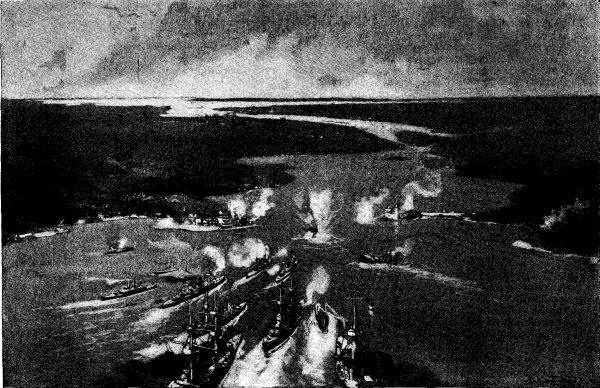
The fleet passes on, only a little crippled, but still wary of mines in the channel. The ships would be subject to a similar cross-fire from mortar batteries on either side of the Sound at every narrow part of the channel. Almost the entire journey down the Sound toward New York would be under a heavy bombardment. There are at least six places where the groups of mortars will be placed. It would not be proper to give their location here. There are also very heavy batteries of this description on Davids Island, which is a military post near New Rochelle, and on Sands Point, Long Island, about sixteen miles east of New York. Then there are the fortifications at Willets Point and Fort Schuyler still nearer to this city, and at a point where the Sound is only three-quarters of a mile wide.
If the enemy should live to come within range of these forts he would find that his troubles were only now beginning in earnest. The great 16-inch rifled guns at Willets Point have a seven-mile range, up past Stepping Stone Light and Execution Rock. They could easily dispose of any number of torpedo-boats trying to destroy submarine mines. More destructive than all these is the "dynamite gun," a tube of steel fifty feet long, and with a bore of fifteen inches. This throws a long cigar-shaped slug of explosive gelatine, more powerful than dynamite, and weighing about two hundred pounds. The shell is driven out of the gun by compressed air.
It is not at all likely that we could get together a fleet of battle-ships of sufficient numbers to cope with the enemy's great squadron. Still, the Maine, the Texas, and half a dozen other fighting ships, each one of which is equal to anything in the foreign navy, would be assembled in the Hudson River awaiting the arrival of the invaders. As soon as the news of their progress down the Sound was telegraphed to this city, they would steam up the East River, take their stations within the arc of the forts at Willets Point and Fort Schuyler, and add their broadsides to the defence of New York. Is there any fleet in the world that could force its way past such an opposition? No American thinks so.