FROM CHUM TO CHUM.
Reading edition
BY GASTON V. DRAKE.
IX.—FROM BOB TO JACK.
London, July —, 189-.
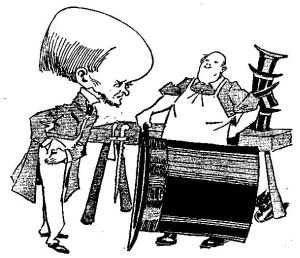
DEAR JACK,—Pop wants me to keep a dairy of this trip, and I told him I would, but it takes an awful pile of time to do it and write letters home too, so it's come down to this: Either you've got to keep these letters I'm writing to you, and let me have 'em type-written when I get back, or I've got to keep the dairy, and if I keep the dairy you don't get any more letters. I'll keep on writing until you let me know what you're going to do about it, because I guess maybe you'll say all right, go ahead. I don't see much sense in keeping dairys, but Pop says that boys that go abroad ought to, because they see lots and lots of things they never saw before and ought to remember. "What's the matter with remembering them?" said I, and he said: "Oh, you can't. Once there was a man who really remembered all he saw and heard, and when he got to be an old man his memory held so much it bulged his head out, and he had to have his hats built for him at ruinous expence."
Speaking of expence reminds me. The money they have over here is fine. My allowance when I'm home is ten cents a week, and over here Pop gives me sixpence. It's a clear gain of two cents a week, and I'm mighty glad I wasn't getting a quarter a week, because then Pop says he'd have made it a shilling, and I'd have lost a cent every week, because a shilling's only worth twenty-four cents. I hate to spend my allowance here though. I don't wonder English people get awful rich. It's easier to save than it is at home because over here when you spend money you feel as if you were spending your collection of coins, which you don't like to do. I've spent two bully coins already. One of 'em had George the Third's head on it, and the other was a Queen's Jubylee sixpence.
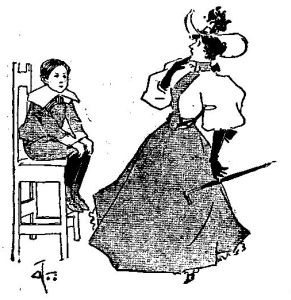
There's other money too, and lots of gold in sight. The five-dollar gold piece and the Queen all go by the same name, the sovereign, though some people call it the pound so as to extinguish it from the Queen. I haven't seen her yet, and I don't know as I want to. They say she wears bonnets just like all other women, and doesn't go round with regal things on at all. I don't see what fun there is in seeing a Queen if she don't carry a wand in her hand and wear a crown on her head.
There's lots of nonsense in the pictures we've seen of these royal personages anyhow. The other day when Pop and I were coming home from the bank in a handsome cab we passed a carriage with the Prince of Whales in it. He's going to be King some day if he has luck and he didn't look any more like a Prince than Sandboys. I've seen Sandboys look a great sight more hortier than he did, and as for the feathers he's always said to wear he didn't have a feather about him. I guess we've got Indians at home that can give him points on feathers and not half try.
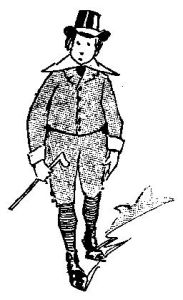
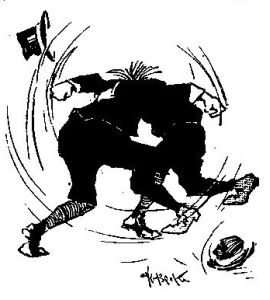
But I tell you you can tell Americans every time even if you can't tell a Prince or a Duke from a hotel-keeper. I was sitting in the office the other day looking at the hotel elevator. They have two of 'em in every hotel because one of 'em seems to be out of order, and a lady came up to me and said she guessed from my spockling black eyes I was a little Italian boy, and I said "Nit," and then she knew right away that I was one of those bad American boys without any manners, but I didn't care and I mayn't have good manners, but I don't wear a beaver hat the way her boy did. It's the funniest thing you ever saw how the kids over here go into beavers as soon as they cut their teeth, and sailor collars. I thought I'd die when I saw that lady's son get into the elevator with his beaver and sailor collar on and a little coat that Pop says is called a Eatin' jacket that stops at his waist so's to make it handy to spank him. I found out afterwards though that he was a great sight better than he looked. When his Ma said my manners was bad he sort of looked up in the air and winked at the roof of the elevator and I had it in for him when I met him alone in the hall. I thought he'd be easy but he wasn't. I knocked his hat off but I had to stop there because while he had good manners enough when his mother was around he didn't have any when he was alone in the hall with me and I tell you we had a time of it until Pop came along and pulled us apart. There wasn't much damage done except to his beaver hat and we made it up afterwards and I sort of like him next to you. When he heard that I'd saved up and had almost three shillings he told me about a fine place near the hotel where they had tarts for sale and my what a gorge we did have on buns.
Since I wrote you about the town we've seen quite a lot of things but I've been kind of disappointed in 'em. We went to the British Museum the other day and I expected to see walruses and British Lions and John Bulls and unicorns and things like that but they didn't have anything worth looking at except mummies. There was some Elgin marbles Pop was anxious to see and I wanted to see 'em too because I'm fond of marbles but when we came to them they weren't our kind of marbles at all, only statchuary and great big slabs of figures with broken noses and things like that. There wasn't a thing in the whole place to compare with the circus museums we have at home except the mummies and they were fine, though there wasn't a live one in the place. We saw the mummy of Cleopatra who used to be the Queen of Egypt about a million years ago, and I must say if she looked like that I'm glad I wasn't alive then. Bogie men aren't in it with people like Cleopatra. She was a fearful looking lady but it was fun looking at her mummy and thinking how she'd been a Queen once and now wasn't anything but a side show to a museum. It sort of makes you satisfied to be a plain American with nothing ahead of you but being President when you think how the Kings and Queens of those times weren't allowed to keep quiet in their sarcophaguses, as they call the boxes mummies are buried in, but have to be trotted out to amuse people. Pop says it's an outrage to disturb a lady like that and I agree with him. I'd hate like anything to be hauled out for a museum a thousand years from now and have people look at me and say O my. That Bob Drake! I thought he was a better looking boy than that. But after all it's the only kind of circus these English boys have and I suppose it's better than none. Pop says they don't know what a three ringed circus is over here and I'm sorry for them, though I must say the circuses home in New York every year are making me cross-eyed trying to see all that is going on at once.
To-morrow we're going out to the Zoo, and next time I write to you I hope to tell you all about it. Somehow or other I expect great things from the Zoo, but I'm afraid that after we get there we'll find that it isn't a bit like the Zoos we are used to. It'll probably be made up of a lot of books and old pictures instead of interesting things like monkeys.
Yours ever, Bob.
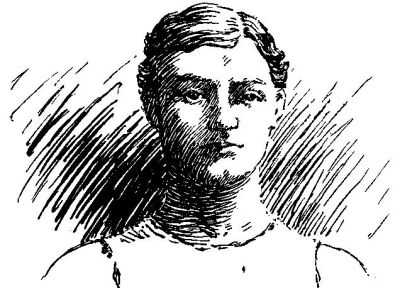
M. C. O'BRIEN.
The seventh annual in-door games of the New England Interscholastic Athletic Association, under the auspices of the Boston Athletic Association, were held a week ago Saturday in Mechanics' Hall, Boston. The games were very interesting and exciting, and unusually well contested. About three hundred personal entries were had from schools scattered throughout Massachusetts and other New England States, and fully 4000 people were present as spectators. This is a record both for competitors and spectators which no scholastic meeting in this city has ever approached.
It was evident from the outset that the race for points was to be close. Four schools—English High, Hopkinson's, Worcester High, and Worcester Academy—were out in earnest for the big championship shield, but English High succeeded in carrying off the shield by one point, getting 17-3/5 points to Worcester Academy's 16-3/5.
Three new records were made, one was equalled, and one established. O'Brien, E. H.-S., put the 16-pound shot 37 feet 3½ inches, which is 7½ inches better than his performance of 1895; and Mills of Berkeley took one-fifth of a second off the record for the 1000-yard run. The chief record-breaker, however, was W. M. Robinson, of Worcester Academy. He ran in the 40 and 300 yard distances, and won both. In the first event he ran three heats in record time, 4-4/5 sec., which is within one-fifth of a second of the world's record. In the longer distance he lowered W. D. Fuller's record of last year by one second, the new time being 35-1/5 sec. This young man will surely be heard from when he gets into college.
INTERSCHOLASTIC IN-DOOR GAMES OF THE B. A. A., MARCH 21, 1896.
Event.Performance.Winner.
40-yard dash 4-4/5 sec.W. M. Robinson, Worcester Academy.
300-yard run 35-1/5 sec.W. M. Robinson, " "
600-yard run1 m. 27-1/5 sec.R. F. Hanson, English High-School.
1000-yard run2 m. 33 sec.E. W. Mills, Berkeley.
45-yard low hurdles 5-4/5 sec.R. C. Seaver, Brookline High-School.
Half-mile walk3 m. 33-3/5 sec.A. L. O'Toole, English High-School.
Running high jump5 ft. 6 in.A. N. Rice, Noble's.
Pole vault9 ft. 10 in.B. Johnson, Worcester Academy.
Putting 16-lb. shot37 ft. 3½ in.M. C. O'Brien, English High-School.
Table of Points[2]
Firsts.Seconds.Thirds.Total.
English High31/52-1/517-3/5
Worcester Academy31/51-1/516-3/5
Hopkinson2-1/51-1/55-3/5
Noble's11/51/55-3/5
Worcester High215
Berkeley15
Brookline15
Phillips Andover1-1/51-1/53-3/5
Cambridge H. and L.113
Cushing Academy12
Chauncy Hall12
Medford High11
The games opened with the 40-yard dash. Contrary to custom, the second men in the preliminary heats were to be given a chance in the semi-finals. Perhaps this accounted for the unusual amount of spirit shown. Four men equalled the record, 4-4/5 seconds, and Robinson of Worcester Academy did it three times. It looked as though the record would have to break in the final heat, with so many fliers, and every one was standing up to see it done, for that is the only record that has not been broken since the games were instituted, and to lower it by a fifth meant to equal the world's record. The six sprinters got off together, and kept well bunched all the way, except Robinson, who sneaked ahead at the 20-yard mark, and finished two yards in front of the field.
A double line of competitors took their places to start in the 1000-yard run. It was seven times around the track to the finish, but the racing began at the crack of the pistol. George Dow took the pole, with E. W. Mills, of Berkeley School, and W. F. Porter, of Chauncy Hall, close behind, and D. T. Sullivan, of Worcester High, running fifth or sixth. On the third lap Mills and Porter both passed Dow, and Sullivan, who had been playing a waiting game, dropped out with a broken shoe-lace. This was a severe blow to the chances of Worcester High, who has held the championship shield for two years. There was apparently some understanding between Mills and Porter, for when they once got in front of Dow they ran side by side, and thereby easily kept him behind. At the last turn Mills and Porter made a dash for the tape, and Mills got there first by a scant six inches, taking one-fifth of a second off the record. Dow made third, with the rest twenty yards behind.
When Delaney was debarred from the walk, O'Toole was looked upon as a sure winner. At the crack of the pistol he, with Rudickhauser and Mohan, all three for E.H.-S., started to the front. They profited by the example of Mills and Porter, and kept all spurters well behind them. On the last lap, however, Mohan and Rudickhauser were both ruled off, and then A. Lockwood, of Worcester Academy, who had been trying for three minutes to get by the bunch, worked himself abreast of O'Toole, and furnished a most exciting finish. It would have been a dead heat except that Lockwood broke into a run in almost his last step. He was ruled out, as was Malletts of Boston Latin, who had been at his heels throughout the race. Then G. Thacher, of Hopkinson, crossed the line, and was very much surprised to learn that he was second.
About this time excitement began to show itself in the English High and Worcester Academy sections. Worcester had 6 points, and English High 5, with Worcester High out of the reckoning. English High was sure of the shot, and Worcester was sure of the pole vault; while the 300 and 600 were in grave doubt, and the hurdles and high jump were conceded to other schools.
The 300-yard trials were run next, and the final of that event furnished the best race of the day. It was another case of Carleton vs. Robinson. Robinson had the advantage of position on the scratch, and took the pole. At every turn it seemed as if Carleton would pass him, but each time Robinson spurted just a little more, and held the place. At the last corner Carleton made a grand attempt to pull out first place, but Robinson held his own, and broke the tape a foot ahead of Carleton, and also broke Carleton's newly made record, establishing a new one of 35-1/5 seconds—a record that Wefers might find hard to smash on a similar track.
The first heat of the 600 was an easy race. W. Dadnum, of Worcester High, was first, J. J. Purtell, English High's crack, a leisurely second, and C. Boyle, of Worcester High, third. Albertson of Worcester High, who won the event last year, followed Purtell's example, and just jogged around until the last lap, when he moved up to second, J. H. Hartwell, of the other Worcester school, leading. But on the last lap two other boys moved up too—R. F. Hanson, of English High, and Mills, who had won the 1000. Just at the last turn they both slipped by the napping Albertson, who awoke to the fact that he had not qualified for the final. This was the third first place that Worcester High had counted on which had slipped through her fingers. Another waiter was W. A. Applegate, of Cambridge High, in the third heat. He ran sixth until the last lap, and then, as if he had just realized that he was in a race, tore round the corners, and pulled down the field, and finished first. Burdan of Newton was second, and Cook of Chelsea third. With Albertson out of the final, it looked like an easy thing for Purtell. But there was a big spill in the first lap. Hartwell, who was leading, fell on the third corner. Purtell, Dadnum, and Burdan fell with him. Hanson and Boyle dodged the heap, but Applegate, who was waiting again, wasn't affected by it. Boyle was leading now, twenty yards ahead of Hanson. Hanson realized that for his school to get the shield this race must be won. Slowly but surely he overhauled Boyle, and at the last turn dove forward and came in ahead. Meanwhile Applegate was tearing through the crowd with one of his thrilling finishes, and made third place. Hanson's work was the pluckiest of the day.
R. C. SEAVER.
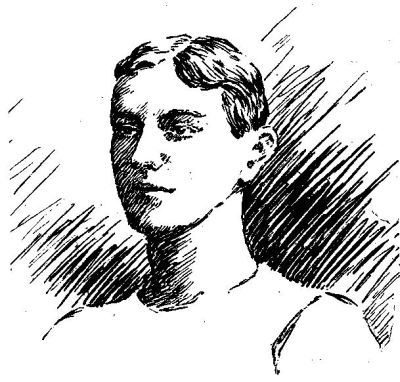
In the 45-yard low-hurdle race Chauncy Seaver, of Brookline High-School, was expected to win with ease, and he did not disappoint his friends, although pushed hard in the final by Mason of Worcester High. As the 45-yard hurdle race over three hurdles 2 feet 6 inches high had never been run before, Seaver was credited with the record of 5-4/5 sec. Last year a record of 6 sec. was made for the distance over four hurdles 2 feet 6 inches high. A. N. Rice had no trouble in winning the jump with a height of 5 feet 6 inches. Five men tied for second at 5 feet 4 inches, drew for the cups, and divided the points. In the weight event M. C. O'Brien put the 16-pound shot nearly five feet farther than his nearest competitor.
The last events of the programme were the team races, the teams being composed of four men each, one of whom ran 390 yards. In the relay race between Worcester High and Worcester Academy the latter's team won, doing the distance in 3 min. 20-4/5 sec, which has never been equalled before.
The Englewood High and Hyde Park schools' dual in-door athletic meeting, in the University of Chicago's gymnasium, resulted in an overwhelming victory for the former, the score being 70 to 27. The figures were not quite up to the standard of Eastern performances, but some of the records are creditable. I give the winners only: 35-yard run—Trude, Hyde Park High-School, 4-3/5 sec.; half-mile run—Teetzle, E.H.-S., 2 min. 15-4/5 sec.; 1-mile run—Hodgman, E.H.-S., 5 min. 12-3/5 sec.; 35-yard hurdle race—Teetzle, E.H.-S., 5-2/5 sec.; half-mile walk—Parker, H.P.H.-S., 3 min. 50 sec.; running high jump—Thayer, E.H.-S., 5 ft. 2-3/5 in.; standing broad jump—Flacken, E.H.-S., 9 ft. 7 in.; running broad jump—Teetzle, E.H.-S., 19 ft. 7 in.; pole vault—H. Boyce, H.P.H.-S., 8 ft. 6 in.; putting 12-lb. shot—Flacken, E.H.-S., 36 ft. 11½ in. The sixteen-lap relay race was the most exciting event on the programme, and went to Englewood, the time being 4 min. 51 sec. Eight men from each school took part, running in pairs for relays of two laps.
Interest in track athletics seems to be developing very rapidly in the West, if we may judge from the formation of new leagues and athletic associations. What ought to prove an exceedingly important interscholastic organization has just been started by the schools of St. Paul and Minneapolis. It is called the Twin City Dual Interscholastic League, and its first field-meeting will be held at the Hamline Fair Grounds, May 29th. The events selected for the card are the 100-yard dash, pole vault, one-mile run, 120-yard hurdle, putting shot, one-mile bicycle, running high jump, half-mile run, throwing hammer, running broad jump, standing high jump, standing broad jump, 220-yard hurdle, 440-yard dash, and 220-yard dash. The first place in each event will count six points, the second three, and the third one. The school winning the highest number of points will earn a cup, and if it succeeds in holding it for three years it will keep the trophy.
I want to enter my usual protest against this list of events, because it contains such absurd features as the standing jumps, and because, apparently for no especial reason, six points are awarded to winners of first place, instead of five points. After very careful calculations, and after many years of experience, athletes and managers best qualified to determine such questions have decided that five points for first place and one point for third place make the closest ratio and the most just. For second place the figures are still in dispute. The colleges have adopted two, but many school associations believe that three points show a closer relation between first and second, admitting at the same time, however, that the ratio of three to one is not a fair one as between second and third.
It is a difficult problem to settle; difficult and complicated enough without having new associations coming along with new ratios. Therefore I think that if the managers of the new Twin City League will ponder over this situation for even a short time they will realize that if for the sake of uniformity only it will be well for them to bring their highest mark down to five points. As for the figure for second honors, I am personally in favor of two points. For one reason, I believe that the college athletes who adopted the 5-2-1 ratio did so after considerable study of the situation, and possibly brought statistics and mathematics into the discussion to help them.
Before the point system was in vogue, the method at the Mott Haven games was to reckon results by firsts and seconds. Thus if Yale had four firsts and no seconds while Harvard had one first and eight seconds, Yale won, of course. By points (5-2-1) the score would have been in Harvard's favor 21 to 20; or if the ratio were 5-3-1 it would have been 29 to 20! Third place was not counted unless there was a tie on firsts and seconds; and seconds, it is evident, were only desirable in case of a tie on firsts, for then the college with the most second-place winners won the day.
No combination of firsts and seconds such as I have just suggested ever came about, so far as I know; but it was figured that if any such result ever did come about, there would be dissatisfaction in the aggregation that took the large number of second places. It was admitted by all that such a team—as a team—would represent a higher standard of efficiency and development; and as the contests at Mott Haven or the Berkeley Oval are contests among teams, and not among individuals, it was decided that a more equable method of adjusting the score that settles the victory must be invented. The point system was then proposed, and those who undertook to discover what the ratio is between athletes in competition, so as to show in figures the relative value of one position to another in the order that the mathematical sum should demonstrate the respective merit of each team as a body, decided that this ratio was as five is to two and as two is to one. Their solution may be incorrect, but it is the closest yet offered, and ought to be accepted wherever points are used in scoring.
The Graduate.