MAPLE-SUGAR MAKING.
Reading edition
BY CHRISTINE TERHUNE HERRICK.
The advent of the sugaring season is looked forward to with joy by the young people in those districts of New England where the sugar-maple grows freely. When the sap begins to flow they know that there will be fun galore, and they watch eagerly for the first mild days that will encourage the farmers to get out the sugar-buckets.
There is something in their anticipation, too, besides the mere thought of the regaling of their palates. The running of the sap means the end of the winter, with all which that has implied of cold and dreariness and isolation. True, there have been periods of glorious cold weather, when coasting and skating and straw rides in great sleighs over sparkling snow and under brilliant moonlight have made even life in winter worth living, but these bright spots have been oases in long deserts of dolefulness. There may be poetry and excitement in being snow-bound; there are only monotony and discomfort in being slush-bound.
"When the ways are heavy with mire and rut, In November fogs, in December snows, When the north wind howls, and the doors are shut, There is place and enough for the pains of prose."
And there are other trials unmentioned by the English poet which the New-Englander knows only too well. Frozen water-pipes, frozen fingers and toes, recurring colds caught in rooms that are too chilly for comfort or close and over-heated by coal stoves, and many more annoyances that, small enough when taken separately, make a formidable sum total when they all come at once.
IN A SUGAR CAMP.
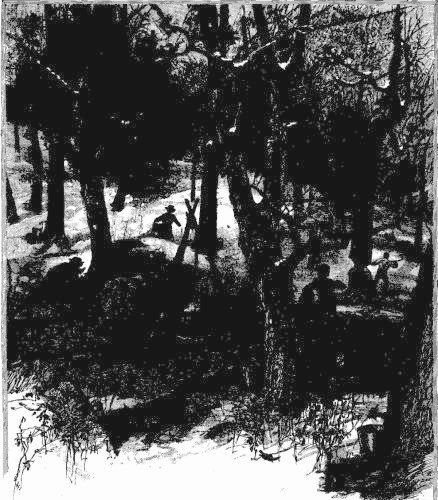
But now the harbingers of spring are at hand. In sheltered places the trailing arbutus has begun to show its fragile blossoms, that "take the winds of March with beauty"; there is even here and there a stray violet; the mosses in damp places are a deliciously vivid green, and the grass is losing its sereness in hollows and on the edge of water-courses. The bluebird has been in evidence for some days, the song-sparrow's rippling note is heard, and there are rumors that a robin has been seen. The ways are still "heavy with mire and rut," but there is a not distant prospect of settled roads and good walking. There is a suggestion of spring in the air, in spite of the drifts of snow in the ravines and in the woods. The young people do not wish to see that snow go too fast, for it is essential to a part of their fun. For how could they "sugar off" without snow? Even the farmers would prefer hauling the sledge that carries the store tub, in which they collect the sap, over the snow than over the bare ground.
To the children and young people the thought of "sugaring off" is the chief one connected with the maple-sugar season. That is unless they live on farms and have to do their part in preparing the sap for market. The time means something quite different to the farmer and his men, who must tramp through snow and mud from tree to tree of the sugar orchard that is generally scattered over hill and dale, and seldom within a small radius, who must watch the sap-buckets and empty them before they overflow, who must bring the sap from the tree to the sugar-house and empty it into the great store tubs that await it. And even then their work is but just begun, for the shorter the space between the time the sap leaves the tree and its transformation into syrup and sugar, the better will be the quality of these. So the sap must not stand long in the store tubs before it is turned into the great evaporator over a roaring fire, where it is to be changed from what appears to be slightly sweetened water into thick, flavorous syrup. The improvement of methods in sugar manufacture no longer render it necessary that the boiling sap should be watched all night, as the sugar-makers had to do in the old days, when the sap was boiled in a great kettle swung over an open fire in the woods. Still the work is hard and absorbing, for the season is short and no time can be wasted.
The women have their share of the toil. To them it falls to boil down the syrup to the proper thickness for sending out as maple molasses or as sugar in cakes. They "sugar off" frequently, but it is only to ascertain whether the syrup has reached the stage where it can be taken from the fire, stirred until it granulates, and then turned into the little tins that mould it into the cakes familiar to us all.
That is what "sugaring off" means to the farmer and his wife. It means something quite different to the young people who have been planning for sugar parties long before the farmer thought of tapping his trees.
A sugar party is not a fall-dress affair. Evening clothes and low-cut gowns would be decidedly out of place in the farm-house kitchen, where the most important part of the entertainment comes off. The "best Sunday-go-to-meeting" garments fulfil all the requirements of the toilet.
A sugar party is very elastic so far as numbers are concerned. It may be either small or large, although as a rule the old principle of the more the merrier holds good here. Both sexes are represented, and the only essential qualities in a guest are a social spirit and a good digestion.
The place to thoroughly enjoy sugar-making is on a farm where they "sugar off" half a dozen times a day. It is the usual thing for a party of young people to arrange for a visit to a farm-house in the height of the sugar season, and they throw themselves into the fun of the hour with an abandon which proves the injustice of the charge that we, as a people, like the English, take our pleasure sadly. The girls and boys inspect the flowing of the sap, form a merry escort around the sledge that conveys the sap to the sugar-house, hang about the golden syrup boiling and bubbling in the big evaporator, and it is a noisy and jubilant crowd that gathers around the tin pans filled with snow, upon which is poured the smoking syrup that is, by contact with the snow, transformed into that delicious compound, "maple wax."
Three or four young people, each armed with a fork, may gather about a small pan, where the syrup lies in golden arabesques upon the white snow. It is very pretty to look at, very good to taste, and very sticky to handle. Unless it has been boiled to a point of brittleness where it snaps when touched by the fork—and this is unusual—it will cling to the tines in a fashion that gives new and literal meaning to the words, "Linked sweetness long-drawn out." The experienced sugar-eater has learned enough to give a dexterous turn of the fork that twists the wax about the prongs in a compact morsel, while the green hand struggles with the strung-out portion that falls to his share, and is forced to make desperate appeals for a knife or a spoon to break the tenuous fragment.
Even when the wax is on the fork all trouble is not over. The next thing is to eat it, and to achieve this operation with the grace and dignity one would desire is well-nigh impossible. The subject of the experiment looks at her fork and wonders whether it is better to nibble at the sugar or to make one huge mouthful of the whole lamp of delight. Woe be to her if she pursues the former course! Unless the sugar is exceptionally crisp, she will find that she has attached to her teeth one end of an unbreakable thread that stretches as do the fibres of a stringy Welsh rarebit. She understands how the spider feels when he spins a never-ending filament.
Under these circumstances she will probably find her chief consolation in the spectacle of her neighbor, who has attempted to take all the sugar on his fork at a single mouthful. He has sunk his teeth into the sugar, and it holds them as closely as it adheres to the fork. He struggles vainly to loosen his teeth or to withdraw the tines. Not until he casts dignity to the winds, and taking the fork in both hands, drags on it with main strength, does he release himself even partially. Then, as the sugar melts in his mouth, he finds himself free once more.
It will readily be imagined that with such scenes as these taking place all over the room there is no lack of fun. The amusement may not spring from a very high mental source, but it is pure, innocent jollity, and everybody enjoys it.
No one knows how much sugar he can devour, and live to tell the tale, until he has been on a Vermont farm in sugaring-time. At each sugaring off he will eat so much that he will declare he never wishes to see maple-sugar again so long as he lives. Nevertheless, when the syrup is ready to sugar off again, he is waiting to take his place among the rest and eat and eat until he is once more satiated. And this performance he repeats half a dozen times a day. Many persons claim that maple-sugar thus eaten makes them drowsy, but the fresh outer air soon dispels such sleepiness and gives them an appetite for more sugar.
One of the indispensable items of a sugaring off is a dish of pickles. The palates that have been surfeited with the cloying sweetness crave the relief of the acid. The advocates of the pickle-jar will assure you that after a pickle or two one can eat as much sugar as if he had not tasted it before, and a little observation and experiment leads one to believe that the theory is correct.
A pleasant variety is made by sprinkling the meats of butternuts, walnuts, or hickory-nuts on the snow, and covering these with the syrup, thus making a toothsome maple nut candy.
All these dainties are sampled at different intervals during the day in every household where sugar is made, but when evening comes there is usually a gathering of the young people at one or another farm-house. The country folk who have social instincts have little terror of long walks, and they think nothing of tramping a mile or more "across lots" over rough pasture-land, or along frozen roads, to a neighbor's where there is to be a sugar party. At such a function there are no refreshments demanded except the "maple wax" and pickles. Formality is altogether lacking. The guests gather about a long table, on which stand the milk-pans full of snow, and dip the syrup from the one big kettle boiling on the stove.
When they have satisfied themselves with sweets for the time, at least, they fall to playing games—such old-fashioned amusements as Twenty Questions, Consequences, Dumb Crambo, or the livelier Fox and Geese and Blindman's Buff. Occasionally Parcheesi, Lotto, and Backgammon will have their devotees, and rarely there will be games of cards. The party does not continue to a late hour. There must be a final sugaring off before the assembly breaks up for the night and muffle themselves for their long trudge homeward in the white moonlight or under the solemn stars.