Chapter II
Reading edition
Flea was a hardy, country-bred child, and as little afraid of thunder, lightning, and flood as of the loneliness of the deserted school-house. She laughed low and gleefully as she drew her skirt up to her knees and stuck out both thin brown legs in the warm rain, wriggling her toes contentedly in the shower-bath. A broad reddish pool was spread out in front of the door in three minutes, and the heavy drops plashing into it raised tiny bobbing bubbles.
"They are fairies dancing at a ball!" ejaculated Flea. "How featly they foot it!"
The rain poured on, the dull rumble on the roof stirring up hollow echoes in the room behind her; the fairies danced more and more wildly as a sharp shower of hail mixed with the rain-drops. The falling pellets stung Flea's legs, and she drew them in, still laughing, drying them imperfectly with a blue cotton handkerchief she took from her pocket. Sitting further back out of the spray, she doubled her legs under her to warm them.
The rain streamed steadily, beating the wind down; the sky darkened slowly, with no alternations of lighter glimpses. In happy unconsciousness of the lapse of time, Flea waited patiently for the "holding-up" that could not be far away.
"When it rains so hard, it doesn't last long," she thought, surprised to find herself yawning.
The monotonous patter upon the roof, the dash and drip from the unguttered eaves, had made her drowsy. She would take a short nap, and find it clear upon awakening. Then there would be a merry tramp through the puddles, and pines, and wet old-field broom-straw, to her supper at sunset.
She shut the door, went back to her corner, and stretched herself upon a bench, putting the bulky Shakespeare under her head for a pillow.
"What rich and strange dreams I ought to have!" she murmured; shut her eyes and took up the examination-day scene where she had left it off.
Yes, that would be just the right thing to say. She must speak distinctly so that other people would hear it as well as the dear Major, who would stand there smiling down at her:
"You do me too—much—honor—I—assure—"
The soughing of the weak gusts in the aspen-boughs, the plashing from the eaves, and the thud upon the clap-boarded roof, steady as a drum-beat, had made quick work of waking dreams.
An hour went by. The wind shifted to the east and blew the door ajar, but the interior was no lighter for the opening. Darkness settled within and without the lonely building—a night in which there would be neither moon nor star to light the child, should she awake, to attempt the measured mile that lay between the school-house and her home.
Before preceding her thither I must try to explain to the young reader of this generation what was the social position of an overseer upon a Virginia plantation at a time when all the house and field servants were negro slaves. The overseer was as white as his employer, but much nearer the slave's level, unwilling as he might be to admit it, and his social rank suffered accordingly.
The Duncombes were too secure in their position in State, county, and neighborhood to be supercilious to inferiors, and too sensible not to appreciate the fact that the Grigsbys were most respectable in their walk of life. The father was a faithful and valuable official upon the great estate which comprised five of the best farms upon the river. Miss Emily and Miss Eliza were often at the overseer's house upon one errand or another, and sat for half an hour in as friendly chat with Mrs. Grigsby as if she had belonged to their visiting-list. Every spring and autumn she was sent for from Greenfield to help with the cutting out and making up of the clothes for the army of servants, who must be looked after and cared for as if they were children. Sometimes Mrs. Grigsby did not return to her home for several days, receiving cordial kindness from all of the Duncombes.
The night was chilly after the hail-storm, and the rain had not ceased. All the children, except Flea, were clustered in "the chamber," where was a glow of heat and light.
The fire was getting so hot that Bea pushed her chair and set the candle-stand further away from it, and demanded of Calley (short for Caledonia) "what she was thinkin' about to let the baby roast his brains by crawlin' so close to the hearth!"
"He'll ketch fire, if you don't mind," she added. "Move him to the other side of the room."
"Do it yourself," retorted the checks-player. "It's my turn now, an' I can't stop for nothin'. One, two, three!"
"We'll see 'bout that, my lady, when ma comes in," said the other, in an elder-sisterly tone, and a step in the passage giving notice of the threatened "coming," Calley missed the marble she had meant to catch upon the back of her hand, and turning over on her side, made a long arm to drag the baby by his frock away from the hearth.
Thus suddenly attacked in the rear, the luckless infant lost his balance and pitched over upon his forehead. The thump was followed by a terrific howl.
"I declar' you children are enough to w'ar anybody's life out of her!" exclaimed Mrs. Grigsby, picking up the screaming child and beginning to rub his forehead hard with the palm of her hand—"to scatter the bruise," she would have said if asked why she did it. "Thar, thar, deary! ma's sugar pie! I should 'a' thought some on you might 'a' hendered him from ketchin' sech a fall as that. Calley, give me one o' them sugar rags to stop his mouth!"
The sugar rags were small squares of old linen or muslin, in which were tied up cold boiled rice or stale bread and brown sugar. Each was of the shape and size of a marble, and, before it was given to the baby, was dipped in milk, or, if milk were not at hand, in water. The smallest Grigsby's howl subsided into a queer whine, like that of a choking puppy, and this into an intermittent grunt, as his mother trotted him on her knee, holding the sugar rag in his mouth all the while.
"I come in to arsk ef any you children has any idea whar your sister Flea is," she was saying, when she could talk down the baby. "I've been a-callin' of her upsta'rs an' down-sta'rs an' all over the place, an' she ain't nowhar to be foun'. Your pa he's gone to the stable to see ef she's crawled up inter the hay-lof', or some sech outlandish place, an' gone to sleep. That chile's as wild as a hawk. You never know what she'll be up to nex'. She'll get los' sure 'nough some o' these days, an' then thar it will be!"
"She's got the right name," giggled Bea. "She's jest like a flea—when you put your finger on her, she ain't there."
"It's no laughin' matter, I ken tell you, Mr. Dee!" retorted his mother, as Dee's snicker answered his sister's giggle. "Well, pa," as her husband entered, "any sign o' her?"
Mr. Grigsby, a tall lean man with sandy hair and whiskers, who looked and spoke like a person with more sense and far more education than the wife he had married fifteen years before for her pretty face and good housekeeping, stalked up to the hearth, shaking the wet from his coat into the fire, after the manner of a huge water-dog. Dee drew back to escape from the flying drops, and Bea put her embroidery behind her. Neither ventured to complain. Their father was kind and just to them, but he was master in his own house, and not to be trifled with when his face was as black as they now saw it. His voice was naturally harsh, and he had a touch of the Scotch "burr" in his speech. He spoke roughly and angrily:
"Sign of her? No! Things have come to a pretty pass if all of you together can't keep the run of one child while I'm off on the plantation working like a horse to put bit and sup into your mouths. Chaney tells me she saw her go off towards the woods right after dinner, with a book under her arm and her knitting in her hand. Have any of you seen her since?"
The children looked from one to the other, and then to their mother, who looked at them in the same way. Nobody said a word. Mr. Grigsby reached up for a lantern that stood on the chimney-piece, opened it, and lighted the candle within with a coal taken from the fire with the tongs. He snapped to the lantern door, crossed the room in three strides, and in another minute was heard outside shouting to Dick to saddle his horse and bring him around.
When the horse was ready he whistled up a couple of dogs, and swung himself into the saddle. As he did so, a voice called shrilly to him, and his wife ran out into the rain, throwing her apron over her head as she came.
"Pa! pa! stop!" she panted. "Bea says she's 'most certain Flea's gone to see Miss Em'ly. The child's jes distracted after her, you know, an' Bea says she was sayin' this mornin' how she'd promised to gether a heap o' life-everlastin' for Miss Em'ly to stuff a piller with. Bea says sure's you're born thar's whar the run-mad thing has gone to, an' they've kep' her all night on 'count o' the rain, Bea says."
Mr. Grigsby's patience and temper were often tried by his children's mother. Sometimes he spoke his mind to her. Oftener he did not express his feelings in words. They found vent now in a single harsh "Pshaw!" a Scotch snort, which she might have divided equally between herself and her oracle, Bea. As he blew it out he struck his spur into the horse's side and vanished into the rainy darkness, the dogs racing after him.
"I never see your pa more heady'n he is to-night," sighed the mother, returning to the waiting group that filled the lighted front door. "He's hard's a rock when he's sot upon anything."
The hard head was turned in the direction of Greenfield. The father might "pshaw" at Bea's suggestions and her mother's conclusions, but his sound sense told him they had given him a likely clew to the whereabouts of the missing child. If she had carried what he named in his displeasure "old-field trash" to "the house," she would have been detained there by the storm. Miss Emily made a pet of the lassie, and they might take it for granted that her family knew where she was. She got caught in a snow-storm up there last winter, and Miss Emily would not let her go home for three days. The idea became more and more plausible as he pushed on, the dogs at his heels, his big umbrella over his head. By the time the lights of the great house on the hill glimmered through the straight lines of rain, he was quite sure he should find his daughter under that safe shelter.
He rode to the stable and put his horse under cover, then made his way to the front door. It stood wide open, and so did that of the drawing-room, the broad red light flashing out into the hall telling that a fire had been kindled there.
A burst of music from the drawing-room arrested Mr. Grigsby's hand as he raised it to the knocker. Miss Emily and Miss Eliza were singing at the piano, and a man's voice joined in with theirs. The listener's knowledge of music was slight, but he had a good ear, and he knew that the unfamiliar voice was remarkably fine. It was strong and clear and sweet, and each word was articulated distinctly. The three were singing one of Moore's melodies arranged as a fugue, or, as unmusical people used to call it, "a chasing tune."
"Meet me by moonlight alo-o-o-ne,"
sang Miss Emily's small voice, as tunefully as a bobolink. And while she went on with
"And then I will tell thee a tale,"
Miss Eliza took up "Meet me by moonlight alone."
Before they could begin the second verse Mr. Grigsby let the knocker fall smartly, and Major Duncombe himself came out into the hall.
"Ah, Mr. Grigsby!" he said, cordially, but looking surprised. "Good-evening. Walk in. Nothing the matter, I hope?"
"I hope not, sir. But I was in hope of finding my little girl here. Fl—Felicia, my second daughter. She has not come home, and I thought she might have come up here on some errand or other, and been kept by the rain."
In the hush that followed his knock what he said was heard plainly in the drawing-room, and all the home party, headed by Miss Emily, now appeared, questioning and anxious.
Miss Emily flew up to the overseer, her blue eyes large, her red lips apart. She was out of breath and quite pale with alarm.
"WON'T YOU ALL GO RIGHT OFF AND LOOK FOR HER?"
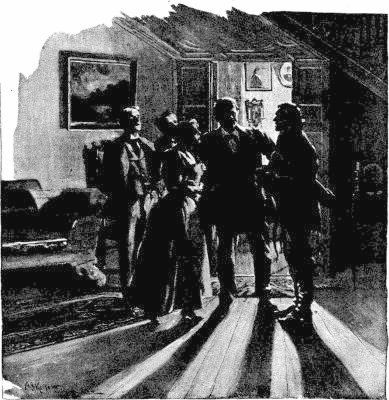
"What did you say, Mr. Grigsby? Is my little scholar lost? She isn't here. She hasn't been here all day—no, not for a week and more. Oh, the poor little dear! I hope nothing has happened to her. Won't you all go right off and look for her?"
She wrung her tiny white hands, and turned, first to her father, then to her grown brother, and lastly to Mr. Tayloe, who was nearest to her. "Can't I go too?" she pleaded, and her eyes had real tears of real distress in them. A little more and she would be crying outright.
Three or four people began to speak all at once, but Mr. Tayloe's voice arose above the rest.
"Isn't that the child we saw at the school-house to-day, Major? We left her there at half past three, Mr. Grigsby. She must have been caught there by the rain."
In some way which nobody could have explained his cool, matter-of-fact manner was like a wet blanket upon the excitement caused by the news of the child's disappearance. Even Mr. Grigsby felt for an instant that much ado had been made over a very little matter. Miss Emily tittered nervously.
"How very clever in you to recollect it, Mr. Tayloe!" gazing gratefully at him. "Please, papa, order ever so many of the men to go right straight after her with lights and blankets and hot coffee and things, and bring her right here. I can find some dry clothes for her, and she can sleep in my room, and—"
"That will do, Emily," said her father, quietly. "Joe"—to the colored footman who had been summoned by the knocker—"tell Jack and Emmanuel to get lightwood knots, and Cæsar to have my gig ready at once. Mr. Grigsby, I will go with you. As Mr. Tayloe suggests, we shall probably find the child at the school-house."
Mr. Grigsby's eyes and ears were quick. He was near enough to Miss Emily to overhear her say in an undertone to Mr. Tayloe:
"Won't you go, too, please? It will be a real favor to me."
The overseer faced her abruptly. "Excuse me, Miss Emily, but I hope you won't persuade Mr. Tayloe to go out this wet night. There is no need whatever for him to do it. Indeed, Major Duncombe, if you will kindly let one of the hands go along with a lightwood torch, it is all I could ask. I am very sorry to cause such a disturbance."
"I shall go, if Major Duncombe will allow me, because it is Miss Duncombe's desire," said Mr. Tayloe, stiffly.
It would be foolish and useless to discuss the matter further. The canny Scotchman knew the impropriety of disputing with one who was now a member of his employer's family. With a brief "good-night" to the ladies, he went off to get his horse.