THE SAILING OF JEAN-PAUL.
Reading edition
(In Two Instalments.)
BY M. L. VAN VORST.
I.
he grandmother of Jean-Paul was proud of the boy. She said he was as "brave as a lion, as brown as a berry, as straight as a birch." Indeed she talked so much about him, and repeated this so many times, that her companions the washer-women grew tired of hearing about Jean-Paul, and after awhile she found that she talked to deaf ears. "Are there not other boys in the village besides Jean-Paul?" they said. "There are Joseph and Victor and Charles. And what has Jean-Paul done, after all? Nothing." So the old woman held her peace, and ceased to say aloud the things she thought about her big brown grandson.
Jean-Paul lived with his grandmother, Mère Vatinel, in a tiny house made of pieces of flint stuck together with white cement. It had a bright red roof, and looked like a house in a fairy-tale.
It was one of many fisher dwellings standing in rows on either side the narrow village street that ran straight down to the sea. From the great expanse of water washing the pebbly beach and curling up about the high cliff-side all the town gained its living.
Jean-Paul knew little of danger, and cared still less. He only knew that he was strong and fifteen years old, that his father had gone to sea at his age; his friends had left the dull little town, and he too longed to board one of the straight-masted vessels that stood so proudly in the harbors of Fécamp and Havre, and put far out and away to follow his fortune and to know the sea.
Jean-Paul sat before the rough pine table in the room that served as kitchen, bedroom, and all rooms in one; he was eating his supper of lentil soup and a piece of coarse bread. Opposite him sat his grandmother, in her white peasant cap and her short blue skirt; she was knitting, and Jean-Paul watched the candle-light flicker on her needles. "Grandmother," he said, trying to speak at his ease, "I am fifteen years old now."
"Yes," nodded the old woman.
"And I am strong too. See?" and he rolled up his blue sleeve and showed her a stout brown arm of which he might well have been proud. "And yesterday with Père Guillaume, whom thou knowest is a weak old man, I dragged in the boat—our boat. In truth, grandmother, it was I, and not Père Guillaume, who made her slide up on the beach."
"Yes," she said, "thou art strong. Praise God keep thy strength; it is mine as well; I need thee, my son."
The bright face of Jean-Paul fell; he ate on in silence for a little, then said, with an effort, "Grandmother, the Belle Hélène sails to-morrow week."
At this Mère Vatinel let her knitting fall, and clasped her hands on the table and faced her grandson. "Jean-Paul," she said, "I am nearly ninety years old; I have but you; the sea has taken all the rest—my two big sons and thy mother's husband, and thou knowest well that when the news came that thy father's ship would never cast anchor again, thy mother fell as one dead, and thus the sea cursed my last child. I hate the sea," she said, raising her old hand as if in turn to curse it; "it is our tomb."
If Jean-Paul heard this it did not make him waver. "One must live, grandmother," he said, stanchly. "It is our friend too. All sailors are not lost. There is Joseph, who comes here every year with his pockets full of louis; and we are poor; I will come home rich, and some day I may even own my bark, grandmother; and it is so cowardly to stay at home with only the old men and the children."
"And thy grandmother, Jean-Paul?"
He did not reply. Then she burst into tears, and rocked to and fro. "Never, never, while I live!" she wept. "All have been taken from me. Jean-Paul, Jean-Paul, thou wilt break my heart!"
"Listen!" he said. "We will speak of this no more. I will not go unless thou art quite content."
It was surprising how quickly the old woman dried her tears. "Thou art a brave gars, a good gars," she said, nodding her head. "Thou shalt perhaps find service at the château. Who knows?"
Jean-Paul did not reply, but Mère Vatinel took it as a sacred promise, for did she not know she would never be content?
Jean-Paul bought his rabbit at the Gingerbread Fair. On certain fête days in the little square before the Mayory all the world goes to buy gingerbread. They are fascinating, those long pieces of brown cake with colored candies on the top. And the extraordinary men! And the animals whose like is seen in few zoological gardens! I should say all the world went to see, and those who had a few sous bought, and the others stood and looked on in admiration and envy. Jean-Paul sauntered along, his blue cap pushed back on his head, his hands in his pockets; he tinkled the ten sous of his savings noisily, for he was the proud owner of ten whole sous. He could buy a good deal of gingerbread with this, but not too much. He thought, however, that he would spend five sous at throwing the rings, and with the rest collect a gingerbread menagerie. To throw the rings is a delightful sport; one can never have too many jack-knives. The knives are stuck by the blades in rows on an inclined board. Then you buy five rings for five sous. You take aim, try to encircle a knife with a ring, and if you succeed the prize is yours. Jean-Paul was an expert, and had his eyes on three "rippers," as he called them in his French slang. The little man who kept the booth knew him, and nodded to him, and held out the rings, when a loud burst of laughter from a group of boys at his right hand made Jean-Paul look toward them. They were gathered in a circle, and intensely watching something in their midst. The lad walked toward them, and looked too. A little brown rabbit, trembling with fright, its eyes wild and startled, cowered in the centre of a chalk circle which the boys had drawn around him.
"Look, Jean-Paul!" said a little boy, plucking his sleeve. "They are laying wagers as to how far the rabbit will jump when Pierre pokes him with his stick. It is my rabbit, Jean-Paul, and they are to give me a sou for the sport."
Jean-Paul said nothing. He looked at Pierre, who was a big brutal fellow with a coarse face. He was cabin-boy on one of the ships that sail between Havre and New York, and he had come home for a holiday. Leaning forward, he gave the rabbit a sharp poke with the pointed stick. The poor thing leaped clear out of the line, and was greeted with shouts of applause.
"She's better than a gingerbread bunny," laughed Pierre, "and just the color. Jump! Jump, ma belle!"
Jean-Paul adored animals, and having a heart in proportion as big as his strong body, he hated cowardly abuse. His first impulse was to strike Pierre a ringing blow, seize the rabbit, and rush off with it. He chose another course. "Is it really yours, the rabbit?" he said, very fast and in a low tone, to the little boy who stood by his side watching the fun with big eyes.
"Yes, really mine. I am to have a sou."
"Will you sell him for ten?"
The boy gasped. Ten sous! He had never in his ragged existence owned ten sous.
"Quick," said Jean-Paul, rattling the money before his eyes.
To be master of ten sous, and to have at the same time a gingerbread fair at his very side was too great a stroke of fortune for the little peasant to grasp. "I should think so!" he said.
"There, then." Jean-Paul crowded the pennies into the boy's hand, leaned forward, and picked up the little rabbit by the ears, and lifted it over the heads of the group.
"See here!" exclaimed Pierre, angrily, "you are a little too fresh, my fine fellow!" and he sprang to his feet and confronted Jean-Paul.
"It is my rabbit, Pierre Fouget," replied the other, whose eyes, though calm, were dangerous. "I have just bought him for ten sous."
"Yes," nodded his former owner, "that is so; and give me my sou for the sport, Pierre."
Pierre measured the straight figure of Jean-Paul. He looked at his broad chest, and at the big hand that held the panting beast tenderly. Jean-Paul stood quite still and looked back at him. Then Pierre laughed sneeringly, and shrugging his shoulders, "My word, if the monsieur has a fancy to collect animals, and can pay for them, it is his own affair," he said, and turned away.
The little boy of the ten sous, his hands full of cakes, was swinging in the merry-go-round. He waved his hand to Jean-Paul as he passed. "I shall ride twice more, Jean-Paul," he said.
This is how Jean-Paul bought his rabbit at the Gingerbread Fair.
Monsieur le Maire was a very important person. I shall not tell about his duties, or all that he did in the little white Mayory over the post-office. Dear me, that would be dry reading! After one had climbed the steep cliff straight up from the village, and walked three kilometres or more, all the fertile farm-lands, and those forests with the green-trunked trees, and the white château with its high gables belonged to M. le Maire. His ancestors had been royalists, and fought for and served many kings and princes. But M. le Maire of Freport was a good republican, and he used to say he belonged to the people, which, of course, pleased them very much indeed; and those of the town who loved the days of the Emperor loved M. le Maire for his ancestry, and the rest honored him as a good servant of the republic.
Jean-Paul saw him go in and out of the Mairie, and drive home every afternoon in his red dog-cart. He thought the Maire was a great man, and admired him, and stood in awe of him a little, perhaps. He would have told you, that he knew the Mayor very well, but the Mayor did not know Jean-Paul—less than he knew Philip or Joseph or the other fisher-lads—for his grandmother had enough to keep them far from want, and never applied for charity to the government. And then the knitting that she did—well, that was an important item, for she turned off an astounding number of thick stockings, and every six weeks Jean-Paul carried the little package to a village by the cross-roads, where another old woman bought the stockings, and sold them to a dealer at Havre.
The brown rabbit had become Jean-Paul's constant companion. She ate sitting close to the boy's elbow, slept at night huddled in a brown heap at the foot of his bed. He called her La Belle Hélène; it brought him a little nearer to the beloved ship he was never to board to say the name over and over, for although he made no sign, and spoke not at all of his great desire, still his heart was on the sea, and the thought that he must spend his youth and strength fishing a little with Père Guillaume, loitering about the town with a few young fellows, that he was never to see the great ice-fields or know the wild joy of catching the mighty fish, that the fisher-seaman's life was forbidden him, it was hard, bitter hard to bear.
He stood with Père Guillaume on the beach; a fierce October storm was coming thick and fast from the west, and the fishermen stood talking together in little groups; and watching the ink-black clouds.
"How ugly it is," said the old fisherman. "From now on we have the black weather. I shall not venture out to-day, Jean-Paul."
"I should like nothing better," said the boy, eagerly. "It is fine out there. One can hear the waves crash. That is real sea. I will do all the work, Père Guillaume," he added. "The fish fairly leap into the boat to-day."
The old man could not be moved. "It is well enough for you," he said; "you are a strong swimmer, Jean-Paul, but for me, to capsize is death. When one is old one hugs the fireside."
"Oh, it must be dreadful to be old," thought the boy; "one fears everything!" Then he remembered that it was the day for his trip to St. Julian with the parcel of stockings that his grandmother had knitted for sale, and he hurried back to the cabin, while the storm gathered faster and the wind swept along the hard flint roads.
"It is bad weather," said the grandmother, as he stuffed the parcel in the pocket of his jacket.
But the journeys to St. Julian were never postponed, for the Havre dealer only passed once in six weeks, and to succeed one must be punctual. Jean-Paul went in all weathers. In his other pocket he put the rabbit Belle Hélène, and the old grandmother watched him as he pulled his cap down hard and bent his head against the wind.
"How strong he is, how straight!" she murmured, and she thought of the rabbit in his pocket and smiled. "La Belle Hélène, La Belle Hélène, his heart is all with the ship. If I were not so old, and the sea has taken so much! It is not fair," she said, shaking her head. "One may at least keep one out of four brave gars." And then she went into her cabin, shut the door against the wind, and commenced a new pair of stockings.
Meanwhile Jean-Paul went sturdily up, up the hill. The road to St. Julian lay past the woods of the château. The young fellow loved these forests when the tree trunks were all green with a bright moss growth, and where the guests of the Mayor came and hunted during the fall weeks, and flashed through the trees in their bright scarlet coats.
THE GAMEKEEPER'S HAND FELL UPON JEAN-PAUL.
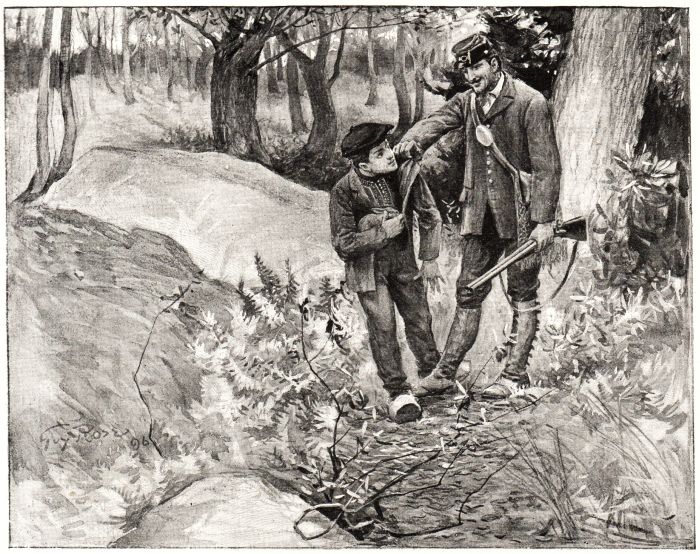
He had often watched the chase, and seen the brown hares jump in the underbrush and the deer fly by. But his thoughts on this day were elsewhere, and do as he would, it was nothing but La Belle Hélène, La Belle Hélène that kept constantly sailing into his thoughts and casting anchor in his brain. It was easy enough to slip off at night, follow the cliff path, and before you know it you are at Fécamp; and the harbor is bristling with barks at this season, and when one knows the mate of La Belle Hélène, and he has said, "Come, Jean-Paul, you will join us next year surely, mon vieux." (That makes one feel so grand to be called old chap by a man of position.) "Next year I will give you a good berth and recommend you to the Captain, and you will do the rest." And this was next year, and he was as far away as ever! Here Jean-Paul drew a big breath that meant a pain was at the other end of it, and went on thinking. When he reached the little knoll just at the end of the forest château, the hard struggle was at an end, but he felt about as beside himself as a healthy boy of fifteen can. The result was that he was more tired than though he had already gone the whole of the long way to St. Julian. Suddenly he remembered what his grandmother had given him just before he left the house—his luncheon; and he sat down on a big stone, and he drew out of his pocket a chunk of coarse bread and a stick of chocolate. He commenced slowly and meditatively to munch this repast and stare way down the long white road into the fast-deepening twilight, while the wind, which was against him, blew so hard that he could with difficulty keep his seat. Far away behind him lay a glimpse of the sea, which showed black and sullen. Jean-Paul felt La Belle Hélène move restlessly in the right pocket of his coat. "Poor little thing, she is hungry too! I will not eat alone," he said, and drew the rabbit out of his pocket, and put her on his knee, gently stroking her while she nibbled a few crumbs of bread. Just then who can say what strange spirit awoke in La Belle Hélène, or what familiar wood call may have reached her ear, for she gave a violent start, and sprang from the knee of Jean-Paul, made one swift bound, pushed her lithe body through the thick hedge, and was off into the dark woods of the château; but almost as quick in his movements was Jean-Paul, for he sprang to his feet, tore his way through the hedge, and started in hot pursuit. She kept ever just in front of him, maddeningly near, yet maddeningly far. He pushed his way through the bushes, and the two soon found themselves in the beautiful woods of the château. Jean-Paul thought of nothing save that La Belle Hélène had escaped and he must get her once more. He called in vain; freedom was sweet, and the leaves must have felt delightfully familiar; and ever pursuing the rabbit who had allured her away, the brown beast kept just beyond her master's reach. Perhaps, however, she lost for a moment the call of her kind, or the imploring tones of her little master touched her, for she stopped. At that moment Jean-Paul threw himself forward and caught La Belle Hélène. As his hand fell upon her, another hand, not half so gentle, fell upon the shoulder of Jean-Paul, and with the rabbit clasped in his hand, the startled lad turned and confronted the gamekeeper, who stood with his gun in his hand, rudely peering in the young fellow's face. "Ha! ha! my pretty fellow, caught in the act, in the very act," chuckled the gamekeeper, maliciously, and he put his hand over the little brown rabbit.